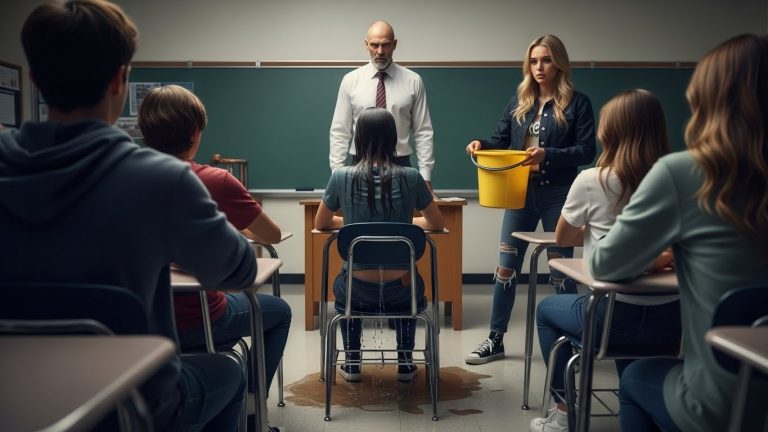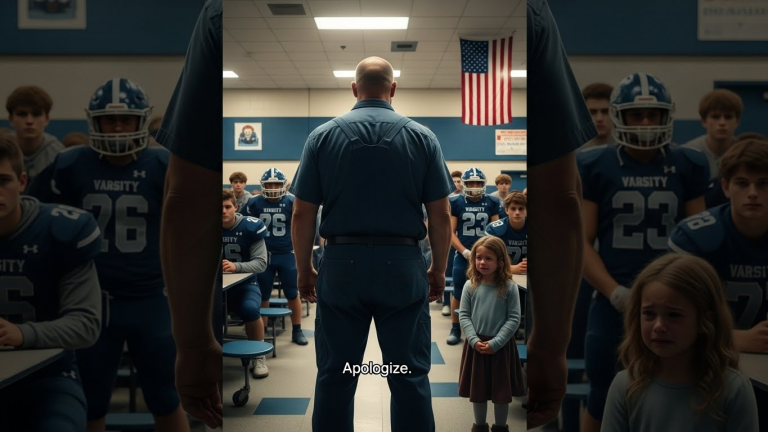
They thought I was just the janitor who mopped their spit. They didn’t know I spent ten years hunting monsters in the desert. When I walked into the chem lab and saw what they were doing to that boy, the mop bucket stayed at the door. The Wolf came out. And for the first time in forever, I didn’t try to stop him.
Chapter 1: The Ghost in the Hallway
In a high school, you learn pretty quickly that there are two types of people: the ones who make the noise, and the ones who clean it up.
I’m the second kind.
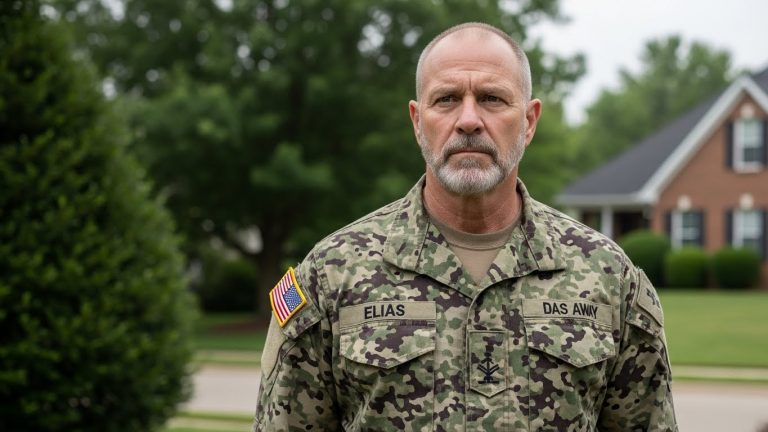
My name is Elias, but most of the kids just call me “The Janitor” or “Mr. E” if they’re feeling polite, which isn’t often. I work at Oakhaven High, a sprawling brick monster in the middle of Ohio. It’s the kind of place where football is a religion and the parking lot is full of trucks that cost more than my yearly salary. The air always smells like floor wax and teenage desperation.
I like the job because it’s rhythmic. Buff the wax. Empty the bin. Wring the mop. Repeat. It keeps my hands busy. It keeps my mind from wandering back to places I don’t want to go. Places with sand, and heat, and the sound of things breaking that can never be fixed.
I’ve been back stateside for three years. The VA says I’m “reintegrated.” They gave me pills to help me sleep and a pat on the back. But the pills make me feel like I’m moving through molasses, so I flush them. I rely on the routine instead. Routine is safe. Predictability is safe.
I start my shift at 2:00 PM, right before the final bell. That’s when the chaos peaks. The hallways flood with a sea of teenagers. They scream, they shove, they drop half-eaten pizzas on the linoleum I just polished.
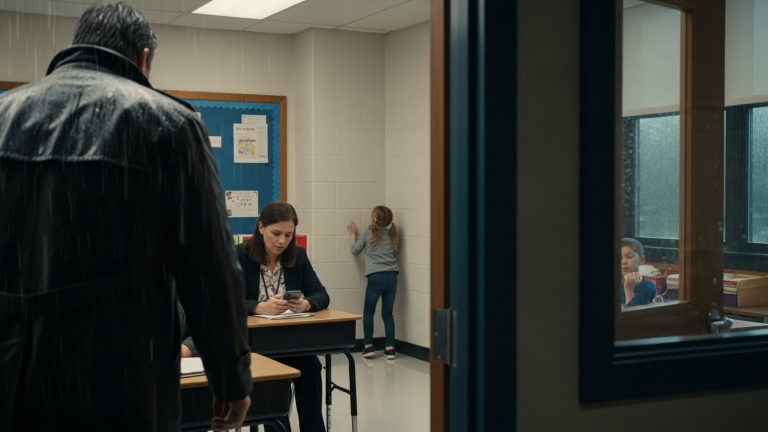
I move through them like a ghost. Eyes down. Shoulders hunched. I wear the gray uniform like camouflage. If you look pathetic enough, people stop seeing you. You become part of the architecture, like a water fountain or a fire extinguisher. People say things around me they’d never say if they thought a human being was listening. I know who’s cheating on who. I know which teachers are hungover.
But being invisible doesn’t mean I’m blind.
I see everything.
I see who’s selling Adderall behind the bleachers. I see who’s crying in the third-stall bathroom of the girls’ wing. And I see the predators. Every school has them. They aren’t much different from the warlords I saw overseas; they just wear letterman jackets instead of tactical vests. They smell fear. They feed on it.
At Oakhaven, the king predator is Brock Tyson. QB1. Golden boy. His dad owns half the car dealerships in the county, which means Brock walks around like he owns the pavement beneath his Nikes. He has that dangerous mix of charm and cruelty that teachers ignore because he wins games.
And then there’s Leo.
Leo creates a different kind of feeling in my gut. He’s maybe ninety pounds soaking wet, with glasses that are constantly sliding down his nose. He’s always carrying a stack of books on astrophysics or coding. He walks close to the wall, trying to take up as little space as possible.
Leo is the only kid in this entire school who acknowledges my existence.
Last week, he dropped his lunch tray. Spaghetti everywhere. Usually, when that happens, the kids laugh and kick the mess around. I walked over with my bucket, ready for the usual jeers.
Leo was on his knees, trying to scoop up the pasta with his bare hands. He looked up at me, his face beet red.
“I’m so sorry, sir,” he stammered. “I’m really sorry. Let me help.”
“Leave it, kid,” I grunted. My voice sounded rusty. I hadn’t spoken to anyone in six hours.
“No, it’s my fault. I… I can get some paper towels.”
“I said leave it.”
He froze. Then he looked me dead in the eye—something nobody does—and said, “Thank you, Mr. E. I appreciate what you do.”
It wasn’t sarcasm. It was genuine. It hit me in the chest like a hollow-point. It reminded me of my little brother before he deployed. Soft. Good. Too good for a world like this.
Since then, I’ve kept an extra eye on Leo. Just a glance here and there. Checking his perimeter. Old habits die hard.
I noticed the bruises on his arm on Monday. I noticed his backpack was ripped on Wednesday. I saw him limping on Thursday.
And today is Friday. The energy in the school is frantic. Everyone is buzzing about the game tonight. The teachers are checked out, staring at the clock, waiting for the weekend.
I’m doing the second-floor sweep, heading toward the Science Wing. It’s usually quiet back there this time of day. Most of the labs are empty.
But as I push my cart past the lockers, the hair on the back of my neck stands up.
It’s a specific sensation. I used to feel it when we were on patrol in Kandahar, right before the air pressure changed. It’s the feeling of a threat. It’s the Wolf waking up.
I stop the cart. The squeaky wheel goes silent.
I listen.
Down the hall, coming from Chemistry Lab 2B, I hear a sound.
It’s not the sound of a class. It’s not the drone of a lecture.
It’s laughter. Low, cruel, wet laughter.
And underneath it, a high-pitched whimper.
Chapter 2: The Blue Cone of Heat
My body reacts before my brain does.
My heart rate drops. My vision tunnels. The noisy chaos of the hallway fades into a dull hum. The only thing that exists is the door to Lab 2B.
I leave the cart. I don’t need a mop for this.
I walk to the door. It’s a heavy fire door with a small rectangular window. I glance through the reinforced glass.
The room is dim. The overhead fluorescents are off, but the late afternoon sun cuts through the blinds in dusty strips, illuminating the dust motes dancing in the air.
Mr. Henderson, the chemistry teacher, is nowhere to be seen. Probably in the supply closet, or maybe he stepped out for a smoke. It doesn’t matter.
What matters is what’s happening at the back table.
There are four of them.
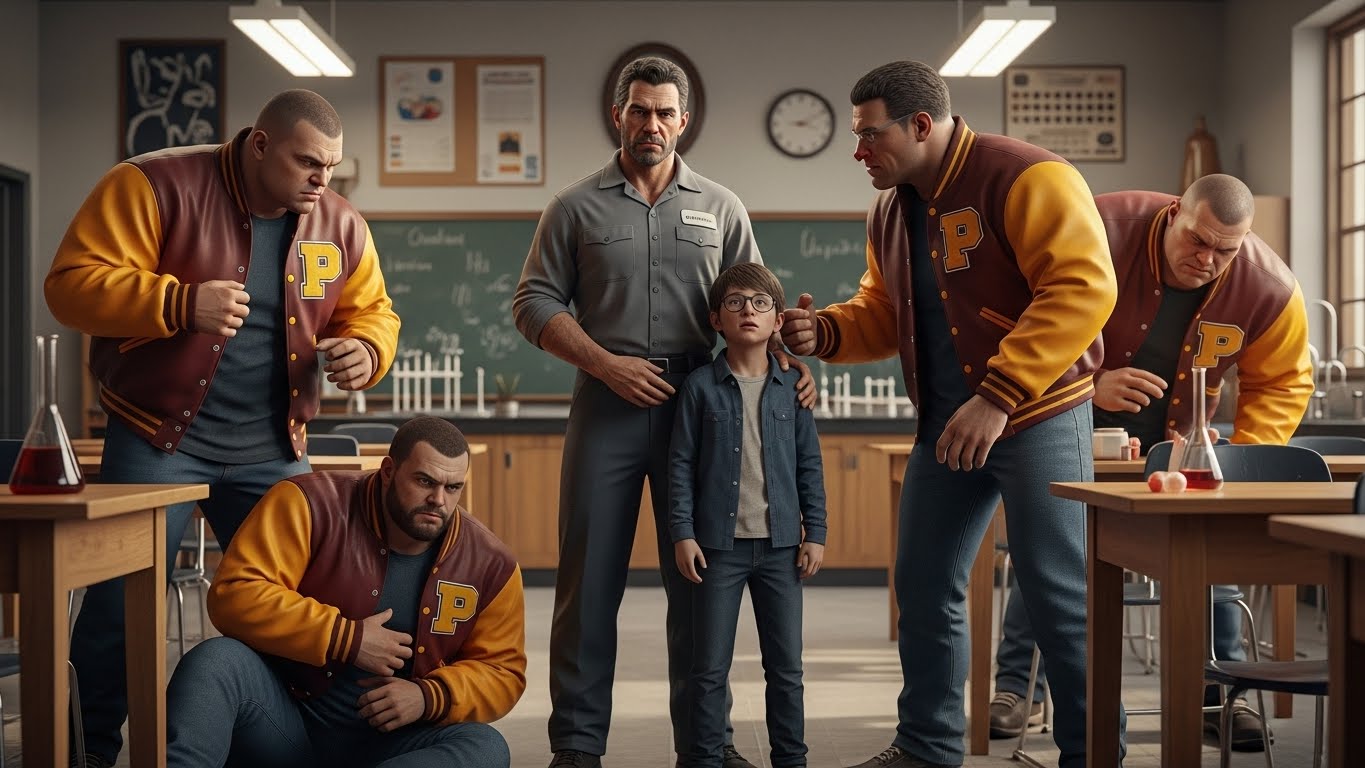
Three are wearing the maroon and gold varsity jackets of the Oakhaven Tigers. Their backs are to me, creating a wall of muscle and synthetic wool. They look like a pack of hyenas circling a carcass.
The fourth person is Leo.
He’s pressed back against the chemical-resistant black countertop. His eyes are wide, white rims of terror behind his crooked glasses. He looks like a trapped animal. His shirt is torn at the collar.
Brock is in the middle. He’s holding Leo’s right arm.
At first, I don’t understand what I’m looking at. Then, I see the light.
A Bunsen burner is sitting on the table. It’s lit. The flame isn’t the wavy, yellow safety flame. It’s been dialed in. It’s a sharp, roaring cone of blue. That’s the hottest part of the fire. Probably over 1,500 degrees Celsius. It’s enough to melt glass.
Brock is saying something, but the glass muffles it. He’s smiling. Not a happy smile. A dead smile. The smile of someone who enjoys power more than humanity.
He forces Leo’s hand toward the flame.
I see Leo trying to pull back, his sneakers squeaking desperately on the floor, but he’s powerless. Brock is a linebacker; Leo is a twig.
The other two bullies, guys I recognize as defensive ends, are leaning in, watching with a sick fascination. One of them is filming with his phone, the screen glowing in the dim light.
“Please,” I hear Leo’s voice through the door. It’s a broken sound. “Please, Brock. Don’t.”
“Just seeing how tough you are, science geek,” Brock’s voice rumbles, muffled but audible. “You like science, right? Let’s test your melting point.”
He shoves Leo’s hand forward.
The skin on Leo’s knuckles is inches from the blue cone.
I see the fine hairs on the back of Leo’s hand curl and vanish in a puff of gray smoke.
Leo screams.
It’s a primal sound. High and desperate.
That sound unlocks the cage in my chest.
The Janitor—the guy who shuffles, the guy who looks at the floor, the guy who eats his sandwich alone in the boiler room—he ceases to exist.
Elias the Ranger takes over.
I don’t open the door. I hit it.
I hit the push-bar with the flat of my palm, hard enough that the metal mechanism cracks like a gunshot. The door swings open and slams against the magnetic stopper on the wall. BANG.
The sound echoes in the tiled room.
The three bullies jump. The guy with the phone almost drops it.
Brock turns his head, annoyance flashing across his face. He doesn’t let go of Leo’s hand, but he stops pushing it toward the flame.
“Get out of here, janitor,” Brock sneers. “We’re busy.”
He turns back to Leo, dismissing me. He thinks I’m a piece of furniture. He thinks I’m nothing. He thinks because I clean up his trash, I am trash.
He’s wrong.
I don’t speak. I don’t shout. I don’t threaten.
I cross the twenty feet between the door and the lab table in two strides. I move silently. My work boots don’t make a sound.
The two defensive ends realize something is wrong. They step forward to block me. “Whoa, old man, back off—”
I don’t even slow down.
I step inside the first kid’s guard. I drop my shoulder and drive it into his solar plexus. It’s a short, controlled burst of violence. All the air leaves his body in a whoosh. He folds in half and drops to his knees, gasping like a landed fish.
The second kid swings a clumsy fist. It’s slow. So slow. I catch his wrist mid-air, twist it outward, and apply pressure to the radial nerve. He yelps and spins away, clutching his arm, effectively neutralized.
That leaves Brock.
Brock finally realizes the threat level has changed. He drops Leo’s hand and turns to face me fully, squaring his shoulders. He’s big—maybe 6’2″, 220 pounds. He’s used to intimidation. He’s used to people backing down.
“You made a mistake, trash man,” Brock says, stepping up to me.
I look at him. I look at the arrogance in his eyes.
“No,” I whisper. “You did.”
I reach out. My hand moves faster than he can track. I grab the collar of his varsity jacket and the back of his thick, muscled neck.
I pivot my hips.
I use his own forward momentum against him. I slam his face down onto the black countertop.
THUD.
It’s a wet, heavy sound. The sound of cartilage meeting hard resin.
Silence falls over the room. The only sound is the hiss of the gas from the Bunsen burner.
And the heavy breathing of the Wolf.
Chapter 3: The Searing Whisper
My forearm was locked across the back of Brock’s head, pinning him to the synthetic resin of the countertop. He wasn’t moving. He was stunned, the wind knocked out of him not by the impact, but by the sheer, unexpected velocity of the attack. His big, quarterback body was utterly useless, a paralyzed lump of muscle.
I adjusted my grip, shifting my weight. Textbook restraint. Simple. Effective. Something I hadn’t used on a civilian in years.
Leo, the victim, was frozen, still leaning against the counter, clutching his burned hand to his chest. He wasn’t looking at the flame anymore. He was looking at me. His protector. His janitor.
The other two bullies, the linemen, were staring at the scene in wide-eyed horror. The one I hit first was still trying to pull air into his deflated lungs. The one I twisted was backing away slowly, pale beneath his acne. They finally understood: this wasn’t a fight with another kid. This was something cold and professional.
“Get out,” I said.
My voice was low. Not a shout. It was the command tone I used when I needed compliance, immediate and unquestioned. It was the voice of the Wolf.
They didn’t hesitate. They abandoned their leader and stumbled backward, turning and running out the door of Lab 2B like rats from a sinking ship. The slam of the heavy door behind them was barely a distraction.
Now it was just three of us: me, the boy I saved, and the monster pinned beneath my arm. And the Bunsen burner.
The blue cone of heat was still roaring, constant and unforgiving.
I shifted my stance again, using my left hand to stabilize Brock’s head. His blood—thick, warm, and coppery—was staining the back of my uniform sleeve. His breathing was coming in ragged, terrified gasps.
I forced his face forward, tilting his head just slightly, so his eyelashes were inches from the fire.
The heat was instantaneous. It radiated off the blue cone like a punch. Brock let out a strangled, animal sound that wasn’t a word.
“You smell that?” I whispered into his ear. My voice was raspy, dry from disuse. I didn’t recognize it. It sounded like gravel.
Brock began to struggle in earnest, his legs kicking out, trying to buck me off, but I was rooted. My stance was perfect. I was immovable.
“No, stop!” he gargled, his voice muffled against the counter. “It burns!”
I pushed his head another quarter-inch forward.
I felt the heat lick his skin. I smelled the microscopic puff of singed hair and the ozone of impending fire. It was the same smell I’d noticed on Leo’s hand moments before.
“The trenches,” I continued, ignoring his panic. “I was in a trench. Not like the ones in history books. Just a hole we dug in the dirt. It smelled like sulfur and dust, and then… it smelled like this.”
I tightened my grip.
“There was a boy. Not much older than you. We got hit. We got hit hard. I was pulling him back. And the heat, Brock… it was so hot it felt thick. And the smell of the diesel, the cordite… and his skin.”
I held his face steady, the heat searing the delicate hairs on his forehead. I watched his eyes squeeze shut.
“You know what burning flesh smells like when you’re twelve thousand miles from home?” I asked. “It’s sweet. Cloying. Like burnt bacon and sugar. It clings to everything.”
I brought his face even closer. His panicked breath was hot against the glass tabletop.
“You forced a kid to feel that, Brock. You forced Leo to smell his own hair burning for fun.”
I paused, letting the silence stretch, punctuated only by the aggressive hiss of the gas and Brock’s ragged breathing. I could feel his heart hammering against the counter. The Wolf needed to mark its territory.
“You have no idea what fire does,” I concluded, the whisper hardening into an ice pick. “You see a game. I see a weapon.”
I felt the control return to my hands. The need to inflict damage receded, replaced by grim satisfaction. Brock was broken. He wasn’t scared of the janitor anymore; he was scared of what lived inside the janitor.
I took a deliberate, deep breath, tasting the chemicals and the faint scent of ozone.
“Stand up.”
I didn’t ask. It was an order. I released him instantly, stepping back two feet, putting space between us, but keeping my stance ready.
Brock didn’t move. He lay there, his head dripping blood and mucus onto the counter. Then, slowly, he pushed himself up. He turned, his face smeared crimson and contorted by humiliation and terror. His eyes were wide and red-rimmed. He looked at me, then at the Bunsen burner, then at Leo.
He was sobbing. Not tough-guy sobbing. Child sobbing.
He stumbled away, tripping over a stool, and then ran out the door after his friends, abandoning his varsity jacket on the floor.
I watched him go, then turned to Leo.
The boy was pale, shaking violently, tears running silent paths through the grime on his face. But he was safe.
“Leo,” I said, my voice returning to a human pitch, quiet and steady. “Are you burned?”
He couldn’t speak. He just shook his head, holding his blistered knuckles out for me to see. The redness was already stark.
I reached over and flicked the gas valve, extinguishing the blue cone with a decisive click.
The silence that followed was heavy, broken only by the sound of the main door bursting open.
Chapter 4: Broken Silence
The man who stumbled into the room looked exactly like a panicked high school teacher whose career was about to explode. It was Mr. Henderson, the chemistry teacher. He was fifty-something, soft around the middle, wearing a tie that was already askew. He had a look of terrified disbelief plastered across his face.
“What in God’s name—” Henderson began, then stopped dead when he saw the scene.
Leo was leaning against the counter, shaking. The floor was scattered with stools. Brock’s blood was pooling on the countertop. And standing over the entire mess, looking completely calm, was me. Elias, the invisible man.
“Elias! What did you do? You hit him? You assaulted a student!” Henderson shrieked, instantly abandoning any sense of control or curiosity about the preceding events. His focus was solely on the disaster.
“He’s fine,” I said, nodding toward the door where Brock had vanished. “Just a busted lip and a little shock.”
“Fine? He’s bleeding! And where are the others? What happened to Brock?” Henderson was waving his arms, his eyes darting frantically between me and the puddle of blood. He hadn’t even looked at Leo yet.
“They were assaulting Leo,” I stated simply, stepping closer to the boy.
“Assaulting? Look at the state of this lab! You can’t put your hands on a student, Elias! This is a school! We have protocols! You’re fired! You’ll be arrested!”
The words “fired” and “arrested” bounced off the concrete walls. They meant nothing to me. I’d faced worse threats from men carrying automatic weapons. Henderson’s panic was just noise.
I ignored him completely, focusing on the only person who mattered.
I gently took Leo’s injured hand. I examined the knuckles. The redness was deepening, and the skin was already tightening in an angry, swollen line where the heat had seared him. It was a second-degree burn, maybe borderline third in a small spot. It needed cold water and attention immediately.
“Leo, go to the sink,” I instructed, keeping my voice low and steady. “Run cold water over this for ten minutes. Don’t stop.”
Leo didn’t move at first, still locked in shock. His eyes were glued to the blood on the counter.
“Now,” I repeated, my tone firm but not aggressive.
He blinked, and the instruction finally registered. He moved robotically toward the steel sink. The sound of running cold water was a small, comforting sound in the ruined laboratory.
Henderson was still flapping his arms. “Don’t tell him what to do! Elias, stop what you are doing! The Principal is on his way! I’m calling the resource officer!”
“The resource officer is on the football field,” I corrected, automatically scanning the perimeter. “I saw him ten minutes ago.”
Henderson faltered, realizing I knew more about the school’s security than he did.
“I need ice,” I said, turning away from the terrified teacher. I walked to the supply closet—the same place where Henderson was likely hiding during the attack—and rummaged around until I found the emergency first aid kit. It had the standard chemical cold packs. Not ideal, but better than nothing.
When I returned, Henderson was on his phone, his voice a frantic whine. He was describing me—the maintenance man, the aggressor, the threat.
I activated the cold pack and gently guided Leo to sit down on a sturdy lab stool.
“Hold this tight,” I told him, pressing the cold pack carefully to his hand. “Don’t let up. It’s going to hurt for a minute.”
Leo finally found his voice, a tremulous whisper. “Mr. E… why… why did you do that?”
I looked at him, at his shock, his gratitude, and his fear. I saw the question in his eyes: Why would the invisible man make himself visible for me?
I pulled up a stool next to him. I leaned forward, my hands resting on my knees, smelling the blood and the lingering metallic scent of fear.
“I spent a long time being trained to stop things like this,” I said, keeping my eyes locked on the cold pack and his injury. “I spent a long time watching predators hurt people who couldn’t fight back. When I came home, I promised myself I was done. I was going to be the ghost. I was going to be safe.”
I lifted my gaze and looked toward the door, where the inevitable authority figures would soon arrive.
“But sometimes,” I finished, meeting his eyes, “being a ghost means letting things happen. And I can’t live with that anymore, Leo. Not when I can stop it.”
He didn’t need to know about the trench, or the Wolf, or the smell of burning skin that had pulled me back to the worst moments of my life. He just needed to know that someone finally cared enough to get their hands dirty.
A moment later, the door swung open again. This time, it wasn’t a fleeing bully or a hysterical teacher. It was Principal Thompson, a woman built like a tank, with the grim, set jaw of someone who handles crises daily. Beside her stood Officer Miller, the school resource cop, who looked surprised to see me, of all people, as the center of a major incident.
Thompson didn’t shout. She just surveyed the scene—the blood, the terrified kid, the whimpering teacher, and me, calm and seated—and her face turned to stone.
“Elias,” she said. Her voice was flat, dangerously controlled. “Step away from the student. Now.”
I stood up slowly, deliberately. I looked her dead in the eye, a gesture I hadn’t made to an authority figure in years.
“I intervened in an act of physical assault and torture, Principal,” I stated, the words clear and unhurried. “I ensured the safety of a student. I am providing first aid for a burn. And I want to be very clear about one thing before anyone starts assigning blame.”
I let the weight of the moment settle on her.
“I don’t regret it.”
Chapter 5: The Principal’s Office
The principal’s office was too warm. It always was. It smelled like old coffee and the cheap, floral air freshener Thompson must have kept hidden behind her desk. It was designed to feel imposing, with dark paneling and a large, intimidating desk carved from polished oak. But after years of standing in sandstorms that could scour the paint off a tank, the room felt merely stuffy.
I sat in a padded chair that was far too comfortable for the circumstances, watching Principal Thompson. Officer Miller, the SRO, was leaning against the wall by the door, his arms crossed, his face unreadable. Mr. Henderson was perched on the edge of a chair, dabbing his sweaty forehead with a crumpled handkerchief. He looked less panicked and more terrified of the potential liability.
Thompson was focused entirely on me. She had a thick file open on her desk—my employee file. She flipped through the pages with sharp, angry movements.
“Elias,” she began, her voice professional but cold as ice. “Let’s be very clear. I understand you had a distinguished, albeit complicated, service record in the Army. I understand you were a Ranger. But you are not in the military anymore. You are a civilian employee of Oakhaven High School. And you have just severely injured the star quarterback of our football team.”
“He wasn’t injured severely,” I corrected calmly. “He broke his nose, maybe. He was fine enough to run out of the building. Leo was minutes away from a serious burn injury.”
“That is entirely beside the point!” Thompson slammed the file shut. “We cannot have employees, particularly custodial staff, physically attacking students! Do you have any idea the legal exposure this school now faces? Brock Tyson’s father is Thomas Tyson! He has three lawyers on retainer who live to sue people like us.”
I let the name Thomas Tyson hang in the air. The local magnate. The man whose money greased the wheels of the entire district. I knew exactly who he was.
“I understand the politics, Principal,” I said, leaning forward slightly. “But I don’t care about the politics. I care about the kid who was being tortured with a gas flame. When I walked in, those three boys were committing felonious assault. They were holding him against his will and attempting to inflict serious bodily harm.”
“Attempting! Attempting, Elias!” Henderson burst out, his voice squeaking. “It wasn’t that serious yet!”
I turned my head slowly to Henderson. I didn’t say anything. I just looked at him with the cold clarity of the Wolf. The teacher instantly shrank back into his chair, looking away, suddenly realizing that I could easily crush him with one hand if I chose to.
Thompson tapped a pen on her desk. “We have surveillance footage of you entering the room and the subsequent physical altercation. It’s violent, Elias. Very violent. You rendered two students helpless and slammed the third’s face onto a countertop. We have student testimony from the two boys who ran—”
“Lies,” I interrupted. “They fled a crime scene they initiated. Talk to Leo.”
“Leo is traumatized and in the nurse’s office. He’s a small, compliant boy. We need to be careful how we interview him.” She emphasized compliant, meaning Leo was easily influenced, especially by the scary Janitor who just saved him.
“You’re protecting the aggressor because his father is rich,” I stated, the realization solidifying in the stuffy office air. It wasn’t a question. It was a tactical assessment. “And you’re firing the man who stopped the crime because it’s easier than dealing with the Tysons.”
Officer Miller, who had been silent up until now, straightened up from the wall. He had been listening, observing. He was an older cop, weary, a Vietnam veteran himself, I suspected.
“Principal Thompson,” Miller’s voice was gravelly. “I’ve seen the lab. I’ve seen the injury to the victim’s hand. The burn is real. The kid, Leo, he’s shaken up, but he says Elias saved him from being scarred. The aggression here was initiated by the Tyson kid and his friends. Elias used a minimum amount of force necessary to immediately neutralize three larger subjects.”
Thompson glowered at the officer. “Miller, you’re the school liaison, not his defense attorney.”
“I’m reporting the facts, Principal,” Miller said, his gaze steady. “Elias’s actions were disproportionate, yes. But the threat was existential. If Leo’s hand had been held in that flame for five more seconds, it’s permanent damage. That’s a felony charge for the boys. Right now, it’s a disorderly conduct charge for Elias, maybe. Not assault.”
“He targeted Brock!” Thompson insisted, her frustration boiling over.
“Brock was the one holding the torch, ma’am,” Miller countered simply.
Thompson sighed, rubbing her temples. The reality was setting in. Officer Miller’s testimony complicated her clean narrative of “Fire the janitor and apologize to Mr. Tyson.”
“Elias,” she said, leaning across the desk, dropping the veneer of civility. “I can’t fire you right now, not with the SRO saying you prevented a felony. But you are suspended, effective immediately, pending an investigation by the board. Go home. You will be contacted.”
She made the word investigation sound like prosecution.
I stood up. I didn’t argue. I had done what I needed to do. The silence in the room returned, oppressive and thick.
“One more thing,” I said, turning at the door. “If any disciplinary action is taken against Leo for this incident—for being the victim—I will be speaking to my attorney. Loudly.”
Thompson stared at me, dumbfounded. The janitor had an attorney? She hadn’t bothered to check.
I didn’t wait for her reply. I walked out of the Principal’s office, the weight of the suspension feeling lighter than the weight of the guilt I had carried for years. I had released the Wolf, and for the first time in a long time, the world felt slightly more balanced.
Chapter 6: The Tyson Problem
The next morning, the small town of Oakhaven exploded.
It wasn’t the kind of explosion you could clean up with a mop. It was a digital, viral shockwave that started in the parent Facebook groups and quickly jumped to the local news channels.
The narrative was immediately polarized.
On one side, you had the Tysons. Brock’s father, Thomas, went straight to the media. He held an impromptu press conference in front of his flagship car dealership, flanked by his three lawyers—the ones Thompson had feared.
He didn’t mention the Bunsen burner. He didn’t mention Leo.
He talked about the ‘unwarranted, brutal, and calculated attack’ on his ‘upstanding, college-bound’ son by a ‘deranged, emotionally unstable former serviceman’ employed by the school. He played the veteran PTSD card, twisting my trauma into a weapon against me. He talked about his son’s ‘shattered nose and emotional scars.’
The narrative he pushed was simple: An unhinged janitor, who should never have been hired, targeted and mutilated a minor out of spite or instability.
The local news ate it up. They showed blurred footage from the hallway security camera—me moving quickly toward the lab, the blurred moment of impact—and sensationalized the violence. The school board, panicked by the impending lawsuit, issued a statement condemning the ‘excessive force’ and confirming my suspension.
On the other side, slowly, quietly, a counter-narrative was forming.
It started with Leo.
I didn’t know the details until later, but when the school nurse tried to call Leo’s mother, Leo asked for Officer Miller instead. Miller, keeping his promise, made sure Leo was interviewed by child protective services (CPS) and not just the school administration.
Leo was small, but he was articulate. He described the incident with devastating clarity: the forced grip, the fear, the smell of his own hair burning, and the specific, chilling cruelty of Brock’s smile. He described the janitor—Mr. E—as appearing like an angel and moving like lightning.
“He saved my hand,” Leo told the CPS worker. “If he hadn’t come in, I wouldn’t be able to type, or write, or code. They were going to burn me because they thought I was weak.”
Leo’s mother, a quiet woman who worked two jobs, was furious. She didn’t have Thomas Tyson’s lawyers, but she had righteous anger. She started posting on social media, fighting back against the Tyson narrative.
Then came the student leaks.
The kid who was filming the torture had his phone confiscated, but the original video had already been sent out. Someone—maybe one of the two linemen who had run, now terrified of Brock’s retribution—leaked the raw footage of the minutes before I walked in.
It wasn’t the full torture, but it showed Brock holding Leo, laughing, and the flame burning. It showed the moment of pure sadism.
When that video hit the local social media feeds, the tide turned immediately.
The sight of the golden boy, the celebrated QB, acting like a genuine monster, changed everything. The high school locker room mentality vanished under the cold, hard reality of the phone screen.
The story was no longer ‘Janitor attacks student.’ It was ‘War Vet Janitor Stops Kidnapping and Torture.’
My phone, which hadn’t rung in weeks, started vibrating incessantly. It was reporters, lawyers, old Army buddies, and messages from strangers offering donations.
I kept the phone face-down on the counter of my small, Spartan apartment. I ignored it all. The fight wasn’t over, and the Wolf was still restless. I was suspended. I was potentially facing criminal charges.
But the most difficult call came that afternoon, not from a lawyer or a journalist, but from Officer Miller.
“Elias,” Miller’s voice was tired. “They’ve filed a temporary restraining order against you. Tyson’s lawyers say you’re a danger to the students. You can’t be within 500 feet of the school grounds.”
“Figures,” I replied. “What about the video?”
“The video changed the narrative, but it didn’t change the laws. The Tysons are arguing that the three seconds of Leo’s hand near the flame doesn’t justify the violence. It’s a high-stakes liability game now. Principal Thompson is trying to survive the week. You’re the sacrifice.”
“And Leo?”
“Leo’s safe. His mother pulled him out of Oakhaven. They’re enrolling him in a charter school across town. He’s shaken, but he’s standing taller. His mom says she wants to thank you.”
“Tell her she doesn’t owe me anything.”
“She knows that. She wants to help you.” Miller paused. “The problem is, Elias, Tyson is calling for criminal charges. The District Attorney is under pressure. You need a good lawyer. And you need a statement that explains why a trained soldier used that kind of force on a child.”
“I used that force because he was committing an act of war on an unarmed child,” I stated flatly.
“They won’t understand that, Elias. They see a janitor. Not a Ranger.”
“Then let them see the Ranger,” I said.
I picked up the vibrating phone, went through the messages, and called the first pro-bono defense lawyer I found who specialized in veterans’ affairs. The time for being silent was over. I was going to tell the world exactly why I did what I did, and what the smell of burning flesh really means.
Chapter 7: The Hearing
The municipal court building was nothing like the high school. It smelled of old paper, ozone, and institutional dread. It was sterile, quiet, and designed to strip away emotion, leaving only cold, procedural truth.
The preliminary hearing for the temporary restraining order and the discussion of potential criminal charges against me—battery and reckless endangerment—was held on a Monday morning.
I was dressed in a suit that felt alien to me, a painful departure from the comfort of my gray uniform. Beside me sat Sarah Jenkins, a sharp, young lawyer from the Veterans’ Defense League. She was efficient, merciless, and utterly confident.
Across the room sat Thomas Tyson, Brock’s father, wearing a bespoke suit, his face pinched with arrogance and indignation. Brock was beside him, his nose bandaged and his eyes still holding a haunted look. The school board attorney was also present, there to manage liability and ensure Oakhaven High looked as innocent as possible.
The District Attorney, clearly annoyed by the media circus, presented the facts quickly: The defendant, Elias, initiated a violent physical confrontation resulting in injury to a student. They presented the blurry security footage again.
When it was Sarah’s turn, she didn’t waste time on technicalities. She went straight for the context.
“Your Honor,” Sarah began, her voice cutting through the stuffy courtroom air. “We are not here to deny that my client used force. We are here to ask why the victim in the original crime, Leo Chen, is sitting across town in a new school while the aggressor, Brock Tyson, is sitting here, demanding retribution.”
She then called her first witness: Officer Miller.
Miller, in his crisp SRO uniform, testified about the scene he found. He described the Bunsen burner, the high heat, the burn on Leo’s hand, and the immediate, non-verbal threat. He affirmed that without immediate intervention, Leo would have sustained permanent, life-altering injuries.
“In your professional opinion, Officer,” Sarah asked, “was the threat to Leo Chen’s safety immediate and life-altering at the time Mr. Elias intervened?”
“Yes, ma’am,” Miller responded without hesitation. “It was. It was minutes away from becoming a crime scene the DA would be prosecuting as aggravated assault.”
Next, Sarah played the new evidence: the raw, leaked cell phone footage.
The courtroom fell silent as the video played on a large screen. It was shaky, poor quality, but the audio was clear. Brock’s cruel laughter. Leo’s desperate “Please, Brock.” The flash of the hair burning. The sheer, predatory enjoyment on the faces of the three boys.
The effect was instantaneous. Thomas Tyson squirmed. Brock looked at the floor, humiliated. The school board attorney paled.
When the video finished, Sarah turned to the judge. “Your Honor, the defense argues that Mr. Elias’s actions were necessary, proportionate to the imminent threat of grievous bodily harm, and constitute justifiable defense of a third party.”
She then called me to the stand.
I sat down, feeling the scrutiny of the room. This was the moment for the Wolf’s explanation.
Sarah’s questions were deliberate, leading me not to the school, but back to the war. She had me describe my training, my deployments, and the specific dynamics of combat intervention—the need for immediate, overwhelming force to save lives.
“Mr. Elias,” she asked, standing directly in front of the judge. “When you entered that chemistry lab, what did you see?”
“I saw three armed predators,” I stated simply, looking straight ahead. “They were armed with fire. A Bunsen burner is a thermal weapon when used that way. I saw a hostage, frozen and unable to defend himself. And I smelled the specific odor of violence—the fear, the ozone, the burning keratin.”
“You reacted to a smell?” the judge asked, leaning forward, intrigued.
“I reacted to a memory, Your Honor,” I replied, my voice steady, clear. “A memory of fire used against the innocent. A memory of what happens when good people stand by and remain silent. My training dictates that when lethal force is imminent, you neutralize the threat instantly. I didn’t use lethal force. I used disabling force. The goal was simple: stop the fire, end the threat, and make sure the predator never touches that weapon again.”
I paused, looking at Brock.
“I had to show him exactly how close he came to becoming an incinerated memory in a trench. I don’t regret that moment of instruction. It saved Leo, and maybe, just maybe, it prevented Brock Tyson from doing something worse to the next victim.”
The courtroom remained absolutely silent. The air was charged, heavy with the weight of the raw truth.
Sarah Jenkins rested her case.
Chapter 8: The Aftermath and the New Routine
The judge recessed for twenty minutes. When she returned, her ruling was decisive and immediate.
The temporary restraining order against me was dismissed. The charges of battery and reckless endangerment were thrown out, citing self-defense and defense of a minor. The judge, in a rare moment of judicial commentary, stated that the school should be investigating Brock Tyson for assault, not the man who saved the victim.
Thomas Tyson exploded, screaming about his lawyers and filing appeals, but the damage was done. The video, the testimony, and the judge’s statement were already being broadcast nationally.
The victory was not a celebration, but a profound quiet relief. I had won the fight for my freedom, but the battle for Oakhaven High was just beginning.
Principal Thompson, facing immense pressure and the threat of multiple lawsuits (including one Sarah Jenkins was now preparing on behalf of Leo’s mother for creating a hostile and dangerous environment), offered me my job back.
I declined.
My name, Elias, was no longer synonymous with “The Janitor.” The Wolf had been seen. I could no longer be the Ghost. The rhythm of my routine—the quiet, safe invisibility—was shattered forever.
I used the money from a massive GoFundMe established by parents and veterans across the country to pay my legal fees and buy a beat-up Ford pickup. I didn’t want the lawsuit against the school; I wanted peace.
Thomas Tyson pulled Brock out of Oakhaven. Brock’s promising football career was over. His name was stained, his violence now a matter of public record, his image permanently associated with the blue cone of the Bunsen burner. Justice, in its own slow, clumsy way, was served.
I saw Leo one last time.
He was outside my apartment complex with his mother. He wasn’t scared anymore. He looked me in the eye, straight and true. His hand was bandaged, but healing.
“Thank you, Mr. E,” he said, holding out his good hand.
I shook it. His grip was firm. “Stay safe, Leo.”
“I am,” he smiled faintly. “I’m learning a new kind of defense now. Physical, mental, and legal.”
I nodded. He had found his strength. My work here was done.
Six months later, I found a new job. I’m working maintenance at a veterans’ center in rural Kentucky. The work is still rhythmic: fixing leaky pipes, mowing the lawns, patching dry wall. The people here understand the quiet. They understand the ghosts we carry. They understand the necessity of the Wolf.
My new uniform is green, not gray. I still keep my head down, but I don’t try to be invisible anymore.
Sometimes, when I’m sweeping the common room, a young veteran will startle at a noise. And I’ll pause, look up, and offer a quiet word of advice.
The routine is different now. It’s not just about cleaning up the messes. It’s about being ready to stop the fire before it starts.
The lesson I taught Brock Tyson wasn’t just about pain. It was about the cost of violence. And for me, the cost of silence was always going to be higher. The scar on my soul from that trench is still there, but now, it’s balanced by the fact that I finally fought for the right side, without apology or regret.
The Janitor is gone. Elias the man, the protector, remains. And he is finally starting to sleep through the night.