THEY FORCED ME TO SCRUB MY OWN BLOOD OFF THE DIRTY LINOLEUM WHILE TWENTY CLASSMATES WATCHED IN DEAD SILENCE, BUT WHEN THE QUIETEST TEACHER IN SCHOOL WALKED THROUGH THE DOOR, HE DIDN’T SCREAM OR CALL SECURITY—HE DID SOMETHING THAT MADE THE BULLY FREEZE IN PURE TERROR AND CHANGED THE SCHOOL FOREVER.
Chapter 1: The Metallic Taste
It didn’t start with a scream. Violence in real life is rarely loud at first. It’s usually quiet, breathless, and shockingly fast. It started with a dull thud, the kind of sound a heavy textbook makes when it hits a desk, except this time, the desk was my face.
I was fifteen, a sophomore at a grim, underfunded high school just outside of Detroit. It was one of those places where the heating system rattled like a dying engine and the hallways always smelled faintly of bleach and stale sweat. We were in third period, History, waiting for Mr. Vance.
Mr. Vance was a ghost of a man. He was in his sixties, always wore the same gray cardigan, and moved with a slowness that made you wonder if he was even fully awake. He was usually five minutes late. That five-minute window was the lawless zone. That was Marcus’s time.
Marcus was six-foot-two, a varsity linebacker with a smile that didn’t reach his eyes. He didn’t just bully kids; he dismantled them. He liked to find the breaking point—the exact moment the light went out in your eyes. That Tuesday, I was his project.
I was sitting in the back row, trying to make myself invisible, sketching in the margins of my notebook. Marcus walked by. He didn’t run into me. He stopped, deliberately, and kicked the leg of my chair. Hard.
“Watch it, garbage,” he muttered, loud enough for the back half of the room to hear.
I didn’t look up. “Sorry,” I whispered. That was the rule. Apologize for existing.
“Sorry?” Marcus echoed, turning around. The class went silent. It was that sudden, suffocating silence where everyone holds their breath, grateful it’s not them. “You think ‘sorry’ fixes my shoes? You got dust on my Jordans, Leo.”
He wasn’t looking at his shoes. He was looking at me.
Before I could stutter out another apology, his hand shot out. He grabbed the back of my neck, his fingers digging into the soft skin near my spine. He yanked me forward. My forehead slammed into the corner of the desk.
That was the thud.
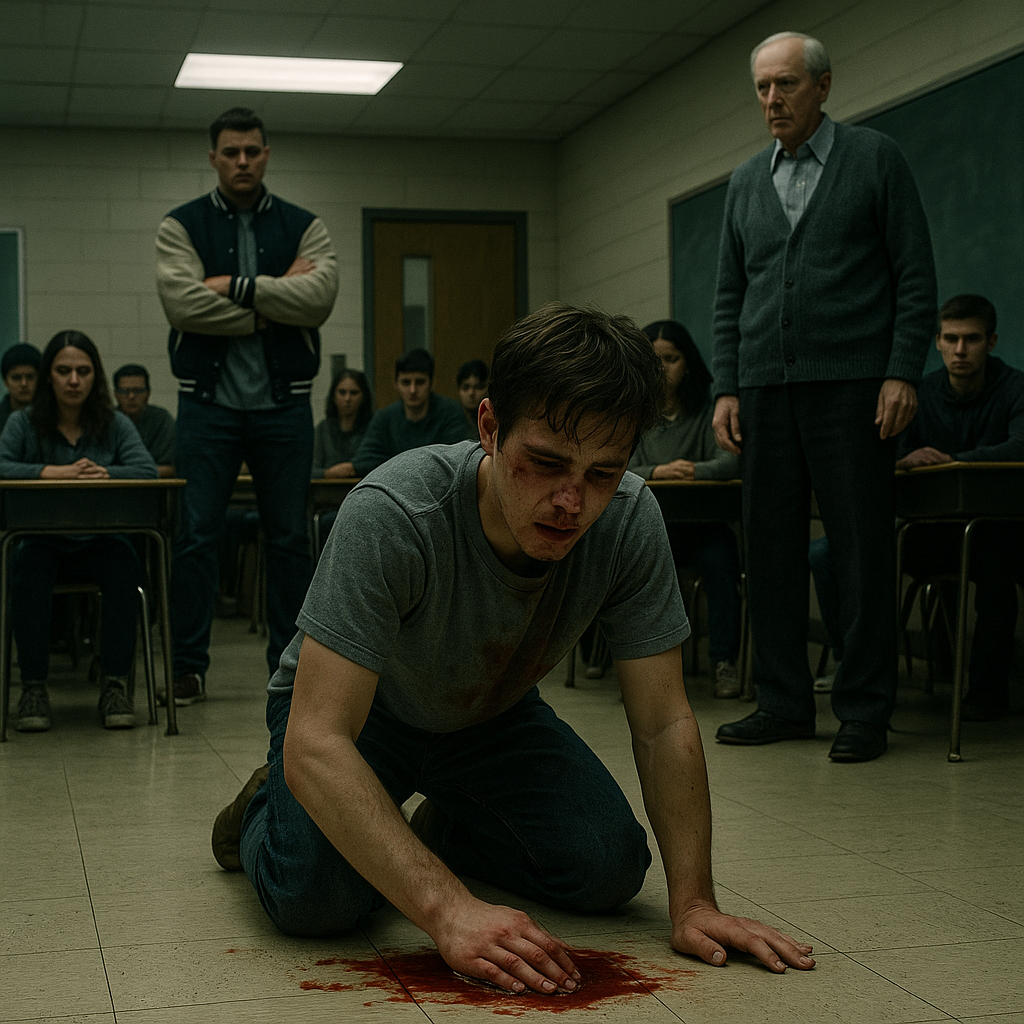
I fell out of the chair, landing hard on my knees. The world spun. A sharp, hot pain exploded in the center of my face. I brought my hand up to my nose and pulled it away. It was coated in bright, red blood. It wasn’t just a trickle; it was pouring.
A drop hit the white linoleum floor. Then another. Drip. Drip. Drip.
“Look at that,” Marcus said, his voice terrifyingly calm. “You’re making a mess, Leo. You know how much the janitors hate a mess?”
I looked up, eyes watering, blood streaming over my lips, tasting like copper and salt. “I… I need to go to the nurse,” I managed to say, my voice thick.
Marcus stepped in front of the door, blocking the only exit. He crossed his massive arms. “No,” he said. “You aren’t going anywhere until you clean up your filth.”
Chapter 2: The Rag and The Floor
The room was spinning. I looked around for help. Sarah, the girl who sat next to me, was staring intently at her textbook, her knuckles white. Jason, the class clown, was looking out the window. Nobody moved. Nobody breathed. In this school, intervening meant you were next.
“I said,” Marcus barked, his voice dropping an octave, “clean it up.”
I looked at the puddle of blood. It was about the size of a saucer now. I reached into my pocket for a tissue, but I didn’t have one. I looked at the paper towel dispenser near the sink at the back. It was empty. It was always empty.
“Use your shirt,” Marcus commanded.
“What?” I choked out.
“Your shirt. The one you’re wearing. It’s ugly anyway. Wipe it up.”
I hesitated. The humiliation was burning hotter than the pain in my nose. I was a human being. I had dignity. But then I looked at Marcus’s eyes. There was no mercy there, only a cold, predatory hunger. He took a step toward me, raising his fist just an inch. A flinch.
I broke.
With shaking hands, I untucked my gray t-shirt. I leaned forward, my knees screaming against the hard tile. I lowered my chest toward the floor. I felt the wet warmth of my own blood soak into the fabric of my shirt. I started to scrub.
I was wiping my own life off the floor while twenty people watched. The sound of the fabric dragging against the tile—shhh, shhh—was the only noise in the room. Tears finally spilled over, mixing with the blood on my face. I felt smaller than I had ever felt in my life. I felt like dirt. I felt like I deserved this.
“Missed a spot,” Marcus sneered, pointing with the toe of his sneaker near my hand. “Right there. Get it all. I don’t want to step in your disease.”
I crawled forward. I was sobbing quietly now, a pathetic, hitching sound that I couldn’t suppress. I wiped the spot. My shirt was ruined. My face was a mask of red. My spirit was crushed.
“Good dog,” Marcus laughed. A few other kids let out nervous, relieved chuckles. They were laughing because they were safe.
I started to push myself up, ready to beg to leave, ready to run and never come back.
Then, the door handle turned.
It wasn’t a fast turn. It was the slow, rhythmic click of the latch. The heavy oak door creaked open.
The laughter died instantly. Marcus stiffened, but he didn’t look scared. Why would he be? Teachers usually just told us to settle down and ignored the obvious. He turned to face the door, ready to charm his way out of it, ready to say I fell, ready to lie.
Mr. Vance stepped in. He stopped one foot inside the threshold. He held his briefcase in one hand and a thermos in the other.
He didn’t look at the class. He didn’t look at Marcus. His eyes went straight to the floor, to the smear of red that I hadn’t fully managed to scrub away yet. Then his eyes moved to me—kneeling, covered in blood, clutching my ruined shirt.
The air in the room changed. The temperature seemed to drop ten degrees.
Mr. Vance didn’t yell. He didn’t rush over to me. He did something much scarier. He very slowly, very deliberately, set his briefcase down on the teacher’s desk. He placed his thermos next to it.
Then, he turned to the door, closed it, and for the first time in the twenty years he had taught at that school… he locked it.
The click of the deadbolt sounded like a gunshot.
Mr. Vance turned around. His posture had changed. The slump was gone. The tiredness was gone. He looked at Marcus, and for a split second, I saw something in the old man’s eyes that I had only seen in documentaries about war.
“Marcus,” Mr. Vance said. His voice was barely a whisper, but it carried to every corner of the room. “Sit. Down.”
Chapter 3: The Silence of a Hurricane
Marcus blinked. He wasn’t used to resistance. He was the king of the hallway, the prince of the locker room. Teachers usually bartered with him. “Please sit down, Marcus.” “Come on, Marcus, let’s focus.”
Mr. Vance hadn’t asked. He had ordered.
“I was just helping Leo,” Marcus said, flashing that politician’s smile. It was slick, oily, and practiced. “He had a little accident. Clumsy kid. I told him to clean it up so nobody slipped.”
“I didn’t ask for a commentary,” Mr. Vance replied. He began to walk.
He walked slowly, his dress shoes clicking against the floor with a rhythmic, military precision. Click. Click. Click. He walked right past Marcus, ignoring him completely, and came to where I was kneeling.
He knelt down. His knees cracked, a sound of old age, but his movement was fluid. He didn’t look at me with pity. Pity would have finished me off. He looked at me with recognition.
He reached into the pocket of his cardigan and pulled out a clean, white handkerchief. It was monogrammed. He pressed it into my hand.
“Hold this to your nose. Pinch the bridge. Lean forward slightly,” he instructed. His voice was gentle but firm. It was the voice of a medic.
I did as I was told. The handkerchief smelled like mint and old paper. It was soft.
“Can you stand?” he asked.
I nodded, though I wasn’t sure. He put a hand under my elbow and hoisted me up. I swayed, dizzy from the adrenaline dump and the blood loss. He steadied me, his grip surprisingly strong. Steel cables wrapped in wool.
“Go to my desk,” he said. “Sit in my chair.”
“But…” I started. Students weren’t allowed behind the teacher’s desk.
“Go.”
I shuffled to the front of the room and collapsed into his leather swivel chair. From this vantage point, I could see the whole class. They were frozen. They looked like statues. Every pair of eyes was glued to Mr. Vance.
Mr. Vance stood in the center of the room, right where my blood was still smeared on the floor. He looked at the red stain. Then he looked up at Marcus, who was still standing, his arms crossed, his smile fading into a look of confusion.
“You made him wipe this with his clothes?” Mr. Vance asked. The question hung in the air.
“It was a joke,” Marcus scoffed, trying to regain the upper hand. He looked around at his friends for backup, but nobody met his gaze. “Just a joke, Mr. Vance. Don’t be so dramatic.”
Mr. Vance took off his glasses. He folded them and placed them in his breast pocket. He began to roll up the sleeves of his cardigan, then the sleeves of the white dress shirt underneath. His forearms were revealed.
We had never seen Mr. Vance’s arms. They were always covered.
They were scarred. Not just a little. They were maps of violence. Long, jagged white lines, burn marks, and a faded tattoo on his left forearm. It was the emblem of the United States Marine Corps, but underneath it, there was something else—a unit designation that I didn’t recognize then, but I would look up later. It was a Force Recon unit from Vietnam.
“A joke,” Mr. Vance repeated. He took a step toward Marcus.
Marcus was six-two. Mr. Vance was maybe five-ten. But as the teacher stepped closer, Marcus seemed to shrink.
“I’ve seen jokes,” Mr. Vance said, his voice rising just a fraction. “I’ve seen men laugh while they did things that would make you vomit in your sleep. I know what cruelty looks like, son. And I know what a coward looks like.”
The word hit Marcus like a slap. “I ain’t a coward,” he snapped, his fists balling up.
“No?” Mr. Vance stopped inches from him. He didn’t flinch at Marcus’s raised fists. In fact, he looked bored by them. “You cornered a boy fifty pounds lighter than you. You blindsided him. And then you made him degrade himself for your entertainment. That is the definition of a coward.”
“You can’t talk to me like that,” Marcus spat. “My dad is on the school board. I’ll have your job.”
Mr. Vance laughed. It was a dry, rasping sound. “Your father,” he said, “can have my job. I have a pension and a paid-off house. I am here because I thought I could teach you something about history. But it seems you need a lesson in humanity first.”
Mr. Vance turned his back on Marcus. It was the ultimate insult. He turned to the rest of the class.
“Who saw what happened?” he asked.
Silence.
“I said,” Mr. Vance’s voice thundered, startling us all, “WHO SAW WHAT HAPPENED?”
Sarah, the quiet girl, raised a trembling hand. “Marcus… Marcus slammed his head into the desk,” she whispered.
“Liar!” Marcus shouted, spinning toward her.
“Sit down, Marcus!” Mr. Vance roared. The sound came from his diaphragm, a drill instructor’s command that bypassed the ears and went straight to the nervous system.
Marcus sat. He actually sat. He looked shocked that his legs had obeyed.
Mr. Vance walked to the supply closet. He took out the mop bucket. He didn’t call the janitor. He filled it with water from the sink at the back. He wheeled it to the center of the room.
“Marcus,” Mr. Vance said calmly. “Come here.”
Marcus stayed seated. “No.”
Mr. Vance looked at the clock. “You have two choices, son. Choice A: You come here, you take this mop, and you clean this floor until it sparkles. Then you apologize to Leo. Choice B: I unlock that door, I walk Leo to the principal, and I file a police report for assault and battery. And I testify. And Sarah testifies.”
He looked at Sarah. “Will you testify, Sarah?”
Sarah looked at Marcus, then at me, holding the bloody handkerchief. She took a deep breath. “Yes,” she said. “I will.”
“And I will too,” said Jason from the window seat.
“Me too,” said another voice.
Suddenly, the dam broke. The fear that Marcus held over the room evaporated. He was outnumbered. He was exposed.
Marcus looked around. His face turned a deep shade of red. He looked at the door, then at Mr. Vance, then at the mop.
He stood up. He walked to the center of the room. He took the mop handle.
Chapter 4: The Unraveling of a King
Watching a bully fall is a strange thing. You expect to feel triumph, a surge of victory. But watching Marcus push that mop across the floor, I didn’t feel happy. I felt a heavy, profound relief, mixed with a realization of how fragile his power really was.
He didn’t look like a varsity star anymore. He looked like a petulant child doing chores. He slopped the water around, muttering under his breath.
“Properly,” Mr. Vance said, leaning against his desk, watching with hawk eyes. “Wring it out. Don’t just push the dirt around. Clean it.”
Marcus’s jaw was clenched so tight I thought his teeth would crack. He wrung out the mop. He wiped the spot where my blood had been. He went over it again. And again.
The silence in the room was different now. It wasn’t fearful. It was judgmental. The class was seeing Marcus for what he was—not a god, but a mean kid who was terrified of consequences.
When the floor was clean, Marcus shoved the mop back into the bucket. “Done,” he grunted.
“Not quite,” Mr. Vance said. “The apology.”
Marcus turned to me. His eyes were full of hate, but his posture was defeated. He looked at Mr. Vance, hoping for a reprieve. Mr. Vance just waited.
“Sorry,” Marcus mumbled.
“Look at him,” Mr. Vance commanded.
Marcus lifted his head. He looked me in the eye. For a second, I wanted to look away, to shrink back into my role as the victim. But sitting in the teacher’s chair, holding the teacher’s handkerchief, I felt different. I held his gaze.
“I’m sorry, Leo,” Marcus said. It sounded like he was swallowing glass.
“Acceptable,” Mr. Vance said. “Now, go to the office. Tell the principal what you did. If you aren’t there when I call down in five minutes, Choice B is back on the table. And the police will be involved.”
Marcus grabbed his backpack. He stormed out of the room, slamming the door so hard the glass pane rattled.
But the spell was broken. The slam didn’t scare us. It just sounded like a tantrum.
Mr. Vance didn’t flinch. He walked over to the door and locked it again. Then he turned to the class.
“We have forty minutes left,” he said, his voice returning to its usual quiet monotone, though the heaviness remained. “Open your books to page 142. We’re discussing the fall of the Roman Empire. Pay attention. It’s about what happens when leaders become tyrants and the people forget their own strength.”
He walked over to me. “Stay there, Leo. Rest.”
I sat in his chair for the rest of the period. I watched him teach. For the first time, I actually listened. He wasn’t just reading from the book. He was talking about power, about corruption, about the duty of the strong to protect the weak.
He wasn’t a boring old man anymore. He was a warrior who had put down his sword but hadn’t forgotten how to use it.
When the bell rang, the class filed out. They were quiet, but as they passed the desk, Sarah smiled at me. Jason gave me a nod. It wasn’t much, but it was everything.
I stood up to leave. “Mr. Vance,” I said. “Thank you.”
He was packing his briefcase. He stopped and looked at me. “Don’t thank me, Leo. I should have stepped in sooner. That is my failure.”
“You stepped in when it mattered,” I said.
He sighed, a long, weary exhale. “The world is full of Marcuses, Leo. They are everywhere. They feed on silence. Today, we broke the silence. But tomorrow, you have to keep it broken. Do you understand?”
“I think so,” I said.
“Good. Keep the handkerchief. You can wash it and bring it back later.”
I walked out into the hallway. The air smelled different. The bleach was still there, but the fear was gone. I walked to my locker, and for the first time in two years, I didn’t check over my shoulder.
Chapter 5: The Aftermath and The Ripple
News travels fast in high school, faster than light, faster than sound. By lunch period, the story had mutated. Some said Mr. Vance had hit Marcus (he hadn’t). Some said I had punched Marcus (I definitely hadn’t). But the core truth was out there: Marcus had been humbled. The King had been made to mop.
I sat at my usual table in the corner of the cafeteria. Usually, I ate alone, staring at my phone. Today, Jason sat down across from me. Then Sarah. Then two other guys from the history class.
“Is your nose okay?” Sarah asked.
“It’s sore,” I said, touching the bridge gently. “But it’s not broken.”
“That was insane,” Jason said, shaking his head. “I’ve never seen Vance like that. Did you see his arms? The guy is like… Rambo or something.”
“He’s a Marine,” I said. “Force Recon.”
“No way,” Jason whispered. “And we’ve been calling him ‘Mr. Valium’ all year.”
We laughed. It felt good to laugh. It felt safe.
Across the cafeteria, Marcus walked in. He was with his usual crew, the football players who wore their jerseys like armor. He scanned the room. His eyes locked on our table.
Normally, I would have looked down. I would have shrunk. But I remembered Mr. Vance’s voice. They feed on silence.
I didn’t look down. I kept eating my sandwich. Sarah glared right back at him. Jason didn’t look away.
Marcus hesitated. He saw that we weren’t alone. He saw that the dynamic had shifted. He looked away first. He turned and walked to the far side of the room.
It was a small victory, microscopic in the grand scheme of the universe, but for me, it was monumental. The predator had backed down.
That afternoon, I was called to the principal’s office. My stomach tightened. Had Marcus’s dad intervened? Was I in trouble?
I walked in. Mr. Vance was sitting in the chair next to the principal, Mr. Henderson. Marcus wasn’t there.
“Leo, have a seat,” Principal Henderson said. He looked tired. “Mr. Vance has given me a full report of the incident in third period.”
I sat down, clutching the edges of the chair.
“Mr. Vance has indicated that Marcus assaulted you and that he witnessed the entire event,” Henderson continued. “He has also provided statements from three other students. Is this true?”
“Yes, sir,” I said.
“Marcus has been suspended for two weeks,” Henderson said. “And he is removed from the football team for the remainder of the season.”
My jaw dropped. The football team was religion here. Removing the star player was heresy.
“Mr. Vance,” Henderson said, looking at the teacher with a mix of annoyance and respect, “made it very clear that if these actions were not taken, he would be contacting the local press and the police department immediately. Given Mr. Vance’s… immaculate record and the severity of the accusation, the board agreed.”
I looked at Mr. Vance. He gave me a barely perceptible nod.
“Thank you,” I said again.
“You can go, Leo,” Henderson said.
As I left the office, I realized something. Mr. Vance hadn’t just saved me in the classroom. He had put his own reputation, his own peaceful retirement, on the line to make sure I was safe outside of it too. He had waged a war for me.
Chapter 6: The Weight of a Ghost
The two weeks of Marcus’s suspension were the quietest of my life. But it wasn’t an empty silence; it was a peaceful one. The hallways, usually a gauntlet of anxiety, became just hallways. I could walk from English to Math without mapping out escape routes.
But the real change happened in Room 302.
I started staying after class. At first, it was just to return the handkerchief. I had washed it three times, bleached it, and ironed it until it was crisp. When I handed it back to Mr. Vance, he looked at it as if it were a relic.
“You didn’t have to iron it, Leo,” he said, placing it gently on his desk.
“It was the least I could do,” I replied. “You saved me.”
“I did my job,” he said, turning back to the papers he was grading. “Don’t confuse duty with heroism. They are cousins, not twins.”
I sat in the front row. “Why did you wait so long?” I asked. It was a bold question, one I wouldn’t have dared ask a week ago. “To lock the door. To stop him.”
Mr. Vance stopped writing. He took off his glasses and rubbed the bridge of his nose. The silence stretched, heavy and thick.
“Because I was afraid,” he admitted.
The admission hit me harder than Marcus’s fist ever had. This man, who had been a Force Recon Marine, who had stared down a linebacker without blinking, was afraid?
“Afraid of Marcus?” I asked.
“No,” Vance smiled grimly. “Afraid of myself. Afraid of what I would do if I let the leash slip.”
He rolled up his sleeve again, tracing the faded ink of his tattoo. “When you come back from war, Leo, you spend a lifetime trying to bury the things that kept you alive. Rage. Violence. The absolute certainty that might makes right. I spent forty years trying to be a gentle man. I was afraid that if I confronted a bully, I wouldn’t stop at a lecture. I was afraid I would hurt him.”
He looked at me, his eyes incredibly sad. “But when I saw you on that floor… scrubbing your own blood… I realized that my passivity was a sin. I was letting my fear of my own darkness allow darkness to happen to you. That is not peace. That is cowardice.”
We talked for an hour that day. He told me about Vietnam, not the glory stories, but the mud, the rain, and the waiting. He told me about the men he lost. He told me that true strength isn’t about never being scared; it’s about what you do when your knees are shaking.
“Marcus will come back,” Vance warned me as I gathered my bag to leave. “And his father is angry. The school board is buzzing like a hornet’s nest. They want me gone. They might want you gone too.”
“Let them try,” I said.
Mr. Vance smiled. It was a real smile this time, reaching his eyes. “Good lad.”
Chapter 7: The Board Meeting
The storm broke three days before Marcus was set to return.
I was called to the auditorium after school. I wasn’t told why, just that it was mandatory. When I walked in, I saw the setup. A long table on the stage. Five people sitting behind it. The School Board.
In the center sat Mr. Halloway, Marcus’s father. He looked just like an older, thicker version of his son. Same square jaw, same expensive suit, same predator eyes.
Mr. Vance was sitting at a small table in front of the stage, facing them. He looked small in the vast, empty room.
I was directed to a seat in the front row. Sarah was there too. And Jason.
“This is an emergency disciplinary hearing,” Mr. Halloway announced into the microphone. His voice boomed. “Regarding the incident in Room 302. We are here to discuss the conduct of Mr. Vance.”
“Conduct?” Sarah whispered next to me. “He’s the hero.”
“We have received reports,” Halloway continued, staring daggers at Mr. Vance, “that a teacher used physical intimidation and threats of violence against a student. That he locked a classroom door, trapping minors inside, and traumatized a young athlete.”
Mr. Vance sat perfectly still. He didn’t interrupt.
“We have a zero-tolerance policy for aggression from faculty,” Halloway said. “Mr. Vance, do you deny that you threatened my son?”
Mr. Vance stood up. He didn’t use the microphone. He didn’t need to.
“I promised your son consequences,” Vance said calmly. “If that is a threat, then every law in this country is a threat.”
“You humiliated him!” Halloway shouted, losing his composure. “You made him mop a floor!”
“He made a mess,” Vance said. “I taught him to clean it up. That is education.”
“You are unfit to teach!” Halloway slammed his hand on the table. “I move for immediate termination of contract and a review of your pension.”
My heart hammered in my chest. They were going to fire him. They were going to destroy his life because he protected me.
I looked at Mr. Vance. He looked resigned. He wasn’t going to fight for himself. He was too tired, too old, too used to taking the hits.
They feed on silence.
I stood up.
“Sit down, kid,” Halloway snapped at me.
“No,” I said. My voice cracked, but I kept standing. “I won’t sit down.”
I walked toward the stage. My legs felt like jelly, but I kept moving. I walked until I was standing right next to Mr. Vance.
“Leo, sit down,” Mr. Vance whispered. “You don’t need to do this.”
“Yes, I do,” I said. I turned to the board. I looked straight at Mr. Halloway.
“Your son smashed my face into a desk,” I said. The room went dead silent. “He split my nose open. He wouldn’t let me go to the nurse. He made me wipe my blood with my own shirt. He called me a dog.”
Halloway’s face turned purple. “That’s a lie. Marcus said it was an accident.”
“I saw it,” Sarah shouted, standing up from her seat. “It wasn’t an accident.”
“I saw it too,” Jason stood up. “Marcus laughed.”
“I saw it,” another student stood up.
One by one, the students in the audience stood up. There were only ten of us, but in that empty auditorium, we felt like an army.
I turned back to Halloway. “Mr. Vance didn’t hurt your son. He stopped your son from becoming a criminal. He stopped me from hating myself. He is the only teacher in this school who actually saw us.”
I took a deep breath. “If you fire him, you have to expel me. And Sarah. And Jason. And you’ll have to explain to the news why you fired a decorated Marine veteran for stopping a violent assault.”
Halloway looked around. The other board members were shifting uncomfortably. They were politicians. They knew a PR disaster when they saw one.
The woman to Halloway’s left leaned into her microphone. “I think… perhaps we have been misinformed about the nature of the incident,” she said.
Halloway looked at her, betrayed. He looked at me. He looked at Mr. Vance, who was standing tall, his hands clasped behind his back, watching the scene with a look of profound pride.
“Meeting adjourned,” Halloway muttered, shoving his papers into his bag and storming off the stage.
We had won.
Chapter 8: The Final Lesson
Marcus returned to school the next Monday. He was different.
He wasn’t friendly. He didn’t suddenly become a saint. But the air around him had changed. The invincibility was gone. When he walked down the hall, people didn’t part like the Red Sea anymore. They just walked.
He avoided me. He avoided Room 302. He played out the rest of the year, graduated, and moved away. I never saw him again.
But I saw Mr. Vance every day.
We finished the curriculum on the Roman Empire. We moved on to the World Wars. History became my favorite subject, not because of the dates and names, but because Vance taught it as a study of human choices.
Two years later, it was my graduation day.
I was the Valedictorian. Not because I was the smartest kid in school, but because after that day in Room 302, I stopped hiding. I joined the debate team. I wrote for the school paper. I applied myself because I realized I had value.
I stood on the podium, looking out at the sea of gowns. My nose had healed long ago, though there was a tiny, barely visible bump on the bridge—a reminder.
I gave my speech. I talked about the future, about hope, the usual stuff. But at the end, I went off-script.
“We are told that the world is cruel,” I said into the mic. “And it is. But it is only cruel because we let it be. We think that silence keeps us safe. But silence is just the darkness where the monsters hide.”
I looked over at the faculty section. Mr. Vance was sitting there, wearing his same gray cardigan over his graduation robes. He looked older, frailer. He was retiring this year.
“I learned that from the quietest man I know,” I said. “Thank you, Mr. Vance.”
The applause started slowly, then built into a roar. The students stood up. Then the parents. Even the other teachers.
Mr. Vance didn’t stand. He just nodded, a sharp, single nod. He took off his glasses and wiped them with a white handkerchief.
After the ceremony, I found him in the parking lot, packing a box into the trunk of his old sedan.
“So,” he said, “off to college.”
“Yeah,” I said. “Journalism. I want to tell stories.”
“Good,” he said. “Tell the truth. Even when your voice shakes.”
He reached into his pocket and pulled out something. It wasn’t a handkerchief this time. It was a small, worn metal pin. The Eagle, Globe, and Anchor.
“I don’t have any children, Leo,” he said, his voice thick. “I want you to have this. It’s not much. But it’s a reminder. You don’t need to carry a gun to be a warrior. You just need to hold your ground.”
He pressed the pin into my hand. His skin was dry and paper-thin, but his grip was still strong.
“Thank you,” I choked out.
“Go on now,” he said, patting my shoulder. “You’ve got a life to live. Don’t let anyone make you wipe it off the floor.”
I watched him drive away, his taillights fading into the summer dusk.
I looked down at the pin in my hand. I pinned it to my graduation gown, right over my heart.
The world was big, and it could be cruel. There would be other Marcuses, other Halloways, other moments where the floor felt cold and hard against my knees.
But as I walked toward my parents, head held high, I knew one thing for certain.
I would never be silent again.