The Stepmother Said I Was a Killer, But Her Eight-Year-Old Daughter Just Ran Barefoot into the Courtroom With the Unspeakable Truth
Chapter 1: The Weight of Silence
The San Diego courtroom, a monument of polished wood and false dignity, was a theater of the absurd where I played the villain. They were deciding whether Emma Miller, a former fourth-grade teacher from Ohio, would spend the rest of her life in a federal prison for the murder of Mark Harrington.
I sat there, thirty-two years old, watching the foreman of the jury rise, and a terrible, cold certainty settled in my gut: they were going to say “Guilty.”
My lawyer, Mr. Choi, an honest man struggling with a bad case, placed a calming hand on my arm, but even his skin felt cold. “Stay strong, Emma. We showed reasonable doubt.”
But reasonable doubt doesn’t stand a chance against cinematic grief. And Allison Harrington, Mark’s widow, was a masterpiece of cinematic grief.
She was across the aisle, a portrait of sorrow in custom black silk, her posture impeccable. Every blink was deliberate, every tear strategically dabbed away with a lace handkerchief. Allison, forty-one, was a woman who hadn’t worked a day in her life but had perfected the performance of the American suburban elite. Her life detail: she ran a small, struggling online boutique selling vintage-inspired jewelry, a business fueled entirely by Mark’s money, which she desperately needed to validate her existence. Her pain was rooted in a deep, gnawing insecurity that only total financial control and the appearance of a perfect life could soothe. Her weakness was her arrogance; she believed her performance was flawless.
I, on the other hand, was worn-out denim and bad lighting. My pain was the memory of a miscarriage three years ago—the event that drove me to leave teaching, leave my small town, and seek a fresh start far from the memory of a crib I never filled. Working for Mark, taking care of Lilly, had been a kind of quiet healing. My weakness: I had given my whole heart to a family that wasn’t mine and had no defense against the woman who wanted to tear it apart.
For three weeks, Allison’s testimony had been gospel. She described the shift in the house atmosphere after Mark’s death, subtly framing me as the jealous, controlling nanny who had grown too attached. She claimed Mark was about to fire me—a total lie—and that my revenge was calculated and vicious.
The heart of the prosecution’s case was that empty orange pill bottle. Mark suffered from severe heart arrhythmia. His medication, Beta-Blockers, was a lifeline. On the night Mark died, the police, guided by Allison’s “grieving” memory, searched my small, perfectly neat bedroom. They found the empty, labeled bottle—the one I had seen nearly full just two days before—tucked under a pile of my sweaters. The actual pills found in Mark’s emergency container were cheap, over-the-counter fillers. An open-and-shut case of substitution and murder by omission.
I looked at Allison. She was looking at the jury now, her lower lip trembling just so. The silence was building, thick and suffocating. I thought about Lilly. Eight-year-old Lilly Harrington, who loved drawing horses with impossible, iridescent manes and tails. A detail I’d always loved: she had a slight speech impediment, a small stutter that only appeared when she was scared. I had protected her, even from the police, because I trusted her small, fear-fueled secret was the key to her survival.
“Don’t tell them what I saw, Emma. She said you would disappear forever.”
I had swallowed my defense for her, unable to break the child’s trust, unable to call the only witness who could clear my name, because calling her would force her to confront the absolute horror she had witnessed. I chose prison over Lilly’s trauma.
The judge cleared his throat, the sound a pistol shot in the silence. The foreman took a deep breath.
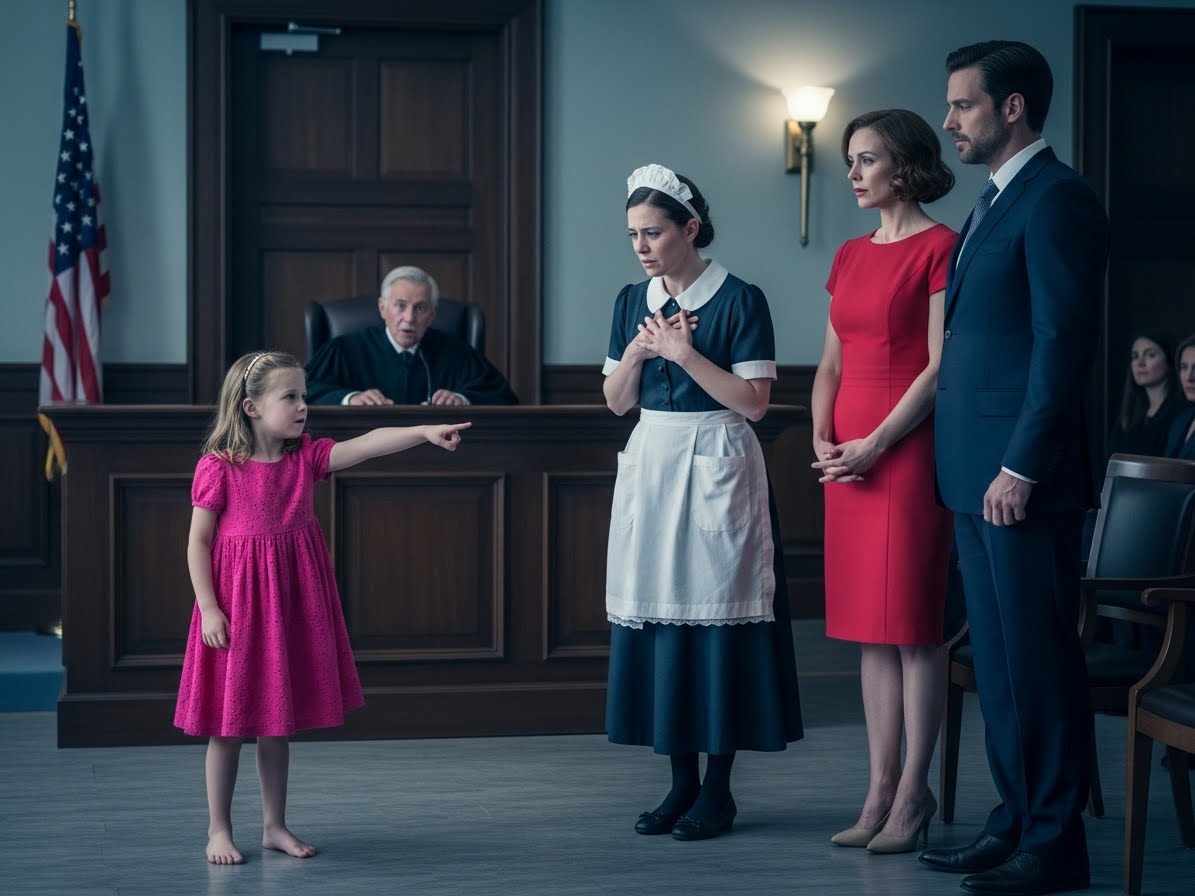
And then, the massive door to the gallery burst inward. It hit the wall with a deafening thwack, and the courtroom jerked as one.
Lilly stood there, backlit by the hallway’s harsh fluorescent light. She was in a rumpled pink t-shirt, no shoes, her hair wild. Her chest was heaving, not just from running, but from the raw, desperate fear finally overcoming the rigid silence Allison had enforced. She looked at Allison, and her face—my beautiful, frightened girl—was pure, unadulterated resolve.
“She’s not guilty!” she screamed, taking a stumbling step forward. The sound was high-pitched, almost a shriek, and she raised her tiny arm, pointing a shaking finger across the space. “It’s all the stepmother!”
The word Guilty was erased from the air, replaced by a seismic shockwave. Allison’s mask finally, irrevocably, broke. Her jaw dropped. Her hands flew to her mouth, not in grief, but in a primitive, terrifying display of pure, naked panic.
Chapter 2: The House of Gilded Cages
Lilly’s entrance was the shattering of a meticulously constructed illusion. To understand the depth of that shock, you had to understand the gilded cage Mark Harrington had unknowingly built for his only daughter, a cage that Allison had been welding shut, bar by bar.
Mark, the victim, was a classic tech entrepreneur. His motivation was simple: build a fortune, leave a legacy. His pain was the guilt from his first failed marriage and a chronic fear of his own heart condition, a condition that made him overly focused on work and neglectful of his home life. His weakness was his inability to truly see people; he solved problems with money and delegation. His memorable detail: he collected vintage Patek Philippe watches, each one a monument to a moment he missed with Lilly.
Allison arrived in Mark’s life like a perfectly curated algorithm. She was gorgeous, attentive, and obsessed with the right charities. She moved into the La Jolla house eight months ago, a house I had kept running smoothly for four years. The atmosphere shifted immediately.
I quickly learned Allison’s life detail: she had come from a modest background in Phoenix and was terrified of ever returning to it. Her online jewelry boutique was a farce, a desperate attempt to appear busy and legitimate, but it was failing, a constant source of stress. She saw Mark’s estate, not Mark, as her true destiny.
Her mission was subtle: systematic control. The first things to go were Lilly’s comfort anchors. The big, messy watercolor set? “Too much staining, dear. We’ll find a nice digital tablet.” The telescope Mark had given her? “Taking up too much space in the observatory. We need that room for a proper home office.”
Lilly was withdrawn, her small shoulders slumping under the pressure of this new, rigid regime. The bruises started a month later—faint, thumbprint marks on her arm. When I asked, Lilly’s eyes darted past me, her small voice stuttering. “I… I just f-fell, Emma.” Allison always had an airtight explanation: the girl was clumsy, overly sensitive, or telling stories for attention.
I confided in my friend, Sarah, a supportive, anxious former teaching colleague (Supporting Character 2). Sarah’s pain: a recent miscarriage had left her questioning her own stability and motherhood potential. Her weakness: she was easily swayed by public opinion and often felt she was overreacting.
“Allison’s a nightmare, Emma, but a murderer? That’s too much,” Sarah had nervously offered over the phone.
But the subtle control was building. I knew Mark had a heart problem, but it wasn’t debilitating. He was diligent about his medication. Then came the medication switch.
The evening before Mark died, I was in the master bathroom, dropping off his pressed shirt. His Beta-Blocker bottle was right there, on the marble counter, its orange plastic a flash of color against the white. Full. A habit of mine, a part of my innate anxiety, made me always check the important details. Full.
Later that night, Mark had gone to his favorite spot, the downstairs reading nook, a brandy on the side table. Allison was upstairs, supposedly on a call with her ‘suppliers.’ I was settling in for the night when I heard a dull, heavy thud from downstairs.
I ran down. Mark was on the floor, gasping, clutching his chest, his face turning an alarming shade of gray. I screamed his name.
Allison appeared at the top of the stairs, not running, but walking down, a look of profound calculation on her face. “Don’t touch him, Emma! You don’t know CPR! You’ll hurt him!”
I hesitated—the memory of my own traumatic past loss making me second-guess my ability to help. That hesitation was my fatal flaw.
Allison then knelt by Mark’s head, placed a hand on his forehead, and in a voice thick with performative pity, said, “Oh, Mark. Why didn’t you take your pills? You always forget.”
She never attempted CPR. She never called 911 immediately. She waited.
And later, when the police came, when the doctor confirmed death by cardiac arrest exacerbated by medication failure, Allison became the inconsolable widow, planting the empty orange bottle in my room with surgical precision, telling the police about my “disgruntled employee syndrome.” When Detective Riley came to my defense table, he saw a perfect narrative: the lonely, stressed nanny who had lost control and enacted a terrible revenge.
The truth—the terrible, silent truth—was what Lilly had seen from the shadow of the hallway. The truth that had just burst into the courtroom, a small, barefoot, terrified girl pointing a finger at the woman who had replaced love with control.
Chapter 3: The Interrogation’s Cold Grip
The explosion of noise in the courtroom—bailiffs rushing toward Lilly, the judge pounding his gavel—was a cacophony that drowned out my own stunned, hopeful gasp. Allison, however, remained silent, a statue of horror. For the first time, her face was unmanaged, showing a predator’s fear of being cornered.
Lilly was quickly pulled away by a bailiff, but not before she managed to shout one more thing, her voice cracking with the effort: “She said… she said I was next!”
I was pulled from the courtroom and back into a holding cell. The lawyer, Mr. Choi, arrived, breathing hard, his usual defeatist slump replaced by an energized, frantic excitement.
“Emma! This is it! Lilly is demanding to speak. She’s not talking to the police—she’ll only talk to the DA and the judge, but she’s adamant. The whole case has turned on a dime.”
He was right. The prosecution’s case rested entirely on circumstantial evidence and Allison’s testimony. A public spectacle, an eight-year-old making a direct, damning accusation, completely undercut their entire narrative of a calculating nanny.
An hour later, I was ushered into a small, windowless conference room to meet Detective Jake Riley (Supporting Character 1). He wasn’t wearing his usual rumpled suit, but a slightly less rumpled one. Riley, mid-40s, was a man hardened by twenty years on the force. His motivation was clean: solve the case and get a promotion. His pain was a recent divorce and a deep-seated guilt over being estranged from his own daughter, a girl Lilly’s age. His weakness was that he was jaded; he always defaulted to the simplest, most obvious explanation. The nanny did it.
He pushed a terrible black coffee across the table at me. “I still think you did it, Miller. But I’m listening.”
“You only thought I did it because it was easy, Detective,” I said, my voice steady for the first time in weeks. “The single nanny, the easy target, the one without a team of corporate lawyers. Allison Harrington is not an easy target. She’s a masterpiece of manipulation.”
He ignored the jab. “The girl is highly traumatized. She’s recanting her previous silence, claiming duress. What was the duress, Emma? What did she see?”
This was my moral choice. I could tell him the whisper, the terror, the fear of me disappearing. But I didn’t want to use Lilly’s pain as my defense yet. I wanted her to tell her story her way.
“She saw what you refused to see, Detective. Allison was there when Mark was dying. She was standing over him. And she didn’t call for help.”
“That’s still circumstantial, Emma,” Riley countered, sipping his coffee. “She’s a woman under stress. Shock can make you freeze. But the pills—that’s hard evidence, a swapped bottle, found in your room.”
“And you believed she put it there,” I said. “She was the only person in that house who had the motive, the access, and the absolute nerve to do it. Mark’s trust was her biggest weapon. Lilly’s silence was her shield.”
I went on to describe the subtle psychological erosion of Lilly: the disappearing toys, the bruises, the enforced quiet. Riley leaned back, his jaded expression finally flickering. The mention of the bruises seemed to pierce his own painful memories of his estranged daughter.
He sighed, his shoulders dropping. “We’ve pulled Lilly into a special witness room. She’s demanding an oath. She says she won’t lie for Allison anymore. You know what that means, don’t you, Miller? If she’s lying, she’s digging her own hole. If she’s telling the truth… she’s burying her stepmother.”
I nodded, feeling a surge of protective fear mixed with fierce pride. Lilly was finally making her stand. But no matter what happened next, the trauma of that night would forever mark her. The hardest part wasn’t going to be the trial; it was going to be the healing.
Chapter 4: A Child’s Secret Fortress
Lilly’s world had become a fortress built of fear and silence. From the moment Allison arrived, the air in the house had turned sharp and metallic. A detail I didn’t fully realize until much later: Allison never hugged Lilly. She always patted her on the head, a gesture of ownership, not affection.
Lilly’s pain was immense: the sudden loss of her easygoing, loving dad, compounded by the presence of a new mother who felt like an icy, ever-present guard. Her inner conflict was paralyzing: the need to save Emma, whom she truly loved, versus the absolute terror of Allison’s threats.
The night Mark died was a jagged, replayed loop in her mind.
She had been awake. Not from a nightmare, but from Allison’s angry, hissed phone call echoing up the grand staircase. Lilly had crept out of her room, drawing herself into a shadow near the top of the stairs, her small hand clutching a plush toy.
She watched Allison storm downstairs, furious. Mark was already in the reading nook, half-asleep.
What happened next was a blur of trauma, yet the details were burned into her memory like a brand. Mark collapsing. Emma rushing down and screaming his name. Allison walking down, slow and deliberate, a strange, triumphant calm on her face.
Lilly saw her stepmother kneel, but not to help. Allison’s hand went into her pajama pocket and pulled out the empty Beta-Blocker bottle—the one Mark thought he had taken, but which had been swapped with the placebo that morning. Lilly had seen Allison in the bathroom, shaking the empty bottle out, watching a pile of the real pills drop into the toilet, then flushing them away with a triumphant, quiet smirk. The sight had paralyzed her, the child unable to process the act of calculated evil.
Allison, leaning over the dying Mark, had whispered, “You signed the new life insurance this morning, didn’t you, darling? You always do what I tell you.” A private joke. A fatal confession.
Then, Allison noticed Lilly. The girl was frozen, a small silhouette against the moonlight streaming through the window. Allison had come up the stairs, her movement liquid and quiet. She didn’t hit Lilly; she used a far more effective weapon. She knelt down, her face inches from Lilly’s, and whispered a terrifying promise.
“Your father is gone because of a bad accident. And now, the bad nanny is going to pay. If you tell anyone—anyone, especially the police—that you saw me, then you will be next. And Emma? She will disappear forever. Do you understand, sweetie? You will lose everyone.”
It was the ultimate psychological manipulation. Lilly’s stutter, her natural tendency toward quietness, became a shield. Her silence was a desperate act of self-preservation, believing that by protecting Allison’s secret, she was protecting Emma’s life.
But silence is a corrosive thing. When I was arrested, when the charges were made public, Lilly was allowed to stay in the house, supervised by a police monitor and Allison. The police monitor, a tired social worker, didn’t notice the little things: how Allison wouldn’t let Lilly close her bedroom door, how she confiscated Lilly’s phone, how the whispers started again at night—whispers about Emma being a killer.
Then, the morning of the verdict. Lilly was watching the trial on a laptop, hidden in the laundry room—the only place she could find a moment of peace. She saw me. She saw my despair. She saw the jury’s faces.
And she finally saw the truth of Allison’s lie: silence wasn’t saving me; it was killing me. Her decision was not brave; it was primal. She couldn’t watch the woman she loved be led away to prison because of a lie born of terror. She ran. She didn’t think about shoes or a jacket. She just ran, a desperate, traumatized child breaking free from her own fear-fortress. She ran to the courthouse, her small legs pumping, driven by the absolute, urgent need to save Emma and to finally honor her father’s memory.
Chapter 5: Climax: The Stand
The courtroom was reconvened, stripped of its previous pomp and quiet formality. It was now a stage for raw, unscripted trauma. The judge, an old man named Justice Harlan, had agreed to an informal, closed hearing in his chambers, with me present, to hear Lilly’s testimony.
Lilly sat in a large, leather chair, a blanket draped over her small body. Allison was seated opposite, flanked by her lawyer, her face a carefully reconstructed mask of benevolent concern that only made her look more chilling. Detective Riley and Mr. Choi were also present.
Lilly’s lawyer, a child advocate appointed by the court, gently asked her to start from the beginning.
Lilly looked at her stepmother. The stutter was intense now, the words catching in her throat like stones. But she pushed them out, her eyes never leaving Allison’s face.
“I… I was awake. I saw her. A-Allison.”
She recounted the phone call, the rage, Mark collapsing. Her voice broke as she reached the crucial, heart-stopping moment.
“Daddy was on the floor… gasping. Emma was yelling. And Allison came down. She knelt. She said… she said, ‘You always f-forget your pills, Mark.'”
The room was silent, save for the hum of the air conditioning. Allison’s lawyer started to object, but Justice Harlan waved him silent.
Lilly continued, her words tumbling out faster now, a torrent of suppressed truth. “She didn’t call 911. She just… just looked at him. And I saw her pocket. She put her hand in. And then, the next morning, she was in the bathroom. I was hiding. I saw her with the orange bottle. She w-was dumping the pills. The real pills.”
Allison’s face finally crumbled beyond repair. Her lip curled, her eyes blazing, the mask of the loving widow dissolving into pure, vicious malice. “She’s lying! She’s a child! She’s been coached by the nanny!”
“I have not!” Lilly screamed back, her small body trembling. The sudden confrontation, the shock of her stepmother’s voice, gave her a final, explosive memory.
“She took the picture! The evidence! She made the evidence!”
This was the unexpected twist.
Lilly pointed a finger at Allison. “She put the bottle in Emma’s room, but first… she put the bottle on the dining table. She took a picture of it on her phone, with the big American flag outside the window. S-She said she needed to make sure the police knew it was my daddy’s house, not Emma’s. The p-picture was on her phone!”
Allison lunged forward, a terrifying, guttural sound escaping her throat. “Liar!”
Detective Riley, who had been quietly taking notes, slammed his hand down on the table. “Stop!” He turned to Allison’s lawyer. “Get your client’s phone. Now.”
The lawyer protested, but the sheer desperation of Allison’s reaction—her immediate attempt to stand and leave, her panicked denial—was all the warrant Riley needed. Two bailiffs restrained her.
The twist wasn’t just the photo. It was the detail of the American flag, a small, innocuous suburban detail that only an eyewitness—or the person staging the evidence—would know.
Lilly, shaking, buried her face in the blanket. “She took it so they would believe her. She took the picture before she planted it in Emma’s room, to make sure she had proof if the police missed it.”
The truth, messy, raw, and delivered by a child, was now irrefutable. The staging. The photograph. The calculated, cold-blooded effort to frame me. The climax was over. Allison Harrington was led out of the judge’s chambers in handcuffs, her perfect life a shattered spectacle.
Chapter 6: The Unbreakable Thread
The days following the testimony were a blur of legal clean-up. The charges against me were immediately dropped. Allison was formally arrested, charged with first-degree murder and evidence tampering. Detective Riley, finally free of his jaded skepticism, found the photo on Allison’s cloud backup, a chilling, time-stamped image of the empty pill bottle staged on a sun-drenched table, the US flag visible through the window, exactly as Lilly described. The case was now solid.
The cooldown was the quiet, agonizing work of recovery.
I was free, but Lilly was still in crisis. She was placed into temporary foster care—a mandatory step—but I spent every permitted hour with her. We didn’t talk about the trial. We talked about horses, about school, about the future.
The realization hit me hard: I hadn’t lost my own child, but I had nearly lost the chance to protect a child who desperately needed me. My old pain had made me cautious; Lilly’s bravery had forced me to be fearless.
Mark’s final, loving detail became clear to me in the aftermath. Mark hadn’t been completely naive. I found a note, tucked into the spine of a vintage book in his reading nook—the place where he died. It was a handwritten amendment to his will, penned a month before his death.
If anything should happen to me, I formally designate Emma Miller, my former nanny, as the primary guardian and trustee of Lilly Harrington, citing the profound change in Allison’s behavior and my distrust of her intentions.
He had seen it. He hadn’t been fast enough, or strong enough, to stop Allison, but he had left one final fail-safe for his daughter. That was his old wound: his inability to speak the truth when it mattered most, yet his ultimate, silent act of fatherly love.
Weeks later, the legal process was complete. Allison was gone. I was appointed Lilly’s official guardian, and we moved out of the big, haunted house. We moved into a smaller, sunnier home near Balboa Park, a place with a huge backyard for real horses, not just drawn ones.
We were sitting on the porch one evening, watching the light fade, when Lilly leaned her head against my shoulder. She wasn’t stuttering anymore.
“Do you think Daddy knows?” she whispered.
I wrapped my arm around her. “I know he knows, sweetie. And he knows you did the bravest thing a person can do. You faced your fear for love.”
Lilly looked up at me, a genuine, small smile finally touching her lips. She was still scared, but she was healing.
The American dream isn’t about the mansion or the perfect spouse; it’s about the second chances and the families you choose. Lilly and I were proof of that.
I pulled her closer, watching the stars come out over our new life, a life built on a terrifying foundation of loss, but now rising strong on a bedrock of truth and unconditional love. The quiet little girl I saved, in turn, saved me.
We didn’t just survive the lie; we became the truth that broke it.