“The Silence Was Worse Than Any Scream: The Jock, The Scholar, and The Secret That Ripped Northwood High Apart—I Stood By and Watched Them Lure Her, And That Guilt Became My Weapon.”
Part 1: The Lure and The Silence
Chapter 1: The Unspoken Rules of Northwood
Northwood High was a beautifully deceptive place. From the outside, it was a postcard of American suburban success: manicured lawns, a state-of-the-art football field, and a massive brick facade that promised a future full of college acceptance letters and professional careers. But inside its fluorescent-lit hallways, the air was thick with the unspoken rules of a cruel, ancient kingdom. And I, Alex, was a ghost in the machine—a senior just trying to get through the next six months without attracting the wrong kind of attention. I excelled at being average, at blending in, at keeping my gaze fixed firmly on my textbooks and my future at State University. I believed in the power of invisibility.
The crown prince of this kingdom was Jason Thorne. Not only was he the star quarterback—the kind of athlete who seemed destined for the NFL and whose picture was permanently on the local news—but he also embodied a toxic entitlement that was terrifyingly absolute. His smile was dazzling, his charisma overwhelming, and his power was derived from the silent consent of everyone around him: students, teachers, and even the administration, who saw him as their golden ticket, their proof of Northwood’s superiority. His word was law, and his cruelty was usually reserved for the periphery, the kids too quiet or too different to matter to the wider school narrative.
That’s where Maya Reyes came in. She was everything Jason wasn’t. Quietly brilliant, her mind was a steel trap of facts and ethical clarity. She was in the competitive debate club, volunteered at the animal shelter, and preferred the company of classic literature to the school’s social scene. She was small, unassuming, with a fierce, quiet passion for justice that she kept mostly contained. Until, that is, she couldn’t.
The incident that started it all wasn’t a dramatic confrontation; it was a simple, clinical dissection. During an AP History class discussion about the role of women in the American Revolution, Jason made a casually contemptuous remark—something about how the wives were just there to “look pretty and make dinner.” It was a classic Jason move, designed to get a laugh and derail the serious conversation. But Maya, sitting in the front row, didn’t laugh. She didn’t even raise her voice.
She simply waited for the titters to die down, looked him dead in the eye, and cited three specific historical sources, complete with page numbers, that detailed the critical, dangerous, and often revolutionary roles women played, concluding with a quiet, devastating question: “Did you actually read the chapter, Jason, or did you just skim the highlighted parts?”
The silence that followed was instant and total. It wasn’t the kind of silence that precedes applause; it was the kind that precedes an execution. Jason Thorne had been verbally neutered in front of thirty of his peers, not by a teacher or a rival, but by a girl he probably hadn’t known existed five minutes earlier. His face went from cocky amusement to a terrifying, mottled red. The humiliation was total. And in that moment, as he glared at her, a promise of retribution was silently, violently exchanged. I watched it all from my seat in the back, the cold knot of dread already forming in my stomach. I knew, with a fatalistic certainty, that Maya had just signed a contract for her own suffering. Jason Thorne never, ever let a slight go unanswered. His revenge was always swift, public, and absolutely brutal. And I was about to become an unwilling witness to the start of it. My carefully constructed wall of invisibility was about to be breached by the simple, terrifying proximity of a crime.
Chapter 2: The Perfect Trap
The retribution began subtly, insidiously, over the next two days. First, the digital assaults. Vicious, poorly doctored images of Maya began circulating on the school’s anonymous chat platform, captioned with crude jokes about her intelligence and her appearance. Mark and Todd, Jason’s loyal, thick-skulled lieutenants, made sure to laugh loudly whenever she walked past. They were his hands, the instruments of his casual cruelty. Maya tried to ignore it, burying herself deeper in her books, but the toll was visible. Her usual upright posture was starting to slump, and the subtle shadows beneath her eyes deepened.
I watched her in the library, tracing lines over the same paragraph for ten minutes straight. I wanted to go over, to say something, anything—Are you okay? Just ignore them. But the thought of Jason seeing me talk to her, of bringing myself into his malicious orbit, was a potent deterrent. The rule of Northwood was self-preservation. I clung to my invisibility like a life raft.
Then came the setup, the perfect lure tailored to her inherent goodness. It was Tuesday, right before the lunch bell—the busiest, most chaotic, and therefore most unsupervised time of the day. I was at my locker, stuffing my geometry book away, when I heard Jason’s voice, low and menacing, near the row of vending machines.
He had Maya boxed in, flanked by Mark and Todd. “Still think you’re so smart, Reyes?” Jason drawled, his breath probably reeking of the energy drink he was holding. He didn’t wait for an answer. That’s when Mark, the more deceptively smooth of the two cronies, stepped forward.
“Hey, Maya. Look, man, listen up,” Mark started, managing to sound genuinely concerned. “Coach Miller is freaking out. He just found out the new weights for the regional finals got delivered to the wrong loading dock. He needs them moved to the gym storage room, like, right now. But his office phone is dead, and he’s tied up with the Principal.”
It was an Oscar-worthy performance. Mark had perfectly manufactured urgency and reliance, hitting all of Maya’s volunteer-driven instincts.
Maya’s eyes flickered with confusion, then concern. “The storage room? But I thought Coach was at the district meeting today.”
Todd, quick to close the trap, interrupted smoothly, “Nah, that was canceled. Look, he said he needs someone responsible. Someone who knows the difference between a dumbbell and a kettlebell. And he knows you volunteer with the equipment setup for the community center. You’re the only one who can do it fast. He said to go right now. It’s the big one by the visitors’ bleachers.”
She hesitated for a beat—a precious, agonizing second where she was weighing the obvious danger against her sense of duty. That hesitation was her undoing. Jason just stood there, a predatory, silent witness, letting his lieutenants work the con. His smug expression was chilling. He knew she would fall for it. Her inherent decency was the bait.
“Okay,” she finally whispered, clutching her books. “I’ll go.”
I watched them herd her away from the main exit, toward the deserted wing of the gym. My mind screamed the truth. Coach Miller had left in his beat-up sedan an hour ago; I’d seen him myself, his golf clubs in the back seat. There were no new weights. There was no urgent delivery. There was only a trap, baited for a cruel and calculated act of revenge, and Maya was walking right into the most isolated, unmonitored space in the school.
A violent, ice-cold rush of adrenaline hit me. I could have yelled. I could have pulled the fire alarm. I could have stopped them. But the fear—the paralyzing, potent fear of Jason Thorne’s inevitable retaliation—kept my feet rooted to the ground for what felt like an eternity. Stay out of it, Alex. It’s not your fight. That cowardly, self-preserving voice whispered in my ear.
But then, I saw the back of Maya’s head disappear around the corner, her small frame dwarfed by Mark and Todd. And the image of her face—so utterly genuine, so focused on helping—broke through the paralysis. My invisibility wasn’t a shield; it was a cage. If I did nothing, I wasn’t just safe; I was complicit. I would carry the weight of what happened to her for the rest of my life.
My heart was a frantic, out-of-control drum against my ribs. I made a choice, a silent, irreversible commitment to shatter my own peace. I pushed off the locker, not running, but walking with a focused, desperate speed that felt agonizingly slow. I took the longer route, cutting through the deserted band room hallway, trying to avoid the main thoroughfare where staff might see me rushing. Every second felt like a year.
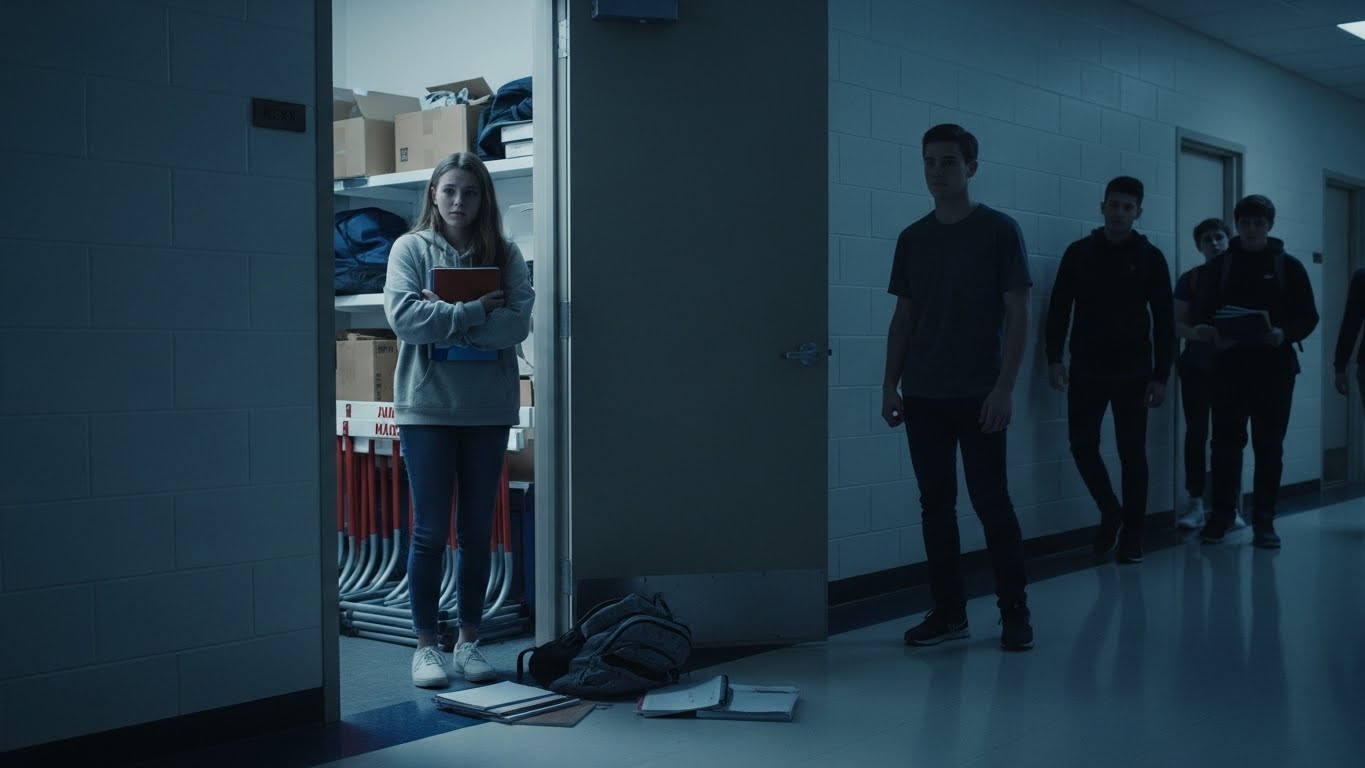
When I reached the gym wing, the silence was suffocating. The hallway was empty, the air heavy with an unnatural stillness. The only sound was the distant thump-thump of a basketball practice in the main gym, a harmless sound that only emphasized the danger I was approaching. The heavy, metallic storage room door was not locked. It was cracked open, just wide enough for a person to slip through.
I pressed my ear to the cold steel. No shouts. No struggle. Nothing. Just an appalling, absolute void. That silence was the most terrifying sound I had ever heard. It wasn’t the sound of a physical fight; it was the sound of something psychological, something calculated and quiet, that was far, far worse.
I pushed the door open, just enough. The room was dark, lit only by a single, dirty bulb swinging precariously in the back. And there they were. Jason, Mark, and Todd, standing in a small circle. And in the middle of it all, Maya. She was utterly still, facing away from them, her back to me. Her hair was messy, a dark smear on her shoulder. The sheer, deliberate stillness of her body spoke volumes.
I heard Jason’s voice—a low, almost bored tone of total triumph. “Well, look who finally decided to join the party. Didn’t think you had the guts, Alex.”
My eyes were locked on Maya’s back. And then she turned. When her eyes met mine, they weren’t filled with tears or rage. They were vacant, yet filled with a profound, terrifying understanding—the look of a person who has just had the most fundamental truth about the world brutally shattered. The quiet, brilliant light was gone, extinguished by a moment of calculated cruelty. What they had done was done quietly, not with a fist, but with the cold, hard force of their entitlement. And in that awful, silent room, I knew that the easy life I had been desperately clinging to had just ended. I was standing in the presence of a truth that would either destroy me or set the whole school on fire.
Part 2: The Fire and The Reckoning
Chapter 3: The Weight of Silence
The air in the storage room felt thicker than mud, charged with the sickening electricity of post-aggression euphoria emanating from Jason and his cronies. They had their victory, a cheap, cowardly win that left the target—Maya—standing perfectly still, a statue carved from despair. The silence that had initially terrified me now felt like a shroud, pulled over the ugliness they had wrought. The red mark on Maya’s cheek wasn’t the worst of it. It was the complete, terrifying absence of her spirit. They hadn’t just scared her; they had tried to erase her. They had taken her quiet conviction and stomped it into the dusty concrete floor, coating it in the grime of the forgotten room.
“You done gawking, Alex?” Todd sneered, clearly boosted by the presence of a terrified audience. His smirk was infectious, spreading to Mark, who just stood there, arms crossed, the picture of smug, casual cruelty.
Jason, however, was focused on me. His face held a dangerous mixture of arrogance and a slight, calculating worry. He knew I was the one loose thread, the unexpected variable in his perfect act of revenge. “Look, Alex,” he said, stepping toward me, his voice dropping into a low, pseudo-friendly rumble. “This stays here. You didn’t see anything. Maya fell, she scraped her knee. Happens all the time. You got that? Go back to the cafeteria. Pretend you never came down this hall.”
He was testing me, offering me the easy out, the return ticket to my cherished invisibility. All I had to do was nod, turn around, and walk away. Just one little lie of omission. But the image of Maya’s vacant eyes—the betrayal not of her body, but of her fundamental belief in decency—had welded my feet to the floor. The guilt from those thirty seconds of paralysis outside her locker was a cold, hard lump in my throat. I couldn’t be a coward again. Not now.
“She didn’t fall,” I heard myself say, the voice thin and reedy, a stranger’s voice, yet filled with an undeniable tremor of conviction. “You lured her here. You hurt her.”
Jason’s smile vanished. His eyes narrowed to cold, hard slits. “Watch your mouth, bookworm. You think anyone is going to believe you over me? Over the captain of the state-bound team? You’re a nobody, Alex. And if you open your mouth, you won’t just be a nobody—you’ll be the biggest target this school has ever seen. Your college applications? Gone. Your senior year? A living hell. We’ll make sure you regret the day you were born.”
It was a clear, unambiguous threat—the kind he’d made and executed countless times. It was a promise to obliterate my future, to make my remaining time at Northwood an exercise in constant psychological warfare. My instinct was to recoil, to back down, to apologize and flee.
But then, Maya finally moved. She lifted her head, and her eyes, still vacant, still wounded, locked onto Jason. And she began to walk. Not running, not sobbing, but walking with a slow, deliberate purpose toward the door. She brushed past me without a word, her expression unreadable. She walked out of the storage room and into the brightly lit hallway. She was not fleeing; she was leaving, and in her departure, she left the silence—and the guilt—with us.
I watched her go, then looked back at Jason. His face was a mask of confused fury. He’d expected tears, pleas, subservience. He hadn’t expected the silent, devastating departure of someone whose spirit he couldn’t completely break.
“Go after her!” Jason roared at Mark and Todd. “Make sure she keeps her mouth shut!”
But I stood my ground, now fully committed to the fire. I looked at Jason, and the fear was still there, a constant, debilitating pressure, but now it was mixed with a surge of cold, righteous rage. “It’s too late, Jason,” I said, my voice barely a whisper, but it carried the weight of the truth. “Everyone already knows who you are.”
It was a lie, a desperate bluff, but it hit him like a physical blow. He lunged, a flash of red and white Northwood jacket, but I was already turning, retreating back into the hallway. I knew I couldn’t fight him physically. My only weapon was the one thing he couldn’t control: the narrative. I ran, not toward the office, but toward the one person I knew had a voice, a conscience, and a platform: Sarah, the editor of the school paper, The Sentinel. The weight of my silence was gone, replaced by the crushing responsibility of the truth. The story had to break, and I was the one who had to tell it. This was no longer just about Maya; it was about tearing down the unspoken rules of Northwood, and I had just declared war on the most powerful person in the building.
Chapter 4: The Unraveling Thread
Finding Sarah, the editor-in-chief of The Northwood Sentinel, was like finding a single, functional life raft in a sinking ocean. She was in the musty, windowless journalism room, surrounded by stacks of proof sheets and half-eaten cafeteria food, her brow furrowed in concentration. Sarah wasn’t just a journalist; she was an investigative mind trapped in a school paper, obsessed with truth and justice. She was also the only person I trusted enough to give this kind of power to.
I burst into the room, gasping for breath, the sight of the storage room still burned behind my eyelids. “Sarah,” I choked out, leaning against the door frame, trying to will my heart rate down. “I need you to listen to me. This is… this is the story.”
She looked up, annoyed at the interruption, her bright, analytical eyes instantly registering the raw panic on my face. “Alex? What is it? Did Mr. Harrison finally try to pull the plug on the op-ed on the school board budget?”
“No. Worse,” I managed, stumbling toward a chair. “It’s Jason Thorne. And Maya Reyes. And the gym storage room.”
The color drained instantly from Sarah’s face. The name ‘Jason Thorne’ had the same chilling effect on everyone, even a fearless journalist. But her mind, sharp and disciplined, immediately went into professional mode. She set her pen down and leaned forward. “Start from the beginning. Every detail. No conjecture. Just what you saw, what you heard, and where. Fast.”
I recounted the entire sequence of events: the insult in history class, the subsequent digital harassment, the perfect, tailored lie about Coach Miller and the weights, the awful paralysis that held me captive, and the terrifying silence inside the storage room. I described Maya’s expression when she looked at me—that profound, vacant horror—and Jason’s cold, calculated threat against my own future.
As I spoke, Sarah took furious, short-hand notes, her pen scratching against the notepad, the only sound in the room. She was meticulous, asking clarifying questions about the exact wording of the lie, the time, the specific location of the fire door, and the identities of Mark and Todd. She wasn’t expressing outrage yet; she was compiling evidence, building a case. She knew the magnitude of what I was telling her: a direct attack on the school’s untouchable icon, a story that could rock the entire community.
“Alex,” she finally said, her voice low and serious, the journalistic detachment momentarily slipping away. “This is huge. And it’s dangerous. We go to press with this, there’s no turning back. Jason and his parents, who are huge donors to the football program, they will try to bury us. They’ll call it libel. They will try to destroy your life. Are you absolutely certain about every single detail? Are you willing to put your name on this, Alex? Because if we run this, we run it with a named source.”
The question hung in the stale, dusty air. She was giving me one last chance to choose invisibility, to retract my statement and retreat to the safety of my textbooks. But the truth was, I had already crossed the line. The guilt, the shame of those thirty seconds of cowardice, was a heavier burden than any retaliation Jason could inflict.
“I saw what I saw, Sarah. And I’m not backing down,” I said, the words solid and clear, finally matching the conviction in my soul. “We have to do this. For Maya. And for every other kid who is afraid of him.”
Sarah gave a curt, professional nod, a sign of respect. “Good. Now, we need proof. Your testimony is strong, but it’s one voice against three, and one of those three is Jason Thorne. We need a physical, undeniable anchor for the story. The time of the incident was right at the lunch bell, right?”
“Yeah. Around 12:05 PM.”
“Okay. Northwood’s security is a joke, but they do have motion-activated cameras covering the main entrances and the athletic wing loading dock. The gym storage room is a blind spot, but the hall leading up to it? Maybe not.” She pulled a school blueprint from her desk drawer, tracing a line with her finger. “There’s a small, rarely-used camera mounted near the coach’s office, about fifty feet from the storage room door. It’s supposed to monitor the equipment checkout window, but its field of view might have caught them going in. It’s a long shot, but it’s our only shot at a visual confirmation of the lure.”
The plan was a desperate gamble. The only person with access to the security footage was the Head of Security, an elderly man named Mr. Henderson, who was notoriously loyal to the Principal and the football program. We had to get the footage before anyone else knew the story was breaking. Sarah, ever the strategist, outlined the steps: a distraction to get Mr. Henderson out of his office, a quick download of the relevant time stamp, and a safe backup of the evidence.
“I need you to keep your head down for the rest of the day, Alex. Don’t look at Jason. Don’t talk to anyone. I’ll handle the extraction. We go to print tonight. And tomorrow morning, Northwood High will no longer be a safe place for Jason Thorne.”
As I left the journalism room, the noise of the school—the ringing phones, the slamming lockers, the easy laughter—all faded into a dull roar. The silence of the storage room was still with me, a ghost clinging to my resolve. I had traded my invisibility for a front-row seat to the biggest explosion in Northwood’s history, and the fuse was now lit. The unraveling had begun.
Chapter 5: The Digital Truth
The next few hours were a blur of nervous anticipation, a tense holding pattern before the inevitable detonation. I felt Jason’s eyes on me in the hallway, a cold, probing stare that promised violence. I avoided him, moving like a hunted animal, but my resolve didn’t waver. The fear was a constant tremor in my hands, but the guilt was a powerful, anchoring weight. I had done the right thing, and now I just had to survive the consequences.
Sarah was the general of this silent war. She had a brilliant mind for disruption and evidence. Her plan was simple, bold, and entirely necessary. While I went to my last two classes, she put her team into motion.
First, the distraction. The sports editor, a quiet tech genius named Kevin, was tasked with triggering a non-critical fire alarm in the school’s west wing—far from the security office—shortly after the final bell. This was a common school occurrence, an annoyance, not a real emergency, which would pull Mr. Henderson, the Head of Security, to the scene for a mandatory inspection, but wouldn’t initiate a full, building-wide lockdown.
Second, the extraction. While the bells were ringing and the security head was busy, Sarah herself, armed with a pre-formatted USB drive, would slip into the security office. She wasn’t just after the footage; she was after the digital truth.
I met her back in the journalism room thirty minutes after the all-clear bell. The room was dark, save for the blue glow of her laptop screen. She was sitting at her desk, her shoulders visibly slouched with exhaustion, but her eyes held the glint of victory.
“We got it,” she whispered, her voice husky. “The motion-activated camera. It’s low-resolution, no audio, but it’s enough. It shows Mark and Todd blocking the hallway, and then Maya following them towards the storage room door. And then…”
She stopped, turning the screen slightly for me to see. The timestamp on the bottom corner clearly read 12:05 PM. The grainy footage showed the empty, brightly lit hallway near the gym. Then, the figures of Mark and Todd appeared, flanking the small, slumped figure of Maya. The camera was too far to catch their expressions, but the body language was undeniable: Maya was being pressured, directed, led against her will. Then, Jason appeared, bringing up the rear, his head held high, his movements full of a chilling, casual authority. They disappeared from the frame right at the corner that led to the storage room door. Crucially, the footage showed them re-emerging exactly seven minutes later. Mark and Todd were smirking, bumping fists. Jason was straightening his jacket, a look of smug satisfaction plastered on his face. Maya was last, walking slowly, her back ramrod straight, but her head down.
Seven minutes. Seven minutes of silence, of calculated cruelty, of the unseen act that broke her spirit. The footage was the irrefutable digital anchor we needed. It wasn’t the physical assault itself, but it was proof of the lure, the isolation, and the triumphant aftermath—a narrative that perfectly corroborated my eye-witness account.
“This is it, Alex,” Sarah said, closing her laptop with a decisive snap. “The evidence, the motive, the witness, and the named victim, if she agrees to come forward. We run this tonight. Print run starts at midnight. The Sentinel is going to be waiting on every desk tomorrow morning.”
But as we were discussing the logistics of the print run, the door to the journalism room flew open. It wasn’t Jason. It was Mr. Daniels, the school principal—a man who usually operated with the quiet, bureaucratic efficiency of a paper-pusher. His face was pale, his breathing ragged, and his eyes were wide with a barely suppressed terror.
“Sarah! Alex! What is going on?” he demanded, his voice trembling. “I just got a call. A call from Mrs. Thorne. She says you two are planning on publishing a defamatory article about Jason. She’s threatening to sue the school board, the paper, and both your families for libel and harassment! She says you’re trying to ruin her son’s future!”
The retaliation had begun, but not from Jason. It came from the top, from the people who saw Jason as an investment, not a person. The Thornes hadn’t even read the article yet; they were reacting purely to a pre-emptive strike, using the threat of massive financial ruin to silence the truth before it was even whispered. Sarah and I exchanged a look. This was the moment of truth. We had the digital truth, but the institutional defense was already in place, massive and terrifying.
“Mr. Daniels,” Sarah said, standing up, her posture straight and defiant. “We have multiple witnesses and irrefutable, time-stamped visual evidence that Jason Thorne and his associates lured a student into an unsupervised location for the purpose of intimidation and harassment. We are not publishing libel; we are publishing the truth. And if you try to stop us, we’ll go to the local newspaper. You will not bury this.”
The Principal looked from Sarah to me, his terror battling with his duty to the school’s primary donor. The power of the truth, backed by the digital evidence, was palpable. He stood there, frozen, realizing he was caught between a powerful lie and an even more powerful truth, and the decision he made would define his career. The fuse had been lit, and the bomb was ticking.
Chapter 6: The Midnight Press
The showdown with Principal Daniels was tense, exhausting, and ultimately inconclusive. He didn’t confiscate the evidence. He didn’t shut down the paper. Instead, he retreated with a final, desperate warning: “You are playing with fire, kids. You have until midnight to think about this. If that paper rolls off the press, you’re on your own. I can’t protect you from the Thornes.”
The threat was clear: the school would deny all knowledge and abandon us to the legal and financial wrath of Jason’s powerful parents. But we had already gone too far to turn back. Abandoning the story now would be a betrayal of Maya, of my own conscience, and of the journalistic ethics Sarah lived by.
Sarah and I spent the next few hours working in a feverish silence, refining the article. We called it: “Seven Minutes in the Dark: The Unspoken Cruelty of Northwood’s Golden Boy.” The narrative was tight, weaving my testimony with the time-stamped security footage as irrefutable proof of the Lure and the Aftermath. The tone was factual, but the suspense was inherent in the details. We focused on the systematic campaign of harassment, making it clear this wasn’t a single, isolated incident but the culmination of a tyrannical entitlement.
The biggest challenge remained Maya. We couldn’t run the story without her consent. We knew her name would appear, and she would have to face the fallout. I used the quiet desperation of my own guilt to send her a message, a carefully worded, non-pressuring plea for her voice. We have the evidence. We can break the silence. But it has to be your choice. I need to know you’re okay with this.
Her reply came back instantly, a single word: Yes.
That single word was a silent roar of defiance. It was all we needed. With renewed purpose, we moved to the printing press, a hulking, dusty machine housed in a separate annex behind the school. The process was antiquated, messy, and loud.
At 12:01 AM, the old press groaned to life. The first copy of The Northwood Sentinel rolled out, smelling strongly of ink and the promise of revolution. The front page was dominated by the damning headline, and beneath it, my name, Alex, listed as the primary source, alongside Sarah’s as the author. The fear was a living thing in my chest, but as I held that physical proof of the truth in my hands, a new feeling emerged: empowerment.
We worked until 3:00 AM, stacking thousands of copies, knowing that within a few short hours, these papers would be placed on every single student and faculty desk in Northwood High. We were delivering not just a newspaper, but an ultimatum.
As the sun began to rise, casting long shadows across the deserted school parking lot, Sarah and I stood on the main quad, watching the custodial staff start to arrive. We looked at each other, two unlikely co-conspirators in a high-stakes journalistic coup.
“The truth is out, Alex,” Sarah whispered, her voice rough with exhaustion. “The narrative belongs to us now. The silence is broken. Now comes the fire.”
I nodded, the full weight of the coming day pressing down on me. I knew what to expect: the rage of Jason, the frantic damage control of the administration, the gossip, the threats, the potential legal action. My simple, invisible life was over. But as I thought of Maya, who had found the courage to say Yes after being so brutally silenced, I felt a kind of quiet, unshakable peace. The time for hiding was done. The truth, however dangerous, was the only thing that mattered. Northwood High was about to have a very long, very explosive day. The reckoning was here.
Chapter 7: The Morning After
The morning of the paper’s release was a cultural shift at Northwood High. It didn’t start with a riot; it started with a silence—a silence heavier and more meaningful than the one in the storage room.
When I walked into the main entrance, the atmosphere was instantly different. Students weren’t chatting or laughing; they were gathered in small, tight knots, whispering, their eyes darting from face to face. On every single desk, every cafeteria table, and taped to a few lockers, was the freshly printed copy of The Northwood Sentinel with the bold, uncompromising headline: “Seven Minutes in the Dark: The Unspoken Cruelty of Northwood’s Golden Boy.”
The paper was being consumed, not read—students were devouring the details, pointing at the embedded QR code that led to the time-stamped security footage, and passing the physical copies with a horrified reverence. The truth, delivered en masse and backed by digital proof, was a physical force.
I found Maya in the library, sitting at a corner table, a copy of the Sentinel folded neatly beside her. She wasn’t hiding. She was reading a book, her head held high. When she saw me, she gave a small, genuine smile—the first true, unburdened expression I’d seen from her since the incident. In her eyes, the terrifying vacancy was gone, replaced by a quiet, determined resilience. The paper hadn’t broken her; it had set her free.
“Thank you, Alex,” she said softly, her voice steady. “For not staying invisible.”
The moment was interrupted by the sudden, overwhelming chaos that erupted at the main entrance. Jason Thorne had arrived.
He stormed into the building, his face a mask of incandescent, primal rage. He wasn’t the golden boy anymore; he was a cornered animal, seeing his perfect world crumbling around him. He saw the papers, he saw the whispering students, and he knew. He knew he’d been exposed.
His eyes swept the crowd and landed on me, standing next to Maya. That was all it took. He charged, pushing students aside, the momentum of his powerful athletic body a terrifying blur. “You!” he bellowed, his voice echoing through the marble-floored hallway. “You destroyed me, you little worm!”
The scene devolved instantly. Students backed away, creating a wide, open arena for the confrontation. Jason reached me and didn’t hesitate, shoving me hard against the lockers. The impact knocked the air from my lungs and sent a searing pain up my back. He raised his fist, the kind of professional athlete’s fist that could do serious damage.
I didn’t fight back. I just looked at him, not with fear, but with a strange, cold pity. “The truth destroyed you, Jason,” I gasped, tasting copper in my mouth. “Not me.”
Before his fist could fall, a new sound cut through the chaos: the wail of sirens. Not a school fire alarm, but genuine police sirens. Mr. Daniels, seeing the inevitable, had finally done the right thing and called the authorities.
Two uniformed officers rushed into the hallway, moving quickly through the stunned crowd. They separated Jason and me, pulling the enraged quarterback away. He struggled, screaming threats and denials, his perfect façade finally shattering in a very public, humiliating spectacle. They put the handcuffs on him right there, in the main hallway of Northwood High, the gold of his football jacket contrasting sharply with the cold steel of the cuffs.
As they led Jason Thorne away, his season over, his future uncertain, the hallway erupted not in cheers, but in a profound, collective sigh. It was the sound of a kingdom falling, the moment the unspoken rules of fear and entitlement were finally and irrevocably repealed.
I stood there, leaning against the lockers, bruised but whole. My invisibility was a distant memory. I was a witness, a survivor, and now, a catalyst for change. The fire had started, and its heat had cleansed the air.
Chapter 8: The Cost of Courage
The aftermath of Jason Thorne’s arrest was a whirlwind that swallowed Northwood High whole. The story was immediately picked up by the local news, then the regional, and within 48 hours, it was a national headline: “High School Quarterback Charged After Student Journalist Breaks Silence.” The Thornes’ attempts at damage control were too late and only further fueled the public outcry. Jason was formally suspended, charged with assault and harassment, and stripped of his captaincy. The school board launched a full-scale investigation into the athletic department’s long-standing culture of favoritism. Principal Daniels was placed on administrative leave.
For Maya and me, the change was equally dramatic. We were no longer invisible; we were symbols. Maya was hailed as a quiet hero, receiving an outpouring of support from students and the wider community. She started the ‘Northwood Integrity Coalition,’ a student-led group dedicated to ensuring accountability and safety within the school. Her trauma was acknowledged, but her resilience was celebrated.
For me, the cost was immediate and personal. The first few days were marked by nervous glances and whispers. My parents, initially terrified by the threats of legal action, eventually stood by me, proud of my courage. But the true, long-term consequence was the end of my easy path. My college applications were flagged, not because of a bad grade, but because of the controversy surrounding my name. A few universities pulled back their offers, wary of the potential drama. My perfect, planned future was messy, complicated, and entirely uncertain.
Yet, I wouldn’t have traded it. The shame of those thirty seconds of paralysis was a powerful, indelible lesson. The easy path is often the coward’s path. The difficult path—the one that demands courage, conviction, and a willingness to accept the mess—is the only path that leads to self-respect.
The final meeting with Sarah summed it all up. She had been offered a full scholarship to a prestigious journalism school. The Sentinel had won a regional award for its reporting. She was already packing her bags.
“You know, Alex,” she said, looking at me over a final, cluttered desk in the journalism room. “You were just a science kid trying to keep your head down. And you ended up being the key that unlocked the whole damn kingdom. You were the witness, but you chose to be the source. That’s the difference between a bystander and a journalist.”
“I just did what I should have done earlier,” I replied, shrugging. “I couldn’t live with the silence anymore.”
My future was a blank page, but for the first time, it felt like my own. I wasn’t defined by my average grades or my safe choices; I was defined by my choice in that terrifying, quiet storage room. I was taking a gap year, planning to work, save money, and reapply to schools not because of their name, but because of their values. I was looking at things differently now. The world wasn’t a neat, controllable set of variables; it was a complex, beautiful, and often dangerous place that demanded engagement, not retreat.
The Northwood High I graduated from was a better place. The fear was gone, replaced by a cautious, budding sense of community and accountability. The silence had been broken, the golden boy was gone, and the unspoken rules were shattered. And it all began with a desperate decision in a dark, dusty storage room, a decision to trade an easy, invisible life for a difficult, public truth. The cost was high, but the reward—the quiet, enduring strength in Maya’s eyes and the clean conscience in my own—was immeasurable. The story was over, but the fire had only just begun to illuminate the path forward.