My Brother Knew Too Much. They Tried to Silence Him. What We Found in the Back of That Truck Will Haunt Me Forever…
Part 1: The Vanishing Point
Chapter 1: The Broken Promise
The summer air in Pueblo, Colorado, was supposed to feel free. It was supposed to smell like cut grass and cheap fireworks. But that June, the only thing I could smell was fear, thick and metallic, like old pennies in my pocket.
My name is Alex. I was fifteen, and my life had just been shattered, not by an earthquake, but by silence.
It started with my little brother, Sam. He was eleven, obsessed with space and old-school walkie-talkies. Sam wasn’t just a kid; he was my anchor. He was the only one who could make my mom smile that real, deep-down smile after our dad left. Sam was smart, maybe too smart for our quiet, sun-baked neighborhood, nestled in the shadow of the Front Range.
We lived paycheck to paycheck, Mom working double shifts at the diner just to keep the lights on. I tried to help, mowing lawns, but Sam, in his own way, was the real hustler. He wasn’t selling lemonade. He was collecting secrets.
Our neighborhood, like a lot of forgotten corners of America, had its ghost stories. Old warehouses down by the decommissioned steel mill. Rumors of things that shouldn’t be happening. Sam, with his walkie-talkie always clipped to his belt, treated these rumors like a treasure map. He was trying to find “The Ghost Truck,” a name he’d given to an unmarked, refrigerated box truck that he swore came and went in the dead of night.
“Alex,” he’d whisper to me one night, his eyes wide and dark in the glow of his cheap flashlight. “They aren’t moving furniture. It’s not groceries. The truck, it moves too quiet, and the people… they look like they’re waiting for a signal. Like spies.”
I’d tried to laugh it off. “Sam, lay off the spy movies, dude. It’s probably just a private courier service.”
But Sam was relentless. He had notebooks full of cryptic dates and license plate fragments. He’d even figured out a rough schedule for the truck’s movements, centered around a crumbling, abandoned auto body shop three blocks from our house. He was convinced it was the heart of something rotten. Sam was a genius with electronics, the kind of kid who could rebuild a broken transistor radio with nothing but duct tape and sheer will. He’d jury-rigged his walkie-talkie with an old radio scanner, trying to pick up on the local police band, but instead, he started picking up chatter on a frequency no one should be using. This chatter wasn’t static; it was coded language, brief, clipped conversations about “shipments” and “deadlines.”
He started spending all his free time meticulously mapping out the truck’s appearances. The times were always between 2 AM and 4 AM, and the location was always the same: Warehouse 5, deep within the desolate, fenced-off territory of the old steel plant. He drew crude, detailed maps in his notebook, marking out fire escapes, blind spots, and what he believed were the hidden security camera locations. He was preparing for a reconnaissance mission, and no amount of my nagging or Mom’s exhaustion was going to stop him.
The last conversation I had with him was the most chilling. It was a Tuesday, stifling hot. He cornered me as I was heading out to mow Mrs. Henderson’s lawn.
“I got a clear signal last night, Alex. Not just static. I heard voices. They were talking about ‘transport’ and ‘delivery points.’ And there were noises… I think I heard a girl crying.” His face was pale. This wasn’t a game anymore. The fear in his eyes was real, not the excitement of a kid playing detective. “The voices… they didn’t sound like anyone from around here. They were talking about ‘moving the merchandise’ before sun-up. And the crying—it stopped so fast, like someone clamped a hand over her mouth.”
He gripped my arm, his small fingers surprisingly strong. “I’m going back tonight. I have to see what’s in that truck. If it’s what I think it is, then people need to know. We can’t let this happen in our town, Alex. Not here. Not to people who don’t have anyone looking out for them.”
I grabbed his shoulder, shaking him gently. “No! Absolutely not. You stay home. This is too much, Sam. You tell Mom, or you tell the cops.” The thought of him going near those men made my stomach turn to ice. I pictured the men I sometimes saw lingering outside the auto shop—cold eyes, no smiles, always watching. They weren’t just workers. They felt like predators.
He shook his head, a stubborn, terrified look in his eyes. “The cops? They’ll laugh, Alex. Or worse, they won’t care. You know they’ll just file a report and nothing will happen until it’s too late. We have to have proof. I’ll just watch from the old water tower. Be back before dawn. Promise.” He gave me a quick, shaky grin, the kind he always gave when he was about to do something reckless, like jumping his bike over the broken-down fence.
But this wasn’t a bike jump. This was playing with fire.
He never came back.
The next morning, his bed was empty. His walkie-talkie was gone. The only thing left was his open notebook, lying on his faded NASA bedspread. The last entry, scrawled in panicked, near-illegible handwriting, was circled five times with a desperate urgency: “Warehouse 5. Back door. T-8. They’re moving them NOW.”
My heart dropped like an elevator with a snapped cable. The fear wasn’t a smell anymore. It was a suffocating weight. My eleven-year-old brother, my space cadet, my anchor, had gone chasing shadows and had become one himself. In that moment, I knew the police weren’t an option. I knew exactly what Sam had stumbled upon, and if I called 911, the evidence, and maybe Sam, would disappear forever. They wouldn’t just be moving cargo. They’d be moving to cover their tracks. Time was a weapon, and it was pointed straight at Sam.
I had to find him. I had to find The Ghost Truck. And I had to do it alone. The thought of what those men might do to an eleven-year-old boy who saw too much fueled a cold, hard determination in my chest. I wasn’t a hero. I was just a big brother, and I was going to war.
Chapter 2: The Whispers of Warehouse 5
Panic is a cold knife, but desperation is a fire. And I was burning. I didn’t waste time looking in the usual places. Sam wasn’t playing hooky; he was executing a disastrously brave plan. His note led me straight to the ruins of the Colorado Steel Works, a vast, skeletal graveyard of rust and broken glass that loomed over the city like a sleeping monster.
I grabbed my bike, a beat-up mountain bike with one squeaky brake, and pedaled hard, pushing past the pain in my legs and the screaming anxiety in my head. I ditched the bike a quarter-mile from the plant’s fence line, knowing a single sound could give me away.
Warehouse 5 was on the farthest perimeter, a behemoth of corrugated iron that seemed to absorb all sound and light. It stood apart from the other derelict buildings, almost hidden by overgrown weeds and a high, chain-link fence that was mostly rust, save for a freshly cut hole near the ground. Sam’s entrance.
I approached it at dusk, using the dense scrub brush and piles of forgotten scrap metal as cover. The air here was heavy with the stench of decay and something else—oil, old coffee, and a faint, sweet cloying smell that I couldn’t place, a scent that prickled the hairs on the back of my neck. It smelled almost…sickly sweet, like cheap perfume trying to mask something foul.
I moved like a ghost, channeling every cheap spy movie I’d ever watched with Sam. Every creak of my sneakers on the gravel sounded like a gunshot. My only weapon was a rusty pipe I’d found near the fence—heavy, cold, and a terrifyingly inadequate defense against whatever I was about to face. I didn’t care about anything but finding my brother. The rational part of my brain screamed to turn back, to call the FBI’s anonymous tip line, but the image of Sam’s terrified face kept me moving forward.
The rear of Warehouse 5 was dimly lit by a single, caged bulb, buzzing with an irritating, high-pitched whine. The massive loading dock was empty, but the back door, a small, personnel-sized steel door, was ajar. Just enough. I could see the tell-tale scratch marks on the bottom of the doorframe—the metallic scrape of a walkie-talkie clip. Sam’s footprint.
As I slipped inside, the silence was broken by the low, insistent hum of industrial-sized refrigeration units. The space was cavernous, smelling overwhelmingly of antiseptic and damp concrete, an environment trying hard to be sterile but failing. There were stacked crates, industrial freezers, and in the middle of it all, the chilling sight: the Ghost Truck.
It was long, white, and completely unmarked, just as Sam had described. Its engine was idling, a low, mechanical growl that vibrated through the floorboards and deep into my bones. The noise was muffled, clearly intended not to carry far outside the massive warehouse walls. Two men, big, silent, and wearing plain, dark, ill-fitting work clothes—the kind of nondescript uniform designed to vanish in a crowd—were securing the back doors. They were faceless, all business, and utterly terrifying. They worked with an unnatural efficiency, never speaking, their movements practiced and precise.
My breath caught. They were closing up. Whatever Sam saw, whatever he was investigating, was inside that truck. And they were about to drive away with it, leaving a silent, empty warehouse behind.
I had seconds. Hiding behind a wall of old wooden pallets—my heart hammering so loud I was sure they could hear it—I watched as one of the men climbed into the cab. The other did a final sweep, checking the door’s seal with a grim finality, his eyes skimming the surroundings without pause. I knew I couldn’t fight them; I’d be dead before I landed a punch with my rusty pipe. I couldn’t reason with them. My only choice was to get inside that truck before it left. It was a leap of faith into a black void, but it was Sam’s only chance.
I moved then, not thinking, just reacting. The adrenaline that had been surging through my body now took over completely. As the second man turned his back to climb into the passenger seat, I sprinted. The movement felt slow-motion, every footstep echoing in my mind. I reached the rear of the truck just as the air brakes hissed and it began to slowly pull forward, tires crunching on the dusty concrete.
The door wasn’t locked yet. The latch was still slightly raised, a heavy steel bar waiting to be dropped. With a surge of strength I didn’t know I had, I grabbed the metal handle, pulled with all my weight, and slipped inside the darkness of the refrigerated trailer. It was a desperate, panicked scramble. My foot caught on the threshold, and I tumbled onto the slick, ribbed metal floor.
The door slammed shut behind me with a thunderous thud. The noise was deafening in the enclosed space. Total blackness, immediate and absolute. The chill instantly hit me, a sickening, bone-deep cold that cut through my thin t-shirt. I was sealed in. The truck was moving faster now, the low whine of the engine picking up speed.
I pressed my back against the rough, cold metal wall, tasting the metallic fear on my tongue, trying to control the ragged, panicked gasps in my lungs. My heart was hammering a frantic rhythm against my ribs. I had accomplished the impossible: I was inside the Ghost Truck.
But the fear was instantly replaced by horror, a sudden, cold wave of absolute reality that washed over me. As my eyes adjusted to the faint slivers of light coming through the door seams and the one small, high vent, I finally saw the cargo.
It wasn’t boxes of goods. It wasn’t frozen meat.
It was children.
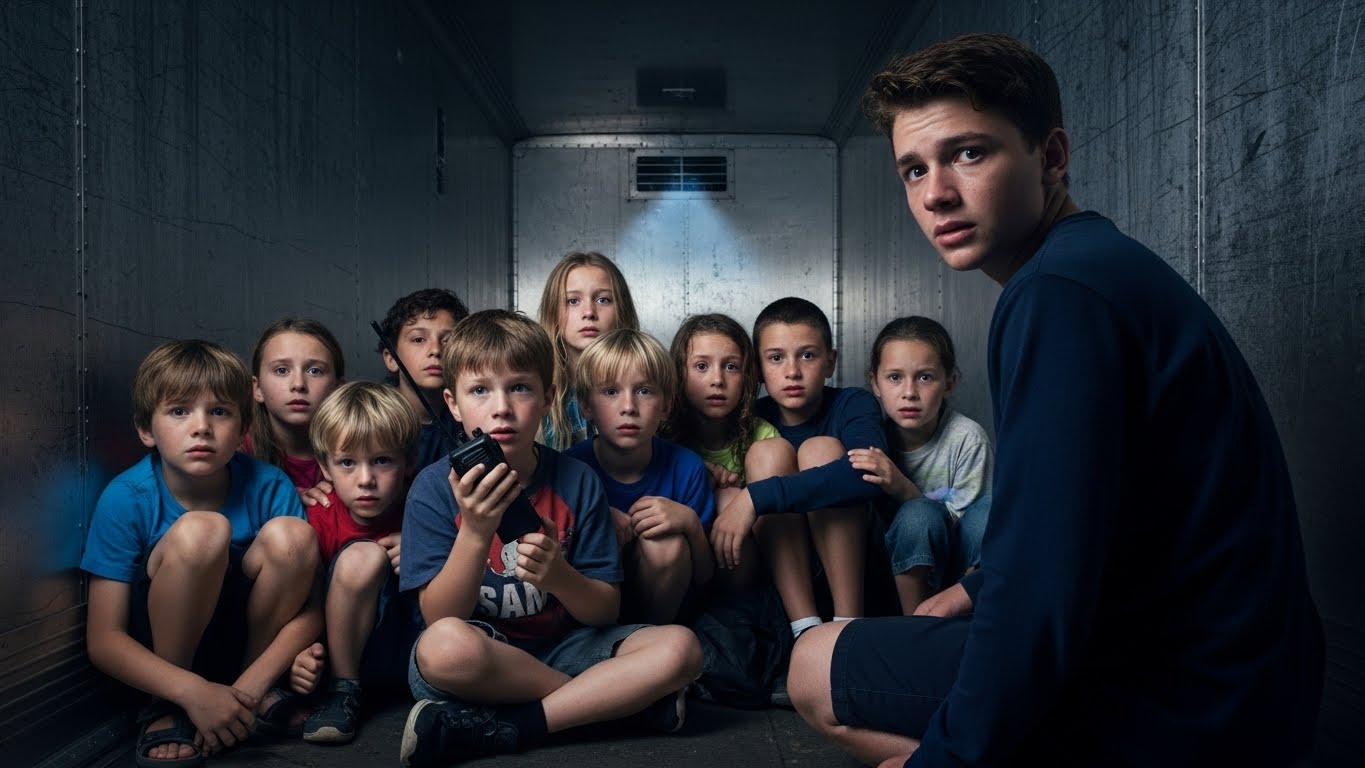
They were huddled together, maybe eight or ten of them, all young—some barely older than Sam—wrapped in thin, scratchy blankets, their faces pale and etched with silent terror. They didn’t cry. They didn’t speak. They didn’t move. They just stared into the darkness, wide-eyed, like startled deer caught in the headlights. The sweet, cloying smell I hadn’t been able to place suddenly made horrifying sense: it was a mixture of fear, cheap disinfectant, and the stale, desperate air of too many people confined in a small, cold space. The kind of smell you’d associate with trying to hide the unhideable.
And then, I saw him. Tucked into the back corner, his face streaked with dirt, his small body curled up, clutching his walkie-talkie like a sacred talisman.
Sam.
He was alive. But he was also one of them. He looked up, and his eyes, usually so full of light and mischief, were flat and dead. He didn’t even have the strength to look surprised. The reality of his terror had frozen him, turning his bright curiosity into a cold, paralyzing dread.
I whispered his name, “Sam!” It was a choked, desperate sound.
A small girl, maybe six, with her hair in messy pigtails, shushed me with an urgency that belied her size, placing a tiny, cold finger to her lips. Her eyes darted nervously. She pointed past me, to the front of the trailer, to where the cargo ended and another section began.
There was a divider, a thin, makeshift wooden panel blocking off a small forward compartment, positioned right behind the cab. It wasn’t a solid wall, but a cheap barrier designed to separate the main cargo from whatever was up front. From that compartment, I heard the sound that confirmed my worst nightmare, the sound that tied the children, the truck, and the men in the cab together in a chilling knot.
It was a woman’s voice, low, smooth, and utterly devoid of kindness. She wasn’t talking on a radio. She was talking to someone inside the trailer, just on the other side of the divider.
“Don’t worry, little bird. You’re almost at your new home. Just try to keep the others quiet. The boss expects a silent delivery.”
The voice had a chilling, predatory quality—a false lullaby meant to soothe and control. This wasn’t just a transport. This was a business. A horrifying, unspeakable business of moving stolen lives. And I was now a stowaway. An uninvited witness.
I looked at Sam, fear replaced by a burning, incandescent rage. I was here. I was with him. But now, my mission wasn’t just to save my brother. It was to save all of them. Every scared, silent child in that freezing compartment. And I had to do it from the inside of a moving coffin, without making a sound that would alert the woman, or the two thugs in the cab, that they had an extra passenger.
The truck sped up, the engine noise loud enough to drown out any quiet conversation. We were on the interstate, the rhythmic rumble of the tires on the asphalt a countdown to an unknown disaster, heading east, out of Pueblo and my old life, into the dark heart of the American night, toward a ‘delivery point’ I had no way of knowing. My story had become their story. And the nightmare had just begun. The silence of the children was more terrifying than any scream. They knew the rules of the truck. And now, so did I.
Part 2: The Moving Coffin
Chapter 3: The Code of Silence
The interior of the refrigerated trailer was a rolling tomb. The bitter cold, meant to preserve perishable goods, was now chilling human life. It didn’t feel like summer anymore; it felt like a January night on a lonely prairie road. I was shivering violently, not just from the temperature, but from the raw shock of what I was witnessing.
I crawled toward Sam, keeping my body low and moving only when the truck hit a rough patch of road, masking the faint scrape of my jeans against the metal floor with the louder vibrations. Sam was huddled with three other boys and a girl, all pressed against the farthest corner, away from the wooden divider.
When I reached him, I pulled him into a desperate, silent embrace. He clung to me, his small body shaking uncontrollably. He didn’t cry, though. The terror had been processed into a numb, stoic acceptance that was far more heartbreaking than tears.
“Alex,” he mouthed, his breath fogging the air between us. “You shouldn’t be here.”
“Where else would I be?” I mouthed back, forcing a small, tight smile that probably looked more like a grimace. “We’re a team, remember? Mission: Extricate. What happened?”
He couldn’t speak, not really. He communicated in frantic, whispered fragments, his eyes darting to the divider. The woman—The Handler—was silent for the moment, but the knowledge of her presence, separated by only a few feet of thin plywood, was an invisible electric fence.
Sam explained his failed reconnaissance. He had slipped in through the back door just as the children were being loaded. He’d planned to hide in the wheel well underneath the trailer, a terrible, desperate idea, but the guards had caught him right as the last child was ushered inside. Instead of killing him or leaving him behind, they had simply tossed him in with the others. “The Handler said he was a bonus,” one of the guards had reportedly smirked. Sam’s technical brilliance had accidentally made him a valuable piece of ‘merchandise.’
The other children, a collection of lost souls from across the American West—Nebraska, Wyoming, a couple from the outskirts of Denver—had been snatched or lured in different ways, but they all shared the same flat, vacant look. They were victims of a ruthless, organized network.
The girl who had shushed me, named Lilly, was the oldest, maybe twelve. She was the one holding the fragile ecosystem of silence together. She had fierce, dark eyes and an authority born of surviving the unimaginable. Lilly had been in the truck the longest—almost three days, she estimated. She explained the rules, her voice barely audible over the truck’s mechanical shudder.
“No noise,” she whispered, pointing to the roof. “She listens. She hits the wall if we talk. Loud enough for the driver to hear.”
“The cold,” I whispered, rubbing Sam’s arms. “How do you stay warm?”
Lilly pointed to the center of their huddle. “We share the blankets. And we move our feet. We can’t sleep for long. If we get too quiet, she checks.”
The small space near the front, separated by the partition, was where the Handler sat. Lilly said she used that area as a temporary holding cell, where she would occasionally tend to the children—giving them small sips of water, a few crackers, or, more terrifyingly, giving them “medicine” that made them “sleepy.” This was why they were so compliant, so eerily quiet. They had been drugged into submission.
I looked at my brother, relieved that he seemed relatively alert, but the relief was short-lived. We were in transit. The sheer scale of the operation hit me. This wasn’t a local, opportunistic crime. This was a multi-state run, crossing the vast emptiness of the plains, likely towards a major hub like Chicago or Dallas, where a stolen child could vanish completely. The truck felt like a metal artery, pumping lives toward a black market.
My mind raced. We had no phone signal. We couldn’t break out the back door while the truck was moving at highway speeds; it would be instant death, or worse, we’d be spotted immediately. The door was a one-way trip, a terrifying gamble that I’d only won because the driver was distracted and the latch wasn’t fully set.
“The Handler,” I mouthed to Lilly. “What does she do?”
“She sleeps sometimes. Up against the wall. She checks her phone a lot. She has a bottle of water and a bag of chips. She leaves the truck when they stop to refuel or change drivers. That’s the only time.”
My hope flared. A stop. A public stop was our only chance. If we could get the truck to stop not at a deserted warehouse, but at a busy travel center on the interstate, we could make enough noise to alert people. But how could we force a stop?
Sam tapped my arm urgently. He unclipped the walkie-talkie from his belt. It was wrapped in a piece of plastic wrap, still intact.
“The scanner,” he mouthed, his eyes blazing with the first spark of his old self. “It’s not just a walkie. I got their frequency. It’s an old military band they think is dead. They use it for short-range checks. I heard them talking about the T-8 code. It means Tollgate 8, the next checkpoint.”
He held up the walkie-talkie. It was our lifeline. It was our weapon.
“We can transmit,” Sam whispered, his voice trembling with a mixture of fear and adrenaline. “I can use their own system against them. I can fake an emergency. A re-route. Something to stop the truck in the open.”
The idea was insane. It relied on their men being disciplined enough to follow a coded, electronic command without question. But it was the only idea we had. It was a Hail Mary pass on the I-70.
I looked at Sam, then at the silent, terrified faces of the other children. They were waiting for me, the oldest, the newest arrival, to be their leader. I gripped the rusty pipe hidden beneath my jacket. It was time to stop thinking like a stowaway and start thinking like a tactical operative.
The engine roared, the truck shuddering as the driver downshifted to take an on-ramp. We were moving inland, away from the familiar mountains, deeper into the dark. We had to act before the next ‘Tollgate.’
I took the walkie-talkie from Sam. It felt cold, fragile, and impossibly heavy in my hand. “Show me the frequency,” I mouthed. Sam, ever the technician, quickly dialed in a sequence of numbers on the small digital screen, numbers that represented the secret frequency of our captors. The screen glowed a faint, sinister red.
We were going to hijack the Ghost Truck. From the inside.
Chapter 4: The Signal
The truck continued its relentless, monotonous churn eastward. The highway sounds were muted, swallowed by the thick walls of the refrigerated unit and the constant mechanical drone. We passed signs I couldn’t clearly read, a blur of neon and exit numbers that told me we were plunging deeper into Kansas now, the endless plains stretching out into a black horizon.
Lilly, always vigilant, signaled that the Handler was quiet. She was likely sleeping, slumped against the partition, relying on the drivers and the secure seal of the truck to do her job. This was our narrow window.
I crouched in the back corner with Sam, examining the walkie-talkie. It was a rugged, military-surplus model Sam had salvaged and modified with extra coils and a higher-gain antenna he’d rigged with a bent paperclip. It wasn’t just a toy; it was a ghost frequency transmitter.
“Their code,” I mouthed to Sam, “What are the common phrases? We need to sound official. Urgent.”
Sam pulled out a tiny, folded piece of paper from the cuff of his jeans—a final, desperate piece of evidence. It was his list of intercepted code words.
- T-X: Tollgate X (Checkpoint/Target location)
- P-3: Priority Three (Low-profile, no trouble)
- W-9: Warehouse Nine (Extraction/Load point)
- Z-1: System compromised/Halt all movement
- M-4: Maintenance/Mechanical failure
- R-2: Reroute immediate/Unscheduled stop
“We use Z-1 and M-4,” I whispered, the words scratching my dry throat. “But we frame it as an order from a higher-up, not a report from the driver. If the driver thinks they’ve been compromised, they’ll panic and run. If they think they’re following orders, they’ll stop and wait.”
We had to get them to stop in a place with people. A place with lights and witnesses. The most common place for a truck to stop on I-70 at this hour was a major travel center. I desperately needed to know where we were.
I risked a brief movement, standing up just enough to peer through the high, small vent near the roof. All I saw was a dark highway, the fleeting red and white taillights of other vehicles, and then, a massive, brightly lit sign flashing by—an oasis of chrome and diesel in the darkness.
“Flying J Travel Center. Next Exit.”
This was it. Our chance was not at the next deserted tollgate, but right here, at the most public, most American stopping point we could hope for. Truckers, travelers, families. Safety in numbers.
I looked at Sam. His eyes were wide but focused. The fear hadn’t left, but the fight was back. He knew the sequence.
“I need exactly two minutes of silence from the Handler after the truck stops,” I instructed Lilly, pointing to the partition. “Can you tell if she’s awake?”
Lilly nodded slowly. “She has a rhythm. When she wakes, she stretches, then she checks her phone. It takes thirty seconds.”
“Okay,” I breathed. “Sam, here’s the script. I’ll transmit the opening, you handle the technical details. You’re the code specialist.”
We formulated the fake order, carefully constructing the language to be brief, commanding, and bureaucratic, designed to appeal to the driver’s ingrained obedience.
The Script:
- Alex: “Attention Ghost Unit One, Priority. Repeat, Priority.” (The official wake-up call)
- Sam (via a pre-programmed, staticky click noise): (To simulate a bad signal/official key access)
- Alex: “Confirming code M-4 on Ghost Unit One. Mechanical failure detected. Z-1 protocol engaged. Route is compromised. Immediate R-2 to nearest secure, public refueling point for ‘maintenance.’ Await extraction team. Acknowledge and standby.”
The message was calculated to cause maximum controlled disruption. M-4 (Mechanical Failure) gave them a reason to stop. Z-1 (System Compromised) gave them a reason to fear stopping in the dark. R-2 (Reroute) and the instruction to stop at a “public” point were the crucial lies, designed to save us. They would stop, wait for the ‘extraction team’ (who didn’t exist), and believe the new orders came from a secure, remote boss.
I pressed the transmit button on the walkie-talkie. It felt like pressing the detonator on a time bomb.
I spoke, my voice low and authoritative, trying to sound like a tired operative in a distant, secure room, not a desperate teenager shivering in a refrigeration unit.
“Attention Ghost Unit One, Priority. Repeat, Priority.”
I felt the truck shudder. The driver must have adjusted the rearview mirror or grabbed the radio. The Handler remained silent, thank God.
Sam quickly toggled the switch for the pre-recorded static click, a digital burst of noise that sounded authentic and urgent.
Then, I delivered the command, injecting every ounce of urgency and cold professionalism I could muster. “Confirming code M-4 on Ghost Unit One. Mechanical failure detected. Z-1 protocol engaged. Route is compromised. Immediate R-2 to nearest secure, public refueling point for ‘maintenance.’ Await extraction team. Acknowledge and standby.”
I released the button. Silence descended, broken only by the engine’s drone and the hammering of my heart. The whole message had taken less than ten seconds.
We waited. Ten seconds. Twenty.
Suddenly, the engine noise changed. The truck slowed dramatically. The air brakes hissed, long and loud. The whole metal cavern vibrated as the driver slammed on the brakes. We were thrown forward slightly.
The truck was stopping.
Then, from the cab, a muffled, thick voice acknowledged the command. “Ghost One confirms M-4 and Z-1. Proceeding to nearest public for standby. Acknowledged.”
My plan had worked. I looked at Sam, his face illuminated by the faint red glow of the walkie-talkie’s screen. We had done it.
But the moment of triumph was annihilated by the sound of the wooden partition door sliding open with a sharp, grating noise. The Handler was awake. And she was coming to check on her ‘merchandise.’
Chapter 5: The Handler’s Eye
The grinding roar of the engine ceased with a final, jarring shudder. The truck had stopped.
The silence that followed was terrifying, amplified by the constant, aggressive hum of the refrigeration unit still running, fighting the heat of the Kansas night outside. I could feel the truck shift slightly as the driver and passenger exited the cab. The muffled thud of two heavy doors slamming shut felt like a judge’s gavel. We were exposed, parked right beneath the glaring, unforgiving fluorescence of a major American travel center. The light, leaking through the small vent, felt like a spotlight on a crime scene.
“She’s moving,” Lilly whispered, her eyes fixed on the thin, wooden partition.
The sliding door in the divider scraped open with a sound like fingernails on a chalkboard. I flattened myself against the wall, pulling Sam tighter into the huddle of children. The chill in the air suddenly sharpened.
The Handler stepped into the main trailer.
She wasn’t what I expected. No leather jacket, no scowl. She was mid-forties, wearing a plain fleece zip-up, sensible jeans, and tennis shoes. She looked like a tired mom on a road trip, utterly, chillingly normal. Her hair was pulled back in a neat ponytail, and she carried a small clipboard. This ordinariness made the horror so much worse—a monster wearing a costume of domestic normalcy.
She didn’t speak. She just stood there, letting her eyes sweep the cramped, dark space. The beam of her small, tactical flashlight was cold and hard, cutting across the terrified faces of the children. It paused on each one, performing a silent inventory.
I held my breath, tucking the rusty pipe beneath my chest. I was the largest target, and the hardest to hide. I squeezed my eyes shut, trying to mimic the vacant exhaustion of the drugged children. The cold was punishing, making my muscles seize up. I prayed the blood rushing in my ears wasn’t audible.
The flashlight beam landed on Sam. I felt my brother flinch slightly, despite his training in silence. His walkie-talkie, his only comfort and our only hope, was jammed deep into the waistband of his shorts, hidden by the thin blanket covering his lap.
The Handler took three steps closer. I could smell her now—cheap, sweet hand lotion and stale cigarettes. She stopped right next to me. If she had reached out, her foot would have connected with my elbow.
She knelt down beside the huddle. Her voice, when she finally spoke, was that same soft, predatory lullaby I’d heard earlier, pitched just above a whisper.
“Looks like we’re taking a break, little birds,” she cooed, her hand reaching out, not to comfort, but to count. She ran her fingers across the top of one boy’s head, then moved to the next. “A little unexpected maintenance. Don’t worry. Boss says it’s all fine. Just a quick check-up.”
Her hand hovered over Lilly, then moved past her, touching the shoulder of the girl next to her. She was counting them, one by one, methodically checking to ensure the ‘cargo’ was complete and quiet.
As she moved past the children, her eyes, sharp and calculating, fell back to Sam. She paused. I felt a spike of pure, raw panic.
She squinted. “Where is that little gadget you were playing with, spacer? The walkie-talkie.”
Sam remained utterly still, his eyes blank. Lilly, with astonishing quickness, leaned into Sam, feigning a sudden, involuntary shiver, her head momentarily blocking the Handler’s direct line of sight to his waist.
The Handler frowned, momentarily distracted by the subtle movement. She sighed, her patience clearly thin.
“Don’t worry,” she muttered, not to Sam, but to herself. “I’ll find it when we get where we’re going. You won’t need toys then.”
She stood up, her attention already shifting back to the external world, the brief scare forgotten. She was halfway back to the partition when the muffled sound of a phone ringing came from the other side of the dividing wall. It was her cell phone, which she had clearly left in her compartment.
She cursed under her breath, a sharp, unprofessional sound.
Before she could retrieve the phone, a voice—one of the drivers—shouted from outside the truck, close to the cab.
“Hey, we’re leaving to grab some coffee and call the central line! We’re too exposed out here! You stay put and keep it quiet!”
“No, wait!” the Handler called back, her voice raised slightly, but they were already gone, the sound of their heavy footsteps fading toward the brightly lit entrance of the travel center.
The Handler looked back at the children with a furious scowl, frustrated by the lack of discipline and the forced stop. She clearly didn’t want the drivers to overhear her talking to the “boss.”
“Fine,” she spat. “Be quiet. I have to go call this in privately. Don’t move.”
She retreated into the partition compartment, grabbed her phone and a small, worn handbag. I heard a metallic click—the sound of the lock engaging on the thin wooden partition door. She was locking herself out of the children’s compartment, sealing us in, but also sealing herself off from us.
Then, the main cab door opened and slammed shut again. I heard the faint, tell-tale sound of a small deadbolt being thrown. She was locking the access door between the cab and the refrigerated unit too. She was securing the truck, locking everything in place, believing the children were too cold, too drugged, and too scared to move.
Finally, the click of a third door, the passenger door of the cab, then the fading sound of her footsteps retreating into the cacophony of the truck stop.
She was gone. For now.
I waited five seconds, then ten. The silence was absolute. I looked at Lilly, who gave me a sharp nod.
“Now,” I mouthed.
The truck was parked. The drivers and the Handler were outside, preoccupied with the fake ’emergency’ we had fabricated. But we were still trapped inside a freezing metal box, locked into place like frozen cargo. Our success in stopping the truck had only bought us minutes, not freedom.
I had to get through that partition. And then I had to get through the back door. The rusty pipe was useless against the partition’s cheap, internal lock. I needed Sam’s ingenuity, and fast. The brightly lit world of the Flying J was mere feet away, separated by thick metal and two crucial locks.
Chapter 6: The Dash for Freedom
The immediate pressure of the Handler’s presence was gone, replaced by the acute, ticking pressure of time. Every second counted. I didn’t know if the drivers were grabbing a quick snack or making a long-distance call to the actual boss. We had minutes, maybe less.
“The lock,” I whispered to Sam, pointing to the partition door. “It’s a simple spring latch, but it’s bolted to the door frame.”
Sam immediately understood. He carefully unwrapped the plastic from his walkie-talkie. This wasn’t just a communication device; it was a toolkit disguised as a toy. He popped the plastic casing off the antenna base, exposing a small, sharp piece of brass wiring used to stabilize the high-gain coil.
“I can pick it,” he whispered back, his breath ragged. “It’s a basic hotel room lock mechanism. Cheap security.”
He worked with the focus of a surgeon. His small, cold fingers were surprisingly nimble. The brass wire was inserted into the keyhole. We were only inches from the Handler’s compartment, and from the sounds of the active truck stop outside—the distant beep of a reversing truck, the loud chatter of a group of travelers. The noise of freedom, so close, yet so locked away.
One of the younger girls, maybe seven, started to whimper, the cold finally overwhelming her drug-induced stupor. Lilly quickly moved, pulling the thin blanket over the girl’s head, shushing her fiercely. The tension in the trailer was so thick it was physically painful.
Click.
Sam pulled the brass wire out. The lock had sprung. He looked up at me, a flash of pride and terror warring in his eyes.
I pushed the thin wooden door open just an inch, peering into the compartment. It was even smaller than I imagined—just a bench seat, a few blankets, and a small area for storage. The Handler’s handbag was sitting on the bench.
I slipped inside, leaving Sam and Lilly to guard the other children. The compartment was warm, relative to the trailer, and the smell of cigarettes and cheap coffee was strong.
I lunged for the handbag, opening it with shaking hands. Inside, I found exactly what I needed: a small burner phone, a thick, greasy wallet stuffed with cash (hundreds of dollars—clear evidence of their illegal operation), and the Holy Grail: a key ring. It was heavy, containing five keys, one of them a massive, silver padlock key.
I grabbed the keys, the burner phone, and as an afterthought, I tore open a sleeve of crackers and an unopened bottle of water from her supply bag, tossing them back to Lilly and Sam. Sustenance and survival.
I retreated, locking the partition again, this time with the Handler’s key. This bought us a few extra seconds of misdirection.
“Okay,” I mouthed, holding up the heavy silver key. “This is for the back door. We go all at once. Lilly, you get the little ones. Sam, you’re the last one out. Go for the nearest bright spot, scream for help, and don’t stop running.”
The truck’s refrigeration unit suddenly stuttered, the loud clunk momentarily silencing the interstate noise. The maintenance code we had faked might be causing a real electrical failure. The distraction was perfect, but the opportunity was about to vanish.
From outside, I heard the faint sound of the cab doors slamming shut again, followed by hurried, heavy footsteps approaching the side of the truck. They were coming back.
The drivers were returning. And the Handler wouldn’t be far behind.
I didn’t hesitate. I shoved the key ring in my pocket, grabbed the rusty pipe, and moved to the back of the trailer. I had to use the small internal handle to open the rear door just enough to insert the key into the external padlock.
I cracked the door, peering out through the sliver of space. The parking lot was a blinding spectacle of light. Truckers milling about, families getting gas, the low, comforting drone of ordinary American life.
I fumbled with the key, my hands slick with cold sweat and fear. The air brake lines and the massive locking mechanism were right there. It took two terrifying attempts, but on the third try, the key slid home.
I twisted it sharply. CLANK. The huge steel padlock on the back of the Ghost Truck opened.
I pulled the key out, my breath catching in a silent sob of relief and terror. We were one move away from freedom.
I turned back to the children, my eyes burning with a desperate intensity. “Now! Go! Run!”
I threw open the rear door with a deafening screech of metal hinges. The bright, glorious light of the Flying J parking lot flooded the dark, frigid compartment.
It was absolute chaos. The children, initially hesitant, were propelled forward by Lilly and Sam. They stumbled out of the cold trailer, thin blankets slipping from their shoulders, gasping for the warm, humid air.
I was the last one out, standing on the ramp, the cold metal pipe held high. I slammed the door shut behind me—not to lock it, but to buy a fraction of a second of confusion.
The children, ten small, disoriented figures, sprinted into the light, headed straight for the glass doors of the travel center, screaming.
“HELP! POLICE! WE’RE TRAPPED!”
The sound of their desperate, unified cries cut through the low noise of the parking lot like a siren. Heads turned. Truckers stopped their conversations. A woman getting gas dropped her nozzle.
We had created the necessary disruption. But the drivers were already running toward us, fury contorting their faces.
“HEY! Get back here!” one driver roared, lunging past the cab.
I stood my ground, my heart a frantic drum solo. I had to hold them off just long enough for the children to reach safety. I raised the rusty pipe, the only thing separating the children from their captors.
The first driver, a huge man with a shaved head, reached me first. His momentum was terrifying.
“You ruined the shipment, kid!” he bellowed, his fist drawn back.
I swung the pipe, not caring where it landed. Survival was primal.
Chapter 7: The Scramble in the Light
The driver was a mountain of muscle and rage. He was on me before I could react fully, fueled by the shock of losing his ‘shipment.’ My swing with the rusty pipe was clumsy and desperate, connecting with his shoulder instead of his head. The impact jarred my teeth, but it bought me a split second. The man stumbled back, roaring in pain and surprise, his eyes blazing with murderous intent.
“You little punk! You just signed your death warrant!” he bellowed.
But that split second was all the children needed. They were sprinting now, their small figures dissolving into the bright light and confusion of the travel center. Their screams were relentless, piercing through the ambient noise—a collective siren calling for help.
From around the corner of the truck’s cab, the other two materialized: the second driver, leaner and faster, and the Handler.
The second driver immediately targeted me, tackling me low and hard. We hit the asphalt with a sickening crack. The rusty pipe clattered away, sliding under a nearby parked tractor-trailer. I felt the breath explode from my lungs. He slammed my head against the ground once, twice, the taste of blood filling my mouth.
“The key!” the driver snarled, his face inches from mine. “Where’s the key, you little thief?”
Meanwhile, the Handler, seeing her merchandise scattered, ignored me. She zeroed in on the leaders: Lilly and Sam, who were nearing the main entrance doors, trying to pull the smaller children along. She was screaming, not in anger, but in a false, panicked tone designed to sound authoritative.
“Those are runaways! They are my children! Stop them! They’re sick!”
But the truckers and travelers weren’t fools. The sight of ten terrified, half-frozen kids stumbling out of the back of a refrigerated truck told a different story. A burly man with a reflective vest—a trucker grabbing a late-night coffee—stood blocking the entrance, his hands raised in a calming, non-threatening gesture toward the children, but his stance clearly defying the Handler.
“Stay back, lady,” the trucker commanded, his voice deep and steady. “Let the kids go. We’re calling the police.”
The Handler’s composure snapped. She lunged, trying to bypass the trucker to grab Lilly. This diversion gave me a chance. The driver straddling me was focused on pinning me down, his knee grinding into my ribs. I lashed out with my heel, kicking his knee sharply. He yelped and shifted his weight.
I used the opportunity to snake my hand into my pocket. My fingers closed around the burner phone I’d stolen. I didn’t have time to use it. I had to create chaos.
With a surge of adrenaline, I shoved the phone, hard, under the dual tires of the truck. Crunch! The sound was loud and sickening, the plastic casing shattering. It was a pathetic, futile act, but it drew the attention of the first driver, who was now stumbling toward the commotion, trying to chase down the children.
The first driver stopped, staring at the ruined phone, then back at me. He realized the extent of the evidence I had destroyed or, worse, gathered. The mission was secondary; silencing me was now primary.
He abandoned the children and charged.
Just as the second driver lifted his fist for a final, heavy blow, and the first driver closed the distance, a new figure entered the fray. It was the trucker who had blocked the Handler, now sprinting from the entrance with a speed that belied his size.
“HEY! Get off the kid!” the trucker roared, tackling the second driver off me with the force of a freight train. They went down in a tangle of limbs and diesel fumes.
The fight had shifted from a private execution to a public brawl.
The Handler, recognizing the situation was spinning irreversably out of control, abandoned her pursuit. She shouted toward the cab, her voice strained and sharp. “Abort! Abort! Get us out of here!”
The first driver, seeing the overwhelming attention, the gathering crowd, and the intervention of the massive trucker, hesitated. He looked at me, lying there bruised and bleeding, and spat on the ground. He knew he was beaten for the night.
The two drivers scrambled back toward the cab. The Handler, her face a mask of cold fury, paused for one last, terrifying moment. She looked past the gathering crowd, past the screaming children, straight at me. She didn’t look angry; she looked like a scientist who had lost a crucial sample.
She pulled something small and metallic from her pocket—a knife, short and wicked. She stalked toward me, completely focused on eliminating the witness.
“You don’t talk, kid,” she hissed, her voice low and chillingly calm. “You disappear. Just like your little brother should have.”
Before she could take another step, a siren wailed—not an emergency vehicle, but a local police car rounding the corner into the travel center, drawn by the panicked 911 calls. The lights were blinding.
That was the final signal. The Handler cursed, jammed the knife back into her pocket, and scrambled into the passenger seat of the truck. The first driver didn’t bother opening the door; he simply floored it.
The Ghost Truck roared to life, tires spinning and spitting gravel, tearing out of the Flying J parking lot, leaving ten saved children, three stunned adults, and one battered, victorious teenager behind. They were gone, but the truck was now compromised, its description broadcast across every state line.
I lay on the cold asphalt, the bright lights overhead blurring into a halo. The trucker knelt beside me, his hand checking my neck.
“You’re alright, son. You’re safe. What in God’s name was in that truck?”
I didn’t answer. I just pushed myself up on one elbow, ignoring the screaming pain in my ribs, and searched the crowd. I was looking for two faces: my brother, Sam, and the brave girl who led the way, Lilly.
I saw Sam first, clinging to Lilly near the main entrance, watching the retreating taillights of the truck. He looked small, terrified, and unbelievably brave. We were alive. We had won. But the cold, dark reality of what we had faced settled over me like a shroud.
Chapter 8: The Echo of the Nightmare
The Flying J Travel Center quickly transformed from a pit stop into a central command post. Within minutes, the local Sheriff’s Department arrived, followed rapidly by the Kansas Highway Patrol. The sight of the ten disoriented, frightened children, huddled together and wrapped in emergency foil blankets supplied by a compassionate employee, brought immediate gravity to the scene. Within the hour, the heavy hitters arrived—unmarked SUVs carrying agents from the FBI’s Human Trafficking Task Force, their faces grim and professional.
I was moved from the rough asphalt to the back of an ambulance, where a kind paramedic checked my concussion and my undoubtedly bruised ribs. My clothes were stained with oil, dirt, and my own blood, but my hands, thankfully, were empty of the rusty pipe. All I could focus on was the sound of Sam’s voice.
I found him sitting on the bumper of a patrol car, surrounded by FBI agents who were trying to gently piece together his account. Lilly sat beside him, her small hand firmly gripping his, her eyes still watching the darkness as if the Handler might materialize from the shadows.
When Sam saw me, he broke away from the agents. He ran, throwing his arms around my waist. This time, he cried. Hard, ragged sobs that shook his entire body, releasing the terror he had held back for two endless nights.
“Alex! I thought… I thought they had you, too,” he choked out.
I held him tight, fighting back my own tears. “Never, Sam. Never. You’re safe. We’re safe. You saved everyone.”
He shook his head, looking at Lilly. “We helped. But you stopped the truck. You were the Z-1. You were the boss.”
Lilly, standing a little apart, looked at me with a rare, genuine smile. “Thank you, Alex,” she whispered. Her gratitude was the only reward I needed. She, along with the others, would be taken into protective custody, their journey ending in a police car, but toward a new life, not a forced one.
The FBI agents immediately understood the significance of the stolen keys and the shattered burner phone. The truck itself, its refrigerated interior serving as a horrifying testament to the crime, provided irrefutable evidence. The forced stop and the public disruption had not only saved the children but had ripped a hole in the infrastructure of a major trafficking network. They had been forced to abandon their cargo and flee, leaving behind vital DNA, fingerprints, and, most importantly, the clear identity of the vehicle.
The most difficult call came around dawn. The FBI allowed me to use a secure line to call my mom, who was hours away in Pueblo, hysterical with fear.
“Mom,” I managed, my voice hoarse. “We’re okay. Both of us. We’re in Kansas. It’s over. Sam is safe.”
I couldn’t tell her the full story—not yet. I just told her that Sam had been taken and I had followed. She cried, shouted, and demanded to know how two kids ended up on the side of I-70, but the overwhelming relief silenced her questions. An FBI escort was arranged to bring her to us immediately.
The investigation would continue for months, tracking the Ghost Truck across state lines, chasing down the leads from the keys and the Handler’s identity. We were instrumental in dismantling a significant piece of their operation.
But the physical evidence was nothing compared to the echoes of the nightmare. I still felt the bone-deep cold of the refrigerated unit. I still heard the Handler’s cold, smooth voice. And I still saw the faces of the children, silent and terrified, huddling for warmth under the blinding lights of the truck stop.
We were told we were heroes—the teenage boy who became a ghost to save his brother and a group of forgotten kids. But I didn’t feel like a hero. I felt like a survivor. I was just Alex, a kid from Pueblo who knew what it felt like to be ignored.
Sam’s walkie-talkie, his magical device that opened the door to a dark reality, was now in the hands of the FBI, a piece of crucial evidence. But the memory of his courage, his technical brilliance, and his stubborn refusal to ignore a quiet tragedy was what I carried with me.
The scars, both physical and invisible, were permanent. I would never look at a white box truck the same way. I would never hear a truck stop idling without feeling a chill.
But every time I saw Sam smile that real, deep-down smile again—a smile that only came when he knew he was truly safe—I knew the price of the fight had been worth it. We had slipped into the darkness and emerged into the blinding, blessed light, carrying the fragile hope of ten stolen lives with us. And we would never be silent again.