The 55-Year-Old Lie: Revered Judge Exposed as Bullying Accomplice by 73-Year-Old Teacher in High-Stakes Testimony
Chapter 1: The Echo of Broken Glass
Mr. Elijah Thorne, a man whose spine was less a column of bone and more a ledger of regrets, sat meticulously grading papers in his silent, book-lined sanctuary. At seventy-three, he was an institution at Northwood High, his classroom a revered space where the wisdom of Dickens and the sorrow of Hemingway hung as thick as the scent of aged paper. Yet, for all the literature he taught, his own life was a novel he’d refused to finish, its defining chapter sealed by a moment of crippling shame five and a half decades earlier.
The afternoon sun, filtering through the tall, arched windows of Room 205, illuminated the dust motes dancing in the air, each one a tiny phantom of the past. Elijah ran a trembling hand over the worn cover of To Kill a Mockingbird, a text he taught every year, its themes of moral courage and silent complicity a constant, agonizing mirror to his soul. He was respected, yes, but emotionally distant. His gentle demeanor masked a deep, entrenched fear: the terror of conflict, the paralyzing dread of being seen, truly seen, in a moment of utter vulnerability.
Lately, that well of old pain had been stirred by a current student, Ethan. Fifteen, quiet, and possessing a sensitive intelligence that made him an easy target, Ethan was becoming increasingly isolated. Elijah had watched the familiar, insidious pattern unfold: the subtle, cutting jokes; the sudden, silent exclusion; the way Ethan’s shoulders seemed to draw inward, trying to become invisible. The lead orchestrator of this sophisticated cruelty was Lucas Sterling, sixteen, handsome, charismatic, and from a family whose name—and money—carried significant weight in the community. Lucas didn’t use crude fists; he wielded psychological precision, turning social pressure into a weapon.
The atmosphere in class that Tuesday was unusually thick. Elijah was delivering a lecture on the tragic flaw in Shakespeare, but his gaze kept drifting to Ethan, who sat rigidly at his desk, his eyes fixed on the floor. Lucas, sitting two rows over, wore a mask of polite attentiveness that Elijah knew was a lie.
The clock on the wall ticked toward the dismissal bell, and Elijah was just summarizing the concept of hamartia—the fatal flaw that leads to a hero’s downfall—when the incident, the moment that would shatter his lifelong commitment to non-intervention, occurred.
“Mr. Thorne, sir,” Lucas called out, his voice smooth and respectful, drawing all attention. “Ethan here was just showing me how good he is at impressions. Specifically, a… prayerful one.” He smiled, but his eyes were cold.
Ethan flushed a deep crimson, stammering, “I—I don’t know what he means, Mr. Thorne.”
Lucas laughed, a light, dismissive sound. “Oh, come on, Ethan. The one you did for us in the hall. You know, the one where you get down on your knees and beg for a passing grade?” He leaned down and, with a swift, theatrical flourish, pulled a small, colorful, Persian-style rug from beneath his desk—a rug that had mysteriously appeared in the room just that morning. He then kicked the rug toward Ethan’s feet.
“Do it, Ethan,” Lucas whispered, but the whisper carried to every corner of the suddenly hushed room. “Or you can explain to everyone why you were crying in the bathroom yesterday.”
Elijah felt a cold, paralyzing dread seize him, a sensation so familiar it was like an old, unwanted friend. The classroom had warped, the faces blurring. This wasn’t happening in 2025; it was happening in 1970. He wasn’t Elijah Thorne, the revered teacher; he was Eli, the shy, bookish boy pinned against a locker, a boot pressed against his cheek.
He saw the fear in Ethan’s eyes, the moment the boy’s will broke. Ethan, desperate to end the spotlight and the inevitable social execution, closed his eyes and began to sink to his knees on the rug.
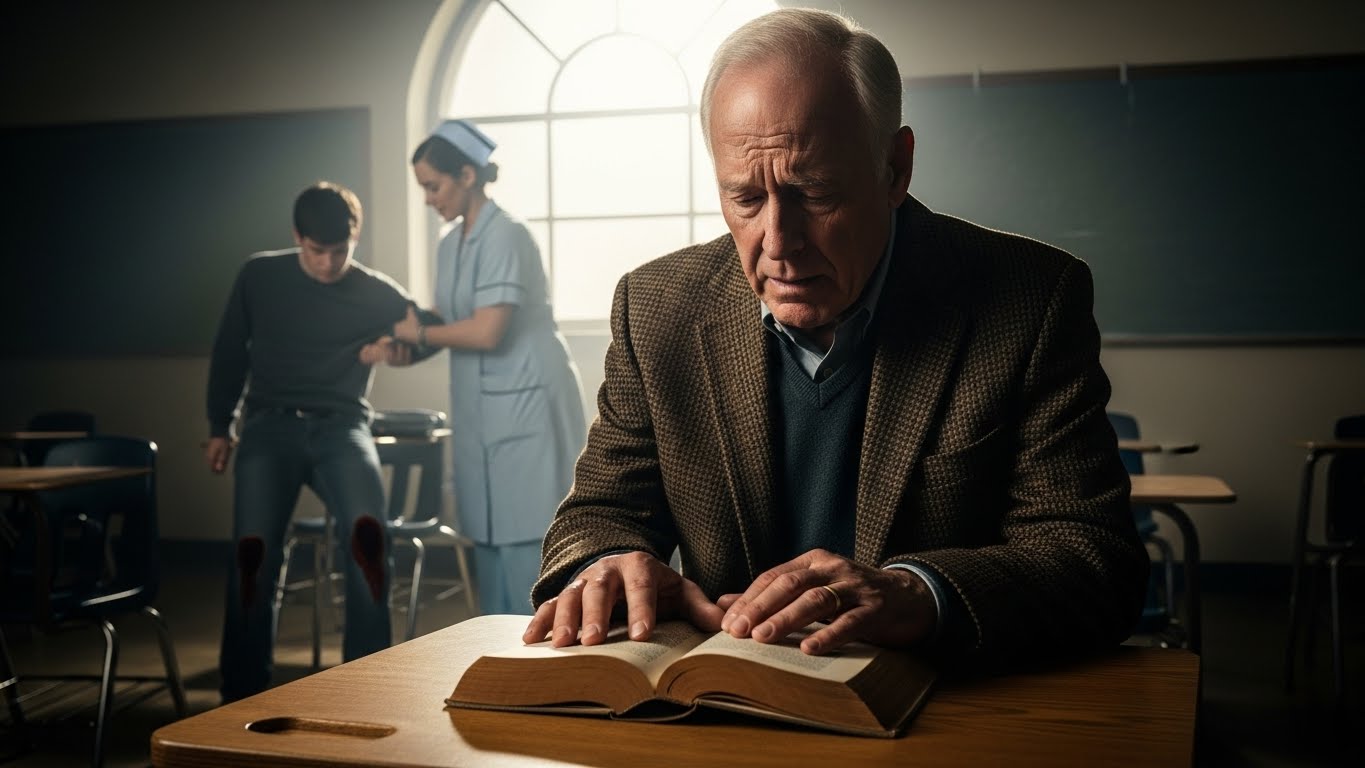
Then, a girl in the front row gasped. A sound like grinding grit cut through the silence as Ethan’s knees made contact with the thin carpet. Lucas had orchestrated this with chilling precision. Underneath the rug, Elijah realized with a sickening lurch, the boy had scattered fragments of broken ceramics—a shattered decorative plate, its edges razor-sharp. It wasn’t just a prank; it was a cruel, calculated act of physical pain masked as a social joke.
Ethan let out a sharp, choked cry, instantly pulling his knees up, but a dark stain was already spreading through the fabric of his jeans. The other students, who moments before had been watching in a horrified silence, were now utterly paralyzed. They were afraid of Lucas, yes, but more deeply, they were afraid of social exile, of being the next target. In their fear, Elijah saw a terrifying reflection of the terrified, silent faces that had watched his own shaming decades ago.
Mark O’Connell. The name was a silent scream in Elijah’s mind. He saw his own classmate, Mark, his best friend, in the crowded corridor, watching as the brute forced young Eli to kiss his muddy boot, not stepping forward, not saying a word. In that paralyzing moment of dual trauma, Elijah’s body failed him. He froze. He saw young Mark’s face superimposed on the faces of his current students—the students who stood by and did nothing.
The frozen moment lasted only an instant in reality, but an eternity in Elijah’s mind. When he finally moved, it wasn’t with the decisive, thunderous rage of a protector. It was a late, passive, and utterly inadequate intervention.
“Lucas, that’s enough!” Elijah’s voice was strained, too high. He rushed forward, pushing Lucas gently aside. His priority wasn’t to condemn, but to contain. He knelt beside Ethan, his own hands shaking as he helped the boy to stand. “Ethan, come with me. We need the nurse. Now.”
He failed to fully condemn Lucas. He failed to mete out justice in that moment. He merely escorted the bleeding, humiliated boy out of the room, leaving the ringleader, Lucas, standing there, a smirk just visible on his lips. Lucas had won. And Elijah had, once again, chosen silence over action. His hamartia—his fatal flaw—had just cost another boy his dignity and his physical safety. As he walked Ethan, leaning heavily against him, down the long, empty hallway toward the nurse’s office, the only sound was the hollow echo of their footsteps and the silent, deafening judgment of his own failure.
The nurse, Mrs. Peterson, a brisk woman with the comforting practicality of a seasoned veteran, cleaned the lacerations on Ethan’s knees. The broken ceramic had cut deep, and the sight of the boy’s involuntary tears—tears of pain and profound mortification—only deepened Elijah’s guilt. He had been a hero of words, but a coward of action.
Later that evening, in the sterile, fluorescent-lit office of Principal Howard, Elijah gave his statement. The room was tense, filled with the palpable anxiety of an administration trying to manage a crisis. Ethan’s parents, Mr. and Mrs. Miller, were there, their faces drawn with a mixture of outrage and exhaustion. Lucas’s father, Mr. Sterling, a man whose tailored suit seemed to contain the entire school budget, stood beside his lawyer, radiating quiet, contemptuous power.
Principal Howard was sweating, dabbing his forehead with a monogrammed handkerchief. “Mr. Thorne, as the sole faculty witness, your testimony is crucial. We must be… judicious in our approach.”
Mr. Sterling leaned forward, his voice low and smooth. “Elijah, we all respect you. Lucas assures us it was a misunderstanding, a youthful prank gone awry. We’re prepared to cover all medical costs, of course. Perhaps a simple suspension, and we put this behind us. Wouldn’t you agree, an overreaction serves no one?”
Elijah felt the familiar pressure, the gravitational pull toward the path of least resistance. He looked at Mr. Sterling, then at the tear-streaked face of Ethan’s mother. The words lodged in his throat. He saw Mark O’Connell’s face again—that look of resigned indifference from fifty-five years ago. The desire to avoid conflict, to protect his reputation, his pension, his peaceful existence, was a powerful, physical force.
“I… I saw an incident,” Elijah said, his voice barely a whisper. He carefully omitted the deliberate placement of the broken glass. “A piece of ceramic had somehow been placed under the rug. Lucas… he encouraged Ethan to kneel on the rug. It was a very unfortunate… accident.”
“Accident,” Mr. Sterling affirmed instantly, locking eyes with Elijah. “Thank you, Elijah. We appreciate your objective honesty.”
Elijah’s statement was vague, protective, and ultimately, a lie of omission. He had cited a fear of “libel and professional repercussions”—the administration’s whispered worry—as his desperate excuse. In reality, it was the old, poisonous fear: the fear of facing down power, of being targeted, of re-living the shame. He had failed Ethan again. He had chosen the silence of the witness box over the courage of the moment. He walked out of the principal’s office that night, not a revered teacher, but a haunted man, his heart echoing with the metallic clink of broken glass. The memory of Mark O’Connell’s silent betrayal had consumed him, making him a ghost of his own trauma.
Chapter 2: The Silent War
The days following the incident at Northwood High were steeped in tension. The official narrative, carefully crafted by the administration under the heavy, silent hand of the Sterling family’s influence, was that of a “misguided, unfortunate prank” that had resulted in “accidental injury.” Lucas received a brief, two-day, in-school suspension—a slap on the wrist that served only to embolden him and further outrage the Miller family and a growing faction of the community.
Elijah Thorne returned to his classroom, but the sanctuary felt compromised, the air thick with the knowledge of his failure. Students avoided his gaze, sensing the fracture in his moral foundation. He was a teacher of moral courage who had demonstrated moral cowardice. He tried to immerse himself in the timeless prose of his lessons, but every discussion of ethical responsibility or the high cost of apathy felt like a hypocritical pronouncement.
The tension escalated when Principal Howard, looking more defeated than ever, called an emergency faculty meeting. He announced that due to the public outcry and the potential for a lawsuit, the School Board had decided to launch an independent, impartial investigation. A special committee would be formed, led by a highly respected member of the community.
Elijah listened, bracing himself for the predictable bureaucratic maneuvering, but the Principal’s next sentence struck him with the force of a physical blow, vaporizing the remaining air in his lungs.
“…and to ensure the integrity of the process, the committee will be chaired by the Honorable Judge Mark O’Connell.”
Elijah’s world tilted. Mark O’Connell. Now Judge O’Connell, a successful, high-profile figure, a community pillar whose portrait adorned the wall of the Town Hall. The man who was once his best friend, the boy whose quiet, terrified inaction had stood as a monument to Elijah’s lowest point. The ghost of 1970 had not just been sighted; he had been appointed to preside over the very trauma he once facilitated by his silence.
Elijah felt a sudden, profound nausea. The injustice was breathtaking. The man who had stood idly by as a system of cruelty crushed a boy—the same man was now being tasked with investigating a modern-day recurrence of that very cruelty. O’Connell was not just protecting Lucas; he was actively trying to maintain the entire corrupt system of silence that had nearly destroyed their youth.
The confrontation was inevitable, and it came swiftly. Two days later, Elijah received a polite but firm summons to meet with Judge O’Connell in the School Board office downtown.
The office was modern and cold, all glass and polished mahogany. Mark O’Connell, though heavier and silver-haired, possessed the same sharp, calculating eyes and the same controlled posture Elijah remembered. He wore his success like a coat of armor. He rose and extended a hand, his smile practiced and empty.
“Elijah. It’s been… too long,” Mark said, his voice smooth, carrying the weight of the courtroom.
Elijah took the hand, the contact sparking decades of repressed bitterness. “Mark. I didn’t realize you were involved in the board’s activities now.”
“I’m serving the community, Elijah. Just like you,” Mark replied, gesturing for Elijah to sit. The small talk was excruciating, a thin veneer stretched over a gaping chasm of unspoken history. They spoke of the investigation, the “sensationalism” of the media, and the need for “discretion.”
Mark then leaned back, his tone shifting, becoming subtly coercive. “Now, about young Ethan. I’ve read the initial report. And your statement. It was, shall we say, admirably cautious.”
“I stated what I saw,” Elijah said, his voice clipped.
“Yes, an unfortunate accident with some ceramic fragments. Good. Very clear. You know, Elijah, we have to be practical here. Lucas Sterling’s family is… influential. A protracted legal battle would cripple the school, jeopardize funding, and drag us all through the mud. You have a pension to protect, a career that is the envy of many. You’ve given your life to this school.”
Mark steepled his fingers, his eyes boring into Elijah’s. “We need to handle this quietly. A firm, private counseling session for Lucas, a generous settlement for the Millers, and we move on. You simply need to maintain your original testimony. It was an accident. Right?”
Mark O’Connell’s face was the very picture of civic responsibility, yet his words were the sound of an iron door slamming shut on justice. This was the silent war. Mark wasn’t asking him to lie; he was asking him to conform, to maintain the system that had allowed a bully to thrive and a good boy to suffer. He was asking Elijah to reenact their shared tragedy, with Mark himself playing the role of the enforcer of inaction.
“Boys will be boys, Elijah,” Mark said, a faint, chilling echo of the past. “We both know how these things go. Sometimes, you just have to weather the storm.”
“I remember weathering that storm, Mark,” Elijah responded, the words coming out flat and cold, breaking the years of silence between them for the first time. “I remember the price of weathering it alone. And I remember who was standing on the sidelines.”
Mark’s composure wavered, a flicker of genuine alarm crossing his face. “Elijah, we were children. It was fifty-five years ago. You must let that go. We are adults now, serving a greater good. Don’t be rash. Don’t let old wounds dictate your professional judgment.”
“My professional judgment is dictated by the principles I teach,” Elijah retorted, standing up. “Justice, courage, and integrity. Principles that seem to be on trial here, Mark, not just a boy.”
He left the office then, not waiting for a reply, the silence of the room heavier than any argument. As he walked out into the cold downtown air, Elijah knew two things: Mark O’Connell was terrified of the truth, and this investigation was anything but impartial. He had to choose: his comfortable silence, or the painful, risky path of moral courage. The time for apathy was over. The ghost of 1970 was demanding a reckoning.
The next few days were a crucible for Elijah. He taught his classes, but his mind was elsewhere, rehearsing the confrontation, the words he needed to say, the cost of saying them. He had a lifetime of fear to dismantle, a structure built on the foundation of Mark’s silent betrayal.
He spent an entire evening looking at his old school yearbook. There he was, young Eli Thorne, smiling nervously. And there was Mark O’Connell, with his confident, boyish grin. A note was scrawled beneath Mark’s photo: “Best of friends. Always have your back, pal.” The hypocrisy was a fresh, searing pain.
He called an old friend, a retired colleague named Agnes. He didn’t mention Mark by name, but he spoke obliquely of a past trauma and a current injustice.
Agnes, whose wisdom was as sharp as her wit, listened patiently. “Elijah,” she said gently, her voice crackling over the phone. “You spent your life teaching the courage of Atticus Finch. But Atticus didn’t just teach it; he did it. He spoke the truth, even when the whole town was against him. You’re being asked to choose between your comfort and your soul. And at our age, old friend, the soul is the only thing we have left to save.”
Her words cut through his rationalizations. He wasn’t just saving Ethan; he was saving the frightened boy inside himself. He needed to break the cycle. He needed to speak the word that Mark had failed to utter, the word that would have saved young Eli: No.
The morning of the School Board hearing dawned gray and overcast, fitting the mood of impending storm. The auditorium, usually reserved for school plays, was packed. The School Board members sat on the stage behind a long table, with Judge Mark O’Connell seated prominently in the center, his expression one of sober, controlled authority.
Ethan and his mother, Mrs. Miller, sat in the front row. Ethan was pale, nervously twisting his hands, but his mother sat with a fierce, quiet dignity. Elijah caught her eye and nodded, a silent promise in the gesture.
Elijah was scheduled to testify early. He had prepared two statements: the vague, protective one the administration had pressured him to deliver, and the one he wrote in the darkness of his living room, the one that held the truth.
As he was called forward, he walked past Mark O’Connell. Mark did not look at him, but as Elijah reached the witness stand, Mark raised his head and gave him a look—a cold, final, silent reminder of the shame they both shared, a non-verbal command to stick to the script. Do not break the silence, Elijah. Do not expose us.
Elijah sat down, placing his trembling hands on the mahogany table. The weight of fifty-five years, of fear and regret, pressed down on him. He saw Ethan’s face, etched with fear and a profound, premature weariness. He saw Mark O’Connell, the enforcer of the system that allowed cruelty to flourish. He saw the ghosts of his own youth. The path of non-intervention, the path of silence, was no longer an option. It was the road to his own downfall.
He took a deep breath, and he chose the truth.
Chapter 3: The Breaking Point
The School Board meeting room was hushed, the atmosphere heavy with the community’s collective anxiety and media expectation. Judge Mark O’Connell, presiding over the table, cleared his throat, his gavel lying ominously beside his hand.
“Mr. Thorne, we thank you for appearing today,” Mark began, his voice official, devoid of personal warmth. “For the record, can you please reiterate your testimony regarding the incident involving young Mr. Ethan Miller on Tuesday, October 15th?”
Elijah looked straight at Mark, then turned to address the Board and the assembled audience. He held the microphone in his hands, its cold metal a grounding sensation. He completely deviated from the administration’s carefully crafted script, and the words, once locked behind a wall of trauma, began to flow with a steady, quiet power.
“I will not reiterate my previous statement, Your Honor,” Elijah said, his voice stronger than he’d heard it in years. “My initial account was a deeply flawed, incomplete, and cowardly act of self-preservation. I allowed myself to be bullied by my own fear, and by the influence of those who wish to dismiss a grievous wrong as an ‘unfortunate accident.’”
A murmur rippled through the room. Mark O’Connell’s face, moments before a picture of professional composure, went utterly slack with shock, then tightened into a mask of pure fury. He opened his mouth to interrupt, but Elijah held up a hand, a small, authoritative gesture he’d refined over decades of teaching.
“Let me be clear on what I witnessed,” Elijah continued, his eyes meeting Ethan’s mother’s, offering a silent apology. “I saw a young man, Lucas Sterling, deliberately place a thin rug over a cluster of broken ceramic pieces. I saw him coerce Ethan Miller, with psychological manipulation, into kneeling on that rug. I saw the immediate, sharp pain on Ethan’s face, and I saw the blood seep through his jeans. This was not a prank gone awry. It was a calculated, sophisticated, and brutal act of physical and emotional cruelty, orchestrated by a bully with a chilling lack of conscience.”
The room exploded into noise—gasps, shouts of outrage, and Mark O’Connell banging his gavel with furious, rhythmic force.
“Order! Order in the hearing room! Mr. Thorne, you are straying from the facts of the current case!” Mark roared.
Elijah ignored him. This wasn’t just about Ethan anymore; it was about the ghost of 1970.
“I am talking about the facts of this case, Judge O’Connell,” Elijah retorted, his gaze unwavering. “But to understand the true weight of the silence that has surrounded this injustice, you must understand the silence of the past. Fifty-five years ago, I was fifteen years old. I was a student at this very high school. And I was bullied. Severely.”
He paused, letting the intimacy of the revelation settle over the stunned crowd. Every word was now a chisel against the concrete block of his lifelong fear.
“My worst moment came during lunch hour. I was pinned against the brick wall. The lead bully forced me to put my mouth on his muddy boot. He made me kiss his filth. And I did. I was overwhelmed by a shame so profound it followed me for half a century. But that wasn’t the worst part.”
Elijah turned his full attention to the judge, the microphone amplifying the raw pain in his voice.
(Monologue Moment): “The worst part, Your Honor, was the crowd. It was the horrified, paralyzed faces of my peers. And standing right there, ten feet away, was the person I considered my best friend, the person who had promised to always have my back. He stood there. He watched. He did not move. He did not intervene. He chose silence. His silence was the loudest, most crushing sound I have ever heard. That silence destroyed a boy. It taught me that words were useless and that courage was a fantasy. I built my life around avoiding that moment of conflict, around hiding. I became an English teacher because I believed words could save people. But fifty-five years ago, the only word I needed was ‘No,’ and the only person who had the courage to say it was silent.”
Mark O’Connell was now a desperate man. His public façade was crumbling. “Mr. Thorne, this is completely irrelevant personal history!”
“It is entirely relevant, Your Honor!” Elijah countered, raising his voice. “Because the boy who was silent then is the man who is trying to silence me now. The boy who failed to act then is the man who is trying to dismiss this current, brutal act as a trivial prank. You are trying to protect Lucas Sterling because in doing so, you are protecting the memory of your own cowardice! You were silent then, and I almost was silent now, becoming the very phantom I’ve been running from. That silence destroyed a boy. It will not destroy another!”
He had said it. He had named the shame, and he had named the betrayer. The truth, stripped bare of all polite diplomacy, hung in the air, a devastating, unassailable fact.
The immediate aftermath was chaos. The auditorium erupted. Reporters were scribbling furiously. Mrs. Miller was openly weeping, not just for her son, but for the profound vulnerability of the old man who had just risked everything for them. Mark O’Connell was banging his gavel, his face mottled purple with rage and humiliation.
The high-stakes turn had worked. Elijah’s testimony wasn’t just evidence; it was a confession and a moral indictment of the man leading the investigation. It forced the board to confront the truth not as a legal technicality, but as a crisis of conscience.
The Board went into an emergency recess. The next day, the dam broke. Elijah’s story was a local and national sensation. His courage opened a floodgate: several other students and alumni came forward with stories of Lucas’s long-standing bullying and the culture of fear at Northwood High.
The Board, faced with overwhelming public and media pressure, had no choice but to act decisively. Lucas Sterling was immediately expelled, and his family’s influence crumbled under the weight of the moral outrage.
As for Mark O’Connell, the damage was irreparable. The successful, respected judge—the pillar of the community—was revealed to be a man whose life was built on a foundation of silent, cowardly inaction. Within a week, citing “health concerns and the need to reduce public commitments,” Judge O’Connell resigned from the School Board and took an immediate, indefinite leave from the bench. He had lost his public standing, not because of what he had done, but because of what he had failed to do. Elijah had lost a friend (or perhaps, finally, the phantom of that friend), but he had gained back his soul.
The healing was gradual. Ethan, witnessing his teacher’s profound act of vulnerability and defense—the great, sacrificial act of speaking the truth—found the courage to speak publicly about his own pain. He addressed the small crowd at a community meeting, his voice quiet but steady, talking about the isolation and the fear. He was no longer the sole victim; he was part of a narrative of courage.
The final scene took place a month later, back in Room 205, the sanctuary restored. Elijah was teaching To Kill a Mockingbird once more. The passage he was discussing was Atticus Finch’s closing statement to the jury.
Ethan was back in his seat. He still carried a quietness, but it was no longer the paralyzing silence of a victim. It was the thoughtful composure of a survivor. He was not fully healed, perhaps he never would be, but he was no longer haunted.
Elijah closed the book. He looked out at his class, his eyes no longer carrying the sorrow of a past tragedy, but the quiet, strong sense of responsibility he had finally earned.
“We talk about courage,” Elijah said, his voice gentle but firm. “We think it means fighting. But moral courage, the kind that truly matters, is the courage to act when everyone else chooses silence. It is the courage to speak the word that is needed, regardless of the cost to your own comfort. It is not enough to observe injustice. The true weight of tragedy is not the suffering endured, but the silence chosen by those who witness it.”
He looked at Ethan, who met his gaze and offered a small, sincere smile. Elijah Thorne had spent a lifetime running from a ghost named Silence. Now, standing on the right side of the truth, he was finally free. He had not only saved a boy; he had finally given young Eli Thorne the justice he was denied fifty-five years ago. The great lesson of moral courage was finally taught, not through a book, but through the profound, life-changing act of a single, long-overdue testimony.