They Thought He Was A Fragile Old Man With Dementia. Then He Unleashed A Lethal Skill He Forgot He Had.
Chapter 1: The Long Fade
The late September sun hung low over the suburbs of Massachusetts, casting long, melancholic shadows across the cracked pavement of Elm Street. The air smelled of dry leaves and distant exhaust fumes. At the corner bus stop, the world seemed to move at a pace just slightly too fast for Arthur “Art” Peterson.
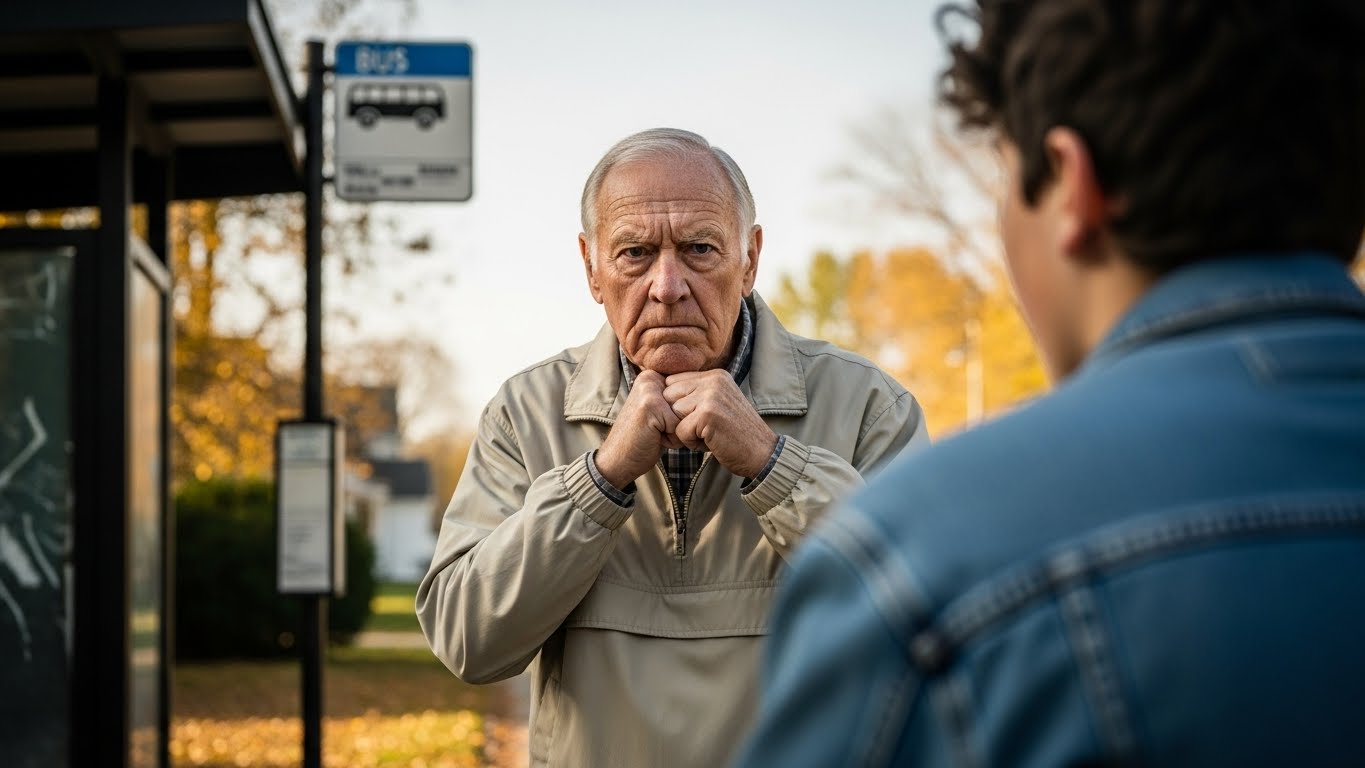
At eighty-three, Art was a man composed of fading edges. His favorite beige windbreaker hung loosely on a frame that had once been formidable, and his pale blue eyes often held the hazy, distant look of a sailor scanning a horizon that wasn’t there. He sat on the laminated bench, his hands resting on his knees, vibrating with a constant, rhythmic tremor—a neurological betrayal that made even holding a cup of coffee a tactical operation.
Sitting next to him was his anchor: his eleven-year-old grandson, Lucas Hayes.
Lucas was small for his age, but he possessed a gravity that most children lacked. It was the maturity born of necessity. He adjusted the straps of his worn backpack and checked the time on his phone: 3:12 PM. The number 42 bus was due in three minutes.
“Grandpa,” Lucas said, his voice a practiced blend of cheerfulness and patience. “We’re almost there. Mom’s making pot roast tonight. You like the carrots, remember?”
Art blinked, the haze in his eyes clearing for a fleeting second. He looked at the boy, and a soft, confused smile touched his lips. “Carrots,” he repeated, the word sounding gravelly, like tires on a dirt road. “Good for the eyes. Is… is Frankie coming for dinner?”
Lucas felt the familiar pang in his chest—a tiny heartbreak he experienced a dozen times a day. Frankie was Art’s boxing manager. Frankie had been dead for twenty years.
“No, Grandpa. Frankie’s busy. Just us,” Lucas said gently. He reached out and took Art’s trembling hand, squeezing it tight. “Just us.”
Art nodded slowly, the information sinking into the quicksand of his short-term memory. He began to hum, a low, wavering melody. Blue Moon. It was the song he used to enter the ring to, back in 1962. Back when he wasn’t Art the old man, but “The Southpaw”—the Golden Gloves champion of New England, a man whose left hook was a localized natural disaster.
But that man was gone. Or so everyone thought.
The tranquility of the bus stop was shattered by the scuff of heavy sneakers and the jarring, raucous laughter of teenage boys.
There were three of them. They moved with the loose-limbed arrogance of predators who knew they were at the top of the food chain. High schoolers. Leather jackets, expensive sneakers, and eyes that were looking for entertainment at someone else’s expense.
The leader was a boy named Brandon. He was a hulking offensive lineman with a face that was already hardening into the permanent sneer of a career bully. He was chewing on a toothpick, rolling it from one side of his mouth to the other as he scanned the street.
His eyes landed on the bench. The trembling old man. The small boy.
“Jackpot,” Brandon muttered to his friends, Gary and Mark.
They fanned out, blocking the sidewalk, cutting off the escape route. The air at the bus stop instantly grew heavy, charged with a static electricity that made the hair on Lucas’s arms stand up.
“Well, looky here,” Brandon drawled, stepping closer. He loomed over them, blocking out the sun. “The crypt keeper is out for a walk. And he brought his little pet.”
Lucas stood up. His heart was hammering against his ribs like a trapped bird, but he stepped in front of his grandfather. “Leave us alone, Brandon. The bus is coming.”
“Ooh, the bus is coming,” Gary mocked, pitching his voice high. “Scary.”
Brandon ignored Lucas. His eyes were fixed on Art, who was looking up with wide, bewildered eyes, the humming of Blue Moon dying in his throat.
“Nice hat, Pops,” Brandon said. He reached out with a casual, cruel speed and snatched the vintage Red Sox cap off Art’s head.
Art flinched. His hand flew up to his bald head, sensing the sudden cold. “My… my hat,” he whispered. “Give it back.”
“Come and get it,” Brandon taunted, dangling the cap just out of reach. He looked at his friends, grinning. “Look at him shake. He’s like a broken toy. Hey, Pops, you gonna cry? You gonna wet yourself?”
“Stop it!” Lucas shouted. The fear was gone, replaced by a sudden, hot flush of protective rage. He lunged forward, grabbing at Brandon’s jacket sleeve.
Brandon looked down at the boy with genuine annoyance. “Get off me, runt.”
He shoved Lucas. It wasn’t a playful push. It was a violent, dismissive thrust of mass and muscle.
Lucas flew backward. He lost his footing on the gravel. His back arched, and the back of his head slammed into the steel support post of the bus shelter.
CRACK.
The sound was sickeningly loud in the quiet street. Lucas slid to the ground, dazed, clutching his head. He didn’t scream, but his face crumpled in silent agony.
And that was the catalyst.
Chapter 2: The Southpaw Returns
For Arthur Peterson, the world didn’t just change; it time-traveled.
When he saw Lucas hit the pole—when he saw the pain etched on the face of the only person in the world who made him feel safe—the fog in his brain didn’t just lift. It was incinerated.
The chaotic firing of his neurons, the tangled webs of dementia, suddenly aligned into a single, terrifyingly clear pathway. The primitive, reptilian part of his brain—the part honed by thousands of hours of sparring, sweating, and bleeding—took command.
The bus stop on Elm Street dissolved. The smell of exhaust was replaced by the acrid sting of wintergreen liniment and stale cigar smoke. The sunlight became the blinding white glare of the Klieg lights at the Boston Garden.
The bully, Brandon, was no longer a teenager in a denim jacket. In Art’s mind, the figure looming over him morphed. The face shifted, becoming the snarling visage of “Killer” Kaufman, the middleweight contender who had cheap-shotted Art in the third round of the Eastern Regionals in ’62.
Kaufman had hurt his corner man. Kaufman had broken the rules.
Art stood up.
It wasn’t the slow, groaning ascent of an octogenarian with arthritis. It was a fluid, coiled motion. His feet, usually shuffling and unsure, planted themselves on the pavement with a wide, stable geometry.
His hands.
The tremor was gone.
It was a medical impossibility, a momentary miracle of adrenaline overriding neurology. His hands stopped shaking instantly. They curled into fists—not the clumsy fists of a brawl, but the tight, dangerous weapons of a technician. Thumbs tucked, knuckles aligned.
“You don’t touch my corner, Kaufman,” Art said.
His voice dropped an octave. It wasn’t the reedy whisper Lucas was used to. It was a growl, deep and resonant, coming from the diaphragm.
Brandon, still laughing, turned back to the old man. He didn’t notice the stance. He didn’t notice the shift in Art’s center of gravity. He just saw an old guy mumbling.
“What did you say, you old freak?” Brandon stepped in close, invading Art’s range, his chin high, his hands down at his waist. He was completely open.
“I said,” Art hissed, his eyes locked on Brandon’s solar plexus, “keep your guard up.”
Brandon opened his mouth to make another joke.
Art moved.
It was a blur. A kinetic explosion of torque. Art pivoted on his back foot, his hips snapping forward, driving the power up through his torso. He ducked under Brandon’s lazy gaze and unleashed the weapon that had made him famous.
The Left Hook.
But he didn’t aim for the jaw. He went for the body. The liver.
It was a punch designed to end fights, not to create drama. Art’s fist sank into the soft tissue just below Brandon’s ribs on the right side. It was a precision strike, hitting the organ with devastating force.
The sound was wet and heavy—a meat-packing thud that silenced the birds in the trees.
Brandon’s eyes went wide, the pupils shrinking to pinpricks. The signal from his liver hit his brain like a lightning bolt. His nervous system panicked. His legs turned to water.
He didn’t make a sound. He couldn’t. His diaphragm paralyzed. He collapsed straight down, hitting his knees first, then curling into a fetal ball on the dirty sidewalk. A low, gurgling sound escaped his throat as he vomited bile onto the concrete.
Gary and Mark stood frozen, their mouths hanging open. Their brains couldn’t process what they had just seen. The trembling old man had just folded their leader like a cheap lawn chair.
But Art wasn’t done.
In his mind, the referee hadn’t stepped in. Kaufman was down, but he wasn’t out. And in the ring, you fight until the ref pulls you off.
“Get up!” Art roared, dancing lightly on the balls of his feet, his fists rotating in a rhythmic defense. “Get up and fight clean, you coward!”
Brandon groaned, clutching his side, tears streaming down his face.
Gary, panic setting in, took a step toward Art, raising his hands. “Hey, man, stop! You’re crazy!”
Art saw movement in his peripheral vision. Another opponent. A flanking maneuver.
He shifted his stance smoothly. “Two on one? Come on then!”
Art stepped forward, a quick, aggressive jab snapping out and catching Gary square on the nose. Snap. Blood blossomed instantly. Gary shrieked, clutching his face, stumbling backward over the bench.
Art Peterson was eighty-three years old, suffering from Alzheimer’s, and wearing a windbreaker two sizes too big. But in this terrifying, electric moment, he was the most dangerous man in the state. He was The Southpaw. And he was winning.
Chapter 3: The Blue Lights of Reality
The silence that followed the violence was louder than the screams had been.
On the pavement, Brandon was still curled in a tight, trembling ball, gasping for air in shallow, wet wheezes. The vomit on his chin was mixing with tears. He wasn’t a tough guy anymore. He was just a child who had encountered a force of nature he didn’t understand.
Gary was on his knees a few feet away, clutching his broken nose, blood seeping through his fingers and dripping onto his expensive sneakers. Mark, the third boy, had backed up so fast he tripped over the curb, scrambling backward like a crab, his eyes wide with absolute terror.
In the center of this carnage stood Arthur Peterson.
He wasn’t panting. He wasn’t shaking. He was bouncing lightly on the balls of his feet, his hands still held high in that classic, impenetrable guard. He looked young. Not in his face, which was still mapped with eighty years of wrinkles, but in his energy. The ghost of The Southpaw had fully possessed him.
“Come on!” Art shouted at the terrified Mark. “Don’t hug the ropes! Step into the center!”
“Grandpa! Stop!”
The scream tore through the air. It was Lucas.
The boy pushed himself up from the ground, ignoring the throbbing lump forming on the back of his head. He ran to his grandfather, but he didn’t hug him. He stopped three feet away, hands raised, terrified.
“It’s not the ring!” Lucas cried, his voice cracking. “Grandpa, look at me! It’s Lucas! It’s the bus stop!”
Art blinked. He pivoted, his fists still raised, ready to strike this new voice. When he saw the boy, he hesitated.
“Lucas?” Art frowned, the feral intensity in his eyes flickering for a millisecond. “Get back to the corner, kid. I got him on the ropes. One more round.”
“There is no round!” Lucas stepped forward, tears streaming down his dusty face. He grabbed Art’s wrist—the left one, the one that had just delivered the liver shot. “Look at your hands, Grandpa. Please.”
Art looked down.
The adrenaline began to fade, leaking out of his system as quickly as it had arrived. The testosterone spike dropped. The “fight” chemicals in his brain receded, leaving behind the confused, tangled neurons of dementia.
Art saw his hands. They were trembling again. Violently. The knuckles on his left hand were red and swollen.
He looked at the boy on the ground—Brandon—who was now moaning in agony. He looked at the blood on the pavement.
“Did… did I fall?” Art whispered, his voice returning to the rasp of an old man. He looked at Lucas, panic rising in his chest. “Why is that boy crying? Did we miss the bus?”
Before Lucas could answer, the wail of sirens cut through the afternoon air.
They came in a swarm. Two police cruisers and an ambulance, their lights painting the suburban street in chaotic flashes of red and blue.
For Art, the lights were just another source of confusion. “Disqualification,” he muttered, swaying slightly. “Too many lights.”
Detective Richard “Rich” O’Connell was the first out of the lead cruiser. He was a veteran cop, a man who had seen everything in this town for thirty years. He knew Art. He bought coffee at the same deli where Art sometimes forgot to pay.
Rich took in the scene instantly. The battered teenagers. The terrified boy. And Art Peterson, looking small and frail, standing over them like a confused titan.
“Dispatch, send a second bus for the medical,” Rich barked into his radio. He walked slowly toward Art, his hands open, palms showing.
“Artie,” Rich said softly. “Artie, look at me.”
Art squinted. “Richie? Is that you? Did you bring the ledger? The taxes are due.”
Rich felt a knot form in his stomach. He saw the swelling on Art’s knuckles. He saw the devastation inflicted on the teenagers. He knew what he had to do, and he hated it.
“Yeah, Artie. We need to go look at the ledgers downtown,” Rich said, his voice gentle. He reached for Art’s arm. “But I need you to put your hands behind your back for me, okay? Just for a minute.”
“No!” Lucas screamed, throwing himself between the detective and his grandfather. “He didn’t mean it! They hurt him first! They pushed me!”
“I know, son. I know,” Rich said, his eyes sad. “But look at that kid on the ground. This is a crime scene now. I have to take him in.”
Rich gently moved Lucas aside. He took Art’s trembling wrists and pulled them behind his back.
The click of the handcuffs was a sharp, metallic finality.
Art didn’t resist. He just looked confused. “Is this part of the show, Richie?” he asked, looking around at the gathering crowd of neighbors filming with their phones. “I don’t remember this part.”
As they led Art to the cruiser, passing the stretcher where paramedics were loading a screaming Brandon, Eleanor—the woman who had been waiting for the bus across the street—ran forward.
“You tell them!” she shouted at the police, pointing at Brandon. “You tell them those punks started it! That old man is a hero!”
But the law doesn’t deal in heroes. It deals in statutes. And as the heavy door of the cruiser slammed shut, separating Art from his weeping grandson, the reality was cold and hard.
Arthur Peterson wasn’t going home to pot roast. He was going to a holding cell.
Chapter 4: The Court of Public Opinion
The booking room at the precinct was a symphony of fluorescent lights and ringing phones. For Art Peterson, it was a torture chamber of sensory overload.
They had taken his shoelaces. They had taken his belt. He sat on a metal bench, his hands shaking so badly he couldn’t hold the paper cup of water they offered him. He kept asking for Frankie, his dead manager. He kept asking why the locker room was so cold.
In the hallway, the situation was spiraling out of control.
Sarah Hayes, Art’s daughter and Lucas’s mother, had arrived like a hurricane. Her eyes were red, her hair messy, her heart breaking.
“You can’t keep him in there!” she yelled at Detective O’Connell. “He has dementia! He doesn’t know where he is! He needs his medication!”
“Sarah, please,” Rich said, trying to lower the temperature. “We’re processing him. He assaulted three minors. One of them is in the ICU with a lacerated liver. Another has a shattered nasal cavity. The DA is already on the phone.”
“They attacked him!” Sarah cried, clutching Lucas, who was sitting on a chair, pressing an ice pack to the back of his head.
“The video says otherwise,” a cold voice interrupted.
Walking down the hallway was a man in a sharp grey suit. He looked like a shark that had just smelled blood. It was Thomas Peterson (no relation), Brandon’s father. He was the most expensive personal injury lawyer in the county, a man known for destroying opponents in court.
“Mr. Peterson,” Rich nodded stiffly.
“That animal,” Thomas hissed, pointing at the holding cell door, “nearly killed my son. Brandon is in surgery right now. Internal bleeding. And I hear you haven’t even charged him yet?”
“We are gathering statements,” Rich said defensively.
“Here is my statement,” Thomas said, stepping close, his voice low and threatening. “If that man is not charged with three counts of aggravated assault with intent to kill by morning, I will sue this department into the stone age. And then I will take every penny that old man has. I will take his house. I will take his pension. I will leave this family on the street.”
He turned his gaze to Lucas. “And you, you little liar. You told the police my son started it? Wait until the judge hears about how you provoked him.”
Sarah stepped in front of her son, trembling with rage. “Don’t you dare speak to him.”
But the real battle wasn’t happening in the police station. It was happening online.
Eleanor’s video—shaky, vertical, and grainy—had hit Facebook at 4:30 PM. By 6:00 PM, it had migrated to TikTok and Twitter. By 8:00 PM, it was the number one trending topic in the country.
The caption read: Bullies pick on wrong grandpa. Watch the Southpaw wake up.
The comments were a war zone.
User789: “That kick to the liver? That was professional. You don’t learn that at the YMCA. That old man is a legend.”
Karen_Be_ Quiet: “He nearly killed a kid! I don’t care if they were rude. You don’t punch a child in the liver! Lock him up!”
Boxing_Historian: “Wait… is that Art Peterson? The ’62 Golden Gloves champ? My dad talked about him. He had a left hook from hell. He’s got Alzheimer’s now? This is tragic.”
The hashtag #SouthpawJustice began to trend.
Back at the station, a new player entered the game. Evelyn Reed. She was a public defender, overworked and underpaid, but she had a reputation for fighting tooth and nail for the underdog. She had seen the video. She had seen the look in Art’s eyes—the vacant confusion before the snap.
She walked straight up to Sarah. “Mrs. Hayes? I’m Evelyn. I’m representing your father.”
“We can’t afford a lawyer,” Sarah wept.
“You don’t have to pay me,” Evelyn said, looking at the door where Thomas Peterson had just exited. “I just want to make sure the story is told right. This wasn’t a crime, Sarah. This was a reflex.”
Evelyn turned to Detective O’Connell. “Rich, I want a psych eval immediately. And I want Dr. Anya Sharma, his neurologist, brought in. You and I both know Art didn’t possess mens rea—criminal intent. He wasn’t there.”
“The kid has a lacerated liver, Evelyn,” Rich sighed, rubbing his temples. “Intent or not, that’s a deadly weapon.”
“His hands aren’t weapons,” Evelyn said, looking through the small window of the holding cell where Art was currently shadowboxing against a ghost in the corner. “They are artifacts. And they were triggered by trauma.”
Inside the cell, Art stopped moving. He looked at the concrete wall. The adrenaline was gone, and the darkness was creeping back in. He slumped onto the bench, burying his face in his hands.
“Lucas?” he whispered into the cold air. “I… I think I lost the hat.”
Outside, the news vans were arriving. The satellite dishes were going up. The story of the Dementia Champion was about to become national news, and Arthur Peterson, a man who couldn’t remember what he had for breakfast, was about to face the fight of his life. But this time, he wouldn’t be throwing the punches.
Chapter 5: The Southpaw’s Arsenal
Evelyn Reed, the public defender, walked out of the precinct that evening feeling the familiar cold grip of fighting a losing battle, but also a strange, electric certainty that she held a winning hand. The evidence was paradoxical: a medically frail old man had demonstrated lethal, world-class athletic skill. Her job was to prove that Art’s hands, though highly trained, were no different than a sleepwalker’s feet—capable of movement, but utterly lacking in conscious direction.
The first crucial appointment was with Dr. Anya Sharma, Art’s neurologist.
Dr. Sharma met Evelyn in her sterile, quiet office, surrounded by brain scans that looked like alien landscapes. She confirmed the grim truth: Art’s Alzheimer’s was aggressive.
“What you saw was a phenomenon known as ‘Involuntary Behavioral Automatism,’ Evelyn,” Dr. Sharma explained, tapping a pencil against a scan. “The trauma of seeing Lucas struck caused a massive emotional surge. That fear—the primal instinct to protect kin—bypassed the damaged frontal lobe, the center of logic and reason. The signal didn’t go to Art, the CPA; it went straight to his cerebellum and his motor cortex.”
She continued: “Those areas hold muscle memory. The deepest, most practiced program in Art’s life was boxing. His brain defaulted to the only language it remembered to defend itself: a perfect, professional response to an antagonist. He genuinely believed he was performing a routine. He wasn’t attacking Brandon; he was finishing ‘Killer Kaufman’ in the final round.”
The next piece of the defense was human evidence. Evelyn tracked down Tony “The Hammer” Mancini, Art’s old sparring partner, now living in a retirement community an hour outside of the city.
Tony was a mountain of a man, his face a roadmap of old ring scars, his heart pure gold. He brought a battered cardboard box full of yellowed clippings, trophies, and a pair of worn, blood-stained leather gloves.
“Arthur would never start a fight outside the ropes,” Tony declared, his voice thick with emotion. “But you touch his corner, you touch his family, you get the Southpaw. That liver shot? That’s not a street fight move. That’s a signature. It was designed to drop the toughest man alive. He perfected it after Kaufman cheap-shotted him in ’62. It was Art’s final, perfect answer to a dirty opponent.”
Tony’s testimony tied the violent act directly to a specific, decades-old trauma that had been preserved, fossilized, in Art’s decaying memory—the exact mechanism Dr. Sharma had described.
Meanwhile, Sarah secured Art’s release on bail, mortgaging their modest home to cover the bond. Art returned home to a world he barely recognized, confused by the flashes of cameras and the news crews camped outside his house. He was placid, but more distant than ever, the temporary clarity he gained from the fight having drained his remaining cognitive energy.
Lucas became his protector. He sat with his grandfather, reviewing the old boxing photos Tony had brought.
“Grandpa,” Lucas asked one afternoon, pointing to a clipping titled ‘Peterson Drops Rival in Fifth.’ “Why did you call him Kaufman?”
Art looked at the picture of his younger, powerful self. A brief flicker of fierce pride crossed his face. “Kaufman,” he whispered, a dangerous edge returning to his voice. “He was a thief, Lucas. He tried to steal the match. You never let them steal the match.”
Lucas realized the profound truth of the situation: Art’s entire life was now a fight. And when he saw Lucas, his grandson, his corner man, threatened, The Southpaw had woken up to save his most precious treasure from the thief who threatened to steal it all. The legal defense was now perfectly aligned: the scientific proof of involuntariness, anchored by the historical context of the punch.
Chapter 6: The Unmasking
As Evelyn built the legal defense in the quiet of her office, the court of public opinion was waging a separate, louder war that benefited Art.
The shaky cell phone video of “The Southpaw” had been viewed tens of millions of times. Initially, the Petersons’ legal team successfully painted Brandon as a clean-cut victim, showing pictures of him in his church youth group.
But the internet, tireless and unforgiving, began to dig.
First came the grainy footage from the high school parking lot—Brandon harassing a smaller student over lunch money. Then came the anonymous testimonials from former classmates detailing years of intimidation, theft, and emotional abuse directed by Brandon and his friends.
The narrative flipped violently. #SouthpawJustice turned from a catchy hashtag into a movement for accountability. People saw Art not as a violent criminal, but as a symbolic avenger for every bullied kid and every marginalized, ignored elderly person in America.
Thomas Peterson, Brandon’s father, was furious. His civil suit for “gross negligence and emotional trauma” was becoming a public relations disaster. His attempts to smear Art by exposing his full medical history only backfired, eliciting huge waves of sympathy and anger against him.
“This is not about money, Mrs. Reed,” Peterson snarled at Evelyn during a pre-trial conference. “It’s about making an example! People can’t just go around assaulting teenagers!”
“The assault was involuntary, Mr. Peterson,” Evelyn replied coolly, presenting a stack of evidence of Brandon’s past. “And frankly, the only thing your son’s history proves is that Art Peterson wasn’t wrong to perceive a threat. He just used the wrong frame of reference.”
The pressure on the District Attorney to file criminal charges for aggravated assault crumbled under the weight of public opinion and the compelling medical evidence. The DA announced a week before the civil hearing that, due to the established medical condition and lack of mens rea (criminal intent), they would decline to file charges.
It was a colossal victory, but the civil suit remained—the Petersons still demanded Art’s house and pension as retribution for Brandon’s costly injuries.
Lucas found his own way to fight back. He started a small, local fundraiser—”Art’s Corner”—to help cover his family’s growing legal bills. People from across the country, inspired by the story of the grandfather who fought for his grandson, sent letters, small donations, and packages of boxing memorabilia.
The outpouring of support brought a moment of clarity to Sarah, who had been consumed by fear. She realized they were not alone. Her father had fought for them once, and now, the community was fighting for him.
But the price of the battle was visible every day. Art was slipping faster. He was confusing his own daughter with his first trainer, and sometimes he would only speak in boxing terminology. Lucas had to constantly remind him to eat, telling him it was “fueling up for the seventh round.”
The hearing loomed, a final confrontation. Evelyn knew the judge was sympathetic, but the fractured ribs and the lacerated liver were hard physical facts. They needed one final, undeniable piece of evidence to seal the defense: they needed Art to demonstrate his confusion under oath.
Chapter 7: The Judge’s Final Call
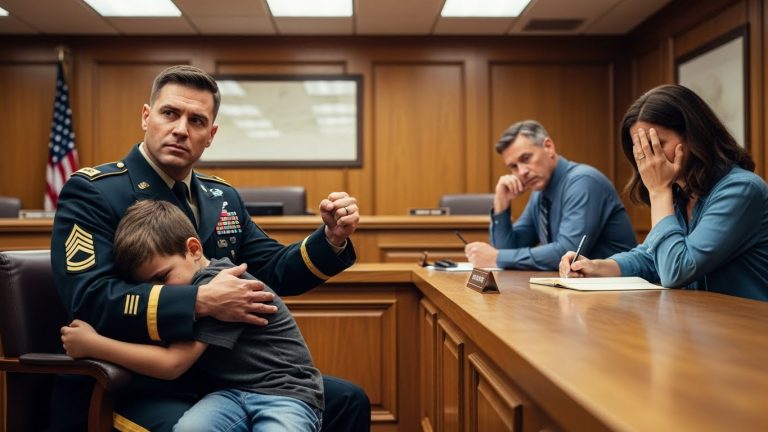
The courtroom on the day of the hearing was packed, with reporters occupying every seat behind the rail. The tension was palpable—a silent battle between the arrogance of wealth (Thomas Peterson) and the heartbreaking fragility of innocence (Art Peterson and Lucas).
Art was seated at the defense table, wearing a borrowed suit that looked too formal for him. He was deeply confused by the surroundings, continually whispering to Lucas, “Is the referee going to check our gloves now? I want a clean fight.”
Thomas Peterson, arrogant and prepared, opened his case by presenting x-rays and medical reports showing the severity of Brandon’s injuries.
“Your Honor,” Peterson concluded, “we are not here to question Mr. Peterson’s past achievements. We are here because a man with a known, dangerous history of violence, regardless of his mental state, inflicted nearly fatal injuries on a minor. His ‘dementia’ is an excuse; his actions were a trained, targeted, and highly effective attempt to permanently disable my son.”
The defense began by calling Dr. Sharma, who calmly explained the medical facts of behavioral automatism, the brain’s “fight protocol,” and the specific trigger caused by Lucas’s injury.
Then, Lucas was called to the stand. He was small, but his voice was steady.
“He called him Kaufman,” Lucas said, looking directly at the judge. “He said, ‘You don’t touch my corner.’ When he saw me hit the pole, he wasn’t my Grandpa anymore. He was The Southpaw. He was defending me. He always defends me.”
The judge, a formidable woman named Judge Thompson, was visibly moved. But the final, necessary theatrical flourish belonged to Evelyn Reed.
“Your Honor, the plaintiff insists Mr. Peterson acted with intent. I ask that we allow the court to assess that intent now.”
Evelyn, against Sarah’s desperate pleas, called Art to the stand.
Art shuffled toward the witness box, looking utterly lost.
Thomas Peterson immediately pounced, trying to prove Art’s inability to distinguish right from wrong. He leaned in, aggressive and loud. “Mr. Peterson! Did you hit my son, Brandon? Do you know why you are here?”
Art blinked, his eyes scanning the serious faces, the cameras, the tension. In his mind, he wasn’t in a courtroom. He was at the post-fight press conference, surrounded by reporters questioning his brutal victory.
Art suddenly straightened up. The trembling stopped. He pointed a steady, accusatory finger directly at Thomas Peterson.
“Listen to me, all of you!” Art announced, his voice booming with the confidence of a champion. “The Southpaw fights clean! He tried to cheap-shot my corner, but I finished him in the fifth round, and I did it clean! You never touch the things I protect! Now, I’m done talking to you, Peterson. Get your kid out of the press room. This champion is going home to his grandson!”
The outburst—a powerful, lucid mix of past and present reality—was the final, irrefutable proof. Art was not evading the question; he was fundamentally incapable of processing the current reality. He believed the fight was over, the victory secured, and the press conference was the only remaining formality.
Judge Thompson called a recess. When she returned, her voice was heavy with finality.
“The court finds that Mr. Arthur Peterson was medically incapable of forming the requisite criminal or civil intent to commit assault,” she ruled. “His actions were a result of an involuntary act—a ‘behavioral automatism’—triggered by his Alzheimer’s and the physical harm to his grandson, Lucas Hayes. The civil suit against Mr. Peterson is dismissed with prejudice.”
The courtroom erupted. Evelyn, Sarah, and Lucas collapsed into relieved tears. The champion had won his final fight.
Chapter 8: The Corner Secured
The dismissal of the lawsuit brought a fragile peace, but it was a peace bought at a steep cost. The incident, the surge of adrenaline, and the subsequent confusion seemed to accelerate Art’s cognitive decline. The Southpaw had spent his last reserve tank of mental fuel.
He rarely spoke now, spending most of his days humming Blue Moon and gently rubbing the knuckles of his left hand. The tremor was back, more pronounced than ever, and the memory of the bus stop was completely gone. The only thing he still held onto was Lucas.
A few weeks after the verdict, on a crisp evening in late November, Art and Lucas sat on the front porch swing, wrapped in a thick wool blanket. The sky was the deep, bruised color of twilight.
Lucas was reading aloud from one of Art’s old boxing clippings—a story about a match Art lost tragically in the tenth round.
Art stopped him mid-sentence. His eyes, though cloudy, focused intently on Lucas’s face.
“Lucas,” he whispered, his voice surprisingly clear, cutting through the silence of the porch.
“Yes, Grandpa?”
Art reached out, his trembling right hand taking Lucas’s shoulder. His grip was surprisingly firm.
“The ring,” Art said slowly, deliberately. “It’s a beautiful, terrible place. But you have to know what you’re fighting for, son. You have to know your corner.”
He paused, a long, profound silence hanging between them. He looked past Lucas, perhaps seeing the long-gone Frankie, perhaps seeing the canvas ropes, or perhaps just seeing the vast, empty space where his memories used to be.
“I always fought for what was right,” Art concluded. He brought his gaze back to Lucas, and a contented, knowing smile touched his lips. “You’re my corner, Lucas. Always my corner.”
Lucas squeezed his grandfather’s hand, tears filling his eyes. “I know, Grandpa. And you’re mine. Always.”
Art leaned his head back against the cushion. The effort of the lucid statement seemed to drain him completely. He closed his eyes, his breathing evening out. The faint scar above his left eye—a souvenir from a particularly brutal fight in Providence—softened.
He was gone now, retreating deeper into the silence. The Southpaw, the fierce protector, was finally at rest. He had secured his legacy, not with a championship belt or a hall of fame plaque, but with a single, perfect act of primal love on the cold pavement of a suburban bus stop. The story of Arthur “Art” Peterson—the Champion who won his last, best fight for the boy he loved—would live on forever, enshrined in the unbreakable memory of his grandson.