I Shattered a Bully’s Kneecap in a Parking Lot to Save My Nephew: They Call It “Brutality,” I Call It Pacification.
Chapter 1: The Snap
The heat in the car was suffocating. It was that specific kind of mid-July humidity that sticks your shirt to the seat and makes the air feel like soup. I was parked in the back corner of “Burger & Shakes,” a greasy spoon joint that had survived three recessions and a health code violation or two.
I was off-duty. My badge was in the glove box. My service weapon, a Glock 19, was locked in the safe under the passenger seat. The only thing identifying me as Officer Cassandra Miller was the tan line on my left ring finger and the permanent scowl etched into my forehead.
I just wanted five minutes. Five minutes to eat a cheeseburger that was 40% grease and 60% regret. I took a bite, closing my eyes, letting the saltiness distract me from the twelve-hour shift I’d just wrapped up. Domestic disputes, a fender bender, and a drunk guy trying to fight a parking meter. Just another Tuesday in suburbia.
Then I heard it.
It wasn’t the usual screeching of tires or the obnoxious bass of a teenage sound system. It was a sound I knew too well. The wet, dull thud of something hitting flesh. Followed by a sharp, ragged gasp.
My eyes snapped open. The burger fell into my lap, forgotten.
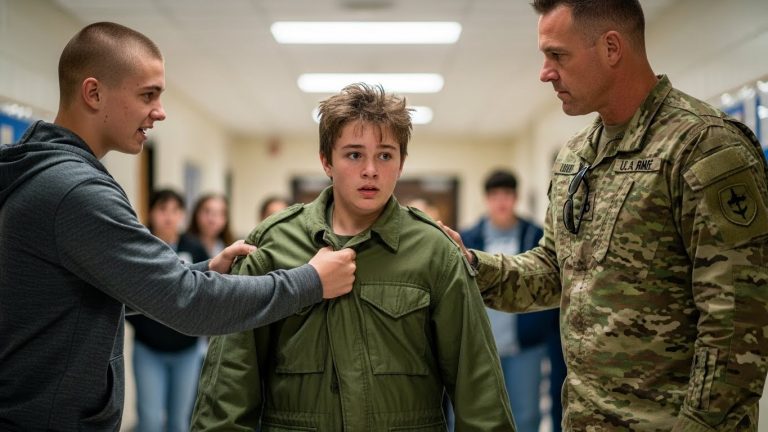
Fifty yards away, near the rusted chain-link fence that separated the burger joint from the high school football field, a circle had formed. Four boys. Big ones. They were wearing hoodies despite the heat, hoods up, posturing like they were in a music video.
In the center of the circle was a crumpled heap of denim and plaid.
My stomach dropped. I knew that plaid shirt. I’d bought it at Old Navy three weeks ago for his birthday.
Liam.
My sister, Sarah, died three years ago. Ovarian cancer. It was quick and brutal. Her husband took off before the diagnosis, leaving me with a mortgage I couldn’t afford and a twelve-year-old boy who looked exactly like his mother. Liam was fifteen now. He was quiet. He liked vintage sci-fi novels and coding. He weighed a hundred and thirty pounds soaking wet.
He was currently curled into a fetal ball, covering his head with his thin arms while four future inmates took turns kicking him.
The “cop” part of my brain assessed the threat instantly. Four aggressors. One victim. Disparity of force: distinct. Imminent risk of great bodily harm: confirmed.
The “aunt” part of my brain just saw red.
I didn’t think. I didn’t plan. I moved.
I shoved the car door open, ignoring the keys still in the ignition. I didn’t reach for the gun. You don’t pull a firearm on unarmed minors in a crowded parking lot unless you want to end up on the national news. But I grabbed the ASP.
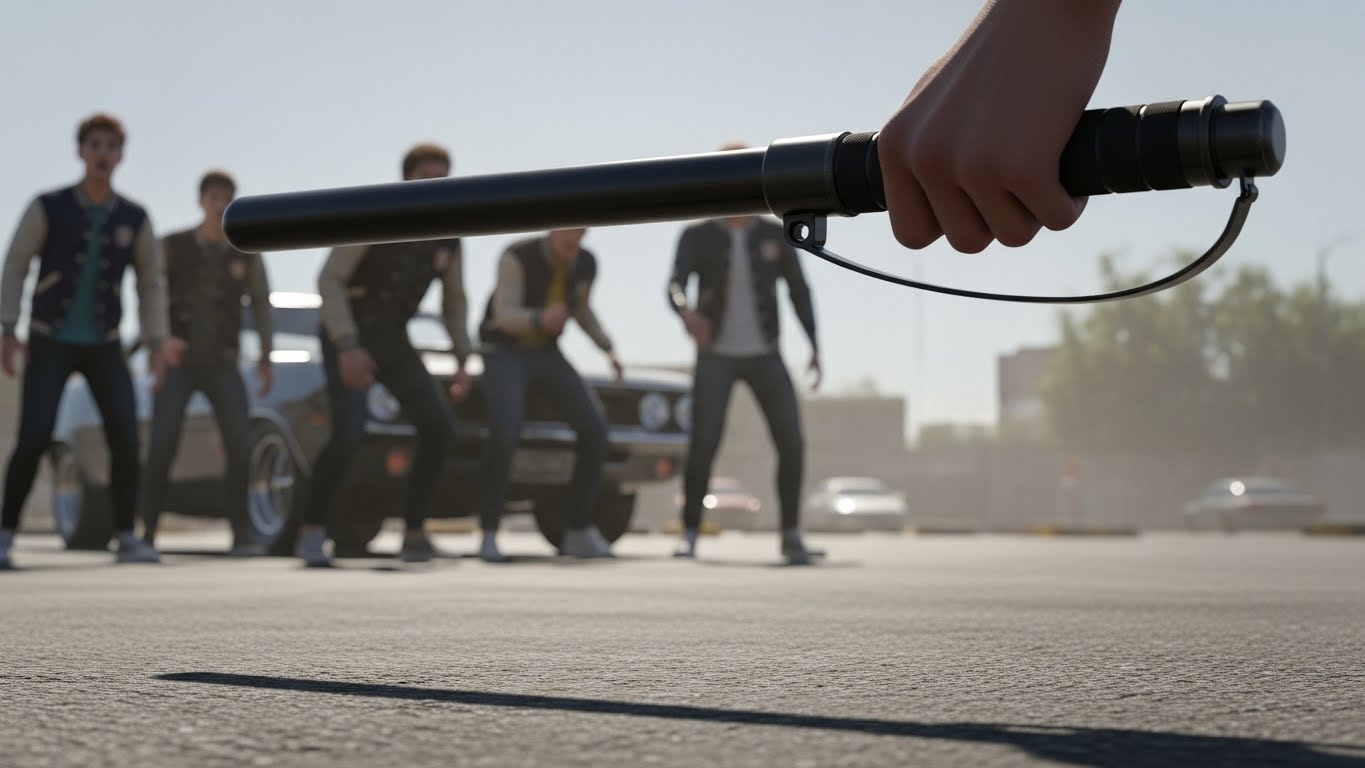
It was my personal baton, a sleek, black steel rod that collapsed into a seven-inch handle. I gripped it tight, my knuckles turning white.
I didn’t run. Running attracts attention. I power-walked. Fast. Silent. Predatory.
As I closed the distance, the sounds became clearer. The jeering. The laughter.
“Get up, freak!” one of them shouted.
“Stay down!” another yelled, contradicting him, before launching a kick into Liam’s lower back.
Liam didn’t make a sound. That scared me more than screaming would have. He was taking it. He was accepting it.
The biggest kid, a boy I’d later learn was named Brendan, stepped back. He was the ringleader. I could tell by the way the others deferred to him. He wiped sweat from his forehead, grinning, and lined himself up. He was preparing for a penalty kick, and Liam’s head was the soccer ball.
I was ten feet away.
Brendan planted his left foot. He drew his right leg back. The muscles in his calf bunched up.
I didn’t yell “Police!” I didn’t yell “Stop!” By the time the sound left my throat, his boot would have connected with Liam’s temple. Brain damage happens in milliseconds.
I lunged.
My arm whipped out in a practiced arc. Flick. The baton expanded with a sharp metallic hiss—SHINK—locking into its full twenty-one-inch length.
I swung low.
I wasn’t trying to bruise him. I wasn’t trying to “scare” him. I was applying a mechanical solution to a biological problem. The problem was the kick. The solution was removing the fulcrum.
The steel tip of the baton connected with the outside of Brendan’s right knee just as his leg reached maximum extension.
The sound was hideous. It was a loud, dry CRACK, like a baseball bat hitting a tree trunk.
Brendan’s leg didn’t just stop; it buckled inward at an angle nature never intended. The kinetic energy of his own kick, combined with the force of my strike, shattered the joint instantly.
The kick never landed.
Brendan hung in the air for a split second, a look of total confusion on his face, before gravity reclaimed him. He hit the asphalt hard, rolling onto his side.
For one second, there was silence. Absolute, heavy silence. The birds stopped singing. The traffic noise seemed to vanish.
Then, the screaming started.
It was a high, undulating wail, the sound of a child who has suddenly realized they are not invincible. Brendan clutched his leg, his face contorting into a mask of pure agony.
The other three boys froze. They looked at their fallen leader, then at me.
I stood over Brendan, the baton held at the “low ready” position across my chest. My breathing was steady. My heart was a cold hammer in my chest.
“Police!” I barked. The voice wasn’t mine; it was the Command Voice. Deep. from the diaphragm. “Get on the ground! Now! Face down! Hands out!”
They hesitated. They were big kids, fueled by adrenaline and stupidity. For a fraction of a second, I saw one of them clench his fists. He was calculating the odds. Three against one woman.
I took a step toward him, raising the baton. My eyes locked onto his. I let him see the cold, hard promise of violence in them. I let him see that I wasn’t just a woman in a parking lot. I was the consequences of his actions.
“Try me,” I said. My voice was barely a whisper, but it carried like a gunshot. “Please. Give me a reason.”
He blinked. The spell broke.
“We… we didn’t do nothing!” he stammered, his hands shooting up.
“Ground!” I roared.
They dropped. All three of them. Scrambling onto the hot asphalt, burning their palms, terrified to look up.
I kept my peripheral vision on them, but my focus shifted to the boy on the ground behind me.
“Liam?” I said, my voice softening, cracking just a little. “Buddy? You with me?”
Chapter 2: The Whisper
Liam slowly uncurled. His face was a mess—blood running from his nose, a nasty bruise forming on his cheekbone—but his eyes were open. He looked at me, then at the baton in my hand, then at the screaming boy writhing a few feet away.
“Aunt… Cassie?” he wheezed.
“Stay down, kiddo,” I said, not looking at him. I couldn’t look at him yet. If I looked at him and saw my sister’s eyes filled with pain, I might do something that would actually land me in prison. “Don’t move. Ambulance is coming.”
I didn’t have my radio, so I grabbed my cell phone with my left hand, never taking my eyes off the three prone boys or the wailing Brendan. I dialed 911.
“This is Officer Miller, Badge 492,” I said calmly. “I have an officer-involved use of force at the Burger & Shakes on Main. Four suspects in custody. One requiring immediate medical for severe lower-body trauma. Victim is a minor. Send the house.”
“Copy, 492,” the dispatcher said. Her voice was familiar. Janice. “Are you secure?”
“Scene is… controlled,” I said.
I hung up and walked over to Brendan. He was hyperventilating now, shock setting in. His leg was bent at a sickening forty-five-degree angle sideways. His face was gray.
I knelt down next to him. Not to help him. Not yet.
“My leg!” he screamed, snot bubbling from his nose. “You broke my leg! You crazy bitch!”
I leaned in close. I put my hand on his chest—not to comfort him, but to pin him there. I brought my face inches from his.
“Listen to me,” I hissed.
He stopped screaming, choking on a sob, his eyes wide with terror.
“You were assaulting a minor,” I said, my voice flat and monotone. “I identified myself as an officer. I perceived a lethal threat. I utilized non-lethal force to neutralize that threat. That is exactly what the report is going to say.”
“You… you just hit me!” he cried.
“I pacified you,” I corrected him. “State-sanctioned pacification. And if you say one word—one single word—that contradicts my report, I will make sure you are charged with attempted manslaughter. Do you understand me?”
I pressed down harder on his chest.
“Do. You. Understand?”
“Yes,” he whimpered. “Yes. Please. It hurts.”
“Pain is a great teacher,” I said, standing up.
The sound of sirens grew louder. Two patrol cars tore into the parking lot, lights flashing, hopping the curb. Sergeant Riley was the first one out. He was an old-school cop, a guy with a mustache that had seen the 80s and never left.
He took in the scene in two seconds. The boys on the ground. The broken leg. Me standing there with the baton.
He walked up to me, his hand resting casually on his holster.
“Cassie,” he said, nodding at Brendan. “That looks… expensive.”
“Subject was delivering a potentially lethal kick to the victim’s head,” I said, holstering the baton. “I intervened.”
Riley looked at Liam, who was sitting up now, holding his ribs. Then he looked back at Brendan, who was moaning softly. Riley knew the score. He knew the paperwork involved in a use-of-force complaint.
“Clean?” Riley asked. It was the only question that mattered.
“Clean,” I lied. Or maybe I wasn’t lying. It depends on your definition of justice.
“Alright,” Riley sighed. He motioned to the rookies pouring out of the second car. “Cuff the ones on the ground. Get EMS for the kicker. And get Miller’s nephew some ice.”
As the EMTs loaded Brendan onto the gurney, I walked over to Liam. I sat down on the curb next to him, the adrenaline finally starting to dump out of my system, leaving my hands shaking.
“Did you kill him?” Liam asked quietly. He wasn’t crying anymore. He just looked tired.
“No,” I said, wiping a smudge of dirt off his forehead. “But he’s not going to be playing football this season.”
Liam looked at me, really looked at me. “He’s the quarterback.”
“Not anymore,” I said. “Now he’s just a suspect.”
But as I watched them load Brendan into the ambulance, I saw his eyes. They weren’t just filled with pain. They were filled with hate. And behind that hate, I saw something else. Entitlement.
I knew then that this wasn’t over. The snap of the bone was just the opening bell. Brendan wasn’t just some random thug; he was wearing a varsity jacket that cost more than my car. He was someone’s “golden boy.”
And I had just broken him.
My phone buzzed. It was a text from an unknown number.
You made a mistake.
I looked up, scanning the crowd of onlookers holding up their cell phones, recording everything. The court of public opinion was already in session, and I had a feeling the verdict wasn’t going to be in my favor.
I helped Liam up. “Come on. Let’s go get that milkshake.”
“Aunt Cassie?”
“Yeah?”
“Thank you.”
“Don’t thank me yet,” I muttered, looking at the sea of camera phones pointed at us. “The real fight hasn’t even started.”
Chapter 3: The Viral Verdict
The emergency room at St. Jude’s smelled of rubbing alcohol, stale coffee, and quiet desperation. It was a smell I had lived in for half my career, usually standing over a suspect or a victim, taking statements while doctors worked. But this time, I was just an aunt sitting in a plastic chair that was bolted to the floor, staring at the scuffed linoleum.
Liam was behind the curtain in Bed 4. The doctor said it was just bruising, maybe a cracked rib, and a mild concussion. He was lucky. Physically, at least.
My phone was vibrating against my thigh like a nervous tic. It hadn’t stopped since we left the parking lot. I pulled it out, the screen glowing harsh in the dim waiting room light.
I didn’t open the messages. I didn’t have to. I went straight to the source of the noise: social media.
It had been less than two hours, but the internet moves faster than justice. The video was already trending locally. It was on Twitter, TikTok, and Facebook. I clicked on the one with the most views—over fifty thousand already.
My stomach turned over.
The video didn’t start with the four boys kicking Liam. It didn’t start with Brendan winding up for a head-shot.
It started exactly two seconds before I swung the baton.
The angle was from the side, probably filmed by a kid sitting in a car near the drive-thru. In the shaky footage, all you saw was a large woman in tactical pants—me—lunging at a teenager who looked, from that specific angle, like he was just standing there.
You couldn’t see Liam on the ground. He was blocked by Brendan’s body and the chain-link fence.
You just saw the swing. The brutality of it. The snap. And then the scream.
The caption read: “Karen Cop SHATTERS high school QB’s knee over a parking spot?? #PoliceBrutality #JusticeForBrendan”
I scrolled down to the comments. I shouldn’t have, but it’s like picking at a scab. You have to know how deep the infection goes.
“Fire her immediately.” “Why did she have a weapon if she was off duty?” “That poor kid. I heard he had a scholarship.” “This is why people hate pigs.”
I locked the phone and shoved it into my pocket, my hand trembling slightly. They didn’t see the fear in Liam’s eyes. They didn’t hear the wet thud of boots on ribs. They just saw the violence I dealt out, stripped of all context. I had been framed by the camera lens.
“Officer Miller?”
I looked up. A young nurse stood there, holding a clipboard. She looked at me differently than she had when we walked in. Before, I was a concerned guardian. Now, I saw a flicker of recognition in her eyes. She had seen the video.
“Is he okay?” I asked, standing up, ignoring the coldness in her demeanor.
“He’s discharged,” she said clippedly. “Doctor wants him to rest for a few days. Watch for vomiting or dizziness. Here’s the paperwork.”
I took the papers. “Thanks.”
I walked back to Bed 4. Liam was sitting on the edge of the gurney, his shirt off, revealing a tapestry of purple and yellow bruises blooming across his pale skin. He looked small. Too small for this world.
“Ready to go?” I asked, trying to keep my voice light.
He looked up at me. “I saw it, Aunt Cassie.”
“Saw what?”
“The video. On my phone.” He swallowed hard. “Everyone at school is sharing it. They’re saying… they’re saying you’re crazy. They’re saying Brendan is going to sue you.”
I walked over and put a hand on his shoulder. I needed him to understand this, more than I needed a jury to understand it.
“Liam, look at me.”
He raised his eyes. They were watery.
“The video is a lie of omission,” I told him firmly. “It shows what I did, but it doesn’t show why. Never let the internet tell you what happened in your own life. You were there. You felt those kicks. Was I crazy?”
He shook his head slowly. “No. You saved me.”
“Exactly. And I’d do it again. I’d break a thousand knees to keep you safe. Now put your shirt on. We’re getting out of here.”
We walked out of the ER doors into the humid night air. The parking lot was filled with the flashing red lights of an ambulance arriving, but behind that, I saw a black sedan parked next to my dusty Impala.
It was a Crown Victoria. Unmarked. Tinted windows.
My heart sank. It wasn’t a patrol car. It was a department admin vehicle.
The driver’s door opened, and Lieutenant Baker stepped out. He was Internal Affairs. We had worked together on a task force five years ago, and I respected him, but seeing him here, now, meant only one thing.
“Cassie,” Baker said, nodding at me. He didn’t smile.
“Jim,” I replied, keeping my body between him and Liam. “You following me now?”
“Captain Velez wants to see you,” Baker said, his voice low. “Tonight. Now.”
“I have my nephew,” I said. “I need to get him home.”
“I have a uniformed officer en route to take the boy home,” Baker said, his eyes sliding to Liam. “You’re coming with me, Cassie. You shouldn’t drive right now.”
“Am I under arrest?” I asked, the words tasting like ash in my mouth.
“Not yet,” Baker said. “But surrender your weapon and your badge. Protocol.”
I looked at Liam. He was terrified again.
“It’s okay,” I told him, forcing a smile I didn’t feel. “Just work stuff. Boring paperwork. Officer Davis is going to drive you home, okay? Order a pizza. I’ll be there in a few hours.”
I turned back to Baker. I reached into my purse—I wasn’t wearing my belt—and pulled out the badge I had earned fifteen years ago. I handed it to him. It felt heavy, heavier than the steel baton.
“You really stepped in it this time, Miller,” Baker whispered as he opened the back door of his car for me.
“He was kicking him in the head, Jim,” I said.
Baker sighed, looking at the viral video playing on his own dashboard mount. “Doesn’t look like that from here. Get in.”
Chapter 4: The Power Player
The precinct was quiet at 10:00 PM, but it was a tense quiet. The kind of silence that happens right before a thunderstorm breaks. As I was escorted through the bullpen, heads turned. Other cops—guys I drank beer with, women I’d backed up on dangerous calls—avoided eye contact. They were already distancing themselves. The Blue Wall of Silence was crumbling, and I was on the wrong side of the rubble.
Baker led me straight to the Captain’s office. The blinds were drawn.
Captain Velez was sitting behind his desk, rubbing his temples. He was a good man, a career cop who played by the book. But tonight, he looked like he’d aged ten years.
Sitting across from him, in a chair that looked too expensive for a police station, was a man I recognized instantly.
Marcus Thorne.
My blood ran cold. Thorne wasn’t just a lawyer; he was the lawyer. The kind who got drug lords off on technicalities and sued the city for millions because a sidewalk was uneven. He wore a charcoal suit that cost more than my annual salary. He was sleek, predatory, and he was smiling.
“Officer Miller,” Velez said, not looking up. “Sit down.”
I sat. I didn’t look at Thorne. I kept my eyes on my Captain.
“You know who this is?” Velez asked, gesturing to the shark in the suit.
“Mr. Thorne,” I said. “I didn’t realize he represented juvenile delinquents.”
Thorne’s smile widened, revealing perfect, bleached teeth. “I represent my family, Officer Miller. Brendan Thorne is my son.”
The air left the room.
Brendan. Thorne.
I hadn’t made the connection. Brendan had a different last name on the initial call sheet—his mother’s, maybe? But it didn’t matter now. I had broken the leg of the son of the most litigious, powerful attorney in the state.
“Your son,” I said, my voice steady despite the adrenaline dumping into my system, “was assaulting a minor. He was engaging in a felony assault.”
“Allegedly,” Thorne said smoothly. “According to the video—which has now been viewed two million times, by the way—my son was standing still when a deranged woman struck him with a deadly weapon. A woman who, I might add, didn’t identify herself until after she crippled a varsity athlete.”
“I identified myself,” I shot back. “And the video is edited. There were three other assailants. There was a victim on the ground.”
“My son says he and his friends were having a verbal disagreement,” Thorne continued, examining his manicured fingernails. “He says you came out of nowhere, screaming, and attacked him. He says he didn’t know you were a cop. He thought you were a crazy homeless person.”
“He’s lying,” I said. “And the injuries on my nephew prove it.”
“Injuries?” Thorne laughed. A dry, humorless sound. “Boys roughhouse. A few bruises? That’s playground stuff. A shattered patella requiring three surgeries and likely ending a potential college football career? That’s… excessive.”
Velez slammed his hand on the desk. “Enough.”
He looked at me. “Cassie, surrender your firearm.”
“It’s in my car,” I said. “Baker has my keys.”
“You are widely known to carry a backup piece,” Velez said. “Ankle holster.”
I hesitated. Then, slowly, I reached down to my left leg and unstrapped the snub-nosed .38 I carried when off-duty. I placed it on the desk.
“You are being placed on administrative leave without pay, pending a full Internal Affairs investigation and a review by the District Attorney’s office,” Velez recited. “Mr. Thorne here is pushing for criminal charges. Aggravated Assault with a Deadly Weapon. Attempted Manslaughter.”
“He was kicking a child in the head!” I yelled, standing up. “I stopped a murder, Velez! You know the stats on head trauma!”
“Sit down!” Velez roared.
I didn’t sit. I stared at him. “You’re feeding me to the wolves because of who his daddy is.”
“I’m following procedure!” Velez snapped. “The Mayor has already called. The optics are a disaster, Miller. You broke a kid’s leg in a parking lot over a fight. You didn’t call it in first. You didn’t wait for backup.”
“There wasn’t time.”
Thorne stood up then. He wasn’t a tall man, but he projected power. He walked over to me, invading my personal space. He smelled of expensive cologne and cigar smoke.
“You think you’re a hero, don’t you?” Thorne whispered. “You think you’re the sheepdog protecting the flock.”
“I know what I am,” I said, meeting his gaze.
“You’re a liability,” Thorne said. “And I’m going to ruin you. I’m going to take your badge. I’m going to take your pension. I’m going to make sure you never work security at a mall, let alone carry a gun again. And when I’m done with you…”
He leaned in closer, his voice dropping to a serpent’s hiss so Velez couldn’t hear.
“…I’m going to make sure your nephew learns his place. Boys like Brendan run this world, Officer Miller. Boys like Liam? They’re just speed bumps.”
I saw red. My hand twitched. I wanted to hit him. I wanted to finish the job I started in the parking lot.
But that’s what he wanted. He wanted me to lose control. He wanted another witness to my “violent temper.”
I forced my hands to unclench. I took a deep breath.
“Get out of my face,” I said quietly.
Thorne smirked and stepped back. “See you in court, Cassandra. Or maybe sooner.”
He grabbed his briefcase and walked out.
Velez sighed, slumping back in his chair. “Go home, Cassie. Stay there. Don’t talk to the press. Don’t talk to anyone.”
“You know he’s going to come for Liam,” I said.
“I can’t protect you right now,” Velez said, looking away. “You’re on your own.”
I walked out of the station into the night. It was raining now, a slow, miserable drizzle. I didn’t have my car; it was impounded as evidence. I didn’t have my gun. I didn’t have my badge.
I stood on the sidewalk, water dripping off my nose, and realized the truth.
I had neutralized the physical threat to Liam. But I had unleashed a much more dangerous monster. The system itself.
And unlike Brendan, the system doesn’t have knees you can break.
I hailed a cab. As I sat in the back seat, watching the city lights blur, my phone buzzed again. Another text from the unknown number.
I know where you live.
I stared at the screen. Thorne? Brendan’s friends? A random internet troll?
It didn’t matter.
I wasn’t a cop tonight. I was just an aunt. And if they thought taking my badge made me less dangerous, they were about to learn a very painful lesson.
I told the driver to change destination. I wasn’t going home. I was going to the one place where I kept the things I didn’t put on my police declaration forms.
Because if war was coming, I needed to re-arm.
Chapter 5: The Tactical Retreat
I paid the cab driver in cash, doubling the fare, and told him to drop me a mile before the turn-off. He looked at me funny, a middle-aged woman in damp civilian clothes, no luggage, standing in the middle of nowhere on a dark, wet road, but he took the money and sped away without asking questions. Cabbies learn quickly when to mind their own business.
I was outside the jurisdiction now. Figuratively and literally.
The turn-off was just a break in the trees, a barely visible dirt track that led deep into the state game lands. This property had been in my family for three generations—a rough-hewn hunting cabin, miles from any cell tower, kept secret from everyone except my sister and me.
It was my sanctuary. Now, it was my armory.
I walked the dirt road in silence. The rain had stopped, but the air hung heavy and thick with the scent of pine and damp earth. Every step I took was a step further away from the clean lines of the police station and the suffocating pressure of Internal Affairs. I was shedding the uniform of the state and putting on the armor of the protector.
The cabin was dark and cold. I used the hidden key under a loose floorboard on the porch. The smell inside was woodsmoke and dust, the comforting, dry smell of stored solitude.
I didn’t turn on the lights. I didn’t need them. My eyes adjusted quickly, tracking the faint light filtering through the small, grimy windows.
My priority was the cache.
I went straight to the old stone hearth. It looked solid, permanent, but years ago, my sister and I had rigged the entire façade. I located the almost invisible seam, pressed a specific stone near the mantel, and the bottom hearth block slid away with a heavy, grinding sound.
Inside was a deep, concrete-lined space. My “retirement fund,” Velez used to joke, back when he thought I was just paranoid.
I pulled out the contents: two Pelican cases, heavy with gear.
The first case held the tools of my former trade, without the department serial numbers. A high-quality ballistic vest, level III-A, folded flat. Three spare Glock 19 magazines, loaded. A compact field medical kit. A set of handcuffs that weren’t the cheap flex-cuffs the rookies used. And a burner phone, sealed in a Faraday bag.
The second case was the “Off-Duty” kit. A folding knife that could field-dress a deer or cut a seatbelt. A powerful pair of night-vision binoculars. Two handheld radios—encrypted, untraceable. And a discreet 9mm carbine, taken down into three easy-to-assemble pieces, oiled and ready. I also retrieved a specialized surveillance device—a tiny, powerful GPS tracker the size of a quarter, designed to be hidden easily beneath a car frame.
I was preparing for a war of shadows, not a public battle in a courtroom. Thorne’s strategy was to use the system against me. Mine would be to operate outside of it.
I charged the burner phone. When it booted up, I did three things: I called a single, untraceable number—an old colleague from my federal task force days, a man who specialized in “data hygiene.” Then, I sent an encrypted text to Liam’s personal phone, a message only he would understand: The snow is falling. Stay indoors. Watch the fire.
And finally, I went online, connecting through a series of anonymous VPNs, to read the Internal Affairs report that Velez had been preparing. My contact at the precinct had sent me a truncated, coded copy.
The report was a beautiful piece of legalistic maneuvering. It wasn’t about the facts; it was about the narrative.
Findings: Officer Miller (492) was off-duty and utilizing non-department-issued force tools (ASP baton). Witness testimony is conflicting. The victim (Liam Miller) suffered only minor injuries. Suspect (Brendan Thorne) suffered catastrophic, permanent injury. The narrative strongly suggests that Officer Miller’s use of force was not proportionate to the immediate threat, possibly indicating personal bias or lack of situational control.
The language was clinical, but the meaning was clear: I was screwed. The department was setting me up to take the fall to protect its relationship with Marcus Thorne and the city council. “Lack of situational control.” That was the phrase that would strip my pension.
I sat down, assembling the carbine on the wooden table. The clicks and snaps of the parts coming together were mechanical and comforting.
Thorne didn’t want a civil suit. He wanted me broken. He wanted to parade me in front of the press as a rogue cop, a loose cannon who attacked his innocent son. That way, he could justify whatever he did next to Liam.
I had to get ahead of him. I had to establish the perimeter.
My next move was simple: I needed eyes and ears on Brendan Thorne, his house, and anyone he sent to watch Liam. I couldn’t be near Liam; that would give Thorne the photo op he needed. But I could watch the watchers.
I packed the surveillance gear into a small, non-descript backpack. I grabbed a pair of wire cutters, a length of black electrical tape, and the 9mm. I changed into dark, non-reflective clothing and my most comfortable boots.
The cop was gone. The hunter remained.
I stood by the door, feeling the coolness of the metal on the weapon in my hand. I had sworn an oath to uphold the law. But the law, I realized, was just another weapon used by men like Thorne. If the law wouldn’t protect my nephew, then the absence of it would.
I opened the cabin door and slipped out into the thick darkness. The air was cold, but my blood was hot. I was driving straight back into the heart of the jurisdiction I was forbidden to enter.
Liam was the bait. And I was the trap.
Chapter 6: The Unmarked Car
It took me four hours to hike back to the main road, hitch a ride with a late-night trucker going south, and get dropped off near Liam’s neighborhood. I moved through the shadows of the suburban streets like a ghost, a black smudge against the manicured lawns and identical vinyl siding.
I found my surveillance perch two blocks from Liam’s house—a low-slung, overgrown shed behind a condemned mini-golf course. It gave me a clear, unimpeded view of the street, the curb, and most importantly, the driveway.
Liam was safe, for now. Officer Davis, the rookie Velez had sent, was still parked down the block, a uniformed presence I both appreciated and resented. But Davis was on the clock and predictable. Thorne was neither.
I settled in just before 4:00 AM, the last, deepest part of the night. I checked the street with the night vision scope. Nothing moved but the sprinklers.
Then, at 4:58 AM, it rolled in.
A black, late-model sedan. A Dodge Charger, popular with off-duty muscle or low-level drug runners. It had heavy tint and no identifying features. It pulled up slowly, killed the engine three houses down from Liam’s, and sat. Silent. Menacing.
It wasn’t a cop. Cops on surveillance would park differently, farther away, blending in. This was a message. This was intimidation.
I raised the night vision scope. Two figures inside. Both large men. They weren’t cops, and they weren’t lawyers. They were muscle. Probably paid an hourly rate to sit and make their presence known.
I had my target. Now, I needed to know who they reported to.
I unzipped my pack and pulled out the tiny GPS tracker. I had minutes before the sun started to lighten the sky.
I moved out of the shed, low and fast, sticking to the deep shadows cast by the enormous oak trees lining the street. The training took over; fifteen years of silent approaches, of moving through a hostile environment without disturbing a single leaf.
I reached the rear of the Charger. The engine was cold. The occupants were talking quietly, their voices a low, unintelligible hum.
I knelt. The underside of the Charger was clean. I quickly peeled the backing off the industrial-strength adhesive on the tracker and, using a small magnet, fixed it high up inside the rear wheel well, where it couldn’t be seen unless you were actively searching with a mirror.
Done. Now I had their location. I could track their headquarters.
But I wasn’t done with the message. I had to let them know they had been seen, that their perimeter was breached, and that their boss was messing with someone who played a different game.
I used the wire cutters to quickly, surgically snip the brake line running along the rear axle. It was a clean cut, designed to cause a catastrophic failure, not a slow leak. When they hit the brakes at speed, the pedal would go straight to the floor. No crash, just panic. And they would know, instantly, that someone had been underneath their car.
I slid back into the darkness. I was barely settled in my perch when the two men in the Charger finally stirred.
They sat for another minute, looking at Liam’s house. Then the passenger pulled out a large smartphone.
I watched through the scope as he took a high-definition photo of Liam’s front door.
That was the trigger. That was the evidence Thorne needed to show his son was “harassed” or “terrorized.” That was the subtle, legal intimidation that precedes the full-scale attack.
The two men exchanged a few final words, and the driver put the car in gear. The Charger pulled away silently, heading down the street.
I watched the red dot on my burner phone’s GPS display shrink down the road. They were heading toward the city center—specifically, toward a high-rise office building downtown. Thorne’s headquarters.
I waited until they were a mile away, then I dialed Velez’s personal number on the burner phone.
He answered on the second ring, his voice thick with sleep and irritation. “Velez.”
“Captain,” I said, my voice low and disguised. “I need you to pull the plate on a black Dodge Charger, no tags, two occupants, currently heading inbound on I-77. Should be approaching Exit 12.”
“Who is this? Miller, is that you?”
“Just listen. Tell me who owns that car.”
Velez sighed, the sound of a man resigning himself to a long night. “Give me the plate.”
I gave him the plate number I had noted earlier. He punched it into his system. The wait was agonizingly long.
“Miller,” he finally said, his voice now wide awake, “that plate is registered to a shell company in Delaware, but the current primary user is listed as a security firm owned by Marcus Thorne’s campaign finance committee.”
“Figured,” I said. “Now, here’s what you’re going to do. You’re going to send an unmarked patrol car to that vehicle. They’re going to pull them over for ‘excessive tint’ or ‘failure to signal.’ They’re going to be professional. They’re going to write a ticket. But they are also going to run the VIN and photograph the undercarriage. They’re going to find a recently severed brake line.”
“What in the hell, Cassie?”
“They were sitting outside my nephew’s house, Captain. Intimidation. Now they’re facing attempted vehicular manslaughter if they get on the freeway and lose their brakes. That will give Mr. Thorne something new to worry about.”
“You did that?”
“I don’t know what you’re talking about,” I replied smoothly. “But I do know that Thorne’s hired help has a very dangerous problem. You need to call him, Captain. You need to tell him that if his people touch my nephew again, they won’t just find a severed brake line. They’ll find a body bag.”
I hung up before he could respond.
I had done more than just send a message. I had turned Thorne’s own weapon—fear and control—against him. He was a power player who thought he could intimidate a defenseless woman. He was about to find out that this “defenseless woman” was now holding the high ground.
The real game had begun. It wasn’t about the broken knee anymore. It was about who controlled the fear. I packed up my gear and slipped back into the suburban darkness, ready for the next move.