I Spent 20 Years Thinking My Parents Were Grieving Victims, Until I Found The Receipt For My “Dead” Sister In My Father’s Safe—Now I Know Why They Really Left Her In The Blizzard.
PART 1
CHAPTER 1: The Longest Night
The cold in Aspen is different. It doesn’t just sit on your skin; it hunts you. It finds the gaps in your zippers and the seams in your boots, and it burrows in until your bones ache. But the cold I felt on December 24, 1998, had nothing to do with the temperature.
I was ten years old, sitting in the back seat of my father’s 1997 Ford Explorer. The leather seats were stiff and freezing. Beside me, my little sister Mia was asleep. She was six, small for her age, with hair the color of spun gold and a laugh that used to fill our massive, empty house. She was clutching “Mr. Jenkins,” a teddy bear missing one eye that she refused to sleep without.
My father was driving too fast. He always drove too fast when he’d been drinking. I could see his eyes in the rearview mirror—bloodshot, frantic, darting back and forth. He wasn’t looking at the road; he was looking at something inside his own head, something that was eating him alive.
“Richard, please,” my mother pleaded from the passenger seat. Her voice was thin, like glass about to shatter. “Slow down. The ice…”
“Shut up, Martha!” He slammed his hand on the steering wheel, causing the heavy SUV to swerve. “Just shut the hell up! We have to do this. We don’t have a choice.”
“We always have a choice,” she sobbed, turning her head to look out the window at the endless wall of black pine trees whipping past us.
I stayed quiet. In the Reynolds household, silence was survival. If you were quiet, you were invisible. If you were invisible, you were safe. But tonight, the air in the car felt heavy, charged with a static electricity that made the hair on my arms stand up.
We weren’t going home. I knew the route to our cabin by heart. We had missed the turnoff three miles back. We were heading deep into the White River National Forest, up toward the old logging roads that nobody used in winter.
“Where are going, Dad?” I asked, my voice trembling.
He didn’t answer. He just turned up the radio. Burl Ives was singing Holly Jolly Christmas, a grotesque soundtrack to the nightmare unfolding.
Suddenly, he slammed on the brakes. The car skidded, the anti-lock brakes grinding loudly as we slid sideways on the ice, coming to a halt just inches from a snowbank. The silence that followed was deafening.
“Get her out,” my father said. His voice was dead. Flat.
“Richard, no…” My mother began to wail, rocking back and forth.
“I said get her out!” he roared, turning to face us. “Do you want to lose everything? Do you want to go to jail? Because that’s what happens if we don’t fix this!”
I didn’t understand. I was ten. I thought “fixing it” meant a flat tire or a broken headlight.
My father got out of the car. The wind howled as the door opened, swirling snow into the cabin. He opened the rear door on Mia’s side. She stirred, blinking her big blue eyes.
“Daddy?” she murmured, rubbing her face. ” are we home?”
He didn’t say a word. He unbuckled her. He grabbed her arm—hard. Too hard.
“Ow! Daddy, you’re hurting me!”
“Out. Now.”
He dragged her into the snow. She was wearing her pink puffy coat and her snow boots, but she didn’t have a hat on. He threw her toward the tree line.
“Stay there,” he commanded.
I panicked. I unbuckled my seatbelt and lunged for the door. “Mia!”
My mother turned around, her face a mask of terror and mascara tears. She grabbed my wrist with a strength I didn’t know she possessed. “Jack, no! Stay in the car!”
“He’s leaving her! Mom, he’s leaving her!”
“It’s for the best!” she screamed at me, shaking me. “You don’t understand, Jack! She’s… she’s not safe with us anymore. Someone is coming for her. Someone better.”
“What are you talking about?” I screamed.
Outside, Mia was standing in the snow, clutching Mr. Jenkins. She looked small. So incredibly small against the towering pines. She wasn’t crying yet. She was just confused. She looked at Dad, then at me through the window.
My father got back in the driver’s seat. He slammed the door and locked it.
“Don’t look back, Jack,” he said, shifting the car into drive.
“Mia!” I pounded on the glass. “Mia! Run!”
The tires spun on the ice, then caught traction. As we pulled away, I saw the realization hit her face. The confusion turned to pure terror. She started to run. Her little boots slipped on the ice. She fell, got up, and ran again.
Jack! Jack!
I couldn’t hear her over the engine and the wind, but I could read her lips.
My father accelerated. We rounded a bend, and the red glow of the taillights swept over her one last time before the darkness swallowed my sister whole.
I turned around in my seat, screaming until my throat bled, watching the empty road behind us.
“She’s going to die!” I shrieked. “She’s going to freeze!”
“She won’t,” my father muttered, more to himself than to me. “They’re waiting for her. They’re right down the road.”
But I saw no other cars. I saw no lights. Just the snow, falling harder and harder, covering the tracks we left behind.
CHAPTER 2: The Lie That Swallowed Us
The police arrived at the cabin three hours later.
By then, my parents had rehearsed the scene. My father had poured himself a fresh drink to “steady his nerves.” My mother had washed her face and taken two Valium. They sat on the expensive leather couch in our living room, the Christmas tree twinkling cheerfully in the corner, and they lied to the Pitkin County Sheriff.
“We had a blowout,” my father said, his voice trembling with a perfect imitation of grief. “I was changing the tire. Martha was holding the flashlight. We thought… we thought she was asleep in the back seat.”
“She must have woken up,” my mother added, dabbing her eyes with a handkerchief. “She likes to chase rabbits. She must have seen something and wandered into the woods.”
“And you didn’t hear her leave the vehicle?” the Sheriff asked, scribbling in his notepad. He was a tall man with a gray mustache, Sheriff Miller. I liked him. He had given me a Junior Deputy badge once.
” The wind,” my father said. “You know how loud it is out there tonight, Sheriff. It was howling.”
I sat on the stairs, hugging my knees. I wanted to scream. I wanted to tell Sheriff Miller that there was no flat tire. That the spare was still pristine in the trunk. That my father had thrown her out like a bag of trash.
But I caught my father’s eye. He looked at me, and for a split second, the grief vanished. His eyes were cold, hard flints. Say a word, the look said, and you’ll be out there with her.
I was a coward. I was ten years old and terrified of the dark and terrified of the man who lived in my house. So I said nothing.
The search lasted a week.
Volunteers came from all over Colorado. They brought dogs. They brought helicopters. They combed the woods in a grid pattern. I watched from my bedroom window as the lines of men in orange vests moved through the trees, poking the snow with long poles.
Every time they stopped, my heart stopped. Is that her? Did they find her?
But they never found a body. Not a boot. Not a glove. Not Mr. Jenkins.
The snow in the Rockies is deep. It hides things. The Sheriff told my parents that the “elements” make it difficult. He talked about coyotes and mountain lions in hushed tones, trying to spare their feelings.
My parents accepted the “presumed dead” verdict with shocking speed. Within a month, they held a memorial service. It was a grand affair. The town’s elite showed up. People whispered about how tragic it was, how strong Richard and Martha were.
They buried an empty casket.
I stood at the graveside, the icy wind biting my ears. I stared at the polished mahogany box and knew it was a lie. Mia wasn’t in there.
That night, after the funeral, I heard them arguing in the library.
“Is it done?” my mother hissed.
“It’s done,” my father replied. “The transfer cleared this morning. offshore accounts. Untraceable.”
“And the… the other party?”
“Gone. Halfway to Europe by now. We’re safe, Martha. The debt is paid.”
I didn’t understand the words then. Debt. Transfer. Other party. But I memorized them. I etched them into the walls of my mind.
Our family disintegrated after that. But not in the way grieving families do. We didn’t bond over the loss. We rotted from the inside out. My father spent more time in the city, “working.” My mother disappeared into a haze of prescription pills and white wine.
I became a ghost in my own home. I stopped celebrating Christmas. I stopped trusting adults. I grew up with a knot of guilt in my stomach that got tighter with every passing year. I was the witness who stayed silent. I was the accomplice.
Fast forward twenty years.
I’m thirty now. I’m not a cop, but I work as a private investigator in Denver. I specialize in fraud, in finding people who don’t want to be found. I tell myself it’s just a job, but I know what I’m really doing. I’m practicing.
Last week, the call came. My father collapsed on the golf course. Massive coronary. He was dead before he hit the grass.
I didn’t cry. I drove to the estate to handle the arrangements. My mother is in an assisted living facility now, her mind gone to dementia years ago. The house was empty.
I went into his study. It smelled of cigar smoke and old secrets. I started going through his papers, looking for the will, for insurance policies.
I moved a heavy oil painting of a ship in a storm—ironic—and found the wall safe. I knew the combination. It was my birthday. He was a narcissist to the end; he used the date he became a father, not the date he lost a daughter.
Inside, I expected cash. Maybe gold.
Instead, I found a single manila envelope.
Inside were bank statements. Transfers of massive sums—$50,000, $100,000—occurring every year on December 26th. The day after Christmas.
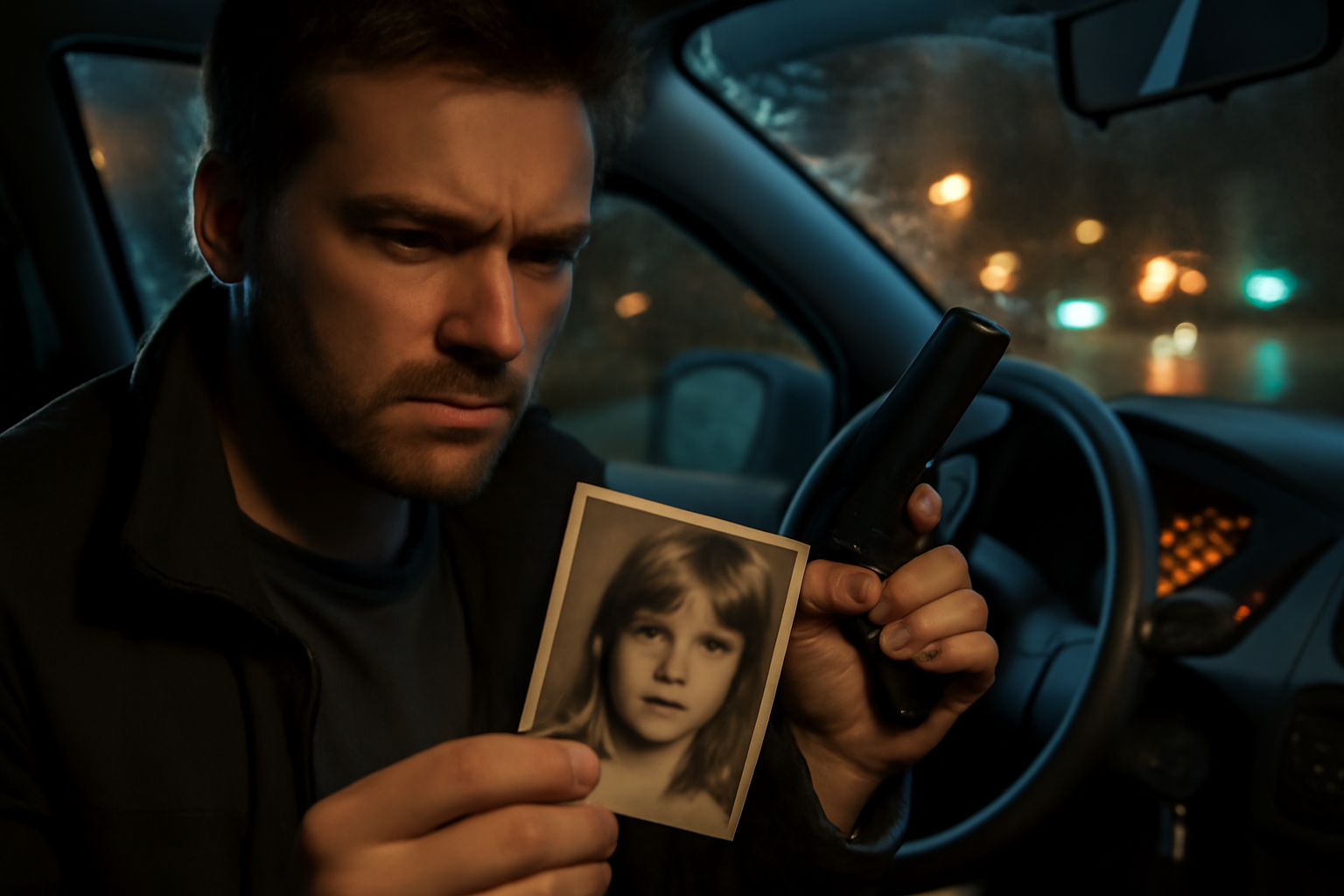
And at the bottom of the stack was a photograph.
It was grainy, taken from a distance with a telephoto lens. It showed a playground. A girl was on the swings. She looked about nine or ten.
My heart hammered against my ribs. I knew that face. I knew the shape of the chin, the way the hair fell over the left eye.
I flipped the photo over.
Subject: M. Location: Chicago, IL. Status: Healthy. Payment Received.
The date on the photo was 2002. Four years after she “died.”
The room spun. I had to grab the edge of the mahogany desk to keep from falling.
She wasn’t dead. She wasn’t eaten by wolves. She didn’t freeze.
They sold her. My parents, the pillars of the community, had sold their own daughter to pay a debt.
I looked at the gun in the open drawer of the desk—my father’s old .38 special. I picked it up. It was heavy. Cold.
I packed a bag. I took the file. I got into my car and pointed it east, toward Chicago.
The blizzard of ’98 didn’t kill my sister. But the storm I was about to bring down on everyone involved? That was going to be lethal.
PART 2: The Hunter
CHAPTER 3: The Cold Trail in the City of Secrets
Chicago in late December felt like the opposite of Aspen. Aspen’s cold was clean and sharp, a natural predator. Chicago’s cold was industrial, gritty, and laced with the smell of wet exhaust and desperation. It settled over the city like a blanket of rust.
I checked into a cheap motel near the Loop, the kind of place where the curtains don’t quite close and the air conditioning unit sounds like a dying machine gun. I didn’t want luxury; I wanted anonymity. I was here on a one-man mission, fueled by two decades of suppressed rage and the sickening realization that my entire childhood was a theatrical production of mourning.
The first few days were spent translating my father’s coded files. He hadn’t been a careful criminal; he had been an arrogant one. The annual payments weren’t made to a person, but to a shell corporation called ‘Aequitas Holdings.’ It was a classic money-laundering funnel, but the final recipient, listed deep within the corporate registry, was an entity known as The Harrington Family Trust.
The name sent a chill down my spine that had nothing to do with the wind whipping off Lake Michigan. The Harringtons. Old Chicago money. Real estate, banking, and a reputation for keeping their affairs utterly clean—and utterly private. They were untouchable. They could buy and sell my father ten times over.
Why would a family like that want my little sister?
I pulled up the address linked to the Trust: a massive, pre-war mansion in the Gold Coast, shielded from the street by wrought-iron gates and towering hedges. Not the kind of place you just walk up to with a photo and say, “Did you buy my sister?”
I started small, focusing on the coordinates scrawled on the back of the 2002 photograph. It led me to a private academy playground on the North Shore. I spent a bleak Tuesday morning sitting in my rental car, watching affluent children in expensive uniforms play tag, trying to superimpose the face of the six-year-old in the snow onto these carefree kids.
The groundskeeper, a man named Manny who looked tired down to his soul, was raking leaves that the wind immediately blew back. I approached him, flashing my PI badge and inventing a story about a missing inheritance linked to a former student.
I pulled out the photograph of nine-year-old Mia.
Manny looked at the picture, his brow furrowing. He was silent for a long moment, watching the kids.
“Yeah,” he finally grunted, his voice rough. “I remember her.”
My breath caught in my throat. “You do?”
“Sure. The little blonde one. Always quiet. Didn’t mix much with the others. She came here for a few years. Used to sit by herself on the swings, reading.”
“What was her name?” I asked, trying to keep the desperation out of my voice.
Manny shrugged, leaning heavily on his rake. “Don’t recall. We just called her ‘The Quiet One.’ But she wasn’t a Harrington. The Harringtons were like royalty here. She was… attached to them, though. Always dropped off by the same black sedan.”
“When did she leave?”
“Must’ve been… maybe ’05? ’06? She just stopped showing up one spring. No farewell party, no moving announcement. Just gone. The Harrington Trust pulled her tuition and that was that.” He narrowed his eyes, studying my face. “You know, you got her eyes. Same blue.”
The recognition was a sharp, physical pain. Mia was here. She was safe, she was educated, but she was still moving in the shadows of my parents’ conspiracy. And then, she vanished again. The trail was eight years colder than I thought.
“Did you ever see the people who drove her?”
“Just the drivers. Always a rotation. But there was one guy… he wasn’t a chauffeur. He was too formal. Too stiff. Looked like a lawyer or a fixer. Always wore a camel hair coat, smoked these long, skinny cigars. He was the one who came the day she left.”
“Do you remember his name?”
Manny spat on the ground. “No. But I remember the car. It wasn’t a Trust car. It was a private plate. From out of state. Wisconsin, maybe. I jotted it down once, for no reason, just boredom. I think I put it on the old maintenance log.”
He led me into a cramped, dusty shed. After fifteen minutes of rooting through stacks of moldy paper and broken sports equipment, he pulled out a yellowed ledger.
Manny ran his finger down the page from 2006. “Here it is. April 14th. Complaints about a non-Trust vehicle blocking the service entrance. Plate number: 894-L-E, Wisconsin.”
I felt a surge of adrenaline so potent it nearly blinded me. A name. A license plate. A connection to the “fixer.”
I thanked Manny, slipping him a hundred-dollar bill that made his tired eyes widen slightly. As I drove away, I looked back at the playground. For a few years, Mia had existed here, a fragile secret in a hostile world. Now, I had to find the man who moved her. The man who knew why a six-year-old had been sacrificed to keep the Reynolds name clean.
CHAPTER 4: The Debt and the Collateral
The Wisconsin plate led me straight to a corporate attorney in Milwaukee named Lawrence Elias. He wasn’t a high-profile criminal lawyer, but a specialist in trust administration and asset protection for high-net-worth individuals—the perfect paper trail cleaner. The man in the camel hair coat.
I didn’t call. I drove the six hours to Milwaukee and found his office in a generic high-rise downtown.
I chose the direct approach. I didn’t want a conversation; I wanted a confession. I waited until 6:30 PM, after the secretaries had left and the office was quiet. I used my lock-picking skills, honed over years of breaking into cheating husbands’ apartments and corporate thieves’ file cabinets, to get into the building and then into Elias’s private office.
I sat in his executive leather chair, facing the door. The .38 Special from my father’s desk was on the polished mahogany. I wasn’t planning on using it, but I needed the presence of danger in the room.
Elias walked in at 7:05 PM, humming a Christmas tune, briefcase in hand. He flipped the light switch and froze.
“Who the hell are you?” His humming died in his throat. His face, soft and pink, went instantly white.
“Jack Reynolds,” I said, my voice low and steady. “We need to talk about my sister. Mia.”
He dropped his briefcase. Papers scattered across the floor. “I—I don’t know anyone named Mia.”
I slowly pushed the photo of the nine-year-old girl across the desk. “Wrong answer, Lawrence. You know the girl in this picture. You facilitated the transfer of funds. You drove the getaway car in 2006. You were my father’s cleanup crew.” I tapped the .38 with my finger. “Now, tell me everything. Start with why my parents left their six-year-old child to freeze to death in a blizzard.”
Elias stumbled back against the filing cabinet, his hands shaking violently. He was a shark in the courtroom, but a coward when confronted by actual threat.
“Your father… Richard was in deep,” Elias stammered, licking his lips. “It wasn’t just a business loss, Jack. It was the Russian syndicate. He borrowed nearly three million to cover up a disastrous real estate scam. When the syndicate came to collect, Richard couldn’t pay.”
My blood ran cold. This was worse than I imagined. “What does that have to do with Mia?”
Elias sat down heavily, defeat radiating from him. “The syndicate doesn’t like loose ends. Richard had two children. He couldn’t pay the principal. So they offered a… a settlement.”
He took a shaky breath. “Mia was never sold for money. She was the collateral. The debt was tied to a payment plan—the Aequitas transfers. The syndicate had connections in adoption networks, private placements. They knew the Harringtons were desperate for a younger daughter. They offered Mia as a ‘favor’ to the Harringtons—a highly sought-after, legitimate adoption, but with the condition that Richard’s debt payments continue in secret to the syndicate through the Trust, guaranteeing his silence and compliance.”
“So, they used Mia to pay off his killers and keep him quiet?” I felt sick.
“It wasn’t quite that simple. Richard was given two choices: lose everything, including his life, and risk exposing Martha’s role in the initial fraud… or give up Mia, ensuring the syndicate’s silence and placing her with a powerful family that would protect her.”
“Protect her? They abandoned her in the snow!”
“The Harringtons were ready to adopt immediately. They had to make it look like an emergency, a plausible scenario. Richard was supposed to leave her at a specific, designated spot just off the road where the Harrington driver was waiting five minutes down the road. They needed the scene to look like a tragedy, so there would be no questions later, no paper trail.”
“And the driver failed?”
“No. Richard just got scared. The blizzard was worse than expected. He stopped too early. He panicked and left her further back than planned. He told me later he thought he saw someone else watching them… a rival business partner. He just drove away and called the driver frantically.”
Mia wasn’t just abandoned. She was a political sacrifice in a dark game of debt and power. The Harringtons were just the receivers of stolen goods.
“Where is she now?” My voice was barely a whisper.
Elias pulled a clean handkerchief from his coat and wiped his forehead. “The Harringtons relocated in 2006. When the syndicate completed the last debt payment, they severed ties with all intermediaries. They wanted a fresh start, total security.”
He opened his briefcase, revealing a secured tablet. He tapped a few keys. “This is a direct, encrypted file from the Trust. I keep it only in case I ever needed leverage.” He turned the screen toward me.
The screen showed a profile: Chloe Harrington, Age 28.
“She’s a journalist,” Elias said, pointing to the occupation. “Based in Washington D.C. She has no idea about her past. They changed her name to Chloe and removed all adoption records. They created a history. They did it for her protection, Jack. Because if the syndicate ever connected her back to Richard, she would be a target.”
“Washington D.C.,” I repeated, standing up. “What did they tell her?”
“They told her they found her in an orphanage in Europe. They wanted her to believe she was safe, beloved, and disconnected from the dark world they all live in.” Elias looked at the gun, then at me. “She’s a Harrington now. You go near her, you involve her in this, and you will bring the entire weight of that family down on you. They are not Richard. They don’t make mistakes.”
I picked up the .38, its weight comforting and familiar.
“Lawrence,” I said, looking him in the eye. “I am done watching people abandon my sister for the sake of appearances. My mistake was staying silent for twenty years. That ends now.”
I left him there, weeping softly in his expensive leather chair. I didn’t care about the Harringtons. I didn’t care about the syndicate. All I cared about was one fact: My sister was alive. And she was less than 700 miles away.
The hunter had found the fox’s lair. Now, the true hunt was about to begin.
CHAPTER 5: The Shadow in Georgetown
Washington D.C. is a city of layers. Beneath the monuments and the marble is a subterranean network of influence, power, and deeply buried secrets. It felt like walking into the heart of the conspiracy. Unlike the stark, open lies of Aspen or the paper trail corruption of Chicago, D.C. felt like a labyrinth designed to confuse and consume the truth.
I rented an apartment in Arlington, across the Potomac, giving me a strategic distance and a clear view of the city I was infiltrating. I found Chloe Harrington’s file almost instantly. The Harringtons were proud of her: Chloe Harrington, 28, Investigative Reporter for the Global News Network. She lived in a beautiful, historic row house in Georgetown, the kind of place my parents would have envied.
For two days, I didn’t approach her. I only watched. I wanted to understand the life they had built for her, and more importantly, how well they were guarding it.
I set up surveillance near her office and apartment, using equipment far more sophisticated than anything my old Denver clients required. What I saw confirmed my worst fears: Elias hadn’t exaggerated the danger.
Chloe was never truly alone.
A dark sedan, always parked discreetly down the block, had two men inside. They read newspapers, fiddled with their phones, and never took their eyes off her door. They were professionals. Private security, almost certainly Harrington assets, but they had the coiled tension of men who were ready to be something much worse than bodyguards. They were keepers.
Watching her was agonizing. She looked so much like the Mia I remembered, but with an adult’s confidence and sophistication. Her eyes—my eyes—were sharp and intelligent. She moved with a purpose, a focused energy that suggested she was hunting for her own version of the truth, perhaps unaware of the massive lie that constituted her foundation.
I saw her laugh with a colleague outside a café, a genuine, full-throated sound that echoed the innocent laughter of the little girl I last saw running on an icy road. It hit me like a physical blow: I wasn’t just here to find a file; I was here to rescue a soul I had betrayed two decades ago.
I knew a direct approach would fail. She would call the police, or worse, her security detail, who would make sure I disappeared into the D.C. bureaucracy. I had to use her instincts against her. I had to appeal to Chloe the Investigator, not Mia the victim.
I drafted an email to her secure work address, using an encrypted server and a burner laptop.
Subject: Source on a Buried Aspen Scandal, Dec ’98.
Ms. Harrington,
I have information regarding a cover-up involving your adopted family and the sudden disappearance of a child in Aspen, Colorado, in December 1998. This involves major financial fraud, a powerful syndicate, and an elite Chicago family. The trail has gone cold, but I have primary documentation that proves the official police report was fabricated.
This story, if revealed, would be the biggest scandal to hit the Harrington name in a generation. I’m contacting you because I believe you value the truth more than your family’s reputation. I require discretion and proof of your identity. If you are interested, respond with the name of the mascot of the last high school you attended.
Source: Jack.
It was crude, but it was tailor-made to ignite her journalistic fire. She wouldn’t be able to resist. The mention of “Aspen,” “December 98,” and “syndicate” was too specific to be random spam.
The reply came seven hours later, at 2:00 AM. A single, terse line: The Eagles.
The bait had been taken.
I proposed a meeting at an obscure, high-end cocktail lounge near Dupont Circle called The Cloakroom. It was a perfect neutral zone: dark, with comfortable booths, and just noisy enough to prevent easy listening. I chose a corner booth that allowed me to monitor the entrance and exit.
I arrived an hour early. I wore a suit, blending into the post-work D.C. crowd of lobbyists and staffers. I watched the door, my heart pounding a rhythm that felt too loud.
The security detail showed up first. Two men. They didn’t come in, but they established positions—one across the street near a newsstand, the other lounging near a planter half a block away. They were running perimeter defense. Chloe Harrington was not a soft target.
Ten minutes later, she walked in.
She was stunning, radiating competence and a fragile, guarded beauty. She scanned the room with the professional intensity of someone used to spotting lies and avoiding threats. She moved through the crowd, heading directly for my booth.
As she slid onto the leather seat across from me, the lighting caught her eyes. They were the same startling shade of blue I remembered from the back of the Ford Explorer. They were my sister’s eyes.
“Jack,” she said, without preamble. It wasn’t a question. It was a challenge. “I’m Chloe Harrington. I don’t deal with anonymous sources who try to blackmail me, but your story is specific enough to pique my interest. I want your documents, and I want them now.”
She looked straight through me, demanding the truth. And in that moment, I knew that even after twenty years and a new identity, Mia was still the fearless one.
CHAPTER 6: The Unveiling
The waiter came, and Chloe ordered a single, neat bourbon, an indication that she wasn’t here for small talk. She leaned forward, the darkness of the booth highlighting the sharp angles of her face.
“Start talking, Jack,” she commanded. “Who are you, and what connection do you have to my family’s past? I run the background checks on my sources. You don’t exist in my world.”
“That’s because my world was designed to protect your lie,” I said, keeping my voice low. “The Harringtons are your adoptive family, Chloe. But you know that, don’t you?”
Her eyes flickered, just a millimeter of doubt, but she recovered instantly. “I was adopted from an orphanage in Geneva, Switzerland. My parents have been completely transparent about my past. Are you going to threaten me with a fake adoption scandal? That’s boring.”
“You weren’t adopted from Geneva. You were adopted from a snowdrift outside Aspen, Colorado, twenty years ago,” I countered. “Your birth name is Mia Reynolds.”
The glass of bourbon, which she had just raised to her lips, stopped midway. The silence in the booth became suffocating, cutting through the background chatter of the bar.
“Get out,” she whispered, her face going pale. “I don’t know who you are, but you are sick. My parents were there when I was born. They have the records.”
“They have forged records,” I corrected gently. “The Harringtons are masters of illusion. But they couldn’t scrub everything. They couldn’t scrub the nightmares.”
“Stop it.” She slammed the glass down, the ice cubes rattling loudly. “If you don’t leave, I’m calling my security. You’ll be arrested before you hit the street.”
“Go ahead,” I challenged, meeting her gaze. “But before you do, look at this.”
I reached into my inner jacket pocket and pulled out two things. First, the grainy, slightly faded photograph of the nine-year-old girl on the swing set in Chicago.
She stared at it. Her hand trembled as she reached out. “Where did you get this?” she breathed. “I… I recognize this playground. I haven’t seen it in years.”
“That was you in 2002. Four years after you were supposedly dead.”
Then, I pulled out the second photo: a picture of Mia and me from Christmas 1997. She was six, sitting on my knee, grinning fiercely, holding Mr. Jenkins. I was ten, awkward, with my arm wrapped tightly around her.
“My name is Jack Reynolds,” I said. “I am your older brother. I was in the car when they left you in the snow.”
Chloe’s denial crumbled. The journalist façade shattered. Her eyes filled with something primal—a mixture of agonizing recognition and absolute horror. She wasn’t seeing a blackmailer; she was seeing a ghost from a trauma she didn’t know she remembered.
“That… that bear,” she stammered, pointing at the photo. “Mr. Jenkins. I lost him. I lost him when… when I was very small. I thought it was a dream.”
“It wasn’t a dream. It was Christmas Eve. The song on the radio was A Holly Jolly Christmas. My mother was wearing the sapphire necklace my father gave her. And you were screaming ‘Jack!’ as we drove away.”
The detail was too specific. It wasn’t in any official report. It was a shared nightmare. Tears streamed silently down her face, the polished composure dissolving into the terror of the six-year-old girl lost in the dark.
“Why?” she choked out. “Why are you doing this now? Why didn’t you find me then?”
“They told me you died,” I confessed, the guilt ripping through me. “They buried an empty casket. They threatened me into silence. I spent twenty years believing I was an accessory to your murder. I found the truth a week ago, in my father’s safe.”
I explained, briefly and cautiously, the debt, the Russian syndicate, the collateral. I told her the Harringtons took her to save her from the syndicate’s immediate wrath, but that they used her to keep my father silent and pay off their own leverage.
“Your life, Chloe, was the final invoice for Richard Reynolds’ debt.”
She stood up abruptly, knocking the small table. Her face was pale with shock, her hands clenched into fists. “My father, Mr. Harrington, saved me! He gave me a life! He’s an honorable man!”
“He’s a powerful man who bought a clean conscience with a stolen child,” I countered. “The Harringtons protected you, yes, but they did it by erasing Mia. They built your life on a lie. And I came here to tell you that the debt is not fully paid. The people who wanted your father dead might be watching you even now. They have you under surveillance.”
I tilted my head toward the door. “The two men across the street? They aren’t yours. They are the Harringtons’ cleanup crew. They are the people who keep the lie intact. They watch you so you never, ever find out who Mia Reynolds was.”
Her eyes darted to the window, then back to me, the fear giving way to a cold, journalistic fury. “I need proof. I need the documents,” she demanded.
“I have them,” I confirmed. “But I won’t give them to you here. Not yet. This isn’t just a story, Mia. This is a threat. You need to trust me, your brother, for the first time in twenty years, because we are in danger. They know I’m looking for you. The Harringtons are about to learn that you can’t bury a secret as big as a six-year-old girl in the snow forever.”
I stood up, leaving the two photographs on the table.
“I’ll contact you tomorrow. Don’t go to your office. Don’t call your parents. Just stay quiet and watch the windows.”
I walked out of the Cloakroom, knowing I had just detonated the life of the only person I had ever truly loved. I could feel the eyes of the two security men on my back, but I didn’t care. The line had been drawn. The Harringtons now knew that Mia was no longer a secret.
CHAPTER 7: The Trap and the Truth
I met Mia—I had to start calling her Mia in my head, reserving Chloe for her public persona—in the dark, wet hours before dawn. The location was the Lincoln Memorial, empty except for the ghosts of history and the Harrington perimeter guards. She had contacted me through a secure text, using coded language about “missing sources.”
She was waiting on the steps, hunched into her heavy coat. The marble was slick with rain. When I approached, her expression wasn’t one of gratitude, but of cold, calculating professional focus. The fear was still there, but now it was tightly controlled.
“I called my mother, Mrs. Harrington,” she began, not meeting my eyes. “I asked about Geneva. She launched into a perfect, detailed story about the convent and the paperwork. It was rehearsed. Flawless. But the way she held the phone, Jack… she was too calm. Too perfect.”
“They’ve had twenty years to rehearse the lie,” I said, handing her a thick, encrypted memory drive. “The documents are all here. Bank records showing the Aequitas payments. The original, un-filed police notes from Sheriff Miller’s deputy—the ones that mention the tracks stopped abruptly, too cleanly for a child who wandered off. And Elias’s signed, notarized affidavit detailing the debt to the syndicate and the collateral agreement.”
She took the drive, her fingers brushing mine. The contact sent a jolt through me, a reminder of the shared blood and trauma.
“And what about the syndicate?” she asked, her voice hushed. “Elias’s affidavit is vague. He mentions a ‘Russian group operating out of Long Island.’ What was the original fraud? Why was my father in that much debt to them?”
“That’s the hole in the story,” I admitted. “My father was a coward, but he was meticulous about his own protection. The main debt file—the one detailing the asset fraud that necessitated the whole mess—wasn’t in the safe. He only kept the payment receipts there. The original contract is the leverage. If we don’t have that, the Harringtons can discredit Elias, claim this is a simple adoption misunderstanding, and bury you in legal battles.”
Mia finally looked up, her blue eyes piercing the gloom. “They didn’t just give me a new life, Jack. They bought a clean slate for themselves and for your father. They have to know what the original debt was. It’s their insurance policy.”
“Exactly. And if we expose the why, we don’t just expose the Harringtons; we expose the syndicate’s financial structure. That’s a massive federal case.”
“Then we have to get it,” she stated firmly. “My career, my entire identity, is based on finding the truth and holding power accountable. I can’t let this be just another tabloid story about a rich family’s secret. This is global corruption tied to my life.”
“Where would he keep something that dangerous?” I mused, scanning the distant White House lights. “Something more important than the money, more hidden than the safe…”
“Think about the night he left me,” Mia urged. “He was drunk, scared, but he was driving back to the cabin. He wanted to get home. He went to the place where he felt safest, even if he didn’t deserve to be safe.”
The cabin. The Aspen estate. A sprawling, old, isolated structure that my father always treated like a vault.
“He had a study,” I whispered, a memory clicking into place. “It had a massive stone fireplace. He used to sit there for hours, even when the fire wasn’t lit. He called it ‘The Keeper.'”
Before we could discuss the logistics, a sudden, blinding flash hit us. It came from a high-powered camera across the reflecting pool.
“They found us,” Mia hissed, pulling her hood up.
“It’s not just a photo,” I warned. “They’re trying to spook us. Look.”
The black sedan, previously parked discreetly near the museum entrance, was now moving slowly toward the memorial grounds. It wasn’t driving toward the exit; it was driving toward us.
“They’re not waiting for backup,” I realized. “They want to handle this quietly, right now. No arrests, no questions. This is the cleanup crew.”
“We run,” Mia said, already moving down the steps toward the street.
“No, we hide. If we run, they catch us in the open. We need to lose them in the city’s underbelly.”
We darted into the shrubbery surrounding the memorial, cutting through the muddy lawns toward the back streets. I could hear the heavy thud of boots running on the paved paths. They were closing fast.
“They know who you are now, Jack,” Mia gasped, her journalist training giving her surprising speed. “If they catch us, they don’t ask questions. The Harringtons will frame this as a kidnapping attempt.”
We slipped into an alleyway, the narrow passage reeking of garbage and rain. I pulled out the .38 Special, checking the clip. It was heavy, reassuring.
“We need a car, now,” I said. “And we are going back to Aspen. If we give them the documents, they stop watching the cabin. That’s our only chance.”
We exited the alley two blocks away and managed to flag down a beat-up taxi, jumping in before the driver could protest. I yelled the address of the nearest rental car agency, throwing a wad of cash into the front seat.
As the taxi sped away, I looked back. The black sedan was already turning the corner, its headlights slicing through the rain. They had lost us, but only for a moment.
“They’re going to check the airports and trains,” Mia said, breathing heavily. “We drive. The long way. And we can’t stop until we hit Colorado.”
We were officially fugitives, but now we were united. We were the children of the snow, finally heading back to face the place that had tried to erase us.
CHAPTER 8: The Blizzard’s Final Secret
The drive west was a blur of caffeine, silence, and the tense sound of the car radio. We talked only in whispers, going over every detail of the Harrington files. Every stop for gas felt like a trap. We were two ghosts driving into the landscape of our worst nightmares.
When we finally reached Aspen, the world had turned white again. A late-season snowstorm had moved in, mirroring the deadly blizzard of 1998. The irony was suffocating.
My father’s cabin was vacant. The windows were boarded up, a ‘For Sale’ sign staked into the frozen lawn. We parked a mile away and approached on foot, cutting through the dense pine forest. The silence was absolute, broken only by the crunch of our boots in the deepening snow.
“The fireplace,” I whispered, pointing to the massive stone structure that dominated the living room. “The Keeper.”
I used a crowbar from my PI kit to force open a side window. The air inside was freezing, stale, and thick with the ghost of cigar smoke.
We went straight to the study. The fireplace was cold, immense, built of rough-hewn granite. I ran my hands along the mantel, then down the massive stone hearth.
“I remember my father sitting here,” I told Mia. “He’d stare at this center stone, right here, for hours.”
I got down on my knees, running my fingers along the mortar. There it was: a hairline fracture I knew shouldn’t be there, subtly masked by decades of soot.
“Help me,” I instructed.
We worked together, prying the heavy stone free. It took all our strength, but it eventually shifted, revealing a shallow, dark recess in the granite behind it.
Inside was a thin, locked steel box. I used a tension wrench and a rake from my kit. Click.
Mia snatched the box open. Inside were two items: a stack of hundred-dollar bills, and a single, yellowing piece of paper—the original debt contract.
It was titled: Agreement on Collateral and Silence: The St. Petersburg Syndicate.
The terms were horrifying. Richard Reynolds had embezzled money from a major construction project tied to the syndicate. The contract stipulated that if the collateral—Mia—ever attempted to contact her family, or if the debt terms were violated, the syndicate reserved the right to “neutralize the asset and all associated parties.”
The names listed on the contract were not just Russian. They included a high-ranking D.C. official who had facilitated the Harringtons’ adoption and covered the legal fees. The Harringtons were not just purchasers; they were deep collaborators.
“This is it,” Mia breathed, her face illuminated by the light from her phone. “This is everything. The whole structure.”
“Upload it now,” I urged. “Before—”
Too late.
A shadow fell across the window. The front door burst inward, shattering the silence. Two men—the same two from D.C., but now wearing ski masks—were in the doorway. Behind them, a third figure stood: a local man, the syndicate’s enforcer we later learned, who knew the land.
“Harrington sends his regrets, Jack,” one of the masked men growled, pulling out a silenced pistol. “He wanted to take the files quietly, but you forced his hand.”
“The files are already gone!” I yelled, knowing it was a lie, giving Mia the critical second she needed.
I lunged, knocking over a heavy antique lamp, plunging the room into near darkness. The first muffled gunshot tore into the wall where my head had been seconds before.
“Go, Mia! Run!”
She didn’t run. She ducked behind the heavy desk, frantically working on her phone.
I grabbed a wrought-iron fireplace poker and swung wildly. The sound of metal connecting with bone echoed horribly. The first security man staggered back, dropping his gun. I spun and used the moment to shield Mia.
“I’m uploading now, Jack!” she screamed over the ensuing struggle. “It’s going to my editor, the Post, and the FBI!”
The third man—the local enforcer—moved fast, grabbing my arm. He was strong, focused on stopping the upload. I heard Mia cry out as he kicked the desk, sending her phone skittering across the floor.
I broke free and dove for the .38 I had left under the stone. I leveled it.
“Stop!” I roared, the sound echoing in the empty cabin.
The syndicate enforcer hesitated, seeing the weapon. But the second security man, blinded by rage, charged me. I didn’t shoot. I shoved Mia hard toward the back exit just as the enforcer tackled me, the .38 flying across the room.
We struggled violently on the cold stone floor, the man trying to break my neck. I heard Mia scream my name one last time.
Then, a deafening blast. Not the muffled sound of a silenced pistol, but a full, terrifying shotgun roar.
The local enforcer collapsed on top of me, heavy and lifeless.
I pushed his weight off and looked up. Mia was standing in the doorway, holding a huge, double-barreled shotgun—my father’s old hunting rifle, which she must have found in the hall closet. Her face was streaked with soot and tears, but her eyes were steady.
“You said… you said you couldn’t leave me again,” she whispered, lowering the heavy gun.
I stumbled up, grabbing the abandoned .38. The remaining security man, seeing his partner down and hearing the shotgun, had fled into the storm.
We didn’t call the police immediately. We spent the next hour securing the files and cleaning up the scene just enough to hide our presence.
By the time we walked out of that cabin and into the renewed blizzard, the world was already changing. News alerts were flashing across every screen in the country. Chloe Harrington’s byline was attached to the biggest financial and political scandal of the decade. The Harrington Trust was collapsing. My father’s debt was finally paid.
Mia and I drove away, not as victims, but as survivors. We were still scarred by the snow, but we were finally, brutally, undeniably free. We had survived the long, cold hunt, and the truth, once buried, had finally come home.