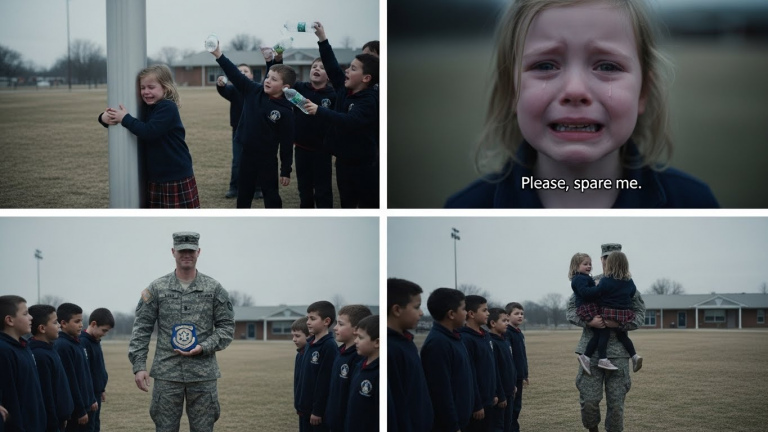
The Bully Broke His Father’s Medal. He Didn’t Know He Just Woke Up A Sleeping Lion.
Chapter 1: The Ghost in the Field Jacket
The town of Oakhaven, Ohio, was the kind of place where high school football wasn’t just a sport; it was a religion, and the players were its gods. At the top of that pantheon sat Brad Miller, the varsity quarterback and son of the town Mayor. Brad was built like a tank, with a smile that charmed parents and eyes that promised misery to anyone who didn’t bow down.
Then there was Leo.
Leo didn’t have a last name that people cared to remember. He was just “the kid in the jacket.” It was an oversized, faded olive-drab M-65 field jacket, dating back to the Vietnam era, fraying at the cuffs and missing a button near the collar. He wore it every day, regardless of the heat, draped over his frame like a shield. Underneath, he carried a battered Army duffel bag instead of a backpack, the canvas stained with grease and age.
Leo walked through the hallways of Oakhaven High like a ghost. He kept his eyes fixed on the linoleum floor, counting tiles to block out the noise. He spoke to no one. He sat in the back of the class. He ate lunch behind the bleachers. He was a shadow, and in a high school ecosystem, shadows are prey.
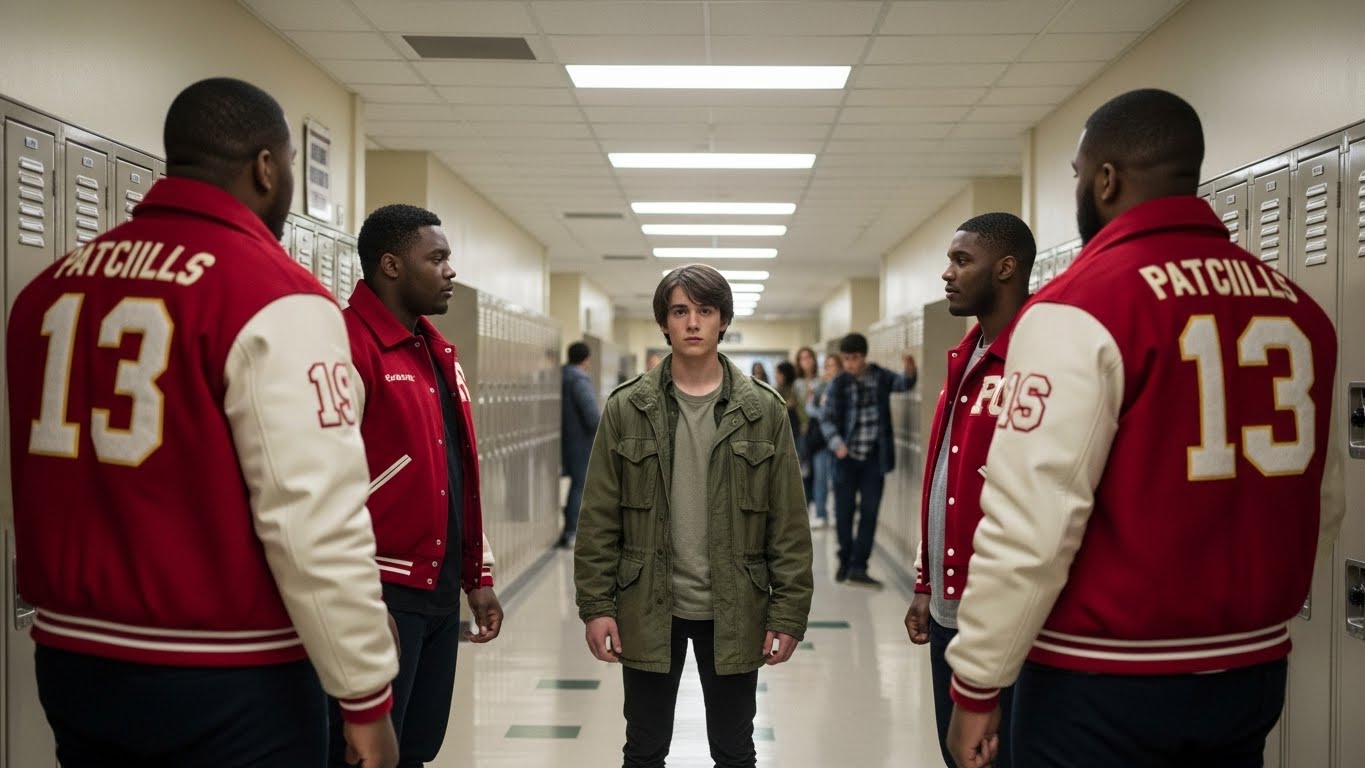
It was a Tuesday in November, the gray sky outside matching the mood in the corridor. The bell had just rung, and the hallway was a river of noise. Leo was navigating the current, hugging the lockers, when a heavy hand slammed into his chest.
The impact drove the air out of his lungs, pinning him against the metal locker bank. The sound of the collision—thud-clang—silenced the immediate area.
“Nice goodwill jacket, trash,” a voice sneered.
Leo didn’t need to look up to know it was Brad. The smell of expensive cologne mixed with locker room sweat was unmistakable. Flanking Brad were his two usual disciples, linemen who mistook bulk for personality.
Leo stabilized his footing. He didn’t flinch. He didn’t cower. He simply stood there, his eyes fixed on the center of Brad’s chest. His hands hung loosely at his sides, open and relaxed. To the untrained eye, it looked like surrender. To a trained eye, it was the “ready stance”—weight distributed, knees slightly bent, center of gravity low.
“I’m talking to you, mute,” Brad laughed, poking Leo in the shoulder hard enough to leave a bruise. “My dad says the city council is thinking about cleaning up the streets. Maybe we should start with you.”
Leo said nothing. His breathing was rhythmic, slow. In through the nose, out through the mouth.
“What’s in the bag, Leo?” Brad grabbed the strap of the duffel. “Cans you collected from the trash?”
“Let it go, Brad,” Leo said. His voice was raspy from disuse, but steady. It wasn’t a plea; it was a statement of fact.
Brad blinked, surprised the ghost could speak. “Or what? You gonna cry?”
Brad shoved Leo again, harder this time. Leo absorbed the force, stepping back with a fluidity that was almost unnatural. He didn’t stumble. He just moved, like water flowing around a rock.
Suddenly, a shadow fell over the group.
“Is there a problem here, gentlemen?”
The voice was gravel and old bourbon. Mr. Henderson, the AP History teacher, stood at the end of the hall. He was a man in his late sixties, with a stiff left leg and eyes that had seen things in the jungles of Southeast Asia that these boys couldn’t imagine in their nightmares.
Brad’s demeanor flipped instantly. The sneer vanished, replaced by the golden-boy smile. “No problem, Mr. Henderson. Just helping Leo here fix his bag. It looked heavy.”
Henderson didn’t smile. He walked forward, his limp pronounced but his pace purposeful. He ignored Brad and looked straight at Leo. He looked at the field jacket, noting the specific way the patches had been removed, leaving ghostly outlines on the fabric. Then, he looked at Leo’s eyes.
He saw the “thousand-yard stare.” It was a look that didn’t belong on a seventeen-year-old boy.
“Class starts in two minutes,” Henderson said, his voice low. “Move.”
Brad shoved past Leo, deliberately checking him with his shoulder. “See you later, trash,” he whispered. The goons laughed and followed their leader.
Leo remained still, adjusting the strap of his bag.
“Leo,” Henderson said softly.
Leo looked up.
“Silence is not weakness,” Henderson said, his eyes locking onto Leo’s. “But it takes a hell of a lot of strength to keep the safety on when the chamber is loaded.”
Leo paused. For a fraction of a second, the mask slipped, revealing a flash of intense, agonizing grief. Then, the wall went back up. He nodded once, barely perceptible, and walked away.
As Leo turned the corner, Henderson watched him go. The old veteran looked down at Leo’s hands. As the boy walked away, his right fist, hidden behind his thigh, unclenched. The knuckles were white. The blood rushed back into the fingers.
Henderson sighed, a heavy sound in the emptying hallway. “God help them if he ever decides to fight back,” he muttered to himself.
Chapter 2: The Promise in the Dark
The house Leo returned to that evening was too quiet. It was a small, two-bedroom rental on the edge of town, where the pavement turned to gravel. The furniture was sparse—military efficient. There were no pictures on the walls, only a folded American flag in a triangular case on the mantelpiece.
Leo dropped the duffel bag by the door and sat on the worn couch. He closed his eyes, and the memory washed over him, as vivid as if it were happening right now.
Six months ago.
The hospice room smelled of antiseptic and dying flowers. The rhythmic beeping of the monitor was the only clock that mattered.
Captain John “Jack” Miller lay in the bed. cancer had eaten away the muscle that had once made him a legend in the Special Forces. The man who had carried rucksacks through mountains and dragged wounded men through firefights was now barely eighty pounds.
But his eyes were still blue steel.
“Leo,” he rasped.
Leo, then sixteen, leaned in. He was holding his father’s hand, terrified that if he let go, the man would float away. “I’m here, Dad.”
“Listen to me,” Jack wheezed, fighting for every breath. “We… we trained. Since you were ten. You know… what you can do.”
Leo nodded, tears streaming down his face. His father had taught him everything. Not just how to throw a punch, but the physics of leverage, the anatomy of pain, the psychology of combat. Leo knew how to break a wrist in three places before the attacker knew the fight had started. He knew how to choke a man out with his own collar.
“You are… dangerous, Leo,” Jack said, his grip tightening with a surprising surge of final strength. “Your hands… they are lethal weapons now. Promise me.”
“Promise you what, Dad?”
“You don’t fight for pride,” Jack whispered intensely. “You never fight… because of words. You never fight… because of ego. If you hurt someone just because they made you mad… you’re not a soldier. You’re a bully.”
Jack coughed, a terrible, rattling sound.
“Promise me… you will hold the line. You only fight to protect the defenseless. Otherwise… you endure. You stand. You be the quiet professional. Promise me.”
“I promise,” Leo sobbed. “I promise, Dad.”
“Good,” Jack exhaled, his eyes drifting toward the ceiling. “Hold… the… line.”
Present Day.
Leo opened his eyes in the dark living room. The silence of the house pressed in on him.
“I’m holding it, Dad,” he whispered to the empty room. “But it’s getting heavy.”
He stood up and walked to the small kitchenette. He made a peanut butter sandwich, eating it over the sink to avoid making crumbs. He moved with a disciplined economy of motion. Every step was silent. Every action was deliberate.
He picked up the duffel bag and brought it to the table to do his homework. He unzipped it, and his heart sank.
The inside of the bag was wet. A sticky, white liquid coated his history textbook and his math notes.
Milk.
Brad must have poured a carton of milk into the bag while Leo was in the restroom during lunch. The papers were sodden, the ink running in blue rivers.
Leo stared at the mess. A surge of heat rose in his chest—a fiery, red rage that wanted to scream, to break something, to march over to the Mayor’s mansion and show Brad exactly what a “throat chop” felt like.
He closed his eyes. In through the nose. Out through the mouth.
He grabbed a roll of paper towels. He didn’t cry. He didn’t curse. He sat down and began to wipe each page, one by one, with the patience of a saint. He laid them out on the table to dry.
It took him three hours to salvage what he could. When he was done, he carefully repacked the bag. Then, he went to the closet and took out the field jacket. He inspected it for damage. It was the only thing of his father’s he could wear. It smelled faintly of old canvas and tobacco, a scent that made him feel safe.
He checked the inside pocket. The velvet box was still there. He never opened it at school, but he touched it every hour to make sure it was safe.
“Hold the line,” he whispered again.
Chapter 3: The Public Execution
The escalation began on Wednesday. Brad, emboldened by Leo’s lack of reaction to the milk incident, decided to up the ante. The silence offended him. It made him feel small, and Brad Miller did not like feeling small.
It happened in the cafeteria, the coliseum of high school social life.
Leo was carrying his tray—plastic meatloaf and mashed potatoes—walking toward the exit to eat outside. The cafeteria was crowded.
Brad was holding court at the central table, surrounded by the varsity team and the cheerleaders. As Leo passed, Brad stretched out a leg. It wasn’t subtle. It was lazy, arrogant, and perfectly timed.
Leo saw it. His peripheral vision was excellent. He could have stepped over it. He could have stomped on Brad’s ankle, shattering the joint. It would have been easy.
But that would be fighting for pride. That would be reacting.
So, Leo made a choice. He tried to stop, but the momentum carried him forward. He tripped.
The tray flew into the air. The mashed potatoes and gravy landed squarely on the front of his field jacket. The plastic tray clattered loudly on the floor.
Leo hit the ground hard, his knees skidding on the linoleum.
The cafeteria erupted.
“Touchdown!” Brad yelled, throwing his hands in the air. “Look at the grace! Look at the agility!”
Laughter crashed over Leo like a wave. It came from all sides. Students pointed. iPhones were raised, recording the humiliation for Snapchat and TikTok.
Leo stayed on his hands and knees for a moment. He looked at the gravy smeared across the name tape that read MILLER—his father’s name tape.
The rage was a physical thing now, a tightening in his throat, a trembling in his forearms. The lethal knowledge in his brain screamed at him: He is sitting down. His solar plexus is exposed. One strike. Just one.
Hold the line.
Leo stood up. He didn’t look at the cameras. He didn’t look at Brad. He picked up the tray. He picked up the scattered napkins.
“Missed a spot, trash,” Brad jeered, kicking a piece of meatloaf toward Leo.
Leo picked that up too.
He walked to the trash can, scraped his plate, and placed the tray on the conveyor belt. Then, he turned and walked out of the cafeteria.
He walked straight to the boys’ bathroom. He locked himself in a stall.
He took off the jacket and stared at the stain. He grabbed a handful of rough brown paper towels and wet them, scrubbing furiously at the fabric.
“I’m sorry, Dad,” he gasped, his breath hitching. “I’m sorry I let them dirty it. I’m sorry.”
The door to the bathroom opened. Mr. Henderson walked in. He saw Leo at the sink, shirtless, scrubbing the jacket with a desperation that was painful to watch.
Henderson stopped. He looked at the bruises on Leo’s back—old ones, from training, and new ones, from the lockers. He saw the scars.
“Leo,” Henderson said.
Leo froze. He put the jacket back on quickly, zipping it up to hide the stain.
“I saw what happened,” Henderson said quietly. “Brad Miller is a coward.”
“It doesn’t matter,” Leo said, staring at the mirror but avoiding his own reflection.
“It matters,” Henderson replied sternly. “There is a line, son. Discipline is admirable. But martyrdom is not a strategy. You have rights.”
“I made a promise,” Leo said, his voice cracking.
“To who?”
“To my father.”
Henderson’s eyes softened. “Your father… was he military?”
“Army,” Leo said shorty. “He died six months ago.”
Henderson nodded slowly, the pieces falling into place. “I was in the 101st Airborne. Vietnam, ’68.”
Leo turned to look at him, really look at him, for the first time. He saw the weariness in the teacher’s posture.
“Then you know,” Leo said. “You know you don’t use the weapon unless you have to.”
“I know,” Henderson agreed. “But Leo… sometimes the weapon isn’t a fist. Sometimes it’s the truth. The Veterans Day assembly is on Friday. The Mayor—Brad’s father—is the keynote speaker. He’s going to talk about ‘Hometown Heroes.'”
“I know,” Leo said.
“Don’t let them take your dignity, Leo. That jacket… it means something. Don’t let them take that meaning away.”
“They can’t take it,” Leo said, and for a moment, his eyes were terrifyingly cold. “Because they don’t know what it costs.”
Chapter 4: The Sacred Violation
Friday arrived with the pomp and circumstance of a small-town holiday. The gymnasium was decked out in red, white, and blue streamers. A large stage had been erected. The Mayor, a portly man with a flushed face and a booming voice, was shaking hands near the entrance.
All students were required to dress up. Leo didn’t own a suit. He wore his cleanest pair of dark jeans and a white button-down shirt that was slightly too tight across his broad shoulders. And, of course, the field jacket.
The gym locker room was buzzing. The football team was changing into their jerseys; they were to sit in the front row as “examples of young patriotism.”
Leo was in the corner, changing his shoes. He had gym class right before the assembly. He had carefully hung the field jacket in his locker.
He returned from the restroom to find the atmosphere in the locker room had shifted. It was silent. Too silent.
Brad was standing by Leo’s locker. The locker door was open.
Brad was holding the jacket.
“Put it down,” Leo said. His voice wasn’t loud, but it carried across the room.
“Relax, G.I. Joe,” Brad smirked. “Just checking for fleas. My dad’s gonna be speaking, can’t have you stinking up the gym.”
Brad dug his hand into the deep front pocket.
“Don’t,” Leo warned. He took a step forward.
Brad pulled out the velvet box.
“What’s this?” Brad laughed. “Stole something from a pawn shop?”
“Give it to me,” Leo said. He was walking now. Not rushing. Stalking.
Brad popped the box open. The Silver Star gleamed under the fluorescent lights. The ribbon was patriotic, the star hanging heavy and gold. It was a medal for gallantry in action. Only the brave possessed them. Most received them posthumously.
“Shiny,” Brad sneered. “Bet this is fake. Just like your tough-guy act.”
Brad made a hacking noise in his throat and pretended to spit on the medal.
Time stopped.
Brad laughed and tossed the box over his shoulder. It hit the wet tiles of the shower floor with a sickening clack. Then, he threw the jacket onto the floor and wiped his muddy cleats on it.
“Oops,” Brad grinned.
The air in the room didn’t just change; it evaporated.
Leo stopped moving. He stood ten feet away from Brad. He looked at the jacket on the floor. He looked at the medal lying in the dirty water.
Something inside Leo snapped. It wasn’t a loud snap. It was the sound of a heavy vault door unlocking.
The promise was to protect the defenseless.
His father’s memory was defenseless.
Leo turned around and walked to the locker room door. He closed it. He turned the deadbolt. Click.
He turned back to face the room. There were six football players, including Brad. They were big. They were strong.
Leo took a deep breath. He rolled his neck. Crack.
“You think noise is power?” Leo whispered. The sound was low, vibrating with a menace that made the hair on the back of Brad’s neck stand up.
Leo looked up. His eyes were dead. There was no fear, no hesitation, no humanity. Only calculation.
“You have no idea what quiet looks like.”
Chapter 5: The Silent Storm
Brad laughed, but it sounded nervous. “You gonna fight us, freak? It’s six against one.”
“No,” Leo said softly. “It’s six sheep against a wolf.”
Brad roared and charged, throwing a wild, haymaker punch aimed at Leo’s jaw.
Leo didn’t block it. He simply wasn’t there when the fist arrived. He stepped inside Brad’s guard, pivoting on his left foot. He grabbed Brad’s extended arm, using the quarterback’s own momentum. With a precise, brutal twist, he locked Brad’s wrist and elbow.
Leo swept Brad’s legs. Brad hit the concrete floor with the force of a car crash. The air left him in a wheezing scream.
Leo didn’t punch him. He kept the arm lock, applying just enough pressure to make Brad scream in agony, but not enough to break the bone. Yet.
“Get him!” Brad shrieked.
Two linemen rushed Leo.
Leo released Brad and moved. He was a blur. He ducked under a swinging arm, grabbed a waist, and used a judo hip toss to send a 250-pound boy flying into the metal lockers. The locker doors dented inward with a deafening crash.
The third boy tried to tackle him. Leo sidestepped, grabbed the boy’s collar and belt, and guided him face-first into the wall.
It wasn’t a fight. It was surgery.
Within thirty seconds, five varsity players were groaning on the floor, clutching twisted limbs and bruised ribs. None of them had landed a single hit on Leo.
Only Brad was left standing, having scrambled to his feet. He was backing away, terror in his eyes. He looked at Leo and saw a monster.
“Stay back!” Brad yelled, holding up his hands.
Leo walked toward him. He didn’t run. He walked.
Brad threw a desperate kick. Leo caught the foot, twisted it, and swept the other leg. Brad fell again. This time, Leo dropped his knee onto Brad’s chest, pinning him to the floor.
Leo leaned down, his face inches from Brad’s. Brad was hyperventilating, tears streaming down his face.
“Please,” Brad whimpered. “Don’t hit me.”
Leo raised his fist. Brad squeezed his eyes shut, waiting for the impact.
Leo held the fist there. He breathed. In through the nose. Out through the mouth.
He saw his father’s face. You only fight to protect.
Leo slowly lowered his hand. He didn’t strike.
“I don’t need to hit you to beat you,” Leo whispered.
He stood up. The room was filled with the groans of the fallen “heroes.”
Leo walked to the shower. He picked up the velvet box. He wiped it gently on his shirt. He picked up the jacket, shaking off the dirt. He put the jacket on.
He walked to the door, unlocked it, and stepped out into the hallway, leaving the carnage behind him.
Chapter 6: The Weight of Truth
The gymnasium was full. The Mayor was at the podium, red-faced and sweating under the lights.
“…and that is why strength is our tradition!” the Mayor bellowed. “We raise our sons to be tough! To take what is theirs!”
The doors at the back of the gym opened.
Leo walked in. He was wearing the dirty jacket. He walked straight down the center aisle.
The crowd murmured. Why was this disheveled kid interrupting the Mayor?
Mr. Henderson, sitting in the front row of the faculty section, stood up.
Leo didn’t stop until he reached the stage stairs. He walked up the steps. The Mayor stopped speaking, looking annoyed.
“Son, you can’t be up here,” the Mayor said. “Get back to your seat.”
Leo ignored him. He walked over to Mr. Henderson, who had moved to the edge of the stage.
Leo handed Henderson the velvet box.
Henderson opened it. He gasped. He looked at the citation inside the lid. Captain John Miller. For conspicuous gallantry…
Henderson looked at the Mayor, then grabbed the microphone from the podium. The feedback squealed.
“Ladies and gentlemen,” Henderson’s voice shook with emotion. “We have been listening to a speech about strength. About heroes.”
He held up the Silver Star. The gold glinted under the lights.
“This,” Henderson said, his voice rising, “is a Silver Star. It belonged to Captain Jack Miller. A Green Beret. A man who died six months ago in silence, without a parade.”
The crowd went deadly quiet.
“His son,” Henderson gestured to Leo, “has been walking these halls every day. And every day, he has endured bullying, mockery, and abuse from the very people who claim to represent this town’s ‘strength.'”
Just then, the side doors burst open. Brad and his teammates stumbled in. They looked like train wrecks—limping, holding their ribs, clothes torn.
“He’s crazy!” Brad screamed, pointing at Leo. “He attacked us! He’s a psycho!”
The crowd gasped, looking at the bruised football team and then at the calm, solitary figure of Leo.
“Look at them!” the Mayor shouted, seizing the moment. “He assaulted my son!”
“No,” Leo spoke. He didn’t need the microphone. His voice was projected from his diaphragm, clear and commanding. “I didn’t attack them. I finished what they started.”
“He’s lying!” Brad yelled.
“Check the locker room cameras,” Leo said calmly.
The Mayor froze. The school had installed cameras in the locker area (outside the changing zones) to prevent theft.
Mr. Henderson looked at the Principal. “Check them.”
The silence stretched for five minutes while the Principal checked his iPad connected to the security feed. When he looked up, his face was pale.
“Well?” Henderson asked.
“Brad… Brad threw the first punch,” the Principal stammered into the silence. “Leo… Leo didn’t throw a single punch. He just… subdued them.”
The murmurs turned into a roar. The town stared at their star quarterback, who was cowering. They looked at the Mayor, who was shrinking behind the podium.
Then, they looked at Leo.
Leo stood tall. He looked at Mr. Henderson. “I held the line, sir.”
Henderson saluted. A sharp, crisp, military salute. “You did, son. You did.”
One by one, the veterans in the audience stood up. The old men from the VFW. They stood and saluted the boy in the dirty field jacket. Then the parents stood. Then the students.
Brad Miller slumped to the floor, small and defeated, not by violence, but by the crushing weight of his own inferiority.
Epilogue
Later that afternoon, the rain began to fall.
Leo stood in the town cemetery, the wet grass soaking his boots. He placed the Silver Star on the fresh soil of his father’s grave.
“I didn’t hurt them, Dad,” Leo said softly. “I just showed them the difference between a bully and a soldier.”
He felt a presence beside him. It was Mr. Henderson. The teacher didn’t say a word. He simply stood at attention, the rain dripping off the brim of his hat, keeping watch over the grave of a brother-in-arms.
The wind blew through the trees, rustling the autumn leaves. The silence wasn’t heavy anymore. It wasn’t a burden.
It was peace.