The Night I Found a Child Crying in the Snow, I Didn’t Know Her Mother’s Secret Would Expose My Own
Chapter 1: The Echo of Failure
The silence in my Capitol Hill apartment had a sound, and tonight, it was the hollow, mocking echo of my own failure. At thirty-two, I was Dr. Eleanor “Ellie” Vance, a children’s psychologist at a busy Seattle school resource center, an expert in mending the shattered edges of young lives. Yet my own life was a meticulously organized vacuum, a high-thread-count prison. My emotions were neatly filed under ‘Hazardous Materials’ and locked away behind a thick, professional veneer.
It was the kind of rare, heavy Seattle snow that turns the city into a quiet, judgmental cathedral. The fog was so dense it swallowed the Christmas lights whole, leaving only a sickly yellow glow on the sidewalks. And I was walking home from the worst blind date of my professional life.
My friend, Benji, a fellow counselor with an aggressively optimistic approach to my lack of dating life, had cornered me weeks ago. “Ellie, you spend eight hours a day saving kids. Can you spend two hours saving yourself?” He’d insisted I meet Travis.
Travis, a product manager for an obscure tech start-up, was a walking testament to my worst fears about connection. At the small, too-trendy cafe near Pike Place, he’d spent ninety percent of the date describing his ‘personal productivity ecosystem,’ complete with flowcharts and acronyms I couldn’t follow, and the remaining ten percent staring into the blue-lit void of his phone screen. He only looked up to nod vaguely when I mentioned my work with at-risk youth. The man was so deeply submerged in his digital world, he was practically a ghost.
My own motivation, I realized as I left the cafe, wasn’t to find love. It was to prove to Benji—and more importantly, to myself—that I could still perform ‘normal.’ But ‘normal’ felt like an ill-fitting costume, a flimsy shield. The moment I stepped back into the swirling, icy fog, I felt colder and more isolated than when I started. Travis hadn’t rejected me; he’d simply failed to see me. And that indifference felt like a more profound rejection than anything hostile. It confirmed the terrifying suspicion I carried: that my inner world was so contained, so devoid of true risk, that it was invisible to outsiders.
I cut down a narrow, cobblestone alleyway, a shortcut that ran behind the closed-up storefronts of antique shops and used book stores. I gripped the strap of my heavy leather purse, the only thing keeping me anchored to the present, a tactile reminder that I was real. The snow had muted all the city’s usual noise—the sirens, the frantic holiday music, the drunken laughter. It left only the sound of my own boots crunching on the fresh white powder, a solitary, repetitive rhythm.
And then, a thin, reedy sound cut through the quiet.
It wasn’t a sob. It was a choked, desperate, animalistic whimper. A sound stripped bare of all social pretense, pure pain.
My professional training, the thing I’d spent a decade honing, instantly took over. The part of my brain that dealt in DSM codes and trauma responses activated. I froze, every nerve ending screaming a warning. A child. Alone. At 9:45 PM on a freezing December night. My heart started a heavy, uneven thud against my ribs.
The whimper was coming from the recessed doorway of an old, shuttered bookstore, tucked behind a towering wooden display of forgotten classics. I hesitated for only a second, battling the primal fear that this was a trap, a setup. But the sound was too real, too small, too fragile.
I took three fast steps, rounding the corner of the display.
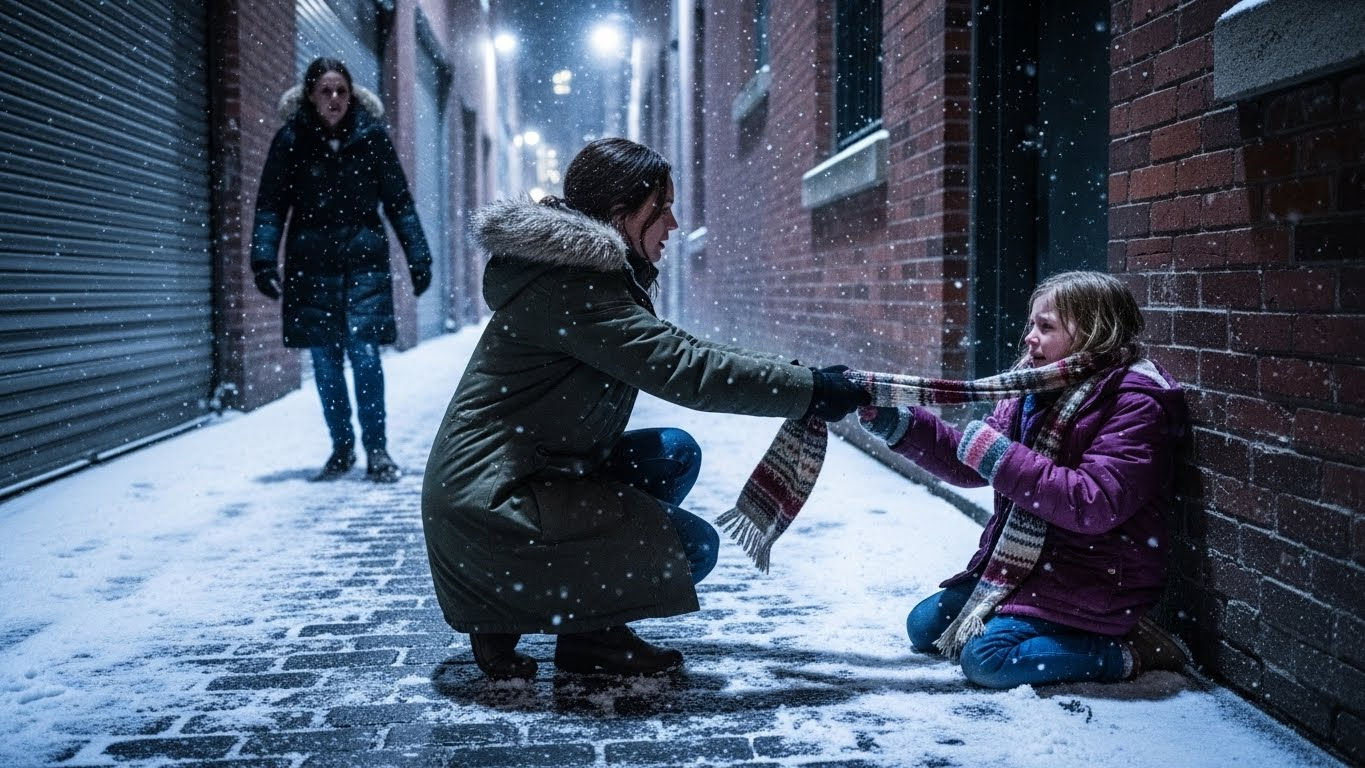
Curled in a fetal position, pressed tight against the cold stone, was a girl. She looked barely eight, tiny for her age, huddled into the darkest corner. Her coat, a cheap, synthetic thing the color of faded grape juice, was thin as tissue paper. Her knees were pulled to her chest, and she was shaking so violently her small body was rocking on the stone.
“Hey,” I said, my voice automatically shifting into the low, calm, non-threatening tone I used in my clinic when faced with a breakdown. “It’s okay. I’m Ellie. Are you hurt?”
She flinched so hard she almost fell sideways. Her head shot up, and the look in her eyes wasn’t just fear from being lost. It was absolute, visceral terror, a cold, empty terror I knew intimately. That look—blank, wide, and locked down—was the mirror image of Liam, a nine-year-old boy I’d failed five years ago, whose desperate plea for help I had tragically misread, leading to a family intervention that ended in disaster and permanent separation. That failure was the reason my life was now a carefully managed, sterile existence.
I didn’t need a diploma to recognize the signs of Level 3 Panic/Distress. The moment I saw her, I knew this wasn’t just a lost kid waiting for a parent. This was a secret. This was a situation rooted in deeper pain. And in my line of work, situations were the landmines I spent my entire career trying to disarm. The old wound—the one I kept locked up beneath my clinical detachment—began to bleed under the surface of my skin. Don’t fail this one. Don’t misread the signs. Don’t let her become Liam.

Chapter 2: The Invitation and the Lie
I didn’t touch her. Touching an unknown, traumatized child is the fastest way to break the fragile shell of their control, to collapse the wall they’ve built against the world. I knelt slowly, keeping my hands visible, making myself small and non-threatening. The snow had plastered itself to the side of her dark hair, already melting from the heat of her frantic body.
“My name is Ellie. I’m going to sit right here, and I’m not going anywhere. I’m going to stay until we figure this out. Can you tell me your name?”
It took a full minute, measured in the tiny, shallow breaths she was taking, before a word finally came out, no louder than the hiss of the falling snow.
“Molly.”
“Hi, Molly. That’s a beautiful name. Molly, are you cold? I am so cold.”
She didn’t answer with words, but a fresh tremor shook her body. The air was pushing below freezing; this wasn’t a matter of finding a parent soon; this was about the clock ticking on a health crisis. I reached for the thick, wool scarf I’d inherited from my grandmother—a rich crimson, the only truly comforting, non-sterile thing I owned—and offered it to her, dangling it gently.
“I have a rule,” I whispered, keeping my eyes soft, my tone steady. “When I get cold, I use this. It’s magic. It keeps the scary away. Do you want to try my rule?”
She reached out a single, tiny, red hand, chapped and ice-cold, and snatched the scarf, pulling it to her neck with a force that was shocking. She wrapped it around herself like a lifeline. It wasn’t a child’s timid acceptance; it was an involuntary, desperate act, and it confirmed my worst professional suspicion: this child was not used to comfort being freely offered. She knew how to survive, how to take what she needed, not how to be cared for.
She finally spoke, her voice still ragged, looking past me at the alley mouth. “I lost her. In the crowds. The lights… they were too much. I ran.”
I ran. That’s the detail that skewered me. Not “I was left behind,” or “I waited for her,” but I ran. Children run from danger, not just to safety. They run from something more terrifying than a few moments of loneliness.
I pulled out my phone and called the non-emergency police line, giving a calm, precise description of our location. While we waited, I gently coaxed details. She loved history—knew all the facts about the Space Needle. She loved her Aunt Clara’s dog, a scruffy terrier named Gus. She didn’t like loud noises, especially the sound of smashing glass. She never mentioned her mother by name, only “her.”
When the patrol car arrived, the lights painted the alley in frantic, artificial blue, momentarily shattering the silence. Molly clung to my hand, and the warmth of her grip felt like an electric current. It was the first time in years I hadn’t felt utterly numb.
At the sterile precinct, the air was thick with the smell of stale coffee and disinfectant. I was giving my statement when the door burst open.
“Molly! Oh, my God, Molly!”
The mother, Clara Alistair, rushed in. She was beautiful, polished, and visibly distraught. Designer coat, expensive-looking boots, hair perfectly messy in an expensive way. But beneath the surface of relief, I saw a flicker of something else in her eyes as she looked at me—a quick, assessing look that felt less like gratitude and more like damage control. It was the look of a person calculating the potential exposure of a secret.
The reunion was loud, almost too theatrical. Clara scooped Molly up, burying her in hugs, asking a flurry of frantic, self-centered questions that Molly, still shaky, couldn’t possibly answer. I stood back, observing the dynamic. Molly was subdued, almost shrinking away from the intensity of the embrace, clinging to the warmth of my grandmother’s scarf even as her mother held her.
Clara finally turned to me, her eyes wet with what seemed like sincere tears, but her jaw was set. “Eleanor Vance. Dr. Vance. I don’t know how to thank you. You saved her. You saved my little girl.”
She insisted on taking my number. “You can’t refuse this. You are coming to our house for Christmas dinner. This year, we’ll make sure you’re not alone. We have family coming—my brother, Dean, is a high school history teacher, you two would love each other. I insist. I’m inviting you into our family.”
I should have said no. A professional always maintains distance. I should have politely declined and filed the incident report in my brain under ‘Good Deed Done.’ But when I looked at Molly, who was now clutching her mother’s coat but staring at me with wide, silent questions, and then back at Clara, who was radiating a practiced, powerful veneer of grateful suburban mom, my professional ethical alarm went off.
The lie was in the polished performance. The secret was in Molly’s lingering fear. And my own old wound—the one that still screamed What if you missed the sign and it happens again?—demanded that I accept. This wasn’t a social call. This was an investigation.
“I’d be honored, Clara,” I lied, shaking her perfectly manicured hand. I wasn’t accepting a dinner invitation. I was initiating a psychological assessment. I was going to find out what Molly ran from, even if it destroyed the very fragile peace I had built for myself.
Chapter 3: The Protector and the Pedestal
Two weeks later, the snow was gone, replaced by the relentless, gray drizzle that truly defined a Seattle Christmas. I drove my modest, ten-year-old Toyota Camry out to the suburbs of Bellevue—a world away from my lonely, intellectual Capitol Hill apartment. Clara Alistair’s house was exactly what I expected: a large, cedar-shingled home, impeccably decorated, an American flag waving proudly on the porch. It was a picture of stability—the kind of stability Molly’s fear suggested was purely cosmetic.
I’d spent the last two weeks researching. Clara Alistair: recently divorced from a high-profile real estate developer, messy custody battle over Molly, and a recent, mysterious dip in her finances. The developer, Victor, was known for a volatile temper. It was all a textbook case of potential emotional distress in the child. Yet, I couldn’t shake the feeling that my initial assessment—Molly ran from something, not just away from a crowd—was still the truer narrative.
I rang the doorbell, adjusting the heavy silver pendant I wore—a tiny, physical anchor I used to ground myself when I felt my professional objectivity slipping.
Clara opened the door, a forced warmth in her smile. “Ellie! You came! Come in, come in. You’re our Christmas miracle.”
Inside, the house smelled overwhelmingly of pine, cinnamon, and, strangely, fresh sawdust. The air was heavy with the pressurized cheer of a forced family gathering. Molly was sitting quietly on the Oriental rug, assembling a complicated Lego castle, still withdrawn but less terrified. She gave me a tiny, genuine smile that hit me harder than any of my adult relationships.
I was introduced to Dean Alistair, Clara’s brother, the history teacher. He was not what I expected. Instead of the quiet, bookish type I’d imagined, he was tall, broad-shouldered, and intensely focused. He wore a neat plaid shirt and khakis, and had the kind of worn, honest hands that looked more comfortable holding a hammer than a piece of chalk. He was currently trying to fix a faulty string of Christmas lights that draped over the fireplace mantel.
Dean Alistair (35):
- Motivation: To be the unshakeable anchor for his sister and his niece, especially after a recent family crisis. He felt he failed his own core family (parents/late fiancée) years ago and won’t let it happen again.
- Pain: The loss of his fiancée, Emily, in a catastrophic car accident years ago—an accident he believes he could have prevented if he hadn’t been so preoccupied with a petty argument. This made him fundamentally mistrust his own judgment in moments of high emotional stress.
- Weakness: Emotional wall, tendency to overly intellectualize feelings, and a profound inability to let anyone in, viewing intimacy as a risk that could lead to another disaster.
- Detail: He fixes up old furniture in his garage as a form of therapy, stripping away the old damage to find the true structure underneath. He wears a small, tarnished silver ring on his pinky finger that belonged to Emily.
When Clara introduced us, Dean’s handshake was firm and quick, his eyes an unsettling shade of hazel that seemed to look right through my polite smile to the calculating mind underneath.
“Dr. Vance,” he said, his voice deep and measured. “Clara has told us how much we owe you. Thank you for your kindness.”
“Please, call me Ellie. It was just instinct. I was glad to help Molly.”
“Instinct,” Dean repeated, a slight arch in his brow. “A good trait in a psychologist, I suppose. Less useful in a historian. We prefer facts.”
The subtle dig—I see your clinical interest, and I don’t trust it—was clear. He was the protector. He had placed his sister and his niece on a pedestal of stability, and he viewed me as a potential threat, someone who could destabilize the carefully curated reality they lived in.
Throughout the dinner, he was attentive, but his focus was not on me; it was on Molly. He watched how she ate, how she responded to noise, and how quickly Clara drank her wine—a detail I had already noted. Every time a car horn sounded outside, Dean would subtly shift his body toward Molly, a human shield.
He was guarded, but his guard was exhausted. The lines around his eyes spoke of chronic, low-grade stress. When he finally talked to me, it was only about my work.
“You deal with a lot of trauma, Ellie. How do you reconcile the clinical distance you must maintain with the human imperative to simply care?” he asked, pouring himself a glass of iced tea instead of the wine everyone else was having.
It was the most authentic question I’d been asked all evening. I met his gaze, letting my professional shield drop just a fraction. “You don’t, Dean. You just choose which failure you can live with. The failure of detachment—which means you can’t help—or the failure of attachment—which means when the case ends badly, you’re the one who breaks.”
His eyes held mine. In that moment, the air shifted. It wasn’t about Molly anymore. It was about shared professional trauma, shared guilt. He nodded slowly, a ghost of pain passing over his face. “Attachment always costs more than detachment. But only one of them is actually living.”
Suddenly, the conversation was interrupted. Clara, after her third glass of wine, stood up, slightly unsteady. “Oh, look! Molly made Ellie a special present!”
Molly shyly presented me with a drawing. On the paper, rendered in thick, colorful crayon, was a woman holding a small child’s hand. They were standing under a cluster of impossibly bright, shining lights that looked like stars falling to earth. Below them, a small, dark shadow was retreating into the corner.
“It’s us,” Molly whispered, her eyes fixed on the retreating shadow. “You and me. And that’s the scary thing running away.”
Clara forced a laugh. “Isn’t that sweet? She’s just so imaginative.”
But Dean was looking at the drawing, and then at his sister. His jaw went rigid. He didn’t see a sweet drawing. He saw the dark shadow, and he saw his sister’s forced composure. He knew exactly what Molly meant. And in that second, I knew my professional instinct had been right. The danger hadn’t been the crowds; the danger was in this house.
I was no longer just a guest. I was a professional observer who had just seen the map to a deep, dark family secret. I had to know what the shadow was. And Dean Alistair, the protector, was now the main obstacle—or the key.
Chapter 4: The Crack in the Anchor
I stayed later than any polite guest should have, but neither Dean nor Clara made a move to rush me out. The tension was too thick, the unspoken conflict now palpable between the three adults. Clara started to clear the dinner plates, humming a little too loudly, deliberately avoiding Dean’s and my eyes. Dean, meanwhile, was meticulously cleaning the small ceramic angel that had fallen during my earlier argument with him, his movements slow and careful, a distraction technique.
I walked over to the mantelpiece where Dean was working. “That’s a beautiful piece,” I said, pointing to the angel.
“It was my mother’s,” he said, not looking up. “She was meticulous about her Christmas decorations. It broke a few years ago. I finally glued it back together, but you can always see the hairline fracture if you look close enough.”
“Like a lot of things,” I murmured.
He paused, finally meeting my gaze. The hazel of his eyes was less defensive now, more tired. “You’re not here for the turkey, are you, Ellie?”
I didn’t flinch. I let the silence hang, confirming his suspicion. “I’m here because Molly ran. Not just got lost. And I’ve seen that look before, Dean. It’s the look of a child who feels they can only rely on themselves.”
“My sister is going through a difficult divorce,” he stated, his voice flat, the history teacher reciting an established fact. “Her ex-husband, Victor, is a piece of work. He’s volatile, he’s financially manipulative. Molly is under stress.”
“Is that the whole truth, or the version you tell yourself to keep the narrative tidy?” I pressed. “Molly ran from the crowds because the crowds were loud. She drew a picture of a shadow that was in the house. She knows how to take comfort—she snatched my scarf—but she doesn’t know how to trust it. Something is wrong, and I believe you know what it is.”
Dean leaned against the mantel, his arms crossed, a massive, unyielding anchor in the room. His pain was radiating off him now—the pain of a man constantly holding a crumbling edifice together.
“You’re an educated woman, Ellie. A doctor. You know the protocols. If you suspect abuse or neglect, you call child services. You don’t infiltrate a family’s Christmas dinner to play detective. That’s unethical.”
His words hit me like a physical blow because they were true. Every part of my professional code was screaming at me. But every part of my trauma—the guilt over Liam—was screaming louder.
“If I call services now, based on a child’s drawing and my ‘instinct,’ I could shatter Molly’s life and Clara’s reputation. I have to be sure. My last ‘textbook protocol’ case ended with a nine-year-old being taken from his grandmother who loved him, all because I misread one small detail. I won’t make that mistake again. I need the truth, Dean. And I think the truth is about Victor, not Clara. Is he the shadow?”
Dean closed his eyes, his breathing shallow. The silence stretched until it felt like a break in the space-time continuum. When he opened them, the wall he’d built for years began to crack.
“Victor is a beast,” he confessed, the word a low growl. “He’s a textbook narcissist. He has never physically hurt Molly, but he terrorizes Clara. He uses money and intimidation. He knows how to break things without leaving a bruise.” Dean pointed to a spot on the wall behind the couch, a barely noticeable patch of freshly painted sheetrock. “Last month, he came over to ‘drop off gifts.’ He didn’t like that Clara had moved some of his mother’s old furniture. He threw a ceramic vase from the shelf. It didn’t hit anyone, but it exploded everywhere. Molly was hiding under the stairs. That’s why she doesn’t like loud noises. That’s why she ran.”
Dean took a ragged breath. “Clara is terrified. She is fighting for full custody. If I report this, if she calls the police, Victor has enough money to bury her. He will spin it, paint her as an unstable mother, and take Molly away. He’s already threatened to move her to Texas. Clara is not negligent, Ellie. She’s paralyzed by fear.”
This was the full, ugly, American-realism conflict. Not a case of simple good vs. evil, but a devastating moral choice: expose the father and risk the child being permanently removed, or protect the mother and risk the child living in terror.
I understood Dean’s motivation now. He wasn’t just protecting his sister; he was protecting himself from another catastrophic failure. He felt responsible for Emily’s death, and now he was trying to earn back his right to a conscience by keeping Clara and Molly safe at all costs. He was the protector, but he was also the man who had lost his faith in his own ability to judge danger. He was afraid to move.
“You’re protecting a secret, Dean, not a child,” I said softly. “Victor is the symptom. The secret is the silence. And silence, in the face of fear, is neglect, intentional or not.”
Dean flinched, the words striking him deep. He looked down at the silver pinky ring. “What do you suggest, Dr. Vance? You go to the police and tell them a child psychologist thinks a realtor is a dangerous narcissist based on a drawing and an unexplained patch of sheetrock? That won’t save Molly. It will only expedite the judge giving her to Victor.”
“Then we stop being doctors and historians, and we start being people,” I countered. “We change the narrative. We don’t just protect Molly from Victor. We give Molly the courage to protect herself. But for that to happen, she needs to see someone else standing up to the fear first.”
“And who will that be?” Dean challenged, his gaze heavy with skepticism.
I didn’t answer right away. I looked at the ceramic angel in his hand, the visible hairline fracture, and the sheer effort he had put into making it whole again. “Someone who knows exactly what it feels like to live with a crack in their own foundation,” I whispered. “Someone who is tired of being afraid to fail.”
Chapter 5: The Unintended Consequence
The next three weeks became a high-stakes, ethically ambiguous shadow operation. My meetings with Dean were meticulously orchestrated—ostensibly for ‘dating’ purposes, but actually covert strategy sessions. We would meet in neutral, public places—the Seattle Central Library, the quiet corners of the history museum where he worked—and talk about everything except a relationship.
We were, in essence, operating as a unit: the psychologist and the historian, rewriting a painful past to protect a vulnerable future. We worked out a strategy: instead of an official report that would initiate a chaotic, public investigation, we would gather evidence directly and provide Clara with the legal and emotional scaffolding she needed to face Victor head-on.
My job was to subtly coach Clara, reinforcing her agency and self-worth. Dean’s job was to leverage his sister’s friends and his own community network to create a powerful, undeniable support system, a counter-narrative to Victor’s planned campaign of isolation and character assassination.
Through it all, the tension between Dean and me was a low, constant hum. We were two broken people, leaning on each other for a purpose that had nothing to do with romance, yet felt profoundly intimate. We knew each other’s deep wounds—my guilt over Liam, his guilt over Emily.
One cold January afternoon, after hours of poring over Clara’s financial records—Dean, the history teacher, turned surprisingly ruthless when defending his family—we were sitting in his truck near Discovery Park. The silence was comfortable, a heavy blanket of shared mission.
“Emily was driving,” Dean said, abruptly breaking the quiet, staring out at the choppy gray water of the Sound. “We had just had a stupid fight about her wanting to move to New York for a job. A petty, selfish argument on my part. I was supposed to be driving. She was upset, I was sulking, and she was going too fast. A semi cut her off. If I hadn’t been so focused on being right, I would have taken the wheel. I let a moment of petty pride cost me the most important person in my life. And that’s why I can’t let anything happen to Clara or Molly. That is my one, necessary penance.”
His confession was raw, a total expose of his deepest vulnerability. I reached out a hand, not for comfort, but for connection, and placed it gently on the back of his neck.
“You were a twenty-five-year-old man having a normal fight, Dean. That wasn’t your failure. That was an accident,” I said, my voice barely a whisper. “But allowing Victor to hurt Molly, now that would be a failure. And that one is still a choice.”
He turned, his eyes searching mine—not the skeptical history teacher, but a desperately weary man. He didn’t kiss me. He did something much harder. He let his forehead rest against mine, a momentary, total surrender of his immense strength.
“I’m scared, Ellie,” he admitted. “Victor is going to destroy Clara.”
“And that’s where the twist comes in,” I said, pulling back, the psychologist back in control. “Clara is strong. She just needs the evidence to realize it. I found the final piece.”
My discovery was simple, yet devastating. In a hidden folder on an old tablet, I found a video—Molly, secretly recorded by Victor, crying and begging him to stop yelling at Clara. But the crucial detail was the timestamp. It was from a day Victor claimed he was out of town. The video was inadmissible in court due to illegal recording, but it was powerful leverage.
“We don’t use this in court,” I told Dean. “We use it to show Clara what she’s fighting for, and what Victor is capable of. We give her back the power.”
The confrontation was planned for the following Tuesday at Clara’s house, with her lawyer present. But on Monday night, everything unraveled.
Clara, bolstered by the small emotional steps we’d helped her take, made a proactive move. She changed the locks on the house and had a formal restraining letter served to Victor, barring him from the property. She felt empowered, ready to fight.
Victor, predictably, did not take it well. He showed up at the house unannounced late that night, banging on the door, drunk and enraged. Clara, alone with Molly, panicked and called Dean.
Dean rushed over. When he arrived, the scene was explosive. Victor, standing in the front yard under the single, harsh glow of a security light, was screaming obscenities, daring Dean to come outside. Dean, the protector, saw only the opportunity to finally face the man who was terrorizing his family.
“Stay inside, Clara!” Dean yelled, running out onto the lawn.
The confrontation was fast, ugly, and devastating.
“You think you’re a hero, Alistair? You think you can stop me?” Victor sneered, staggering toward Dean.
Dean grabbed Victor by the shirt, his control finally snapping. “You leave them alone. You get off this property right now.”
Victor laughed—a hollow, cruel sound. “She doesn’t want you, Dean. She never wanted you. You know why she married me? Because you, the real man she wanted, were too busy wallowing in guilt over killing your fiancée!”
The word killing hung in the air, a devastating accusation. Dean froze, his grip loosening, the blood draining from his face. It was his deepest fear, weaponized and flung at him in a moment of pure adrenaline.
Victor seized the opening. He didn’t hit Dean. He simply shoved him hard, leveraging Dean’s momentary paralysis. Dean stumbled back, tripped over a low brick planter, and fell heavily, his head striking the edge of the granite porch step with a sickening, wet crack.
Victor looked down, sobered instantly by the sight of the blood blossoming on the granite. Molly and Clara, who had opened the door in a split second of terror, saw everything.
Chapter 6: The True Miracle
The noise—the awful, crushing noise of bone hitting stone—was a sound that would forever replace the sound of the falling snow in my memory.
I arrived ten minutes later, called by a hysterical Clara who couldn’t form coherent sentences. I found the scene frozen: Victor, pale and staggering, detained by the first arriving officer; Clara sobbing uncontrollably on the lawn; and Molly, standing utterly still, staring at the dark pool forming on the granite porch step, holding my red scarf clutched tight to her chest. Dean was unconscious.
I pushed past the officers, my professional cool shattering into a thousand pieces. I knelt beside Dean, checking for a pulse, my hands shaking violently. He was alive, but the injury was severe.
At the hospital, the wait was an eternity of fluorescent lights and terrible coffee. I sat with Clara, who was now a shell of her former, manicured self. She was broken, her carefully constructed world shattered by a moment of violence. Molly, sedated but stable, was being monitored in pediatrics.
Clara finally confessed everything, not to me, the psychologist, but to Ellie, the woman who had put her life on the line. Victor had not just been verbally abusive. He had been escalating for months, pushing, throwing objects, threatening to take Molly. Dean had been their silent rock, taking the emotional blows, keeping the secret, determined to win the custody battle without putting Clara or Molly through the trauma of testifying to physical intimidation. His greatest act of protection had cost him everything.
Later that night, the surgeon delivered the news: Dean had suffered a severe concussion and an intracranial bleed. He was in stable but critical condition.
I walked down the hall to the waiting room and sat down on a cold plastic chair. I was alone, truly alone, stripped of my title, my professional ethics, and my purpose. I had come to Seattle to fix broken children, but I had only succeeded in helping to break a good man. I hadn’t saved Molly from a disaster; I had merely changed the victim. My entire mission had been an act of hubris, fueled by my own guilt over Liam.
I pulled out the crimson scarf from my bag and buried my face in it, letting the sterile hospital air tear down the last of my defenses. The tears came, hot and messy, for Dean, for Molly, for Liam, and for the hollow woman I had become.
Hours later, as the first gray light of dawn broke over the city, I received the call: Dean was awake.
I was the first person allowed in. He was pale, his head bandaged, but his eyes—those searching, hazel eyes—were open.
“Ellie,” he whispered, his voice thick and slurred.
“Don’t talk, Dean,” I said, pulling a chair close. I took his hand—the same honest, hardworking hand that had been so meticulous about fixing the ceramic angel—and held it tightly. “You’re safe. Victor is in custody. Clara is filing for an emergency protective order. Molly is fine.”
He squeezed my hand. “Did… did she see?”
“She saw,” I confirmed, tears welling up again. “She saw the truth, Dean. She saw you, the person she relies on, get hurt trying to protect her. But she also saw something else.”
I pulled out Molly’s drawing from my purse—the woman holding the child’s hand, the dark shadow retreating.
“She saw someone standing up to the scary thing. She saw the cost, but she also saw the purpose. You gave her the greatest gift a child can receive, Dean. You gave her the end of the silence.”
He smiled, a slow, painful movement that cracked the serious lines around his eyes. “The historian was wrong, then. Attachment always costs more, but the ledger balances out differently, doesn’t it?”
“Yes,” I whispered, leaning down. “The miracle wasn’t the snow. The miracle was the strength of the foundation you built for them. You were right all along: you were their anchor.”
Victor’s fate was sealed. The officers had witnessed the assault. Clara, galvanized by her brother’s sacrifice and armed with the final financial evidence, filed for divorce and a permanent restraining order. Molly, after weeks of therapy, began to thrive, her silence replaced by the confident chatter of a child finally free to be herself. The shadow was gone.
Six months later, Dean and I were sitting on the porch of his house, overlooking the Sound. The summer evening was quiet. Dean was recovering fully, and I was recovering from a lifetime of fear. I had resigned from the resource center, deciding to open a private practice where I could focus on family trauma without the stifling weight of institutional protocol. I had finally stopped trying to be ‘Dr. Vance’ and started to simply be ‘Ellie.’
He put his arm around me, and I leaned into his side, feeling the steady, predictable rhythm of his heartbeat.
“You know, I still don’t trust instinct,” he said, teasing.
“That’s okay,” I replied, looking at the scarred line barely visible on his temple. “I don’t trust rules. But I trust the one thing that pulled us both out of the dark.”
He looked down at me, his eyes full of the quiet, deep love that comes from witnessing each other’s worst failures and choosing to stay anyway.
“And what is that?” he asked.
I took his hand, the one that used to carefully glue ceramic pieces back together, and laid it over my heart.
“The knowledge that even when everything breaks, the right kind of love is the one thing that knows how to put itself back together.”