The Billionaire’s Son Smashed a Janitor’s “Trash” Violin. He Didn’t Know It Was a Missing $18 Million Masterpiece.
Chapter 1: The Ghost of the Basement
The Whitmore Conservatory of Music in New York City was not just a school; it was a temple. The hallways were lined with marble, the practice rooms were soundproofed with acoustic foam imported from Germany, and the air always smelled of expensive rosin, floor wax, and the nervous sweat of prodigies.
For Leo Vance, Whitmore was a dream he was only allowed to touch with the tips of his fingers.
Leo was seventeen. He had the calloused hands of a worker and the eyes of an old soul. His father was the head janitor, a quiet man named Frank who had scrubbed the floors of Whitmore for twenty years just to get the tuition discount that allowed Leo to attend.
They lived in a small apartment in Queens, but Leo’s real home was the Boiler Room B practice space. It was a windowless closet in the basement, next to the humming HVAC units, the only place he felt safe to play.
And he played on a ghost.
Leo’s violin was, to the naked eye, a disaster. The varnish was peeling in unsightly patches, revealing dark, stained wood beneath. The scroll was chipped, missing a small chunk of the spiral. The chin rest was worn down to the grain. It looked like something found in a damp attic or a pawn shop bargain bin. Leo called it “The Old Man.”
But when Leo put the bow to the strings, the Old Man didn’t look ugly anymore. It sang. It had a voice that was dark, rich, and painfully human. It wept in the lower registers and screamed with a terrifying clarity in the highs.
It was 10:00 PM on a Tuesday. The Grand Evaluation—the most important event of the academic year—was tomorrow. The winner would perform a duet with the legendary Vladimir Korlov.
Leo was playing Sibelius. His eyes were closed. He wasn’t in the basement anymore. He was standing on a cliff edge, shouting at a storm. The music flowed through him, bypassing his brain and going straight to his heart.
He didn’t hear the door open.
“God, it smells like mold in here. Or maybe that’s just you.”
The music stopped. The spell broke.
Leo opened his eyes to see Julian Sterling leaning against the doorframe, a sneer plastered across his handsome, wealthy face.
Julian was everything Leo was not. He was the son of a tech mogul who had recently donated the funds for the new “Sterling Concert Hall.” Julian played a pristine, modern violin made by a contemporary master in Cremona, worth $50,000. It was bright, loud, and shiny.
But when Julian played, it sounded like a machine. Technically perfect. Emotionally dead.
“Hello, Julian,” Leo said quietly, carefully lowering his violin and protecting it with his body. “I’m just practicing.”
“Practicing?” Julian laughed, stepping into the small room. He wrinkled his nose. “Is that what you call it? It sounds like you’re strangling a cat. And that… thing…”
Julian pointed a manicured finger at Leo’s violin.
“I don’t know why the Dean lets you bring that firewood into the building. It’s an eyesore. It degrades the prestige of the Conservatory.”
Leo gripped the neck of his violin tighter. “It was my grandfather’s. It has a good tone.”
“It has termites,” Julian countered. “You know, my father could buy you a proper instrument. Maybe if you cleaned our pool for a summer, you could afford a starter Yamaha.”
“I’m fine, Julian,” Leo said, his voice steady but his heart racing. He began to pack the violin away into its battered, sticker-covered case. “I need to go.”
Julian stepped in front of him, blocking the exit. The amusement in his eyes turned to something colder. Jealousy.
Julian had heard Leo play from the hallway. He had heard the soul in the notes—the “gift” that no amount of money could buy. And he hated Leo for it.
“You think you have a shot tomorrow, don’t you?” Julian hissed. “You think Korlov is going to pick the janitor’s kid over me?”
“I think he’ll pick the best musician,” Leo said softly.
Julian’s face twisted. “You’re nothing, Leo. You’re a charity case. And tomorrow, I’m going to make sure everyone knows it.”
Julian turned and left, leaving the door swinging. Leo stood in the silence of the boiler room, hugging the battered case to his chest, praying that the music would be enough to save him.
Chapter 2: The Hall of Judgment
The next morning, the atmosphere at Whitmore was suffocating. The Grand Hall was filled with the Board of Directors, wealthy donors, and the entire student body. At the center of the front row sat the empty chair reserved for the guest judge: Maestro Vladimir Korlov.
Korlov was a titan. Known as the “Lion of St. Petersburg,” he was arguably the greatest living classical pianist and conductor. He was famous for his genius, but also for his temper. He had once stopped a concert mid-measure to yell at a coughing audience member.
Backstage, the students were warming up. The cacophony of scales and arpeggios was dizzying.
Leo stood in a quiet corner, applying rosin to his bow. His hands were shaking slightly. He wore his only suit—a black polyester one he had bought at a thrift store. It was slightly too large in the shoulders, but his father had ironed it until the creases were razor sharp.
“Look at him,” a voice whispered nearby. “He looks like a waiter.”
Leo ignored the whispers. He focused on the wood under his chin. Just sing, he told the violin. Just sing for me one more time.
Julian was standing near the stage entrance, surrounded by his entourage. He looked immaculate in a bespoke tuxedo. His $50,000 violin gleamed under the stage lights. But Julian wasn’t looking at his music. He was staring at Leo.
The jealousy that had started in the basement had boiled over into a toxic rage. Julian knew, deep down, that if Leo played, Julian would lose. The “Sterling” name wouldn’t be enough to hide the lack of soul in his performance.
He needed to level the playing field.
“Leo!” Julian called out, putting on a fake smile. “Come here a second. The stage manager wants to check your… instrument.”
Leo hesitated. “Really?”
“Yes, hurry up. You’re on in ten minutes.”
Leo walked over, clutching the neck of the Old Man. As he approached, Julian signaled his friends to block the view of the teachers.
They were now standing in a secluded alcove behind a marble pillar, just out of sight of the main backstage area.
“What does the manager want?” Leo asked.
Julian’s smile dropped. “He doesn’t want anything. But I do.”
Julian stepped closer, invading Leo’s space. “I want you to withdraw.”
“What?” Leo blinked.
“You heard me,” Julian whispered, his voice venomous. “Go out there, tell them you’re sick, and go home. You don’t belong on that stage with people like us.”
“I earned my spot,” Leo said, his voice trembling but firm. “I’m playing.”
“You’re an embarrassment!” Julian snapped. “Look at you! Look at that trash in your hand! It smells like a garage sale!”
“Leave me alone, Julian,” Leo tried to push past.
Julian grabbed Leo’s arm. “I’m not asking, janitor.”
“Let go!”
In the struggle, Julian’s hand shot out. He grabbed the neck of Leo’s violin.
“No!” Leo gasped.
“You want to play this garbage?” Julian sneered. “I’m doing you a favor. I’m upgrading you.”
Julian ripped the violin from Leo’s grip. He held it high above his head.
“Please!” Leo begged, tears instantly springing to his eyes. “Please, no! It’s all I have!”
“It’s firewood!” Julian yelled.
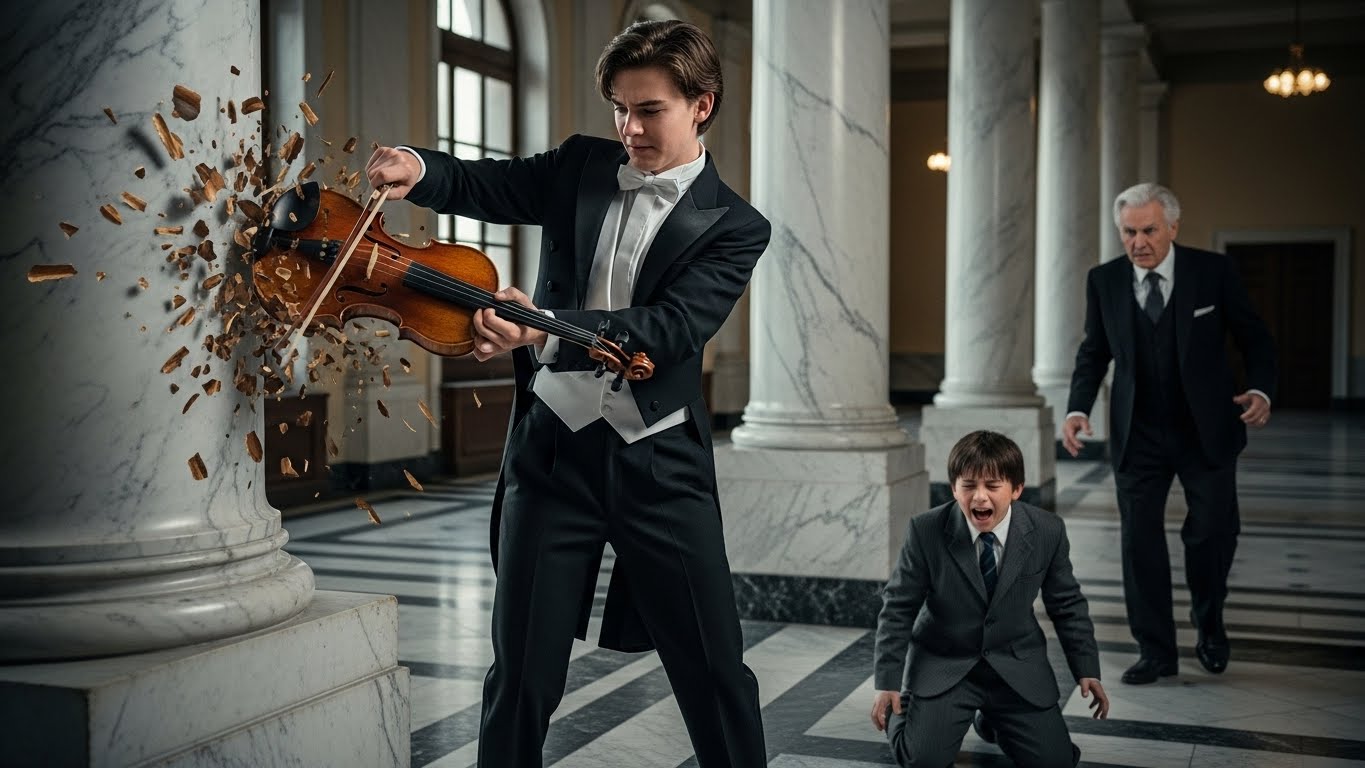
With a grunt of exertion, Julian swung the violin down.
Chapter 3: The Sound of Breaking
CRACK.
The sound was sickening. It wasn’t just a thud; it was the scream of dry, ancient wood splintering under violence.
Julian smashed the violin against the sharp edge of the marble pillar.
The body of the instrument exploded. The bridge snapped in half, flying across the room. The strings tangled into a chaotic mess of wire and gut. The neck, snapped cleanly from the body, remained in Julian’s hand for a second before he dropped it onto the pile of debris.
Time seemed to stop.
The noise had been loud enough to cut through the warm-up chatter backstage. Silence rippled outward from the alcove.
Leo dropped to his knees. He didn’t scream. He couldn’t breathe. It felt as if his own chest had been cracked open.
He reached out with trembling hands, touching the shards of wood. The back plate was split down the middle. The ribs were crushed. The soul of the instrument—the soundpost—rolled away across the floor.
“Oops,” Julian laughed, breathless from the adrenaline. He dusted off his hands. “Don’t worry, peasant. My dad will buy you a new toy from Amazon. One that doesn’t have scratches all over it.”
Julian looked down at Leo, who was sobbing silently, cradling the broken pieces like a dead child.
“You should thank me,” Julian spat. “Now you have an excuse for why you’re a failure.”
“What is the meaning of this?”
The voice was deep, accented, and carried the weight of a thunderclap.
Julian froze. He straightened his tie and turned around.
Standing in the doorway of the alcove was Vladimir Korlov.
The Maestro was an imposing figure. He wore a long black coat, a silk scarf, and his silver hair was swept back from a face that looked carved from granite. He was staring at the pile of wood on the floor with an expression of confused horror.
Julian quickly composed himself. This was his chance to spin the narrative.
“Maestro Korlov!” Julian said, putting on his most charming, deferential smile. “I am so sorry you had to see this. I was just… helping. This student brought some trash in—rotten wood, really—and it fell apart. I was just disposing of it so it wouldn’t clutter your stage.”
Julian kicked a piece of the violin toward Leo. “It was just junk, sir. We’ll get it cleaned up immediately.”
Korlov didn’t look at Julian. He didn’t look at the stage manager who had run over.
He walked past them all. He walked right into the dust and debris.
Korlov knelt down on the floor next to the janitor’s son.
Chapter 4: The Screaming Angel
“Don’t touch it,” Leo whispered, shielding the pieces with his body. “Please don’t hurt him anymore.”
Korlov’s eyes softened. “I will not hurt him, little one.”
The great pianist reached out a hand—a hand insured for ten million dollars—and gently picked up the back plate of the broken violin.
He turned it over in his hands. He brushed away the dust. He brought the wood close to his face, inhaling the scent of the interior. Old wood. Resin. And a specific, metallic scent of ancient varnish.
Korlov’s eyes widened. His pupils dilated. His hand began to shake uncontrollably.
He peered into the interior of the shattered body, looking for a label that was covered in decades of dust and grime. He rubbed his thumb over a faint, handwritten inscription on the inner lining.
IHS.
Korlov stopped breathing. He closed his eyes, a look of physical pain crossing his face.
“My God,” Korlov whispered. “It is you. I found you.”
He stood up slowly. The sorrow on his face vanished, replaced by a cold, terrifying fury. He turned to Julian.
“Trash?” Korlov asked. His voice was quiet, but it echoed off the marble walls. “You call this… trash?”
Julian blinked, confused by the intensity. “Well… yes. Look at it. The varnish was peeling. It was ugly, sir.”
Korlov took a step toward Julian. The students backed away. The Maestro looked like he was about to commit murder.
“This ‘ugly’ instrument,” Korlov roared, holding up the shattered back plate, “is known as the ‘Screaming Angel.’ It is a Guarneri del Gesù, crafted in Cremona in the year 1741.”
A collective gasp went through the crowd. Even the non-musicians knew the name Guarneri. It was the only name that rivaled Stradivari.
“It is not firewood!” Korlov shouted, shaking the wood at Julian. “It was played by my mentor, the great Jakob Rosen, in the Berlin Philharmonic. It was played on the night the bombs fell in 1944. It was stolen by the Nazis and has been missing for eighty years. It is one of the most significant lost artifacts of the 20th century!”
Korlov pointed a trembling finger at the pile of splinters on the floor.
“It is not an instrument, you idiot! It is a soul! It survived a World War! It survived the fires of Berlin! And it died… here? At the hands of a spoiled child?”
Julian’s face went pale white. “Guarneri? But… it looked like…”
“It looked like history!” Korlov bellowed. “Do you know the value of what you have just destroyed?”
Julian stammered. “A… a few thousand?”
“Eighteen. Million. Dollars,” Korlov enunciated every syllable.
The silence that followed was heavy enough to crush the building.
Chapter 5: The Cost of a Soul
Julian’s knees buckled. He grabbed the pillar for support. “Eighteen… million?”
“Mr. Korlov!”
Julian’s father, Mr. Sterling, pushed through the crowd. He was a man used to fixing problems with his checkbook. He looked at his son’s pale face and the angry Russian legend.
“There must be a misunderstanding,” Mr. Sterling said smoothly. “If my son broke another student’s instrument, we will replace it. Whatever the cost. I can write a check right now.”
Korlov turned his gaze to the father. He walked over to a grand piano sitting in the hallway and slammed the lid shut with a violent BANG.
“You cannot write a check for history, Mr. Sterling!” Korlov spat. “You cannot buy back art once it is murdered! Can you write a check to bring back the Mona Lisa if I slash it? Can you write a check to bring back the dead?”
Korlov pulled out his phone.
“I am calling the District Attorney,” Korlov announced. “This is not a schoolyard prank. This is the destruction of historic property. It is grand larceny. It is a felony.”
Mr. Sterling paled. “Now, hold on, there’s no need for police…”
“There is every need!” Korlov cut him off. “And as for this school…”
Korlov turned to the Dean of Whitmore, who was shaking in the corner.
“If this boy—this vandal—is not expelled within the next five minutes, I will walk out of here. And I will make it my life’s mission to ensure that no musician of repute ever steps foot in this building again. I will burn your reputation to the ground.”
The Dean didn’t hesitate. He looked at Julian.
“Mr. Sterling,” the Dean said, his voice trembling. “Please take your son and leave. Security will escort you. You are expelled. Effective immediately.”
“But… the new hall…” Mr. Sterling protested.
“GET OUT!” Korlov roared.
Security guards grabbed Julian by the arms. The arrogant bully was dragged away, crying, his tuxedo rumpled, while the students he had terrorized watched in silence.
Chapter 6: The Healing
When the yelling stopped and the police had arrived to document the “crime scene,” the hallway cleared out.
Only Leo remained.
He was sitting on the floor, holding the neck of the violin—the only part that was still intact. He wasn’t crying about the money. He didn’t care about the millions. He was crying because his friend was dead.
Korlov walked over. The rage was gone from his face, replaced by a deep, melancholic sadness. He sat down on the marble floor next to the janitor’s son.
“The wood is dead, Leo,” Korlov said softly. “I am sorry.”
Leo wiped his eyes with his sleeve. “It was my grandfather’s. He found it in an attic in Germany after the war. He didn’t know what it was. He just… gave it to me.”
Leo looked up at the Maestro. “I didn’t know it was worth millions. I just loved how it sang.”
Korlov nodded, placing a hand on Leo’s shoulder. “That is why it sang for you, Leo. Because you loved it. Not for the price tag. Not for the fame. You loved the wood. That is why it revealed its voice to you. Julian could have played that violin for a thousand years, and it would have remained silent.”
Korlov stood up and brushed off his coat. He signaled to his assistant, who was standing nearby holding a sleek, carbon-fiber double case.
“The Screaming Angel is gone,” Korlov said. “But the music must not die.”
Korlov opened the case. Inside lay two violins. One was a modern instrument. The other…
The other glowed with a golden-red fire. The varnish was deep and lustrous. It looked like it was burning from the inside.
“This,” Korlov said, lifting the instrument, “is the ‘Empress.’ It is a Stradivarius from the Golden Period, 1715. It belongs to my foundation. I have been looking for a partner for my world tour next month. Someone who understands that music is not about showing off, but about bleeding.”
Korlov held the Stradivarius out to Leo. He offered the bow.
“It is not the Old Man,” Korlov said. “But she has a good voice. Will you try her?”
Leo stood up. His hands were shaking. He reached out and took the multi-million dollar instrument. It felt lighter than his old one. It felt alive.
He placed it under his chin. It fit perfectly.
“Play for me, Leo,” Korlov commanded softly. “Let’s see if we can heal the silence.”
Chapter 7: The First Note
Leo closed his eyes. He thought of his father scrubbing floors. He thought of the boiler room. He thought of the shattered wood on the floor.
He raised the bow.
He played a single open A string.
The sound was blinding. It filled the hallway, rich and golden and pure. It resonated in Leo’s collarbone and vibrated in the floor.
Leo began to play the Sibelius concerto he had practiced in the dark.
The students who were still lingering stopped. The police officers stopped writing their reports. The Dean stopped breathing.
The music soared. It was grief and triumph wrapped in one.
Korlov watched, a smile slowly spreading across his face. He closed his eyes and swayed to the music.
“Yes,” Korlov whispered to himself. “There it is.”
The camera pans down to the floor, where the broken shards of the $18 million Guarneri lie in the dust. They are broken, yes. But they are not gone. Because in their destruction, they revealed the truth. And from the wreckage, a new legend was beginning to play.