They told us she was just a confused seven-year-old with an overactive imagination when she started screaming about the ‘red man’ in the basement, but twenty years later, I found the drawings she hid inside the walls of our childhood home, and I finally realized that my silence didn’t protect her—it protected the monster sleeping down the hall.
Chapter 1: The Tomb in the Wall
My hands are still shaking as I type this. I’ve tried to pour a cup of coffee three times, and three times I’ve spilled it on the counter. I don’t know if I should be posting this. My lawyer would tell me to shut up. My family would tell me to let the past stay buried. But the statute of limitations doesn’t apply to the truth, and the dead don’t care about lawsuits.
I bought the old family house in upstate New York three months ago. It sits on a ridge overlooking a valley that’s beautiful in the summer and oppressive in the winter. It was supposed to be a flip. A quick renovation, a coat of “accessible beige” paint, some modern fixtures, and a sale to some young couple escaping the city prices. I wanted to erase the memories with subway tile and quartz countertops.
But the house has a way of keeping things. It remembers.
Yesterday, I was tearing out the drywall in the upstairs hallway. It’s the spot right outside the bedroom where my cousin Lily used to sleep when her parents stayed over. It was a dark corner of the house, always colder than the other rooms, no matter how high we cranked the thermostat.
I swung the sledgehammer, and the plaster crumbled. It wasn’t the satisfying crunch of modern construction; it was a dull thud, followed by a cloud of dust that tasted like chalk, mold, and stale time.
Something fell out of the wall cavity with a heavy, metallic clank.
It wasn’t insulation. It wasn’t a rat’s nest.
It was a rusty, terrifyingly familiar biscuit tin. A blue tin with a picture of a Danish castle on it. I recognized it immediately. It hit the floorboards and the lid popped open.
I froze. The sledgehammer hung heavy in my hand.
It was the tin Lily used to hoard her crayons in. She carried it everywhere. It was her shield, her purse, her safe.
I sat on the floor, covered in white dust, and reached for it.
There were no crayons inside. Just paper. Dozens of folded sheets of cheap printer paper, yellowed at the edges, brittle to the touch.
I unfolded the first one.
It was a drawing, done in the frantic, heavy-handed wax strokes of a child. Stick figures. A house. A sun in the corner that looked more like an angry eye.
But the house was bleeding. Red crayon scribbles poured out of the windows like water.
I unfolded the next one.
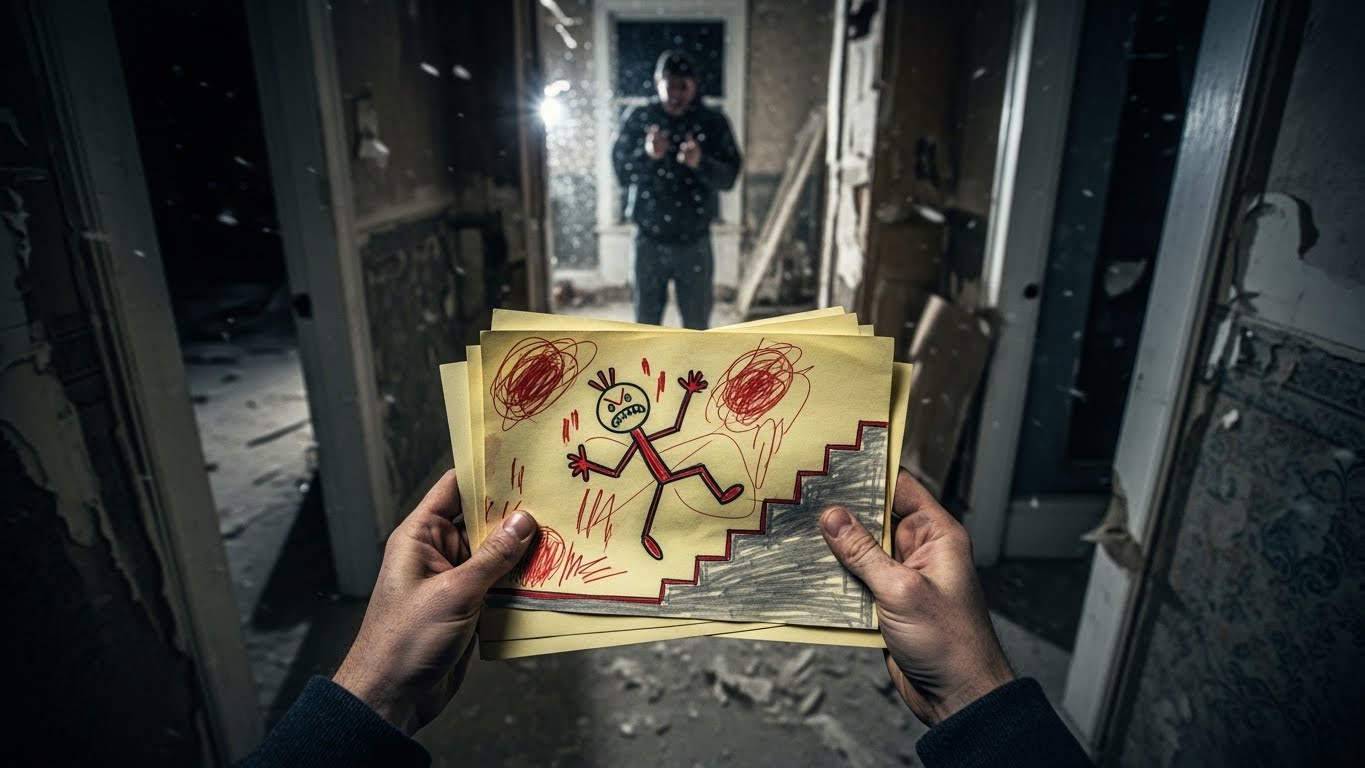
Two figures on the stairs. One small, one big. The big figure had a smile that stretched off its face, drawn in jagged black lines. The small figure was falling, limbs askew.
My stomach dropped. The air in the hallway suddenly felt freezing. I remembered the official story. I remembered what the police report said in 1999. Accidental fall. Tragic domestic incident. A loose carpet runner.
I kept going through the stack. The drawings got more specific. More violent. They were a storyboard of a nightmare.
Then I found the one that made me freeze.
It was a drawing of the basement. The furnace was there, a grey blob in the corner. And standing next to it was a man. Lily had drawn him with a very specific detail—a purple tie with yellow dots.
I haven’t seen that tie in twenty years. But I remember exactly who wore it the night my Aunt Sarah died.
I remember because I was the one who tied it for him.
I sat there in the wreckage of the hallway, holding the evidence of a murder my seven-year-old cousin witnessed, understood, and tried to tell us about. We just didn’t listen. We told her to hush. We gave her warm milk and sedatives and told her it was a nightmare. We told her she was confused.
But Lily knew. She was too young to understand the politics of our family, the hierarchy of money and influence, but she was too smart to forget what she saw. She hid the truth in the only safe place she could find—inside the walls, through a loose vent cover I had forgotten existed until just now.
Now the walls are open. And I have to decide if I’m going to bury this again, or if I’m finally going to burn this family to the ground.
Chapter 2: The Winter of ’98
You need to understand the atmosphere before you can understand the crime.
It started snowing on a Tuesday in late November, 1998. By Friday, the roads out of Blackwood were impassable. The weatherman called it the “Storm of the Century,” but to us, it just felt like the world was closing in.
We were trapped. Just us, the dark timber of the house, and the tension that you could practically taste in the air like metallic ozone.
I was fifteen. Old enough to know the adults were drinking too much, but young enough to be ignored. I spent most of my time listening to Nirvana on my Discman, trying to drown out the sound of passive-aggressive bickering.
Lily was seven. She was a quiet kid, always watching. She had these big, dark eyes that seemed to absorb light rather than reflect it. She was Aunt Sarah’s shadow. Where Sarah went, Lily went.
And then there was Uncle Marcus.
Marcus—that’s who wore the tie in the drawing—was the life of the party. He was always laughing, always pouring drinks, always slapping backs. Everyone loved Marcus. He was the golden boy of the family. The successful real estate agent with the billboard face. The perfect husband to Aunt Sarah.
But the family dog, a gentle Golden Retriever named Buster, would growl low in his throat whenever Marcus walked into a room. Animals know. They always know.
That night, the night the power lines snapped under the weight of the ice, the laughter stopped.
We were all in the living room by the fireplace. The wind was howling outside, rattling the windowpanes in their frames. The shadows danced on the walls, stretching and twisting into grotesque shapes as the fire flickered.
“Where’s Sarah?” my mom asked, looking around. She was holding a glass of wine that was far too full.
“She went down to the basement to check the breaker,” Marcus said. He didn’t look up from his scotch. He was staring into the amber liquid like it held the secrets of the universe. “She thought maybe a fuse blew before the main line went. She’s been gone a while.”
I remember looking at Lily. She was sitting in the corner, clutching that biscuit tin. She wasn’t drawing. She was staring at Marcus.
And she was trembling. Not a shiver from the cold. A vibration of pure terror.
“I’ll go check on her,” my dad said, standing up. He was a good man, my dad, but slow on the uptake.
“No,” Marcus said. Sharp. Too loud. It cracked the air like a whip.
The room went dead silent. The fire crackled, a gunshot sound in the quiet. Marcus realized he had slipped.
“I mean,” Marcus softened his voice, putting on that charming, salesman smile that could sell ice to an Eskimo. “I’ll go. It’s my wife. I should be the gallant hero. You guys stay warm.”
He stood up. He smoothed his tie—the purple one with yellow dots. I had tied it for him hours earlier because he’d hurt his hand “fixing the garage door.”
He walked toward the basement door. The hinges whined as he opened it. It was a maw of darkness leading down into the earth.
That’s when Lily spoke. Her voice was so small, a whisper that carried across the room.
“Don’t go,” she said.
Marcus paused. He looked back at her. His eyes were dead flat. Shark eyes.
“Why not, sweetie?”
“Because the red man is down there,” Lily whispered.
We all laughed. Nervous, relieved laughter. Kids say the creepiest things, right? Just an imagination running wild in the dark. The “red man.” Probably Santa Claus, right?
“There’s no red man, honey,” my mom soothed her, reaching out to stroke Lily’s hair. “It’s just the furnace. It glows red sometimes.”
Marcus smiled at her. A smile that didn’t reach his eyes. “See? Just the furnace.”
He went down.
Five minutes later, we heard the scream. But it wasn’t Sarah screaming. It was Marcus. A theatrical, gut-wrenching howl of grief.
And then, the sound of a body hitting concrete. Or so we thought.
But here is the thing… here is the part that has kept me awake for twenty years…
When Marcus came back up, sobbing, telling us Sarah had fallen down the stairs in the dark, that her neck was broken, that she was dead… his tie was straight. Perfectly straight.
And Lily was drawing. She was drawing furiously, tearing the paper with the force of her crayons.
She wasn’t looking at him. She was drawing what she had seen before he even went down there.
Because Sarah didn’t fall while Marcus was in the living room. Sarah was already dead.
And Lily had been in the basement playing hide and seek twenty minutes before. She had been hiding behind the old water heater. She had been there the whole time.
Chapter 3: The Gaslight
The police couldn’t get up the mountain for three hours.
Those were the longest three hours of my life. The house became a coffin. My mother was hysterical, weeping into the sofa cushions. My father was pacing, trying to be useful, checking the windows, checking the fire.
Marcus sat in the armchair by the fire, his head in his hands. He looked the picture of the grieving widower. Every now and then, his shoulders would heave with a fresh sob.
But I was watching him. I was fifteen, sitting on the stairs, hugging my knees. And I saw him.
In between the sobs, when he thought no one was looking, he would stop. He would lift his head just an inch and scan the room. He was calculating. He was checking the angles.
And his eyes always landed on Lily.
Lily hadn’t moved. She was still in the corner, clutching her tin. She hadn’t cried. Not once. She just stared at her paper.
I walked over to her. I wanted to comfort her. I was her big cousin; it was my job to protect her.
“Lily?” I whispered, kneeling beside her. “Are you okay?”
She didn’t look at me. She just pushed the paper toward me.
It was a drawing of a hand. A large hand. And on the ring finger, there was a gold ring with a black stone.
Marcus’s class ring.
In the drawing, the hand was pushing against a woman’s back.
“Lily,” I whispered, my heart hammering against my ribs. “Did you see something?”
She looked up at me then. Her eyes were old. Ancient.
“He made her fly,” she said.
My blood ran cold.
Before I could say anything, a shadow fell over us. I looked up. Marcus was standing there. He was huge from this angle, blocking out the firelight.
“What are you two whispering about?” he asked. His voice was gentle, but there was an edge to it. A razor blade hidden in cotton candy.
“Nothing,” I said, too quickly. I stood up, instinctively blocking Lily from his view. “She’s just… drawing.”
Marcus leaned down. He reached for the paper. “Let me see, sweetie. Drawing helps the pain, doesn’t it?”
Lily snatched the paper back. She crumpled it into a ball and shoved it into her tin. She snapped the lid shut.
“No,” she said.
Marcus stared at her. For a second, the mask slipped. I saw pure, unadulterated rage. It was a look that said, I will break you.
Then, the mask was back. He sighed, a tragic, heavy sound. “It’s okay. You’re in shock. We all are.”
He put a hand on my shoulder. It was heavy and hot. “Take care of her, Jack. She has a vivid imagination. We need to make sure she doesn’t… confuse herself. Trauma does strange things to kids.”
He squeezed my shoulder. Hard. It wasn’t a comfort. It was a warning.
Keep her quiet.
The police finally arrived in a flurry of flashing lights and crackling radios. They stamped snow onto the hardwood floors. They took photos. They asked questions.
They ruled it an accident almost immediately. The stairs were steep. The bulb was blown. She was wearing socks. It was a classic domestic tragedy.
They didn’t interview Lily. Why would they? She was seven. She was traumatized. And her loving uncle Marcus insisted that she be spared the ordeal.
“She’s sleeping,” he told the Sheriff. “Let her rest.”
She wasn’t sleeping. She was in my room, sitting on the floor, drawing picture after picture. Hiding them in the tin.
That night, she asked me to open the vent cover. She said the air was too hot. When I pried it open, she didn’t adjust the airflow. She shoved the tin inside the wall.
“Don’t let him find it,” she whispered.
I didn’t understand then. I thought she was just hiding her treasures. I didn’t know she was hiding the evidence.
Chapter 4: The Aftermath
The funeral was a blur of black umbrellas and wet snow. Marcus was the star of the show. He gave a eulogy that made grown men weep. He talked about Sarah’s light, her laughter, her clumsiness. He made a joke about how she could trip over air.
Everyone laughed through their tears. Classic Sarah.
He was rewriting history in real-time. He was planting the seed that she was clumsy, that she was prone to falling. He was building his defense before he was even accused.
I stood next to Lily at the graveside. She was holding my hand so tight her knuckles were white.
“He’s lying,” she whispered.
“Shh,” I said. “Not here, Lily.”
“He pushed her.”
“Lily, stop.”
“He’s a bad man.”
People were starting to look. My mother shot me a glare that said control her.
I squatted down. “Lily, you have to stop saying that. It was an accident. The police said so.”
She looked at me with betrayal in her eyes. “You believe him?”
“It’s not about believing him,” I hissed. “It’s about… it’s about not making things worse.”
I was a coward. I was fifteen and scared and I just wanted things to go back to normal. I wanted to play video games and worry about girls, not murder.
So I silenced her. I joined the conspiracy of silence.
In the weeks that followed, Marcus was around a lot. He was “leaning on family.” He brought gifts. A new bike for me. A dollhouse for Lily.
But Lily wouldn’t touch the dollhouse. She wouldn’t even look at him.
One night, about a month after the funeral, I woke up to a sound. A scream.
It was coming from Lily’s room.
I ran down the hall. My parents were already there. Marcus was there, too—he had stayed over for dinner and “fallen asleep” on the couch.
Lily was thrashing in her bed, screaming about the Red Man.
“He’s burning her! He’s burning her!”
Marcus was sitting on the edge of her bed, holding her arms down. “Shh, shh, it’s just a nightmare, sweetie. Uncle Marcus is here.”
Lily opened her eyes. She saw him. And she screamed like her soul was being torn out.
“Get away! Get away from me!”
“She’s having night terrors,” Marcus said, looking up at my parents with sad eyes. “Poor thing. She’s internalizing the accident.”
“I saw you!” Lily screamed. “I saw you push her!”
My dad looked uncomfortable. “Maybe we should get her a therapist.”
“I know a guy,” Marcus said immediately. “Dr. Saperstein. He’s the best. He handles childhood trauma. I’ll pay for it. It’s the least I can do.”
And just like that, Lily’s fate was sealed.
They sent her to Dr. Saperstein. A man Marcus paid. A man who specialized in “False Memory Syndrome.”
Week after week, they chipped away at her reality. They told her she was confused. They told her that grief manifests as blame. They told her that she loved her aunt so much she needed someone to be angry at, so her brain invented a villain.
They gaslit a seven-year-old girl until she stopped speaking altogether.
By the time she was eight, Lily was a ghost. She didn’t draw anymore. She didn’t talk about the Red Man. She just stared at walls.
And Marcus? Marcus thrived. He used the life insurance money to start his own firm. He ran for city council. He became a pillar of the community. The tragic widower who rose from the ashes.
We all moved on. I went to college. I moved to Seattle. I forgot about the drawings. I forgot about the tin in the wall.
Until yesterday.
Chapter 5: The Red Man
I sat on the dusty floor of the hallway for hours, the sun moving across the floorboards until the light turned orange, then grey, then gone. I read every single sheet of paper in that tin.
It was a timeline. A chronological descent into hell.
The first few drawings were innocent enough. Pictures of Buster the dog. Pictures of me playing Sega. But then came the night of the storm.
I laid them out in a grid. And that’s when I understood the “Red Man.”
In the drawings, the basement wasn’t black. It was washed in red. I racked my brain, digging through twenty-year-old memories of that house. The basement was unfinished. Concrete floors, exposed beams.
And the emergency floodlight.
My grandfather had installed an industrial emergency light above the workbench in the ’80s. It was one of those old, clunky units with a massive battery. And the plastic casing over the bulb?
It was red.
When the power cut, that light would have snapped on instantly, bathing the entire basement in a crimson, blood-soaked glow.
Lily’s drawing showed the Red Man standing over Aunt Sarah. The figure was drawn in heavy black wax, but the background was aggressively red.
And the figure wasn’t just standing. He was holding something.
A heavy, iron fireplace poker.
I remembered that poker. It used to hang by the woodstove in the basement. After the “accident,” my dad said we lost it. He bought a new set. We never questioned it.
But the most damning detail wasn’t the poker. It was the watch.
Lily had drawn a circle on the Red Man’s wrist. Inside the circle, she drew a tiny, jagged line. A crack.
I closed my eyes, and the memory hit me like a physical blow.
The morning of the funeral, Marcus was pacing in our kitchen. He was checking his watch constantly. It was his expensive Rolex—his pride and joy. I remembered staring at it because he was rubbing the glass face with his thumb, over and over again.
There was a crack in the crystal face.
“Must have smashed it against the railing when I tried to catch her,” he had told my dad, catching me looking. “Damn thing is ruined. Just like my life.”
He threw the watch in the trash. My dad fished it out later, saying it was worth too much to toss, that he’d get it fixed for Marcus one day. But he never did. It sat in a junk drawer in our kitchen for a decade.
Lily saw the crack before Marcus came upstairs to tell us Sarah was dead.
She saw the crack when the poker made contact. She saw the crack when the force of the blow shattered the crystal against Sarah’s skull or the concrete floor.
The “Red Man” wasn’t a monster. It was Marcus, bathed in emergency light, murdering his wife while his niece watched from behind the water heater.
I packed the drawings back into the tin. My hands were steady now. The shaking had stopped. It was replaced by a cold, hard resolve.
I needed to see Lily.
Chapter 6: The Girl in the Glass House
I haven’t seen my cousin in twelve years.
After the “therapy” worked its dark magic, Lily became a shell. When she was twelve, she had her own “accident.”
She fell from the hayloft in the old barn behind Marcus’s new house. She survived, but she shattered her pelvis and suffered a traumatic brain injury.
Marcus was the one who found her. Marcus was the one who called the ambulance.
Everyone said it was tragic. First the aunt, now the niece. That family is cursed.
I drove four hours south to the “Sanctuary of St. Jude,” a long-term care facility for adults with cognitive impairments. It’s a nice way of saying “asylum for the rich and inconvenient.”
Marcus pays for it, of course. He pays for the best room. The best doctors. He pays to keep her comfortable.
He pays to keep her quiet.
I walked into the facility. It smelled of lavender and antiseptic. I signed the visitor log. When I wrote “Cousin” under the relationship column, the receptionist smiled.
“She doesn’t get many visitors,” she said. “Just Senator… I mean, Mr. Thorne, once a month.”
I found Lily in the solarium. She was sitting in a wheelchair, looking out at the garden. She’s twenty-seven now, but she looks like a child. Small. Fragile. Her dark hair is cut short.
“Lily?” I said softly.
She didn’t move. She didn’t blink.
I pulled a chair up beside her. “It’s Jack. Your cousin Jack.”
Nothing. She was somewhere else. A place where the walls were thick and the memories couldn’t hurt her.
I reached into my bag and pulled out the tin.
I set it on the small table between us. The sound of the metal hitting the glass table was sharp.
Lily’s head snapped toward the sound.
Her eyes locked onto the blue Danish biscuit tin. Her pupils dilated. Her breath hitched in her throat.
“I found it, Lily,” I whispered. “I found it in the wall.”
She started to shake. A low keen built in her chest, a sound of pure animal distress.
“It’s okay,” I said, opening the lid. I pulled out the drawing of the Red Man. “I know you were telling the truth. I know he did it.”
Lily looked at the drawing. Her hand, trembling violently, reached out. She traced the red scribbles. She traced the purple tie.
Then, she looked at me. And for the first time in twenty years, I saw the girl I used to know. The fog lifted, just for a second.
“He… he fixed his tie,” she whispered. Her voice was rusty, unused.
“Yes,” I said. “He fixed his tie.”
“He washed his hands in the sink,” she continued, the words spilling out faster now. “He washed the red off. But he missed a spot. On his ear. He had a red spot on his ear.”
“I believe you, Lily.”
She grabbed my wrist. Her grip was surprisingly strong.
“He knows,” she hissed. “He knows I saw. That’s why I fell.”
My blood turned to ice. “The barn?”
“He pushed me,” she said, tears spilling down her cheeks. “He told me to look at the pigeons. And then he pushed me. He wanted me dead. But I didn’t die. So he put me here.”
She leaned in close, her eyes wide with terror.
“He comes here, Jack. He comes here and he whispers to me. He tells me that if I ever remember, he’ll finish the job.”
I squeezed her hand. “He’s never going to hurt you again. I promise.”
I stood up. I had what I needed. I had the witness. I had the corroboration.
But I needed one more thing. I needed the smoking gun.
“Lily,” I asked, “where is the poker?”
She blinked. “The stick?”
“The stick he used to hurt Sarah. Where is it?”
She closed her eyes. She rocked back and forth. Then, she opened them.
“The snowman,” she said.
“The snowman?”
“He didn’t throw it away. He was scared the garbage men would see the red. So he buried it. In the snowman.”
I stared at her, confused. Then I remembered.
The blizzard. The snow was five feet deep. We had built a massive snowman in the backyard the day before the murder. It stayed frozen for weeks.
Marcus had gone outside “for fresh air” while we waited for the police.
He didn’t throw the poker in the woods. He shoved it deep into the frozen body of the snowman. When the snow melted weeks later, the poker would have just been lying in the grass, rusted and clean.
“Did he find it later?” I asked.
Lily shook her head. “No. Buster took it.”
“The dog?”
“Buster liked sticks. He took the iron stick. He buried it. Under the porch.”
My heart stopped.
The porch. The one part of the house I hadn’t renovated yet. The one part of the house that had been sealed up with lattice since 1999 because of a skunk infestation.
“Buster was a good boy,” Lily whispered.
“Yes,” I said, fighting back tears. “Buster was the best boy.”
Chapter 7: The Lion’s Den
Driving back to the house, I felt like I was being watched. Every headlight in my rearview mirror looked like Marcus’s sleek black Mercedes.
Marcus Thorne. The frontrunner for the State Senate. His face was on every other billboard I passed. Integrity. Strength. Family.
The irony made me want to vomit.
I pulled into the driveway of the old house at midnight. The moon was full, casting long, pale shadows across the overgrown lawn.
I didn’t go inside. I went to the trunk and grabbed a shovel and a crowbar.
I walked around to the side of the porch. The wooden lattice was rotted, covered in dead vines. I jammed the crowbar behind a panel and ripped it open. The wood screamed as nails pulled free.
I crawled underneath.
It was tight, damp, and smelled of earth and decay. I clicked on my flashlight. The beam cut through the dust motes.
“Come on, Buster,” I muttered. “Show me where you hid it.”
The ground was hard packed. I scanned the dirt. There were old bones—chicken bones, probably. A tennis ball that had turned grey with age.
And then, near the back pillar, I saw a depression in the dirt. A place where the earth had been disturbed and settled again.
I started digging.
The dirt was cold. I dug until my fingers were raw.
Then, metal struck metal.
I scraped away the loose soil.
It was there.
The fireplace poker.
It was rusted, pitted, and ugly. But the handle… the handle was brass. And brass doesn’t rust the way iron does.
I shone the light on the heavy brass handle.
Even through the corrosion, I could see dark, crusty stains in the grooves of the metal design. Blood doesn’t just wash away. Not completely. Not from intricate crevices. DNA lasts.
I pulled it out of the earth. It felt evil in my hand. Heavy with the weight of a life taken.
I crawled out from under the porch, clutching the murder weapon. I stood up in the moonlight, breathing hard.
And then I heard the gravel crunch.
I turned around.
A car was idling at the bottom of the driveway. A black Mercedes.
The headlights flicked off.
A door opened.
Marcus stepped out. He was wearing a suit, even at midnight. He looked impeccable. He looked like a Senator.
“Jack,” he called out. His voice was smooth, pleasant. “What are you doing under the porch at this hour?”
He started walking up the driveway. He wasn’t rushing. He walked with the confidence of a man who owns the world.
“I found it, Marcus,” I said, holding up the poker.
He stopped. He squinted in the dark.
“Found what, son? Some old scrap metal?”
“The poker,” I said. “The one you used to kill Sarah.”
Silence stretched between us. The wind rustled the dead leaves in the oak trees.
Marcus sighed. He reached into his pocket.
I tensed, gripping the poker like a baseball bat.
He pulled out a pack of cigarettes. He lit one, the flame of the lighter illuminating his face. He looked older than I remembered. The lines around his eyes were deep.
“You know,” he said, exhaling a plume of smoke. “I always worried about that dog. Buster. He never liked me.”
“He knew what you were,” I spat.
Marcus chuckled. A dry, humorless sound. “And what am I, Jack?”
“You’re a monster.”
“I’m a survivor,” he corrected. “Sarah was… leaving me. Did you know that? She was going to take half the business. She was going to ruin me. I did what I had to do.”
He took another step closer.
“And Lily?” I asked. “Did you have to push her out of a barn?”
“Lily was a loose end,” he said casually. “A glitch in the system. But I took care of her. She lives in luxury. She wants for nothing.”
“She wants her life back!”
“Life is for the strong, Jack,” Marcus said. “Now, give me the stick. You’re a smart kid. You flip houses. You want to make money? I can make you rich. I can buy this dump from you for triple the market value. You can go back to Seattle. Be happy.”
He opened his arms.
“Or,” he said, his voice dropping an octave, “we can have another accident. The stairs in this old house are so treacherous. Just like your aunt found out.”
He was ten feet away now. I could see the glint of a gun tucked into his waistband.
I tightened my grip on the poker.
“I’m not Sarah,” I said. “And I’m not seven years old.”
Chapter 8: The Broadcast
Marcus smiled. “No. You’re just a trespassing nephew with a rusty piece of metal and a wild story. Who are they going to believe, Jack? The Senate hopeful? Or the failed house flipper?”
He reached for his gun.
He expected me to run. He expected me to cower.
He didn’t expect the floodlight.
I hit the switch in my pocket.
I had set it up earlier. The construction lights I used for the renovation. Two massive, 5,000-lumen LEDs mounted on the porch railing.
They blasted on, blindingly white, turning the night into day.
Marcus stumbled back, throwing his hands up to shield his eyes. “What the hell!”
“Smile, Marcus!” I yelled.
I pointed to the window.
Behind the glass, my phone was taped to the tripod. It was streaming.
Facebook Live.
“Say hello to the internet,” I shouted. “We’ve got five thousand people watching. They heard everything. They heard you admit to killing Sarah. They heard you admit to pushing Lily.”
Marcus froze. He looked at the window. He looked at the phone.
The color drained from his face. For the first time in his life, the charm evaporated. He looked small. He looked trapped.
“You’re lying,” he stammered. “This is… this is a deepfake. A setup.”
“The poker has your DNA on it, Marcus,” I said, bluffing slightly—I didn’t know for sure, but he didn’t know that. “And it has Sarah’s. And Buster kept it safe for us.”
Sirens wailed in the distance. I had called them ten minutes ago.
Marcus looked at the gun in his waistband. He looked at me. He looked at the woods.
He knew it was over. The recording was out there. The comments were already flying. I could see the notifications cascading down the screen of my phone inside the window.
He slumped. He dropped the cigarette and crushed it under his expensive Italian loafer.
“You ruined everything,” he whispered.
“No,” I said, feeling the weight of twenty years lift off my shoulders. “I just finished the drawing.”
The police cruisers swarmed the driveway. Red and blue lights flashed, painting the house in a chaotic rhythm.
As they handcuffed him, as they read him his rights, I walked over to the porch steps. I sat down.
I pulled out my phone. I ended the livestream.
Then I dialed the Sanctuary of St. Jude.
It was late, but the night nurse answered.
“Is Lily awake?” I asked.
“Jack? It’s 1 AM. But… yes. She’s awake. She’s been staring at the door all night.”
“Tell her,” I said, my voice breaking. “Tell her the Red Man is gone. Tell her he can’t hurt anyone ever again.”
I hung up.
I looked down at the poker sitting in the grass. I looked at the biscuit tin full of drawings.
The house is quiet now. The police are gone. Marcus is in a cell. The media storm is just beginning.
I’m looking at the wall where I found the tin. I’m going to patch it up tomorrow. But I’m not selling the house.
I think Lily might want to come home.
There’s a beautiful room upstairs with a view of the valley. I’m going to paint it yellow. I’m going to buy her the biggest box of crayons they make.
And we’re going to draw a new story. One where the house doesn’t bleed. One where the sun isn’t an angry eye.
One where the monsters are just drawings, and the good guys win.
But for now, I’m going to leave this post here. I’m going to leave it as a warning to anyone who thinks they can bury their secrets in the dark.
The truth doesn’t rot. It waits. And eventually, the walls come down.
[End of Story]