The Billionaire’s Son Threw a “Janitor’s” Jacket in the Trash—Until He Saw the Medal Hanging Around the Man’s Neck
Chapter 1: The Relic in the Mud
The autumn wind in New England carried a bite that went straight to the bone, but for Leo Davis, the cold was a familiar companion. He walked the manicured grounds of St. Jude’s Academy with his head down, clutching the lapels of a jacket that was three sizes too big for his seventeen-year-old frame.
It was an M-65 field jacket, olive drab, faded by decades of sun and rain. The fabric was fraying at the cuffs, and the zipper stuck halfway up, but to Leo, it was armor. It was the only thing that made him feel like he wasn’t just a scholarship kid drowning in a sea of trust funds and designer wool coats. It smelled faintly of old tobacco and gun oil—the scent of a father he hadn’t seen in fifteen years.
“Look at him,” a voice sneered from the stone archway of the school entrance. “G.I. Joe is reporting for duty.”
Leo tightened his grip on his backpack straps. He knew the voice. Everyone at St. Jude’s knew the voice of Brad Harrington. Brad was the kind of boy who had been told “yes” so many times that the word “no” sounded like a foreign language to him. His father, terrified of the world but armed with a tech empire’s fortune, had donated the new library wing, effectively buying Brad a permanent “Get Out of Jail Free” card.
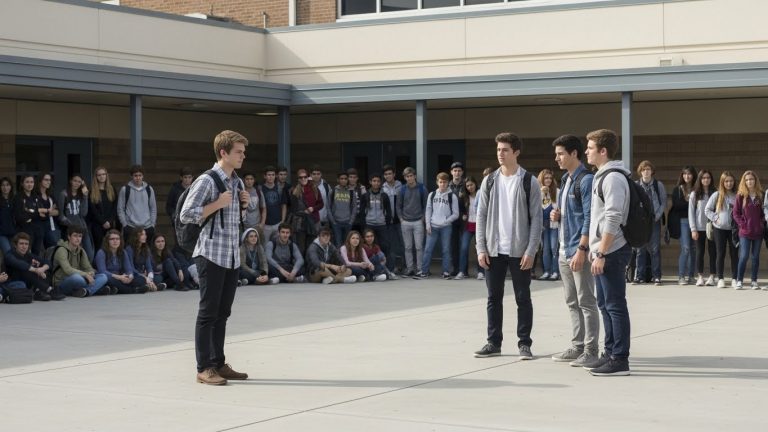
Leo tried to pass, but three boys stepped out, blocking the path. They were clones of Brad—slick hair, expensive blazers, sneers practiced in front of mirrors.
“Excuse me,” Leo said, his voice quiet. He didn’t want trouble. He couldn’t afford trouble. One demerit meant a review of his scholarship. Two meant expulsion.
“Excuse me,” Brad mocked, stepping forward. He was taller than Leo, fed on organic steaks and personal trainers. He reached out and fingered the fabric of Leo’s jacket with exaggerated disgust. “My dad’s gardener wears better clothes than this. Seriously, Leo. It’s embarrassing. You’re bringing down the property value just by standing here.”
“It’s warm,” Leo said, trying to step around.
“It’s trash,” Brad corrected. “Just like your old man. What was he? Some grunt who got lost in the desert?”
Leo stopped. The heat rose up his neck, instantaneous and violent. “Don’t talk about him.”
“Ooh, touched a nerve.” Brad laughed, looking at his friends. “What are you going to do? Write me a sad poem? Or go cry to your grandma in that little shoebox you live in?”
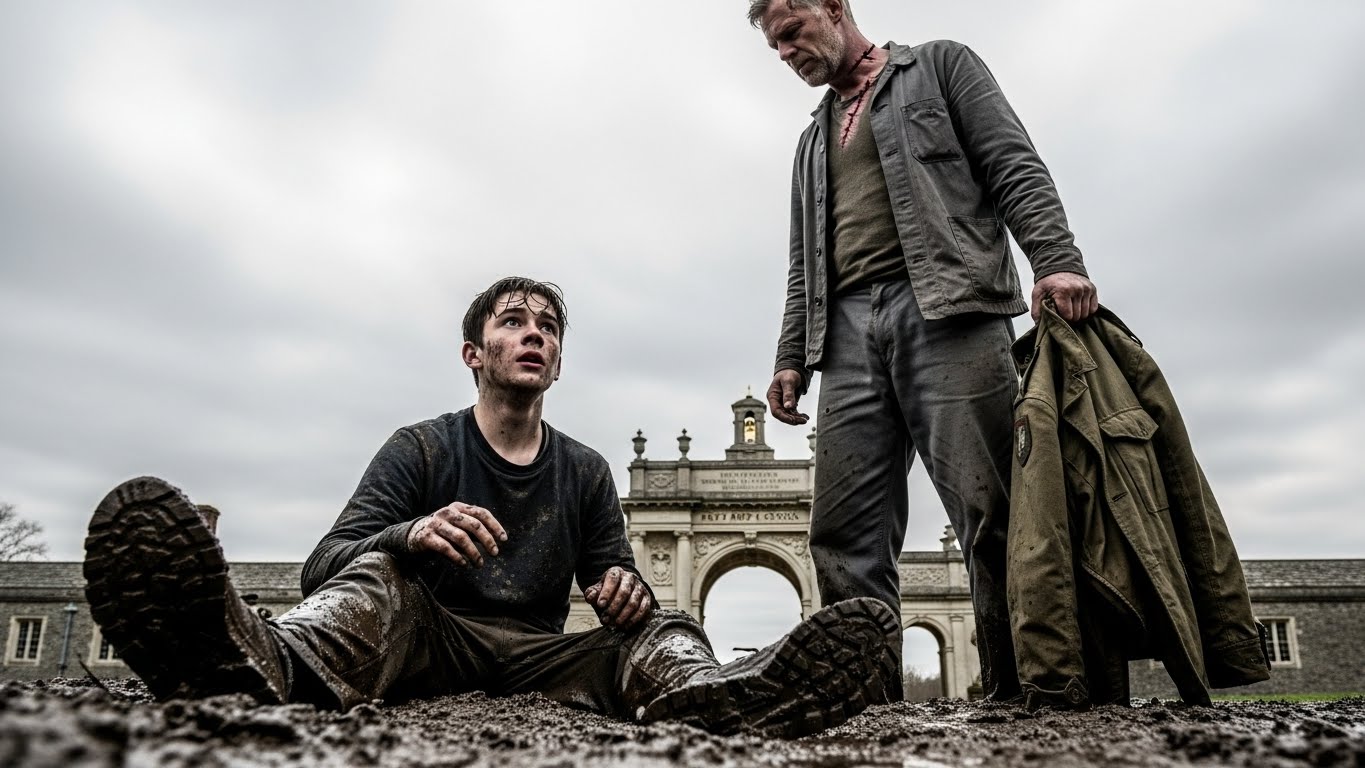
Before Leo could react, Brad lunged. It wasn’t a fight; it was an ambush. He shoved Leo hard in the chest. Leo’s heel caught on the wet cobblestones, and he went down backward, landing hard in the landscaping bed. The mud, cold and wet from the morning rain, seeped instantly into his jeans.
“Oops,” Brad grinned.
“Get up,” one of the lackeys laughed.
Leo tried to scramble up, but Brad stepped on the hem of the field jacket. “Actually, let’s help you out. You shouldn’t be wearing this. It’s a health hazard.”
With a violent yank, Brad and his friends tore the jacket off Leo’s shoulders. The sound of a seam ripping echoed like a gunshot in Leo’s ears.
“No!” Leo shouted, scrambling on his hands and knees. “Give it back!”
“Fetching is for dogs, Leo,” Brad sneered. He balled up the heavy olive fabric and walked over to the large industrial dumpster near the cafeteria loading dock.
“Brad, don’t!” Leo pleaded, ignoring the mud caking his hands. “Please. It’s my dad’s.”
“Then go be with him,” Brad said, and tossed the jacket into the dumpster. It landed with a wet thud on top of cafeteria slop and wet cardboard.
Leo froze. The humiliation was a physical weight, crushing the air out of his lungs. He felt tears stinging his eyes, hot and angry. He was going to kill him. Scholarship be damned, future be damned. He balled his fists, ready to launch himself at the billionaire’s son.
“I wouldn’t do that if I were you,” a voice grumbled. It wasn’t Brad’s. It was deep, raspy, and sounded like gravel grinding together.
The boys turned.
Standing by the maintenance shed was the new janitor. Nobody knew his name yet. He had only been there a week. He was an older man, maybe in his sixties, wearing a gray work jumpsuit that had seen better days. He held a push-broom in one hand. But what everyone noticed—what everyone looked away from—was the scar. It was a jagged, purple line that ran from behind his left ear, down his neck, and disappeared under his collar.
He didn’t look like a janitor. He looked like a storm waiting to break.
“This doesn’t concern you, old man,” Brad snapped, though his voice wavered slightly. “Go scrub a toilet.”
The janitor didn’t blink. He didn’t move. He just stared. His eyes were the color of steel, cold and utterly devoid of fear. He took one slow step forward. Then another.
The air around them seemed to drop ten degrees. There was a dangerous stillness to the man, the kind of stillness found in a predator right before the strike.
“You threw something away,” the janitor said. His voice was low, hardly a whisper, but it carried across the yard like a command. “That didn’t belong to you.”
“It’s trash,” Brad said, stepping back. “And so is he.”
The janitor stopped three feet from Brad. He towered over the boy, not in height, but in presence. He leaned in close. “Trash,” the janitor repeated. “You think you know what trash is, son? Trash is a man who uses his wallet to hide the fact that he has no spine.”
Brad opened his mouth to retort, to use his father’s name like a weapon, but the words died in his throat. The janitor’s eyes were boring into his soul. It was the look of a man who had seen death, touched it, and sent it away. Brad felt a primal fear, the instinct of a prey animal recognizing a wolf.
“Let’s go,” Brad muttered to his friends, his face pale. They scattered, hurrying toward the safety of the main building, casting nervous glances back.
Leo sat in the mud, shivering. He felt shame burning his cheeks. He had been saved by the janitor. It was just another layer of humiliation.
The older man propped his broom against the wall. He walked over to the dumpster. He didn’t look at the filth. He reached in, his movements precise and respectful, and pulled out the olive jacket. He shook off a banana peel and brushed away the wet coffee grounds.
He walked over to Leo and held it out.
Leo looked up. He expected pity. He hated pity. But he didn’t find it in the man’s eyes. He found recognition.
“Thank you,” Leo whispered, taking the jacket.
“Sergeant Michael Davis,” the janitor read the faded name tape on the breast pocket. He paused, his hand lingering on the fabric for a fraction of a second too long. His eyes seemed to glaze over, seeing something far away in time and space.
“My dad,” Leo said, standing up and wiping the mud from his pants. “He… he went missing. Fifteen years ago.”
The janitor looked at Leo. Really looked at him. He studied the shape of Leo’s jaw, the set of his eyes. “Get yourself cleaned up, kid. The world’s going to keep knocking you down. You better learn to stand up faster.”
“I tried,” Leo said bitterly. “But they have everything. I have nothing.”
The janitor picked up his broom. He turned his back to Leo, starting to sweep the leaves. “You have the jacket,” he said, his back turned. “If you knew what it cost to earn that patch, you’d know you’re the richest man on this campus.”
Leo watched the man work for a moment, confused, before clutching the dirty jacket to his chest and running toward the locker rooms. He didn’t see the janitor stop sweeping, touch the scar on his neck, and whisper a single word into the cold wind.
“Found him.”
Chapter 2: Shadows of the Past
The apartment smelled of camphor and boiled cabbage. It was a small, two-room walk-up in the part of town where the streetlights flickered and the police sirens were a nightly lullaby.
Leo sat at the wobbly kitchen table, carefully scrubbing the stain out of the field jacket with a toothbrush and soapy water. His grandmother, Elara, sat in her armchair by the window, staring at the brick wall of the adjacent building. Dementia was a slow thief; it had stolen her memories of yesterday, but left the distant past vividly intact.
“Is Michael home yet?” she asked, her voice frail.
Leo stopped scrubbing. His heart ached every time she asked. “Not yet, Grandma. Soon.”
“He promised he’d fix the porch step,” she murmured, closing her eyes.
Leo looked at the jacket. The name DAVIS was barely legible. He remembered the letter the government had sent. Missing in Action. Presumed dead. An ambush in a valley with no name. No body recovered. Just a folded flag and a box of personal effects sent years later when a cache was found. This jacket hadn’t been in the box; Leo had found it in the attic, a spare his dad had left behind.
“I’ll make them pay, Dad,” Leo whispered to the empty room. “I’ll get into Harvard. I’ll become someone. I won’t let them look down on us.”
But at school, the walls were closing in.
The next morning, the atmosphere in the administrative wing of St. Jude’s was toxic. Brad Harrington sat in the Principal’s office, his legs crossed, looking the picture of injured innocence. His father, Mr. Harrington, paced the room, barking into a Bluetooth headset before slamming it onto the desk.
“This is unacceptable, Principal Skinner,” Mr. Harrington boomed. “My son tells me he was threatened. Physically threatened! By a member of your staff!”
Principal Skinner, a man whose spine was made of fundraising spreadsheets, sweated profusely. “Mr. Harrington, I assure you, we take student safety—”
“I don’t want assurances!” Harrington slammed his hand on the desk. “I’m donating three million dollars for the new science center next month. Do you know what happens to that check if my son feels unsafe walking these halls?”
“What do you want, sir?” Skinner asked, defeated.
“I want him gone,” Brad piped up, a smirk playing on his lips. “The creep with the scar. The janitor. He looked at me like he was going to kill me. He’s obviously unstable. Probably some PTSD psycho.”
“Brad,” his father warned gently, “let me handle the terminology. But yes. He goes. Today.”
“But,” Skinner stammered, “Arthur just started. He’s a veteran. There are labor laws…”
“Pay him off,” Harrington waved his hand dismissively. “Give him five thousand dollars to sign a non-disclosure and walk away. Or I walk away. Your choice.”
Skinner sighed. He pressed the intercom button. “Ms. Higgins, please send Arthur into my office.”
When Arthur walked in, he filled the room. He wasn’t wearing the jumpsuit today; he was wearing a simple button-down shirt and slacks, but he still looked dangerous. He looked from Brad to Mr. Harrington, then to the Principal. He didn’t need to be told. He knew.
“Mr… Arthur,” Skinner began, avoiding eye contact. “There has been a complaint.”
“I bet there has,” Arthur said. His voice was calm, deep, and steady.
“You threatened a student,” Harrington accused, stepping into Arthur’s personal space. “My son says you were aggressive.”
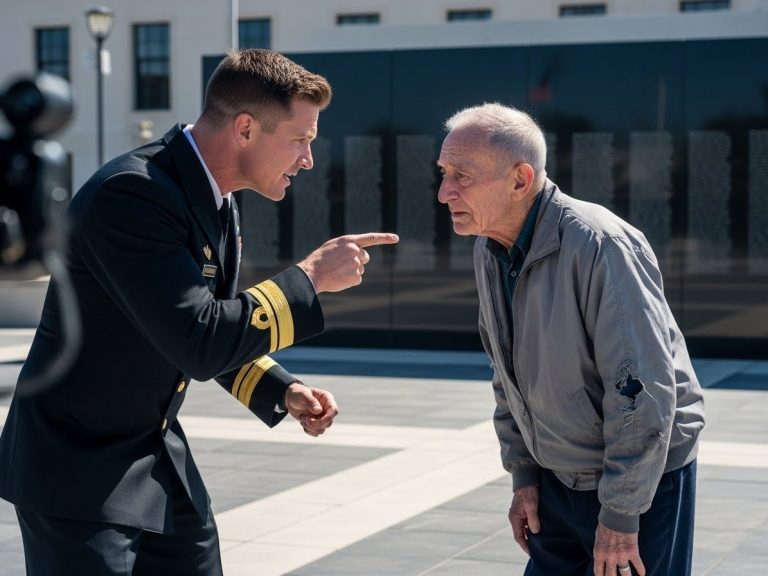
Arthur looked down at the billionaire. “I stopped a bullying incident. Your son was assaulting a scholarship student.”
“My son was engaging in horseplay!” Harrington shouted. “And you are a janitor! You clean floors! You do not police the student body! You are fired. Effective immediately.”
Brad smirked from the chair. “Bye bye, GI Joe.”
Arthur looked at Brad. For a second, the mask slipped, and a look of profound sorrow crossed his face. “You have no idea what you are,” Arthur said softly.
“Here,” Skinner pushed a check across the desk. “Two months’ severance. Just… please go quietly.”
Arthur looked at the check. He didn’t take it. “I’ll finish my week,” he said. “The Legacy Gala is Saturday. The setup is heavy. You’ll need the hands.”
“Absolutely not,” Harrington said.
“I’ll finish the week,” Arthur repeated, and this time, there was that steel in his voice again. “Or I go to the local press and tell them the school fired a disabled veteran for stopping a billionaire’s son from assaulting a minor.”
The room went silent. Harrington turned purple.
“Fine,” Skinner squeaked. “Saturday night. After cleanup, you’re done.”
Arthur turned and walked out. He didn’t look back. But as he walked down the hall, he saw Leo at his locker. Leo looked defeated, small. Arthur’s hand went to the scar on his neck, the old wound throbbing.
Not yet, Arthur thought. I can’t leave yet. The mission isn’t over.
Chapter 3: Gold Spoons and Iron Wills
Saturday night arrived wrapped in silk and smelling of expensive perfume. The St. Jude’s Legacy Gala was the event of the season. The gymnasium had been transformed into a ballroom with chandeliers, velvet drapes, and tables that cost ten thousand dollars a plate.
Leo was there, but not as a guest. He was wearing a white vest and black bow tie, balancing a tray of champagne flutes. He needed the overtime pay. The rent was due, and Grandma’s medication wasn’t covered by insurance anymore.
The room was a sea of influential people. Senators, CEOs, old money families who had founded the colony. And in the center of it all, holding court, was Mr. Harrington and Brad.
Brad looked sharp in a tuxedo, laughing loudly at a joke a Senator had made. He spotted Leo weaving through the crowd. Brad’s eyes lit up with malicious delight.
“Hey! Waiter!” Brad called out, snapping his fingers.
Leo froze. He took a breath, composed his face into a mask of servitude, and walked over. “Yes, sir? Champagne?”
“Is this the best the school can do?” Brad asked the table loud enough for everyone to hear. “Hiring the charity cases to serve us? I guess it keeps them off the streets.”
The table chuckled nervously.
“Can I get you anything, Brad?” Leo asked through gritted teeth.
“It’s Mr. Harrington to you, peasant,” Brad said. He reached out for a glass, but as Leo extended the tray, Brad stuck his foot out.
It was subtle, practiced. Leo tripped. The tray tipped.
Three flutes of vintage champagne cascaded onto the table—and right into the lap of Mr. Harrington Senior.
The crash of glass silenced the room.
“You idiot!” Mr. Harrington roared, jumping up. His expensive tuxedo trousers were soaked. “Look what you did! Do you know how much this suit costs?”
“I… I tripped,” Leo stammered, his face burning. “He tripped me.”
“Liar!” Brad shouted, standing up. “He’s clumsy and he’s vindictive! He did it on purpose because he’s jealous!”
Principal Skinner rushed over, wringing his hands. “I am so sorry, Mr. Harrington. I will handle this.”
“Handle it?” Harrington screamed. “I want him out! Throw him out! And expel him! I won’t have my son endangered by this… this trash!”
Brad laughed, cruel and sharp. He reached under the table where he had stashed a bag. He pulled out the olive drab field jacket. He had fished it out of the dumpster after Arthur left, just for this moment.
“Look, everyone!” Brad held the jacket up like a trophy. It was still stained and wrinkled. “This is what he cries over! His daddy’s magic coat! He thinks wearing this makes him a man!”
Leo’s eyes went wide. “Give that to me.”
“Come and get it, soldier!” Brad taunted, dancing back. “Oh wait, you can’t. Because you’re just a waiter. And your dad was just a loser who died in the dirt.”
The room was silent. The cruelty was palpable, but no one moved. The wealthy elite watched, uncomfortable but unwilling to cross the Harringtons.
Leo felt tears of rage. He was alone. Completely alone against the weight of their money and their power.
Then, the double doors at the back of the hall slammed open.
The sound was thunderous, echoing off the high ceilings. The heavy oak doors bounced against the walls.
All heads turned.
Standing in the doorway was not the janitor.
The man standing there was tall, broad-shouldered, and posture-perfect. He was wearing the Dress Blue uniform of the United States Marine Corps. The high collar was clipped tight. The white gloves were pristine. The trousers had the blood stripe running down the leg.
But it was the chest of the uniform that stole the breath from the room.
Rows of ribbons climbed halfway up his shoulder. A Silver Star. A Purple Heart. A Navy Cross.
And around his neck, resting on the blue cloth, hung a blue ribbon with a gold starpad and star.
The Medal of Honor.
Chapter 4: The Weight of Blue
Arthur walked into the room. He didn’t walk like a janitor pushing a broom. He marched. His steps were rhythmic, the heels of his polished boots striking the floor with the authority of a gavel. Click. Click. Click.
The silence in the room changed. It wasn’t the silence of awkwardness anymore. It was the silence of awe.
Mr. Harrington, wiping champagne from his pants, looked up. His face went pale. He didn’t know military decorations intimately, but he knew what that blue ribbon around the neck meant. Everyone in America knew what that meant.
At the back of the room, an elderly Senator, a man who had served in Vietnam, stood up. His cane clattered to the floor. He didn’t notice. He snapped to attention.
Arthur marched straight toward the commotion. He didn’t look at the Principal. He didn’t look at the crowd. His eyes were locked on Brad Harrington.
Brad was still holding the field jacket, but his grin was faltering. The man approaching him was terrifying. The scar on his neck stood out starkly against the high collar of the uniform.
Arthur stopped two feet from Brad.
“Hand it over,” Arthur said.
Brad’s hands shook. He held out the jacket. Arthur took it with his white-gloved hands, handling the dirty, old fabric as if it were the shroud of a saint. He folded it once, gently, over his arm.
Then, Arthur turned to the microphone stand near the band. He adjusted it. The feedback whine pierced the room, making people flinch.
“You called this a rag,” Arthur said. His voice was amplified, filling every corner of the hall. “You laughed at this name.”
He pointed to the faded patch: DAVIS.
Arthur looked at the crowd. “Fifteen years ago, in the Korengal Valley, a patrol was ambushed. Rocket-propelled grenades. Heavy machine-gun fire. We were pinned down. Outnumbered ten to one.”
Leo stood frozen, tears streaming down his face. He had never heard the story. The letter had been generic.
“I was the Lieutenant in charge,” Arthur continued, his voice wavering slightly with emotion. “I took a round to the neck. Severed my artery. I was bleeding out in the dirt. I couldn’t move. The order came to pull back.”
Arthur touched the Medal of Honor around his neck. “They say this medal is for bravery. But sometimes, it’s just for being the one who lived to tell the story.”
He pointed a gloved finger at Leo.
“That boy’s father, Sergeant Michael Davis, refused the order to retreat. He ran back into the kill zone. He put me on his back. He carried me two miles under direct fire. He took three bullets in his back—bullets that were meant for me.”
A gasp went through the room. Mr. Harrington looked like he was going to be sick. Brad was shrinking, trying to hide behind his father.
“Michael Davis died as he put me on the chopper,” Arthur said, a tear finally escaping and rolling down his scarred cheek. “His last words were, ‘Tell my boy I love him. Tell him to be good.'”
Arthur turned to Mr. Harrington. The fury in his eyes was gone, replaced by a cold, righteous judgment.
“I spent ten years in hospitals. Five years looking for his family. I took this job scrubbing your toilets because I wanted to see if Michael’s son had his heart.”
Arthur looked at Leo and smiled—a genuine, warm smile. “And he does. He has more dignity in his little finger than you have in your entire bank account.”
Arthur stepped closer to Harrington. “You fired me because you thought I was trash. But let me tell you something, sir. Your money builds libraries. Michael Davis’s blood built your freedom to stand there and be an arrogant coward. If you ever, ever disrespect this boy again, you won’t answer to a janitor. You will answer to every Marine, soldier, and sailor who ever wore a uniform.”
Mr. Harrington looked around. The room had turned against him. The Senator was glaring. The CEOs were looking at the floor in shame. The social capital he had spent a lifetime building had evaporated in three minutes.
“Come on, Brad,” Harrington whispered, his voice trembling. “We’re leaving.”
“Leave,” the Senator shouted from the back. “And take your checkbook with you!”
As the Harringtons scurried out the side door like rats, the room erupted. Not in applause—it wasn’t a show. But in a low, respectful murmur of acknowledgment.
Arthur walked over to Leo.
Leo was sobbing now, openly. The grief of fifteen years, the loneliness, the bullying—it all came crashing down.
“He saved you?” Leo choked out.
“He saved me,” Arthur said. “And I’m sorry it took me so long to find you, son.”
Arthur draped the field jacket over Leo’s shoulders. It felt heavy. It felt warm.
Then, in the middle of the ballroom, surrounded by the elite of society, the Medal of Honor recipient took a step back. He stood tall. He snapped his hand up in a crisp, slow salute.
He wasn’t saluting a superior officer. He was saluting the son of the man who died for him.
Leo stood straighter. He wiped his eyes. For the first time in his life, he didn’t feel like the poor kid. He didn’t feel like a victim. He felt the blood of a hero in his veins.
Epilogue
The final scene wasn’t at a school. It was a grassy hill with white stones lined up in perfect rows.
Arthur, wearing his janitor clothes again but looking cleaner, happier, stood next to Leo. They were looking at a white headstone.
Michael Davis. Silver Star. Beloved Father.
“I got the scholarship back,” Leo said. “The board reinstated it. And they fired Skinner.”
“Good,” Arthur said. “You going to college?”
“Yeah,” Leo said. “But not yet. I’m thinking… maybe the Corps first.”
Arthur looked at him, surprised, then smiled. He put a heavy arm around Leo’s shoulders. “Your grandma would kill me. But your dad… he’d be proud. Whatever you choose, Leo, you’re never walking alone again.”
The wind blew, but Leo wasn’t cold. He tightened the M-65 jacket around him, and they walked down the hill together.