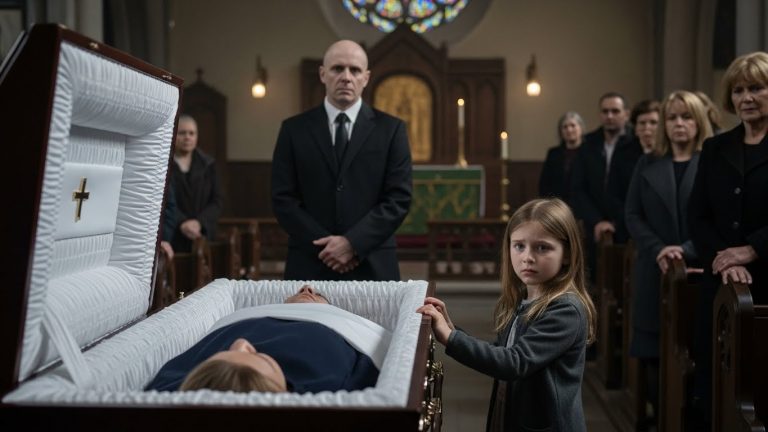
She Wore Long Sleeves in July: The Dark Secret Hidden Beneath a “Perfect” Mother’s Sunday Best
Chapter 1: The Lace and The Lies
The humidity in Mapleton, Georgia, was already climbing past eighty degrees, but inside the Jenkins household, the air was cold enough to crack glass. It was Sunday morning. The Lord’s Day. For eight-year-old Lily, it was the day she practiced the art of becoming invisible while standing in plain sight.
“Stand still, Lillian. Stop twitching,” Martha’s voice was a low hum, dangerous and vibrating in the small, pastel-colored room. It wasn’t a shout; Martha rarely shouted. Shouting left echoes that the neighbors could hear through the thin drywall of the suburbs. Whispers, however, stayed within the walls, soaking into the beige carpet like damp rot.
Lily held her breath. It was a survival tactic she had perfected over the last year. If she didn’t breathe, her ribcage wouldn’t expand. If her ribcage didn’t expand, the stiff fabric wouldn’t stretch against the skin that had turned a sickly shade of mottled purple and yellow just two days ago.
“I said, turn around,” Martha commanded, her fingers snapping.
Lily rotated slowly, her small, bare feet sinking into the plush carpet. She caught a glimpse of herself in the vanity mirror. She looked like a porcelain doll—blonde curls wrestled into submission with a cloud of hairspray, eyes wide and blue. But the eyes were wrong. They were too old, too glassy, like a window pane just seconds before it shatters from pressure.
Martha held up the dress. It was a masterpiece of deception: white eyelet lace with a high collar and long sleeves, specifically chosen for its coverage, not its fashion. It was beautiful, the kind of dress grandmothers cooed over in the department store. To Lily, it was an iron maiden.
“Arms up,” Martha said, her face impassive. She was already dressed for the service in a navy blue suit that screamed respectability. Her pearl necklace sat perfectly against her throat, choking her in a way Lily wished she could replicate.
Lily raised her arms, wincing as the movement pulled at the bruised tissue along her side. She bit the inside of her cheek to keep the sound in. A whimper would mean a restart. A whimper would mean she was “ungrateful.”
The dress slid down. The fabric was stiff, starchy. As it settled, the rough interior lining grazed the tender skin of her torso. Lily’s eyes watered, a reflex she couldn’t control.
Martha saw it. Her hands, which had been smoothing the skirt, froze. She grabbed Lily’s shoulder—not hard enough to mark, but hard enough to send a jolt of electric fear down the girl’s spine.
“Don’t you dare,” Martha hissed, her face inches from Lily’s. “Don’t you dare cry and ruin that face. Do you know how much this dress cost? Do you know how hard I work to make sure you look presentable? To make sure people don’t think you’re some wild, feral animal?”
“I’m sorry, Mama,” Lily whispered, the air hissing out of her lungs. “It just… it scratches.”
“It scratches because you’re sensitive. You’re soft,” Martha scoffed, spinning Lily around to fasten the back.
This was the worst part. The zipper.
Martha pulled the fabric tight. The dress was a size six; Lily was a growing eight. Martha insisted it still fit, refusing to buy a new one until Easter. She gathered the material at the back, her knuckles grazing Lily’s spine. Then, she squeezed.
She squeezed Lily’s waist to bridge the gap in the zipper. Her fingers dug deep, pressing directly into the bruised ribs—the result of a fall down the stairs that Martha claimed happened because Lily was “clumsy,” though Lily remembered the push.
Lily gasped, her body jerking forward involuntarily.
“Stand. Still!” Martha growled, yanking Lily back by the sash. The sudden motion felt like a hot poker being driven into her side. The zipper hissed up, locking the pain inside.
“There,” Martha said, stepping back and admiring her work. She reached out and pinched Lily’s cheeks, hard, until a flush of red appeared. “Now you look alive. You looked like a corpse before.”
Martha turned to her own reflection, adjusting a stray hair. “We are going to be late for the choir warm-up. And you know how Mrs. Gable is. She watches everyone like a hawk. You will smile. You will sing ‘Jesus Loves Me.’ And you will not slouch. Do you understand?”
“Yes, Mama.”
“If you slouch, it tells the world you’re lazy. Are you lazy, Lillian?”
“No, Mama.”
“Good. Grab your Bible. The one with the gold lettering. Let’s go.”
The car ride to the First Baptist Church was a study in suffocating silence. The family sedan smelled of Martha’s overpowering floral perfume and the stale scent of old mints. Lily sat in the back seat, the seatbelt cutting across her chest. She held the belt away from her body with a thumb, trying to create a millimeter of space.
Every bump in the road was a fresh assault. Mapleton was a beautiful town, full of weeping willows and manicured lawns, but the roads were old. As the car jostled, Lily focused on the back of her mother’s head. She wondered if other mothers looked at their children with eyes that turned into flat, black stones. She wondered if other children wore long sleeves in the summer to hide the fingerprints that didn’t wash off.
They pulled into the parking lot. It was packed. The whole town was here. It was a social runway, a place where morality was measured by the whiteness of your shirt and the shine of your shoes.
Martha killed the engine and turned around. The mask was firmly in place now. She smiled, but it didn’t reach her eyes.
“Remember, Lillian,” she said, her voice dripping with a terrifying sweetness. “We are a happy family. We are blessed. If anyone asks about the mark on your forehead…”
Lily touched the spot where her bangs covered a fading yellow bruise from a “dropped” hairbrush.
“…I bumped into the doorframe,” Lily recited robotically.
“Good girl.” Martha unlocked the doors. “Now, let’s go praise the Lord.”
Chapter 2: The Sanctuary of Silence
The First Baptist Church of Mapleton was a cavernous structure of oak and stained glass that loomed over the town square. It smelled of lemon polish, old hymnals, and judgment. To most, it was a sanctuary. To Lily, it was a courtroom where she was constantly on trial, and the verdict was always guilty.
They walked up the steps, Martha’s hand resting heavily on Lily’s shoulder. To an outsider, it looked like a protective, loving gesture—a mother guiding her lamb. To Lily, the fingers digging into her collarbone were a reminder: I am right here. I control you.
“Good morning, Martha! Oh, and look at little Lily. Don’t you look just precious in that lace!”
It was Mrs. Gable. Elara Gable. She was the matriarch of the church, a woman in her late sixties with silver hair done up in a bun and eyes that missed absolutely nothing. She ran the Sunday School, the bake sales, and, unofficially, the town’s grapevine.
“Good morning, Elara,” Martha beamed, the transformation instant. Her voice went up an octave, full of light and grace. “Doesn’t she? I told her she looks like a little angel. But she’s so shy today.”
Mrs. Gable leaned down, her knees popping slightly. She looked Lily dead in the eye. Unlike the other adults who just glanced and cooed, Mrs. Gable looked. Her gaze lingered on the way Lily stood—slightly tilted to the left to favor her injured side. She noticed the way Lily’s breath was shallow, sipping air rather than gulping it.
“Hello, Lily,” Mrs. Gable said softly. “That’s a very stiff dress for a warm morning, isn’t it sugar?”
Lily opened her mouth, but Martha answered for her. “Oh, she insists on it. She loves feeling dressed up for God. Doesn’t you, sweetie?”
Martha’s thumb pressed into the soft hollow of Lily’s shoulder.
“Yes, ma’am,” Lily whispered, looking at her black patent leather shoes. “I love it.”
Mrs. Gable straightened up, her eyes narrowing just a fraction as she looked at Martha. “Well, alright then. We better get inside. Pastor Miller has a long sermon prepared on ‘Truth and Light’ today.”
“Wonderful,” Martha said. “We wouldn’t miss it.”
They found their usual pew—third row, left side. The pew was solid wood, unforgiving and hard. As they sat, Lily had to perform a complex maneuver to lower herself without bending her torso. She kept her back rigid, sliding to the edge of the seat.
The organ music swelled, vibrating through the floorboards. The congregation stood for the opening hymn. Stand up, stand up for Jesus…
Lily stood. The movement caused the waistband of the dress to dig in. A sharp, hot pain shot through her right side, radiating to her back. She gasped, her hand flying to her side instinctively.
Martha, singing loudly with her hymnal raised high, didn’t miss a beat. But her elbow shot out, sharp and precise, knocking Lily’s hand away. “Sing,” she whispered through a smile, not breaking eye contact with the cross at the front of the room.
Lily sang. Her voice was thin and trembling, lost in the sea of baritones and sopranos. Ye soldiers of the cross…
Forty minutes into the service, the pain was becoming a roar in Lily’s ears. The air in the church was stifling. Sweat gathered at her hairline, stinging the concealer on her forehead. She felt dizzy. The Pastor’s voice drifted in and out… darkness cannot hide… everything comes to light…
“Mama,” Lily whispered, tugging gently on Martha’s sleeve. “I need… I need the restroom.”
Martha stiffened. She leaned down, keeping her eyes forward. “Can you not hold it? We are in the middle of the scripture reading.”
“I feel sick,” Lily pleaded, her face turning a ghostly pale.
Martha looked at her, assessing the risk. If Lily threw up in the pew, it would be a scene. A scene was unacceptable.
“Fine,” Martha hissed. “Go. Quickly. And fix your hair, it’s a mess.”
Lily shimmied past her mother’s legs, wincing as she squeezed through the narrow gap between the pews. She walked as fast as she could without running down the long, carpeted aisle. She could feel eyes on her.
She pushed into the women’s restroom. It was cool and quiet. She rushed to the nearest stall and dry-heaved over the toilet, but nothing came up. It was just pain and fear.
She stayed there for a moment, resting her forehead against the cool metal of the partition. She carefully unzipped the side of her dress just an inch to relieve the pressure. The relief was instant, bringing tears to her eyes.
“Lily?”
The voice made Lily jump. She frantically tried to zip the dress back up, but her sweaty fingers slipped.
“Lily, honey, are you alright in there?”
It was Mrs. Gable.
“I’m fine!” Lily squeaked, panic rising in her throat. “I’m just… I’m washing my hands!”
“Unlock the door, child. Let me help you.”
“No! My mama said I have to be quick.”
There was a silence on the other side of the stall door. Then, a soft sigh. “Lily, I’m not going to be mad. But I heard you retching. Do you have a fever?”
Lily didn’t answer. She managed to pull the zipper up, biting her lip until it bled to keep from screaming. She unlocked the stall door and stepped out.
Mrs. Gable was standing there, holding a wet paper towel. She wasn’t smiling, but her face wasn’t angry. It was filled with a terrible, heavy sadness.
“Here,” Mrs. Gable said, reaching out to wipe Lily’s forehead.
As she raised her hand, Lily flinched. It was a violent, full-body flinch. She threw her hands up to cover her face, cowering back against the stall door.
Mrs. Gable froze. Her hand hovered in the air. The silence in the bathroom was louder than the organ music outside.
“Oh, baby,” Mrs. Gable whispered, her voice trembling. “Oh, sweet girl. Did you think I was going to hit you?”
Lily lowered her hands slowly, her breathing ragged. “I… I tripped. I’m clumsy. Mama says I’m clumsy.”
Mrs. Gable looked at the girl. She saw the fear. She saw the way the dress fit too tightly around the middle. And then, she saw it.
Because Lily had been rushing to zip the dress, she had caught the fabric in the zipper. A small gap remained open on the side. Through the white lace, a patch of skin was visible. It wasn’t pink. It was a deep, angry purple.
Mrs. Gable’s eyes dropped to the spot. Lily saw her looking and quickly covered it with her arm.
“It’s nothing,” Lily said, her voice shaking. “I fell on the stairs.”
Mrs. Gable straightened up. The softness in her face hardened into something resembling steel. She wasn’t looking at a child anymore; she was looking at a mission.
“Wash your hands, Lily,” Mrs. Gable said, her voice surprisingly steady. “Fix your hair. We’re going back out there.”
“Please don’t tell Mama I took too long,” Lily begged.
Mrs. Gable knelt down—painfully, ignoring her arthritis—and took Lily’s small hands in hers.
“I promise you, Lily,” Mrs. Gable said, looking deep into the girl’s terrified eyes. “You don’t have to worry about your Mama being angry ever again. Now, let’s go. There’s a potluck after the service, and I believe it’s time for some truth.”
Chapter 3: The Feast of Deception
The transition from the cool, sterile silence of the bathroom back to the humid, murmuring reality of the church hallway felt like walking underwater. Mrs. Gable didn’t let go of Lily’s hand. Her grip was firm, dry, and warm—the grip of a woman who had churned butter by hand in her youth and wrestled with difficult truths her entire life.
“Now listen to me, Lily,” Mrs. Gable whispered as they neared the double doors of the Fellowship Hall. “You just stay close to me in spirit, you hear? I’m going to have to let your hand go, but I am not letting you go.”
Lily nodded, though her throat felt like it was stuffed with cotton. The fear was a living thing in her gut, a cold snake coiling tighter with every step closer to Martha.
They pushed through the doors. The smell hit them first—a dense, heavy wave of fried chicken, vinegar-soaked collard greens, and the sugary sweetness of ambrosia salad. The Fellowship Hall was a sea of folding tables and metal chairs, populated by men in loosened ties and women balancing paper plates on their knees.
Martha was standing near the buffet line, her foot tapping a frantic rhythm against the linoleum. She had a smile plastered on her face, but her eyes were scanning the room like a predator seeking movement in the grass. When she spotted them, the smile didn’t change, but the temperature around her seemed to drop.
“There you are!” Martha called out, her voice bright and brittle. She rushed over, ignoring Mrs. Gable and placing a hand on the back of Lily’s neck. To the onlookers, it was a mother’s caress. To Lily, it was a clamp. “I was beginning to worry, Elara. I thought maybe she’d gotten sick.”
“She’s just fine, Martha,” Mrs. Gable said, her voice smooth and unreadable. She didn’t step back. She stood her ground, forcing Martha to look up at her. “We just had a little chat. About school. About summer.”
Martha’s fingers tightened on Lily’s neck, pressing into the sensitive tendons. “Is that right? Well, Lillian is known for her… active imagination. I hope she didn’t bore you with her stories.”
“Not at all,” Mrs. Gable said. She looked at Martha’s hand on Lily’s neck. She looked at it for a long second, until Martha, sensing the scrutiny, slowly withdrew it.
“Well,” Martha cleared her throat, adjusting her pearl necklace. “We should get in line. The chicken is going fast, and you know how Lillian gets if she doesn’t eat on time. She gets so… cranky.”
They joined the line. It was a slow procession of judgment and gossip. Lily kept her head down, staring at the scuffed heels of her mother’s navy pumps. She tried to make herself small. She tried to float away from her body, to become a speck of dust in the rafters.
“Fill your plate, Lillian,” Martha hissed into her ear as they reached the buffet. “Don’t take just a roll. It makes it look like I starve you. Take the green beans. Take the potato salad. And smile at Mrs. Higgins.”
Lily obediently scooped a mound of potato salad onto her flimsy paper plate. The weight of the plate strained her wrist, which was still sore from being twisted the night before.
“Hello, Lily! My, don’t you look festive,” Mrs. Higgins chirped from behind the serving tray of deviled eggs.
“Thank you, ma’am,” Lily whispered.
“Speak up,” Martha murmured, pinching the soft flesh of Lily’s upper arm, hidden by the lace sleeve.
“Thank you, ma’am!” Lily said louder, her voice cracking.
They found a table in the corner. It was the “good family” table, situated near the window but far enough from the trash cans to be dignified. Martha arranged her napkin with surgical precision. She began to eat with delicate, bird-like bites, her eyes darting around the room, checking who was sitting with whom, who was laughing, who was watching.
Lily stared at her food. The potato salad looked like yellow sludge. The smell of the mayonnaise was making her stomach turn over. The waistband of her dress was a vice, digging into the bruises on her ribs every time she took a breath.
“Eat,” Martha said without moving her lips. She was smiling at the Pastor across the room.
“I can’t,” Lily breathed. “My tummy hurts.”
Martha turned to her. The smile vanished instantly, replaced by a look of pure, concentrated venom. “You will eat that food, Lillian. You will eat it, and you will look like you are enjoying it. If you embarrass me here, if you make people think you are sick or unhappy, you know what happens when we get home. Do you want the closet again?”
The closet. The small space under the stairs where the air was stale and the darkness was absolute. Lily shivered.
“No, Mama.”
“Then eat.”
Lily picked up her plastic fork. Her hand was trembling so hard the tines rattled against the plate. She forced a bite of potato salad into her mouth. It tasted like ash. She swallowed, fighting the urge to gag.
Across the room, near the dessert table, Mrs. Gable was not eating. She was standing next to a tall man in a tan uniform. Sheriff Miller. He was holding a cup of punch, listening intently as Mrs. Gable spoke low and fast into his ear.
Lily watched them. She saw Mrs. Gable gesture subtly toward their table. She saw the Sheriff’s eyebrows draw together. He set his cup down.
Martha noticed Lily’s gaze. She snapped her fingers in front of Lily’s face. “Stop staring. It’s rude. Who are you looking at?”
“No one, Mama.”
Martha followed Lily’s line of sight. She saw the Sheriff. She saw Mrs. Gable. For a split second, the color drained from Martha’s face. But she recovered quickly, her arrogance acting as a shield.
“Busybody,” Martha muttered, stabbing a piece of ham. “That woman thinks she runs this town just because she bakes the communion bread. Eat, Lillian. Faster.”
But Lily couldn’t eat faster. She couldn’t eat at all. Because she saw the Sheriff start to walk. And he was walking straight toward them.
Chapter 4: The Crack in the Porcelain
The Fellowship Hall was loud—a cacophony of scraping chairs, children shouting, and fifty different conversations merging into a roar. But as Sheriff Miller navigated through the maze of tables, a pocket of silence seemed to travel with him.
He was a big man, broad-shouldered and heavy-footed, but he moved with a gentle deliberation. He wasn’t wearing his hat indoors, revealing a tan line across his forehead. His badge caught the overhead fluorescent light, flashing like a warning beacon.
Martha saw him coming. She stiffened, her spine snapping straight against the metal chair. She wiped the corner of her mouth with her napkin, checking it for lipstick stains.
“Sheriff Miller,” Martha said as he arrived at their table. Her voice was too loud, too cheerful. It cut through the nearby chatter. “To what do we owe the pleasure? Did you come to arrest us for gluttony? Because Mrs. Higgins’ pecan pie is certainly a crime.”
She laughed. It was a practiced, tinkling sound, like ice cubes hitting a glass. No one else laughed.
The Sheriff didn’t smile. He hooked his thumbs into his belt, his eyes obscured by the shadow of his brow. He didn’t look at Martha. He looked at Lily.
“Hey there, Miss Lily,” the Sheriff said, his voice a low rumble. “That’s a mighty fancy dress for a hot day like this.”
Lily looked up, her eyes wide and terrified. She flicked a glance at her mother, seeking permission to speak.
“She loves dressing up,” Martha interjected quickly, placing a protective—possessive—hand over Lily’s trembling hand on the table. “She’s my little princess. Aren’t you, sweetie?”
“Ma’am,” the Sheriff said, finally turning his gaze to Martha. His eyes were flat and hard, devoid of the usual small-town warmth. “I was speaking to the child.”
The air at the table seemed to vanish. The neighbors at the adjacent table—the Hendersons—stopped chewing. Mr. Henderson slowly lowered his fork.
Martha’s smile faltered, the corners twitching. “Excuse me? I am her mother, Sheriff. I think I can answer for her. She’s shy.”
“I don’t think she’s shy, Martha,” Mrs. Gable’s voice came from behind the Sheriff. She stepped into view, her face set in grim determination. “I think she’s scared.”
Martha stood up so abruptly her chair screeched backward, drawing the attention of half the room. “Elara, I have had just about enough of your interference today. First, you ambush us in the parking lot, then you corner my daughter in the bathroom, and now this? I don’t know what kind of drama you’re trying to stir up, but we are leaving.”
She grabbed Lily’s upper arm. “Come on, Lillian. We’re going.”
Martha yanked. It wasn’t a gentle tug. In her anger, she forgot the audience. She forgot the mask. She jerked the girl upward with a violence that made Lily’s head snap back.
“Ow! Mama, my arm!” Lily cried out, the pain flaring white-hot where Martha’s fingers dug into the fresh bruises.
“Sit down, Martha,” the Sheriff said. His voice wasn’t a request anymore. It was an order.
“You can’t tell me what to do!” Martha shrilled, her voice rising to a frantic pitch. “This is my child! I raise her as I see fit! She is clumsy! She falls! She needs discipline!”
“Discipline?” Mrs. Gable stepped forward, her voice trembling with suppressed rage. “Is that what you call it? Because I saw her back, Martha. I saw the marks. That wasn’t a fall. That was a zipper pulled over broken skin. That was a hand shaped like a claw.”
The room went dead silent. The only sound was the hum of the refrigerator in the kitchen and the ragged breathing of a little girl who looked like she was about to faint.
Martha looked around the room. She saw the faces of her neighbors. People she had swapped recipes with. People she had sung hymns with. They weren’t looking at her with admiration anymore. They were looking at her with horror.
Panic set in. The cornered animal instinct took over. Martha squeezed Lily tighter, pulling the girl against her hip like a human shield.
“You’re all lying,” Martha hissed, spittle flying from her lips. “You’re all jealous. You’re jealous because she’s perfect. Because I made her perfect! You don’t know what it takes! You don’t know how hard it is to mold something into… into…”
“Into what, Martha?” The Sheriff took a step closer, his hand hovering near his radio. “Into a punching bag?”
“Into a lady!” Martha screamed. She looked down at Lily, her face contorted into a mask of pure loathing. “And you… you ungrateful little wretch. You told them. I told you not to speak. I told you to keep your mouth shut!”
Martha raised her hand. It was a reflex, a habit ingrained by years of secret violence. In the privacy of her home, that hand would have descended with the force of a hammer.
But she wasn’t home.
Lily flinched, dropping to her knees on the dirty linoleum floor, covering her head with her arms. “I didn’t! I didn’t say anything! Please, Mama, not the belt! Not the belt!”
The words hung in the air, echoing off the high ceilings. Not the belt.
It was the final nail in the coffin of Martha’s deception.
Sheriff Miller moved with surprising speed for a big man. He caught Martha’s raised wrist mid-swing. He didn’t just hold it; he twisted it, forcing her body around.
“Martha Jenkins,” he growled, forcing her arm behind her back. “That is enough.”
Martha struggled, kicking out. Her navy pump flew off, hitting the leg of a table. “Get off me! You have no right! She’s mine! She’s my property!”
“She is a human being,” Mrs. Gable said, dropping to her knees beside the sobbing child. She wrapped her arms around Lily, shielding her from the sight of her mother being restrained.
“Get your hands off her!” Martha shrieked, thrashing against the Sheriff’s grip. “She needs me! She’s nothing without me! Look at her! She’s a mess!”
“The only mess here is you, Martha,” the Sheriff said, pulling a pair of handcuffs from his belt. The metallic click-click of the cuffs locking into place was the loudest sound Lily had ever heard.
Lily peeped out from under her arms. She saw her mother—the giant, the monster, the god of her small world—bent over a table, hands cuffed behind her back. Her hair was coming loose from its bun. Her face was red and twisted.
For the first time in her life, Lily saw her mother not as an all-powerful force of nature, but as something small. Something broken. Something caught.
“You’ll regret this!” Martha spat as the Sheriff began to march her toward the exit. “She’ll rot without me! She doesn’t know how to do anything! She’s stupid! She’s weak!”
Mrs. Gable pressed Lily’s face into her shoulder, covering her ears with her hands. “Don’t listen, baby. Don’t you listen to a single word. It’s over. It’s finally over.”
But as the Sheriff dragged the screaming woman out the double doors, leaving a stunned congregation in their wake, Lily felt a new, terrifying sensation rising in her chest. It wasn’t relief. Not yet.
It was the sudden, vertiginous feeling of the ground disappearing. The monster was gone, yes. But the monster had been her entire world. Now, there was only a vast, terrifying empty space where the fear used to be.
Lily looked up at Mrs. Gable, tears streaking through the heavy makeup Martha had applied that morning.
“What happens now?” Lily whispered.
Mrs. Gable smoothed the hair back from Lily’s forehead, her touch light as a feather.
“Now,” Mrs. Gable said, her voice cracking with emotion, “now we get you out of that dress.”
Chapter 5: The Unzipping
Mrs. Gable’s house was nothing like the pristine, museum-like quality of Lily’s home. It was cluttered with life. There were knitted throws on every chair, stacks of magazines on the coffee table, and the air smelled of lavender and dust. To Lily, it smelled like a foreign country.
Mrs. Gable led Lily into the guest bedroom. It was painted a soft yellow. “Alright, sugar,” Mrs. Gable said, closing the door gently to shut out the noise of the world. “Let’s get that thing off you.”
Lily stood in the center of the room, her arms rigid at her sides. The conditioning ran deep. “Mama says I can’t take it off until bedtime. It wrinkles.”
Mrs. Gable knelt down, her knees cracking. She looked Lily in the eye. “Mama isn’t here, Lily. And this dress… this dress is hurting you. I can see it in your eyes.”
Lily turned around slowly. She held her breath, waiting for the pinch, the yank, the criticism.
Mrs. Gable reached for the zipper. Her hands were shaking slightly, but her touch was agonizingly gentle. She pulled the tab down.
Zzzzzzt.
The sound was loud in the quiet room. As the fabric parted, the pressure released. Lily let out a gasp—half pain, half relief. The lace had been fused to the dried fluids on her skin.
Mrs. Gable peeled the dress back from Lily’s shoulders. As the white lace fell away, the truth was laid bare in the afternoon sunlight.
It was a map of violence.
There were old bruises, yellow and green like fading storms. There were fresh ones, deep purple and black. There were fingernail crescents dug into the soft skin of her upper arms. And there, running along her ribs, was the raw, angry abrasion where the zipper had been forced over swollen flesh.
Mrs. Gable didn’t scream. She didn’t gasp. She went very still.
Lily waited for the judgment. “I’m sorry I’m ugly,” she whispered, repeating a phrase she had heard a thousand times in front of the mirror.
Mrs. Gable made a choked sound. She stood up and walked to the window, turning her back for a moment. Lily saw her shoulders shaking. When Mrs. Gable turned back, her face was wet, but her voice was steady.
“You are not ugly, Lily,” Mrs. Gable said fiercely. “You are a survivor. And I am so sorry. I am so sorry I didn’t look closer sooner.”
She went to the adjoining bathroom and came back with a warm, wet washcloth and a first-aid kit.
“This might sting a little,” Mrs. Gable said.
She began to clean the wounds. For the first time in her life, pain was met with tenderness instead of more pain. Every time Lily flinched, Mrs. Gable stopped, apologized, and waited.
“Why?” Lily asked, her voice small.
“Why what, baby?”
“Why are you being nice? I ruined the potluck.”
Mrs. Gable paused, the washcloth hovering over a bruise on Lily’s shoulder. She looked at the girl—so broken, so convinced of her own guilt.
“You didn’t ruin anything, Lily,” Mrs. Gable said, her voice trembling with a righteous fury she tried to hide. “You saved yourself. And today, we are going to burn this dress.”
Chapter 6: The Voice in the Room
The hospital room was bright, sterile, and cold. It was very different from Mrs. Gable’s yellow bedroom, but it felt safer than home. Here, there were witnesses.
Lily sat on the edge of the examination bed, wearing a paper gown that crinkled every time she moved. Sheriff Miller was there, standing by the door like a guard dog. A lady named Dr. Evans was sitting on a rolling stool, holding a clipboard. She had kind eyes and wore a pin on her lanyard that looked like a cartoon cat.
“Okay, Lily,” Dr. Evans said softly. “I know this is scary. You’re doing a brave job.”
“I want to go home,” Lily lied. She didn’t want to go home. She wanted to disappear. But the script in her head was still running. If you tell, I’ll kill you. If you tell, they’ll take you away and lock you in a dark room forever.
“We can’t let you go home right now, sweetie,” Dr. Evans said. “We need to make sure you’re safe. Can you tell me how you got this mark on your arm?”
Lily looked at the Sheriff. He gave her a small nod. “It’s okay, Miss Lily. You can tell the truth. The Bad Man isn’t here. Neither is your Mama.”
“She said…” Lily started, then stopped. Her throat closed up.
“What did she say, Lily?” Dr. Evans asked.
“She said I’m clumsy,” Lily whispered. “She said I fell down the stairs.”
Dr. Evans wrote something down. “Did you fall down the stairs, Lily?”
Lily looked at her hands. She twisted the paper gown. She remembered the stairs. She remembered standing at the top, Martha’s hands on her back. She remembered the feeling of being shoved—not a slip, but a push.
“No,” Lily said. The word was so quiet it was almost a thought.
“I didn’t hear you, honey,” Dr. Evans said.
Lily closed her eyes. She saw the lace dress. She saw the reflection in the mirror. She saw Mrs. Gable’s tears.
“No,” Lily said, louder this time. “She pushed me.”
The air in the room changed. It was as if a heavy weight had been lifted, only to be replaced by a different kind of gravity.
“She pushed you?” Dr. Evans asked, her voice neutral but intense.
“She pushed me because I spilled the milk,” Lily said, the dam breaking. “And she pinched my arm because I cried. And she made me wear the dress so nobody would see. She said if I told anyone, nobody would love me because I’m a bad girl.”
Sheriff Miller cleared his throat. It sounded like a growl. He turned away, his knuckles white where he gripped his belt.
Dr. Evans put the clipboard down. She reached out and covered Lily’s hand with hers.
“She lied to you, Lily,” Dr. Evans said firmly. “You are not a bad girl. You are a child. And mothers are supposed to protect their children, not hurt them. What she did is a crime. That is why the Sheriff took her away.”
“Is she coming back?” Lily asked, the terror spiking in her chest. “Is she coming to get me?”
Sheriff Miller turned back around. He walked over to the bed and squatted down so he was eye-level with Lily.
“No,” he said. “I promise you, Lily. As long as I am Sheriff in this town, she is never coming near you again. You are safe now.”
Lily looked at him. She looked for the lie. She looked for the trick. But she only saw a tired man with sad eyes who meant every word he said.
For the first time that day, Lily cried. Not the silent, suppressed weeping she did in the closet, but loud, ugly, heaving sobs that shook her entire small body. It was the sound of poison leaving a wound.
Chapter 7: Shadows in the Garden
Three months later, the leaves in Mapleton were turning gold and crimson. The air was crisp, smelling of woodsmoke and dried corn.
Lily sat in the dirt in Mrs. Gable’s backyard. She was wearing a pair of denim overalls and a t-shirt that had a small stain of grape juice on the collar. Her hair was loose, a tangled mess of windblown curls.
She was digging a hole with a plastic shovel.
“Careful with those petunias, Lily!” Mrs. Gable called from the porch, where she was shelling peas.
Lily froze. The old fear, like a muscle memory, seized her. She had dug too close to the flowers. She had made a mistake.
She dropped the shovel and scrambled backward, curling into a ball. “I’m sorry! I’m sorry! Don’t hit me!”
She squeezed her eyes shut, waiting for the blow. Waiting for the voice that would tell her she was worthless.
But the blow never came.
Instead, she heard footsteps crunching on the dry leaves. Then, the creak of Mrs. Gable’s knees as she lowered herself to the ground.
“Lily,” Mrs. Gable said softly.
Lily peaked through her fingers. Mrs. Gable was sitting in the dirt next to her. She wasn’t holding a belt. She wasn’t holding a switch. She was holding a handful of dirt.
“Look,” Mrs. Gable said, letting the soil run through her fingers. “It’s just dirt, baby. And flowers grow back. Even if you stomped on every single one of these petunias, I wouldn’t hit you.”
Lily slowly lowered her hands. “But I made a mess.”
“Life is messy,” Mrs. Gable smiled. She reached out and bopped Lily on the nose with a dirty finger, leaving a smudge of soil. “See? Now I’m messy too.”
Lily blinked. She touched her nose. She looked at the smudge on her finger.
A giggle bubbled up in her throat. It was a rusty sound, unused for years, but it was there.
“You have dirt on your face,” Lily said.
“So do you,” Mrs. Gable laughed. “We’re a couple of dirty rascals.”
Lily picked up her shovel. She looked at the hole she had dug. She looked at Mrs. Gable.
“Can I… can I dig a deeper hole?” Lily asked tentatively.
“You can dig all the way to China if you want,” Mrs. Gable said, leaning back on her hands. “Just be home for supper.”
Lily went back to digging. The sun warmed her back. The denim overalls were soft and loose. Her ribs didn’t hurt. Her heart beat steady and slow.
She was just a girl in a garden. It was such a small thing, but to Lily, it felt like flying.
Chapter 8: The New Sunday
A year had passed since the Sunday of the white lace dress.
The First Baptist Church of Mapleton looked exactly the same. The stained glass still gleamed, the oak doors were still heavy, and the organ music still drifted out into the parking lot.
But everything else had changed.
Martha Jenkins was not in the third pew. She was in a state facility three counties away, serving a sentence for aggravated child abuse. The house with the beige carpets had been sold. The secrets that had rotted in its walls were gone.
Lily stood at the bottom of the church steps. She was holding Mrs. Gable’s hand.
“You ready?” Mrs. Gable asked.
Lily looked down at her outfit. She wasn’t wearing lace. She wasn’t wearing patent leather shoes that pinched her toes. She was wearing a soft blue cotton dress with sunflowers on it. It had short sleeves.
Her arms were bare.
Lily looked at her arms. There were faint white lines—scars that would never fully tan—but the purple was gone. The yellow was gone.
“I’m ready,” Lily said.
They walked up the steps. The usher, Mr. Henderson, smiled at them. He didn’t look through Lily anymore. He looked at her.
“Morning, Lily,” he said. “Nice dress.”
“Thanks,” Lily said, her voice clear and strong. “I picked it out myself.”
They walked into the sanctuary. The smell of lemon polish was still there, but the smell of fear was gone. They didn’t sit in the third row on the left. Mrs. Gable liked the back, near the window where the breeze came in.
As the service began, the congregation stood to sing. Amazing Grace, how sweet the sound…
Lily stood. She took a deep breath. Her lungs expanded fully, her ribcage moving without restriction. The fabric of her dress moved with her, soft and yielding.
She looked around the room. She saw Mrs. Higgins. She saw the Sheriff in the back corner. She saw people who knew the truth, and who loved her anyway.
She wasn’t a porcelain doll. She wasn’t a reflection in a mirror. She was Lily.
She opened her mouth and sang. She didn’t have the best voice—she was a little off-key—but she sang loud. She sang because she could. She sang because no one was pinching her arm to make her stop.
I once was lost, but now am found…
Sunlight streamed through the stained glass, painting colors on the floor. Lily watched the dust motes dancing in the light. She realized she wasn’t trying to be invisible anymore.
She was standing in the light, and for the first time, she wasn’t afraid of what it might reveal.
She was bruised, yes. She was scarred, yes. But beneath the Sunday best, beneath the skin, her heart was finally, beautifully whole.
THE END.