We Pranked The Disabled Girl Next Door, But When Her Dad Caught Us, We Realized He Wasn’t Just A Dad—He Was A Hunter.
Chapter 1: The Hill on Sycamore Drive
The heat in Ohio during July isn’t just a temperature; it’s a physical weight. It presses down on your shoulders, makes your shirt stick to your spine, and turns the air into a soup of humidity and asphalt fumes. It was 2004, the summer before our senior year, and we were drowning in it.

I was sitting on the curb of Sycamore Drive, spinning a pebble between my fingers. Next to me was Tyler, the kind of guy who peaked in high school and knew it. He had that varsity jacket draped over his shoulder even though it was ninety degrees out, a symbol of a hierarchy that only mattered in our zip code. Flanking him were Mark and Chris, two guys who had never had an original thought in their lives. They were just echoes, laughing whenever Tyler laughed, hating whoever Tyler hated.
And then there was me, Jake. The narrator of this train wreck. I wasn’t a bully, or at least I told myself I wasn’t. I was just the guy who didn’t want to be on the receiving end. In the ecosystem of high school, if you aren’t the predator, you’re the prey. So, I ran with the pack.
“This town is a graveyard,” Tyler groaned, crushing an empty can of Mountain Dew against the pavement. “Nothing ever happens.”
“We could go tip cows,” Chris suggested, snorting a laugh.
“Shut up, farm boy,” Tyler shot back.
That’s when the rhythmic clack-clack-clack of wheels caught our attention.
At the bottom of Sycamore Drive, the steepest hill in the neighborhood, a figure was moving. It was Lily Thorne. She lived in the old, peeling Victorian house at the corner—the one with the overgrown hedges and the blinds that were always drawn.
Lily was a ghost in our school. She was in a wheelchair, paralyzed from the waist down since she moved here three years ago. She didn’t have friends. She didn’t go to football games. She just existed in the periphery, a silent reminder that life could be cruel.
She was struggling. Her arms, thin and pale, were straining against the wheels of her manual chair. She was trying to get up the slope to the mailbox cluster halfway up the block.
Tyler sat up, a wicked glint entering his eyes. It was the look he got before he started a fight in the locker room. “Well, well. Look at the little engine that could.”
“Leave it, Ty,” I said, though my voice lacked conviction. “It’s too hot for this.”
“Don’t be a buzzkill, Jake,” Tyler stood up, stretching. “I’m just gonna go offer some… assistance.”
He winked at Mark and Chris. They grinned like hyenas. I stood up too, my stomach twisting. I knew that “assistance” meant humiliation. But I followed. God help me, I followed.
We walked down the hill, cutting through the grass so she wouldn’t hear us coming. The air was thick with the smell of cut grass and impending disaster. Lily had paused to rest, engaging the brakes on her chair. She was wiping sweat from her forehead, her back to us.
We surrounded her before she knew we were there.
“Need a push?” Tyler asked, his voice dripping with faux-sweetness.
Lily jumped, her hands flying to her chest. She whipped her head around, eyes wide. When she saw Tyler, her face drained of color. She didn’t speak; she just shook her head quickly, gripping the armrests until her knuckles turned white.
” assertive,” Tyler said, stepping closer. “Come on, guys. It’s hard work going uphill. Let’s help her out.”
“Please,” Lily whispered. It was the first time I’d ever heard her speak. Her voice was raspy, unused. “Just leave me alone.”
“We’re just helping,” Tyler said. He reached down to the brake lever on the right wheel.
“Ty, don’t,” I said, stepping forward. “The hill is too steep.”
Tyler ignored me. He looked at Lily, grinning. “Oops.”
He kicked the brake release.
Chapter 2: The Predator
The sound of the brake disengaging was a sharp click that echoed like a gunshot in the quiet street.
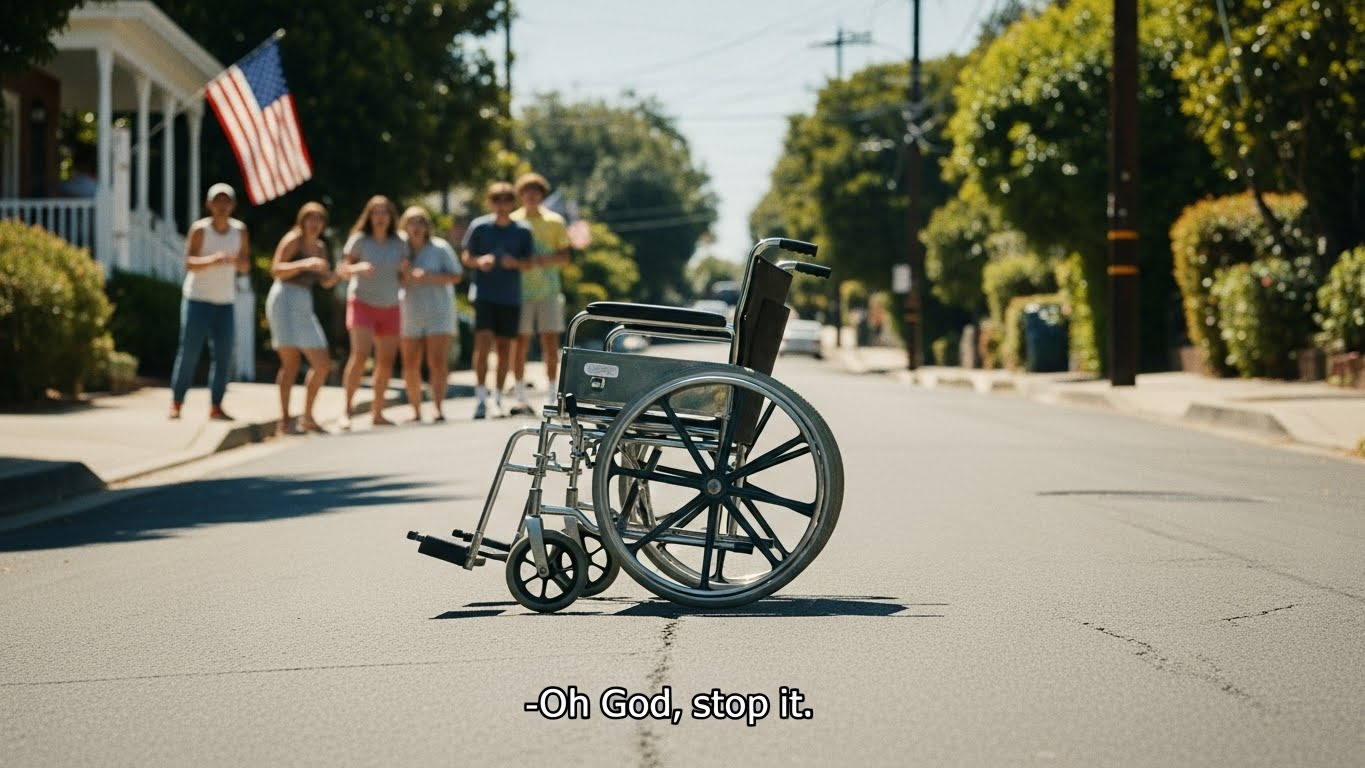
Because the hill was so steep, gravity took over instantly. The chair didn’t just roll; it lurched. Lily gasped, a sound of pure, unadulterated panic.
“Catch her!” I yelled, my instincts finally overriding my cowardice. I lunged forward.
Tyler threw his arm out, slamming it into my chest and stopping me. “Relax, Jake! She’ll roll five feet and stop in the grass. It’s funny.”
But it wasn’t funny. Tyler had miscalculated. He hadn’t noticed the patch of sand left over from winter road salting.
The left wheel hit the sand. The chair didn’t drift into the soft grass. It spun, correcting its course straight down the center of the asphalt.
And it was picking up speed.
“Oh shit,” Mark whispered.
Lily was screaming now. It wasn’t a scream for help; it was a scream of terror. She was rolling backward, gaining momentum with every yard. Twenty feet. Thirty feet.
At the bottom of the hill, the cross-street was blind. A massive, lifted Ford F-150 was turning the corner, rumbling loudly. The driver couldn’t see Lily. Lily couldn’t see the truck.
She was on a collision course.
“Do something!” I screamed at Tyler, but he was frozen. The bully was gone, replaced by a scared kid watching a manslaughter charge unfold in real-time.
I started to sprint, but I was too far away. I was watching death happen. I closed my eyes for a split second, bracing for the crunch of metal and bone.
Then, the air changed.
A screen door slammed. Not just slammed—it sounded like it had been ripped off its hinges.
From the porch of Lily’s house, a gray blur launched itself. It was her father, Mr. Thorne. I had only seen him a few times—a quiet man who mowed his lawn with military precision and never waved back.
He didn’t run like a normal person. He ran low, his center of gravity dropped, his legs pumping with explosive, violent power. He covered the forty yards of front lawn in seconds, vaulting the white picket fence without even breaking stride.
The truck was ten feet from Lily. The driver slammed on the brakes, tires screeching, smoke billowing. But a truck that heavy doesn’t stop on a dime.
Mr. Thorne hit the asphalt. He didn’t dive; he slid like a baseball player stealing home, but with controlled, terrifying precision. His work boots ground into the road, creating friction, sparks literally flying from the metal eyelets.
He reached out with one hand—just one—and grabbed the frame of the wheelchair.
The physics of it should have ripped his arm out of the socket. The chair was moving at probably twenty miles an hour.
Thud.
He stopped it. Just like that.
He absorbed the entire momentum of the chair and the girl into his body, anchoring himself to the ground. The wheelchair halted inches—literally two inches—from the chrome bumper of the Ford.
The truck driver was laying on the horn, shouting obscenities.
Mr. Thorne ignored the truck. He didn’t even look at it. He stood up slowly, dusting off his knees. His jeans were shredded. His arm had to be screaming in pain, but his face remained impassive.
He knelt in front of Lily. He placed a hand on her cheek, checking her eyes. He whispered something to her. She was sobbing hysterically now, burying her face in his shoulder. He held her for a moment, solid as a rock.
Then, the truck driver yelled, “Watch your kid, asshole!”
Mr. Thorne turned his head. He didn’t shout back. He just looked at the driver.
The driver stopped yelling mid-sentence. He actually rolled up his window, put the truck in reverse, and backed away slowly before peeling out.
Then, Mr. Thorne stood up and turned toward the hill.Toward us.
The distance was significant, but it felt like he was standing right in front of me. I couldn’t breathe. My heart was hammering against my ribs like a trapped bird.
His eyes. God, his eyes.
They weren’t the eyes of a concerned parent. They weren’t the eyes of a suburban dad who sells insurance. They were flat. Dead. A void where humanity should be. It was a look of assessment. He was calculating wind speed, distance, and threat level.
He looked at Tyler. Tyler flinched physically, stepping behind Mark.
He looked at me.
A chill went down my spine that had nothing to do with the wind. He held my gaze for three seconds. In those three seconds, I felt like he had read my entire life history, judged my soul, and found it wanting.
He didn’t say a word. He didn’t point a finger. He just turned back to Lily, effortlessly lifted her—wheelchair and all—over the curb, and began pushing her back toward the house.
“We have to go,” Tyler whispered. His voice was high-pitched, cracking. “Now.”
We didn’t walk. We ran. We scrambled up the hill and through the backyards, tearing our clothes on fences, not stopping until we were safely in Tyler’s basement with the door locked.
But locks are for keeping out honest people. And I had a feeling Mr. Thorne was something else entirely.
Part 2
Chapter 3: Paranoia
We sat in Tyler’s basement for three hours. The room smelled of damp carpet and stale pizza, usually a comforting scent, but now it felt like a bunker. The television was on, muted, flashing colors across our pale faces.
“He didn’t see us,” Chris said, breaking the silence. He was pacing back and forth, chewing his thumbnail until it bled. “We were too far up the hill. He couldn’t have ID’d us.”
“He looked right at me, Chris,” I snapped. My hands were still shaking. I couldn’t get the image of that slide out of my head. The unnatural speed. “He looked right at all of us.”
“So what?” Tyler blustered, trying to regain his alpha status. He cracked a fresh soda, but his hand trembled, spilling foam onto the floor. “He’s just some old vet or something. What’s he gonna do? Call the cops? We didn’t touch her. Gravity did.”
“We released the brake, Ty,” Mark murmured from the corner. “That’s assault. Maybe attempted murder.”
“Shut up!” Tyler threw the can across the room. It exploded against the wall. “Nobody says a word. If nobody talks, it never happened. It was an accident. The brake slipped. End of story.”
We agreed. We made a pact. The stupidity of youth is believing that silence can bury the truth.
I walked home around sunset. The shadows stretched long and thin across the pavement, looking like grasping fingers. Every rustle of leaves made me jump. Every car passing slowly made me want to dive into the bushes.
I lived four blocks away. My house was a typical suburban two-story. I let myself in, mumbled a hello to my parents who were watching Jeopardy, and went straight to my room.
I locked the door. Then I propped a chair under the handle.
I lay in bed, staring at the ceiling fan spinning lazily. Who is he?
I grabbed my laptop and pulled up the local property records. It’s amazing what you can find when you’re terrified. I searched the address on the corner of Sycamore.
Owner: Thorne, Elias. Purchase Date: 2001. Previous residence: [REDACTED]
Redacted? I frowned. I tried to search his name on Google. Elias Thorne. Nothing. No Facebook, no LinkedIn, no news articles. It was like the man didn’t exist before he bought that house.
I finally fell into a fitful sleep around 2:00 AM.
I woke up to a sound. Tap. Tap. Tap.
It was rhythmic. Gentle. Deliberate.
I froze. My clock read 3:33 AM. The witching hour.
The sound was coming from my window. I’m on the second floor. There is no balcony. There is no tree branch close enough to hit the glass.
Tap. Tap. Tap.
I threw the covers off, sweat drenching my t-shirt. I crept toward the window. My heart was in my throat, beating so hard it hurt my ears. I reached for the blinds.
I peeked through a single slat.
My front lawn was bathed in the orange glow of the streetlamp. And there he was.
Elias Thorne.
He was standing in the exact center of my lawn. He wasn’t hiding. He was wearing the same grey t-shirt, his arms crossed over his chest. He wasn’t looking at the house in general. He was looking directly at the slit in the blinds where my eye was.
He knew.
He didn’t wave. He didn’t make a threatening gesture. He just stood there, a statue made of flesh and bone.
Then, he raised his right hand. He pointed two fingers at his own eyes, then pointed them at me.
I’m watching you.
I fell back from the window, scrambling backward on the carpet until my back hit my bed. When I worked up the courage to look again five minutes later, the lawn was empty.
But in the dew on the grass, I could see two perfect footprints where he had stood.
Chapter 4: The Hunter’s Game
The next day at school—summer school for Mark, football practice for Tyler and me—the atmosphere was poisonous.
I tried to tell Tyler about the man on my lawn.
“You were dreaming, Jake,” Tyler scoffed, lacing up his cleats. “You’re letting him get in your head. It’s a psyche-out. That’s all.”
“He was there, Ty. I saw the footprints.”
“Whatever. Just focus on the drills.”
We went out to the field. It was another scorching day. The heat waves shimmered off the bleachers.
Practice was brutal. Coach was riding us hard. About halfway through, during a water break, I looked toward the parking lot.
A black sedan was parked in the far corner, under the shade of an oak tree. The windows were tinted dark. It hadn’t been there when we started.
“Who’s that?” I asked Mark.
“Probably a scout,” Mark said hopefully.
I kept watching. The car didn’t move.
Practice ended. We hit the showers. When we came out, the car was gone.
But when we got to Tyler’s car—a prized Mustang his dad had bought him—we stopped dead.
“What the hell?” Tyler screamed.
His car was boxed in. Not by other cars, but by shopping carts. Hundreds of them. Someone had taken every single shopping cart from the grocery store across the street and zip-tied them together in a tight, impenetrable circle around Tyler’s Mustang.
It was a fortress of metal wire.
“This is impossible,” Mark whispered. “We were only in the showers for twenty minutes. How could one person do this so fast?”
I walked up to the carts. They were zip-tied with heavy-duty, military-grade black cable ties. The kind you can’t break without wire cutters.
On the hood of the Mustang, sitting innocently on the wax finish, was a single object.
A wheelchair brake handle.
Tyler went pale. He recognized it. It was the rubber grip from Lily’s chair.
“He was here,” I whispered. “He did this while we were showering.”
“How?” Tyler yelled, kicking a cart. It didn’t budge. “This takes an hour! There’s cameras here!”
We looked up at the school security camera mounted on the light pole. It was pointing straight down at the ground, dangling by a wire. Broken.
“He’s not just a dad,” I said, the realization settling in my stomach like lead. “Ty, think about the speed yesterday. The silence. The redacted records. The tactical ties.”
“So what is he?” Tyler hissed. “A ninja?”
“No,” I said, feeling a cold dread wash over me. “He’s a pro. We didn’t prank a neighbor. We pranked a soldier. Or a spook. And he’s starting a campaign.”
“A campaign?”
“Psychological warfare,” I said. “He’s deconstructing us. Step by step.”
Tyler laughed, but it sounded like a bark of fear. “You watch too many movies, Jake. I’m cutting these ties. Then I’m going to his house to have a little chat.”
“Don’t,” I warned. “Do not go to that house.”
“Watch me.”
Tyler went to his trunk, grabbed a pair of pliers, and started snapping the ties. It took us an hour to free the car.
That night, Tyler didn’t answer his phone. I called him six times. Straight to voicemail.
I drove by his house around 10 PM. His Mustang was in the driveway. The lights were on. But the front door was wide open.
I slowed my car, rolling down the window. “Ty?”
Silence.
I got out of the car, my legs shaking. I walked up the driveway. The front door was ajar, swaying slightly in the breeze.
“Tyler?”
I stepped into the foyer. “Mr. and Mrs. Henderson?”
No answer. His parents were out of town for the weekend. Tyler was alone.
I walked into the living room. The TV was on. A bowl of popcorn was spilled on the floor.
And on the wall, painted in what looked like red grease… or maybe lipstick… was a single arrow. Pointing to the basement door.
I knew I should run. I knew I should call 911. But the arrow pulled me.
I opened the basement door.
“Ty?”
It was pitch black down there. I flipped the switch. The bulb popped and went out.
“Help,” a voice whimpered from the dark.
I used my phone light. The beam cut through the darkness.
Tyler was there. He was sitting in a chair in the middle of the room. He wasn’t tied up. He wasn’t bleeding.
But he was staring at the corner of the room, tears streaming down his face, his pants soaked with urine. He was catatonic with terror.
“Ty, what happened?” I rushed to him.
He didn’t look at me. He just pointed a trembling finger at the corner.
“He… he didn’t touch me,” Tyler whispered. “He just… sat there. In the dark. For hours. Telling me things.”
“What things?”
“Things about me. Things nobody knows. He told me exactly how I’m going to die if I ever go near Lily again.”
I shined the light in the corner. It was empty. But on the floor, carved into the concrete with a knife, was a message.
ONE DOWN. THREE TO GO.
Chapter 5: The Silence of the Farm Boy
Tyler was gone. Not dead, but gone. His parents committed him to a private mental health facility two towns over the next morning. The official story was a “nervous breakdown caused by academic pressure.” But we knew.
Mark, Chris, and I stood in the parking lot of the 7-Eleven, sipping Slurpees that tasted like ash.
“One down,” Chris whispered, his eyes darting around the parking lot. Chris was the big one of the group, a farm kid who grew up hauling hay bales. He was loud, obnoxious, and physically imposing. Usually, nothing scared him. Now, he looked like a child lost in a department store. “He said three to go. Who’s next?”
“We need to stick together,” I said. “He picks us off when we’re alone. Safety in numbers.”
“Screw that,” Chris spat, throwing his cup into the trash. “I’m going to my uncle’s cabin in Kentucky. I’m leaving tonight. If I’m two states away, the freak can’t touch me.”
“Chris, don’t,” Mark warned. “Running makes you prey.”
Chris didn’t listen. He peeled out of the lot in his lifted Silverado. Mark and I watched him go, a heavy sense of dread settling between us.
Chris made it home and started packing. He told me later—much later—what happened.
He was throwing clothes into a duffel bag, his room chaotic. The sun had set, and the Ohio countryside was pitch black outside his window. He lived on a farm, miles from the nearest neighbor. Usually, the isolation was peaceful. Tonight, it was a tomb.
He carried his bag out to his truck. The gravel crunched loudly under his boots. He threw the bag in the passenger seat and climbed into the driver’s side. He locked the doors instantly.
He turned the key. The engine roared to life. He sighed in relief.
Then, the radio turned on.
Chris hadn’t touched the dial. It was set to a static-filled AM frequency. But through the white noise, a sound cut through.
Screech. Thud. Gasp.
It was the recording of the wheelchair accident. The exact sound of the tires sliding. The sound of Lily’s terrified intake of breath.
Chris frantically hit the power button. It wouldn’t turn off. The volume climbed higher.
SCREECH. THUD. GASP.
“Stop it!” Chris screamed, punching the dashboard.
The dashboard lights flickered and died. The headlights cut out. The truck was plunged into total darkness. The engine killed.
Silence.
Chris sat there, breathing hard, his hands gripping the steering wheel. He reached for the door handle. Locked. The manual lock wouldn’t budge. He was trapped in a metal box in the middle of nowhere.
Then, a voice spoke. It didn’t come from the radio. It came from the backseat.
“Field stripping a weapon requires patience, Christopher. So does dismantling a life.”
Chris froze. He hadn’t checked the backseat.
He looked into the rearview mirror. A match flared to life in the darkness.
The flame illuminated the lower half of Elias Thorne’s face. He was calmly lighting a cigarette. He wasn’t looking at Chris; he was looking at the flame.
“You like to make noise,” Elias said softly. “You laughed the loudest when my daughter cried.”
“I’m sorry!” Chris wailed, tears streaming down his face. “I’m so sorry, man! I’ll do anything!”
Elias blew out the match. Darkness returned. The glowing cherry of the cigarette was the only light, hovering in the black void behind Chris’s head.
“Fear is a teacher,” Elias’s voice drifted from the dark. “And you have been a very poor student. You think distance saves you? I hunted men in jungles you couldn’t find on a map. I tracked targets across continents. You think a cabin in Kentucky is going to hide you from me?”
“What do you want?” Chris sobbed.
“I want silence,” Elias said. “Absolute silence.”
The cigarette cherry moved closer. Chris squeezed his eyes shut, screaming.
The next morning, Chris’s truck was found parked on the shoulder of the interstate, ten miles out of town. The keys were in the ignition. The engine was running.
Chris was found walking in a cornfield three miles away. He wasn’t hurt physically. No bruises. No cuts.
But he wouldn’t speak.
The doctors called it “selective mutism induced by extreme trauma.” When the police asked him what happened, he just shook his head and put a finger to his lips.
Two down.
Chapter 6: The Law is not a Shield
It was just me and Mark now.
We met at the public library. It felt safe there. Quiet. Public. Too many witnesses for Elias to pull anything.
Mark was unraveling. He had dark circles under his eyes, and his fingernails were chewed to the quick.
“He’s a ghost, Jake,” Mark whispered, hiding behind a stack of encyclopedias. “He got Tyler in his own basement. He got Chris in his own truck. We can’t hide.”
“We go to the police,” I said firmly. “We have to. This is stalking. Kidnapping. Harassment. We confess to the prank—hell, I’ll take the assault charge if it means getting a restraining order against this guy.”
Mark nodded vigorously. “Yes. The police. Chief Miller knows my dad. He’ll help us.”
We walked to the police station. It was a brick building downtown, smelling of floor wax and stale coffee. The air conditioning was blasting, a stark contrast to the humid hell outside.
We walked up to the front desk. Sergeant Miller, the Chief’s brother, was on duty.
“Boys,” he nodded. “What can I do for you?”
“We need to report a… a dangerous individual,” Mark stammered. “He’s stalking us. He threatened our friends.”
Sergeant Miller frowned, pulling out a notepad. “Names?”
“Elias Thorne,” I said. “He lives on Sycamore Drive.”
The pen stopped moving.
Sergeant Miller didn’t write the name down. He slowly looked up, his expression shifting from boredom to something like… wariness.
“Thorne?” Miller asked quietly. “You sure that’s the name?”
“Yes,” I said. “He’s crazy. He boxed Tyler’s car in. He did something to Chris.”
Miller put the pen down. He looked around the lobby to make sure it was empty, then leaned over the counter.
“Listen to me, sons. You go home. You stay out of trouble.”
“What?” Mark shouted. “We’re trying to file a report! You have to investigate!”
“I can’t investigate a ghost,” Miller hissed. “Do you know who that man is?”
“He’s a nobody!” Mark yelled.
The door to the inner office opened.
“Problem out here?” a deep voice boomed. It was Chief Miller.
And walking out right behind him was Elias Thorne.
My blood ran cold. Elias was wearing a clean polo shirt and khakis. He looked like a normal, respectable citizen. He was holding a file folder.
“No problem, Chief,” Elias said, his voice smooth and calm. “Just some local kids.”
Elias looked at us. He didn’t glare. He didn’t scowl. He smiled. A polite, neighborly smile that didn’t reach his eyes.
“Hello, Jake. Hello, Mark,” Elias said.
“You know these boys, Major?” the Chief asked.
Major.
“They live in the neighborhood,” Elias said. “Just spirited young men.” He turned to the Chief and handed him the folder. “Here are the consultation files you asked for, regarding the new tactical training protocols. I’m happy to help the department modernize.”
“We appreciate it, Elias,” the Chief said, shaking his hand warmly. “It’s an honor to have someone with your… expertise in town.”
Mark looked like he was going to vomit. Elias wasn’t just a dad. He was consulting for the police. He was training them.
Elias walked toward the exit. As he passed us, he stopped. He leaned in close to Mark, so only we could hear.
“The law protects citizens, Mark,” Elias whispered. “But we operate outside of that, don’t we? You boys started a war without rules. Don’t come crying to the referee now.”
He patted Mark on the shoulder. It looked friendly to the Chief. To Mark, it was a death sentence.
Elias walked out into the sunlight.
Mark collapsed onto a bench in the lobby, hyperventilating. “He owns them. He owns the police.”
“He doesn’t own them,” I said, watching the door swing shut. “They respect him. They fear him. That’s worse.”
We left the station. Mark was shaking so hard he could barely walk.
“I’m going home,” Mark mumbled. “I’m locking the doors. I have a gun in my dad’s safe. If he comes, I’ll shoot.”
“Mark, no,” I said. “That’s what he wants. He wants you to escalate.”
“I’m not going out like Chris!” Mark yelled, running toward his car.
I watched him go. I stood alone on the sidewalk. Three down.
I was the only one left.
I checked my phone. I had a text message. It was from an unknown number.
Check your pocket.
I froze. My hand went to the back pocket of my jeans. I felt something hard and cold.
I pulled it out.
It was a single, rusted bolt. One of the bolts from the wheel of a wheelchair.
I looked around the street. It was empty. But I knew he was there. watching.
It wasn’t about revenge anymore. It was about teaching a lesson. And the final exam was coming for me.
Chapter 7: The Siege of Mark
Mark didn’t just go home. He fortified.
I stood outside his house at 9:00 PM. The windows were boarded up—literally nailed shut with plywood he must have found in the garage. The floodlights were blinding, turning the front lawn into a stage.
I called his phone. He answered on the first ring.
“He’s here, Jake,” Mark whispered. He sounded manic. “I can hear him in the bushes.”
“Mark, put the gun down,” I pleaded, staring at the empty shrubbery. “There’s nobody there. You’re doing exactly what he wants. You’re isolating yourself.”
“No! I’m ready!” Mark shouted. “Come get some, you freak!”
I heard the distinct rack of a shotgun slide over the phone.
Suddenly, the floodlights on Mark’s lawn flickered. Once. Twice. Then, with a loud pop, they blew out.
Total darkness swallowed the house.
“He cut the power!” Mark screamed. “He’s coming in!”
“Mark, stay calm!”
But calm had left the building a long time ago. Inside the house, I saw the beam of a flashlight swinging wildly.
Then, a sound erupted from the backyard. It was a loud, sharp whistle. The kind a commander uses to signal a charge.
“I see him!” Mark shrieked.
BLAM.
A shotgun blast blew out the living room window from the inside. Glass shattered onto the porch.
BLAM. BLAM.
Mark was shooting at shadows. He was destroying his own home, firing blindly into the dark corners of his living room, terrified of a ghost that wasn’t there.
I dialed 911. “My friend is having a psychotic break. He has a gun.”
Within minutes, sirens wailed in the distance. Blue and red lights washed over the street.
“Come out with your hands up!” the police bullhorn boomed.
Mark didn’t come out. He was huddled in the hallway, screaming about the “Hunter” and the “invisible man.”
The SWAT team breached the door. I watched from across the street as they dragged Mark out. He was weeping, kicking, foaming at the mouth. He looked broken.
As they shoved him into the back of the cruiser, I saw a car parked down the street. A black sedan.
Elias Thorne was leaning against the hood. He was eating an apple. He looked bored.
He watched Mark get taken away—arrested for discharging a firearm in a residential area and reckless endangerment. Mark’s life as a “tough guy” was over. He’d have a record. He’d be the crazy kid who shot up his own house.
Elias took a bite of the apple, chewed slowly, and then looked at me.
He nodded. Just once.
Three down.
I was the only one left.
I didn’t run. I didn’t go home and lock my doors. I realized then that locks didn’t matter. Darkness didn’t matter.
Elias Thorne wasn’t a monster who hid under the bed. He was a force of consequence. And you can’t run from consequence.
I got in my car. My hands were steady now. A strange calm had washed over me.
I drove down Sycamore Drive.
I pulled up to the curb in front of the peeling Victorian house.
I walked up the cracked concrete path. The porch light was on.
I knocked on the door.
Chapter 8: The Penance
The door opened almost immediately.
Elias stood there. He wasn’t wearing tactical gear. He was wearing a “World’s Okayest Dad” apron and holding a dish towel. The smell of spaghetti sauce wafted out. It was disarming. Terrifyingly normal.
“Jake,” he said. His voice wasn’t threatening. It was just… firm.
“Mr. Thorne,” I said. I swallowed the lump in my throat. “I’m done running.”
He studied me for a long moment. His eyes searched my face, looking for deception. He must have found what he was looking for because he stepped aside.
“Take your shoes off,” he said.
I walked into the lion’s den.
The house was modest, clean, and full of books. In the living room, Lily was sitting in her wheelchair—a new one—watching a cartoon. She looked up when I entered. She didn’t look scared. She looked curious.
“Lily,” I said, my voice cracking. “I… I’m sorry. I’m so sorry.”
She looked at her dad. Elias nodded. Lily gave me a small, hesitant smile.
“Sit,” Elias pointed to the kitchen table.
I sat. He placed a cup of coffee in front of me. Black.
He sat opposite me. The silence stretched for a minute, heavy and thick.
“Why didn’t you finish me?” I asked finally. “You broke Tyler. You silenced Chris. You dismantled Mark. Why am I sitting here drinking coffee?”
Elias leaned back, crossing his arms. The playful dad vibe vanished, replaced by the steel of the operator.
“Because you hesitated,” he said.
I looked down at the table. “I still let it happen.”
“Yes. You were a coward,” Elias stated. It wasn’t an insult; it was a fact. “You followed the pack. But when the brake was kicked… I saw you. You reached out. You tried to grab the chair. Your friend blocked you.”
He took a sip of his coffee.
“There are three types of people in this world, Jake. Wolves, sheep, and sheepdogs.”
He pointed a finger at the door. “Your friends? They were wannabe wolves. They prey on the weak because it makes them feel strong. I hate wolves. I hunt wolves.”
He looked at Lily, his expression softening. “Then there are the sheep. Innocent. Vulnerable. They need protection.”
He looked back at me, his eyes piercing. “And then there are the sheepdogs. We have fangs, like the wolves. But we use them to protect the flock.”
He leaned forward. “You aren’t a wolf, Jake. You don’t have the stomach for cruelty. But you aren’t a sheepdog either. Not yet. You’re just… a lost puppy.”
“So what happens now?” I asked. “Are you going to haunt me forever?”
“No,” Elias said. “My business with you is done. You’ve seen what happens when you wake up a monster. That fear you felt for the last 48 hours? That’s the fear my daughter feels every single day when she leaves this house. wondering if someone will mock her, push her, or hurt her.”
He stood up.
“Keep the fear, Jake. Let it change you. Next time you see a wolf… don’t just stand there. Bite back.”
He walked to the garage door and opened it. He pulled out a toolbox and tossed it onto the table with a heavy thud.
“However,” he added, a dry smile touching his lips. “Restitution is required. Lily’s old chair is bent. The axle is shot.”
He pointed to the backyard.
“You’re going to fix it. Every screw. Every spoke. And if it squeaks when you’re done… we start over.”
I spent the rest of the summer in that garage. I learned how to grease bearings. I learned how to true a wheel.
I didn’t see Tyler or Chris or Mark again. They drifted away, ghosts of a past life.
But every now and then, when I’m out in public and I see someone being hassled—someone weak being pushed around by someone strong—I feel a coldness in my chest. I think of the skid marks on Sycamore Drive. I think of the man who could slide on asphalt.
And I step in.
Because the wolf is always watching. And sometimes, he recruits.