They laughed while holding the door shut, trapping my panic-stricken daughter inside the school bathroom, completely unaware that the man driving 90 mph toward them wasn’t just a worried father—he was a retired Tier 1 Operator who had just decided that “Rules of Engagement” didn’t apply to high school bullies.
Chapter 1: The Distress Signal
It started with a vibration in my pocket. One buzz. Short. Sharp.
I was in the garage, changing the oil on my Ford F-150. It was a Tuesday. A mundane, boring American Tuesday in the suburbs of Virginia. The kind of day I fought fifteen years overseas to earn. The kind of day where the biggest worry is supposed to be the price of gas or the crabgrass creeping into the lawn.

I wiped my grease-stained hands on a rag, annoyed at the interruption, and pulled out the phone.
My heart stopped. The world tilted on its axis.
It was a text from Lily. My fourteen-year-old daughter. The girl who draws anime characters in her sketchbook and is afraid to ask for extra ketchup at McDonald’s. The girl who I promised her mother I would protect with my life.
“Dad. Bathroom. They won’t let me out. I’m scared.”
I stared at the screen. My brain tried to process the words through the filter of a normal suburban dad. Maybe it’s a prank? Maybe she’s exaggerating?
Then, a second text came through.
“Please.”
That word. Please.
It wasn’t a request. It was a distress signal. It was the same tone I’d heard on radios in the Hindu Kush when a patrol was pinned down. Desperate. Final.
The rag dropped from my hand, landing with a wet thud on the concrete. The silence of the garage, usually my sanctuary, was instantly replaced by a high-pitched ringing in my ears. It’s a sound I hadn’t heard since Kandahar in 2011. It’s the sound of the switch flipping.
The “Dad” part of my brain—the guy who grills burgers, attends PTA meetings, and worries about algebra grades—shut down.
The “Operator” woke up.
I didn’t bother washing my hands. Black grease was smeared across my knuckles. I didn’t lock the house. I didn’t check the mail. I walked to the driver’s side of the truck, and I didn’t just get in; I mounted up.
I keyed the ignition. The V8 roared to life, sounding less like an engine and more like a beast waking up.
I didn’t just drive. I executed a movement to contact.
The GPS said the high school was twelve minutes away. Traffic was moderate. School zone speed limits were in effect.
I made it in four.
I don’t remember running the red light on Main Street. I don’t remember the honking horns or the middle fingers from other drivers. All I saw was a tactical map in my head.
Target location: Oak Creek High School. Status: Active hostility. Asset: Compromised.
My hands gripped the steering wheel so hard the leather groaned. My breathing shifted. Box breathing. In for four. Hold for four. Out for four. Regulate the heart rate. Keep the adrenaline from making you shake.
“Hold on, Lily,” I whispered to the empty cab. “Daddy’s coming.”
But it wasn’t Daddy coming. It was Sergeant Jack Brennan, 1st Special Forces Operational Detachment-Delta (Retired). And someone was about to learn a very painful lesson about perimeter security.
Chapter 2: Breach and Clear
I parked the truck on the sidewalk, right in front of the main entrance. I didn’t care about the fire lane. I didn’t care about the optics. The engine was still ticking, heat radiating from the hood, as I slammed the door.
A security guard, a retired guy named Earl who usually waves at me during pick-up, stepped out of his booth. He looked confused.
“Hey! Mr. Brennan! You can’t park—”
I didn’t stop. I didn’t yell. I just looked at him as I walked past.
I don’t know what he saw in my eyes. Maybe he saw the graveyard of memories I carry. Maybe he saw the predator that lives under my skin, the one I keep caged behind bad jokes and lawn maintenance. But Earl stopped talking mid-sentence. He actually took a step back, his hand falling away from his belt, and let the glass doors close behind me.
I was inside.
The atmosphere hit me instantly. The smell of floor wax, stale cafeteria pizza, and teenage hormones. The noise was a dull roar of lockers slamming, sneakers squeaking, and kids shouting. It was chaos, but to me, it was just background noise to be filtered.
My phone buzzed again.
“They’re kicking the door.”
My vision narrowed. Peripheral vision blurred. The hallway became a tunnel.
I moved fast, but silent. It’s a habit you never lose. Heavy boots, but you roll your step from heel to toe. You don’t make a sound until it’s too late for the target to react.
I turned the corner toward the girls’ bathroom near the science wing. It was the furthest one from the teachers’ lounge. A strategic choice by the aggressors. Isolated. minimal foot traffic.
And then I heard it.
Laughter. Cruel, sharp, hyena-like laughter. It echoed off the linoleum tiles.
Three girls were standing outside the bathroom door. One was leaning her back against it, bracing her legs against the opposite wall to create leverage. She was scrolling on her phone with a bored expression. The other two were taking turns kicking the bottom of the wood, shouting things that made my blood turn to absolute ice.
“Cry louder, loser! No one can hear you!”
“Maybe if you stay in there long enough, you’ll dissolve!”
They were having fun. This was entertainment. This was sport.
They didn’t see me. Not yet.
I was twenty feet away. Ten. Five.
The girl leaning against the door—blonde hair, varsity jacket, clearly the ringleader—looked up.
She expected a teacher she could manipulate. She expected a janitor she could ignore.
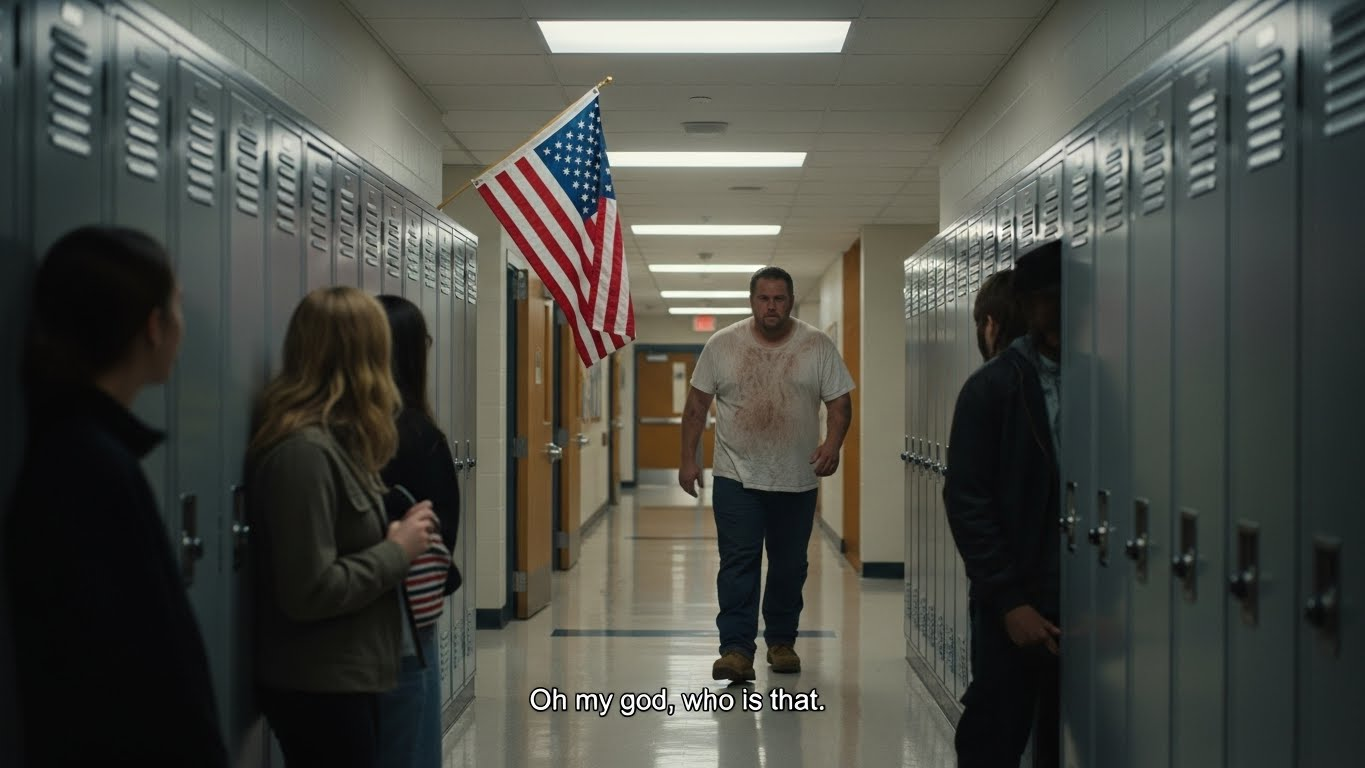
Instead, she saw a six-foot-two man with grease on his hands, veins bulging in his neck, and eyes that looked like two burning coals.
She didn’t move immediately. Her brain couldn’t process the threat level. She smirked, falling back on her social hierarchy training.
“Excuse me? This is a girls’ area. You can’t—”
I didn’t slow down.
I didn’t speak.
I reached out with my left hand—the hand that had pulled grown men out of burning Humvees—and grabbed the top of the doorframe, slamming my palm against the wood right next to her head. The sound was like a gunshot.
I leaned in, occupying her entire field of vision. I sucked the air out of the hallway.
“Move,” I whispered.
It wasn’t a shout. Shouting shows emotion. Shouting implies you’ve lost control.
This was a command. Low. Gravelly. The voice of a man who has decided the outcome of the situation before it even begins.
The smile vanished from her face. Her arrogance evaporated. She looked at her friends for backup, but they were frozen, staring at the scar that runs from my jawline to my neck.
“I said… move.”
She scrambled away, slipping on the slick floor, nearly tripping over her own feet to get away from the blast radius of my presence.
The door swung open.
And what I saw inside broke the soldier and brought back the father, just for a split second, before the rage consumed everything again.
Chapter 3: The Casualty of Innocence
The heavy door swung inward, hitting the tiled wall with a dull thud.
For a heartbeat, time suspended.
I wasn’t in a high school anymore. I wasn’t standing on cheap linoleum in a Virginia suburb. The adrenaline flooding my system told me I was back in a breach point, scanning a cleared room for survivors.
But the survivor was my daughter.
Lily was huddled in the far corner, wedged between the porcelain sink and the hand dryer. She was curled into a ball so tight she looked half her size. Her knees were pulled up to her chest, her face buried in her arms.
She was shaking. Not just shivering, but vibrating with a primal, uncontrollable fear.
The air in the room was thick and humid. The faucet was running—a continuous, wasteful stream of water.
And then I saw it.
Her sketchbook.
The leather-bound pad I had bought her for her birthday. The one she carried everywhere. The one she used to hide from the world when it got too loud.
It was thrown into the sink, directly under the stream of water.
The pages were sodden, dissolving into a grey mush. Ink—hours of her careful drawings, her dreams, her little escape routes—bled down the drain in swirling dark ribbons.
It wasn’t just bullying. It was an execution. They hadn’t just trapped her; they had tried to erase her.
My chest tightened. A physical pain, sharp and jagged.
I took a step forward, the grease on my boots squeaking against the wet floor.
“Lily,” I said.
My voice cracked. The operator was gone. The dad was back, and he was terrified.
She flinched. Her head snapped up.
Her face was a map of devastation. Eyes red and swollen, cheeks streaked with tears and splotchy red marks. She looked like she had been expecting a monster to come through that door.
When her eyes focused on me, the relief that washed over her face was so intense it almost knocked me over.
“Dad?” she whispered. It came out as a squeak.
I dropped to my knees. I didn’t care about the water on the floor soaking into my jeans. I didn’t care about the oil on my shirt.
I reached out, my hands hovering for a second, afraid that my own anger might somehow burn her. Then I wrapped my arms around her.
She collapsed into me. She buried her face in my dirty work shirt, sobbing. It was a guttural, heaving sound—the sound of someone letting go of a breath they had been holding for an hour.
“I’ve got you,” I murmured into her hair, rocking her slightly. “I’ve got you, baby. You’re safe. I’m here. Daddy’s here.”
I scanned her body while I held her. A habit. Check for blood. Check for trauma.
No physical wounds. But the psychological shrapnel? That was embedded deep.
I looked over her shoulder at the open door.
The three girls were still there. They hadn’t run. They were hovering in the hallway, peeking in like curious vultures.
The blonde one—the ringleader—had her phone out again. She was recording.
Recording.
She was filming my daughter’s breakdown. She was filming a father hugging his crying child in a bathroom. She was planning to upload this. To turn my daughter’s worst moment into content.
Something inside me snapped. It wasn’t the hot, fiery anger of a fight. It was the cold, absolute zero of a tactical decision.
I gently pulled away from Lily. I brushed a strand of wet hair from her forehead.
“Lily, look at me.”
She sniffled, looking up.
“Can you stand?”
She nodded, wiping her nose on her sleeve.
“Good. We’re leaving. Now.”
I stood up. I reached into the sink and grabbed the ruined sketchbook. It dripped heavily in my hand. I didn’t try to dry it. I wanted them to see it. I wanted them to see the corpse of what they had killed.
I took Lily’s hand. Her fingers were ice cold. I squeezed them, transmitting every ounce of strength I had into her small frame.
“Head up,” I told her, my voice low. “Do not look down. Do not look away. You have nothing to be ashamed of.”
She straightened her spine. She was trembling, but she stood.
We walked toward the door.
I wasn’t walking a child out of school. I was escorting a VIP through a hostile zone.
As we stepped into the hallway, the ringleader held her phone higher, a smirk playing on her lips. She thought she was untouchable. She thought the screen was a shield.
“Aww, did daddy come to save the wittle baby?” she mocked, her voice dripping with venom.
I stopped.
I released Lily’s hand gently and took one step toward the girl.
I didn’t touch her. I didn’t have to.
I snatched the phone out of her hand so fast she didn’t even register it was gone until her fingers were grasping at empty air.
“Hey! Give that back! That’s my—”
I looked at the phone. It was recording.
I looked at her.
“You like an audience?” I asked. My voice was dead calm.
I dropped the phone.
It hit the hard tile floor face down.
CRACK.
But I wasn’t done.
I stepped on it. I put the full weight of a 220-pound man wearing steel-toed work boots onto the device.
The crunch of glass and electronics was sickeningly loud in the sudden silence of the hallway.
I twisted my heel. Grinding it. Pulverizing the lens. Destroying the evidence. Destroying the weapon.
The girl gasped, her hands flying to her mouth. “You… you broke my phone! You can’t do that! My dad is going to—”
I leaned in. Close enough that she could smell the motor oil and the old, cold violence.
“Your dad isn’t here,” I whispered. “I am.”
Chapter 4: The Chain of Command
The hallway had gone silent.
The laughter died. The gossip ceased. The ecosystem of the high school froze.
Students were lining the lockers, eyes wide. They had seen fights before. They had seen shouting matches. But they had never seen a grown man execute a cell phone and stare down the Queen Bee with the intensity of a reaper.
I turned back to Lily. “Let’s go.”
We began to walk down the main corridor. I kept myself positioned slightly ahead and to the left of her—blocking the line of sight from the majority of the crowd. A human shield.
But the silence didn’t last long.
“HEY! YOU!”
The shout came from behind us. Heavy footsteps. The squeak of dress shoes trying to run.
I didn’t stop.
“SIR! STOP RIGHT THERE!”
A hand grabbed my shoulder.
Reflex.
I didn’t think. My body reacted before my brain could process “High School Administrator.”
I spun, dropping my center of gravity, my left arm sweeping up to break the grip while my right hand came up to strike—
I froze the strike inches from the man’s throat.
It was a man in a cheap grey suit. Mid-forties. Balding. Red-faced. Vice Principal badge clipped to his belt. Mr. Henderson. I remembered him from orientation. He was the type of man who enjoyed the power he had over children because he had none in the real world.
He stumbled back, eyes bulging, terrified by the speed of my turn and the fist hovering near his windpipe.
“Jesus!” he yelped.
I lowered my hand slowly. I didn’t apologize.
“Don’t grab me,” I said. “Ever.”
Henderson straightened his tie, trying to regain some dignity as students pulled out their phones to record this new drama.
“You are trespassing!” he sputtered, his face turning a darker shade of crimson. “You just destroyed a student’s property! I saw it! That is assault and destruction of property. You need to come to my office immediately.”
He moved to block our path. He puffed out his chest.
I looked at him. I looked at the sweat beading on his forehead.
“Get out of my way,” I said.
“Excuse me?” He blinked, stunned. “Mr. Brennan, is it? You can’t just barge in here and—”
“My daughter,” I interrupted, pointing a grease-stained finger at Lily, who was trying to shrink behind me, “was trapped in a bathroom for twenty minutes. She sent a distress text. Where were you?”
Henderson scoffed. “We have hall monitors. I’m sure it was just a misunderstanding. Kids play pranks. That doesn’t give you the right to—”
“A prank?”
I held up the sketchbook. It was a sodden, dripping mess of pulp.
I thrust it toward his chest. He flinched, stepping back to avoid getting his cheap suit wet.
“They held the door shut,” I said, my voice rising just enough to carry down the hall. “They trapped her. They destroyed her property. That’s false imprisonment. That’s harassment. And you want to talk to me about a cell phone?”
“We will handle the discipline internally!” Henderson shouted, trying to regain control of the narrative. “But you are an outside threat right now! I am calling the police!”
He reached for his radio. “Security to the main hall. We have a hostile parent.”
Hostile.
He wanted hostile?
I laughed. It was a dry, humorless sound.
“Call them,” I said. “Call the police. Call the SWAT team. Call the National Guard.”
I took a step closer to him, forcing him to retreat until his back hit the lockers.
“Because when they get here, I’m going to file a police report against those three girls for unlawful restraint. And then I’m going to file a report against you for negligence.”
Henderson’s mouth opened and closed like a fish out of water.
“And while we wait,” I continued, “I’m taking my daughter home. If you try to stop me, if you try to touch her, or if you try to block this exit…”
I let the sentence hang there. I let his imagination fill in the blank.
I didn’t make a threat. I didn’t have to. The look in my eyes told him that the “Rules of Engagement” he was used to—detention, suspension, parent conferences—did not apply to me.
I turned my back on him. The ultimate insult.
“Come on, Lily.”
We walked past him.
He didn’t move. He didn’t speak. He just held his radio, his thumb hovering over the button, frozen by a force of nature he didn’t understand.
We reached the double doors of the main entrance. The sun was shining outside. It looked jarringly bright after the dim tension of the hallway.
We stepped out onto the sidewalk.
My truck was there, still running, exactly where I left it.
But we weren’t alone.
A sleek black Mercedes had just pulled up behind my truck, blocking me in.
The door opened.
A man stepped out. Expensive suit. Gold watch. slicked-back hair. He looked like a lawyer, or a politician, or the kind of guy who pays other people to do his dirty work.
He looked at the school entrance. He saw Lily crying. He saw me.
And then he saw his daughter—the blonde girl—running out of the school behind us, screaming, “Daddy! He broke my phone! He almost hit me!”
The man’s eyes locked onto mine.
He didn’t look scared. He looked annoyed. Like I was a bug on his windshield.
“Hey!” he shouted, slamming his car door. “You the redneck who touched my daughter?”
I sighed.
I opened the passenger door of my truck and helped Lily in. “Buckle up, sweetie. Put your headphones on.”
“Dad?” she asked, worried.
“Just a minute, honey.”
I closed her door.
I turned to face the man in the suit.
I cracked my neck.
The war wasn’t over. It had just moved to a new theater.
Here is Part 3 of the story.
PART 3
Chapter 5: Rules of Engagement
The man in the suit marched toward me. His name, I would later learn, was Richard Sterling. A local real estate developer. The kind of man who owned half the town and thought he owned the people in it, too.
He was red-faced, fueled by the indignation of someone who had never been told “no” in his entire adult life.
“I’m talking to you!” he shouted, invading my personal space. He poked a finger into my chest. A hard, stabbing jab.
That was mistake number one.
In the civilian world, a poke in the chest is an annoyance. In my world, it’s a pre-assault indicator. It’s an initiation of contact.
“You touched my daughter,” he spat, spittle flying. “You destroyed her property. Do you have any idea who I am? I’ll have your truck impounded. I’ll have you thrown in a cell so deep you’ll need a flashlight to find your ass!”
I looked down at his finger, still pressing into my sternum. Then I looked at his face.
“Remove your finger,” I said. My voice was a low rumble, barely audible over the idling engine of my truck.
“Or what?” Sterling challenged, puffed up like a toad. “You gonna hit me? Do it. There are cameras everywhere. Go ahead, tough guy. Hit me and I’ll own everything you have.”
He poked me again. Harder.
“You’re nothing but a piece of white trash who thinks—”
Mistake number two.
I didn’t hit him. Striking a civilian, especially one with lawyers on speed dial, is tactical suicide.
Instead, I moved.
My left hand flashed up, gripping his index finger and the meat of his hand. In one fluid motion, I twisted his wrist outward while stepping into his guard.
It’s a simple joint manipulation. Small circle jujitsu.
Sterling let out a high-pitched yelp as his body was forced to rotate to relieve the pressure. I drove him forward, slamming him face-first onto the hood of his own shiny black Mercedes.
Thump.
“AHH! My arm! You’re breaking my arm!”
I leaned my weight onto his shoulder, pinning him to the warm metal. I wasn’t breaking anything. I was just holding him in a position of maximum discomfort.
“Listen to me closely,” I whispered into his ear.
The blonde girl, his daughter, was screaming now. “Daddy! Let him go! Help!”
I ignored her.
“I didn’t touch your daughter,” I told Sterling, keeping the pressure steady. “I stopped her from committing a felony. She and her friends held my child against her will. That is false imprisonment. She filmed my daughter in a state of distress in a bathroom. That is a violation of privacy and cyberbullying statutes.”
I pulled his arm up another inch. He groaned, sweat popping out on his forehead.
“You want to talk about lawyers? You want to talk about owning this town?”
I leaned closer.
“If you or your daughter ever come near my family again… if I ever see her bullying another kid… I won’t come for your money, Richard. I won’t come for your reputation.”
I let the silence hang for a second.
“I will come for you. And I promise you, the police won’t get here fast enough.”
I released him.
I stepped back, hands raised, palms open. The universal sign of de-escalation.
Sterling scrambled off the hood, clutching his wrist. His face was purple. He looked like he was going to have a stroke.
“You… you maniac!” he screamed, backing away. “You’re dead! You hear me? You’re finished!”
Sirens wailed in the distance. Getting louder.
“Finally,” I muttered.
I leaned against my truck, crossed my arms over my grease-stained chest, and waited.
Sterling was busy comforting his daughter, who was now crying—crocodile tears, mostly because things hadn’t gone her way.
The first cruiser screeched into the lot. Then a second.
This was the part where things usually went wrong for guys like me. The “Optics” were bad.
Dirty mechanic vs. Wealthy businessman. Aggressor vs. Victim.
I took a deep breath. I needed to switch modes again. The Operator had to recede. The Citizen needed to step forward.
Chapter 6: The Blue Line
Two officers exited the lead car. Hands on their holsters, but weapons not drawn. Good discipline.
“Break it up! Step away from the vehicles!” the first officer shouted. A younger guy, high and tight haircut. Officer Miller, according to his tag.
Sterling immediately ran toward them, waving his good arm.
“Officer! Arrest him! He assaulted me! He assaulted my daughter! He’s a lunatic!”
Miller looked at Sterling, then at me. I stayed by my truck, hands clearly visible, resting on the side mirror. No sudden movements.
“Sir, stay back,” Miller ordered Sterling. Then he turned to me. “Sir, I need you to step away from the truck and keep your hands where I can see them.”
I complied slowly. “Officer, I am moving to the sidewalk. No weapons on my person.”
“Turn around. Hands on your head.”
I did it. I felt the pat-down. Thorough. Professional.
“What’s going on here?” the second officer asked. An older sergeant. He looked tired.
“He attacked us!” Sterling yelled, pointing a shaking finger. “He broke into the school! He cornered my daughter in the bathroom! Then he twisted my arm!”
The Sergeant looked at me. “Is that true?”
“Officer,” I said, my voice calm, level, and devoid of anger. “My daughter sent me a distress text from the school bathroom. She was being held against her will by three students. I entered the school to retrieve her. The gentleman screaming over there blocked my vehicle and initiated physical contact by poking me in the chest multiple times. I utilized a control hold to neutralize the threat without causing injury. I did not strike him.”
Sterling scoffed. “Liar! He’s a psycho!”
The Sergeant walked around me to look at my face. He squinted.
He looked at the scar on my neck. He looked at the calluses on my hands. Then he looked at my eyes.
There’s a look. A specific, thousand-yard stare that you recognize if you’ve been there.
“Name?” the Sergeant asked.
“Brennan. Jack Brennan.”
The Sergeant paused. “Jack Brennan? 1st SFOD-D?”
I didn’t say yes. I didn’t say no. I just held his gaze.
The Sergeant’s demeanor shifted instantly. It was subtle, but I felt it. The tension in his shoulders dropped.
He turned to his partner. “Miller, get statements from the witnesses. Talk to the security guard.”
“Sarge?”
“Do it.”
The Sergeant turned back to me. “You can put your hands down, Mr. Brennan.”
I lowered my arms. “My daughter is in the truck. She’s traumatized. I want to take her home.”
“This guy wants to press charges for assault,” the Sergeant said quietly, jerking a thumb at Sterling. “And the school is claiming trespassing.”
“The school,” I said, leaning in, “allowed a fourteen-year-old girl to be held hostage in a bathroom while teachers ignored it. If they want to press trespassing charges, I will unleash a media storm about negligence that will have the school board resigning by Friday. And as for him…”
I looked at Sterling, who was now yelling at Officer Miller.
“He assaulted me. I defended myself. Check the cameras.”
The Sergeant sighed. He scratched his chin.
“Look, Brennan. I know who you are. I know what you did in the sandbox. But you can’t go around breaking phones and twisting arms in a high school parking lot. This isn’t Fallujah.”
“It felt like it for my daughter,” I said coldly.
The Sergeant nodded. He understood.
He walked over to Sterling. They spoke for a few minutes. I saw Sterling gesturing wildly, then pointing at me, then looking shocked as the Sergeant said something firm. Sterling’s face went pale. He looked at me, then back at the cop.
He stormed off toward his Mercedes, grabbed his daughter, and shoved her into the car.
The Sergeant walked back to me.
“He’s not pressing charges. He realized that a public court case involving his daughter bullying a special needs kid—or a kid with anxiety—wouldn’t look good for his business.”
“Smart man,” I said.
“But the school… they aren’t happy. You’re banned from campus, Brennan.”
“Fine,” I said. “I’m pulling her out anyway.”
The Sergeant looked at the truck. He saw Lily’s silhouette through the tinted window.
“Get her out of here,” he said. “Drive safe.”
“Thanks.”
I got back into the truck. The cab was quiet. Lily had her headphones on, but she wasn’t listening to music. She was watching me.
I shut the door. The sound sealed us in. The world outside—the cops, the rich bullies, the incompetent teachers—disappeared.
“Dad?” she asked, pulling the headphones down. “Are you going to jail?”
I started the engine. I looked at her, and for the first time in an hour, I smiled. A real smile.
“No, honey. No one is going to jail.”
I put the truck in gear.
“But we aren’t going back there. Ever.”
She exhaled. “Okay.”
“And Lily?”
“Yeah?”
“We need to make a stop on the way home.”
“Where?”
“The art supply store. You need a new sketchbook.”
She managed a weak, watery smile.
I pulled out of the parking lot, driving right past Sterling’s Mercedes. I didn’t look at him. I didn’t need to.
The battle was won.
But as I watched Lily staring out the window, watching the school fade into the distance, I knew the war wasn’t over. The trauma was there. The fear was there.
And I realized that saving her from the bathroom was the easy part. Saving her from the memories… that was a mission I wasn’t trained for.
But I was going to learn. Fast.
Because that night, as I sat on the porch cleaning my shotgun—just a habit, nothing more—my phone rang.
Unknown Number.
I answered.
“Mr. Brennan?”
The voice was distorted. Digital.
“Speaking.”
“You made a mistake today. You embarrassed the wrong family.”
Click.
I stared at the phone.
The Operator woke up again.
Here is the final part of the story.
PART 4
Chapter 7: Castle Doctrine
I didn’t sleep.
Sleep is a luxury for people who believe the law protects them. I knew better. The law is a reactive force; it draws chalk outlines after the event. I was in the business of prevention.
I moved Lily’s mattress into the master bedroom, away from the street-facing windows. I told her the AC in her room was acting up. She didn’t question it. She was too exhausted, clutching her new sketchbook like a lifeline.
Once she was asleep, I went to work.
Lights out. Blinds drawn.
I sat in the dark living room in a wingback chair facing the front door. My granddaddy’s chair. On the side table, a glass of water. In my lap, a suppressed carbine. Not illegal, just… specialized.
I watched the feed from the hidden cameras I’d installed in the oak trees three years ago.
2:14 AM.
Movement.
A black SUV, lights off, rolled down the street. It wasn’t a patrol car. It was too nice for a gangbanger, too quiet for a drunk teenager.
It stopped three houses down.
Two men got out. Hoodies. Balaclavas. Crowbars. And something else… a gas can.
My stomach churned. They weren’t coming to talk. They were coming to burn.
Richard Sterling wasn’t just a bully; he was a coward who hired arsonists to settle his grudges. He wanted to torch my truck. Maybe the house. He didn’t care who was inside.
I stood up. My knees didn’t pop this time. My body was fluid, warm, ready.
I didn’t call 911. The response time in our precinct is twelve minutes on a good night. These guys would have the house lit in two.
I moved to the back door. I slipped out into the humid Virginia night. The grass was wet. I was barefoot. Boots make noise.
I circled the house, moving through the shadows of the hedges like a ghost.
I saw them. They were at the foot of the driveway, creeping toward my F-150. One guy was unscrewing the cap of the gas can. The lighter in his other hand flickered.
“Do it quick,” one whispered. “Then the brick through the window.”
“Got it.”
They were ten feet away.
I stepped out from behind the azalea bush.
“Gentlemen.”
The word hung in the air, heavier than the humidity.
They spun around. They saw a man in tactical pants and a t-shirt, barefoot, holding a rifle that looked very much like military hardware.
The guy with the gas can froze. The lighter flame died.
“Drop it,” I said.
The second guy, the one with the crowbar, panicked. He raised the bar, taking a step toward me. “Back off, man! I’ll—”
Thwip.
I put a round into the asphalt between his feet. The suppressed shot was no louder than a hand clap, but the spark and the hole in the driveway were very real.
“The next one goes in your knee,” I said. “Drop. It.”
The crowbar clattered to the ground. The gas can followed.
“On your knees. Hands behind your heads. Ankles crossed.”
They complied. They weren’t professionals. They were hired thugs used to scaring tenants and soccer moms. They had no idea how to handle a Tier 1 threat.
I walked over, keeping the muzzle trained on them. I pulled a handful of zip ties from my back pocket.
“Who sent you?” I asked, cinching the first guy’s wrists.
“Man, we don’t know! Just a text! Cash App payment!”
“Liar.”
I tightened the tie until he winced.
“Richard Sterling,” I guessed.
Silence.
“Nod if you want to walk away from this tonight.”
The guy nodded vigorously.
I finished tying them up. I pulled out my phone. But I didn’t call the cops. Not yet.
I took a picture of them. Kneeling. Bound. Terrified.
Then I recorded a video.
“Tell the camera who paid you.”
“Sterling! It was Sterling! He said he wanted to scare you!”
“Good.”
I stood up.
“Get up,” I ordered.
They scrambled to their feet, awkward with their hands bound.
“Start running,” I said. “If I see you on this street again, I won’t aim for the ground.”
They ran. They ran like rabbits escaping a wolf.
I watched them disappear into the night. Then I looked at the gas can left on my driveway.
Sterling had escalated it to lethal force. He had threatened my home. My daughter.
The Rules of Engagement had just shifted from ‘Defense’ to ‘Direct Action.’
Chapter 8: The Final Lesson
The next morning, I drove Lily to a diner for breakfast. Chocolate chip pancakes. She smiled, actually smiled, when the waitress brought the whipped cream.
“Dad?”
“Yeah, kiddo?”
“Why are you wearing a suit?”
I looked down at my charcoal suit. It was a little tight across the shoulders, but it still fit.
“I have a meeting,” I said. “Business.”
“I thought you were a mechanic.”
“I am. But sometimes, I have to fix things that aren’t cars.”
I dropped her off at her aunt’s house for the day. “Stay inside. Draw. Watch movies. I’ll be back for dinner.”
I drove to downtown. Specifically, to the Sterling Development Group headquarters.
Glass building. Marble lobby. Security at the front desk.
I walked in. I didn’t look like a mechanic today. I looked like a problem.
“I’m here to see Richard Sterling,” I told the receptionist.
“Do you have an appointment?”
“No. Tell him Jack Brennan is here. Tell him I have a video of two men and a gas can.”
The receptionist’s eyes widened. She made a call. murmured tones.
“Go right up. Top floor.”
The elevator ride was smooth. The doors opened to a plush office. Richard Sterling was standing behind his mahogany desk. He looked tired. He looked nervous. But he was trying to hide it behind bravado.
“You have some nerve coming here,” Sterling said. “I should call the police.”
I closed the door behind me. I locked it.
I walked over to the chair opposite his desk and sat down. I didn’t speak. I just placed my phone on the desk, screen up.
I pressed play.
The video of the two thugs confessing played. The sound of their fear filled the expensive room.
Sterling went pale. “That… that proves nothing. You coerced them.”
“Maybe,” I said. “But I also have the logs from your ‘burner’ phone. You’re not very tech-savvy, Richard. You used the same cell tower triangulation as your personal device.”
I leaned forward.
“Here is what is going to happen.”
Sterling started to sweat.
“One: You are going to resign from the School Board. Effective today. Citing ‘health reasons.'”
“I can’t—”
“Two,” I interrupted. “Your daughter is going to transfer schools. I don’t care where she goes. Switzerland, boarding school, the moon. But if she is within ten miles of my daughter, I release this video to the news, and I give the raw data to the District Attorney. Attempted arson is twenty years, Richard.”
Sterling slumped in his chair. He looked small. The power was gone. The money was useless.
“And Three,” I said, standing up. “You are going to write a check to the Art Department of Oak Creek High School. A donation. anonymous. Fifty thousand dollars.”
“Fifty thousand?” he choked.
“Consider it a fine for being a terrible father,” I said.
I picked up my phone.
“Do we have a deal?”
Sterling looked at the phone. He looked at me. He saw the end of his career, his reputation, his freedom.
“Yes,” he whispered. “Deal.”
I turned to leave.
“Brennan?” he called out.
I stopped at the door.
“Who are you? Really?”
I looked back at him.
“I’m just a dad,” I said.
I walked out.
That evening, I sat on the porch. The sun was setting, painting the Virginia sky in purple and gold.
Lily was sitting next to me on the swing. She was sketching again.
“What are you drawing?” I asked.
She turned the book toward me.
It was a drawing of a knight. He was battered, armor dented, holding a shield that was cracked. But he was standing tall. And behind him, peeking out from his cape, was a little girl.
“It’s you,” she said softly.
I felt a lump in my throat the size of a grenade.
I put my arm around her shoulders and pulled her close.
“It’s pretty good,” I managed to say.
“Dad?”
“Yeah?”
“I’m not scared anymore.”
I looked out at the street. Quiet. Safe.
“I know, baby,” I said. “I know.”
And for the first time in a long time, I believed it. The monster in the garage could go back to sleep. The Dad was in charge now.
But the rifle? It stayed under the bed.
Just in case.
(End of Story)