My Son Was Buried Alive in the Schoolyard Snow—And the Principal Called It “Just Horseplay”
Chapter 1: The White Tomb
The Minnesota cold that February wasn’t just weather; it was a weapon. It was the kind of cold that froze the hairs inside your nose the second you stepped outside, a bitter, thirty-below-zero beast that turned the world into concrete and ice.
At Oakhaven Elementary, the snowbanks lining the playground perimeter were six feet high—dirty, jagged walls of ice created by the city plows. To the teachers, they were just boundaries. To the kids, they were a blind spot. A lawless zone where the playground monitors, huddled by the doors with their steaming coffees, couldn’t see.
I fixed the scarf around Leo’s neck, my fingers lingering a second too long.
“Mom, I’m choking,” Leo mumbled, pulling the wool away from his chin. His face was pale, his eyes too big for his head. He looked like what he was: an artist, a dreamer, a soft soul in a town that prized hockey players and hunters.
“It’s freezing, Leo. Keep it on,” I said, my voice tight. “And please… just stay near the building today. Okay?”
He didn’t look at me. He just nodded, grabbing his oversized backpack. “I know, Mom. Avoid Brock. I know.”
He opened the car door and the frigid air rushed in, stinging my face. I watched him trudge toward the red brick building, his boots crunching on the salt. I had that feeling again—the heavy, twisting knot in my gut that had been there for a month.
Brock Henderson. A fifth-grader with the build of a high schooler and eyes that were dead flat. He didn’t just bully Leo; he hunted him.
I drove away, forcing myself to breathe. It’s just six hours, I told myself. He’ll be fine.
I was wrong.
Recess started at 11:30 AM. The sky was a suffocating white sheet, blocking out the sun. The playground was a chaotic mix of screaming voices and colorful parkas.
Leo stood on the fringe of the blacktop, clutching his sketchbook to his chest like a shield. He was trying to be invisible. He was drawing a superhero—someone strong enough to fight back.
“Hey, Leonardo Da Loser.”
Leo froze. The voice was deep, mocking, and too close.
He didn’t need to turn around to know it was Brock. Flanking him were his two shadows, Tyler and Sam. They circled him like wolves cutting a straggler from the herd.
“Leave me alone, Brock,” Leo whispered, stepping back toward the snowbank.
“What’s in the book?” Brock asked, his voice deceptively bored. He snatched it before Leo could react.
“Give it back!” Leo lunged, but Brock easily held it above his head, laughing. Then, with a flick of his wrist, he tossed the sketchbook into a puddle of brown, salty slush.
“Oops,” Brock smirked.
Leo gasped, scrambling to his knees to save his drawings. That was the mistake. He was on the ground. He was vulnerable.
“He wants to play in the snow, guys,” Brock said. “Let’s help him.”
Brock didn’t push him. He tackled him. He drove his knee into Leo’s spine, slamming my son face-first into the deep, untouched snow at the base of the six-foot plow pile.
The world instantly went dark for Leo.
“Stay down,” Brock grunted, sitting his full weight on Leo’s back.
Leo thrashed. He tried to push up, but Tyler and Sam grabbed his legs, pinning them to the frozen earth. Leo opened his mouth to scream for a teacher, to scream for anyone.
But when he opened his mouth, Brock did something that went beyond schoolyard bullying. It was sadistic.
Brock scooped up a jagged chunk of hard-packed ice crust. He grabbed Leo by the back of the hair, yanked his head up an inch, and then smashed his face back down into the ice, grinding it in.
“Eat it,” Brock hissed.
Leo panicked. His survival instinct screamed BREATHE. He gasped in, a desperate, reflexive inhale.
But there was no air. Only snow.
The powder rushed into his nose. The ice chunks packed into his open mouth. He gagged, trying to cough, but the weight on his back pinned his lungs against the ground. The cough turned into a reverse vacuum, sucking the melting ice and freezing water deep into his windpipe.
I’m drowning, Leo thought, his mind flashing white. I’m drowning on dry land.
The cold burned. It felt like swallowing broken glass. The silence under the snow was terrifying. He could feel the vibrations of the boys laughing above him, but he couldn’t hear them.
“Count to twenty!” he heard Brock say, the voice muffled and distorted.
Leo’s chest heaved against the ice, spasms of terror rocking his small body. His vision, pressed against the white darkness, began to spark with grey and black spots.
The cold seeped into his blood, slowing his heart. The panic began to fade, replaced by a heavy, terrible sleepiness.
“He stopped moving,” one of the shadows said nervously.
“He’s faking,” Brock laughed, grinding Leo’s face down one last time.
Leo didn’t fight back. His hands, which had been clawing at the frozen dirt, went limp at his sides.
Chapter 2: The Call
My phone rang at 11:48 AM.
I was in a client meeting, reviewing tax returns. I usually let calls go to voicemail, but when the screen lit up with “Oakhaven Elementary,” the air left the room.
I answered on the first ring.
“Mrs. Miller?”
It was Mrs. Gable, the school nurse. I had known her for years; she was a steady, calm woman. But today, her voice was high, thin, and trembling.
“Yes? Is it Leo?” I stood up so fast my chair tipped over. My client stared at me, alarmed.
“You need to get to St. Jude’s Hospital. Immediately. The ambulance just left with him.”
Ambulance.
The word hung in the air, heavy and suffocating.
“What happened?” I screamed, grabbing my keys, not caring that I was leaving my purse behind. “Is he alive?”
“There was… an incident on the playground,” Mrs. Gable stammered. “He wasn’t breathing when they found him, Sarah. They had to… they had to do CPR. Just get there.”
I don’t remember leaving the office. I don’t remember the drive. I ran two red lights. I drove on the shoulder. My hands were gripping the steering wheel so hard my knuckles turned white.
The whole way, I was bargaining with God. Take everything. Take the house. Take my job. Just let his heart be beating.
When I burst through the emergency room doors, I was a wild woman. My coat was open, my hair a mess, tears freezing on my cheeks.
“Leo Miller!” I shrieked at the receptionist. “Where is my son?”
A doctor in blue scrubs stepped out from behind the double doors. He looked exhausted. He looked grim.
“Mrs. Miller?” he asked softly.
I ran to him, grabbing his arm. “Is he…?” I couldn’t finish the sentence.
“He is stabilized,” the doctor said, guiding me to a plastic chair because my legs finally gave out. “But it is critical. Leo suffered severe hypothermia and acute respiratory distress. He has what we call aspiration pneumonia.”
“Pneumonia?” I shook my head, my brain misfiring. “From recess?”
“From drowning, Mrs. Miller,” the doctor said, his voice dropping an octave. “His airway was impacted—packed solid—with snow and ice. We had to suction a significant amount of water out of his lungs. He was hypoxic for at least three to four minutes.”
I stared at him. Packed solid.
“He didn’t just fall?” I whispered.
“No,” the doctor said, his jaw tightening. “You don’t inhale a cup of hard-packed ice by tripping, Sarah. Someone did this to him.”
I felt the room tilt. My gentle boy. My baby.
“Can I see him?”
“He’s sedated. He’s on a ventilator to help his lungs heal. He’s fighting, but… the next twenty-four hours are crucial.”
Walking into that hospital room was the hardest thing I have ever done. Leo looked so small in the bed, swallowed by machinery. A plastic tube was taped to his mouth, breathing for him. His skin was a translucent grey-blue, slowly turning pink under the heated blankets.
I sat down and took his hand. It was ice cold.
I sat there for three hours, watching the monitor beep, watching his chest rise and fall mechanically.
At 4:00 PM, the door opened.
I expected the doctor. Instead, Principal Skinner walked in.
He was a tall, nervous man who cared more about the school’s state rankings than the children in the desks. He was holding his hat in his hands, shifting his weight from foot to foot. Behind him stood a police officer.
“Sarah,” Skinner said, his voice hushed, fake-sympathetic. “I am so, so sorry.”
I didn’t let go of Leo’s hand. I turned my head slowly, fixing Skinner with a glare that should have set him on fire.
“Who did this?” I asked. My voice was calm. Dangerously calm.
“We are still investigating,” Skinner said quickly, glancing at the officer. “The playground monitors didn’t see the start of it. But… it appears the boys were roughhousing in the snowbanks.”
“Roughhousing,” I repeated.
“Yes. You know how boys are. It looks like a game of ‘King of the Mountain’ that just… got a little out of hand.”
“A game?” I stood up then. The rage that had been building in my chest exploded. “The doctor just told me they pulled ice out of his throat, Skinner! Packed ice! That’s not a game. That is torture.”
“Now, Sarah, let’s not jump to conclusions,” Skinner said, putting his hands up. “We have to be careful with accusations. The other student involved… well, it’s the Henderson boy. Brock.”
The name hit me like a slap. Of course. Robert Henderson, Brock’s father, owned half the town. He had just paid for the new scoreboard in the gym.
“He’s claiming Leo started it,” Skinner continued, looking at the floor. “He says Leo tackled him and they both fell.”
I looked at my son, unconscious, a machine pumping air into his damaged lungs. Then I looked at the man whose job it was to protect him.
“Get out,” I said.
“Sarah, please, we need to discuss—”
“GET OUT!” I screamed, the sound echoing off the sterile walls, making the nurse in the hallway jump. “And you tell Robert Henderson to get the best lawyer money can buy. because I am going to bury him.”
Skinner retreated, his face pale.
I sat back down, my hands shaking. They thought they could spin this. They thought they could use money and influence to turn my son’s near-murder into an “accident.”
They had no idea. They had no idea what a mother would do when her cub was hurt.
I picked up my phone. I wasn’t calling a lawyer. Not yet.
I was going to find the truth.
Chapter 3: The Wall of Silence
The next forty-eight hours were a blur of beeping monitors and the smell of antiseptic. I slept in the plastic chair, my neck cramped, waking up every twenty minutes to check if Leo’s chest was still moving.
When they finally took the tube out, I expected relief. I expected my son to cry, to ask for me, to tell me what happened.
I got silence.
Leo lay there, propped up on pillows, his throat raw and swollen. He looked at me, then he looked at the window. When the nurse came in to check his vitals, Leo flinched so hard he nearly pulled out his IV.
He was terrified. Not just of the pain, but of the world.
“Leo, baby,” I whispered, brushing the hair off his forehead. “You’re safe. Mommy’s here.”
He didn’t speak. He just stared at the door, as if expecting Brock to walk through it. The sparkle in his eyes—the one that lit up when he talked about comic books or art—was gone. Replaced by a dull, flat grey. They had broken his spirit.
That afternoon, Officer Miller (no relation, just a cruel irony of a common name) came by the room. He was a young guy, looked like he’d played football for the local high school a few years back. He stood awkwardly at the foot of the bed, refusing to make eye contact with me.
“Mrs. Miller,” he said, thumbing his belt. “We’ve done some interviews.”
“And?” I asked, standing up. “Did you arrest him? Did you arrest Brock Henderson?”
The officer sighed, scratching the back of his neck. “Look, it’s a tricky situation. We talked to the boys. Tyler and Sam… they’re backing up Brock’s story. They say Leo jumped off the snowbank and landed wrong. They say they were trying to help him up, dig him out.”
“Help him?” I laughed, a sharp, jagged sound. “The doctor said ice was jammed into his pharynx. You don’t help someone by shoving ice down their throat.”
“There’s no video, Ma’am. It’s the blind spot of the playground. Without a neutral witness, it’s he-said-she-said. And considering the ages of the boys… the D.A. isn’t likely to press charges for an accident.”
“It wasn’t an accident!” My voice rose, causing Leo to curl into a ball on the bed. I lowered my voice, trembling. “It was assault. Attempted murder.”
“I’m sorry, Ma’am. Unless new evidence comes to light, we’re closing the file as an accidental injury during recess.”
He left. Just like that.
I walked to the window and looked out at the parking lot. The snow was still falling, covering the cars, covering the world in white.
They were closing ranks. This was a small town. Robert Henderson employed half the people here. He sponsored the July 4th fireworks. He bought the uniforms for the football team. The police, the school, the administration—they were all protecting the golden boy.
My son was collateral damage. A speed bump in Brock Henderson’s bright future.
I turned back to Leo. He was asleep, his breathing rasping slightly.
I felt a coldness settle over me that had nothing to do with the winter. It was the coldness of clarity.
If the police wouldn’t help, and the school wouldn’t help, I had to do it myself. I had to be the detective, the prosecutor, and the judge.
I kissed Leo’s forehead. “I’ll be back, baby,” I whispered. “Mommy has to go fight a dragon.”
I drove to the school the next morning. I didn’t call ahead. I didn’t ask for an appointment.
The secretary, Mrs. Gable—the nurse’s sister, actually, but far less sympathetic—looked up, startled, as I stormed into the main office.
“Mrs. Miller, you can’t just—”
“Is he in?” I asked, pointing to Skinner’s door.
“He’s in a meeting, you need to—”
I didn’t wait. I walked past her desk, grabbed the handle of the heavy oak door, and threw it open.
Chapter 4: The Lion’s Den
The office smelled of stale coffee and expensive cologne.
Principal Skinner was sitting behind his desk, looking like a deer in headlights. But he wasn’t alone.
Sitting in the leather guest chair, legs crossed, looking as comfortable as if he owned the building (which, practically speaking, he did), was Robert Henderson.
He was wearing a charcoal suit that cost more than my car. He didn’t stand up when I entered. He just turned his head, his eyes scanning me with a mix of pity and annoyance.
“Mrs. Miller,” Henderson said. His voice was smooth, like oil. “We were just discussing the… unfortunate situation with the boys.”
“Unfortunate situation,” I repeated, walking further into the room. I didn’t sit. I wanted to loom over them. “Is that what we’re calling it? My son is relearning how to swallow solid food, and you call it an ‘unfortunate situation’?”
“Sarah, please,” Skinner stammered, gesturing to a chair. “Sit down. We want to help.”
“I don’t want a seat,” I snapped. “I want to know why the police think my son shoved ice down his own throat. I want to know why you haven’t expelled Brock yet.”
Henderson chuckled. It was a low, dry sound. “Expel him? For what? Roughhousing? Listen, Mrs. Miller, I know you’re emotional. It’s tough raising a boy on your own. You tend to… coddle them.”
I felt the blood pounding in my ears. “Excuse me?”
“Brock is a spirited kid,” Henderson continued, waving a manicured hand. “He’s a leader. He plays hard. Maybe if Leo spent a little more time on the field and a little less time with his… drawing books… he wouldn’t panic when things get a little physical. He needs to toughen up.”
The room went dead silent.
I looked at this man. I looked at the arrogance etched into every line of his face. He truly believed it. He believed his son was destined for greatness, and my son was just weak prey who deserved what he got.
“You think this is about toughness?” I stepped closer to him, invading his personal space. “Your son held a ten-year-old down and waterboarded him with snow. That’s not a leader, Robert. That’s a psychopath.”
Henderson’s smile vanished. His eyes turned into hard little stones.
“Watch your tone,” he said, his voice dropping to a growl. “And watch your accusations. My lawyers are already drafting a defamation suit. If you go to the press, if you post your little sob stories on Facebook and slander my son’s name, I will sue you for everything you have.”
He stood up then, towering over me.
“You’re an accountant, right, Sarah? A freelancer? You can’t afford a legal battle with me. I will bury you in paperwork and fees until you lose your house. Until you can’t afford to buy pencils for that kid of yours.”
He buttoned his jacket.
“Take the offer Skinner is going to give you. Move Leo to a different class. Let the boys stay away from each other. And move on.”
He walked past me, bumping my shoulder, and left the office.
I stood there, shaking. Not from fear. From a rage so pure it felt like it was burning my skin off.
Skinner cleared his throat, looking down at his desk. “Sarah… he’s serious. The Board… they don’t want a scandal. If you drop it, we can arrange for Leo to have extra tutoring. We can ensure they aren’t at recess at the same time.”
“You coward,” I whispered.
“I’m trying to protect the school,” Skinner said weakly. “And I’m trying to protect you. You can’t win against Robert Henderson.”
I looked at Skinner. I saw a man who had sold his soul for a quiet life and a new scoreboard.
“You’re right,” I said, my voice eerily calm. “I can’t win against his money.”
I turned to the door.
“But you’re forgetting something, Principal Skinner.”
“What’s that?”
“I’m a mother. And I don’t care about money. I care about the truth.”
I walked out of the office.
I knew they were right about one thing: The “he-said-she-said” game was a losing battle. The bullies were united in their lie. The teachers were “looking the other way.” The administration was bought and paid for.
I needed a crack in the wall.
I needed the one thing bullies never account for. They think everyone fears them. They think everyone will stay silent.
But there is always someone watching.
I got in my car, but I didn’t go back to the hospital. Not yet. I drove to the one place I hadn’t looked yet.
The scene of the crime.
It was 12:00 PM. Lunchtime. Recess.
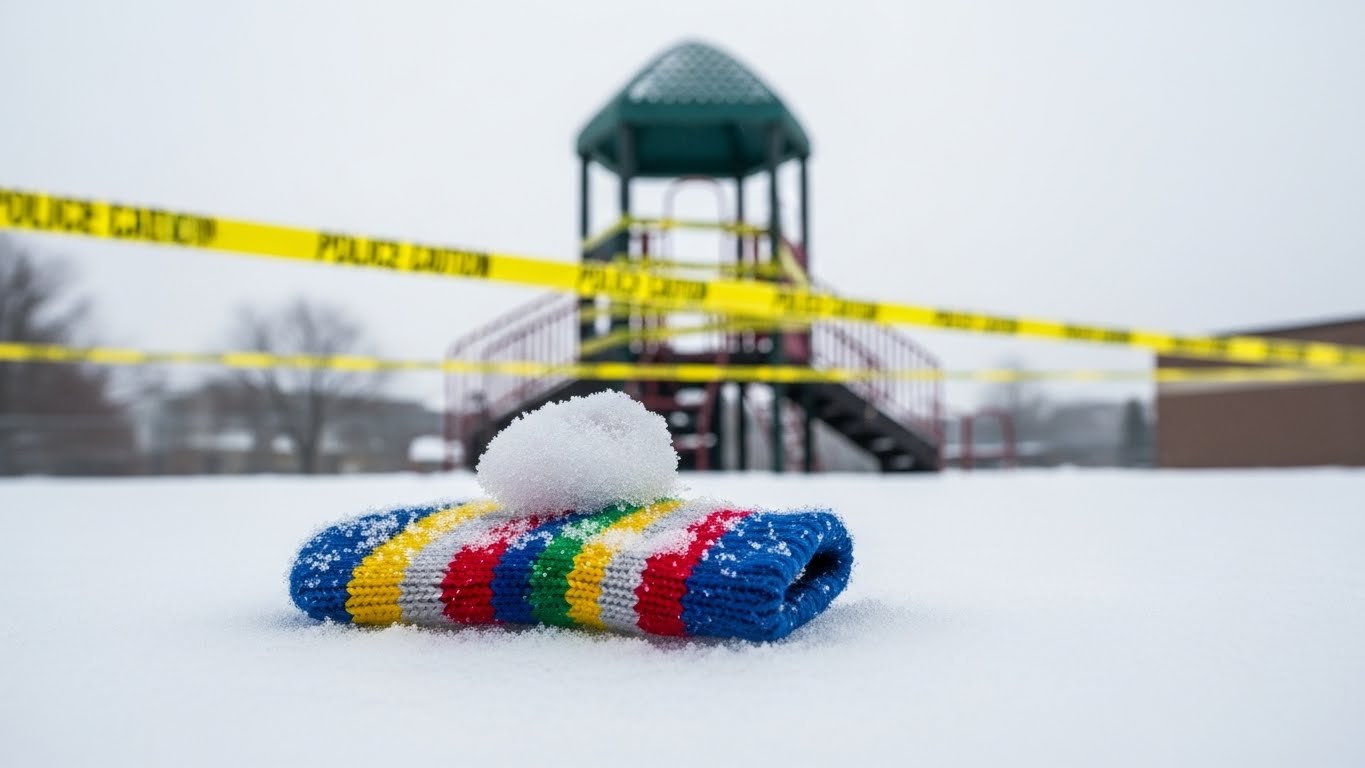
I parked across the street from the playground. I watched the kids swarm out in their colorful coats. I saw the snowbank, the “White Tomb,” standing tall and ominous against the grey sky. Yellow caution tape fluttered around a small section of it, but the kids were already playing right next to it.
I needed a witness.
I scanned the playground. I saw Brock. He was there, laughing, pushing another boy, acting like nothing had happened. Like he hadn’t almost killed a classmate three days ago.
I watched the other kids. Most were running around, screaming. But then I saw her.
A small girl in a bright pink coat. She wasn’t playing. She was standing by the bike racks, far away from the main group. She was looking at the snowbank, and she was hugging herself, rocking slightly back and forth.
I recognized her. Maya. She was in Leo’s art class. Leo had mentioned her before—said she was the only other kid who liked to draw anime.
She looked terrified.
I got out of my car and walked to the chain-link fence.
“Maya?” I called out softly.
She jumped, her eyes wide. When she saw it was me, her shoulders dropped, but she didn’t come closer. She looked back toward the teachers, then back at me.
“Mrs. Miller?” she whispered. The wind carried her voice.
“It’s okay, honey,” I said, leaning against the cold metal fence. “I’m not going to come in. I just… I wanted to ask you something.”
She looked at her boots.
“You were there, weren’t you?” I asked. “On Tuesday.”
She nodded, a tiny, jerky movement.
“Did you see what happened to Leo?”
She looked up, and I saw tears tracking down her cold-reddened cheeks. She looked around to make sure Brock wasn’t watching.
“I was behind the shed,” she said, her voice trembling. “I was hiding because I didn’t want to play tag.”
“What did you see, Maya?”
“I saw them jump him,” she said. “And I heard what Brock said.”
My heart hammered against my ribs. “What did he say?”
“He said… he said he was going to make an ‘ice bomb’.”
“An ice bomb?”
“Yes,” Maya sniffled. “He took his glove off so he could make the ice harder. He said… he said, ‘Let’s see if fish can breathe on land.'”
I closed my eyes, a wave of nausea hitting me. Let’s see if fish can breathe on land.
That wasn’t roughhousing. That was premeditated malice. That was a ten-year-old psychopath experimenting with suffocation.
“Maya,” I said, opening my eyes. “Did you tell anyone? Did you tell a teacher?”
“I told Mrs. Gable,” she said. “The nurse. When she ran out to help Leo.”
I froze. “You told the nurse? What did she say?”
“She… she was crying. But then Mr. Skinner came in. He took me to the hallway.”
“And what did Mr. Skinner do?” I asked, though I already knew the answer.
“He told me I had an overactive imagination,” Maya said, wiping her nose with her mitten. “He said I shouldn’t tell stories or I’d get in trouble. He said… he said it would be bad for Leo if I made things up.”
Rage, cold and sharp, crystallized in my chest. Skinner knew. He knew it wasn’t an accident. He had a witness, and he had silenced a ten-year-old girl to protect his donor’s son.
This wasn’t just negligence anymore. It was a conspiracy.
“Maya,” I said, reaching a hand through the fence. “You are very, very brave. You didn’t do anything wrong.”
“I’m scared,” she whispered. “Brock is mean.”
“I know,” I said. “But he’s not going to hurt you. I promise.”
I pulled my hand back. I had the truth now. But Maya’s word against the Principal and the richest man in town still might not be enough. They would tear this little girl apart on the stand. I couldn’t put her through that unless I had backup.
I needed the nurse.
I needed Mrs. Gable. She was the weak link. She was a grandmother. She had seen Leo blue and lifeless. She had a conscience, unlike the men in that office.
I checked my watch. 12:30 PM.
I wasn’t going back to work. I was going to find Mrs. Gable. And I wasn’t leaving until I had a confession.
Chapter 5: The Smoking Gun
I waited in the school parking lot until 4:30 PM. The snow was picking up again, burying the windshield wipers, but I didn’t turn the car on. I sat in the cold, watching the staff exit the building one by one.
Finally, I saw her. Mrs. Gable. She was walking with her head down, clutching her purse tight to her chest. She looked ten years older than she had last week.
I stepped out of my car. “Mary.”
She flinched, dropping her keys in the slush. When she looked up and saw me, her face crumbled. There was no defiance there, only exhaustion.
“Sarah,” she breathed. “I… I can’t talk to you. Mr. Skinner said—”
“I don’t care what Skinner said,” I cut her off, walking over to pick up her keys. I handed them to her, our gloved hands touching. “I know Maya told you what happened. I know you know it wasn’t an accident.”
Mrs. Gable looked around nervously. “Sarah, please. I need this job. My husband’s pension isn’t enough.”
“My son almost died, Mary,” I said, my voice cracking. “He is ten years old. He has tubes in his throat. And the boy who did it is walking around laughing because Skinner is terrified of Robert Henderson.”
She looked at the ground, tears welling in her eyes.
“Maya told me about the ‘ice bomb’,” I pressed. “She told me Brock wanted to see if ‘fish could breathe on land.’ You heard that, didn’t you?”
Mrs. Gable closed her eyes and let out a shuddering sob. “Yes. Maya told me.”
“And you let Skinner silence her?”
“He made me change the report!” she blurted out, the guilt finally breaking the dam. “I wrote it down, Sarah. I wrote exactly what Maya said. I wrote ‘Assault with intent.’ But Skinner called me into his office. He stood over me while he deleted the file from the server. He made me type a new one. ‘Accidental collision during recess.'”
I felt a surge of adrenaline. “He deleted it?”
“Yes.”
“But you’re a nurse, Mary,” I said, stepping closer. “You’re meticulous. You keep records. Tell me you didn’t just delete it.”
She looked at me, her lip trembling. Then, she opened her purse. She pulled out a small, battered USB drive.
“I didn’t know what to do with it,” she whispered. “I made a backup of the original report before I went to his office. And… Sarah, I did something else.”
“What?”
“I recorded the meeting,” she said, her voice barely audible over the wind. “Skinner has been threatening the staff all year. I started using the voice memo app on my phone whenever he calls me in. I have him on tape, Sarah. I have him telling me to destroy the evidence to protect the Henderson family.”
I took the USB drive from her hand. It felt heavier than it looked. It felt like a weapon.
“You are going to lose your job, Mary,” I said softly.
She wiped her eyes and looked at me, a newfound strength settling in her shoulders. “I know. But I haven’t been able to sleep since Tuesday. I can’t look at Leo’s empty desk anymore.”
Chapter 6: The Showdown
The School Board meeting three days later was standing room only.
I hadn’t been quiet. I had posted a simple update on Facebook: “My son is out of the ICU. Tonight, I am going to the School Board meeting to ask why the boy who buried him alive is still in class.”
The post had been shared four thousand times in forty-eight hours. The town was buzzing.
Leo was with me. He was pale, still coughing, and wearing a thick scarf, but he insisted on coming. He sat in the front row, holding my hand, his knuckles white.
Robert Henderson was at the microphone when we walked in. He was in full damage-control mode, oozing charisma.
“It was a regrettable incident,” Henderson was saying, flashing a winning smile at the Board President. “But let’s not ruin a young man’s future over a playground tussle. Brock is getting counseling. He feels terrible. But expulsion? That’s extreme. We need to focus on healing the community, not dividing it.”
Principal Skinner sat next to him, nodding like a bobblehead.
“Thank you, Mr. Henderson,” the Board President said, looking eager to move on. “Does anyone else wish to speak?”
“I do.”
I stood up. The room went dead silent.
“Mrs. Miller,” the President said, shifting uncomfortably. “We have a strict three-minute limit for public comments.”
“This won’t take three minutes,” I said. I walked to the podium. I didn’t have a speech written. I didn’t need one.
I placed the USB drive on the podium and plugged it into the laptop connected to the auditorium’s speaker system.
“You call it a tussle, Mr. Henderson,” I said, looking directly at him. “Principal Skinner calls it an accident. But I think the parents in this room deserve to hear how ‘accidents’ are handled at Oakhaven Elementary.”
“Mrs. Miller, you cannot play unauthorized audio,” Skinner shouted, standing up, his face draining of color.
“Sit down, Skinner,” a voice boomed from the back. It was the Chief of Police. He had been tagged in the Facebook post too many times to ignore it.
I clicked the file.
The speakers crackled, and then, Principal Skinner’s voice filled the auditorium. Clear as a bell.
Voice of Skinner: “We can’t put ‘assault’ in the file, Mary. Robert Henderson will have our heads. He just bought the scoreboard. We need him for the library renovation.”
Voice of Mrs. Gable: “But the ice, Principal Skinner. It was packed in his throat. That doesn’t happen from a collision. And the little girl, Maya… she said Brock called it an ‘ice bomb’.”
Voice of Skinner: “It happens if we say it happened. Delete the file, Mary. Write ‘collision.’ And keep that girl quiet. Tell her she’s confused. If this gets out, it’s not just my job on the line, it’s yours. Do you want to keep your pension?”
The recording ended.
The silence that followed was heavy, suffocating, and absolute. You could hear the hum of the heating vents.
I looked at the crowd. Parents were standing with their mouths open. Teachers looked horrified.
Then, I looked at Robert Henderson. The arrogance was gone. He looked small. He looked trapped.
Chapter 7: The Avalanche
“That is a fabrication!” Henderson shouted, pointing a shaking finger at me. “That is AI! That is fake!”
“It’s not fake,” a small voice said.
Maya walked up the aisle. Her mother was holding her hand, looking terrified but determined. Maya walked right up to the microphone, which I lowered for her.
“He did it,” Maya said into the mic. Her voice trembled, but she didn’t stutter. “Brock held Leo down. He put the ice in Leo’s mouth. He said, ‘Let’s see if fish can breathe on land.’ And then Mr. Skinner told me to shut up.”
The room erupted.
It wasn’t polite applause. It was a roar. Parents were shouting. One father was holding back another father who looked ready to storm the stage.
“Order! Order!” the Board President banged his gavel, but no one was listening.
I saw the Police Chief walk down the aisle. He walked right past me. He walked right past Henderson. He stopped in front of Principal Skinner.
“Principal Skinner,” the Chief said, loud enough for the first few rows to hear. “I’m going to need you to come with me. We have some questions about obstruction of justice and child endangerment.”
Skinner slumped in his chair, defeated.
Henderson tried to slip out the side door, but he was blocked by a wall of angry parents. He was forced to wait until the deputies arrived.
I walked back to my seat and sat down next to Leo. He looked up at me, his eyes wide.
“Did we win, Mom?” he whispered, his voice still raspy.
I hugged him, burying my face in his hair that smelled like shampoo and winter air.
“Yeah, baby,” I said, crying for the first time in days. “We won.”
Chapter 8: The Thaw
The snow finally melted in late March. The dirty, jagged mountains of ice on the playground turned into puddles, then into mud, and finally into green grass.
The fallout was swift and brutal.
Principal Skinner was fired and faced criminal charges. He took a plea deal to avoid jail time, but he would never work around children again.
The Henderson family didn’t sue. They couldn’t. With the recording public and the police investigation reopened, Brock was charged in juvenile court with aggravated assault. They pulled him out of school and moved two towns over before the trial even started. Their reputation in our town was incinerated.
Mrs. Gable lost her job, technically, for violating protocol. But the GoFundMe the parents started for her raised three times her annual salary in a week. She retired peacefully to her garden.
But the real change was in Leo.
It took time. He had nightmares about the cold for months. He flinched when snow fell the next winter. But he started drawing again.
One afternoon in April, I came home to find him on the porch, sketching in a new book I had bought him. The sun was warm, the air smelling of wet earth and worms.
“Whatcha drawing?” I asked, sitting beside him with two lemonades.
He turned the book toward me.
It wasn’t a superhero in a cape this time. It was a drawing of a woman in a business suit, standing in front of a small boy, holding a shield against a giant, shadowy monster. The woman on the page looked fierce. She looked tired. She looked like me.
“It’s you,” Leo said, looking down at his shoes. “The Dragon Slayer.”
I felt a lump in my throat the size of a golf ball. I wrapped my arm around his shoulders, pulling him tight.
“I love it,” I whispered. “But do me a favor?”
“What?”
“Draw yourself a helmet for next winter,” I joked, kissing the top of his head.
Leo laughed. It was a rusty sound, unused for a while, but it was there.
The winter had been long, and the cold had been deep. But sitting there on the porch, watching my son smile, I knew the ice had finally broken.
The End.