I Found My Missing Sister in a ‘Pain Cult’—When I Tried to Rescue Her, The Believers Didn’t Bleed, They Just Smiled
Chapter 1: The Sanctuary of Suffering
The heat in southern Missouri didn’t just sit on you; it weighed you down like a wet wool blanket dipped in boiling water. It was the kind of oppressive, suffocating humidity that made the asphalt shimmer and the cicadas scream until your ears rang.
I sat in the cab of my beat-up Ford F-150, the air conditioning having given up the ghost somewhere around the state line, sweat dripping down my back and soaking into the cracked leather seat. I wasn’t here for the weather. I wasn’t here for a vacation. I was here for Sarah.
It had been six months since my little sister vanished. One day she was a sophomore at the community college, complaining about her biology finals and texting me about which Netflix series to binge next. The next day, her apartment was empty. No note. No signs of a struggle. Just a Bible left open on the kitchen counter with certain passages highlighted in aggressive red ink—passages about suffering, about how the flesh is a prison, about purification through agony.
The police called it a “voluntary departure.” They said she was twenty-two, an adult, and she had the right to disappear if she wanted to. They didn’t know Sarah. They didn’t know my baby sister, the girl who cried when she got a papercut, the girl who was terrified of needles.
I tracked her to a place the locals in town only whispered about, and only when they thought no one was listening: Eden’s Rest.
It sounded like a retirement home, maybe a spa. But the triple-strand barbed wire fence and the rusted “NO TRESPASSING” signs suggested something far less hospitable. It was a sprawling, dilapidated farm at the end of a dirt road that didn’t appear on Google Maps. The grass was overgrown, yellow and dying, and the farmhouse itself looked like a rotting tooth jutting out of the dry earth.
I checked the glove compartment. The tire iron was there, cold and heavy. I wasn’t a violent man—I was a contractor. I built houses, I didn’t break them. But the stories I’d heard about the “Faithful” who lived here made my blood run cold. They said these people believed that pain was the only way to talk to God. That a scream was the only honest prayer.
I stepped out of the truck, my boots crunching loudly on the gravel. The silence was unnerving. No dogs barked. No machinery hummed. Just the wind rattling the dry corn stalks in the adjacent field like rattling bones. I walked toward the porch, my heart hammering a chaotic rhythm against my ribs.
“Can I help you, brother?”
The voice came from the deep shadows of the porch. A man stepped out. He was tall, wearing denim overalls with no shirt underneath. But it wasn’t his clothes that made me freeze. It was his chest.
It looked like a roadmap of devastation. Scar tissue upon scar tissue. Old burns, jagged lines, keloid welts that had healed poorly. It was a canvas of torture. But he was smiling. It was a genuine, warm, welcoming smile that didn’t match the horror written on his skin.
“I’m looking for my sister,” I said, keeping my voice steady, though my stomach churned. “Sarah. Sarah Miller.”
The man’s smile didn’t falter. “We have no Millers here. Only children of the Father. Only the Faithful.”
“She’s twenty-two. Blonde hair. Blue eyes. She has a birthmark on her left cheek.” I took a step forward, my hand twitching toward my belt. “I know she’s here. I tracked her phone signal to this road before it went dead.”
The man tilted his head, his eyes glassy and serene. “You speak of Sister Mercy. She has found peace here. She has shed her old name and her old burdens.”
“I want to see her.”
“She is in prayer,” the man said softly. “The purification is deep today. She cannot be disturbed.”
“I’m not asking,” I said, my patience snapping. I pushed past him toward the door.
I expected him to grab me. I expected a fight. Instead, he just stood there, that beatific smile plastered on his face, as if my aggression was a gift he was happy to receive.
“Go then,” he whispered to my back. “Witness the glory.”
I stormed into the house. The smell hit me instantly—a cloying, thick mix of stale sweat, copper-tangy blood, and something sterile, like rubbing alcohol. The windows were covered with thick wool blankets, casting the interior into a gloom illuminated only by flickering candles.
“Sarah!” I shouted.
I moved through the hallway, kicking open doors. The first room was empty save for a stained mattress on the floor. The second contained three people—two men and a woman—sitting in a circle. They were passing a piece of broken glass between them.
As I watched, frozen in the doorway, the woman took the shard. She didn’t hesitate. She drew the glass across her forearm, opening a fresh line of red. She didn’t flinch. She didn’t wince. She closed her eyes and let out a long, shuddering breath, looking for all the world like she had just received a lover’s caress.
I felt bile rise in my throat. “Where is she?” I demanded.
They didn’t even look at me. They were lost in their trance, high on their own endorphins.
I found her in the kitchen.
She was sitting at a heavy wooden table, her hands resting flat on the surface. A man stood over her—an older man with silver hair and eyes that looked like chips of glacial ice. He was holding a lit candle, the wax dripping slowly.
“Sarah?” I choked out.
She turned her head slowly. It was her, but it wasn’t. Her cheeks were gaunt, her eyes sunken and surrounded by dark circles like bruises. But the worst part was her arms. My sister, who used to wear long sleeves in the summer because she was self-conscious about her pale skin, now had arms covered in fresh burns and healing scabs.
“Caleb?” Her voice was a rasp, like dry leaves skittering on pavement.
“I’m getting you out of here,” I said, rushing to her side. I grabbed her arm to pull her up, but my fingers pressed into a fresh wound. I recoiled, horrified that I had hurt her.
She didn’t pull away. She didn’t cry out. She looked at where my hand had been, then looked up at me with a terrifyingly blank expression. “It’s okay, Caleb. Pain is just the husk leaving the soul.”
“Get away from her,” I snarled at the older man. This had to be the leader. The one they called Father John.
Father John blew out the candle, the smoke curling between us. “You are interrupting a sacrament, son.”
“She’s coming with me.” I grabbed Sarah again, more gently this time, gripping her shoulder. “Sarah, stand up. We’re leaving. Mom is sick with worry. Dad can’t sleep.”
“They don’t understand,” Sarah whispered, her eyes darting between me and the cult leader. “The world is numb, Caleb. Everyone is numb. Here… here we feel. We feel everything so we can be clean.”
“You’re not clean, you’re hurt!” I yelled, shaking her. “Look at yourself! Look at what they’ve done to you!”
“I am beautiful,” she said, a single tear leaking from her eye. “Father John says my scars are the stairs to heaven.”
“He’s lying to you.” I glared at the leader, my fists clenched so hard my nails dug into my palms. “I’m taking her. If you try to stop me, I swear to God…”
Father John smiled. It was the same smile the man on the porch had. Serene. Detached. Terrifying. “We will not stop you, Caleb. But you cannot take what does not wish to leave. And you cannot fight what does not fear you.”
“Watch me.”
I hauled Sarah to her feet. She was light, terrifyingly light, like a bird made of hollow bones. She resisted, dragging her feet, her body going limp.
“No, Caleb, please,” she whimpered, not in pain, but in distress. “I haven’t finished the session. I’m not pure yet.”
“You’re done,” I said, dragging her toward the back door. “We’re done.”
I kicked the back door open, pulling Sarah out into the blinding afternoon sun. I thought we were free. I thought I could just bundle her into the truck and drive until the wheels fell off and we were back in a world that made sense.
I was wrong.
Chapter 2: The Smile of the Broken
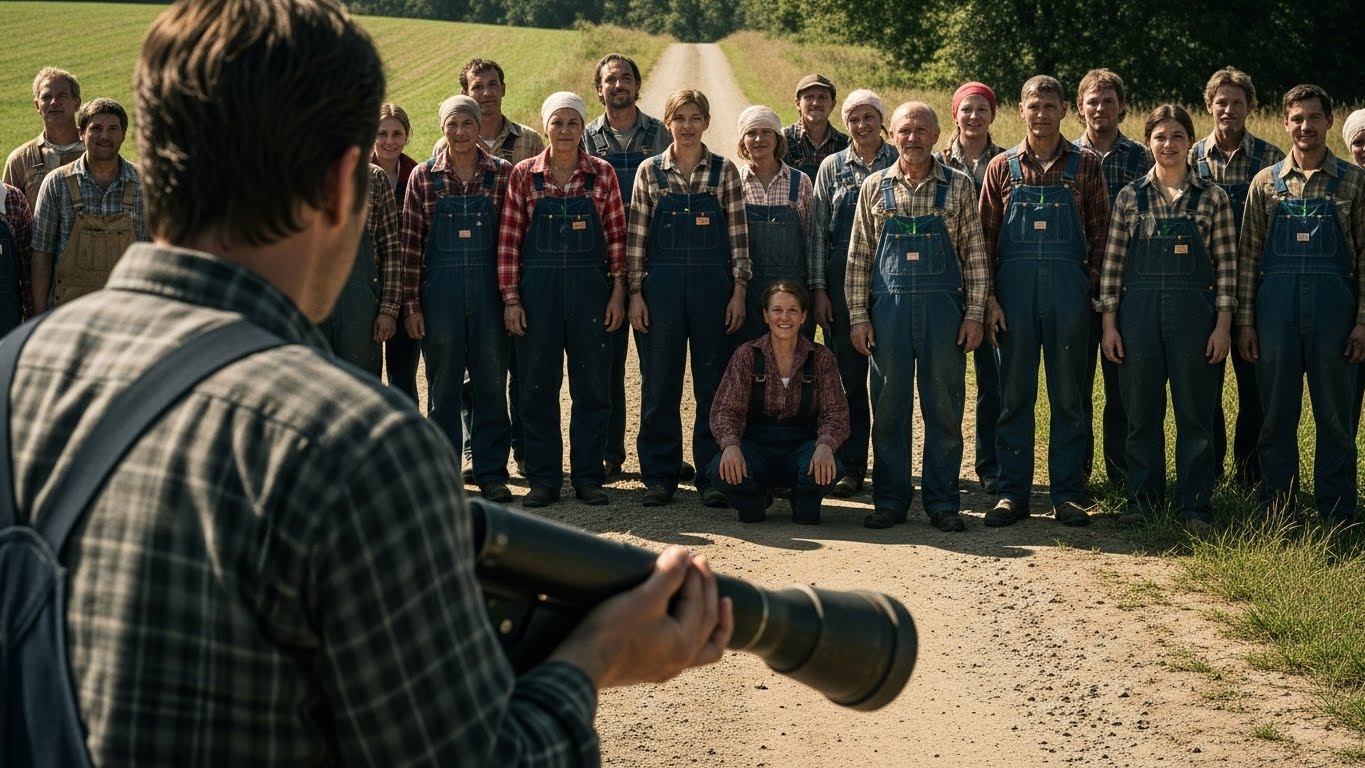
Standing between the house and the barn, effectively blocking the path to my truck, were twenty of them.
The Faithful.
Men and women, young and old. They stood in a perfect semi-circle, silent and still. They held tools—not weapons, strictly speaking, but farm tools that could easily kill. Rusted pitchforks, heavy iron shovels, scythes meant for wheat.
They weren’t in a combat stance. They were relaxed. Shoulders dropped, breathing even. And every single one of them was smiling.
“Let us pass!” I shouted, positioning myself between Sarah and the mob. The air was thick with tension and the smell of dry dust.
“The girl stays,” the man from the porch said. He had joined the line now. He held a ball-peen hammer in his hand, tapping it lightly against his own thigh. Tap. Tap. Tap. He wasn’t tapping hard enough to break the bone, but hard enough to leave a bruise. He didn’t seem to notice.
“Get in the truck, Sarah,” I hissed, pushing her behind me.
“I can’t,” she sobbed, clutching the back of my shirt. “They won’t let us. They love us too much to let us go back to the numbness.”
I looked at the circle of smiling faces. There was no anger there. No hate. Just a serene, terrifying conviction. They looked at me like I was a wayward child who needed to be disciplined for his own good. Like they were doing me a favor.
I reached into my belt and pulled out the heavy flashlight I carried—I had left the tire iron in the truck like an idiot. It was a heavy Maglite, solid aircraft aluminum, filled with D-cell batteries. It was a formidable club.
“I’m warning you,” I said, raising the makeshift weapon. “I will put you down.”
The man with the hammer took a step forward. “Pain is a gift, brother. Let us share it with you.”
The violence didn’t start with a shout or a scream. It started with a whisper. The man with the hammer lunged, not with the frantic energy of a fighter, but with the deliberate motion of a worker swinging at a nail.
I dodged left, the hammer whistling past my ear with terrifying speed, and swung the Maglite with everything I had. It connected with a sickening crack against the man’s jaw.
It was a knockout blow. It had to be. I felt the bone give way under the metal.
The man stumbled back, blood instantly spraying from his mouth. But he didn’t fall. He didn’t drop the hammer. He spat out a tooth, looked at it in the dirt, and then looked back at me.
He smiled.
His jaw was hanging loose, clearly broken, swelling rapidly, turning purple. But his eyes were bright, ecstatic. “Thank you,” he gurgled through the blood. “Thank you for this clarity.”
Fear, cold and sharp, pierced my gut. How do you fight someone who treats a broken jaw like a birthday present? How do you stop someone who wants you to hurt them?
“Sarah, run to the barn!” I yelled, shoving her toward the large wooden structure to our right. The truck was cut off. The barn was the only defensible position.
“Caleb, stop hurting them!” Sarah screamed, tears streaming down her face. She wasn’t worried about me; she was worried about them.
“Go!” I roared.
Two more believers moved in. A woman with a garden hoe and a teenager—no older than sixteen—holding a length of rusty chain wrapped around his fist. They swung at me.
I ducked the hoe, but the metal blade caught my shoulder, tearing through my shirt and skin. I felt the sting, the hot rush of blood. I gritted my teeth and kicked the teenager in the knee. I heard the distinct pop of cartilage tearing.
The boy went down, but he didn’t scream. He laughed. He lay in the dust, clutching his ruined knee, laughing up at the sky as if he’d just heard the funniest joke in the world.
I backed up, swinging the flashlight wildly to keep them at bay. “Back off! Stay back!”
They kept coming. Slow. Relentless. Zombies would have been less terrifying; zombies act on instinct. These people were choosing this. They were walking into my blows because they wanted to feel them.
I turned and sprinted for the barn, grabbing Sarah’s arm and practically throwing her inside. I slammed the heavy oak doors shut and dropped the thick wooden crossbar into place just as the first bodies thudded against the wood outside.
The barn was dark, smelling of old hay and engine grease. Sunlight sliced through gaps in the wood planking, illuminating dust motes dancing in the air.
“You shouldn’t have done that,” Sarah cried, huddled in the corner. She was rocking back and forth, scratching at the burns on her arms until they bled. “Father John will be so disappointed. I was almost ready.”
“Ready for what, Sarah? To die?” I paced the floor, looking for another exit. The barn had a loft, but no other doors that I could see. We were trapped.
“To be free of the vessel,” she mumbled.
Outside, the thumping stopped. Then, a scraping sound. Metal on wood. Then, the rhythmic thud-thud-thud of something heavy hitting the door. Axes. They were chopping their way in.
I looked around for a weapon. My flashlight was sturdy, but against twenty of them, it was a toothpick. I saw a workbench in the back. I ran to it. Rusty saws, a vice, some old gasoline cans…
Gasoline.
I grabbed a red jerry can. It felt half-full. A desperate plan began to form.
“Sarah, listen to me,” I said, crouching in front of her. I needed to break through the brainwashing, fast. “Remember when we were kids? Remember when you fell off your bike and scraped your knee, and I carried you all the way home? You cried for an hour.”
“That was weakness,” she recited, her voice robotic.
“That was being human!” I shouted. “Pain tells you something is wrong! It tells you to stop! These people… they’ve twisted your mind. If you don’t feel pain, you don’t know when you’re dying. And they are going to kill us, Sarah.”
“They won’t kill us,” she said softly, looking past me. “They’ll just peel us. Layer by layer until the light shines through.”
The wood of the door splintered. An axe head poked through, gleaming in a shaft of light. A hand reached through the gap, groping for the latch.
I smashed the hand with the flashlight. I expected a yelp. I got silence. The hand merely withdrew, the fingers mangled, and the axe chopping resumed with the same steady rhythm.
“We need to barricade it,” I said. I dragged an old tractor tire and some bales of hay against the door. It wouldn’t hold them forever.
“Caleb,” Sarah said, her voice trembling. She was looking at my shoulder. “You’re bleeding.”
“I’m fine.”
“Does it… does it hurt?”
“Yes, it hurts like hell,” I snapped.
She stared at the blood soaking my shirt. For a second, just a split second, I saw a flicker of the old Sarah. The sister who was empathetic, who cared. “It hurts,” she repeated, testing the word on her tongue.
“That’s real, Sarah. That pain means I’m alive and I want to stay that way.”
Suddenly, the chopping stopped. The silence returned, heavier than before.
Then, the smell of smoke.
“They’re not coming in,” I realized, horror dawning on me. “They’re burning us out.”
Wisps of gray smoke began to curl under the door and through the cracks in the walls. The dry hay in the loft would go up like tinder.
“Fire is the ultimate purifier,” Sarah whispered, terrified. “Father John says fire leaves nothing but the soul.”
“We’re not souls yet,” I said, grabbing her hand. “Come on.”
I looked up at the loft. There was a hay loading door high up on the back wall. It was a twenty-foot drop, but it was the only way out that wasn’t covered in fanatics.
“Climb,” I ordered, pointing to the ladder.
“I can’t.”
“Climb or burn!” I shoved her toward the rungs.
As we scrambled up the ladder, the heat began to rise. The front doors were already glowing orange from the outside. The crackle of flames was becoming a roar.
We reached the loft. The smoke was thicker here, stinging my eyes. I kicked open the loading door. Fresh air rushed in, feeding the fire behind us. I looked down. It was a drop into a patch of overgrown weeds and rusty machinery.
“Jump,” I told her.
“I’m scared,” she said, peering over the edge.
“Good. Being scared keeps you alive.”
I pushed her. She screamed—a real, human scream—as she fell, landing awkwardly in the weeds. I jumped after her, tucking and rolling as I hit the ground. The impact jarred my teeth, sending a jolt of pain up my spine.
I welcomed it.
We were behind the barn now. The mob was at the front, watching the fire, waiting for our screams. We had a chance. But as I pulled Sarah up, I saw the shadow emerge from the corner of the building.
It was Father John. And he wasn’t smiling anymore.
Chapter 3: The Weight of the Iron
We were behind the barn now. The mob was at the front, watching the fire, mesmerized by the flames they believed were purifying our souls. We had a window of time, perhaps only seconds, before they realized we hadn’t burned to ash.
“Run,” I gasped, pulling Sarah up. She was limping, favoring her left ankle. “To the truck. It’s just past the silo.”
We skirted the edge of the property, using the tall, drying corn for cover. The stalks whipped against my face, leaving stinging welts, but I didn’t care. The smoke from the burning barn billowed into the sky, black and oily, blotting out the harsh sun. We could hear them singing now. It wasn’t a frantic chant; it was a low, droning hymn that sounded more like a funeral dirge than a celebration.
We broke through the corn line and stumbled onto the gravel driveway. The F-150 was there, a beacon of rust and salvation.
I fumbled for my keys, my hands shaking so violently I dropped them in the dirt. I cursed, scrambling to my knees to find them.
“Leaving so soon?”
The voice was calm. Cultured. It cut through the roar of the fire like a knife through silk.
I froze. My hand closed around the keys, but I didn’t rise. I looked up.
Father John was standing by the driver’s side door. He wasn’t holding a weapon. He was holding a book. The Bible, bound in black leather that was worn smooth by years of handling.
He didn’t look like a man whose compound was burning. He looked like a man waiting for a bus. His silver hair was perfectly combed, and his eyes reflected the orange glow of the distant flames.
“Get out of my way,” I said, standing up slowly. I gripped the keys like a shank between my knuckles.
“You have interrupted the ceremony,” John said, shaking his head with a look of profound disappointment. “But perhaps this is God’s will. A greater sacrifice is required to truly open the eyes of the unbeliever.”
He took a step toward me. “Sarah, come to me, child. Your brother is lost to the numbness of the world. But you… you are so close to the breaking point.”
“Don’t listen to him, Sarah!” I shouted. I moved to open the truck door, but John was faster.
He lunged at me. Not with the book, but with his bare hands. For a man in his sixties, he moved with the speed of a striking viper. He slammed me against the side of the truck, the metal groaning under the impact.
The air left my lungs in a whoosh. Before I could recover, his hands were around my throat. His thumbs dug into my windpipe with a strength that felt unnatural, fueled by a lifetime of fanatical conviction.
I struggled, clawing at his face, punching his ribs. It was like hitting a statue. He didn’t blink. He didn’t grimace. He just squeezed harder, that serene, terrifying smile never leaving his lips.
My vision started to swim. Black spots danced at the edges of my sight. I couldn’t breathe. I couldn’t scream.
“Sarah…” I wheezed, the sound barely escaping my crushed throat.
Sarah stood there, frozen near the rear tire. She was watching her brother die. She was watching her “Father” kill him. Her hands were twitching at her sides.
“Help… me…”
Father John didn’t look at me. He looked at Sarah, his eyes beaming with love. “Watch, child. Watch the life leave him. See how peaceful the vessel becomes when the struggle ends? Pain is only temporary. Death is the ultimate release.”
Sarah looked at me. She looked at my desperate, terrified eyes, bulging from their sockets. Then she looked down at her own arms. She looked at the burns. The scabs. The roadmap of pain she had been taught to worship.
The pain that was currently killing the only person who had come for her.
Something in her eyes shifted. The glassy, drugged look of the cult member shattered, replaced by a spark of primal, human rage.
The passenger window of my truck was rolled down—the AC was broken, after all. And sitting on the passenger seat, where I had tossed it hours ago, was the tire iron.
Sarah didn’t scream a prayer. She didn’t ask for forgiveness. She let out a shriek that tore through her throat, raw and ugly.
She reached through the open window, grabbed the heavy iron bar, and swung it with both hands.
It struck Father John across the back of the head.
The sound was wet and heavy, like dropping a melon on concrete.
John released me instantly, stumbling forward. He reached up, touching the back of his head, looking at the bright red blood coating his fingers. He turned slowly to look at Sarah, confusion clouding his icy eyes.
“My… child?” he slurred.
“I am not your child!” she screamed.
She swung again.
This time, the iron connected with his shoulder, sending him to his knees. He didn’t smile this time. He grunted—a noise of shock.
“I am Sarah Miller!” she yelled, swinging a third time.
She didn’t stop. She didn’t stop until he stopped moving. She didn’t stop until the tire iron clattered from her numb fingers onto the gravel.
She stood over him, heaving, her chest rising and falling in spasmodic jerks. She looked at her hands, shaking uncontrollably. She looked at the man who had promised her salvation, now lying broken in the dirt.
“Does it hurt?” she whispered to the unmoving body. Her voice was trembling, terrified. “I hope it hurts.”
I coughed, sucking in greedy gulps of air, massaging my bruised throat. “Sarah,” I rasped. “Get in the truck.”
She didn’t move. She was staring at the blood.
“Sarah!” I grabbed her arm, shaking her. “They’re coming!”
From around the corner of the burning barn, the mob appeared. They saw the fire. They saw us. And they saw their fallen prophet.
The singing stopped.
For the first time, the smiles vanished.
Chapter 4: The Ghost of a Touch
The drive back to the interstate was a blur of adrenaline and dust. I drove like a madman, the suspension of the F-150 groaning as we hit potholes at sixty miles an hour. I constantly checked the rearview mirror, expecting to see headlights, expecting to see a mob of smiling, bleeding people chasing us down the dirt road.
But there was nothing. Just the column of black smoke rising from Eden’s Rest, marking the pyre of their insanity against the twilight sky.
Sarah didn’t speak for the first hour. She sat curled in the passenger seat, hugging her knees to her chest, staring out the window at the passing telephone poles. She was shivering, despite the lingering heat of the day.
I wanted to say something, anything, to break the silence. But my throat felt like it was filled with crushed glass, and my mind was reeling. I kept replaying the sound of the tire iron hitting bone. I kept seeing the look in my sister’s eyes—a look that scared me almost as much as the cult had.
We crossed the state line as the sun finally dipped below the horizon, painting the sky in bruises of purple and red.
I pulled into a truck stop three counties over. It was a brightly lit oasis of neon and diesel fumes. Normalcy. I needed normalcy.
My hands were still shaking so badly I could barely hold the pump nozzle. I filled the tank, my eyes scanning the shadows, jumping at every slamming car door.
I went inside the convenience store. The clerk, a bored teenager with headphones around his neck, didn’t even look up from his phone. I wanted to shake him. I wanted to scream, Do you know what’s out there? Do you know how lucky you are to just be bored?
Instead, I bought two large bottles of water, a pre-packaged sandwich, and a first aid kit.
When I got back to the truck, Sarah hadn’t moved. She was looking at her reflection in the side mirror. She was tracing the line of a jagged scar on her cheek with a dirty fingernail.
“Here,” I said, opening the door and handing her the water. “Drink.”
She took it, her fingers brushing mine. Her skin was ice cold. She drank greedily, water spilling down her chin and mixing with the soot on her face. She finished half the bottle in one breath and gasped, wiping her mouth.
“I killed him,” she said suddenly. Her voice was flat, devoid of emotion.
“You saved me,” I said firmly, leaning against the open door frame. “It was self-defense, Sarah. It was him or me. He was going to snap my neck.”
“He didn’t scream,” she whispered, staring at the pavement. “Even at the end. He just looked… confused.”
“He was sick, Sarah. They all are. They rewired their brains to ignore reality.”
I opened the first aid kit on the dashboard. The smell of antiseptic wipes filled the cab, instantly reminding me of the farmhouse. I flinched, but forced myself to continue.
“Give me your arm,” I said gently. “Let me clean those cuts. They look infected.”
She hesitated. For a long, agonizing moment, I saw the indoctrination warring with reality in her eyes. The belief that the cuts were holy versus the reality of infection and rot.
“Father John said cleaning the wounds is washing away the grace,” she murmured.
“Father John is dead,” I said, my voice hard. “And you’re alive. Let’s keep it that way.”
Slowly, painfully, she extended her arm.
The wounds were nasty. Cigarette burns, shallow slices, deeper gashes that were oozing yellow pus. My stomach turned, but I kept my hands steady.
I poured hydrogen peroxide onto a cotton pad. “This is going to sting,” I warned her. “It’s going to hurt like hell.”
She looked at me, her blue eyes wide and haunting. “I know.”
I dabbed the wound.
She flinched violently. Her breath hitched, a sharp intake of air through her teeth. Her hand tried to pull away, a natural, biological reflex.
“Sorry,” I said, pulling back slightly.
“No,” she said, tears welling up in her eyes again. “Don’t be sorry.”
She looked down at the bubbling liquid on her torn skin. She watched the white foam rise as the peroxide attacked the bacteria.
“It hurts,” she said. Her voice broke, and a sob ripped from her chest. “Caleb, it hurts so much.”
I dropped the kit and pulled her into a hug. It was awkward over the center console, but I held her as tight as I could. She buried her face in my bloody, sweat-stained shirt and wept.
She didn’t cry silently, like she had at the farm. She wailed. She cried for the pain. She cried for the time lost. She cried for the horror of what she had done and what had been done to her.
“It’s supposed to hurt,” I whispered into her matted hair, tears stinging my own eyes. “That’s how you know you’re still you. That’s how you know you’re not one of them.”
We stayed like that for a long time, under the buzzing neon lights of the gas station, ignoring the stares of passersby.
Eventually, she pulled back, wiping her eyes. She looked at the red, angry skin on her arm.
“It stings,” she said, a small, watery smile touching her lips.
“Good,” I said, starting the engine. The rumble of the V8 was the most comforting sound in the world. “Hold onto that.”
I put the truck in gear and pulled onto the highway. The road ahead was dark, stretching out into the American night. We had a long way to go. The physical recovery would take weeks. The mental recovery… that was a road we would be walking for the rest of our lives.
But as I looked over at Sarah, watching her blow gently on her stinging arm, I knew we had made the first step. She wasn’t smiling anymore. She was hurting.
And thank God for that.
Chapter 5: The Withdrawal
We didn’t go home. Not straight away. I didn’t trust the road, and I didn’t trust that the fire at Eden’s Rest had consumed all the monsters.
We drove through the night, putting miles and state lines between us and the smoke. Sarah slept in fitful, twitching bursts. Every time the truck hit a rumble strip, she would jerk awake, eyes wide and scanning the dark cab for a threat, or perhaps, for an opportunity.
We stopped at a motel on the outskirts of St. Louis just as the sun was beginning to bleed gray light into the sky. It was a nondescript place with peeling yellow paint and a sign that promised “Color TV.”
I paid cash. I didn’t want a paper trail. Not yet.
Inside the room, the smell of stale cigarettes and industrial cleaner was overwhelming, but it was better than the smell of blood and burning hay.
“Shower,” I told Sarah gently. “You need to wash the ash off.”
She nodded, zombie-like, and went into the bathroom. I sat on the edge of the bed, the tire iron still within arm’s reach. I listened to the pipes groan, then the hiss of the water.
Ten minutes passed. Then twenty.
Then, a rhythmic thud… thud… thud.
My heart stopped. It was the same sound I had heard at the farmhouse. The sound of the hammer against the thigh.
“Sarah!”
I kicked the bathroom door open.
She wasn’t hurting herself. Not exactly. She was sitting in the tub, fully clothed, the water cold and running over her. She was banging the back of her head against the tile wall. Gently. Rhythmically.
Her eyes were open but unseeing.
“Sarah, stop,” I said, turning off the tap and kneeling beside the tub.
She looked at me, shivering. “It’s too quiet, Caleb,” she whispered. “The water… it doesn’t hurt. The air… it doesn’t hurt. I feel… floating. I hate floating.”
I realized then that this wasn’t just trauma. It was withdrawal.
They hadn’t just brainwashed her; they had addicted her. They had flooded her system with so much adrenaline and endorphins—the body’s natural painkillers—that normal existence felt like numbness. She was a junkie, and pain was her needle.
“I know,” I said, pulling her wet, shivering frame out of the tub. “I know it feels wrong. But we have to get used to the quiet.”
I wrapped her in the thin, scratchy motel towels. She sat on the bed, staring at the blank television screen.
“Father John says the quiet is the devil,” she murmured. “He says silence is where the sin hides.”
“Father John is gone,” I reminded her, my voice hard.
She flinched. “I know. I… I broke him.”
She looked at her hands. “My hands hurt.”
“Good,” I said, handing her a dry shirt I had pulled from my bag. “Keep feeling that.”
I didn’t sleep that night. I pushed a dresser in front of the door and sat in the chair, watching the parking lot through the curtains. Every pair of headlights that swept across the glass looked like an accusing eye.
Chapter 6: The Clinical Cold
The hospital in St. Louis was a different kind of hell. It was white, sterile, and bureaucratic.
I had to take her. The burns on her arms were looking angry, red streaks climbing toward her elbows. Sepsis was a real threat, and I couldn’t fight that with a first aid kit and a tire iron.
The triage nurse took one look at Sarah—the gaunt face, the bruises, the burns in various stages of healing—and called security. Then she called the police.
I expected it. I sat in the waiting room while they took Sarah back. I told the officers everything. Or, at least, the version of everything that wouldn’t get me thrown in a psych ward.
I told them about the farm. About the “Faithful.” About the self-harm cult. I told them I went to get her, things got violent, and we fled. I left out the part where my sister caved a man’s skull in with a tire iron. I let them assume the fire and the chaos were the cause of any casualties.
“We’ll contact the local Sheriff in Missouri,” the officer said, looking at me with a mixture of suspicion and pity. “But son… if what you’re saying is true, this is a federal matter.”
“Just check the farm,” I said, exhausted. “Eden’s Rest. Check the barn.”
They kept Sarah for three days. Dehydration, malnutrition, severe infection. They put her on IV antibiotics and arranged for a psychiatric evaluation.
I visited her every hour allowed.
She looked small in the hospital bed. The wires and tubes seemed to tether her to the earth, preventing her from floating away into that dissociation she craved.
“The doctors keep asking me if I want pain medication,” she told me on the second day.
“What did you say?”
“I told them no.” She picked at the hospital blanket. “If I take the medicine, I can’t feel the healing. That’s what Father John… that’s what he would have said.”
“What do you say, Sarah?”
She looked at the IV line in her arm. “I say it hurts. And I’m afraid that if the pain goes away, I’ll forget why I left.”
That was the hardest part. The fear that without the constant reminder of the physical trauma, her mind would snap back to the indoctrination. That the scars were the only map she had back to reality.
On the third day, the news broke.
The TV in the waiting room showed aerial footage of the farm. Or what was left of it. The barn was a pile of ash. The house was scorched.
The reporter spoke in a grave tone about “human remains” and a “suspected cult suicide pact.”
They hadn’t found everyone. The police report said that many of the Faithful had fled into the surrounding woods when the fire started. Scatter like cockroaches when the light turns on.
Father John’s body was identified. They called it blunt force trauma, likely from falling debris.
I turned the TV off.
Sarah was discharged that afternoon. We walked out into the parking lot, the automatic doors sliding open with a cheerful whoosh.
“Where do we go?” she asked.
“Home,” I said. “We go back to living.”
Chapter 7: The Phantom Limb
Six months later, “living” was still a work in progress.
Sarah moved into my spare bedroom. I couldn’t leave her alone in her old apartment. I was terrified she’d find a highlighted Bible or a sharp object and slip back.
The recovery wasn’t a straight line. It was a jagged spiral.
There were good days. Days where she would laugh at a bad joke, or help me cook dinner, or complain about the humidity. Those were the days I saw my sister returning.
But there were bad nights.
I would wake up to the sound of screaming. Not the “primal scream” of the cult, but the terrified shriek of a nightmare. I’d rush into her room, and she’d be thrashing in the sheets, sweating, clawing at her arms as if trying to peel off her own skin.
“They’re smiling!” she would yell. “Make them stop smiling!”
I would hold her until the tremors passed.
The worst night happened three months in.
I woke up at 2:00 AM. The house was silent. Too silent.
I got up for a glass of water. When I walked into the kitchen, the light was off, but the moonlight streamed through the window.
Sarah was standing by the counter. She was staring at the magnetic strip where I kept my kitchen knives.
Her hand was hovering over the chef’s knife. Her fingers were trembling.
“Sarah?” I said softly, staying by the doorway. I didn’t want to startle her.
She didn’t turn around. “I had a bad day, Caleb.”
“I know. It’s okay to have bad days.”
“I feel numb,” she whispered. “I feel like… like I’m made of cotton. I just want to know I’m real. I just want to see the red.”
She reached for the knife.
“Don’t,” I said. I didn’t yell. I stepped forward. “Sarah, look at me.”
She gripped the handle. She turned to me. Her eyes were glazed, that old, terrifying look returning. “Just a little cut. Just to let the pressure out.”
“Give me the knife.”
“Why?” she challenged me. “Why shouldn’t I? It’s my body. It’s my pain.”
“Because pain isn’t a ladder to God, Sarah. And it isn’t a pressure valve.” I stopped two feet from her. “Pain is a warning light. It’s your body screaming ‘Protect me!’ because it wants to live. If you cut yourself, you’re not mastering the pain. You’re surrendering to the lie.”
She looked at the knife. Then she looked at the faded, jagged scars on her forearms—the legacy of Eden’s Rest.
“I miss the clarity,” she admitted, her voice cracking.
“That wasn’t clarity,” I said. “That was simple. Life isn’t simple. Life is messy and boring and complicated. But it’s real.”
I reached out my hand. palm open.
She looked at the blade. The moonlight glinted off the steel. For a second, I thought she was going to do it. I thought I had lost her.
Then, her shoulders slumped. The knife clattered onto the counter.
She collapsed onto the floor, pulling her knees to her chest.
“I hate them,” she sobbed. “I hate what they did to me.”
“I know,” I said, sitting on the linoleum beside her. “I hate them too.”
That was the turning point. The anger. Before that, it was fear, or confusion, or twisted love. But anger… anger is a survival instinct. You only get angry if you believe you deserve better.
Chapter 8: The Mosquito Bite
We were sitting on the back porch yesterday. It was late summer again, almost a year since I drove down that dirt road in Missouri.
The heat was breaking, giving way to a cool evening breeze. The sun was setting, painting the sky in shades of orange and violet—colors that used to remind me of the fire, but now just looked like a sunset.
Sarah was reading a book. A trashy mystery novel. Something light. She wore a t-shirt. For months, she had worn long sleeves to hide the scars, but today, she didn’t care. The scars were there—white, ropy lines crossing her skin—but they were just history now. Not a map.
I was sipping a beer, watching the fireflies blink in the yard.
A mosquito, bloated and slow, drifted down and landed on Sarah’s forearm, right on top of an old burn scar.
I watched, holding my breath.
In the past, at the farm, she would have let it bite. She would have watched it feed, welcoming the itch, welcoming the minor suffering as a gift.
She didn’t look up from her book. But her nervous system did the work.
Slap.
Her hand moved instinctively, swatting the bug.
She rubbed the spot, frowning.
“Ouch,” she muttered.
I froze. My beer hovered halfway to my mouth.
It was such a small word. A throwaway syllable. But to me, it was a symphony.
She caught me staring and raised an eyebrow. “What?”
“Nothing,” I said, feeling a smile spread across my face—a real smile, not the empty, terrifying grin of the Faithful. “Just… glad you felt that.”
She looked down at her arm. A small, red bump was forming. It was inflamed. It was irritated. It was imperfect.
She didn’t see a sign from God. She didn’t see a test of her faith. She didn’t see a portal to purity.
She saw a bug bite.
“Damn mosquitoes,” she grumbled, scratching it. “Pass the bug spray?”
“Yeah,” I said, tossing her the bottle. “Here.”
Eden’s Rest burned to the ground. The police found bodies, but they never found everyone. Sometimes, when I’m at a job site or in a crowded store, I’ll see someone smile—a smile that’s a little too wide, a little too empty, a little too tolerant of the world’s misery—and my blood freezes.
I wonder where the survivors went. I wonder if they’re still out there, cutting themselves in the dark, smiling at the blood.
But then I look at my sister. I see her wince when she stubs her toe. I see her complain when the coffee is too hot. I see her cry when a movie is sad.
Pain is a burden, yes. Nobody wants it. But I learned something in that barn, surrounded by people who had forgotten their humanity.
Pain is the anchor. It’s the tether that keeps us connected to the earth, to each other, to the reality of our fragile, precious lives. It tells us where we end and the world begins.
I’ll take the scars. I’ll take the hurt. Because the alternative—that smiling, painless void—is a hell I never want to see again.
Sarah slapped another mosquito. “Seriously, Caleb, are you going to fix the screen door or not?”
“I’ll get to it,” I laughed.
And for the first time in a year, I believed that we were going to be okay. We were hurting. We were healing. We were human.