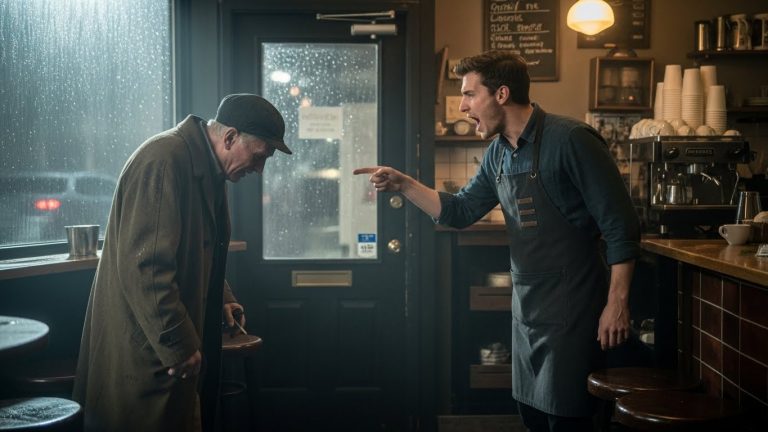
He Refused To Sell His Home To His Debt-Ridden Daughter. Two Days Later, She Claimed He Was Insane—But She Didn’t Know Her Mute Son Was Recording Every Word.
Chapter 1: The Serpent in the Sanctuary
The late afternoon sun in Oakhaven, Vermont, didn’t just shine; it seemed to rest heavy and gold upon the earth, particularly on the plot of land Arthur Vance called home. At seventy-two, Arthur moved with the deliberate, careful grace of a man who respected the toll time took on his joints but refused to be mastered by it. He knelt in the rich, dark soil of his garden, his hands—weathered and map-like with veins—gently guiding the stem of a heritage tomato plant against a wooden stake.
Beside him sat Ethan, his ten-year-old grandson. Ethan was a small boy, pale and fragile-looking, like a ceramic doll that had been broken and glued back together just slightly askew. He didn’t speak. He hadn’t spoken a single word in three years, not since the “incident” with his father before the divorce, a trauma locked deep within his throat. But here, in the garden with Arthur, the silence wasn’t empty. It was companionable. It was a language of its own.
“You see, Ethan,” Arthur said softly, his voice a low rumble that vibrated with the warmth of a man who had spent forty years reading Steinbeck and Hemingway aloud to high school freshmen. “The roots need to feel secure before the fruit can grow. If the foundation is shaky, the whole thing comes down in the first strong wind. People are much the same.”
Ethan looked up, his large hazel eyes wide with understanding. He handed Arthur a spool of twine. It was their rhythm. A dance of small gestures.
The Vance farmhouse stood behind them, a Victorian beauty of white clapboard and wraparound porches that had stood on this hill since 1890. It wasn’t just wood and stone; it was a repository of history. Every creak in the floorboards was a memory of Arthur’s late wife, Eleanor. Every book in the sprawling library was a friend they had shared. The town of Oakhaven revered Arthur. He was the moral compass, the man who had taught half the town council how to write a thesis statement and how to understand the concept of integrity.
But peace, Arthur knew, was often the breath before a storm.
The storm arrived in a red convertible that looked too flashy for the gravel driveway. The crunch of tires was violent, scattering the robins that had been pecking at the lawn.
Arthur stiffened. Ethan flinched, dropping the twine. He scrambled backward, hiding behind Arthur’s legs.
“It’s alright, son,” Arthur soothed, though his own heart hammered a warning rhythm against his ribs. “It’s just your mother.”
Linda Vance-Miller stepped out of the car. At forty-five, she was undeniably beautiful, possessing the same sharp cheekbones as her mother, but her eyes were different. Eleanor’s eyes had been soft, full of light. Linda’s eyes were frantic, hard, and constantly scanning, like a predator looking for weakness or a gambler looking for an exit.
“Dad!” Linda exclaimed, her voice pitching up into a performance of delight. She hurried over, her heels sinking into the grass. “Look at you, playing in the dirt. You’re going to catch your death out here.”
“Hello, Linda,” Arthur said, wiping his hands on a rag. He didn’t stand up immediately; he wouldn’t give her the satisfaction of seeing him struggle with his knees. “We aren’t playing. We’re tending. There’s a difference.”
Linda ignored the correction and bent down to wave at Ethan. “Hi, sweetie. Mommy missed you.”
Ethan didn’t move. He gripped Arthur’s pant leg tighter. Linda’s smile faltered for a fraction of a second—a micro-expression of annoyance—before the mask of the doting mother slid back into place.
“He’s getting worse, isn’t he?” she sighed, standing up and lighting a cigarette, ignoring Arthur’s frown. “He needs specialists, Dad. Real doctors in the city. Not this… rural stagnation.”
“He needs safety, Linda. He needs consistency. He has that here,” Arthur said, finally rising to his full height. He was a tall man, still imposing despite his age.
“Let’s go inside,” Linda said, exhaling a plume of smoke. “We need to talk. Grown-up talk.”
Inside, the kitchen smelled of old paper, coffee, and lemon polish. It was a comforting smell, but Linda paced the room like a caged animal. She picked up a ceramic figure, checked the bottom for a maker’s mark, and set it down.
“I’m in a bit of a bind, Dad,” she started, skipping the pleasantries.
“How much, Linda?” Arthur asked, pouring himself a glass of water. He was tired. He had paid her rent three times this year. He had paid for a car she wrecked.
“It’s not like that,” she laughed nervously. “I have an opportunity. A business investment. But I need liquidity. And let’s be honest, this place…” She waved her hand dismissively at the hand-carved cabinetry. “It’s too much for you. The upkeep, the taxes. It’s a drain. I found a developer. They want to turn the land into luxury condos. The offer is insane, Dad. We could move you into that nice assisted living facility near the highway. The one with the heated pool.”
Arthur set his glass down. The sound was sharp against the wooden table. “This house is not an asset, Linda. It is a home. It is Ethan’s inheritance. It is where your mother died.”
“Mom is dead!” Linda snapped, her facade cracking. “And you’re going to be dead soon too! Why hold onto a pile of wood when we could be rich? I need this, Dad. You don’t understand.”
“I understand perfectly,” Arthur said, his voice dropping to that terrifyingly calm register he used to use on rebellious seniors. “I see the shaking in your hands, Linda. I see the phone calls you ignore. You’re gambling again. Or you owe people who don’t use banks.”
Linda’s face went pale, then red. “You self-righteous old bat.”
“I will not sell this house,” Arthur stated clearly. “And I will not give you another dime to throw into a slot machine or hand over to a loan shark. I am securing Ethan’s future, since you seem incapable of doing so.”
The silence that followed was heavy, suffocating. Linda walked over to the counter and leaned in close to her father. The smell of expensive perfume and stale tobacco was overwhelming.
“You think you’re untouchable because you taught everyone in this town how to read,” she whispered. Her voice was venomous, low enough that Ethan, listening from the hallway, had to strain to hear. “But you’re just a confused old man. People talk, Dad. They say you’re slipping. Maybe you’re forgetting things. Maybe you’re becoming… aggressive.”
“Get out of my house,” Arthur ordered.
“It won’t be yours for long,” Linda hissed. “If you won’t give it to me, I’ll take it. And I’ll destroy you to do it. I will burn your reputation to the ground, Arthur. I will make sure the world sees you as a monster.”
She turned and stormed out. Arthur stood trembling in the kitchen, not from fear, but from a profound, breaking sorrow. He didn’t see Ethan standing in the shadow of the doorframe, his small hand clutching a smartphone, the recording app still running, the red light pulsing like a tiny, silent heartbeat.
Chapter 2: The Poisoned Well
The destruction of a man’s character does not happen with a bang; it happens with a whisper. Linda Vance-Miller was a master of the whisper.
The campaign began the next morning at “Betty’s Diner,” the social hub of Oakhaven. Linda sat in a corner booth, wearing a conservative dress, looking disheveled and teary-eyed. She ordered a coffee but didn’t drink it. She just stared into the mug until Betty, a woman who had known Arthur for thirty years, came over to refill it.
“You alright, honey?” Betty asked.
Linda flinched, dramatically pulling her sleeve down. But she made sure Betty saw it—the purple bruise on her forearm. It was a masterwork of makeup and self-inflicted pinching she had perfected in the bathroom mirror that morning.
“I… I don’t want to talk about it,” Linda sobbed softly. “I just worry about Dad. The dementia… it’s making him so violent. He didn’t mean to hit me. He didn’t know who I was.”
Betty’s eyes went wide. “Arthur? Violent? Honey, Arthur Vance wouldn’t hurt a fly.”
“That’s what I thought too,” Linda wept, clutching Betty’s hand. “But he’s changing. He throws things. He screams at Ethan. I’m so scared for my son, Betty. But I don’t know what to do. He’s a pillar of the community. Who would believe me?”
By noon, the rumor had spread to the post office. By dinner, it was at the church. Arthur Vance is losing his mind. Arthur Vance is beating his daughter. Arthur Vance is a danger to that poor mute boy.
Small towns run on trust, but they feed on scandal. The seeds of doubt, once planted, grew with terrifying speed.
Two days later, Arthur walked into the local hardware store to buy more twine. The silence that greeted him was absolute. Men he had known for decades looked down at their boots or suddenly found the ceiling tiles fascinating.
“Morning, George,” Arthur said to the owner.
George didn’t smile. He didn’t ask about the garden. He rang up the twine with stiff, jerky movements. “That’ll be four dollars, Arthur.”
“Is everything alright, George?”
“Just pay, Arthur. Please. Just go.”
Arthur walked out, confused and hurt, the bell on the door sounding like a knell. When he got to his car, he saw it. Someone had spit on his windshield. A thick, glob of mucus sliding down the glass.
His heart hammered. He drove home, his hands shaking on the wheel. When he pulled into the driveway, he saw Linda’s car again. She was standing on the porch with two police officers. One of them was Deputy Miller, a man Arthur had failed in 11th-grade English for plagiarism.
“There he is!” Linda shrieked, pointing a trembling finger. “Please, don’t let him near me!”
Arthur stepped out of the car, his hands raised. “What is going on here?”
“Mr. Vance,” Deputy Miller said, his hand resting on his holster. “We’ve received a report of domestic disturbance and child endangerment. Your daughter claims you threatened her life and that you are keeping the boy in unsafe conditions.”
“That is a lie,” Arthur said, his voice steady despite the chaos in his mind. “My daughter is trying to coerce me into selling this property. She is lying.”
“Look at this!” Linda screamed, rolling up her sleeves to reveal fresh bruises. “And look at the house! He locks Ethan in the basement!”
“I do not!” Arthur roared, losing his temper for the first time. “Ethan helps me in the library! It is his sanctuary!”
“He’s aggressive, Officer! See?” Linda wailed.
“Mr. Vance, we have an emergency order here,” the Deputy said, stepping forward. “We need to remove the child for his safety until a competency hearing can be held.”
The world tilted on its axis. “No,” Arthur gasped. “He doesn’t speak. He needs me. You can’t take him.”
At that moment, the front door opened. Ethan stood there, clutching a book. He looked at the police, then at his mother, then at his grandfather. His eyes filled with absolute terror.
“Come here, Ethan,” Linda said, her voice dripping with fake honey. “Mommy is going to take you somewhere safe.”
Ethan shook his head violently. He ran to Arthur, burying his face in the old man’s coat.
“Grab the boy,” Deputy Miller ordered his partner.
The scene that followed was a nightmare. The officer pulled the sobbing, silent child from Arthur’s arms. Arthur lunged forward—”Don’t touch him!”—and was immediately slammed against the hood of the police car. The cold steel of handcuffs bit into his wrists.
“You are under arrest for obstruction and assault,” the Deputy spat.
Ethan’s mouth was open in a silent scream, his face contorted in agony as Linda shoved him into the back of her car. Neighbors were watching from their windows, phones recording, capturing the “violent old man” attacking the police.
As the squad car pulled away with Arthur in the back, he watched his home—his legacy—disappear in the distance. But the image that burned his soul was Linda’s face in the rearview mirror of her convertible. She wasn’t crying anymore. She was smiling.
Chapter 3: The Court of Broken Trust
The courtroom was sterile, smelling of floor wax and stale air—a stark contrast to the rich, organic scents of Arthur’s garden. It had been three weeks. Three weeks of Arthur living in a motel because a temporary restraining order barred him from his own home. Three weeks of Linda parading around town as the “survivor.”
Judge Martha Sterling presided. She was a stern woman who followed the law to the letter, but she had also known Arthur for years. However, in a court of law, personal history meant nothing against evidence.
And Linda had manufactured mountains of evidence.
Her lawyer, a slick man from the city named Mr. Kincaid, paced the floor like a shark in a suit.
“Your Honor,” Kincaid began, his voice smooth. “We are not here to punish Mr. Vance. We are here to protect him. And to protect his family. It is a tragedy, truly. Dementia is a cruel thief.”
He held up a black leather-bound book. Arthur gasped. It was his private journal.
“We found this in the home,” Kincaid said. “Listen to the entry from January 14th: ‘I feel as though the walls are closing in. The silence is deafening. I want to smash it all. I want to tear the world apart until I find her again.’“
Kincaid closed the book with a snap. “Violent ideation. Confusion. Depression. A man who wants to ‘tear the world apart’ should not be the guardian of a vulnerable, mute child.”
“Objection!” Arthur’s public defender called out weakly. “That entry was written on the anniversary of his wife’s death! It is grief, not dementia!”
“Grief that manifests as violence is danger, nonetheless,” Kincaid countered smoothly.
Then came the witnesses. Neighbors who had seen Arthur yelling at the police. Betty from the diner, who tearfully recounted seeing Linda’s bruises. Linda herself took the stand, putting on the performance of a lifetime. She wept about how much she loved her father, how hard it was to take his keys away, how he had thrown a lamp at her when she suggested he needed help.
It was a lynching. A systematic dismantling of a life’s work.
When it was Arthur’s turn to speak, he looked old. The last few weeks had aged him ten years. He stood up, his hands trembling on the railing.
“Judge Sterling,” Arthur said, his voice raspy. “I have lived in Oakhaven my entire life. I have graded your children’s essays. I have planted trees in the park. I am not a perfect man. I am old. I grieve my wife. But I am not mad. And I am not violent.”
He turned to look at Linda, who was dabbing her dry eyes with a tissue.
“You can have the wood and the stone, Linda,” Arthur said, his voice gaining a sudden, fierce strength that silenced the room. “You can sell the farm. You can pay your gambling debts. But you cannot have the truth. You have killed the father who loved you to feed your greed. And one day, that money will run out, and you will be left with nothing but the echo of your own lies.”
The courtroom was silent. Judge Sterling looked conflicted. She rubbed her temples. “This is a difficult case,” she began. “The testimony regarding the physical abuse is… concerning. Based on the evidence presented, I am inclined to grant guardianship of Ethan to his mother and power of attorney over Mr. Vance’s estate to…”
“Wait.”
The sound was small, scratchy, and unused. Like a rusty gate opening for the first time in years.
Everyone froze. Heads turned.
In the back row, next to a social worker, Ethan stood up. He was shaking violently. He walked into the aisle.
“Ethan?” Linda stood up, her eyes wide with panic. “Honey, sit down. Don’t—”
“Wait,” Ethan said again, louder this time. The boy who hadn’t spoken in three years was speaking.
He walked past the bar, ignoring the bailiff. He walked straight to the witness stand where the microphone was. He reached into his pocket and pulled out a battered smartphone.
“Ethan, you can’t be up here,” Judge Sterling said gently.
Ethan didn’t look at the judge. He looked at his grandfather. A small, brave smile touched his lips. He tapped the screen of the phone and held it up to the microphone.
Chapter 4: The Sound of Justice
The audio that blasted through the courtroom speakers was crystal clear. It wasn’t the fuzzy, indistinct noise of a pocket recording. It was high-fidelity, recorded by a boy who knew how to be invisible.
First, the sound of a slap. A wet, meaty sound.
Then, Linda’s voice. Not the weeping victim, but a cold, calculating monster.
“Hit yourself harder, Mom needs the bruise to look real before the cops get here.”
A gasp ripped through the courtroom. Linda froze, her face draining of all color.
The recording continued. The sound of Linda panting, likely from the exertion of inflicting pain on herself.
“We need that old man in a home by Christmas. The developers are pushing for the land. If he won’t sign, we’ll declare him incompetent. Just remember, Ethan, if you make a sound, if you try to tell him… Mommy will send you away to a place where they lock bad boys in the dark. Do you understand?”
Then, the sound of a car door slamming.
Ethan hit ‘stop’.
The silence in the courtroom was different now. It wasn’t the silence of respect or confusion. It was the silence of a vacuum before an explosion.
Every pair of eyes in the room turned to Linda. Her lawyer, Mr. Kincaid, was slowly moving his papers away from her, physically distancing himself from his client.
“That… that’s doctored!” Linda shrieked, her voice cracking. “It’s AI! He’s a tech wiz! He made it up!”
Judge Sterling stood up, her face a mask of fury. “Sit down, Ms. Vance-Miller. Bailiff, secure the doors.”
“He speaks!” Linda yelled, pointing at Ethan like he was a demon. “He’s been faking it! He’s a liar just like his grandfather!”
“He speaks,” Arthur said, his voice booming as he walked toward the boy, “because he finally feels safe enough to tell the truth.”
Arthur reached the stand and dropped to his knees, embracing his grandson. Ethan buried his face in Arthur’s shoulder and began to sob—great, heaving sobs of release.
Judge Sterling banged her gavel, not to silence the room, but to declare judgment. “This hearing is suspended. Deputy, take Ms. Vance-Miller into custody immediately. I want the District Attorney down here within the hour. We are looking at fraud, perjury, filing a false police report, and child endangerment.”
As the bailiff clicked the handcuffs onto Linda’s wrists—real handcuffs, for real crimes—she looked at her father. She didn’t see anger in his eyes. She saw pity. And that burned her more than any hatred could.
Epilogue: Roots and Recovery
Six months later.
The garden was in full bloom. The tomato plants were heavy with fruit, bowing slightly under the weight, but held up by the strong stakes Arthur had driven into the earth.
The town of Oakhaven was still apologizing. Casseroles appeared on the porch almost daily. People who had crossed the street to avoid Arthur now tipped their hats with extra reverence. Arthur accepted it all with grace, though he had stopped caring about the town’s opinion. He knew now how fickle their adoration was.
He sat on the porch swing, a book open on his lap. Ethan sat beside him.
“Grandpa?” Ethan asked. His voice was getting stronger every day, though he still preferred to save his words for things that mattered.
“Yes, Ethan?”
“Do you think the tomatoes are ready?”
Arthur looked out at the garden, then down at his grandson. He took the boy’s hand—the hand that had held the phone, the hand that had saved his life.
“Yes, son,” Arthur smiled, and the lines on his face deepened, not with age, but with peace. “I think the harvest is finally here.”