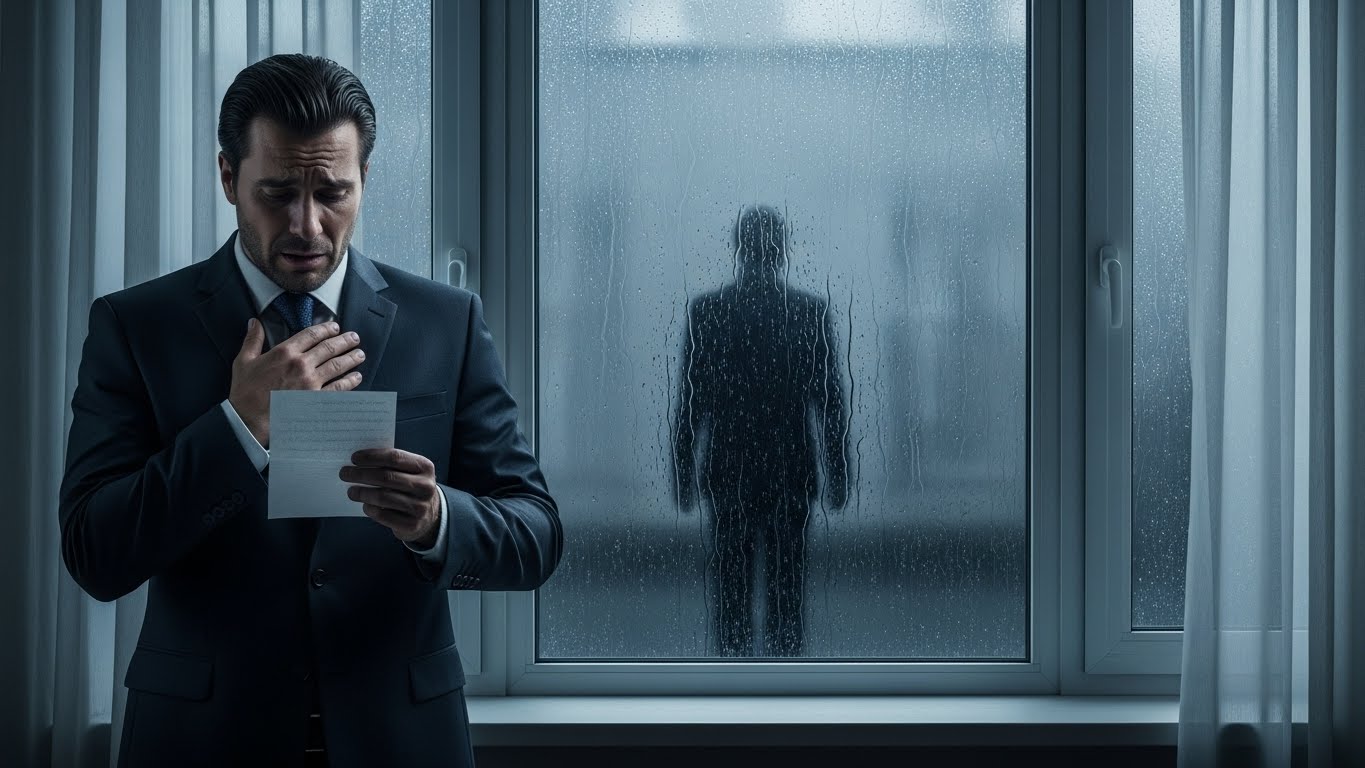
HE MOCKED HIS HIGH SCHOOL VICTIM AT THE REUNION, 3 DAYS LATER THE POLICE HANDED HIM A NOTE: “I Was Tired of Being The Sheep.”
Chapter 1: The Lion in the Winter
The rain in Seattle didn’t wash things clean; it just made the grime slicker. Mark Vance stood under the awning of the Grand Hyatt, checking his reflection in the glass doors. At forty-eight, he was a monument to American capitalism. His suit was bespoke Italian wool, his shoes were hand-stitched leather, and the Patek Philippe on his wrist cost more than most people’s college tuition.
He adjusted his cuffs. He wasn’t nervous. Mark Vance didn’t get nervous. He got aggressive.
“Are you ready, babe?”
Tiffany, his twenty-six-year-old fiancée, stepped out of the Uber. she was stunning, a trophy he had acquired to signal to the world that he was still in his prime. But as he looked at her, he felt… nothing. Just the satisfaction of possession.
“It’s a high school reunion, Tiff,” Mark scoffed, offering his arm. “It’s a graveyard with an open bar. Let’s go show them what success looks like.”
Inside, the ballroom was a sea of balding heads, expanding waistlines, and nametags pinned to cheap polyester. The Class of ’94. The music was too loud—Bon Jovi’s Livin’ on a Prayer playing for people who had mostly stopped living and started existing.
Mark moved through the crowd like a shark in a koi pond. He shook hands firmly, flashing his teeth. He dropped casual references to his real estate firm, his property in the Hamptons, his Tesla. He enjoyed watching the envy in the eyes of men who used to be competition and were now just tired fathers with mortgages they couldn’t afford.
He left Tiffany at a table with some cheerleaders who had aged poorly and headed to the bar for a double scotch.
That’s when he felt the tap on his shoulder. It was light, hesitant. The touch of a ghost.
Mark turned.
Standing there was a man in a cardigan that had seen better decades. He was thin, his posture hunched as if he expected the sky to fall on him at any moment. He held a glass of water with both hands to stop them from shaking.
“Mark?” the man whispered.
Mark squinted. The face was older, lined with worry, but the eyes—wet, fearful, pleading—were the same.
“David?” Mark let out a short, incredulous laugh. “David Moore? David the Dreamer?”
David Moore. The kid Mark and his football buddies had shoved into lockers. The kid they had tripped in the cafeteria. The kid whose poetry notebook they had stolen and read aloud over the PA system senior year.
“I… I didn’t think you’d come,” David stammered. He looked at Mark’s suit, then down at his own scuffed shoes.
“I almost didn’t,” Mark said, taking a sip of his scotch. “But I figured, why not? What are you doing with yourself, Davey? Still writing poems about clouds?”
David swallowed hard. “I’m a librarian. At the county branch.”
“A librarian. Shocker.” Mark rolled his eyes. “Well, good for you. Keeping it quiet. Keeping it small.”
David took a step closer. It took visible effort. He looked like a man standing on the edge of a cliff, trying to find the courage to step back.
“Mark, I just…” David’s voice trembled. “I wanted to talk. About back then. I’ve carried it for thirty years. The fear. I wanted to see you. To see if… if things could be different now. I wanted to tell you that I forgive you.”
The ballroom seemed to go quiet around them. Or maybe it was just the blood rushing in Mark’s ears. For a split second, Mark felt a strange sensation in his chest—a tightness. Regret?
But then he saw the people nearby watching. He saw an old teammate, Steve, grinning. The instinct kicked in. The defense mechanism he had built his entire life on. Kill or be killed. Dominate or be dominated.
Mark threw his head back and laughed. It was a cruel, sharp sound that cut through the music.
“Forgive me?” Mark boomed, loud enough for the surrounding tables to hear. “You want to forgive me? For what? For toughening you up? For teaching you how the real world works?”
He stepped into David’s personal space, looming over him.
“Look at you, David. You’re forty-eight years old and you’re shaking like a leaf. I didn’t break you. You were born broken. Some people are lions, David. And some people are sheep. You were always a sheep.”
He leaned in, whispering the final blow with a smile on his face. “Go home, Davey. Go read a book. The adults are talking.”
The effect was immediate. It was like watching a building implode. The light in David’s eyes didn’t just fade; it was extinguished. His shoulders collapsed. The hope that had brought him to this reunion, the thirty years of gathered courage, evaporated in ten seconds.
David placed his water glass on the bar. He didn’t say a word. He looked at Mark one last time—not with anger, but with a profound, crushing sadness. A look that said, I was right to be afraid.
David turned and walked toward the exit. He moved slowly, a gray figure disappearing into the dark hallway.
“Jesus, Mark,” Steve said, walking up with a beer. “That was brutal. Even for you.”
“He needed to hear it,” Mark said, downing his scotch. “Guy’s a loser.”
But as Mark watched the exit doors swing shut, the scotch tasted like ash in his mouth. He checked his Patek Philippe. It was 9:00 PM.
He didn’t know it was the time of death for his own soul.
Chapter 2: The Letter from the Dead
Three days later, the silence in Mark’s corner office was absolute. He was looking at a blueprint for a new condo complex, but the lines kept blurring.
He hadn’t slept well since the reunion. Every time he closed his eyes, he saw David Moore’s face. That look of total defeat. It was haunting him, scratching at the back of his mind like a rat in the walls.
His intercom buzzed. “Mr. Vance? There are two police officers here to see you.”
Mark frowned. He mentally scanned his recent business dealings. Had he cut a corner too sharp? “Send them in.”
The officers weren’t looking for financial records. They looked grim. They held their hats in their hands.
“Mark Vance?” the older officer asked.
“Yes. What’s this about?”
“We’re investigating the death of a Mr. David Moore.”
Mark felt the blood drain from his face, pooling in his feet. The room spun. “Death? What… what happened?”
“He was found yesterday morning,” the officer said, his voice flat. “Suicide. Overdose.”
The word hung in the air, heavy and suffocating. Suicide.
“I… I haven’t seen him in thirty years,” Mark lied, his voice sounding thin and reedy. “Except for a few minutes at the reunion Saturday.”
“We know,” the officer said. He reached into his jacket pocket and pulled out a photocopy of a handwritten note. “He left a journal. The last entry was dated Saturday night, 11:00 PM. Just two hours after he left the Hyatt.”
The officer placed the paper on Mark’s mahogany desk. “He mentioned you.”
Mark stared at the paper. The handwriting was neat, small, and precise.
To whoever finds this,
I went tonight. I finally went. I told myself that 30 years would change a man. I told myself that the monster in my head was just a child, and that we were both men now. I thought if I looked him in the eye, the fear would go away. I wanted peace.
But Mark Vance looked at me with the same eyes. He laughed at me. He told me I was a sheep. He told me I was born broken.
He was right. I am tired of being afraid. I am tired of the noise in my head telling me I am worthless. I tried to stand up, and he pushed me down again. I don’t have the strength to get up this time.
I am just so tired.
Please tell my mother I love her. And tell Mark… tell him he won.
Mark couldn’t breathe. The air in the room felt solid, like concrete. He wasn’t reading a suicide note; he was reading an indictment.
“Did I…” Mark choked. “Am I being charged?”
“Being an asshole isn’t a crime, Mr. Vance,” the officer said coldly. “But you have to live with it. Good day.”
They left.
Mark sat alone in his glass tower. He looked at the panoramic view of the city he had helped build. It all looked meaningless.
He didn’t just bully a kid in 1995. He had validated David’s darkest thoughts in 2024. He had handed him the pills. He had pulled the trigger.
Mark stood up and ran to the executive bathroom. He fell to his knees and retched, his body trying to expel a guilt that was already in his bloodstream.
He looked in the mirror. The “Lion.” The winner.
He saw a murderer.
Chapter 3: The House on Maple Street
The funeral was a small affair at a rundown chapel on the edge of town. Mark parked his Tesla three blocks away and walked. He wore a black suit, but stripped off the expensive watch. He felt unworthy of it.
He stood in the back, hidden in the shadows of the vestibule. There were maybe ten people there. A few librarians. A neighbor. And in the front row, a small, frail woman leaning on a cane.
Mrs. Evelyn Moore.
She was seventy-five, white-haired, wearing a black dress that was clearly decades old. She didn’t cry. She just stared at the closed casket with a look of devastation that was too deep for tears.
When the service ended, Mark intended to slip away. He just wanted to pay respects, to acknowledge the weight of what he had done.
But as the mourners filed out, Mrs. Moore stopped near the door. She was adjusting her thick glasses, clearly struggling to see. She bumped into Mark.
“Oh, excuse me,” she said, her voice soft and trembling.
Mark froze. “I’m sorry, ma’am.”
She paused, tilting her head. “I don’t recognize your voice. Are you… were you a friend of David’s?”
This was the moment. The moment to confess. I’m the reason he’s dead. I’m the one who broke him.
Mark looked at her fragile face. If he told her the truth, it would shatter her. It would kill her. Cowardice and mercy wrestled in his chest.
“Yes,” Mark whispered. “I’m… Mark. We went to high school together.”
A smile broke across her face—a tragic, beautiful thing. She reached out and grabbed his hand with surprising strength. Her hands were cold.
“Mark,” she breathed. “David never brought friends home. He was so shy. But I’m so glad he had someone. Thank you for coming. It means the world to me that he wasn’t alone.”
The lie tasted like bile. “He wasn’t alone, ma’am.”
“Please,” she said. “Call me Evelyn. You must come by the house. David… David was helping me fix the porch before… before. I’d love to hear stories about him. I want to know the happy parts.”
Mark couldn’t say no. He was trapped in his own penance.
The next day, Mark Vance, the CEO who billed $500 an hour, called his assistant. “Cancel my meetings. All of them. Indefinitely. Tell the board I’m taking a sabbatical.”
He drove to Home Depot. He bought work boots, canvas pants, a tool belt, paint, and lumber.
He drove to 402 Maple Street.
The house was a dying thing. The paint was peeling in long gray strips. The gutters were hanging by rusted nails. The garden—David’s sanctuary—was choked with weeds.
Mrs. Moore opened the door. She couldn’t see well enough to notice Mark’s Tesla parked down the street, or the brand-new shine of his tools.
“Mark,” she said. “You came.”
“I promised, Evelyn.”
Mark didn’t go inside to drink tea. He went to work.
For the first time in twenty years, Mark used his hands for something other than signing checks. He stripped the rotting wood from the porch. He scraped the blistering paint. He sweated. He bled when a rusted nail tore his palm, and he welcomed the pain.
Every stroke of the hammer was an apology. I’m sorry, David. I’m sorry.
Mrs. Moore would sit on the lawn chair, listening to him work. She would ask questions.
“Was he funny in school, Mark?”
Mark would pause, wiping sweat from his brow. He had to invent a man he had destroyed.
“He was… brilliant, Evelyn,” Mark lied, his voice choking. “He had this dry wit. One time, in English class…”
Mark spun fictions. He gave David the laughter he had stolen. He gave Mrs. Moore memories of a popular, happy son. And with every lie, Mark felt the weight of the whisper growing heavier. He was building a monument to a man who never existed, trying to cover the grave of the man he had buried.
Chapter 4: The Lion in the Attic
Summer turned to Autumn. The leaves on Maple Street turned gold and red.
Mark had transformed the house. The roof was patched. The siding was a fresh, crisp white. The porch was sturdy. But the real work was inside him.
He had lost fifteen pounds. His face was tan and weathered. He stopped returning Tiffany’s calls. Eventually, she left a voicemail saying she was keeping the ring and leaving him. Mark deleted it without listening to the end.
One rainy Tuesday, Evelyn asked him to clear out the attic. “I can’t go up there anymore,” she said. “Too many stairs. Just… box up his things.”
Mark climbed into the dusty gloom. It smelled of old paper and cedar.
David’s life was packed into cardboard boxes. Comic books. A collection of smooth stones. And notebooks. Dozens of them.
Mark sat on the floorboards, illuminated by a single bare bulb, and opened one.
It was poetry.
Mark expected bad high school angst. What he found was breathtaking. David wrote about loneliness with a clarity that cut Mark to the bone. He wrote about the beauty of a spiderweb, the sound of rain on a tin roof.
Then, Mark found a notebook dated Senior Year, 1995.
He turned the pages, his heart hammering. He found a poem titled The Lion.
The Lion roars not because he is King, But because the silence scares him. He shows his teeth to hide his trembling tongue. He strikes the lamb, Because if he stops striking, He might realize he is hollow inside. I do not hate the Lion. I pity him. For he has to be the Lion every day, While I am free to dream.
Mark dropped the notebook.
David had known. Even back then, the scared little kid had seen right through Mark’s armor. Mark wasn’t the predator; he was just loud. David wasn’t the victim; he was the one with the soul.
Mark curled up in the dust of the attic, holding the notebook to his chest, and wept. He cried for David. He cried for the thirty years he had wasted being a hollow man. He cried until his throat was raw.
Downstairs, the phone rang. It was the eye doctor. Mark had anonymously paid twenty thousand dollars for a specialist to perform corneal surgery on Evelyn.
“Mr. Vance?” the doctor left a message. “Good news. The surgery is scheduled for Friday. She’s going to see again.”
Mark froze.
If she could see… she would see the yearbook photo sitting on the mantle. The one Mark had carelessly left out while cleaning. The photo of the football team.
She would see Mark. And she would see David. And she would realize Mark wasn’t the friend. He was the tormentor.
Chapter 5: The Weight of Mercy
The surgery was a success.
Mark drove Evelyn home from the clinic three days later. She had bandages over her eyes, but the doctor said they could come off this afternoon.
Mark led her into the living room. The house smelled of lemon polish and fresh flowers he had bought.
“It smells beautiful, Mark,” she said.
“It is beautiful, Evelyn.”
“Will you stay? When I take the bandages off? I want… I want to see the face of the man who saved my home.”
Mark’s stomach twisted. “I… I should go.”
“Please,” she insisted.
Mark stayed. He stood by the fireplace, waiting for the execution.
Evelyn sat in her armchair. Slowly, with trembling hands, she unwound the gauze. She blinked against the light. She looked around the room, gasping at the fresh paint, the clean windows.
Then, her eyes landed on Mark.
She squinted. She smiled. “You look… tired, Mark.”
Then her gaze drifted. It landed on the mantle. On the yearbook.
Mark stopped breathing.
Evelyn stood up. She walked to the mantle. She picked up the book. She opened it to the page Mark had bookmarked. The football team photo. Mark, center, grinning arrogantly. And in the background, blurry, a kid being shoved by a teammate. David.
She looked at the photo. Then she looked at the poem Mark had left on the table—The Lion.
She looked back at Mark. The realization hit her like a physical blow. Her hand flew to her mouth.
The silence stretched for an eternity.
“You aren’t his friend,” she whispered. Her voice wasn’t angry; it was shattered. “You… you are the one he wrote about. You are the Lion.”
Mark dropped to his knees. He didn’t beg. He just surrendered.
“I killed him,” Mark sobbed, his head bowed low. “I didn’t push him off a bridge. But I pushed him. At the reunion… I mocked him. I sent him home to die. I’m sorry. I am so, so sorry.”
He waited for the scream. He waited for her to strike him with her cane. He deserved it. He wanted it.
He heard her footsteps approaching on the hardwood floor. Click. Click.
She stopped in front of him.
“Stand up,” she said.
Mark shook his head. “I can’t.”
“Stand up, Mark.”
He slowly rose. He couldn’t look her in the eye. He looked at his boots.
She reached out. Her wrinkled, newly sighted eyes filled with tears. She placed a hand on his cheek. It was warm.
“I cannot forgive you for what you took from me,” she said, her voice shaking. “That is not my right. David is the only one who could do that.”
Mark closed his eyes, tears leaking out.
“But,” she continued, “I can thank you for the roof over my head. I can thank you for the dignity you gave this house.”
She squeezed his face, forcing him to look at her.
“Mark, look at me. You cannot bring him back. You cannot fix the past. But you have spent six months trying to be a different man. Do not let that go to waste. Do not let David’s death be for nothing.”
“I don’t know how to live with it,” Mark whispered.
“You carry it,” she said sternly. “You carry the weight. And you use it to build something better. That is your penance. Not suffering. But building.”
She let him go. “Now, finish the garden. The weeds are coming back.”
Chapter 6: The Sanctuary
Five years later.
The building stood on the corner of 4th and Main. It used to be a derelict warehouse. Now, it was bright, airy, and filled with light.
Above the door, a modest bronze plaque read: THE DAVID MOORE COMMUNITY CENTER.
Inside, it was noisy. But it was a good noise. In one room, a group of men sat in a circle, talking about depression, divorce, and failure. In another, kids were painting canvases.
Mark Vance walked through the hallway. He wasn’t wearing a suit. He was wearing jeans and a flannel shirt, covered in sawdust. He wasn’t the CEO anymore. He was the Director, the janitor, and the carpentry teacher.
He walked into the woodshop. Ten teenage boys were standing around workbenches. They were the outcasts. The quiet ones. The ones who looked at their shoes when they spoke.
“Alright,” Mark said, his voice calm and steady. “Today we’re building birdhouses. Not because birds need houses, but because we need to learn how to make something strong enough to weather the storm.”
He saw a commotion in the back. A bigger kid—a new arrival—shoved a smaller boy into the lumber rack.
“Watch it, freak,” the big kid sneered.
The room went silent. The old Mark would have laughed. The old Mark would have praised the aggression.
Mark set down his plane. He walked over. The big kid flinched, expecting to be yelled at.
Mark knelt down so he was eye-level with the bully. He put a firm, gentle hand on the boy’s shoulder.
“We don’t do that here, son,” Mark said softly.
“He’s in my way,” the bully muttered.
“Strength,” Mark said, looking the boy deep in the eyes, “isn’t about who you can knock down. It’s about who you can lift up. You have strong hands. Use them to build, not to break.”
The boy’s aggression melted. He looked ashamed. “Sorry.”
“It’s okay,” Mark said, standing up. “Now, help him pick up the wood.”
Mark walked back to the front of the room. He looked out the large window that faced the garden.
For a moment, just a fleeting heartbeat, the sunlight caught the leaves of the oak tree outside. Mark saw a figure standing by the treeline. A man in a cardigan, holding a book.
The ghost of David Moore looked at Mark. He wasn’t crying anymore. He wasn’t shaking.
David smiled. A genuine, forgiving smile. And then, he faded into the light.
Mark took a deep breath. The weight was still there—it would always be there. But for the first time in his life, he was strong enough to carry it.
“Okay,” Mark said to the class. “Let’s get to work.”