Rich Bully Throws Poor Student’s $150 Book Into A Dumpster, Then Freezes When He Hears A Cane Tap Behind Him
Chapter 1: The Weight of Paper and Sole
The alarm clock on the bedside table didn’t buzz; it rattled, a harsh, mechanical death rattle that signaled 5:30 AM. For sixteen-year-old Leo Miller, the sound wasn’t just a wake-up call; it was the starting gun for another marathon he wasn’t sure he had the energy to run.
He slapped the snooze button, his hand rough and red from the dishwater and sanitizer chemicals at Jerry’s Diner. He had clocked out at 11:30 PM the night before, walked the two miles home to save bus fare, and then spent two hours wrestling with derivatives and integrals under the dim light of a desk lamp that flickered every time the furnace kicked on.
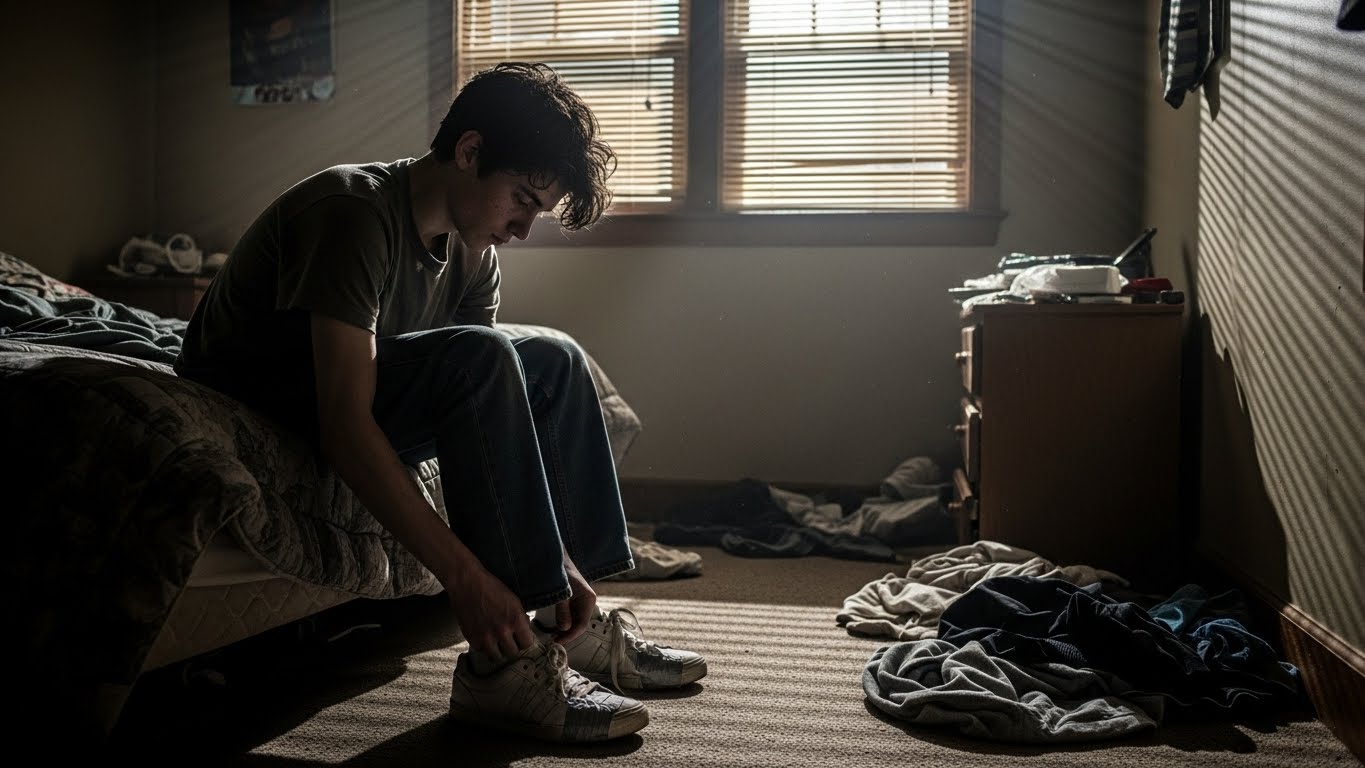
Leo swung his legs out of bed, his feet hitting the cold linoleum. He winced. The soles of his feet throbbed, a dull, persistent ache that never really went away. He looked down at his sneakers sitting by the door. They were white Nikes, once. Now, they were a shade of greying canvas, the “swoosh” peeling off on the left side, and the rubber sole separating from the toe on the right. He had found them at the Goodwill on 3rd Street three months ago. They were a size too big, so he wore two pairs of socks to keep them from slipping, which only made his feet sweat and blister during the long shifts at the diner.
“Leo?” A voice called from the other room, weak and raspy.
“I’m up, Ma,” Leo called back, softening his voice. He walked into the small living room.
His mother, Sarah, was sitting in her recliner, a blanket pulled up to her chin. The rheumatoid arthritis had been bad this week—the kind of bad that turned her joints into swollen knots of fire and made standing up a Herculean task. She looked smaller than she used to, frail against the oversized floral patterns of the chair.
“Did you eat?” she asked, her eyes adjusting to the morning gloom.
“I’m grabbing something at school,” Leo lied. He poured her a glass of water and set her morning medication on the side table. “I’ve got the early shift again tonight, so I’ll be home late. There’s casserole in the fridge. You just have to microwave it, okay? Don’t try to use the oven.”
“You work too hard, baby,” she whispered, reaching out a crooked hand to touch his wrist. “You’re just a boy. You should be playing baseball or… or going to movies.”
Leo smiled, a tight, practiced expression. “I’m fine, Ma. I like the work. It keeps me busy.”
He kissed her forehead, grabbed his backpack, and headed out into the crisp autumn air of Columbus, Ohio. The lie tasted like ash in his mouth. He didn’t like the work. He hated the grease that clung to his hair, the rude customers who snapped their fingers for refills, and the bone-deep exhaustion that made him feel forty years old instead of sixteen.
But he loved the goal.
He adjusted the straps of his backpack. It was heavier today, not because of gym clothes or a packed lunch, but because of The Book.
It was a hardcover behemoth: Advanced Placement Calculus BC: Early Transcendentals. The spine was stiff, the pages glossy and crisp. It smelled like opportunity. The school district, underfunded and overstretched, had run out of copies for the AP track students two weeks into the semester. The teacher, Mr. Henderson, had shrugged apologetically and said, “You can share during class, or try to find a PDF online.”
But Leo couldn’t learn from a shared book or a blurry screen on the library computer. He needed to hold it. He needed to write in the margins. He needed to own the knowledge.
So, he had picked up four extra shifts. He had scrubbed burnt lasagna off pans until his knuckles bled. He had bused tables for tips that barely covered a gallon of milk. And finally, two days ago, he had walked into the university bookstore downtown and slapped $150 in crumpled ones and fives onto the counter.
It was the most expensive thing he owned. It was his ticket out.
Oak Creek High School was a sprawling brick complex that divided the town geographically and socially. On the north side of the parking lot sat the lifted trucks and BMWs of the kids from the “Hill”—the new development where the houses had three-car garages and manicured lawns. On the south side, near the bus loop, were the rusted sedans and the kids who walked.
Leo kept his head down as he navigated the hallway. He had a system: eyes on the floor, walk fast, don’t engage. In a school of two thousand kids, anonymity was safety.
“Hey, check out the moon boots,” a voice sneered as Leo passed the lockers near the gym.
Leo didn’t look up, but he knew the voice. Braden Halloway. The quarterback. The golden boy. The kind of kid who had never heard the word “no” in his seventeen years of existence. Braden’s father owned the biggest Ford dealership in the county, and Braden wore that fact like armor.
Leo tightened his grip on his backpack straps and kept moving. He could feel the heat rising in his cheeks. He knew his shoes were clownish. He knew his flannel shirt was frayed at the cuffs. He didn’t need a reminder.
First period passed in a blur. Then second. By the time lunch rolled around, Leo’s stomach was growling loudly enough to rival the bell. He had fifty cents in his pocket—not enough for a slice of pizza. He bypassed the cafeteria line, ignoring the smell of pepperoni and yeast, and headed for the side exit.
He needed quiet. He needed to study.
The “loading dock” was the unofficial smoking area for the bad kids after school, but during lunch, it was usually deserted. It was a concrete slab behind the cafeteria kitchens, lined with massive, industrial dumpsters that smelled of rotting lettuce and sour milk. It wasn’t scenic, but it was private.
Leo sat on a clean patch of concrete near the brick wall, pulling his knees to his chest. He unzipped his backpack with the reverence of a priest handling a relic. He pulled out the calculus book.
The sunlight hit the cover, making the silver lettering gleam. Calculus. The language of the universe. The language that didn’t care if your shoes were old or your mom was sick. In math, there was always an answer. If you worked the problem long enough, if you followed the rules, you got the solution. Life wasn’t like that. But this book was.
He opened to page 142. Derivatives of Trigonometric Functions.
He uncapped a pen and began to read, his world narrowing down to the symbols on the page. For a moment, the smell of the dumpsters faded. The hunger in his belly quieted. He wasn’t Leo the dishwasher. He was Leo the scholar, the future engineer, the boy who was going to buy his mother a house with no stairs.
He was so absorbed in the elegance of the chain rule that he didn’t hear the heavy metal door swing open behind him. He didn’t hear the scuff of expensive sneakers on the concrete until a shadow fell across his page, blocking the sun.
“Well, well,” Braden’s voice dripped like molasses. “Look what we have here. The genius is studying in his natural habitat.”
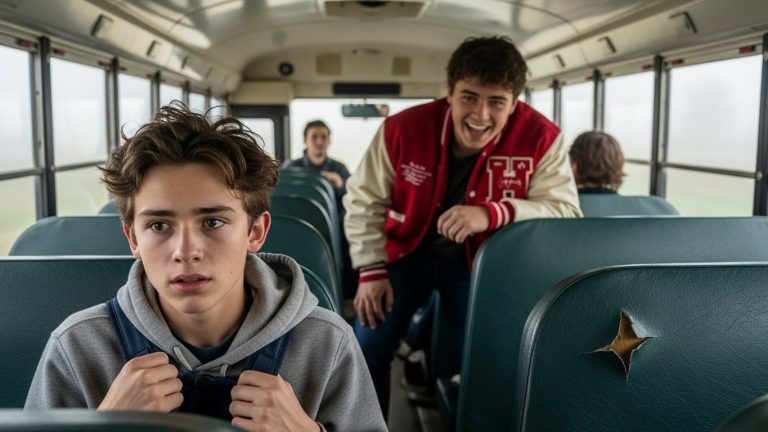
Leo’s heart hammered against his ribs. He looked up. Braden stood there, flanked by two of his offensive linemen, distinct in their blue and gold letterman jackets. They looked like a wall of muscle and entitlement.
“I’m just reading, Braden,” Leo said, his voice steady despite the trembling in his hands. He started to close the book.
“Whoa, hold on,” Braden said, stepping closer. He reached down, his movement too fast for Leo to react, and snatched the heavy book from Leo’s hands. “Let’s see what’s so important that you have to sit by the trash to read it.”
“Give it back,” Leo said, standing up. He was tall, but thin—wiry strength versus bulk.
Braden held the book high above his head, flipping through the pages with careless aggression. “Look at this,” he laughed, showing the book to his friends. “He writes in it. ‘Note: Remember the limit approaches zero.’ Nerd graffiti.”
“That’s mine,” Leo said, stepping forward. “I paid for it.”
“You paid for this?” Braden scoffed. He looked Leo up and down, his eyes lingering on the taped-up shoes. “With what? Food stamps? Did you steal it, Leo? There’s no way a scrub like you affords a hardcover.”
“I worked for it,” Leo said, his voice rising. “Please, Braden. Just give it back. I need to study for the midterm.”
Braden’s smile vanished, replaced by a cold, bored sneer. “You try so hard, trash-boy. That’s the funny part. You think if you read enough numbers, you’ll stop being… this.” He gestured vaguely at Leo’s outfit. “But look at your shoes. Look at your shirt. You smell like old fryer grease.”
Leo flinched. He had scrubbed his skin raw in the shower, but the diner smell was stubborn. It seeped into his pores.
“You don’t get it,” Braden continued, walking toward the edge of the dock, toward the largest, rustiest dumpster. The lid was propped open, revealing a black abyss of garbage bags, wet cardboard, and cafeteria sludge. “Some things just belong where they belong.”
Leo’s stomach dropped. “Braden, no.”
Braden held the book out over the open dumpster. The heavy volume dangled from his fingertips.
“Please,” Leo begged, the dignity draining out of him. “I worked three weeks for that. It was a hundred and fifty dollars. Please.”
Braden tilted his head, pretending to consider. “Three weeks? Wow. That’s a lot of dishes.”
He looked Leo in the eye, grinning.
“Oops.”
Braden opened his fingers.
Chapter 2: The Crash
Time seemed to slow down. Leo watched, paralyzed, as the book tumbled through the air. It didn’t flutter; it was too heavy for that. It fell like a stone.
Thud. Splat.
The sound was sickeningly wet.
Leo rushed to the edge of the dumpster and looked down. The book had landed face down, splayed open like a broken bird, right in the center of a pile of wet coffee grounds and the slimy remnants of someone’s chili mac lunch. The glossy pages were already soaking up the brown, oily liquid.
A strangled cry escaped Leo’s throat. “No!”
Behind him, Braden and his friends erupted into laughter. It wasn’t a nervous laugh; it was deep, belly-shaking mirth. They found the destruction genuinely hilarious.
“Bullseye!” one of the linemen crowed, high-fiving Braden.
“See?” Braden said, dusting his hands off as if he had just taken out the garbage. “I was just helping you organize, Leo. Trash belongs with trash. It’s simple physics. You should know that, Mr. Calculus.”
Leo gripped the cold metal rim of the dumpster. His knuckles turned white. Tears, hot and angry, pricked at the corners of his eyes. He wanted to turn around and swing. He wanted to smash his fist into Braden’s perfect, smiling teeth. But he knew what would happen. He would get suspended. He would lose his job if he had a record. His mom would cry.
He was trapped.
“You’re pathetic,” Leo whispered, his voice cracking.
“What was that?” Braden stepped closer, looming over Leo’s back. “Speak up, dishwasher.”
“I said you’re pathetic,” Leo said, turning around. The tears were falling now, carving tracks through the invisible layer of exhaustion on his face. “You have everything, and you still have to take from people who have nothing.”
Braden’s face hardened. He didn’t like being talked back to. He shoved Leo, hard, in the chest. Leo stumbled back, his heel catching on the uneven concrete, and he fell, scraping his palms against the rough ground.
“Know your place,” Braden spat. “Come on, guys. It smells like poverty out here.”
The three boys turned to leave, their varsity jackets rustling. They were laughing again, already moving on to the next joke, the next victim. To them, this was just a Tuesday. A momentary diversion.
“Gentlemen.”
The word was spoken softly, but it cut through the laughter like a guillotine blade.
It didn’t come from the school doors. It came from the shadowed corner of the loading dock, near the maintenance shed.
Braden froze mid-step. His friends stopped so abruptly they almost bumped into him. The laughter died instantly, sucked out of the air, leaving a terrified vacuum.
Stepping out of the shadows was a man. He was tall, African-American, with close-cropped grey hair and a posture that was painfully upright. He wore a simple grey suit that looked like it had been ironed with military precision. In his right hand, he held a dark wooden cane with a silver handle.
Mr. Silas Vance. The Dean of Discipline.
The students called him “The Stone.” Rumor had it he was a Vietnam vet, a former drill sergeant, or maybe special ops. Nobody knew for sure. What they knew was that Mr. Vance never yelled. He never smiled. And he walked with a limp that sounded like a ticking clock in the quiet hallways: Step, tap. Step, tap.
He had been the Dean at Oak Creek for twenty years. He was retiring in the spring. Most students were terrified of him.
Vance walked slowly toward the group. Step, tap. Step, tap. The sound echoed off the brick walls. He stopped five feet from Braden. His face was unreadable. His eyes, dark and deep set, didn’t blink.
“Mr. Vance,” Braden stammered, his confident facade cracking like cheap plaster. “We were just… uh… we were just leaving.”
Vance didn’t answer immediately. He looked at Braden. Then he looked at Leo, who was scrambling to his feet, wiping his scraped hands on his jeans. Then, slowly, Vance turned his gaze to the dumpster.
He walked to the edge and looked down at the ruined book sitting in the muck. He stared at it for a long, agonizing ten seconds.
Finally, he turned back to Braden.
“You think you are kings,” Vance said. His voice was gravel—low, rumbling, and dangerous. “Because your father sells trucks? Because you can throw a ball?”
“It was an accident,” Braden lied, his voice pitching higher. “He dropped it. I was trying to catch it.”
Vance’s eyes narrowed slightly. It was the only change in his expression, but it was enough to make the linebacker on the left take a step back.
“Do not insult my intelligence, Mr. Halloway,” Vance said. “I have been standing there for five minutes. I saw the theft. I saw the assault. And I saw the disposal.”
Braden swallowed hard. “Look, I’ll pay for it. Okay? My dad will write a check. It’s just a book.”
Vance stepped forward, invading Braden’s personal space. For a man in his sixties with a cane, he was intimidatingly physically present.
“Just a book,” Vance repeated, tasting the words with distaste. “To you, perhaps. To him, that book is a meal he didn’t eat. It is sleep he didn’t get. It is a sacrifice you are too soft to understand.”
Vance pointed the rubber tip of his cane at the dumpster.
“Retrieve it.”
Braden blinked. “What?”
“The property you destroyed,” Vance said. “Get it.”
Braden laughed nervously, looking around for support, but his friends were staring at their shoes. “Mr. Vance, I can’t… I mean, look at that. It’s garbage. I’m wearing three-hundred-dollar Jordans. I’m not climbing in a dumpster.”
“You are correct,” Vance said. “You are not climbing in. You are going to step in. Or…”
Vance reached into his jacket pocket and pulled out a small notepad and a pen.
“Or I will walk to my office right now and process your expulsion papers. Assault. Destruction of property. Harassment. I will ensure it goes on your permanent record. I will personally call the athletic director at Ohio State, where I believe you are hoping to commit, and I will tell him exactly what kind of character you possess.”
The color drained from Braden’s face. “You can’t do that.”
“Try me,” Vance said. “I served with men who died face down in mud so you could stand here in your clean sneakers and act like a tyrant. I have zero tolerance for bullies, son. You have ten seconds.”
Vance looked at his watch. “One. Two.”
Braden looked at the dumpster. The smell wafted over him.
“Three.”
“Fine!” Braden yelled, his voice cracking. “Fine! I’m doing it!”
Chapter 3: The Stone’s Justice
A small crowd had gathered by the cafeteria windows. Students were pressing their faces against the glass, phones out, recording. Braden Halloway, the king of the school, was about to be dethroned.
Braden approached the dumpster. He looked at the grease-stained metal rim. He looked at his pristine jersey. With a groan of disgust, he hoisted himself up. He swung one leg over, then the other.
He dropped inside.
Squish.
“Oh, god!” Braden gagged. “It’s everywhere!”
“The book, Mr. Halloway,” Vance commanded from outside. “And be careful not to damage it further.”
Braden waded through the trash. A banana peel stuck to his elbow. Coffee grounds smeared across his white pants. He reached down, two fingers pinched, and grabbed the spine of Leo’s calculus book.
He climbed out, struggling for purchase, slipping once and landing chest-first against a bag of wet trash before finally hauling himself over the edge. He dropped to the concrete, panting, covered in slime.
He held the dripping book out to Vance.
“Give it to its owner,” Vance said.
Braden turned to Leo. The bully’s eyes were watery, his face red with humiliation. He thrust the book at Leo. “Here.”
Leo took it. The cover was warped. The pages were swollen and stained brown. It was ruined.
“Get out of my sight,” Vance said to Braden and his crew. “Go to the nurse. Clean yourself up. Then report to my office. You are suspended for three days. And if I ever—ever—see you touch this young man again, you won’t step foot on this campus or a football field again. Is that clear?”
“Yes,” Braden whispered. He scrambled away, trailing garbage juice, his friends following silently in his wake.
The loading dock was quiet again. Just the hum of the ventilation fans.
Leo looked down at the book in his hands. He tried to wipe the coffee grounds off the cover with his sleeve, but it was hopeless. The water damage had already set in. The pages were fused together.
“It’s gone,” Leo choked out, the adrenaline fading, leaving only despair. “It’s totally ruined. I can’t… I can’t afford another one.”
He sank down onto the concrete, putting his head in his hands. He didn’t care that the Dean was watching. He was just tired. So incredibly tired.
Vance stood over him for a moment. Then, with a groan of effort, the old man lowered himself down until he was sitting on the concrete next to Leo. He ignored the dirt on his suit pants.
“Let me see it,” Vance said softly.
Leo handed him the sodden mess. Vance inspected it, his face softening. The ‘Stone’ mask cracked, revealing something grandfatherly underneath. He pulled a handkerchief from his pocket and wiped a smear of grime from the title.
“You know,” Vance said, staring at the brick wall opposite them. “Forty years ago, I worked in this building. But I didn’t wear a suit.”
Leo looked up, wiping his eyes. “You did?”
“I was the janitor,” Vance said. “I mopped these floors. I emptied these dumpsters. I was ‘trash’ to a lot of people back then. I had just come back from the war. I had a bad leg and no degree.”
Vance looked at Leo. “I used to find books in the trash. Textbooks kids threw away at the end of the year. I’d take them home. I taught myself algebra at night, at a kitchen table not much bigger than a TV tray.”
Leo listened, mesmerized. He had never heard Mr. Vance speak more than two sentences at a time.
“It took me ten years of night school to get my teaching degree,” Vance continued. “I know what it costs, Leo. Not just the money. The piece of your soul you sell every time you have to scrub someone else’s mess just to buy a pencil.”
Vance set the ruined book down on the ground. He reached for the leather briefcase he had left leaning against the wall. He clicked the brass latches open.
“I watched you at the diner last week,” Vance said. “I was in a booth in the back. I saw you studying between orders. You remind me of myself.”
Vance pulled a book out of his bag. It wasn’t new, but it was pristine. A vintage, leather-bound edition of a Calculus text, heavy and substantial.
“This was the first book I ever bought with a teacher’s paycheck,” Vance said, handing it to Leo. “It’s a bit older than the one you had, but the math hasn’t changed. Math is eternal. It’s the one thing they can’t muddy up.”
Leo took the book. The leather was cool and smooth. He opened the cover.
Inside, tucked into the first page, was a personal check. It was made out to “Oak Creek High School Guidance Dept – For Leo Miller.” The amount was five hundred dollars.
Leo gasped. “Mr. Vance… I can’t… this is…”
“That covers your AP exam fees and your college application deposits,” Vance said, closing his briefcase. He used his cane to push himself back up to a standing position. “Consider it an investment. I expect a return on it.”
Leo stood up, clutching the leather book to his chest. “Thank you. I don’t know what to say.”
Vance adjusted his tie. The ‘Stone’ expression returned, but his eyes were warm.
“You don’t need to say anything, Mr. Miller. You just need to excel.” Vance pointed his cane at the exit. “The boy who threw that book in the trash? He belongs to the garbage, because his spirit is empty. No amount of money will fix him. But you?”
Vance tapped Leo lightly on the shoulder with a heavy hand.
“You are the diamond in the dust, son. Don’t let the dirt blind you. Now, get back to class. You’re late.”
Leo watched him walk away. Step, tap. Step, tap.
Leo looked down at the book, then at the check. He took a deep breath. The air still smelled like the dumpster, but for the first time in a long time, Leo didn’t smell the garbage. He smelled the future.
He turned and walked back into the school, head high, leaving the ruin behind him.