My Rich Neighbor Poisoned My Dog Over 4 Inches Of Grass. I Dug A Hole For Him That He’ll Never Forget.
Chapter 1: The Kingdom of Green
Frank Miller was a man of routines. His life, much like his lawn, was structured, orderly, and maintained with a discipline that had been forged in the jungles of Vietnam and hardened by thirty years on the assembly line at Ford. At 6:00 AM sharp, the coffee pot hissed. At 6:15 AM, he was on his back porch, mug in hand, surveying his domain.
He called it the “Kingdom of Green.” . It was a quarter-acre of Kentucky Bluegrass, a verdant carpet so lush and uniform it looked like a putting green. Frank didn’t just mow his lawn; he groomed it. He knew the soil pH balance by heart. He knew the precise height to cut the blades depending on the season—three inches in the summer to shade the roots, two in the fall.
To anyone else, it was just grass. To Frank, it was order. It was proof that if you took care of something, if you defended it and nurtured it, it would thrive. It was the only thing in his life that made sense anymore, especially as his wife Martha’s memory began to fade, drifting away like dandelion seeds in the wind.
But the peace of the Kingdom was under siege.
Six months ago, Mrs. Gable, the sweet widow next door, had passed away. Her house, a modest ranch like Frank’s, was snapped up by a developer, flipped, and sold for a ridiculous sum. The buyer was David Thorne.
David was thirty-something, drove a white Tesla, and seemed to communicate exclusively through Bluetooth earbuds. He was “new money”—loud, flashy, and utterly lacking in neighborly grace. He didn’t wave when he saw Frank. He didn’t bring his trash cans in on time. He threw parties on Tuesdays that went until 2:00 AM.
Frank had tolerated the noise. He had tolerated the ugly modern renovations that made the house look like an Apple Store. But he could not tolerate the fence.
Three days prior, a crew had arrived to tear down the old chain-link divider. They were installing a six-foot privacy fence—”composite vinyl, slate grey,” David had bragged.
Frank didn’t care about the color. He cared about the placement.
He set his coffee down and limped across the dew-soaked grass. His hip was acting up, a souvenir from shrapnel in ’68, but he walked with a stiff, angry purpose.
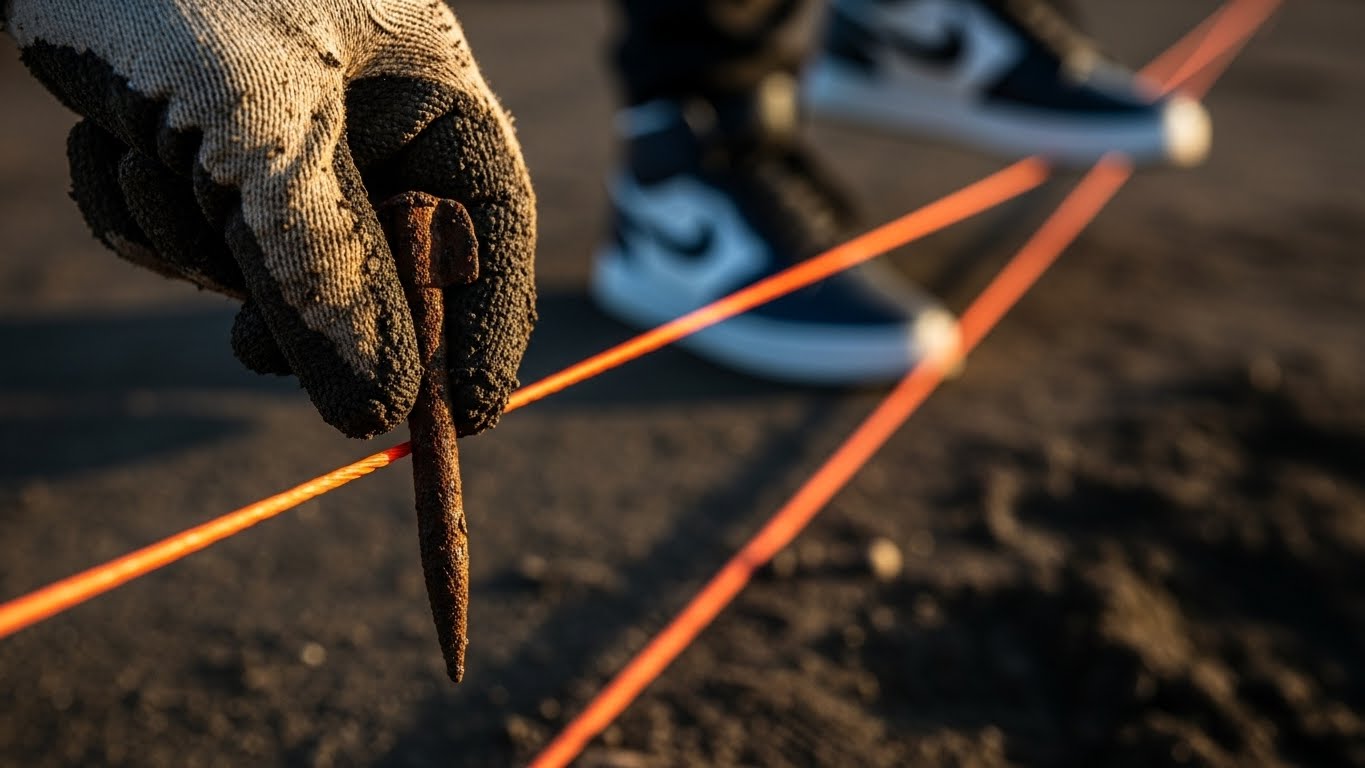
The construction crew hadn’t arrived for the day yet, but their prep work was visible. Wooden stakes with neon orange flags were driven into the ground. A string line was pulled taut between them, marking where the post holes would be dug.
Frank stopped at the line. He stared down at the grass. He closed his eyes, took a breath, and looked again.
The string was wrong.
It wasn’t off by feet. It was off by inches. Four inches, to be exact. The line cut into Frank’s property, slicing off a strip of his beloved turf along the entire eighty-foot length of the yard.
To a man like David, four inches was a rounding error. To Frank, it was an invasion. It was land he had paid for. Land he had taxed. Land he had watered and loved.
“Hey! Morning, neighbor!”
Frank looked up toward the enemy’s deck. David was there, wearing a silk robe and holding a green smoothie. He looked down at Frank like a lord addressing a serf.
“Mr. Thorne,” Frank said, his voice gravelly.
“David, please. I told you, call me David.” He flashed a bright, white smile. “Excited for the fence? It’s going to look sleek. Total privacy.”
“Your string is wrong,” Frank said, skipping the pleasantries. He pointed a finger at the neon line.
David blinked behind his designer sunglasses. “Excuse me?”
“The survey line. It’s four inches onto my property. You’re encroaching.”
David laughed, a sound that grated on Frank’s nerves like sandpaper. “Oh, Frank. Don’t be that guy. The contractors used GPS. It’s digital. It’s accurate. Besides, what is it? A sliver of dirt? I’m doing you a favor. This fence is costing me ten grand. You get a free upgrade.”
“I don’t want your upgrade. I want my property,” Frank said, his jaw tightening. “I have the original survey from 1984. There’s an iron pin buried right here.” He tapped the ground with his boot near the rhododendron bush. “Your string is on the wrong side of it.”
David sighed, the smile vanishing. “Look, Frank. The concrete truck is coming at 8:00 AM. I’m not halting construction because you think you know better than modern satellites. It’s four inches. Let it go.”
“Let it go?” Frank felt the heat rising up his neck. “If I took four inches of your Tesla, would you let it go? If I shaved four inches off your deck?”
“You’re being ridiculous,” David snapped. “And frankly, your sprinkler heads spray my driveway every morning. So let’s call it even.”
David turned his back and walked inside, sliding the glass door shut.
Frank stood alone in the yard. He felt a tremor in his hands—not from age, but from rage. It was the dismissal that stung. The arrogance. The assumption that because Frank was old and drove a ten-year-old Ford, he didn’t matter.
Frank walked to his garage. He bypassed the rake and the leaf blower. He went to the corner and picked up his heavy spade shovel. He also grabbed a metal detector he used for finding old coins at the beach.
He went back to the rhododendron bush. He scanned the ground. Beep… Beep… BEEEEEEP.
He dug. Carefully. Deliberately.
Six inches down, he hit metal. He cleared away the soil until the rusted cap of the iron survey pin was visible. . It was exactly where he knew it was.
The orange string—David’s string—was four inches on Frank’s side of the pin.
Frank grabbed a lawn chair. He unfolded it and placed it directly over the hole he had dug, right in the path of the string line. He sat down, crossed his arms, and waited.
When the contractors arrived, the foreman—a burly guy named Mike—took one look at Frank and the exposed pin, then looked up at David’s house.
“We got a problem, boss!” Mike yelled.
David stormed out, dressed in a suit now. “What is it? Why aren’t you digging?”
“Old timer found the pin,” Mike said, gesturing to Frank. “If that pin is real, your line is off. We can’t pour concrete on a disputed line. It’s a lawsuit waiting to happen.”
David marched down the stairs, his face turning a shade of red that matched the flags. “Frank, move the chair. You are obstructing work I paid for.”
“I’m sitting on my land,” Frank said, not moving a muscle. “You pour concrete here, you’re trespassing. And I’ll sue you for the cost of removal plus damages.”
“I’ll call the cops!” David screamed, losing his composure.
“Call ’em,” Frank said. “I’ll wait.”
The police arrived twenty minutes later. They were young, bored, and clearly didn’t want to be mediating a dispute over four inches of grass. But when Frank showed them the pin and the deed he had retrieved from his safe, they shrugged.
“It’s a civil matter, sir,” the officer told David. “But we can’t force him to move off what looks like his property. You need to get a new survey done.”
David looked like he was going to explode. He dismissed the crew, screaming about “incompetence” and “billing hours.”
As the police cars pulled away, David walked up to the property line. He leaned in close to Frank.
“You think this is a win, old man?” David hissed. “You have no idea who I am. I have lawyers who eat people like you for breakfast. And while they bury you in paperwork, I’m going to make living here hell.”
Frank looked him in the eye. “I’ve been through hell, son. This is just a lawn.”
David sneered and walked away. But Frank knew the truth. The battle for the grass was over, but the war for the neighborhood had just begun.
Chapter 2: Chemical Warfare
The escalation was immediate and brutal.
That very night, Frank and Martha were sitting in the living room watching Wheel of Fortune. Martha was having a bad day; she kept asking where their son was, forgetting he had moved to Seattle ten years ago. Frank was holding her hand, trying to soothe her.
Suddenly, the room turned white.
“Frank! What’s happening?” Martha cried, shielding her eyes.
Frank went to the window. David had installed motion-activated security floodlights on the side of his house. Two industrial-grade LED arrays were pointed not at David’s yard, but directly at Frank’s living room and bedroom windows.
“That son of a…” Frank muttered.
He went to the back door and shouted, “Turn off the lights!”
The only response was the deep, rhythmic thrum of bass. Thump. Thump. Thump.
David had set up outdoor speakers. He was playing electronic dance music. It wasn’t loud enough to violate the municipal noise ordinance—Frank knew David had checked—but the low frequency was maddening. It vibrated the pictures on the walls. It rattled the teacups.
“I can’t sleep with that light, Frank,” Martha wept, confused and scared.
Frank spent the next hour taping cardboard over the bedroom windows. He played classical music on his own stereo to drown out the bass. He held Martha until she finally drifted off, aided by her medication.
Frank didn’t sleep. He sat in the dark kitchen, watching the floodlights cut through the cracks in the cardboard.
The next morning, Frank found the trash. Fast food wrappers, soda cups, and greasy bags were scattered across his front lawn. It looked like a garbage truck had exploded.
He knew David hadn’t thrown it there himself. He was too smart. He had probably paid some neighborhood kid to do it, or used a leaf blower to push his own trash over the line.
Frank cleaned it up silently. He didn’t yell. He didn’t give David the satisfaction. He started keeping a logbook. June 12: Floodlights, 8 PM to 6 AM. June 13: Trash on lawn. June 14: Bass music, low frequency.
He was building a case for the Homeowners Association, though he knew it was likely futile. The HOA president was terrified of litigation.
But then, David crossed a line that no amount of paperwork could fix.
It was a Tuesday. Frank went out to the side yard to check on his roses. These weren’t just any flowers. They were hybrid tea roses, a deep, velvety red called “Mr. Lincoln.” He had planted them for Martha on their 30th anniversary. They were her pride and joy. Even on her worst days, the smell of those roses made her smile.
They were dead. .
The leaves were curled and brown. The stems were black and slimy. The petals had fallen in a heap of rot.
Frank knelt down, his knees cracking. The smell hit him instantly—acrid, chemical, sweet. Glyphosate. Industrial-strength herbicide.
Someone had sprayed them directly.
Frank stood up, his vision blurring with red rage. He looked over the fence line. David was washing his Tesla in the driveway, whistling.
Frank walked over. “You killed them.”
David looked up, feigning innocence. “Killed what, Frank?”
“The roses. You sprayed them.”
“Whoa, easy there. Accusations?” David chuckled. “Maybe you just used the wrong fertilizer. Or maybe they just got old. Things die, Frank. It happens.”
“I smell the chemical,” Frank said, his voice shaking.
“Prove it,” David whispered, his face changing instantly from mockery to menace. “You have no cameras back there. It’s your word against mine. And who are the cops going to believe? The guy with the clean record, or the angry old vet who threatens construction workers with a shovel?”
Frank stared at him. David was right. He needed proof.
“You’re a small man, David,” Frank said.
“And you’re a dinosaur,” David retorted. “Go extinct already.”
Frank walked away. He went inside and told Martha the aphids had gotten the roses. She cried for an hour.
That night, Frank went to the basement. He unlocked his gun safe. He bypassed the Remington 870 and the Colt .45. Instead, he reached for a small, camouflage box. A high-end trail camera he used for hunting.
He waited until 2:00 AM. Dressed in dark clothes, moving with a stealth he hadn’t used since 1969, he crept into the backyard. He climbed the old oak tree that straddled the property line. He mounted the camera high up, hidden among the leaves, angled directly down at the fence line and David’s yard.
“Smile, you son of a bitch,” Frank whispered.
For a week, the camera caught nothing but squirrels and the wind. David was careful. He did his damage in the blind spots.
But then came the day that broke Frank Miller.
He had a dog named Buster. . Buster was a Golden Retriever mix, ten years old, with a face white with age. He moved slowly, his hips arthritic, but his tail still wagged with the rhythm of a metronome whenever Frank walked in the room. Buster was the child they never had in their later years.
On a humid Thursday afternoon, Frank let Buster out into the backyard. He watched from the kitchen window while drying a plate.
Buster sniffed around the perimeter. He stopped near the disputed property line—the spot where the grass was still scarred from the construction markers.
Buster sniffed intensely at a patch of tall clover. He licked something. Then he swallowed.
“Buster! No!” Frank yelled, tapping on the glass.
The dog looked up, guilty, and trotted back to the house.
Frank let him in. “What did you find, boy? Dead bird?”
Buster just nudged Frank’s hand for a treat.
Two hours later, Frank was reading in his armchair when he heard it. A sound that rips the soul of any dog owner in half. A high-pitched, confused yelp, followed by the sound of claws scrambling for traction on the hardwood.
Frank ran to the kitchen.
Buster was on his side. His legs were paddling frantically, running a race that wasn’t there. Foam was frothing at his mouth. His eyes were rolled back, showing only the whites.
“Martha! Call the vet! NOW!” Frank roared.
He dropped to his knees, ignoring the pain in his own joints. He grabbed a towel and put it under Buster’s head to stop him from banging it against the floor.
“It’s okay, buddy. It’s okay. I got you,” Frank choked out.
Buster’s body went rigid, then limp, then rigid again.
They drove to the emergency vet doing eighty miles an hour. Frank carried the eighty-pound dog into the clinic in his arms, his shirt stained with drool and urine.
They waited for three hours. The longest three hours of Frank’s life.
When the vet came out, her face told the story.
“Mr. Miller… I’m so sorry.”
“Is he…?”
“He’s gone. The toxins shut down his kidneys and caused massive neurological failure. His heart gave out.”
“Toxins?” Frank whispered.
“We found high concentrations of ethylene glycol in his stomach,” the vet said softly. “Antifreeze. And… traces of raw ground beef.”
Frank felt the room spin. “Antifreeze and beef?”
“It’s a bait ball,” the vet said, looking down at her clipboard. “Dogs love the sweet taste of antifreeze. When you mix it with meat… they don’t stand a chance.”
Frank didn’t scream. He didn’t cry. He felt a cold, hard stone settle in the center of his chest.
“He was poisoned,” Frank said.
“It appears intentional,” the vet confirmed.
Frank drove Martha home in silence. She was in shock, clutching Buster’s collar. He put her to bed.
Then, he went to the computer. He pulled the SD card from the trail camera in the oak tree.
He scanned the footage. 10:00 AM. 11:00 AM.
At 11:42 AM, ten minutes before Buster went outside.
The camera caught movement. Not a face—David was too smart for that. He had stayed behind the corner of his house. But an arm reached out. A manicured hand. On the wrist was a distinctive, heavy gold watch. A Rolex Submariner.
The hand dropped a small, round object into the clover on Frank’s side of the line.
Frank paused the video. He zoomed in. The sunlight glinted off the watch.
He knew that watch. He had seen David check it a dozen times while bragging about his time is money.
Frank sat back in his chair. The sadness was gone. The grief had been burned away by a white-hot clarity.
The police couldn’t help him with the fence. They wouldn’t help him with the roses. And without a face on the video, they would say the evidence was circumstantial. They would say maybe someone else wore a Rolex.
David thought he was untouchable. He thought the world was a transaction.
Frank stood up and walked to the garage. He looked at his reflection in the dusty window. He didn’t see an old man. He saw a soldier.
He picked up the shovel. He picked up a pickaxe.
He wasn’t going to call the cops.
“David,” Frank whispered to the empty garage. “You wanted to dig? Let’s dig.”
Chapter 3: Ghosts in the Machine
The funeral was small. Just Frank, Martha, and the hole in the earth.
He buried Buster in the far corner of the yard, beneath the sprawling canopy of the oak tree—the same tree that had held the camera, the silent witness to his murder. Frank didn’t say a prayer. He just patted the fresh dirt with his spade, the soil dark and rich against the manicured green of his lawn.
Martha wept softly, clutching Buster’s favorite chew toy. “What are we going to do, Frank? The house is so quiet.”
“We’re going to survive, Martha,” Frank said, helping her up. “We always do.”
He took her inside, made her lunch, and waited until she was settled in her rocking chair. Then, Frank went to work.
He didn’t storm next door. He didn’t slash tires. That was amateur hour. In the jungle, you didn’t run screaming at the enemy. You learned their habits. You found the weakness in their perimeter. You waited until the fear did half the work for you.
Frank turned the guest bedroom—the one facing David’s house—into an observation post. He set up a tripod with a spotting scope. He sat there for two days, motionless, drinking black coffee and taking notes.
07:00 AM: David wakes up. Espresso machine runs. 07:30 AM: David goes to the backyard, talks on the phone. Pace: frantic. 08:15 AM: Cleaners arrive. 06:00 PM: David returns. Usually alone. 10:00 PM: Lights out on the main floor. Bedroom light stays on until 1:00 AM. Blue light flicker—TV or phone.
Frank learned something important: David was afraid of the dark.
Every night, before bed, David checked the locks on his sliding glass doors three times. He checked the motion sensor lights. He was paranoid. People who made their money stepping on others usually were; they always expected the boot to come down on them eventually.
On the third night, Frank began the psychological operations.
He waited until 2:30 AM. The neighborhood was a tomb. The only light was the harsh LED glare from David’s security floods, which were still scorching Frank’s siding.
Frank slipped out the back door. He was wearing his old fatigue jacket, the one that still smelled faintly of damp canvas and cordite. He crawled on his belly through the tall ornamental grass, staying below the sensor line of the floodlights.
He reached the property line. He didn’t cross it. Not yet.
He picked up a handful of gravel from his landscaping. He tossed a single pebble.
Clack.
It hit the glass of David’s sliding door.
Frank froze.
Inside, the blue light of the TV went off. A shadow moved to the window. David peered out, squinting into the darkness.
Frank didn’t move. He was a stone. He was a shadow.
David watched for a minute, then turned away, likely dismissing it as a bug.
Frank waited five minutes. He threw another pebble.
Clack.
This time, David ripped the curtains open. He turned on the outside deck lights. He stepped out, looking nervous.
“Hello? Is someone there?” David called out. His voice trembled slightly.
Frank lay in the grass, ten feet away, hidden by the rhododendrons. He could hear David’s breathing. It was shallow. Fast.
“Frank? Is that you?” David yelled. “I’m calling the cops if you’re out here!”
Frank smiled in the dark. Call them. Tell them you’re scared of a rock.
David stood there for five minutes, shivering in the night air, scanning the yard. He saw nothing but the wind moving the trees. Finally, he went inside and locked the door aggressively.
Phase one was complete. The seed of paranoia was planted.
The next day, Frank escalated.
He went to the hardware store three towns over. He bought a high-powered directional speaker—the kind used for bird calling. He hooked it up to his laptop in the observation room.
He downloaded a sound file: the low, guttural growl of a large dog.
That night, at 3:00 AM, Frank aimed the speaker out the window at David’s bedroom. He played the sound.
Grrr… rrrr…
It wasn’t loud. It was just loud enough to be heard through the glass. Subliminal.
The lights in David’s house snapped on instantly.
Frank watched through the scope. David was pacing his bedroom, phone in hand. He looked out the window. He looked terrified. He knew Buster was dead. He knew he had killed him. Now, the ghost was back.
Frank stopped the sound. Silence returned to Oakwood Estates.
David didn’t sleep that night. Frank watched him pace until sunrise.
By Friday, David looked like a wreck. He was wearing sunglasses to hide the dark circles under his eyes. He yelled at his cleaning lady for moving a vase. He was unraveling.
He walked to the fence line when he saw Frank gardening.
“You’re doing something,” David accused, his voice raspy. “I don’t know how, but you’re doing something.”
Frank leaned on his hoe. He looked calm, rested. “Just tending the soil, David. We reap what we sow.”
“I hear things,” David whispered, looking around wildly. “At night.”
“Guilt is a noisy neighbor,” Frank said.
“Screw you,” David spat. “I’m getting cameras. Everywhere. If you step one foot on my land, I’ll have you arrested.”
“You do that,” Frank said. “But cameras only see what’s in the light.”
David stormed off.
Frank watched him go. The man was fraying at the edges. He was tired, scared, and angry. That was exactly how Frank wanted him.
It was time for the harvest.
Frank went to the garage. He looked at the weather report. A storm front was moving in from the west. Heavy rain. Thunder.
“Perfect,” Frank muttered.
He took the shovel off the wall. He sharpened the edge with a metal file until it sang. Shhhk. Shhhk.
Tonight, the property line dispute would be settled. Tonight, the “Four Inch War” would end.
Chapter 4: The Longest Night
The storm hit at 1:00 AM. It was a violent, Midwestern thrasher—sheets of rain lashing against the siding, thunder shaking the foundation. The wind howled through the trees like a banshee.
It was the kind of noise that covered everything. A scream would sound like the wind. A breaking window would sound like thunder.
Frank dressed in full black. He wore his combat boots, laced tight. He put on leather gloves. He took the shovel.
He went to the basement and flipped the main breaker for his own house. Martha was safe asleep with her earplugs in; she wouldn’t notice the power outage.
His house went dark.
Then, he went outside. The rain soaked him instantly, plastering his gray hair to his skull. The cold felt good. It made him feel alive.
He moved to the utility cluster between the two houses. In these modern subdivisions, the external breaker boxes were often unlocked, accessible for the fire department.
Frank found David’s box. He opened the gray metal panel.
He didn’t just flip the switch. He pulled the main fuse block.
Instantly, David’s house died. The floodlights cut out. The Tesla charger stopped humming. The blue glow of the TV vanished. The house was a black void against the stormy sky.
Frank moved. He ran to the center of David’s backyard, directly into the mud. He planted his feet. He waited.
Inside the house, he saw the flashlight beam.
David was awake. Of course he was awake.
The beam swung wildly around the living room. Then, it moved to the back door.
David opened the sliding door. “Who’s there? The power is out!”
He stepped out onto the deck, the flashlight cutting a cone through the rain. He was wearing silk pajamas and slippers. He looked pathetic.
“Is anyone there?” David screamed over the thunder.
Frank stepped into the beam of light.
He stood twenty feet away, the shovel resting on his shoulder, rain dripping from the brim of his hat. He didn’t look like a neighbor. He looked like the Reaper.
David screamed. He dropped the flashlight. It rolled on the deck, the beam spinning dizzily.
“Frank? What the hell are you doing?” David shrieked. “Get off my property!”
“Come down here, David,” Frank said. His voice wasn’t a shout, but it projected with a command authority that cut through the storm.
“I’m calling the police! I have a gun!” David lied. His voice cracked.
“The lines are down,” Frank bluffed. “Cell towers are out. It’s just us.”
Frank took a step forward. He slammed the shovel blade into the mud. THWACK.
“You wanted this dirt,” Frank said. “You killed for this dirt. Come claim it.”
David was paralyzed. He was soft. He had never been in a fight in his life. He bullied people with lawyers and money. He had no idea what to do when the threat was physical and immediate.
“Please,” David whimpered. “I’ll pay you. How much for the dog? Five grand? Ten?”
Frank moved.
He covered the distance with a speed that defied his age. He vaulted the low steps of the deck.
David tried to run back inside, but he slipped on the wet wood. He went down hard.
Before he could scramble up, Frank was there. He planted a boot on David’s chest, pinning him to the deck.
Frank leaned down, his face inches from David’s. The lightning flashed, illuminating Frank’s eyes. They were dead calm.
“You think you can buy a life?” Frank whispered. “You think you can poison a soul and write a check?”
“I’m sorry! I’m sorry!” David sobbed, rain and snot mixing on his face. “I didn’t mean to kill him! I just wanted him to stop barking! I swear!”
“Get up,” Frank commanded. He stepped back.
David scrambled to his feet, shaking so hard his teeth chattered. “What are you going to do?”
Frank pointed to the backyard. To the spot near the property line where the poison had been placed.
“We have work to do.”
“What?”
Frank tossed a second shovel—one he had brought from his garage—at David’s feet.
“Pick it up.”
“Frank, please…”
Frank raised his own shovel, holding it like a baseball bat. “Pick. It. Up.”
Terrified, David grabbed the handle.
“Walk,” Frank said.
They marched into the rain. The mud sucked at their shoes. They reached the spot where the survey string had been. The ground was soft and wet.
“Dig,” Frank said.
“Dig what?” David cried.
“A hole. A big one.”
“Are you… are you going to bury me?” David’s voice went up an octave. “Oh god, don’t kill me.”
“Dig,” Frank roared, a sound of pure fury that silenced the thunder.
David dug. He struck the wet earth. He lifted a scoop of mud. He threw it aside.
“Faster,” Frank ordered, standing over him like a drill instructor.
David dug. His silk pajamas were ruined. His expensive slippers were lost in the muck. His hands, soft and uncalloused, began to blister within minutes.
He cried the whole time. He begged. He bargained.
“I can give you the house! Take the Tesla!”
“Dirt,” Frank said. “Just dirt. Keep digging.”
The hole got deeper. Shin deep. Knee deep.
David was exhausted. He fell to his knees in the mud, gasping for air. “I can’t… I can’t do it…”
“Buster couldn’t breathe either,” Frank said coldly. “He seized on the floor while his organs shut down. You think you’re tired? Get up.”
Frank poked him with the shovel handle.
David got up. He kept digging.
He dug for an hour. The storm raged around them. The hole was now waist deep. David was a broken man. He was covered in filth, shivering uncontrollably, his spirit completely crushed.
He looked up at Frank from the pit. “Please. I’ll do anything. Just let me go.”
Frank looked down at him. He saw the fear. He saw the realization that money meant nothing in the dark. He saw a man who had finally been touched by consequence.
Frank lowered his shovel.
“That’s enough,” Frank said quietly.
David slumped against the wall of the hole, weeping.
Frank reached into his pocket. He pulled out a small, plastic bag. Inside was the receipt from the vet. The bill for the cremation. And a photo of Buster.
He dropped the bag into the hole next to David.
“You buried my happiness,” Frank said. “Now you know what it feels like to be in the hole.”
Frank turned around. “Fill it back in.”
“What?”
“Fill it in. Cover it up. And while you do it, you think about every time you look at this yard. You think about what’s buried here.”
David stared at him, bewildered.
“And David?” Frank paused. “If you ever cross that line again… if you ever touch my wife, or my house, or even look at me wrong… I won’t make you dig the hole next time. I’ll just put you in it.”
Frank walked away through the rain, back to his dark house.
He didn’t look back. He heard the wet slap of mud as David began to frantically fill the grave he had dug for himself.
Frank went inside. He stripped off his wet clothes. He dried his hair. He sat in the chair next to Martha’s bed.
His hands were shaking now. The adrenaline was fading. He felt old. He felt tired.
He had won the battle. But looking at his trembling hands, Frank wondered if he had lost something else. The soldier in him was satisfied, but the man in him was sad.
But then he looked at the window, where the rain was washing away the sins of the night.
The floodlights were still out. It was dark. It was quiet.
For the first time in months, Frank closed his eyes and slept.
Chapter 5: The Exodus
The sun rose on Oakwood Estates with a deceptive innocence. The storm had scrubbed the sky clean, leaving a brilliant, cloudless blue. Birds chirped. Sprinklers hissed. It was the picture of suburban paradise.
Except at the Thorne residence.
At 7:00 AM, a moving truck backed into David’s driveway. It wasn’t a planned move. There were no boxes packed. It was an emergency extraction.
Frank stood on his porch, sipping his coffee. He watched as a team of movers frantically threw designer furniture into the back of the truck. They weren’t wrapping things in bubble wrap. They were just tossing them in.
David was there, pacing by his Tesla. He wore dark sunglasses and a hoodie, despite the heat. He kept looking over his shoulder at Frank’s house. When he saw Frank standing on the porch, he flinched physically, as if he’d been struck. He practically dove into the driver’s seat of his car.
Frank didn’t wave. He didn’t smile. He just took a sip of coffee.
By noon, the house was empty. A “For Sale” sign was hammered into the lawn—staying well clear of the disputed property line.
The rumors started by dinner time. The neighborhood gossip mill was faster than the internet.
“I heard he had a breakdown,” Mrs. Higgins down the street told Frank over the fence. “Said he couldn’t handle the ‘energy’ of the house. Said it was haunted.”
“Is that so?” Frank asked, his face a mask of polite disinterest.
“He told the realtor the neighbor was a ‘psycho,'” Mrs. Higgins whispered, leaning in. “But honestly, Frank? We all know David was the problem. Good riddance to bad rubbish, I say.”
Frank nodded slowly. “He just wasn’t cut out for the quiet life, I suppose.”
David Thorne had arrived like a lion, roaring and claiming territory. He left like a beaten dog, tail tucked, running from a shadow he couldn’t fight.
The fence holes were filled in by the realtors the next day. The grass was re-sodded. It was as if David had never existed.
But Frank knew. The patch of earth where he had made David dig was slightly darker than the rest. A scar on the land. A reminder.
Chapter 6: The Silence
Peace returned to the Kingdom of Green, but it was a heavy peace.
Frank tried to settle back into his routine. Coffee. Inspection. Mowing. But the rhythm was off.
When he walked the perimeter, he instinctively listened for the jingle-jangle of Buster’s collar. When he sat in his chair in the evening, his hand would drift down to pet a head that wasn’t there.
The silence in the house was deafening. Martha was getting worse. Without the dog to ground her, she drifted further into her dementia. She would ask Frank, “Where is the nice boy? Where is Buster?”
“He’s playing outside, Martha,” Frank would lie, his heart breaking every time. “He’s chasing squirrels.”
Frank realized that his victory was hollow. He had driven the enemy away, he had defended his land, but the cost had been too high. The toxicity of the feud had leached into the soil of his life.
He spent hours in the garage, cleaning his tools. He oiled the shovel. He wiped down the handle. He looked at the metal, remembering the feeling of it hitting the mud, the sound of David’s weeping.
He wasn’t proud of what he had done. He knew, deep down, that terrorizing a man—even a bad man—was a sin. But Frank was old school. He believed in an eye for an eye. And he had taken his pound of flesh.
Weeks turned into months. The “For Sale” sign faded in the sun. The market had cooled, and the expensive, overpriced house next door sat empty. It stood like a mausoleum to greed.
Frank kept the lawn next door mowed. The realtors didn’t ask him to, and they certainly didn’t pay him. He just did it. He couldn’t stand the sight of weeds, even on enemy territory. He mowed right up to the line, and then kept going, blending the two yards into one seamless ocean of green.
It was his way of conquering it completely.
Chapter 7: The Buried Truth
Six months later, the house finally sold.
A young couple, the Petersons, moved in. They were nice. They had a baby on the way. They drove a Honda. They brought Frank a pie on the first day.
“We love the yard,” the husband, Mark, said. “We were worried about the property line, though. The disclosure said there was a dispute with the previous owner?”
Frank leaned on his rake, looking at the young man. “No dispute. He just got confused.”
“Right,” Mark nodded. “Well, we’re going to put up a small fence for the baby, eventually. We hired a surveyor just to be safe. He’s coming tomorrow. I hope that’s okay?”
Frank felt a cold spike of adrenaline in his gut. A surveyor.
“That’s fine,” Frank said, his voice steady. “Smart to be sure.”
That night, Frank didn’t sleep.
At 2:00 AM, he was out in the yard again. The moon was sliver-thin. He went to the rhododendron bush.
He had a secret. A secret he had kept for forty years. A secret that David had almost exposed.
Frank knelt down and dug up the iron pin—the one he had showed the police, the one he had made David kneel before.
He pulled it out of the ground. It came up easily.
It was a real survey pin, yes. But it wasn’t the original location.
Back in 1984, when Frank had first moved in, he had realized the true property line actually cut right through the middle of the old oak tree. The tree he loved. The tree he wanted to build a swing on for his son.
So, one night in 1984, young Frank Miller had dug up the pin and moved it. He moved it four feet—not four inches—into the empty lot next door. He stole four feet of land so he could keep the tree.
For forty years, he had lived on a lie.
David Thorne, with his GPS and his lasers, had been right. The digital survey had been accurate. The “line” Frank had defended with such savage fury, the line he had justified poisoning a man’s mind over… it was a fraud.
Frank held the rusted pin in his hand. He looked at the spot where Buster was buried. Buster was actually buried on what was technically the neighbor’s land.
Frank looked at the sleeping house of the new neighbors. They were good people. They didn’t deserve a war.
Frank took his shovel. He went to the true property line—four feet closer to his own house. He dug a hole. He hammered the pin down deep, burying it under layers of clay where it belonged.
He moved the line back. He surrendered the territory.
He would lose four feet of his manicured grass. He would lose the claim to the oak tree.
But he had to do it. Not because of the law. But because he couldn’t start a war with innocent people. David had been a monster, so Frank had become a monster to fight him. But these kids? They were just neighbors.
Frank smoothed the dirt over the moved pin. He patted it down.
He had won the war against David, but he had finally made peace with the truth.
Chapter 8: The Watchman
The surveyor came the next day. He set up his tripod. He used his lasers.
Frank stood on the porch, holding his breath.
“Looks good,” the surveyor called out to Mark. “The line is right here.” He pointed to the spot where Frank had moved the pin the night before.
“Oh, wow,” Mark said, looking at the oak tree. “So the tree is… mostly on your side, Frank?”
“Looks like it,” Frank lied. “Tell you what. You guys can use it. Put a swing up for the kid. I don’t mind.”
Mark smiled. “Thanks, Frank. You’re a good neighbor.”
Frank nodded and turned back to his house.
He walked into the living room. Martha was sitting by the window, looking out at the yard.
“Look, Frank,” she whispered, pointing.
Frank looked.
A stray dog was trotting across the lawn. It wasn’t Buster—it was a scruffy little terrier mix. It stopped at the oak tree. It sniffed the spot where Buster was buried. It wagged its tail, then peed on the trunk.
Martha laughed. It was the first time she had laughed in months.
“He likes our tree,” she said.
“Yeah, Martha,” Frank smiled, tears pricking his eyes. “It’s a good tree.”
Frank went to the kitchen and poured two cups of tea. He felt lighter. The anger that had fueled him for so long was gone, replaced by a quiet resignation.
He was an old man. He had defended his kingdom. He had buried his enemies. And now, he had redrawn the borders.
He took the tea to Martha. He sat beside her, holding her hand.
Outside, the sun climbed high over Oakwood Estates. The grass was green. The lines were straight. And for the first time in a long time, the neighborhood was truly quiet.
Frank Miller closed his eyes and listened to the silence. It didn’t sound like a battlefield anymore. It sounded like home.
The End.