The Mayor Threw a Poor Boy’s Flag in the Dirt, Laughing at His “Trash” Heritage—Until a Four-Star General Walked In and Dropped to His Knees
Chapter 1: The Weight of Silence
The rain in Oakhaven, Virginia, always seemed to fall harder on the wrong side of the tracks. It was a cold, November drizzle that seeped into the marrow of your bones, the kind that turned the dirt roads into brown slurry and made the tin roof of Silas’s cabin rattle like a cage full of marbles.
Inside that cabin, ten-year-old Liam sat at a wobbly pine table, his small hands smoothing out the wrinkles of a plastic grocery bag. Inside the bag was his life—or at least, the only piece of it that mattered for tomorrow.
“Do you think it’s enough, Uncle Silas?” Liam asked, his voice barely rising above the drumming rain.
Silas, a man carved from granite and weathered by seasons of unspoken grief, didn’t answer. He couldn’t. The town knew Silas as “Old Man Mute,” the limping janitor at the VA hospital who cleaned bedpans and mopped floors with a rhythmic, ghostly efficiency. He hadn’t spoken a word in Oakhaven since the day he arrived six years ago, holding a four-year-old Liam by the hand.
Silas turned from the wood stove, where a pot of thin stew was bubbling. He walked over to the boy, his left leg dragging slightly—a hitch in his step that the local kids mocked when they thought he couldn’t hear. He looked down at the object Liam had pulled from the plastic bag.
It was an American flag. But it wasn’t the crisp, nylon flags that flew on the porches of the mansions on Elm Street. This one was cotton, heavy and coarse. It was stained with something dark that wouldn’t wash out, and the edges were frayed, the white stripes yellowed by time and desert dust. It smelled of old smoke and sacrifice.
Silas placed a large, calloused hand on Liam’s shoulder and squeezed. It was a language they had developed over the years: one squeeze for yes, two for no, a long grip for I’m here.
“Brody Sterling is bringing his great-grandfather’s sword,” Liam whispered, looking down at the tattered cloth. “He says it killed ten men in the Civil War. And Sarah is bringing a medal her dad got in the Gulf. I just have… this.”
Silas’s eyes, usually dull and guarded, flashed with a sudden, intense blue fire. He reached down, took the flag, and folded it with a precision that was almost religious. Triangle over triangle, tight corners, no red showing. He placed it back in the bag and patted Liam’s cheek. It is enough, his eyes said.
The next morning, Oakhaven Elementary was buzzing with the self-important energy that only small towns can generate during “Heritage Week.” The hallways were plastered with red, white, and blue construction paper.
Liam walked into Mrs. Gable’s fifth-grade classroom wearing his best clothes: a pair of corduroys that were two inches too short at the ankle and a plaid button-down shirt that had belonged to a boy much larger than him. He kept his head down, clutching the plastic bag to his chest.
“Well, if it isn’t the State Ward,” a voice sneered from the back of the room.
It was Brody Sterling. The son of Mayor Sterling. Brody was a carbon copy of his father—soft hands, expensive clothes, and a smile that didn’t reach his eyes. He was wearing a blazer that cost more than Silas made in a month.
“Leave him alone, Brody,” whispered a girl in the front row, though she didn’t look up from her desk.
“I’m just saying,” Brody laughed, leaning back in his chair. “It’s Heritage Week. You need a family to have a heritage, don’t you? Liam just has a mute janitor and a government check.”
Mrs. Gable clapped her hands. “Settled down, class. Let’s begin. Brody, since you’re so eager, why don’t you go first?”
Brody marched to the front of the room, holding a velvet case. He opened it to reveal a pristine, polished cavalry saber. He told a rehearsed story about bravery and land ownership, about how the Sterlings had founded Oakhaven and how they were the “bedrock of this community.”
The class applauded. Mrs. Gable beamed. “Excellent, Brody. A true testament to our town’s lineage.”
One by one, the children went up. They held up black-and-white photos, medals in glass cases, and old letters. They spoke of grandfathers who were doctors, lawyers, and captains.
“Liam?” Mrs. Gable’s voice was tight, as if saying his name left a bad taste in her mouth. “Do you have something to share, or will you be observing today?”
Liam stood up. His legs felt like lead. He walked to the front of the room, the plastic bag crinkling loudly in the silence. He could feel thirty pairs of eyes boring into him.
He pulled out the folded flag. It looked small and dingy against the bright fluorescent lights of the classroom.
“This is… this is my family’s flag,” Liam stammered.
Brody let out a loud snort. “Did you find that in the dumpster behind the VA, Liam? It looks like a rag my maid uses to clean the floor.”
Laughter rippled through the room.
“It’s not a rag,” Liam said, his voice trembling but getting louder. “My uncle gave it to me. He keeps it in a special box.”
“Your uncle?” Mrs. Gable sighed, taking off her glasses. “Liam, honey, we talked about this. We want history, not… make-believe stories from your uncle. We know he has… difficulties.”
“He doesn’t have difficulties,” Liam said, clutching the flag tighter. “He’s silent. There’s a difference.”
Brody stood up and walked to the front, standing right next to Liam. He was a head taller. “My dad says your uncle is a drain on the taxpayer. He says people like you don’t have a history because you were thrown away. That flag is trash.”
Before Liam could react, Brody reached out and swatted the flag from Liam’s hands.
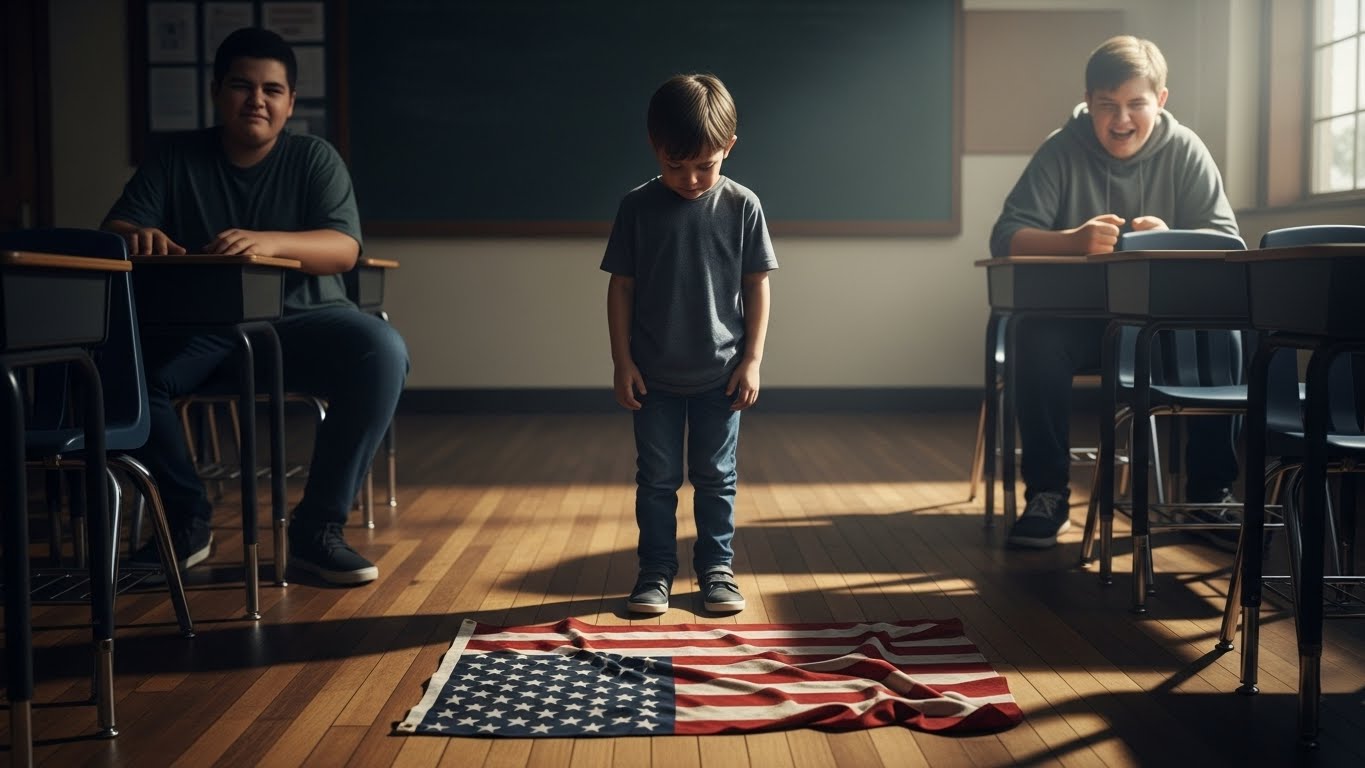
The heavy cotton bundle hit the floor with a thud. It unraveled slightly, the stained stars touching the dirty linoleum where hundreds of muddy shoes had walked that morning.
“Oops,” Brody smirked.
The room went dead silent. Liam stared at the flag. His heart hammered against his ribs like a trapped bird. He expected Mrs. Gable to yell. He expected her to send Brody to the principal’s office.
Mrs. Gable looked at the flag on the floor, then at Liam. She sighed, a sound of pure exhaustion. “Liam, pick that up. And please… maybe it’s best if you sit out the rest of the presentation. We don’t want to make the other children uncomfortable with dirty items.”
She didn’t reprimand Brody. She reprimanded the victim.
Liam dropped to his knees. He felt tears stinging his eyes, hot and humiliating. He touched the fabric of the flag. I’m sorry, he thought to the cloth. I’m so sorry.
He folded it clumsily, his hands shaking so hard he could barely align the edges. He shoved it back into the plastic bag.
“Go take your seat, Liam,” Mrs. Gable said, turning her back to write on the chalkboard.
Liam didn’t take his seat. He walked to the door.
“Liam? Where are you going?” Mrs. Gable called out.
Liam didn’t answer. He pushed the door open and walked out into the hallway, then out the front doors of the school, and into the pouring rain.
He walked all three miles home. The water soaked through his thin coat, chilling him, but the cold inside his chest was worse.
When he opened the door to the cabin, Silas was sitting in his armchair, mending a pair of work boots. He looked up, alarmed to see Liam home hours early, drenched and shivering.
Liam dropped the plastic bag on the table. He looked at his uncle, his face streaked with rain and tears.
“They said I was trash, Uncle Silas,” Liam choked out, his voice breaking into a sob. “Brody threw the flag on the ground. The teacher let him. They said I don’t have a heritage.”
Silas stood up. The boot fell from his hands. He limped over to the table and looked at the wet plastic bag.
“Why don’t we have a story?” Liam cried, hitting his small fist against his thigh. “Why are we nobodies?”
Silas looked at the boy. For a moment, the old man looked terrifying. His jaw set hard, the muscles in his neck cording like steel cables. The dullness in his eyes vanished, replaced by a cold, calculating storm—the look of a predator who has been woken from hibernation.
He reached out and pulled Liam into a hug. He held him tight, rocking him as the boy wept into his flannel shirt.
Then, Silas pulled away. He walked to the corner of the room, to a spot on the floor covered by a ragged rug. He kicked the rug aside. Beneath it were loose floorboards.
Liam sniffled, wiping his nose on his sleeve. “What are you doing?”
Silas pryed up the boards. Beneath the floor, resting in the cool darkness of the earth, was a black, waterproof trunk. It wasn’t a standard footlocker. It was high-grade military issue, sealed with heavy latches.
Silas hauled it up. He didn’t open it yet. He just ran his hand over the lid. Then he looked at Liam. He pointed to the calendar on the wall.
November 11th. Veterans Day.
The Mayor was hosting the biggest assembly in the town’s history in two days.
Silas turned back to Liam. He didn’t speak, but his posture had changed. The stoop in his shoulders was gone. He stood at a perfect, rigid position of attention.
The silence in the cabin was no longer empty. It was heavy. It was the silence before the thunder.
Chapter 2: The Invitation and the Shadow
The town of Oakhaven was drowning in bunting. Red, white, and blue streamers strangled every lamppost, and the town square was dominated by a large, veiled structure—the statue Mayor Sterling had commissioned of his own grandfather.
Mayor Sterling sat in his mahogany-paneled office, reviewing the guest list for the Veterans Day Assembly. He was a man who believed that image was the only currency that mattered. He smoothed his silk tie and picked up a sheet of paper.
“Mrs. Gable,” the Mayor said into his phone, leaning back in his leather chair. “I heard about the… disturbance in your class yesterday.”
“Yes, Mayor,” Mrs. Gable’s voice crackled on the line, obsequious and nervous. “The boy, Liam… he brought in some dirty laundry essentially. Brody was just trying to maintain the standards of the assignment.”
“Good. Good,” Sterling purred. “We can’t have the event tarnished. I’m looking at the seating chart. I want the front rows reserved for the Gold Star families, the council members, and the donors. I don’t want any… riff-raff visible to the cameras. The Governor might be sending a representative.”
“I understand, sir.”
“In fact,” Sterling picked up a pen, “I’m going to draft a letter to Liam’s guardian. That mute janitor. We need to ensure they understand their place. We can’t have that boy showing up in rags and causing a scene while I’m unveiling the statue.”
Later that afternoon, the mail carrier’s truck crunched up the gravel driveway of Silas’s cabin. He didn’t even get out; he just shoved an envelope into the rusted mailbox and drove off quickly, as if afraid of catching poverty.
Liam fetched the mail. He brought the thick, cream-colored envelope inside. It had the official gold seal of the Mayor’s office.
“Uncle Silas?” Liam called out.
Silas was in the bathroom, shaving. It was the first time in years he had shaved his gray, scraggly beard clean off. When he walked out, Liam gasped. Without the beard, Silas’s face was sharp, angular. There was a jagged scar running from his jawline down his neck, disappearing into his shirt. He looked younger, yet infinitely more dangerous.
Silas took the letter. He opened it with a knife. He read it standing by the window.
Dear Mr. Silas,
Regarding the upcoming Veterans Day Assembly and Statue Unveiling: While we appreciate all residents of Oakhaven, the committee feels it would be best if you and your nephew, Liam, declined attendance this year. The event is formal, broadcasted, and requires a certain level of decorum and attire that we feel would place an undue burden on your household.
Please consider this a request to stay home, for the comfort of the other guests and for Liam’s own sake. We wouldn’t want him to feel out of place among the town’s distinguished families.
Sincerely, Mayor Percival Sterling.
Silas read the letter once. He didn’t tear it up. He didn’t throw it in the fire. He folded it neatly and placed it in his pocket.
He looked at Liam. The boy was looking at his shoes, shame radiating off him in waves.
“We aren’t going, are we?” Liam whispered.
Silas walked over to the black trunk he had pulled from the floorboards. He knelt down and undid the latches. Snap. Snap. The sound was like a gunshot in the quiet room.
He lifted the lid.
Inside, there was no smell of mothballs. It smelled of oil and polished leather. Liam crept closer, peering over his uncle’s shoulder.
Inside the trunk was a uniform. It wasn’t the gray jumpsuit Silas wore to scrub floors at the VA. It was a Dress Blue uniform, dark and immaculate. The fabric was heavy, expensive.
But it was what lay on top of the uniform that made Liam’s breath hitch.
There were medals. Not just one or two. There were rows of them. Purple Hearts, Bronze Stars, Silver Stars. And in a separate velvet box, resting in the center, was a medal shaped like a star, hanging from a blue ribbon with white stars on it.
Silas took the uniform out. He handled it with the same reverence he had shown the tattered flag. He held up a white dress shirt, crisp and still in its plastic wrapping. It was small. Liam’s size.
Silas handed the shirt to Liam. He pointed to the bathroom. Put it on.
Liam looked at the shirt, then at his uncle’s intense eyes. “But the Mayor said…”
Silas shook his head. He placed a hand on his own chest, then pointed at Liam. Family.
He turned to the trunk again and pulled out a pair of high-gloss black boots. He sat down and began to polish them, even though they already shone like mirrors. The rhythmic swish-swish of the brush was hypnotic.
That night, the cabin felt different. It wasn’t a shack anymore; it was a barracks. Silas moved with a new energy. He ironed Liam’s oversized trousers until the pleats were razor-sharp. He trimmed Liam’s hair with a pair of scissors, giving him a clean, military-style cut.
The morning of the assembly arrived with a bright, mocking sun. The air was crisp.
Silas dressed in the bathroom. When he emerged, Liam didn’t recognize him. The mute janitor was gone. Standing there was a giant. The Dress Blues fit him perfectly, accentuating the width of his shoulders. The rows of ribbons on his chest were a colorful armor. The star around his neck—the blue ribbon—caught the light.
Silas didn’t limp. He marched to the door and held it open for Liam.
They didn’t have a car. They walked.
The walk to town was three miles. Usually, Liam dragged his feet. Today, he had to jog to keep up with Silas’s long, driving strides. Cars passed them on the road. Some slowed down, the drivers gawking at the tall man in the uniform and the boy in the white shirt, walking with a purpose that unsettled the dust on the road.
As they reached the edge of the school grounds, the parking lot was full of luxury SUVs and sedans. A news van was setting up a satellite dish.
A police officer, Deputy Miller, was guarding the entrance to the auditorium. He saw them approaching. He stepped forward, his hand resting on his belt, a smirk forming on his face.
“Now, Silas,” Deputy Miller said, stepping in their path. “You know the Mayor sent word. This is a private event for… constituents. We don’t want any trouble.”
Silas didn’t stop. He didn’t slow down. He walked straight up to Deputy Miller.
The Deputy was a big man, but Silas loomed over him. Silas looked down, his eyes like glacial ice. He didn’t speak. He just stared. The stare wasn’t aggressive; it was something worse. It was the stare of a man who had looked death in the face a thousand times and found it wanting.
Deputy Miller swallowed hard. His smirk faltered. He looked at the medals on Silas’s chest. He didn’t know what they all meant, but he knew enough to know that you didn’t buy that kind of hardware at a surplus store.
“I…” Miller stammered.
Silas stepped forward. Miller instinctively stepped back, clearing the path.
Silas put a hand on Liam’s back and guided him through the doors.
The auditorium was packed. Five hundred people. The air smelled of cheap perfume and floor wax. On the stage, Mayor Sterling was adjusting the microphone. Behind him, the veiled statue loomed. Brody sat in the front row, wearing a little suit, looking bored.
Silas didn’t go to the back. He walked down the center aisle.
The sound of his boots on the hardwood floor was distinct. Clack. Clack. Clack.
Heads turned. Whispers started like a brushfire. “Is that the janitor?” “Look at him.” “Is that a costume?”
Silas marched to the front. He saw an empty spot in the second row, right behind the Mayor’s family. A woman had her purse on the seat to save it. Silas stopped and looked at her. She immediately grabbed her purse and clutched it to her chest, shrinking away.
Silas sat down. He motioned for Liam to sit beside him.
Mayor Sterling looked down from the stage. He froze. His face went red. He glared at Deputy Miller by the door, who shrugged helplessly. Sterling cleared his throat loudly into the microphone.
“Welcome, citizens of Oakhaven,” Sterling boomed, regaining his composure. “Today, we honor the true heroes. The men of lineage. The men who built this town.”
He launched into his speech. It was a long, self-aggrandizing sermon about how his grandfather had served in the Navy (as a cook, though he omitted that part) and how “bloodlines matter.”
Every few minutes, Sterling would glare at Silas. Silas sat like a statue, staring straight ahead, unblinking.
“And now,” Sterling said, gesturing to the heavy velvet curtains behind him, “before we unveil the statue, I want to invite the children to come up and sing the anthem. But first, let us remember that patriotism is inherited. It is taught at the dinner tables of decent families.”
He looked directly at Liam. “It is not something found in the gutter.”
The crowd murmured. Some laughed nervously. Brody turned around and stuck his tongue out at Liam.
Liam shrank in his seat. He wanted to disappear. He felt Silas’s hand grip his knee. Stay.
Suddenly, the double doors at the back of the auditorium slammed open with a violence that made half the crowd jump.
Chapter 3: The General’s Salute
The sound echoed like a thunderclap. Every head in the room swiveled to the rear.
Standing in the doorway were four men. Two were Military Police, wearing white helmets and carrying sidearms. One was a Colonel.
And in the center, flanked by them, was a man with four silver stars on each shoulder. A Four-Star General.
The room gasped. This wasn’t a local reservist. This was the Pentagon walking into Oakhaven Elementary.
Mayor Sterling’s eyes went wide. He smiled, a greedy, hungry smile. He thought they were here for him. He thought his influence had finally reached Washington.
“Ladies and gentlemen!” Sterling shouted into the mic, his voice cracking with excitement. “It seems we have a surprise guest of honor! General! Please, come to the stage! What an honor for my statue!”
The General didn’t smile. He didn’t acknowledge the Mayor. He began to walk down the center aisle. The Military Police fell into step behind him. The sound of their boots was the only sound in the room.
The General was an older man with a face like tanned leather and eyes that saw everything. He walked past the local councilmen. He walked past the wealthy donors. He walked past the school principal.
He walked right past the stage.
Mayor Sterling was left with his hand extended, shaking in the air. “General? The stage is…”
The General stopped. He was standing in the second row. He turned and faced Silas and Liam.
The entire town held its breath.
The General stood at attention. He looked at Silas—the janitor, the mute, the outcast.
“Sergeant Major,” the General said. His voice was deep and carried without a microphone.
Silas stood up. He snapped a salute so sharp it vibrated in the air.
The General returned the salute. He held it for a long, silent ten seconds. Then he dropped his hand and turned to Liam.
To the shock of everyone in the room, the Four-Star General got down on one knee. He was now eye-level with the ten-year-old boy in the oversized shirt.
“Liam,” the General said softly. “My name is General Vance. I work for the Department of Defense. I’m sorry I’m late.”
Liam blinked, terrified and confused. “Late for what, sir?”
General Vance reached into his pocket and pulled out a microphone pack. He clipped it to his lapel. When he spoke next, his voice boomed through the auditorium speakers, silencing the confused whispers.
“I am late,” Vance said, his voice hard as steel, addressing the room but looking at Liam, “because I had to wait for the mission clock to hit zero. For six years, this town has watched a boy grow up. You judged him. You mocked him. You treated his guardian like a ghost.”
Vance stood up and turned to face the stage. He looked at Mayor Sterling, who was now pale and sweating.
“Mayor,” Vance said, “you spoke of lineage? You spoke of bloodlines?”
The General gestured to the Colonel behind him. The Colonel tapped a tablet.
The massive projector screen behind the stage flickered to life. It didn’t show the Mayor’s statue.
It showed a photo of a man and a woman in desert camouflage, standing in front of a Blackhawk helicopter. They were smiling, their arms around each other. They looked tired, but strong.
Liam gasped. “Mom? Dad?”
“Meet Captain David Miller and Captain Sarah Miller,” the General announced. “Liam’s parents.”
The crowd began to whisper. “I thought they abandoned him…” “The Mayor said they were drug addicts…”
“They did not abandon you, Liam,” the General continued. “Six years ago, they were selected for a deep-cover operation in a hostile region. To protect you, and to protect the mission, they had to disappear. They had to give up their names, their rank, and all contact. They signed over custody to the only man they trusted—a retired Delta Force operator named Silas.”
The General pointed to Silas.
“The man you call a janitor,” Vance said, his voice rising with anger, “is a recipient of the Medal of Honor. He took a vow of silence and poverty, living in a shack to ensure no enemy intelligence could ever trace Liam to him. He scrubbed your toilets and took your insults to keep this boy safe.”
Mayor Sterling sank into his chair. Mrs. Gable covered her mouth with her hand.
“Three days ago,” the General said, his voice catching slightly, “the mission ended. Your parents, Liam… they saved two hundred American hostages. They got them out.”
The General paused. The room was deathly silent.
“They didn’t make it to the extraction point.”
Liam let out a small, broken sound. Silas put his heavy hand on the boy’s shoulder.
“They died heroes,” the General said. “The kind of heroes that don’t need statues because their legacy is written in the lives they saved.”
The General turned back to the Mayor. “Mayor Sterling, I was told you refused to let this boy present his family’s flag? You told him he had no heritage?”
The General signaled to one of the MPs. The officer stepped forward carrying a wooden case with a glass front. Inside was a triangularly folded American flag—crisp, new, and solemn.
“This is the flag that draped your father’s coffin, Liam,” the General said, handing it to him.
Then he signaled again. The second MP stepped forward with another case.
“And this,” the General said, “is the flag for your mother.”
Liam stood there, a flag in each arm, tears streaming down his face.
“And regarding the flag you brought to school,” the General said, looking at the plastic bag Liam still had at his feet. “The one this town called trash.”
The General picked up the plastic bag. He pulled out the stained, tattered flag. He unfolded it.
“This flag,” the General said, holding it up for the room to see, “flew over the outpost where your uncle held off a hundred insurgents alone for twelve hours to let his team escape. That is why he limps. That is why he can’t speak well—shrapnel in the throat. This is not a rag. This is a holy relic.”
The General walked up the stairs to the stage. He walked over to Brody, who was trembling.
“Son,” the General said firmly but not unkindly, “never judge a book by its cover. And never, ever disrespect this flag.”
He turned to the Mayor. “Get off the stage.”
It wasn’t a request.
Sterling scrambled up, tripping over his own feet, and hurried off the stage, disappearing behind the curtains to the sound of zero applause.
The General motioned for Silas and Liam to come up.
They stood center stage. The tattered flag, the two burial flags, and the Medal of Honor shining under the lights.
“Brigade!” the General shouted.
Suddenly, throughout the auditorium, movement erupted. Old men stood up. The veterans. The grandfathers who had sat quietly while the Mayor bragged. They stood up from their wheelchairs. They stood up on creaking knees.
Dozens of them.
They ignored the Mayor. They ignored the school board. They turned toward the stage.
“Present… ARMS!” the General commanded.
The General saluted. The Colonel saluted. The MPs saluted. And fifty veterans in the audience saluted.
They weren’t saluting the General. They were saluting Liam and the janitor.
Liam looked at Silas. For the first time in six years, Silas smiled. It was a genuine, open smile. He leaned down and whispered, his voice raspy and damaged, but clear enough for Liam to hear.
“Head up, son. They see you now.”
And as the tears fell, Liam lifted his chin. He wasn’t the boy from the shack anymore. He was the son of heroes, standing tall in the light.