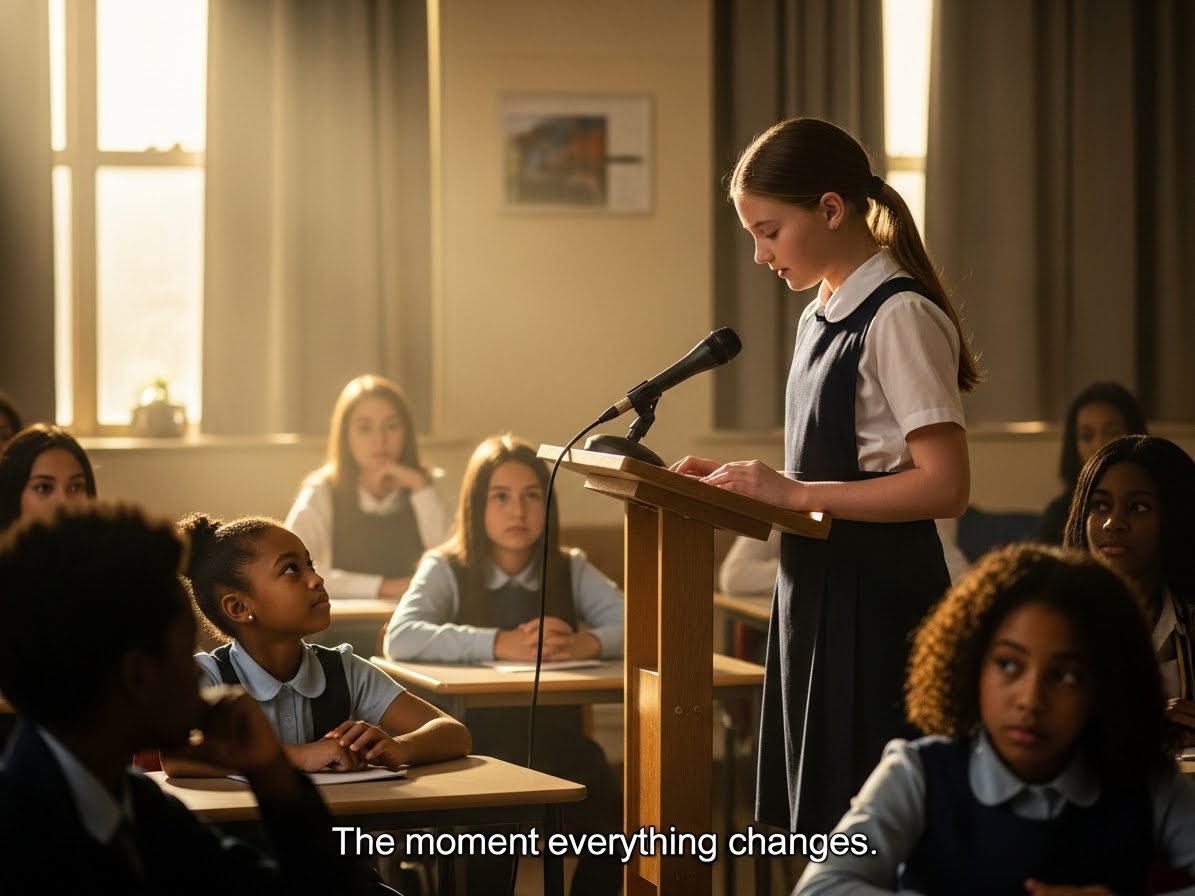
The Teacher Accused The New Student Of Theft Just Because Of His Skin Color. She Didn’t Expect The Quietest Girl In Class To Stand Up And Destroy Her Career.
Chapter 1: The Invisible Line
At Willow Creek Elementary, there were rules you read in the handbook, and then there were the real rules. The handbook said “Be Kind, Be Safe, Be Responsible.” The real rules were unspoken: Don’t run in the halls, don’t correct the teachers, and if you want to survive, fit in.
I was Ava. I was ten. My superpower was blending in. I got A-minuses, wore clothes that were trendy but not flashy, and never, ever caused a scene. I liked the safety of the middle of the pack.
Mrs. Gable was our 5th-grade teacher. She was a legend. Parents baked her casseroles. The principal, Mr. Henderson, called her “The Standard.” She had a smile that could light up a room, but I had noticed that the light didn’t shine on everyone.
Leo joined our class in October. He was the only Black kid in the 5th grade. He was small for his age, with neat cornrows and glasses that slid down his nose when he concentrated. He was brilliant at math—better than me, better than everyone.
I remember his first day. Mrs. Gable introduced him.
“This is Leo,” she said, her hands resting on his shoulders. “He’s from the inner city, so we need to make him feel welcome to our way of doing things.”
She emphasized “inner city” and “our way” with a strange lilt in her voice. The other kids didn’t notice. They just stared. But I felt a weird prickle on the back of my neck. Leo wasn’t from the “inner city”—I heard him tell the secretary he moved from a suburb in Chicago. But he didn’t correct her. He just looked at his shoes.
The separation started immediately.
Mrs. Gable had a seating chart. The “good” kids—the ones whose parents were on the PTA—sat in the front. The “rowdy” kids sat in the back.
Leo was placed in the back corner, next to the radiator that hissed and clanked. He hadn’t even spoken a word yet, and he was already in the penalty box.
It was subtle at first. A “death by a thousand cuts,” my mom would later call it.
If Sarah forgot her homework: “Oh, try to remember next time, sweetie.” If Leo forgot his homework: “I suppose you aren’t used to this level of academic rigor, Leo. Do you want me to move you to a lower reading group?”
The class absorbed this poison like a sponge. Kids are mimics. When they saw the authority figure treating Leo like he was slow, or dangerous, or “other,” they started doing it too.
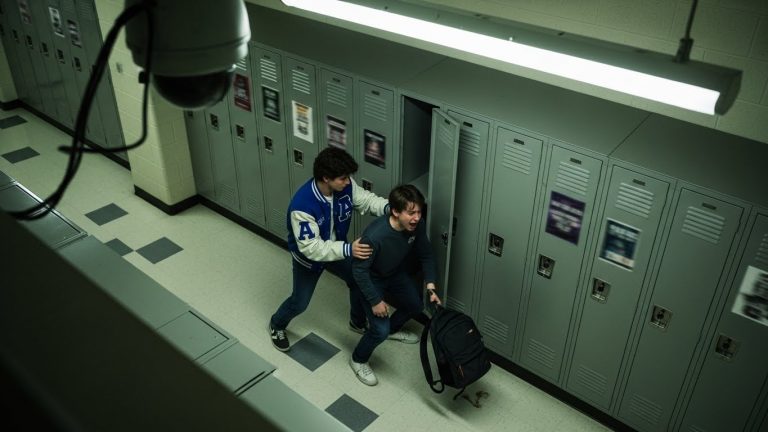
Kyle, the class clown, started bumping into Leo in the hallway. “Watch it,” Kyle would sneer.
Leo never pushed back. He just adjusted his glasses and kept walking. He was trying to survive.
I watched it all. I saw the way Leo’s shoulders hunched up near his ears whenever Mrs. Gable walked by his desk. I saw him eating lunch alone, reading a book, while the other boys played kickball.
I wanted to say something. I wanted to ask him to sit with me. But the fear of breaking the social code paralyzed me. I was a coward.
Until the day of the Red Pen.
We were taking a history test. The room was silent. Mrs. Gable was grading papers at her desk.
I saw Kyle lean over and whisper something to Leo. Leo ignored him. Kyle flicked a paper ball at Leo’s head. Leo flinched, and his red grading pen rolled off his desk.
It hit the floor with a tiny clack.
Mrs. Gable’s head snapped up like a trap springing shut.
“Leo!” she shouted.
The whole class jumped.
“I have told you,” she said, standing up and walking slowly toward him, her heels clicking ominously on the tile. “We do not disrupt tests. Why can’t you sit still?”
“I… I dropped my pen,” Leo whispered.
“Because you were fooling around,” she accused. “I saw you.”
“Kyle threw—” Leo started.
“Don’t you dare blame others for your lack of self-control,” Mrs. Gable snapped. She loomed over his desk. “Pick it up. And give me your test. You get a zero.”
A zero. For dropping a pen.
Kyle snickered. Mrs. Gable didn’t look at Kyle. She stared at Leo with cold, hard eyes.
I looked at Leo. He wasn’t crying. He was staring at the desk, his jaw set so tight I thought his teeth would crack. It wasn’t sadness on his face. It was the look of someone who knew the game was rigged, but had no choice but to play.
My heart started thumping against my ribs. This is wrong. The thought was so loud I thought everyone could hear it. This is wrong.
But I didn’t speak. I looked down at my test. I let the moment pass. And that silence tasted like ash in my mouth.
Chapter 2: The Jar of Lies
Two weeks later, the atmosphere in Room 5B was toxic. Leo had become the class pariah. Mrs. Gable had successfully painted him as the “problem child.” If something was broken, Leo did it. If there was noise, Leo made it.
Then came the incident with the Pizza Fund.
We had a glass mason jar on Mrs. Gable’s desk. Every Friday, students would bring in a dollar or two for an end-of-year party. By November, there was about fifty dollars in there—mostly in crumpled singles and a few fives.
It was a Tuesday morning. Rainy. The sky was a bruised purple outside the windows.
We came in from recess. We were noisy, wet, and chaotic.
Mrs. Gable clapped her hands. “Settled! Everyone in your seats!”
She walked to her desk to grab her attendance sheet. Then she stopped. She froze theatrically.
She looked at the mason jar. It was empty.
She gasped. A loud, dramatic gasp.
“The money,” she whispered, looking at the class with wide, betrayed eyes. “It’s gone.”
A murmur went through the room.
“Someone stole the party money?” Sarah asked.
“It was there before recess,” Mrs. Gable said. Her voice turned icy. “I locked the door. But… I suppose someone could have slipped back in.”
She scanned the room. Her gaze didn’t rest on Kyle, who had been unsupervised in the hallway for five minutes “getting water.” It didn’t rest on me.
It landed on Leo.
“Leo,” she said.
Leo looked up from his book. He looked tired. “Yes, Mrs. Gable?”
“Did you come back to the classroom during recess?”
“No,” he said. “I was in the library.”
“The library,” she repeated, dripping with skepticism. “Did anyone see you in the library?”
” The librarian, Mrs. P,” Leo said.
“Well, Mrs. P is at lunch right now,” Mrs. Gable said. She crossed her arms. “Leo, bring your backpack up here.”
“Why?” Leo asked. His voice was shaking.
“Because I need to ensure the safety of this classroom’s property. Bring it here. Now.”
“That’s not fair!” Leo said, standing up. “You’re not checking anyone else!”
“Nobody else has a history of disruptive behavior,” Mrs. Gable lied. “If you have nothing to hide, you have nothing to fear. Empty it.”
Leo walked to the front. The room was deadly silent. Twenty-four pairs of eyes watched him. He looked small.
He unzipped his backpack. He turned it over.
Books tumbled out. A pencil case. A crushed granola bar. A library book.
No money.
Mrs. Gable frowned. She used a ruler to poke through his things, treating his personal belongings like trash.
“Check his pockets,” Kyle shouted from the back. “He probably has it in his pockets!”
Mrs. Gable looked at Leo. “Turn out your pockets, Leo.”
“No,” Leo said. Tears were welling in his eyes now. “I didn’t take it!”
“Do it, or I’m calling the police,” Mrs. Gable said. The word hung in the air. Police. For a ten-year-old. Over fifty dollars.
I looked at Mrs. Gable. I saw the cruelty in her posture. She was enjoying this. She was breaking him to show the rest of us who was in charge.
I looked at Leo. He was trembling. He reached for his pockets.
And then I saw it.
Kyle was leaning back in his chair, grinning. And sticking out of the side pocket of his cargo shorts was the distinct, green corner of a five-dollar bill. Kyle didn’t have lunch money today; he had asked me for a quarter earlier.
I looked at the teacher. I looked at Leo.
The heat in my chest exploded. It wasn’t fear anymore. It was fury.
I stood up. My chair scraped loudly against the floor.
“Stop it,” I said.
Mrs. Gable turned to me, shocked. “Excuse me, Ava?”
“Stop it,” I said louder. I walked out from my safe, middle-of-the-pack desk. I walked to the front of the room and stood next to Leo.
“He didn’t take it,” I said, my voice shaking but loud.
“Sit down, Ava,” Mrs. Gable warned. Her eyes narrowed. “This doesn’t concern you.”
“Yes, it does,” I said. I pointed a finger at the back of the room. “Because Kyle has the money in his pocket.”
Chapter 3: The Double Standard
The silence that followed my accusation was heavier than the one that had preceded it. It felt like the air had been sucked out of the room.
Kyle froze. His hand, which had been inching toward his pocket to push the money deeper, stopped mid-air. His face flushed a deep, guilty crimson.
Mrs. Gable didn’t look at Kyle. She looked at me. Her eyes were wide, but not with realization. With fury.
“Ava,” she said, her voice dropping to a dangerous whisper. “Sit down. Do not make baseless accusations against your classmates to create a distraction.”
“It’s not baseless,” I said. My heart was hammering so hard I felt dizzy. I had never spoken back to a teacher. I was the good girl. But the sight of Leo, standing there with his pockets inside out, humiliated, gave me a spine of steel. “Look at his pocket, Mrs. Gable. The money is right there.”
Every head in the class turned to Kyle.
Kyle panicked. He tried to cover his pocket with his hand, but he was clumsy. The crumpled edge of the five-dollar bill fell onto the floor.
It landed on the white tile. Green. Undeniable.
Mrs. Gable blinked. She looked at the money. She looked at Kyle. Then she looked back at Leo.
In a fair world, this would be the moment of apology. This would be the moment she hugged Leo and sent Kyle to the principal’s office.
But Willow Creek Elementary wasn’t a fair world.
“Kyle,” Mrs. Gable said, her voice suddenly soft, almost maternal. “Did you find that money on the floor? Were you holding it to keep it safe?”
My jaw dropped. I actually felt it unhinge. She was giving him an out. She was handing him an alibi on a silver platter.
Kyle, realizing he had a lifeline, nodded frantically. “Yeah! Yeah, I found it near the door. I was gonna give it to you, but then you started yelling at Leo and I got scared.”
“See?” Mrs. Gable sighed, clasping her hands together. “It was just a misunderstanding. Kyle, put the money back in the jar. Thank you for being honest.”
She turned to Leo. Her face hardened instantly.
“Leo, you can sit down. But let this be a lesson. If you hadn’t been acting so suspicious, we wouldn’t have had to go through this. You brought this negative energy into the classroom.”
I felt like I had been slapped.
She was blaming him. She was blaming him for being accused of a crime he didn’t commit, while the actual thief was being praised for “honesty.”
“That’s a lie!” I shouted.
“Ava!” Mrs. Gable snapped.
“Kyle didn’t find it! He took it! He was bragging about buying snacks!” I was shaking now. “You were ready to call the police on Leo, but you just let Kyle put it back? That’s not fair! That’s racist!”
The word hung in the air. Racist.
It was a forbidden word. A nuclear word. In our bubble, we didn’t talk about race. We pretended everyone was the same, even while treating them differently.
Mrs. Gable’s face went white, then purple.
“Go to the principal’s office,” she hissed, pointing a trembling finger at the door. “Now. Both of you. Ava for disruption and disrespect. Leo for… for instigating this entire scene.”
“Me?” Leo whispered. “I didn’t do anything!”
“Out!” she screamed.
I grabbed my backpack. I grabbed Leo’s hand. And we walked out of that classroom together, leaving the “teacher of the year” standing in the wreckage of her own prejudice.
Chapter 4: The View from the Hallway
The walk to the principal’s office is usually the scariest walk of a kid’s life. But I wasn’t scared. I was numb.
Leo walked beside me. He wasn’t crying anymore. He wiped his glasses on his shirt, his face blank.
“You didn’t have to do that,” he said quietly.
“Yes, I did,” I said. “She was going to call the cops, Leo.”
“She still might,” Leo said. He sounded so old. Like a forty-year-old man trapped in a ten-year-old’s body. “My mom says when people like her get scared, they get dangerous.”
We sat on the hard wooden bench outside Principal Henderson’s office. We could hear Mrs. Gable inside. She had beaten us there. Her voice was high-pitched, frantic.
“…out of control… shouting slurs at me… I felt unsafe…”
She was spinning the narrative. She was painting me—the ten-year-old girl in a cardigan—as a threat.
The door opened. Mr. Henderson waved us in.
He was a tall man who disliked conflict. He looked at Mrs. Gable, who was dabbing fake tears from her eyes with a tissue.
“Ava,” Mr. Henderson said sternly. “Mrs. Gable tells me you caused a significant disruption today. You used… inappropriate language.”
“I said she was being unfair,” I said, my voice steady. “Kyle stole the money. She saw it. But she screamed at Leo. She made Leo empty his pockets. She treated Kyle like it was a mistake and Leo like he was a criminal.”
“I was following protocol!” Mrs. Gable interjected. “Leo fits the description of…” She stopped herself.
“Description of what?” I asked. “A student?”
“Enough,” Mr. Henderson sighed. He rubbed his temples. He didn’t want to deal with race. He wanted to deal with noise. “Ava, you cannot shout at a teacher. That is insubordination. You will serve two days of detention.”
I stared at him. “And Kyle?”
“Kyle’s situation has been handled,” he said dismissively.
“And Leo?”
Mr. Henderson looked at Leo, who was standing silently by the wall.
“Leo, you need to work on your attitude. Mrs. Gable feels you are defiant. If you want to succeed at Willow Creek, you need to fit in better.”
Fit in. There it was again. The code for “be white.” Or at least, “be invisible.”
We were dismissed.
I walked Leo to the bus stop after school. It was still raining.
“I’m sorry,” I told him. “I tried. But I just got us in trouble.”
Leo looked at me. He smiled—a real smile this time.
“You didn’t just get us in trouble, Ava. You stood up. Nobody has ever stood up for me here. Not once.”
He kicked a pebble into a puddle.
“At my old school, in Chicago… we talked about this stuff. My dad taught me about civil rights. He told me that bad things happen when good people stay quiet.”
“I’m not staying quiet anymore,” I vowed. “I’m going to get her fired.”
Leo laughed. “You can’t get her fired. She’s the golden teacher. Who’s going to believe us? We’re kids.”
“We need proof,” I said. The gears in my head were turning. I thought about the debates we watched in history class. I thought about how lawyers built cases. “We need to show everyone who she really is. Not just tell them.”
“How?”
” The 5th Grade Speech Competition,” I said. “It’s in two weeks. The whole school watches. The parents watch. The school board watches.”
Leo’s eyes widened. “You want to call her out… on stage?”
“I want to put her on trial,” I said. “And I need your help. You’re the math genius. I need data.”
Chapter 5: The Trojan Horse
The 5th Grade Speech Competition was the highlight of the year. The theme this year was: “What Liberty Means to Me.”
Usually, the speeches were boring. Kids read essays about the Statue of Liberty or the bald eagle, parents clapped, and everyone went home.
Mrs. Gable assigned the topics. She wanted control.
“Ava,” she said the next day, not making eye contact. “Since you have such strong opinions, I’ve assigned you a topic on ‘The Importance of Following Rules in Society.'”
She smiled. It was a punishment. She wanted me to get up there and preach about obedience.
“Thank you, Mrs. Gable,” I said sweetly. “I’ll work hard on it.”
That afternoon, I started my “Shadow Notebook.”
I met Leo in the library during lunch. We hid in the back corner behind the encyclopedias.
“Okay,” I whispered. “I need you to track everything. Every time she scolds someone. Write down the name, the time, and what they did.”
Leo pulled out a small notepad. “I’ve already started. Yesterday: Kyle threw an eraser. She laughed. 10:15 AM. Today: Jenny talked during reading. Mrs. Gable said ‘shh’. 9:00 AM. Me: I sneezed. She told me to go to the nurse if I was ‘sick and infecting people’. 11:30 AM.”
“Good,” I said. “Keep tracking. We need a pattern. We need numbers. Adults love numbers.”
For two weeks, we were spies.
I wrote my “decoy speech” for Mrs. Gable to approve. It was full of fluff about crossing guards and stop signs. She loved it. She patted me on the head. “See, Ava? You can be a good student when you try.”
But at home, late at night, I was writing the real speech.
I practiced in front of my mirror. I timed my pauses. I channeled the anger I felt every time Mrs. Gable looked at Leo with that cold, dead stare.
Leo and I met every day. He made graphs. He was incredible. He calculated that Mrs. Gable corrected him 400% more often than any other student, even though his grades were in the top 1% of the class.
“This is evidence,” Leo said, showing me the bar chart. “It’s undeniable.”
“It’s perfect,” I said.
The day of the competition arrived. The gymnasium was packed. Five hundred folding chairs. Parents with camcorders. The School Board members sitting in the front row in their suits.
Mrs. Gable was fluttering around, fixing ties and smoothing dresses. She looked nervous but proud. This was her show. Her students were her trophies.
“You’re going to do great, Ava,” she whispered to me before I went on stage. “Just stick to the cards.”
“I will,” I promised.
I walked up the stairs to the stage. The spotlight hit me. It was blindingly hot.
I looked out at the sea of faces. I saw my mom and dad. I saw Mr. Henderson looking bored. I saw Mrs. Gable standing in the wings, smiling.
And then I saw Leo. He was sitting in the front row with the other students. He gave me a tiny nod.
I walked to the podium. I placed my index cards on the wood.
Then, I reached into my pocket and pulled out a different set of cards.
I leaned into the microphone.
“Good evening,” I said. My voice echoed through the gym. “My topic was supposed to be about following rules. But I learned something recently. Sometimes, rules are just a mask for something ugly.”
I saw Mrs. Gable’s smile falter. She took a step forward from the wings.
“Tonight,” I continued, looking directly at the School Board. “I want to talk about ‘Liberty.’ And I want to talk about why one student in this room doesn’t have any.”
The room went silent.
“I want to talk about Leo.”
Chapter 6: The Graph of Truth
The gymnasium was so quiet you could hear the hum of the air conditioning. Five hundred people were staring at me. In the wings, Mrs. Gable was making a “cut it” motion across her throat, her face a mask of panic. Mr. Henderson was halfway out of his seat.
But I had the microphone. And for this moment, I had the power.
“Liberty means freedom,” I said, my voice gaining strength. “But in Room 5B, freedom depends on who you are.”
I pulled out a large piece of poster board that I had hidden behind the podium. I unfolded it. It was a bar graph Leo had drawn with a ruler and markers. It was simple, colorful, and damning.
“This is a chart,” I said, holding it up. “My friend Leo made it. He’s a math genius. He tracked every time our teacher, Mrs. Gable, scolded a student in the last two weeks.”
I pointed to a tiny blue bar. “This is Kyle. Kyle threw an eraser, talked during reading, and was caught with stolen money. He was corrected two times.”
I pointed to a massive red bar that shot off the top of the page.
“This is Leo. Leo dropped a pen. Leo sneezed. Leo read a book. He was corrected forty-three times.”
A gasp rippled through the audience. I saw parents leaning forward. I saw the School Board members exchanging glances.
“Mrs. Gable,” I said, turning to look directly at her in the wings. “You told us that rules keep us safe. But you don’t use rules to keep us safe. You use them to keep Leo down.”
“Turn off the microphone!” Mrs. Gable shrieked. She forgot where she was. She forgot the parents. She lunged toward the sound booth guy.
But I kept talking, shouting now.
“Two weeks ago, money was stolen from the class jar! Mrs. Gable saw the money in Kyle’s pocket! She saw it! But she made Leo empty his bag in front of everyone! She threatened to call the police on him!”
“That is a lie!” Mrs. Gable yelled, running onto the stage. She grabbed my arm. “Get away from the podium, Ava! You are suspended!”
The crowd erupted.
But then, a voice boomed from the front row.
“Get your hands off that child!”
It was Leo’s father. He stood up. He was a tall man in a suit, radiating a quiet dignity that was rapidly turning into righteous fury.
He walked toward the stage. “Let her finish.”
Mrs. Gable froze. She looked at Leo’s dad. She looked at the audience, who were now standing, phones out, recording everything. She realized, in that split second, that her reign was over. She let go of my arm and stepped back, her hands trembling.
I looked back at the crowd. I found Leo. He was smiling, tears streaming down his face.
“Liberty,” I whispered into the mic, “means that when a teacher is a bully, we are allowed to say so. It means the rules apply to everyone. Even her.”
I dropped the mic. It hit the floor with a heavy thud.
Chapter 7: The Avalanche
The Speech Competition didn’t have a winner that year. It ended in chaos.
Mr. Henderson rushed the stage, trying to do damage control, but the dam had broken. Parents were swarming the floor. My mom and dad ran up to me, grabbing me in a hug that felt like a shield.
“I’m sorry,” I sobbed into my dad’s coat. “I’m sorry I caused a scene.”
“Don’t you ever apologize for telling the truth,” my dad said, his voice fierce. “Never.”
The next week was a blur of meetings. The “Shadow Notebook” Leo and I had kept became Exhibit A in the investigation.
At first, the district tried to dismiss it as “a student misunderstanding.” They wanted to suspend me for “disruption.” They wanted to transfer Leo.
But they underestimated the power of the suburbs when the veil is lifted.
Other parents started talking. Sarah’s mom remembered Sarah saying Mrs. Gable called Leo “one of those people.” Another parent remembered Mrs. Gable making jokes about Leo’s hair.
The “perfect teacher” facade crumbled.
But the real turning point was the hearing. The School Board held a special session. Mrs. Gable was there with her union rep, looking small and victimized. She cried. She said she loved all her children. She said I was a troubled girl seeking attention.
Then, they called Leo to speak.
He sat in the big leather chair, his feet barely touching the ground. He adjusted his glasses.
“Mrs. Gable makes me feel like I’m dirty,” Leo said quietly. “She wipes her hands after she touches my desk. She never calls on me when I raise my hand. I thought… I thought it was because I wasn’t smart enough.”
He looked up at the Board members.
“But then Ava showed me the math. And math doesn’t lie. She just doesn’t like me because I look different.”
The room was silent. You could hear a pin drop.
Mrs. Gable was placed on administrative leave that night. Two weeks later, she “resigned to pursue other opportunities.”
We never saw her again.
But removing her was only the first step. The school was still broken. The kids were still confused. Kyle was still a bully who thought he was untouchable.
I realized that firing one teacher wasn’t enough. We needed to change the air we were breathing.
Chapter 8: The Debate Club
Three months later.
Room 5B looked different. There was a new teacher, Mr. Lewis. He was young, energetic, and he moved the desks into a circle. No back row. No “penalty box.”
But the biggest change was happening after school.
I stood at the front of the room. It was 3:30 PM. The room was packed with kids—5th graders, 4th graders, even some 6th graders.
On the whiteboard, I had written: TOPIC: IS “COLORBLINDNESS” A GOOD THING?
This was the first meeting of the “Willow Creek Student Union.” It was my idea, but Leo was the Vice President.
“Okay everyone,” I said, tapping the desk. “Settle down.”
Leo stood up next to me. He looked confident. He wasn’t hiding anymore.
“Today we’re going to talk about something uncomfortable,” Leo said. “We’re going to talk about why saying ‘I don’t see color’ is actually hurtful.”
A hand went up. It was Kyle.
Kyle hadn’t been expelled, but he had been stripped of his status. He was trying, in his own clumsy way, to understand why he had been the villain of the story.
“But isn’t it good to treat everyone the same?” Kyle asked.
“It is,” I answered. “But treating everyone the same doesn’t mean ignoring who they are. If you don’t see Leo’s color, you don’t see what he goes through. You don’t see why Mrs. Gable treated him differently.”
We talked for an hour. It was messy. It was awkward. Kids asked questions that made the adults in the room cringe.
“Why can’t I say the N-word if it’s in a rap song?” “Why are all the teachers white?” “Is it racist if I clutch my purse when I see a black teenager?”
We didn’t have all the answers. But we were asking the questions. We were popping the bubble.
After the meeting, Mr. Henderson—who had surprisingly let us form the club—walked up to me.
“You know, Ava,” he said, looking at the diverse group of kids cleaning up snacks. “I’ve been an educator for twenty years. I thought I knew how to run a school. I thought keeping things quiet meant keeping things good.”
He looked at the empty spot where Mrs. Gable’s desk used to be.
“You taught me that peace isn’t the absence of noise,” he said. “It’s the presence of justice.”
I smiled. I looked over at Leo, who was laughing with Sarah, showing her a math trick. He wasn’t the invisible boy anymore. He was the star.
I walked over to the window. I looked out at the manicured lawns of Willow Creek. It was still a bubble, in many ways. But there was a crack in it now. A crack where the light could get in.
I was ten years old. I was just a kid. But I had learned the most important lesson of my life:
You don’t need a degree to spot injustice. You don’t need a title to be a leader.
You just need eyes to see the truth, and a voice loud enough to speak it.
[END OF STORY]