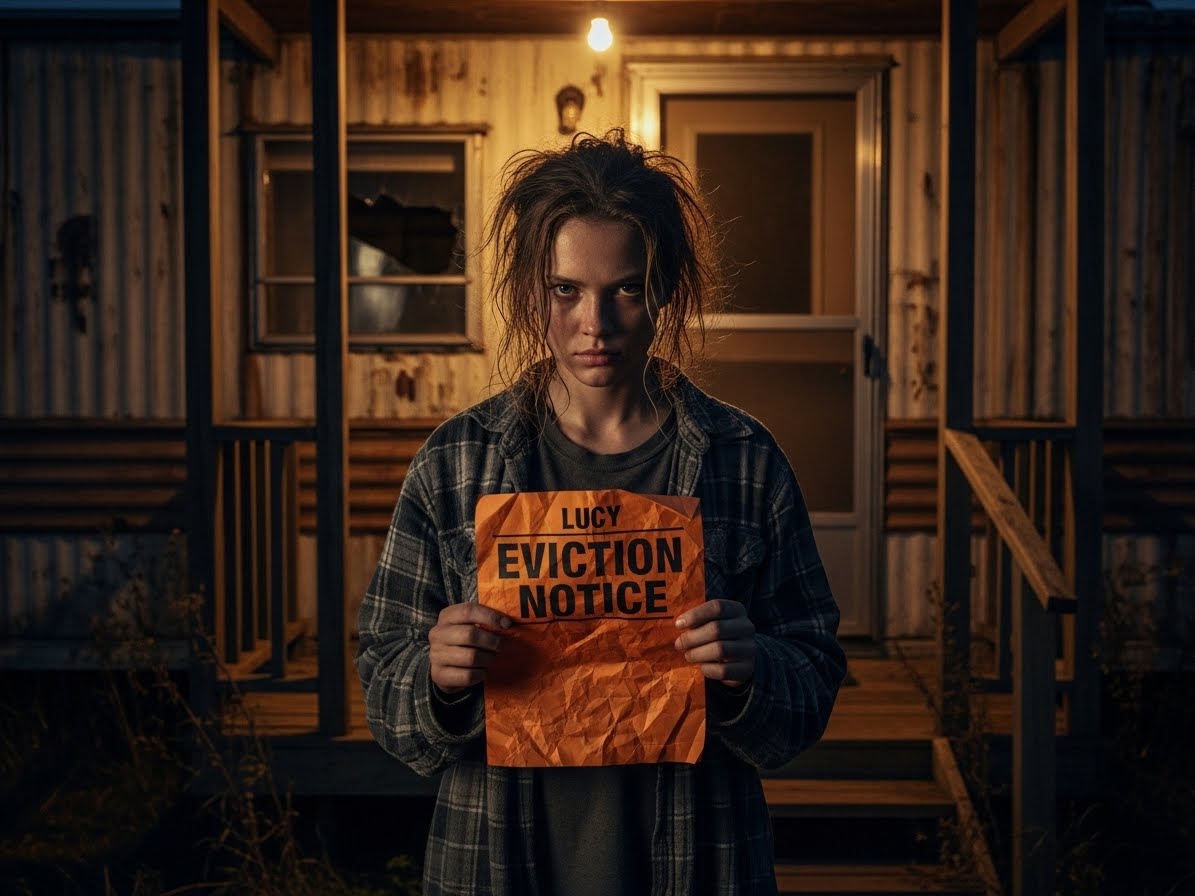
They Said She Was “Trash” Because She Lived In A Trailer. But When She Walked To The Microphone, She Made The Entire City Council Tremble.
Chapter 1: The Zip Code of the Forgotten
If you want to know what hopelessness looks like, don’t look at a war zone on the news. Look at the lunch line at Iron Creek High School. Look at the kids who pretend they aren’t hungry because their account balance is zero and they’re terrified of the “cheese sandwich of shame.”
I was one of those kids. My name is Lucy. I lived in “The Stacks.”
The Stacks wasn’t just a trailer park; it was a containment zone. It was where the town of Iron Creek put the people who cleaned their toilets, fixed their cars, and served their food, but who they didn’t want to see after 5:00 PM.
Our trailer was a 1988 single-wide with aluminum siding that rattled like a skeleton in the wind. In the winter, we slept in our coats. In the summer, it was an oven. But it was home.
It was just me and Nana. My mother was a memory, a blurry photo on the fridge. My father was a ghost I never met. Nana was the reality. She was seventy-two years old, worked as a janitor at the hospital, and had hands that felt like sandpaper but held me like silk.
“We ain’t poor, Lucy,” she would tell me, soaking her swollen feet in a bucket of Epsom salts after a twelve-hour shift. “We’re just broke. Poor is a state of mind. Broke is a temporary financial situation.”
I loved her for lying to me. We were poor. Dirt poor. The kind of poor where a flat tire means you don’t eat dinner for three days.
At school, I was invisible. I wore oversized hoodies to hide my clothes. I sat in the back. I got straight A’s, but I never raised my hand. I learned early that if you speak up, you get noticed. And if you’re from The Stacks, getting noticed is dangerous. It gives people a reason to check your shoes, your hair, your address.
But the silence was corrosive. It ate at me. I watched the rich kids from the “Hill” complain about their parents buying them the wrong color BMW, while I was worrying if the space heater would start a fire while we slept.
I had a secret, though. I wrote.
I wrote on the back of napkins, in used notebooks I found in the trash, on the margins of my math homework. I wrote about the injustice. I wrote about the way the police cruiser slowed down every time it passed our bus stop, eyeing us like future criminals. I wrote about the hunger that felt like a physical weight.
I didn’t think anyone would ever hear my voice. I thought I would graduate, get a job at the diner, and fade away just like everyone else in The Stacks.
Until the day they tried to take The Haven.
Chapter 2: The Orange Notice
The Haven wasn’t much. It was an old, converted warehouse at the entrance of the trailer park. The paint was peeling, the roof leaked, and the heating system groaned like a dying beast.
But to us, it was a palace.
It was run by Mrs. Higgins, a retired teacher who smelled of peppermint and patience. It was where the latchkey kids went after school. It was where we got help with algebra. It was where, on Wednesdays and Fridays, there was a hot meal that didn’t come from a can.
It was the only place in the world where I felt like I had a future.
I was walking my little neighbor, Leo, to The Haven on a Tuesday afternoon. The wind was biting, cutting through my thin denim jacket. Leo was seven. He was clutching a drawing he made for Mrs. Higgins.
“Do you think she has cocoa today?” Leo asked, his teeth chattering.
“Maybe,” I smiled. “If not, we’ll make some magic water.” (Magic water was hot water with a peppermint candy melted in it).
We rounded the corner, and I stopped dead.
A chain was wrapped around the double doors. A heavy padlock hung from it like a dead weight.
And there, stapled to the wood, was the bright orange notice.
CONDEMNED.
I stepped closer, my breath hitching. Below the big letters, in smaller print: Property acquired by Sterling Development Corp. Scheduled for Demolition on 12/01. Future Site of Iron Creek Luxury Personal Storage.
Luxury storage.
I felt a wave of dizziness. They were evicting three hundred at-risk kids to build a place for rich people to store their extra junk.
Leo tugged on my sleeve. “Lucy? Why is the door locked?”
I looked down at him. I saw the confusion in his eyes. I saw the future waiting for him—a future with nowhere to go, hanging out on street corners, getting swallowed by the streets just like his older brother did.
“They closed it, Leo,” I whispered.
“But… where do we go?”
That question hung in the cold air. Where do we go?
The answer from the town was clear: Away. Out of sight. We don’t care.
We walked back to the trailer in silence. I dropped Leo off at his place and went home. Nana was in the kitchen, staring at a pile of bills.
“Nana,” I said, my voice shaking. “They closed The Haven.”
She looked up, her eyes sad and resigned. “I heard at the hospital. Mr. Sterling bought the land. He’s on the City Council. Nothing we can do, baby.”
“He can’t just take it!” I yelled. I surprised myself. I never yelled. “That place saves lives, Nana! Where is Mrs. Higgins? Did they even ask us?”
“Rich folks don’t ask, Lucy. They take.” She went back to counting quarters.
I went to my room—a closet sized space separated by a curtain. I sat on my mattress. I looked at my notebooks.
Rich folks don’t ask.
I felt a heat rising in my chest. It started in my stomach and moved up to my throat. It was anger. Pure, molten anger. But it wasn’t the helpless kind I was used to. It was different. It felt like fuel.
I pulled out my phone. It was an old model with a cracked screen, but it had data. I searched “Iron Creek City Council Meeting.”
Tonight. 7:00 PM. Town Hall.
I looked at the clock. 5:30 PM.
I grabbed my backpack. I put my notebook inside.
“Where you going?” Nana called out as I headed for the door.
“For a walk,” I lied.
I didn’t walk. I marched. Four miles in the freezing cold. I didn’t feel the wind. I only felt the fire. I was going to the Town Hall. And for the first time in my life, I wasn’t going to be invisible.
Chapter 3: The Marble Fortress
Town Hall looked like a cathedral. It had white pillars, polished marble floors, and golden light spilling out of tall windows. It was beautiful. It was intimidating. It was designed to make people like me feel small.
I stood outside for a moment, catching my breath. My sneakers were soaked through. My hair was frizzy from the humidity. I looked at my reflection in the glass door—a skinny girl in a faded hoodie that was two sizes too big.
You don’t belong here, a voice in my head whispered. Go home. Nana needs you.
But then I thought of Leo asking where he was supposed to go. I thought of the lock on The Haven’s door.
I pushed the heavy door open and walked in.
The warmth hit me first. Then the smell—floor wax and expensive cologne.
I walked past a security guard who was dozing by a metal detector. He barely looked up. I guess he didn’t think a teenage girl looked like a threat. He was wrong.
I followed the signs to the “Council Chamber.” The hallway was lined with portraits of old white men—past mayors, past councilmen. They all looked the same. Stern. Important. Rich.
I reached the double doors of the chamber. I peeked inside.
The room was packed. Not with people like me, but with people in suits. Developers. Contractors. Lawyers. The people who carve up the town like a Thanksgiving turkey.
At the front of the room, on a raised platform, sat the five council members. In the center was Councilman Sterling.
He looked exactly like his billboards. Silver hair, perfectly tanned skin, a smile that didn’t reach his eyes. He was leaning back in his leather chair, tapping a gold pen on the desk, looking bored as a woman complained about potholes on her cul-de-sac.
I slipped into the back row. I tried to make myself invisible, shrinking into the corner seat.
My heart was hammering against my ribs like a trapped bird. I clutched my notebook so hard my knuckles turned white.
“Next item on the agenda,” Sterling’s voice boomed through the speakers. It was smooth, practiced. “Proposal 84-B. The redevelopment of the South End Industrial District.”
That was their code word. “South End Industrial District.”
They meant The Stacks. They meant my home.
Chapter 4: The “Blight”
A man in a gray suit stood up. He set up a poster board on an easel. It showed a glossy, computer-generated image.
It was a rendering of the new “Iron Creek Luxury Storage and Business Park.” It was sleek, modern, and clean. There were fake digital trees and fake digital people walking happy digital dogs.
“As you can see,” the man said, pointing to the spot where The Haven currently stood, “this development will bring significant tax revenue to the town. It will clean up a blighted area that has been a sore spot for property values for decades.”
Blight. That’s what they called us. We weren’t families struggling to survive. We were mold. We were rust. We were something to be scraped off so the property value could go up.
“The current structure on the lot,” the man continued, “is a dilapidated warehouse that attracts… undesirable elements. Loitering. Truancy. It’s a safety hazard.”
Undesirable elements. He meant Leo. He meant Mrs. Higgins. He meant me.
“Thank you, Mr. Vance,” Sterling nodded. He looked out at the crowd. “I think we all agree that it’s time to move Iron Creek forward. We can’t let the past hold us back. This storage facility meets the needs of our growing upper-middle-class residents who simply need more space.”
He chuckled. A few people in the audience chuckled with him.
“I move to approve the demolition permit,” Sterling said. “Do I have a second?”
“Second,” another councilman said quickly.
“All in favor?”
“Wait!”
The word ripped out of my throat before I could stop it. It was loud. It echoed off the high ceilings.
The room went dead silent. Every head turned.
I stood up. My legs felt like jelly. My face burned. I was the only person standing. I was the only person not wearing a suit.
Sterling peered over his reading glasses. He looked annoyed, like a waiter who had just spotted a fly in the soup.
“This is a closed session for voting, miss,” he said dismissively. “Public comments were at 6:00 PM.”
“I walked four miles to get here,” I said. My voice shook, but I forced it to be louder. “I didn’t know there was a time limit on my life.”
“Security,” Sterling sighed, waving a hand toward the back of the room.
The guard I had passed earlier started walking down the aisle. He was big. He looked grumpy.
Run, my brain screamed. Run before they arrest you.
But I didn’t run. I walked.
I walked straight down the center aisle. I walked past the lawyers. I walked past the developers. I walked right up to the microphone stand in front of the dais.
The guard was ten feet away.
“You have to leave,” Sterling barked. “Now.”
I grabbed the microphone. It gave a high-pitched squeal of feedback that made everyone wince.
“You called us a blight,” I said into the mic.
Chapter 5: The Cheese Sandwich
The guard grabbed my arm. “Let’s go, kid.”
“Let her speak!”
The voice came from the press section. A young woman with a camera—a reporter for the local paper—had stood up. She had her lens trained on me.
Sterling hesitated. He looked at the camera. He was a politician; he knew what it would look like if he dragged a teenage girl out by force on the evening news.
He held up a hand to the guard. “Fine,” he sneered. “Two minutes. Then you’re out.”
I looked at Sterling. Up close, he smelled like mints and money.
I looked at the microphone. I took a deep breath.
“My name is Lucy,” I began. “I live in The Stacks. The ‘blighted area’ you’re talking about.”
I looked at the poster of the luxury storage unit.
“You want to tear down The Haven to build storage for your extra things,” I said. “You have so much stuff that it won’t fit in your big houses, so you need to build a mansion for your jet skis and your winter coats.”
The room was silent. Uncomfortably silent.
“Do you know what Mrs. Higgins keeps in The Haven?” I asked. “She doesn’t keep jet skis. She keeps peanut butter. She keeps winter coats for kids who walk to school in windbreakers. She keeps us alive.”
I pulled a crumpled piece of paper from my pocket. It was the drawing Leo had made earlier. A crayon drawing of him and me, holding hands in front of the community center.
“This is Leo,” I said, holding it up to the camera. “He’s seven. He learned to read at The Haven because his mom works two jobs and isn’t home to teach him. He ate a hot meal there tonight. Tomorrow, because of you, he won’t eat.”
I turned to Sterling.
“You called us ‘undesirable elements.’ We aren’t elements. We are children. We are the people who wash your cars and mow your lawns. And we are tired.”
I felt tears pricking my eyes, but I refused to let them fall. I channeled Nana.
“You think because we are poor, we are stupid,” I said, my voice gaining strength. “You think because we live in trailers, we don’t matter. But we are watching you. And we are going to tell everyone what you did tonight. You are trading a child’s dinner for a storage locker.”
I slammed Leo’s drawing onto the podium.
“You can have your storage unit, Mr. Sterling. But you’re going to have to look at us while you build it. We aren’t invisible anymore.”
“Time’s up,” Sterling snapped, his face turning a shade of red I had never seen before.
The guard grabbed my arm again, firmer this time. He dragged me away from the mic.
“Get off me!” I yelled. “I’m leaving!”
I shook him off and marched up the aisle. My heart was exploding. I felt like I was going to throw up.
But as I reached the double doors, I heard something.
One person started clapping.
Then another.
I looked back. It wasn’t the councilmen. It was the reporter. It was the lady who had complained about the potholes. It was the janitor standing in the back corner.
Sterling banged his gavel furiously. “Order! Order in the chamber!”
I pushed through the doors and burst out into the cold night air. I collapsed on the steps of Town Hall, gasping for air, shaking uncontrollably.
I had done it. I had spoken.
But I had no idea that the camera in the back of the room hadn’t just been recording. It had been livestreaming.
And by the time I walked the four miles back to the trailer, the video of “The Girl in the Hoodie” had already been shared five thousand times.
Chapter 6: The Avalanche
The walk home felt different. The wind was still biting, my shoes were still wet, and the darkness of the unlit road leading to The Stacks was still oppressive. But the silence inside my head was gone.
My phone started buzzing around mile two. At first, I ignored it. I thought it was a glitch or maybe a weather alert. But it kept buzzing. Bzzzt. Bzzzt. Bzzzt. A continuous, angry rhythm.
I pulled it out. The screen was lit up with notifications.
Instagram: 99+ Twitter: 99+ Facebook: 99+
I froze under the dim light of a streetlamp. My hands were shaking so hard I almost dropped the device. I opened Twitter.
The hashtag #TheGirlInTheHoodie was trending. Not just in Iron Creek. In Ohio.
I clicked on a video. It was me. Grainy, shaky footage taken from the back of the Council Chamber. The audio was clear, though. My voice, cracking but loud, cut through the tinny speakers: “You are trading a child’s dinner for a storage locker.”
The comments were rolling in faster than I could read them.
“Who is this girl? She just destroyed that guy.” “I live in Iron Creek. Sterling is a crook. Finally someone said it.” “Where can we donate? Save The Haven!”
I felt a wave of nausea. I hadn’t wanted to go viral. I just wanted them to stop. Now, millions of eyes were on me. Millions of eyes were on The Stacks.
I ran the rest of the way home.
When I burst through the front door of the trailer, Nana was standing in the kitchen. She wasn’t counting quarters anymore. She was holding her ancient flip phone, staring at it with wide eyes.
“Lucy,” she whispered. “Baby, what did you do?”
“I just spoke, Nana,” I panted, locking the flimsy door behind me. “I just told them.”
“Mrs. Higgins called,” Nana said, looking up at me. “She said her phone is ringing off the hook. People from Cleveland. People from Chicago. They want to send food. They want to send money.”
I sank onto the linoleum floor, the adrenaline crashing. “Is it enough? Will it stop them?”
Nana walked over and sat down beside me. She pulled me into her arms. She smelled of bleach and lavender. “I don’t know, baby. Mr. Sterling is a proud man. And proud men don’t like being embarrassed by little girls in hoodies. You poked the bear.”
She was right.
The next morning, the bear swiped back.
I woke up to a sound that shakes the teeth in your skull. A low, guttural rumble that vibrated the thin walls of the trailer.
VRRRRRR-CLANK.
I scrambled out of bed. It was 6:00 AM. The sun wasn’t even fully up.
I looked out the window.
At the entrance of the park, surrounding The Haven, were trucks. Massive, yellow flatbeds. And on top of them were bulldozers.
They weren’t waiting for December 1st. They weren’t waiting for the outrage to grow.
Sterling had moved the timeline up. He was going to demolish The Haven today.
Chapter 7: The Human Chain
I didn’t think. I didn’t brush my teeth. I didn’t put on shoes. I grabbed my boots by the door and sprinted out in my pajamas and coat.
“No!” I screamed, running down the gravel road. “Stop! You can’t do this!”
I wasn’t the only one running. Doors were flying open all over The Stacks. Mothers in bathrobes, fathers in work uniforms, kids with backpacks—everyone was pouring out.
We reached The Haven just as the first bulldozer was rolling off the flatbed. The driver, a guy in a hard hat and reflective vest, looked confused. He was just doing a job. He didn’t know he was driving into a war zone.
Standing near the construction foreman was Councilman Sterling. He wasn’t wearing a suit today. He was wearing a casual jacket, looking impatient, talking into a cell phone.
I ran right up to him.
“You said December!” I yelled, breathless. “The notice said December 1st!”
Sterling snapped his phone shut. He looked at me with cold, shark-like eyes. “Permits changed. Emergency demolition order. Structure is unsafe. We’re doing the community a favor.”
“You’re doing this because of the video!” I accused him. “You want to destroy the evidence before anyone can save it!”
“It’s private property, young lady,” Sterling stepped closer, looming over me. “And you are trespassing. If you don’t move, I will have the Sheriff remove you.”
Behind him, two Sheriff’s cruisers pulled up, lights flashing silently.
I looked at the bulldozer. It was massive. The blade was taller than me. The engine roared to life, spewing black smoke into the morning air.
I looked at The Haven. I saw the window where Leo learned to read. I saw the door where Mrs. Higgins handed out bread.
I looked at the crowd of my neighbors. They looked scared. They were used to losing. They were used to stepping back when men like Sterling stepped forward.
Not today.
I walked past Sterling. I walked past the foreman.
I walked directly into the path of the bulldozer.
I sat down in the mud, right in front of the tread.
“What are you doing?” the driver yelled over the engine. “Get out of the way, kid!”
“No,” I said. I crossed my arms. “If you want to tear it down, you have to go through me.”
“Lucy, get up!” Sterling shouted. “Officer!”
A deputy started walking toward me.
Then, movement caught my eye.
Leo ran out from the crowd. He was wearing his Spider-Man pajamas. He sat down next to me. He grabbed my hand. His hand was tiny and warm.
Then Nana came. Her knees cracked as she lowered herself into the mud on my other side.
“I’m too old for this,” she grumbled, linking her arm with mine. “But I’m too old to be pushed around, too.”
Then Mrs. Higgins. Then Leo’s mom. Then the guy from trailer 4B who I thought hated everyone.
One by one, they sat. A human chain, stretching across the entire width of the driveway. Fifty people. Then a hundred. Then two hundred.
The “trash” of Iron Creek formed a wall of flesh and bone.
The bulldozer driver killed the engine. He threw his hands up. “I’m not doing this,” he yelled to the foreman. “I’m not running over kids.”
Sterling was furious. His face was purple. He was screaming at the Sheriff to arrest us all.
“Arrest three hundred people?” the Sheriff said, crossing his arms. “On what charge? Sitting?”
“They are obstructing a lawful demolition!” Sterling shrieked.
“Actually,” a voice called out.
Everyone turned.
It was Sarah, the reporter. She was standing on the roof of her news van, filming everything. And behind her, coming down the main road, were more cars. News vans from Columbus. From Cleveland. Even a CNN truck.
“I think the world is watching, Mr. Sterling,” Sarah yelled. “Say hi to the livestream!”
Sterling looked at the cameras. He looked at the silent, immovable wall of people sitting in the mud. He looked at me.
For the first time, I saw fear in his eyes. He realized his money couldn’t buy him out of this. He realized he had lost.
He stormed to his car, got in, and peeled away.
The foreman waved the trucks off. “Load ’em up, boys! We’re done here.”
A cheer went up. It started low, a rumble in the throat of The Stacks, and grew into a roar that shook the remaining leaves off the trees.
We stood up. We were muddy. We were freezing. But we had never been cleaner.
Chapter 8: The Foundation
That day didn’t just save a building. It saved a town.
The viral fame was intense, but we used it. A GoFundMe page set up by Sarah raised $400,000 in three days.
We didn’t just save The Haven; we bought it. Mrs. Higgins held the deed. No bank, no landlord, no Sterling Development Corp could ever touch it again.
We fixed the roof. We installed a new heating system. We built a computer lab with brand-new Macs donated by a tech company in California.
Sterling resigned from the City Council a month later. The “unwanted attention” into his business dealings uncovered a few things the IRS found very interesting. Last I heard, he was spending his time in a facility much smaller than a luxury storage unit.
But the biggest change wasn’t the building. It was us.
The people of The Stacks walked differently now. We looked people in the eye at the grocery store. We spoke up at PTA meetings. We realized that our voices, when harmonized, were louder than any money.
As for me?
I didn’t fade back into the background. I couldn’t.
I graduated Valedictorian of Iron Creek High two years later. In my speech, I didn’t thank the faculty or the administration. I thanked the people who sat in the mud.
I went to college on a full scholarship—a scholarship created by donors who saw that video. I studied Political Science and Law.
Ten years have passed since that day in the mud.
Today, I’m back in Iron Creek. But I’m not living in the trailer (though Nana still refuses to move, saying she likes the neighbors).
I’m standing in Town Hall. The same marble floors. The same high ceilings.
But the portraits in the hallway are changing.
I check my reflection in the glass door. I’m not wearing a hoodie. I’m wearing a suit. Not a $5,000 suit like Sterling’s, but a sharp, practical one.
I push open the double doors to the Council Chamber.
The room is packed. But not just with developers. It’s full of people from The Stacks, from The Hill, from everywhere.
I walk up the aisle. I don’t stop at the microphone stand this time. I walk past it.
I walk up the steps to the raised platform.
I sit down in the center chair. The nameplate in front of me reads: MAYOR LUCY HERNANDEZ.
I pick up the gavel. It feels heavy, but good. I look out at the crowd. I see Leo, now seventeen and heading to engineering school, sitting in the front row. I see Nana, eighty-two and still fierce, winking at me.
I tap the gavel.
“This meeting of the Iron Creek City Council is now in session,” I say. My voice doesn’t shake. “The floor is open. And in this town, everyone gets a turn to speak.”
We came from nothing. They told us we were trash. They told us to be quiet.
But they forgot one thing about people who have nothing to lose.
We have everything to fight for.
[END OF STORY]