Teacher Shreds Student’s Essay Calling Him a Liar—Then The Door Opens
Chapter 1: The Paper Snow
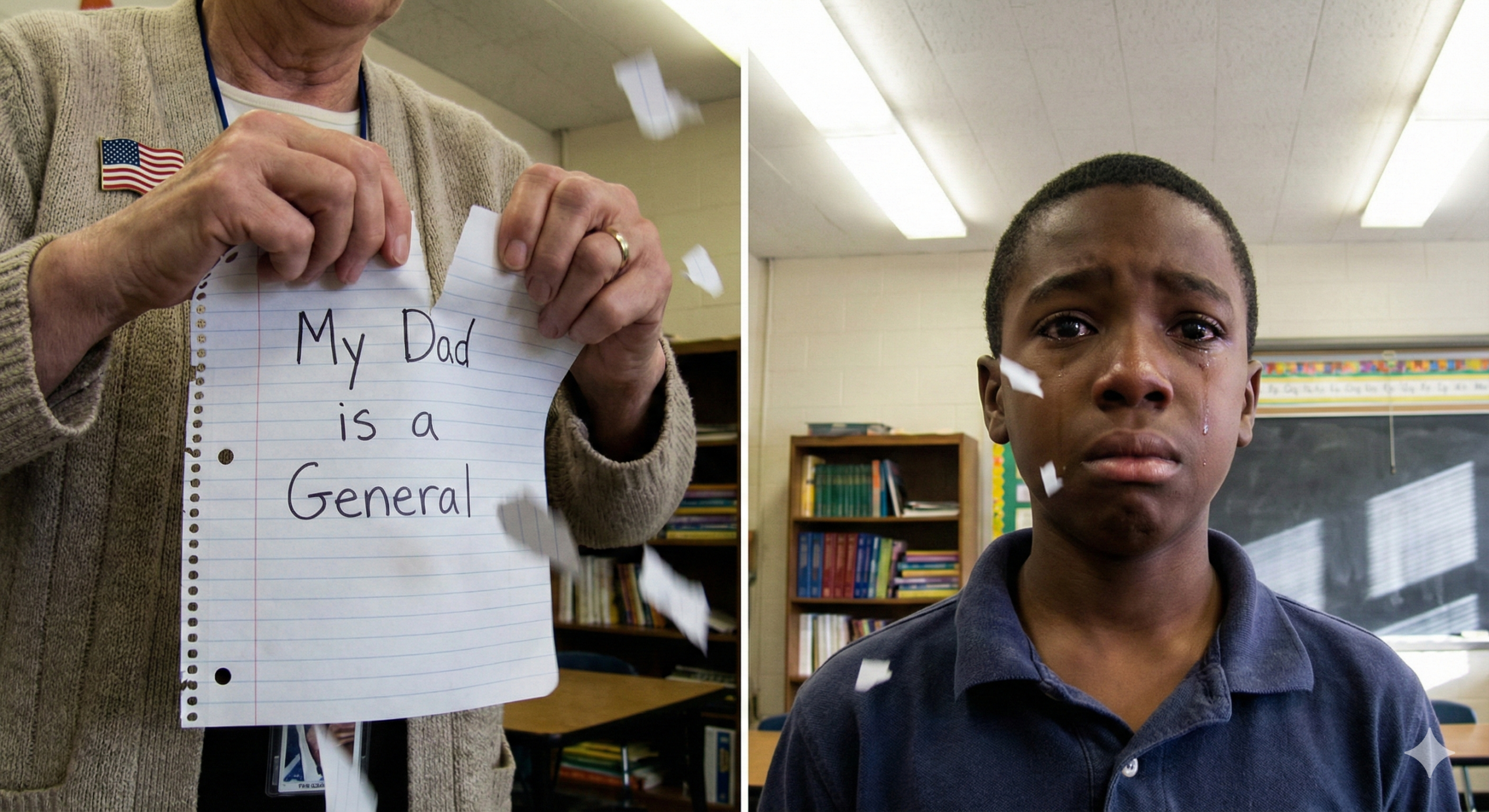
The sound was violent. That was the only way to describe it. It wasn’t just paper tearing; it was the sound of a story being destroyed.
Rrrripp.
Mrs. Patricia Whitmore didn’t whisper. She never whispered. She stood in the center of the fourth-grade classroom at Jefferson Elementary like a judge handing down a life sentence. In her hands, she held the wide-ruled notebook paper that ten-year-old Lucas Hughes had spent two nights perfecting.
“Class, look at me,” she commanded. Twenty-three heads snapped up. “This is what happens when we use creative writing time to indulge in fantasies instead of facts.”
She ripped the paper again.
Lucas sat in the second row, his hands gripping the edges of his desk so hard his knuckles turned the color of ash. He could feel the heat rising up his neck, burning his ears. He stared at his sneakers—Reeboks that were six months old and starting to fray at the toes.
“But… it’s true,” Lucas whispered. His voice felt small, trapped in his throat.
Mrs. Whitmore dropped the confetti-sized pieces of his assignment onto his desk. They fluttered down, landing on his hands and the worn laminate surface.
“Lucas,” she said, her voice dropping to that sickly-sweet tone adults used when they were explaining why you couldn’t have candy. She leaned down, bracing her hands on his desk, bringing her face close to his. She smelled of coffee and chalk dust. “We talked about this. Honesty is a core value here. We don’t make up stories to impress our friends.”
“I didn’t make it up,” Lucas insisted, a little louder this time. “My dad is a General. He has four stars.”
A ripple of giggles moved through the room.
Tyler Bennett, sitting two desks over, leaned back in his chair. Tyler wore a crisp Polo shirt and had a dad who lobbied for oil companies on Capitol Hill. Tyler had brought a signed letter from a Senator for his show-and-tell. “Four stars?” Tyler scoffed. “That’s like… Eisenhower. Or the guy in the movies. Your dad drives a Honda, dude.”
Mrs. Whitmore straightened up, silencing the class with a look. But she looked at Lucas with pity. Deep, insulting pity.
“Lucas, look at me,” she said. “Generals live in Great Falls or McLean. They live in gated estates with security systems. Their children go to Sidwell Friends or St. Albans. They drive Mercedes and have drivers.”
She gestured vaguely at Lucas’s outfit—a clean but faded t-shirt and jeans that had been patched at the knee.
“They certainly don’t live in the Maplewood Garden Apartments,” she finished, her voice cold. “And they don’t have fathers who are never seen at PTA meetings, never seen at pickup, and never seen at games. Absence isn’t proof of importance, Lucas. Usually, it’s just proof of absence.”
That stung more than the ripping paper.
Lucas thought about the nights he sat by the window, waiting for the headlights that didn’t come. The birthdays celebrated over FaceTime with a pixelated face freezing every five seconds. The “absence.”
“He’s busy,” Lucas said, his voice trembling. “He keeps us safe.”
“He’s a government employee,” Mrs. Whitmore corrected him sharply. “I checked your file, Lucas. ‘Department of Defense – Civil Service.’ That implies a clerk. Maybe a driver. And there is dignity in that work, Lucas. There is honor in honest labor. But stealing valor? Pretending your family is something it isn’t? That is pathetic.”
She pointed to the trash can by the door.
“Throw that away. You have twenty minutes to rewrite your assignment. I want three sentences on what your father actually does. And if you lie again, you’re going to the principal’s office.”
Lucas stood up. His legs felt like jelly. He gathered the scraps of his essay—the one where he described the medals, the flag, the weight of command. He walked to the front of the room.
Every eye followed him. He could hear Sophia Wilson whispering to Deshawn. “I believe him,” she murmured.
“Shh, you don’t want to get in trouble too,” Deshawn whispered back, looking terrified.
Lucas dropped the pieces into the gray bin. He didn’t go back to his seat. He stopped at the door.
“Where are you going?” Mrs. Whitmore asked.
“My dad is coming,” Lucas said, turning to face her. “It’s Career Day. He promised.”
Mrs. Whitmore laughed. It was a short, sharp bark of a sound. “Lucas, if your father—this imaginary General—walks through that door, I will eat my grade book. Sit down.”
“No,” Lucas said.
The room went silent. You didn’t say ‘no’ to Mrs. Whitmore.
“I’ll wait in the office,” Lucas said, his voice shaking but his chin high. “I’ll wait for him there.”
Chapter 2: The Soldier at Breakfast
Three hours earlier, the world had been different.
The alarm clock in the Hughes apartment buzzed at 06:00. The apartment was small—three bedrooms, one bath, located in a brick complex in South Arlington that housed mostly young professionals and working-class families. It was clean, filled with books, but humble. The linoleum in the kitchen was peeling slightly at the corners.
But inside the kitchen, the atmosphere was warm.
Lucas had walked in to find his father already awake, sitting at the small round table.
Vincent Hughes didn’t look like a Titan of War. He was wearing a grey Georgetown Hoyas sweatshirt with the sleeves pushed up, revealing a scar on his left forearm that he never talked about. He was reading a physical newspaper, a habit he refused to break.
“Morning, soldier,” Vincent said, his voice a deep, gravelly rumble that vibrated in Lucas’s chest.
“Morning, Dad.” Lucas sat down. He watched his father carefully.
Most kids saw their dads every day. Lucas saw his dad in bursts. Three weeks here, six months gone. Two days here, four weeks gone. When Vincent was home, he was present—he cooked, he fixed the leaky faucets, he checked homework. But there was always a part of him that seemed elsewhere, listening to a frequency no one else could hear.
“Big day,” Vincent said, folding the paper. “Career Day.”
“Yeah,” Lucas said, poking at his cereal. “Dad… are you sure you can come? Mrs. Whitmore, she’s…”
“She’s what?”
“She’s intense,” Lucas said. “She likes proof. She likes things to be fancy.”
Vincent chuckled, taking a sip of black coffee. “Well, I’m not fancy, Lucas. You know that. I’m just a soldier.”
“But you’re a General,” Lucas said. “You’re the General.”
Vincent’s face grew serious. He leaned forward. “Rank is what I wear, Lucas. It’s not who I am. We don’t flash it around. You know why we live here?”
Lucas recited the lesson he’d been taught since he was five. “Operational security. Financial discipline. Humility.”
“That’s right,” Vincent said. “And because your mother wants to save every penny for your medical school tuition.”
Speaking of Mom, Dr. Angela Hughes breezed into the kitchen, looking exhausted but beautiful in her navy blue scrubs. She kissed Vincent on the cheek and ruffled Lucas’s hair.
“I have an emergency surgery at Walter Reed,” she said, grabbing a travel mug. “Vincent, you have the briefing at the Pentagon at 07:30?”
“Yes. Then I’m heading straight to the school. I’ll be there by 10:00.”
Angela looked at Lucas. “You have your essay?”
“Yeah.”
“Did you tell them about the time Dad met the Queen?”
“Angela,” Vincent warned gently.
“What? It’s a cool story,” she smiled. She turned to Lucas. “Baby, don’t let anyone make you feel small today. Your father is a great man because of how he serves, not because of the stars. But… the stars are pretty cool.”
She kissed them both and ran out the door.
Vincent checked his watch—a heavy, black tactical Garmin, not a Rolex. He looked at Lucas.
“Lucas, I know it’s hard. I know the other kids talk. I know Mrs. Whitmore judges the book by the cover.” Vincent reached out and covered Lucas’s small hand with his large, rough one. “But integrity is doing the right thing when no one is watching. And today? Today I want you to be proud. Not of my rank, but of our family.”
“I am proud,” Lucas said.
“Good. Then I’ll see you at 10:00. Uniform and all. I promised.”
“You promise?”
“Hughes men don’t break promises,” Vincent said.
Lucas held onto that memory now, sitting on the hard wooden bench outside the Principal’s office. He replayed it over and over. Hughes men don’t break promises.
But it was 9:45 AM.
And his dad wasn’t here.
Chapter 3: The Longest Wait
The administrative office of Jefferson Elementary smelled like stale coffee and copier toner. It was a purgatory for bad kids, and today, Lucas was one of them.
Mrs. Gable, the school secretary, typed furiously at her computer, occasionally peering over her glasses at Lucas. She had known him since kindergarten. She knew he was quiet, polite, and never in trouble. seeing him here, sent out of class during Career Day, clearly confused her.
“You want a peppermint, honey?” she asked, softening.
“No, thank you, ma’am,” Lucas said. He was staring at the clock on the wall. The second hand swept around with agonizing slowness. Tick. Tick. Tick.
9:50 AM.
The door to the inner office opened, and Vice Principal Thornton stepped out.
Thornton was a man who seemed to believe that elementary school was a battleground and he was the warden. He was tall, balding, and wore a tie that was too short for his torso. He had received the call from Mrs. Whitmore.
“Lucas Hughes,” Thornton said, sighing. He gestured to the chair opposite his desk. “Come on in.”
Lucas walked in. The office was lined with filing cabinets. Thornton sat down and opened a folder.
“So,” Thornton began, lacing his fingers together. “Mrs. Whitmore tells me we have a bit of a situation. She says you’re disrupting the class with… elaborate fabrications.”
“I’m not lying,” Lucas said. He felt tears pricking his eyes again. Why didn’t adults ever listen? Why was the default assumption always that he was wrong?
“Lucas,” Thornton said, adopting a ‘buddy’ tone that was even worse than the scolding. “I get it. Everyone wants to be a hero. My dad was a mailman. I used to tell kids he worked for the CIA. It makes us feel big. But you can’t double down when you get caught. Stolen Valor—claiming military rank—is a serious thing. It’s offensive to the real families serving.”
“My family is serving!” Lucas shouted. He stood up. “My dad has been to Iraq three times! He’s in Korea right now—well, he was, he flew back last night!”
“Sit down,” Thornton snapped. The ‘buddy’ act was dropped. “Now.”
Lucas sat.
“I’m looking at your file, Lucas. Father: Vincent Hughes. Employer: US Govt. Address: Maplewood Gardens. No rank listed. No military ID on file for emergency pickup.”
“He doesn’t put it on the forms!” Lucas pleaded. “He says it’s for security! Because of the bad guys!”
Thornton rolled his eyes. “The ‘bad guys.’ Lucas, you watch too many movies. Real Generals don’t hide. They are public figures. If your father was a General, I would know. Principal Hayes would know. We would have had a protocol meeting.”
Thornton checked his watch. “Here is what is going to happen. You are going to stay here during the Career Day presentations. I am going to call your mother…”
“She’s in surgery,” Lucas said. “She can’t answer.”
“Convenient,” Thornton muttered. “Then I’ll leave a message. You will write a letter of apology to Mrs. Whitmore for being disrespectful. And tomorrow, you will apologize to the class.”
“No,” Lucas said.
Thornton’s face turned red. “Excuse me?”
“My dad is coming. He said 10:00. It’s…” Lucas looked at the clock.
9:58 AM.
“It’s almost time. Just wait. Please.”
Thornton sighed, seeing the desperation in the boy’s eyes. He stood up and walked to the window that looked out over the front parking loop.
“Lucas, look at the driveway,” Thornton said, pointing. “It’s empty. There are no tanks. No helicopters. Just the delivery truck for the cafeteria.”
Lucas walked to the window. His heart sank. The driveway was indeed empty.
He promised.
The doubt crashed over Lucas like a wave. Maybe Mrs. Whitmore was right. Maybe his dad wasn’t a General. Maybe he just told Lucas that to make him feel better about him being gone all the time. Maybe he was just a clerk who bought a uniform at a costume shop.
Lucas felt his chin tremble. “He promised,” he whispered, a tear finally escaping and tracking through the dust on his cheek.
“Come away from the window, son,” Thornton said, his voice softer now, almost gentle. “Let’s get some paper and start that apology.”
Lucas turned away from the glass. He took a breath, accepting defeat. He had lost. He was the liar.
Vrrrroooom.
A deep, low rumble vibrated through the glass of the window. It wasn’t the rattle of the cafeteria truck. It was the heavy, guttural purr of reinforced engines.
Thornton stopped. “What is that?”
Lucas spun back to the window.
Turning into the school driveway wasn’t a Honda. It wasn’t a minivan.
It was a cavalcade.
First, a black Chevrolet Suburban with flashing police lights in the grill, cutting off the traffic from the main road. Then, two massive black government SUVs with tinted windows so dark they looked like oil slicks. Then, a police motorcycle escort bringing up the rear.
They didn’t park in the visitor spots. They pulled right up to the curb in the fire lane, moving with aggressive precision.
“What on earth…” Thornton muttered, adjusting his glasses. “Is the Governor here?”
The vehicles came to a synchronized halt.
The doors of the lead and rear SUVs flew open instantly. Four men in dark suits with earpieces jumped out. They didn’t look like school security. They looked like the guys in the movies who protect the President. They scanned the roofline. They scanned the playground.
One of them tapped his wrist microphone and nodded at the center vehicle.
“Oh my god,” Thornton whispered.
The door of the center SUV opened.
A polished black shoe stepped onto the curb. Then a leg in blue trousers with a thick gold braid down the side.
Lucas gasped. He knew that braid.
The figure stepped out, rising to full height. The sunlight hit him, and for a second, he looked like a statue come to life.
He was wearing the Army Service Uniform—the Dress Blues. The jacket was tailored perfectly to his broad shoulders. Rows of colorful ribbons stacked high on his left chest—Silver Star, Bronze Star, Purple Heart.
But it was the shoulders that caught the light.
Four silver stars on each epaulet.
General Vincent Hughes adjusted his cover (hat), squared his jaw, and looked up at the school building. He didn’t look happy. He looked like a man on a mission.
And the mission was Lucas.
Thornton stumbled back from the window, his face pale. “Four… four stars. That’s… that’s a full General.”
Lucas wiped his tears with the back of his hand. A smile, small at first but growing rapidly, broke across his face.
“I told you,” Lucas whispered. “I told you.”
The front door of the school office buzzed. The General was here.
Chapter 4: The General
Vice Principal Thornton didn’t have time to fix his tie. He barely had time to stand up.
The door to the main office didn’t just open; it was held open by a Secret Service agent who scanned the room with eyes hidden behind dark glasses. The atmosphere in the room shifted instantly. The air grew heavier, charged with static electricity.
General Vincent Hughes walked in.
He had to duck slightly to clear the doorframe—not because he was overly tall, but because his presence filled the space. The Dress Blue uniform was immaculate, a deep midnight blue that made the gold braid and silver stars pop like neon. The ribbons on his chest were a roadmap of American history over the last thirty years: Desert Storm, Bosnia, Afghanistan, Iraq.
Mrs. Gable, the secretary, dropped her stapler. It hit the floor with a clatter, but no one moved to pick it up.
“General… General Hughes,” Thornton stammered, his voice jumping an octave. He rounded his desk, knocking over a cup of pencils. “Sir. We… we weren’t expecting—”
General Hughes ignored him completely.
He didn’t look at the Vice Principal. He didn’t look at the terrified secretary. His eyes locked onto the small boy sitting on the wooden bench, clutching a backpack to his chest.
The General stopped. The hard lines of his face—the jaw of a commander, the eyes that had stared down warlords—softened instantly. The transformation was physical. His shoulders dropped an inch. The steel in his gaze melted into pure warmth.
“Lucas,” he said softly.
“Dad,” Lucas breathed. He slid off the bench.
Vincent Hughes dropped to one knee. The expensive fabric of his uniform trousers hit the dusty linoleum floor, but he didn’t care. He opened his arms, and Lucas ran into them.
The embrace was tight. Desperate. Lucas buried his face in the wool of his father’s jacket, smelling the familiar scent of starch and Old Spice. He started to cry, the sobs finally breaking loose now that safety had arrived.
“I told them,” Lucas sobbed into his father’s neck. “I told them you were coming. She tore up my paper, Dad. She said Generals don’t look like us.”
Vincent Hughes closed his eyes for a second. His hand cupped the back of his son’s head, protective and firm. When he opened his eyes again, looking up at Thornton, the steel was back. And it was colder than before.
“Mr. Vice Principal,” Vincent said, his voice low and dangerous.
“Yes… yes, General?”
Vincent stood up, keeping a hand on Lucas’s shoulder. “My son tells me he was sent here for lying. Is that correct?”
“Well, sir, it was a misunderstanding,” Thornton began, sweating profusely. “You see, Mrs. Whitmore, she has strict standards for… verifying facts. And given the… the demographics of the neighborhood… we just assumed…”
“You assumed,” Vincent finished for him. “You assumed that a boy from a rental apartment couldn’t possibly be the son of a Senior Officer. You assumed that because we don’t drive a Porsche, we don’t matter.”
“No, sir! No, it’s just—”
“I have a briefing with the National Security Council at 13:00 hours,” Vincent said, checking his watch. “But right now, my priority is my son. Where is this teacher?”
“Room 4B,” Thornton whispered. “Down the hall.”
“Come on, Lucas,” Vincent said, taking his son’s hand. “Let’s go to class.”
“Sir,” the Secret Service lead stepped forward. “We haven’t swept the hallway.”
“It’s an elementary school, Agent,” Vincent said dryly. “If I can handle Kabul, I can handle the fourth-grade hallway. Stand down. Wait by the vehicles.”
“Yes, General.”
Chapter 5: The Long Walk to Room 4B
The walk to Mrs. Whitmore’s classroom felt like a victory parade, but silent.
Heads poked out of other classrooms as they passed. Teachers gasped. Students pointed. A janitor stopped mopping and saluted as the General walked by. Vincent nodded to him—a genuine sign of respect between working men—and kept walking.
Lucas held his dad’s hand tight. He felt taller. He felt lighter. The shame that had been crushing him ten minutes ago was evaporating, replaced by a soaring sense of vindication.
They reached the door of Room 4B.
Inside, Mrs. Whitmore was still talking. Her voice drifted through the wood.
“…and that is why honesty is so important, class. We must accept who we are. Tyler, your father’s job is very impressive. Thank you for sharing.”
General Hughes looked down at Lucas. “You ready, soldier?”
Lucas nodded. “Ready.”
Vincent turned the handle and pushed the door open.
He didn’t slam it. He didn’t have to. The sight of him was enough to suck the oxygen out of the room.
Mrs. Whitmore was standing by the whiteboard, holding a dry-erase marker. When she saw the figure in the doorway, the marker slipped from her fingers and bounced on the floor. Click-clack.
The room went dead silent.
Tyler Bennett’s mouth fell open. Deshawn’s eyes went wide as saucers.
General Vincent Hughes stepped into the room. He seemed to take up the whole front wall. The four silver stars on his shoulders caught the overhead lights, flashing like camera strobes.
“Good morning,” Vincent said. His voice was calm, polite, and terrifyingly authoritative.
Mrs. Whitmore couldn’t speak. She made a sound like a squeak. Her eyes darted from the General to Lucas, then back to the General. The resemblance was undeniable. The same chin. The same eyes.
“I believe,” Vincent said, walking to the center of the room, his boots loud on the tile, “that my son, Lucas, has an assignment to finish.”
He stopped in front of Mrs. Whitmore. She was trembling.
“Mrs… Whitmore, is it?”
“Y-yes,” she whispered. “Sir. General. Sir.”
“My son called me,” Vincent said, his voice carrying to the back of the room where the parents were sitting, stunned. “He told me that you ripped up his essay. He told me that you announced to this class that ‘Generals don’t live in apartments.’ Is that correct?”
Mrs. Whitmore turned a shade of red that looked painful. “I… I didn’t know… I thought he was…”
“You thought he was what?” Vincent asked gently. “Lying? Because of his zip code? Because of his sneakers?”
He turned to the class. He looked at the children—white, black, brown, rich, poor.
“Listen to me,” Vincent said, addressing the kids. “I am a four-star General. I command forty thousand troops. I advise the President of the United States. And do you know where I choose to live?”
The class shook their heads in unison.
“I live in the Maplewood Garden Apartments,” Vincent said. “Because it’s close to the base. Because the neighbors look out for each other. And because my wife, Dr. Hughes, likes the view of the park.”
He looked back at Mrs. Whitmore.
“Wealth is not rank, ma’am. And flashy things are not character. My son told you the truth. He stood his ground when an authority figure tried to shame him. In my line of work, we call that courage.”
Vincent reached into his pocket. He pulled out a heavy, gold coin. It was his Command Coin—the specific medallion given by Generals to soldiers who go above and beyond duty.
He held it out to Lucas.
“Lucas Hughes,” Vincent said formally.
Lucas stood at attention, just like they practiced at home.
“For displaying integrity under pressure. For maintaining bearing when insulted. And for never, ever compromising the truth.”
Vincent placed the coin in Lucas’s palm and closed his son’s fingers over it.
“Good job, son.”
Then, Vincent turned to the trash can. He reached in—ignoring the gasp from the parents—and pulled out the shredded remains of Lucas’s essay.
He smoothed the pieces out on Mrs. Whitmore’s desk.
“Mrs. Whitmore,” Vincent said. “I would appreciate it if you would tape this back together. And then, I would like you to grade it based on its content, not your prejudice.”
Chapter 6: The Lesson
The silence that followed was broken by a single sound.
Clapping.
It started from the back. It was Tyler Bennett’s dad, the lobbyist. He was standing up, clapping slowly. Then Sophia’s mom stood up. Then the other parents.
Then the students.
Deshawn jumped up and cheered. “That’s my boy! That’s Lucas!”
Mrs. Whitmore stood frozen. Tears were streaming down her face. But they weren’t just tears of embarrassment. They were tears of realization. She looked at the General, then down at Lucas—really looked at him, for the first time all year. Not as a statistic, not as a ‘student from that complex,’ but as a boy.
She wiped her face and took a shaky breath. She walked around her desk and knelt down in front of Lucas, mirroring the General’s earlier posture.
“Lucas,” she said, her voice cracking. “I am… I am so sorry.”
The room quieted down to hear her.
“I was wrong,” she said. “I judged you. I was arrogant. And I hurt you. You didn’t deserve that. You deserve to be believed.”
She looked up at General Hughes. “Sir, you are right. I made assumptions. And I will spend the rest of my career making sure I never make that mistake again.”
Vincent Hughes studied her. He was a man who knew how to read people. He saw the genuine shame in her eyes.
“Apology accepted, ma’am,” Vincent said. He offered her a hand and helped her stand up. “We all have things to learn. Today, you learned one. Dismissed.”
The rest of the hour turned into an impromptu assembly. General Hughes stayed. He didn’t just stand there; he engaged.
He let Tyler Bennett try on his hat (it fell over Tyler’s eyes). He answered questions about tanks and planes. But mostly, he talked about service. He told them that the most important uniform wasn’t the one with the stars; it was the one worn by doctors, by firefighters, by janitors, and yes, by teachers.
“Everyone serves,” he told the class. “My job isn’t better than your parents’ jobs. It’s just different.”
When the bell rang, the dynamic of the school had shifted.
Lucas walked out the front doors, his hand still in his father’s. The black SUVs were waiting.
“Can I ride with you?” Lucas asked.
“You bet,” Vincent grinned. “Mom’s meeting us for lunch. Pizza.”
“In the uniform?”
“In the uniform. I think I’m done hiding it for a while.”
As they drove away, Lucas looked out the tinted window. He saw Mrs. Whitmore standing on the sidewalk, watching them go. She wasn’t frowning. She looked like someone who had just been woken up from a long, bad dream.
Lucas fingered the heavy gold coin in his pocket.
The cold metal felt warm against his skin. He realized something then. The victory wasn’t that his dad was a General. The victory wasn’t the SUVs or the salute or the look on Tyler’s face.
The victory was that he had told the truth, and the truth had won.
Years later, Lucas would keep that taped-together essay in a frame. It earned an ‘A’. But the comment Mrs. Whitmore wrote in red ink at the bottom mattered more than the grade.
“To Lucas: Thank you for teaching your teacher the most important lesson of her life. Never stop telling your truth.”
The SUVs turned the corner, fading into the Virginia traffic, just a father and son going to get pizza. But at Jefferson Elementary, the echo of those boots on the linoleum floor would last forever.
Generals don’t live in apartments? Maybe not. But heroes? They live everywhere.