He Scrubbed Toilets And Mowed Lawns In 100-Degree Heat For Three Months Just To Buy The Sneakers That Would Finally Make Him Visible. But He Didn’t Know That The School’s Worst Predators Were Tracking His Every Move. When They Cornered Him In The Blind Spot Of The Stairwell, They Thought They Had The Perfect Crime. They Laughed As They Took His Dignity. But They Made One Fatal Calculation: They Didn’t Look Up At The Maintenance Grate Where A Silent Guardian Was Recording Every Single Second.
Chapter 1: The Sweat Equity
The heat in Georgia during July doesn’t just sit on you; it hunts you. It felt like a wet wool blanket dipped in boiling water, wrapping around your face until every breath was a labor. But sixteen-year-old Leo didn’t have the luxury of complaining about the humidity. He just wiped the stinging sweat from his eyes and pushed the roaring lawnmower across Mrs. Higgins’ overgrown backyard.
Every step was a calculation. Every strip of cut grass was a deposit into the mental bank account that kept him going.
Leo wasn’t like the other kids at Lincoln High. He didn’t come from money. His mother, Sarah, worked double shifts at the local diner just to keep the lights on and food in the fridge. There was no extra cash for luxuries, and in the brutal social hierarchy of an American high school, footwear was the ultimate luxury. It was the currency of cool. If you walked in with generic, off-brand sneakers, you were invisible. If you walked in with raggedy shoes, you were a target.
Leo had been invisible for three years. For his senior year, he wanted to be seen.
He had his eyes on a pair of Air Jordan 4 Retros. Crisp white leather, cement grey accents, and that iconic Jumpman logo. The price tag was steep—over two hundred dollars—but to Leo, they were priceless. They represented dignity. They represented a shield against the world.
“You missed a spot near the hydrangeas, Leo!” Mrs. Higgins hollered from her porch, fanning herself with a newspaper.
“I got it, Mrs. Higgins!” Leo shouted back, wiping his forehead with his forearm. He wheeled the mower around. He didn’t mind the criticism. He didn’t mind the blisters on his palms or the way his lower back ached at night. He had a goal.
By late August, the shoebox under his bed was heavy with crumpled fives, tens, and the occasional twenty-dollar bill. He had mowed lawns, cleaned gutters, walked dogs, and even helped clean out a neighbor’s garage that smelled entirely of mildew and old motor oil. When he finally counted the stack, he had three hundred dollars. Enough for the shoes, tax, and a new shirt to match.
The day he bought them was a ceremony. He took the bus to the mall, walked into the sneaker store, and pointed at the display wall with a trembling finger. The clerk, a guy named Mike who had seen kids like Leo before, gave him a nod of respect.
“Hard work pays off, huh?” Mike asked as he laced them up.
“All summer,” Leo beamed.
When he got home, he placed the box on the kitchen table. His mom looked at the shoes, then at Leo’s calloused hands. She didn’t scold him for spending the money. She knew what this meant. She just sighed, a sound filled with a mother’s specific kind of worry.
“They’re beautiful, Leo,” she said softly. “Just… please be careful. You know how some of those boys are at school. They see nice things, and they get jealous.”
“I can handle myself, Ma,” Leo said, puffing out his chest slightly. “It’s senior year. I’m not a little kid anymore.”
But as the first day of school approached, a knot of anxiety tightened in his stomach. Lincoln High wasn’t a war zone, but it had its territories. There were the rich kids who parked their BMWs in the front lot, the athletes who owned the cafeteria, and then there was the crew that ran the hallways near the East Stairwell.
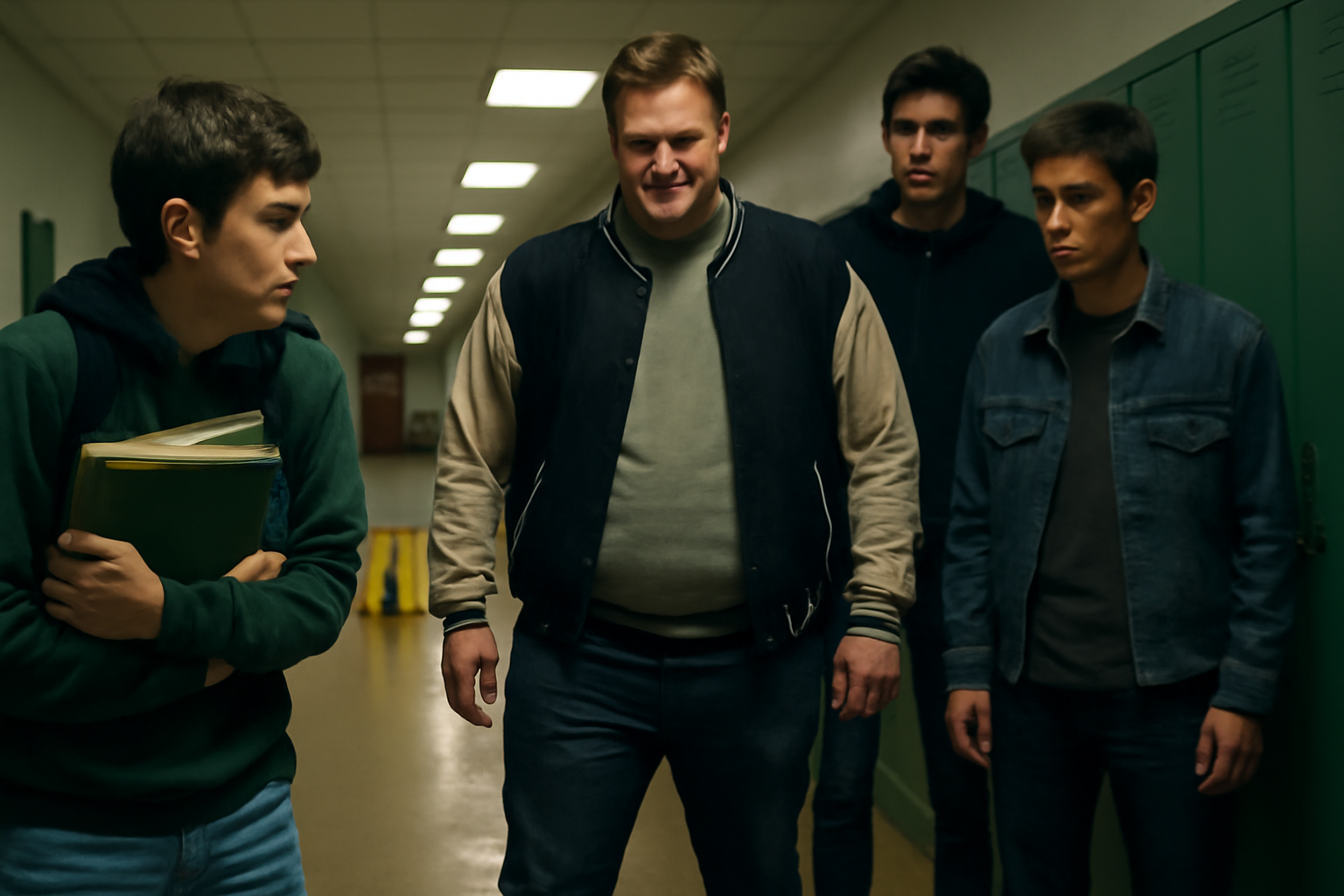
They were known as the “Toll Collectors,” though never to their faces. Led by a senior named Marcus—a linebacker with a neck as thick as a tree trunk and eyes devoid of empathy—they specialized in “checking.” It was a simple, brutal tactic. They would walk three or four abreast in the hallway, identify a target, and shoulder-check them hard. If the victim dropped their books, they laughed. If the victim fought back, they swarmed.
But usually, they just used the intimidation to herd the victim into a quiet corner, usually the blind spot of the stairwell, to relieve them of anything valuable.
Leo knew the geography of the school. He knew where to walk and where to avoid. He planned his route to first period: enter through the main doors, stick to the populated corridor near the administration office, and duck into AP English.
The morning of the first day, Leo laced up the Jordans. They were pristine. Not a crease, not a smudge. He felt taller. He felt armored. He kissed his mom goodbye and walked out the door, the morning sun gleaming off the white leather.
When he stepped off the bus, he felt the eyes. For the first time, people weren’t looking through him; they were looking at him. A couple of sophomores nodded. A girl he had a crush on since ninth grade, Maya, actually smiled and said, “Nice kicks, Leo.”
His heart soared. The sweat, the heat, Mrs. Higgins’ yelling—it was all worth it. He felt like he belonged.
Chapter 2: The Dead Zone
He navigated the morning classes with a new confidence. He participated in discussions, joked with friends, and walked with his head up. He forgot, for a few hours, that in the ecosystem of high school, rising up the food chain makes you more visible to the predators.
It was during the transition between third and fourth period that he made a mistake. The main hallway was gridlocked with students. To get to history class on time, he needed to take a shortcut. He looked at the clock on the wall. Three minutes to the bell. If he took the East Wing hallway, he could beat the crowd.
He hesitated. The East Wing was Marcus’s territory. But he scanned the crowd and didn’t see the familiar varsity jackets of the Toll Collectors. They’re probably out to lunch or smoking behind the bleachers, he reasoned.
Leo turned the corner into the East Wing. It was quieter here. The lockers were older, the lights dimmed by a flickering ballast. He walked briskly, the squeak of his new soles on the linoleum sounding loud in the semi-silence.
He was halfway down the hall when the door to the boys’ bathroom swung open.
Three figures stepped out.
Leo’s heart hammered against his ribs like a trapped bird. In the center was Marcus, chewing on a toothpick, wearing a grin that didn’t reach his cold, dead eyes. Flanking him were his two lieutenants, jackals named Ty and Davis.
Leo slowed down, hugging his books to his chest. Just keep walking, he told himself. Don’t make eye contact. Just walk past.
Marcus stopped in the middle of the hallway, blocking the path. He looked down at Leo’s feet, then slowly panned up to his face.
“Well, well,” Marcus said, his voice a low rumble. “Look at this. Little Leo got an upgrade.”
“Just trying to get to class, Marcus,” Leo said, his voice surprisingly steady, though his knees felt like water.
“We all are, Leo. We all are,” Marcus said, taking a step forward. Ty and Davis fanned out, cutting off Leo’s retreat. “But you know, there’s a toll for using the express lane.”
The air in the hallway seemed to drop ten degrees. Leo took a step back, but he felt the cold metal of a locker handle dig into his spine. He was boxed in.
“I don’t have any money, Marcus,” Leo lied. He had ten dollars lunch money in his pocket, but he knew that wasn’t what they were after.
Marcus chuckled, a dry, humorless sound. “Money? Nah. Inflation, man. The dollar ain’t worth what it used to be.” He pointed a thick finger at Leo’s feet. “But those? Those hold value.”
Leo’s stomach dropped. “No,” he said instinctively. “I worked all summer for these.”
“That’s cute,” Ty sneered from the left. “He thinks effort matters.”
“Let’s see if they fit,” Marcus said, lunging forward.
Leo tried to dodge, but Davis caught him with a hard shoulder check—”The Check.” It wasn’t just a bump; it was a calculated collision designed to off-balance and disorient. Leo stumbled sideways, his books crashing to the floor. Before he could regain his footing, Marcus grabbed him by the collar of his new shirt.
“Don’t make this messy, Leo,” Marcus whispered, his breath smelling of stale tobacco. “We can do this right here, or we can go to the office. Oh wait, no, we can’t go to the office. Snitches get stitches, right?”
“Get off me!” Leo shouted, shoving Marcus. It was a mistake.
Marcus’s face hardened. He signaled to the others. They grabbed Leo by the arms and dragged him towards the heavy fire door that led to the East Stairwell. This was a dead zone. No cameras. No teachers. Just concrete and echoes.
Leo struggled, kicking out. The pristine white rubber of his left shoe scuffed against the floor, leaving a black mark. The sight of it made him furious. He thrashed, landing a kick on Ty’s shin.
Ty yelped and punched Leo hard in the ribs. The wind left Leo’s lungs in a wheezing gasp. He folded over, gasping for air.
They threw him into the stairwell. He stumbled and fell onto the cold concrete landing, scraping his palms. The heavy door slammed shut behind them, muffling the sounds of the school, sealing them in a concrete acoustic chamber.
“You shouldn’t have kicked him,” Marcus said, shaking his head as if disappointed in a misbehaving puppy. “Now the tax went up. Shoes and the jacket.”
“No,” Leo wheezed, standing up. He backed into the corner where the railings met. “You’re not taking them.”
“Look at him,” Davis laughed. “He thinks he has a choice.”
Marcus cracked his knuckles. “Last chance, Leo. Take ’em off, or we beat you until you can’t walk, and we take ’em off your unconscious body. Either way, we’re walking out with those 4s.”
Leo looked at the three of them. They were bigger, stronger, and meaner. He thought about Mrs. Higgins’ lawn. He thought about the sweat. He thought about his mom’s warning. Tears of frustration and rage pricked his eyes. It wasn’t fair. It wasn’t right.
But he knew the physics of the situation. If he fought, he’d lose the shoes and his teeth.
Trembling with humiliation, Leo bent down. His fingers shook so badly he could barely untie the laces.
“Faster,” Ty barked, kicking Leo’s foot.
Leo pulled the shoes off. The cool air hit his socked feet, making him feel naked and vulnerable. He handed them to Marcus, unable to look him in the eye.
Marcus held them up, inspecting them like a diamond appraiser. “Size 10. Perfect. Thanks for breaking them in for me.” He tossed his own battered sneakers at Leo. “Trade-in value. You’re welcome.”
“Jacket too,” Davis reminded him.
Leo peeled off his denim jacket. They took that, too.
“Pleasure doing business, Leo,” Marcus smirked. “Now, stay here for ten minutes. If you come out before then…” He made a slashing motion across his throat.
The three bullies turned and exited the stairwell, laughing and high-fiving. The door clicked shut.
Leo stood alone in the dim light of the stairwell, standing in his socks on the dirty concrete. He looked at the battered, smelly sneakers Marcus had thrown at him. He didn’t put them on. He just slid down the wall, pulled his knees to his chest, and buried his face in his arms. The shame was hotter than the summer sun. He felt foolish for thinking a pair of shoes could change his life. He felt weak.
He didn’t hear the service door on the landing above him open quietly.
Chapter 3: The Silent Guardian
The sound wasn’t a slam. It was the slow, deliberate groan of a heavy metal hinge needing oil.
Leo froze. He was still huddled in the corner of the stairwell landing, his socked feet tucked beneath him, trying to make himself as small as possible. The shame was a physical weight, pressing down on his chest. He didn’t want anyone to see him like this. Not a teacher. Not another student. He just wanted to dissolve into the concrete.
He wiped his face aggressively with his forearm, sniffing back the tears that threatened to spill over. He expected another round of torment. Maybe Marcus had forgotten to take his watch. Maybe they just wanted to laugh a little more.
But the footsteps descending the metal stairs from the upper maintenance catwalk weren’t the hurried, chaotic stomps of teenagers. They were heavy, rhythmic, and slow. Clank. Pause. Clank. Pause.
Leo looked up, squinting into the gloom of the stairwell’s upper reaches.
Emerging from the shadows was a silhouette he recognized but had never truly seen. It was Mr. Henderson.
To the student body of Lincoln High, Mr. Henderson was just “The Janitor.” He was the background noise of their lives. He was the gray jumpsuit pushing a mop bucket during lunch. He was the man who unclogged the toilets and painted over the graffiti in the locker rooms. He was sixty-five, walked with a distinct limp—a souvenir from a tour in Da Nang back in ‘69—and usually kept his eyes on the floor.
But right now, his eyes were locked on Leo. And they weren’t the tired, passive eyes of a man counting down the minutes to retirement. They were sharp. flinty. The eyes of a man who had seen war and recognized a casualty when he saw one.
Mr. Henderson reached the landing. He didn’t say a word at first. He just stood there, a large ring of keys jangling softly at his hip. He looked at Leo, then at the empty space where the Jordans used to be, and finally at the battered, smelly sneakers Marcus had thrown on the floor.
Leo flinched as the old man moved, expecting a lecture about loitering or cutting class.
Instead, Mr. Henderson reached into the deep pocket of his coveralls and pulled out a pristine, ironed handkerchief. He held it out.
“Dry your eyes, son,” Mr. Henderson said. His voice was like grinding gravel, deep and rough, but surprisingly gentle. “Tears don’t fix leaks, and they don’t fix thieves.”
Leo took the handkerchief with a shaking hand. “I… I fell,” Leo lied, his voice cracking. The instinct to protect his pride was still fighting a losing battle. “I just… my shoes…”
“Cut the bull,” Mr. Henderson rumbled. He walked over to the corner where Marcus’s old, beat-up sneakers lay. With a look of utter disgust, he kicked them. They skittered across the concrete and hit the wall.
“Trash belongs in the trash,” he muttered. He turned back to Leo. “You’re Sarah’s boy, right? The one who’s been mowing the Higgins place on Oak Street all July?”
Leo blinked, stunned. “How did you know that?”
“I see a lot of things, Leo. People think because I empty the trash, I am the trash. They don’t look at me. So I get to look at them.” Mr. Henderson gestured to the metal grate of the catwalk above them. “I was changing the ballast in the emergency light up there. I’ve been there for ten minutes.”
A cold chill went through Leo. “You saw them?”
“I saw them,” Henderson nodded grimly. “Marcus Johnson. Tyrell Davis. And that little weasel Davis Smith. I saw the shoulder check. I saw them drag you in here. And I saw them take what you earned.”
Leo looked down at his socks. “I couldn’t fight them. There were three of them.”
“You did the right thing,” Henderson said firmly. “Shoes you can replace. Teeth are expensive. You survived. That’s step one.”
The old man extended a hand. It was calloused, rough as sandpaper, and swallowed Leo’s hand completely. He pulled the teenager to his feet with surprising strength.
“Come on,” Henderson said.
“I can’t go to class like this,” Leo panicked, looking at his feet. “Everyone will know.”
“We ain’t going to class,” Henderson said, opening the door not to the hallway, but to a service elevator Leo didn’t even know existed. “We’re going to my office. It’s warm, and I got a coffee pot. And more importantly, I got a phone.”
“I can’t tell the Principal,” Leo whispered, terror seizing him again. “Marcus said… he said snitches get stitches. He runs the East Wing. If I talk, he’ll kill me.”
Mr. Henderson stopped holding the elevator door. He leaned in close, his face serious.
“Leo, there’s a difference between snitching and reporting a crime,” he said. “Snitching is when you tattle on someone for cutting line or smoking a cigarette to get ahead. This? This is robbery. This is assault. And let me tell you something about bullies like Marcus. They rely on your silence. Your silence is their armor. You strip that away, and they’re just scared little boys playing gangster.”
He tapped the side of his chest pocket.
“Besides,” Henderson added, a dark glint in his eye. “You ain’t the one telling. I am.”
Chapter 4: The Evidence
The “office” was actually a converted section of the boiler room in the basement. It hummed with the steady vibration of the school’s heating system. It smelled of lemon industrial cleaner, old coffee, and sawdust. To Leo, it felt like a bunker. A safe house.
Mr. Henderson pulled up a folding chair for Leo and poured him a cup of water from a cooler. Then, he sat behind his metal desk, which was cluttered with work orders and spare parts.
Leo sipped the water, his hands finally stopping their trembling. “You said you’re going to tell? But it’s your word against theirs. Marcus is the star linebacker. The administration loves him. They’ll just say I lost them or sold them.”
Mr. Henderson didn’t answer immediately. He fished a smartphone out of his pocket. It was an older model, the screen cracked in the corner, but the camera lens was clean.
“People think old men don’t know how to use technology,” Henderson chuckled dryly. “Big mistake.”
He tapped the screen a few times and turned the phone toward Leo.
On the small screen, a shaky but clear video played. It was shot from a high angle, looking down through the metal grate of the stairwell landing. The audio was echoey but intelligible.
“Money? Nah. Inflation, man…” Marcus’s voice tinny but distinct.
Leo watched in horror and fascination as the scene replayed. He saw himself get shoved. He saw the kick. He saw the humiliation of unlacing his shoes. He saw Marcus holding them up like a trophy.
“Pleasure doing business, Leo.”
The video ended.
“I started recording the second they pushed you through the door,” Henderson said, placing the phone on the desk like a loaded gun. “I’ve got faces. I’ve got names. I’ve got the theft clearly captured. In the state of Georgia, this is admissible.”
“You recorded it?” Leo breathed out.
“I’m the eyes of this school, son,” Henderson said. “I’ve been waiting for Marcus to slip up. He’s been breaking lockers and terrorizing freshmen for two years. But today? Today he graduated to a felony.”
Mr. Henderson picked up the landline on his desk. He didn’t dial the main office. He didn’t dial the Principal’s secretary. He dialed a direct number he had memorized.
“Who are you calling?” Leo asked.
“Not the school,” Henderson said. “Schools like to handle things ‘internally.’ They like to suspend kids for three days and make them write apology letters. We aren’t doing that today.”
The line clicked.
“Dispatch? This is Henderson over at Lincoln High. Let me speak to Miller. Yeah, tell him it’s important.”
He waited a beat, drumming his fingers on the desk.
“Miller? It’s Henderson. I need a unit at the high school. No, not a noise complaint. I’ve got a 211 in progress. Strong-arm robbery. Victim is a minor. Perpetrators are on campus.”
He paused, listening.
“Yeah, I have positive ID. And Miller? I have video evidence of the assault. Bring the cuffs. And call Sarah Williams at the diner; tell her to get here. It’s her boy.”
He hung up. The click sounded final.
“Now,” Henderson said, leaning back in his creaky chair. “We wait.”
The next twenty minutes were the longest of Leo’s life. He sat in the boiler room, the hum of the machinery filling the silence. He thought about the summer. The 90-degree days. The smell of cut grass. The way his back ached. He thought about how proud he felt walking into school that morning.
“Do you think I’m stupid?” Leo asked suddenly, breaking the silence. “For spending that much money on shoes?”
Mr. Henderson looked at him over the rim of a coffee mug. “I think a man works for what he wants. It ain’t about the leather and the rubber, Leo. It’s about the work. You didn’t buy shoes. You bought a trophy for your own discipline. Nobody has the right to take that trophy.”
The heavy steel door to the boiler room opened. It wasn’t the police yet. It was Leo’s mom.
She was still wearing her diner uniform, a stained apron tied around her waist. Her hair was messy, flying out of her ponytail. She looked frantic. Officer Miller must have called her cell.
“Leo!” she screamed, rushing forward. She grabbed his face, checking him for bruises, checking his eyes. “Are you okay? Did they hurt you?”
“I’m okay, Ma,” Leo said, his voice small. “I’m okay.”
She looked down at his feet. At the white socks stained with the dust of the boiler room floor. Her face crumbled for a split second—pain, heartbreak, financial stress all washing over her. But then, it hardened. The worry evaporated, replaced by a cold, white-hot fury.
She turned to Mr. Henderson. “Who did it?”
“Marcus Johnson,” Henderson said calmly. “And his crew.”
“Where are they?” she demanded, looking ready to storm the cafeteria herself.
“They’re in fourth period,” Henderson said. “Physics, I believe.”
At that moment, the boiler room door opened again. Two uniformed officers stepped in. One was Officer Miller, a man Leo recognized from around town. He was big, bald, and looked like he ate concrete for breakfast.
“Mr. Henderson,” Miller nodded. “Sarah.”
“They took his shoes, Miller,” Sarah said, her voice shaking with rage. “He worked all summer.”
“I know,” Miller said. He looked at Leo. “You ready to tell me what happened, son?”
Leo looked at his mom. He looked at Mr. Henderson, who gave him a subtle nod. He took a deep breath.
“Yes, sir,” Leo said.
Miller listened, taking notes. Then he turned to Henderson. “Let me see the video.”
Henderson played it. Miller watched it once. Then he watched it again. His jaw tightened.
“That’s enough,” Miller said. “That’s robbery by force. That’s a felony.”
He keyed his radio. “Dispatch, we are 10-4 at the scene. Proceeding to the suspect’s location. Advise the Principal we are coming in. We are executing an arrest.”
Miller looked at Leo. “You stay here with your mom. We’ll bring your property back.”
“Wait,” Henderson said, standing up. He grabbed his mop bucket. “I’m coming too.”
“You don’t need to do that, Henderson,” Miller said.
“Someone’s got to clean up the mess,” the janitor said, his eyes hard. “And I want to see the look on Marcus’s face when he realizes the walls have eyes.”
Chapter 5: The Long Walk
The hallways of Lincoln High were usually a sanctuary during fourth period. It was the quiet time. The only sounds were the muffled drones of teachers lecturing on history or calculus behind closed doors.
But that silence was about to be shattered.
Officer Miller walked with a purpose that made the linoleum floor shake. His hand rested near his belt, not on his weapon, but with an air of authority that screamed business. Beside him walked a second officer, a younger guy named Ramirez. And flanking them was Mr. Henderson.
Mr. Henderson wasn’t pushing a mop this time. He wasn’t looking down. He was walking stride for stride with the law, his jaw set in a line of grim determination.
As they passed the administrative offices, the door flew open. Principal Vance stepped out, his face flushed. He was a man who cared about two things: test scores and the football team’s win record. Marcus Johnson was vital to the second one.
“Officer Miller!” Vance hissed, trying to keep his voice down but failing. “What is the meaning of this? You can’t just storm into my school in the middle of a lesson. If there’s an issue with a student, we handle it in my office.”
Miller didn’t even slow down. He kept walking, forcing the Principal to scurry alongside them like a nervous terrier.
“This isn’t a school issue anymore, Vance,” Miller said, his voice carrying down the empty hall. “It’s a criminal one.”
“It’s a misunderstanding!” Vance argued, wiping sweat from his upper lip. “I’m sure whatever Leo said—”
“Leo didn’t say anything,” Miller cut him off, stopping abruptly. He turned to face the Principal. “Mr. Henderson did.”
Vance looked at the janitor as if noticing him for the first time in years. “The… janitor?”
“The witness,” Henderson corrected, his voice deep and resonant. “And I have it in 4K, Mr. Vance. Your star linebacker committed a felony. Robbery by sudden snatching. Assault. Intimidation. If you want to obstruct this investigation, I’m sure the school board would love to see the video of you trying to protect a violent criminal.”
Vance’s mouth opened and closed like a fish out of water. He stepped back, defeated. The hierarchy had just flipped. The man with the keys to the trash cans held more power than the man with the keys to the office.
“Room 204. Physics,” Miller said to his partner.
They marched on.
The destination was just ahead. The door to Mr. Harrison’s physics class was closed. Through the narrow vertical window, you could see the students hunching over their desks.
Miller didn’t knock.
Chapter 6: The Taking
The door swung open with a heavy thud that silenced the room instantly.
Mr. Harrison, holding a dry-erase marker, froze mid-equation. Thirty heads whipped around.
At the back of the room, lounging in his chair with his legs stretched out into the aisle, was Marcus. He looked bored. He looked untouchable.
And on his feet, gleaming under the fluorescent lights, were the white Jordan 4s.
He hadn’t even bothered to hide them. Why would he? In his mind, he owned the school. Leo was just a supplier.
Officer Miller stepped into the room. The air was so thick with tension you could choke on it. He scanned the room, his eyes locking onto the back row.
“Marcus Johnson,” Miller barked. “Stand up.”
Marcus blinked. A flicker of confusion crossed his face, followed by his trademark smirk. He didn’t stand. He leaned back further, crossing his arms.
“Is there a problem, Officer?” Marcus drawled. “I’m trying to learn about velocity here.”
“The only velocity you need to worry about is how fast you’re going to the station,” Miller said, walking down the aisle. The other students pulled their desks away, parting the sea.
“For what?” Marcus laughed, looking around at his friends for support. Ty and Davis were in the next row, but they weren’t laughing. They looked pale. They saw Henderson standing in the doorway.
“Stand up, son. Now,” Miller commanded, stopping two feet from Marcus.
Marcus stood up slowly, towering over the officer. He puffed out his chest. “You got nothing on me. Whatever that little scrub Leo said, he’s lying. He sold me these shoes.”
“Sold them?” Miller raised an eyebrow. “For what price?”
“Trade,” Marcus lied smoothly. “My old ones for these. Fair exchange.”
From the doorway, a voice cut through the room.
“I didn’t see a trade, Marcus.”
Mr. Henderson stepped into the light. The class gasped. The janitor never spoke to the cool kids.
Marcus’s eyes widened. “You shut up, old man. You don’t know anything.”
“I know you hit him,” Henderson said, holding up his phone. “I know you cornered him in the East Stairwell. And I know you threatened to beat him unconscious if he didn’t give them up. It’s all right here. Cloud backup included.”
The color drained from Marcus’s face. The arrogance evaporated, leaving behind the scared kid Henderson had predicted.
“Turn around,” Miller said, pulling the handcuffs from his belt. The metallic ratchet-ratchet-ratchet of the cuffs tightening was the loudest sound in the world.
“You can’t do this!” Marcus shouted as Miller spun him around. “I have a game Friday! Coach!”
“You’re not making the game, Marcus,” Miller said, guiding him toward the door. “And Tyrell Davis? Davis Smith? Let’s go. You’re coming too. Accessories to robbery.”
As the three bullies were marched out of the classroom, Marcus looked down at his feet.
“And Marcus?” Miller stopped him at the door. “We’re gonna need those shoes back. Now.”
Right there in the hallway, in front of the Principal, the teachers, and the students peeking out of doorways, Marcus had to sit on the floor. With his hands cuffed behind his back, Officer Ramirez unlaced the Jordans and slid them off.
Marcus was hauled away in his socks.
Chapter 7: The Return
Back in the boiler room, the atmosphere was quiet. Leo was still sitting in the folding chair, his mom pacing back and forth.
The door opened. Officer Miller walked in, carrying a clear evidence bag. Inside, looking just as white and pristine as they had this morning, were the shoes.
“We processed them,” Miller said gently. “Took the photos for the D.A. Since we have the video evidence and the serial number match, I don’t need to keep the physical property in the locker. I think these belong to you.”
He handed the bag to Leo.
Leo took them. He felt the weight of them. An hour ago, they felt like a curse. Now, they felt like… justice.
“They arrested them?” Sarah asked, her hand on Leo’s shoulder.
“Booked on felony charges,” Miller nodded. “The Principal is already drafting the expulsion papers. The school board doesn’t mess around with video evidence of violence. Those boys won’t be walking these halls again.”
Leo unzipped the bag. He slid his feet into the shoes. They were still warm from Marcus’s feet, which made him grimace slightly, but he laced them up tight. He stood up.
He looked at Mr. Henderson, who was leaning against his mop bucket, sipping lukewarm coffee.
“Thank you,” Leo said. “You saved me.”
“I didn’t save you,” Henderson said, shaking his head. “I just turned on the lights. Cockroaches scatter when the lights come on.”
Leo’s mom walked over to the janitor and hugged him. She didn’t say anything, but she held on tight. Henderson, awkward and unused to affection, patted her back stiffly.
“He’s a good kid, Sarah,” Henderson said. “You raised a worker. That’s worth more than any sneaker.”
Officer Miller tipped his cap. “You take the rest of the day, Leo. Go get some ice cream or something. Stay out of trouble.”
As Leo and his mom walked out of the boiler room, Leo paused at the door. He looked back at the old man in the gray jumpsuit surrounded by pipes and cleaning supplies.
“Mr. Henderson?”
“Yeah, kid?”
“Can I… can I help you with the lawn at the stadium this weekend? I know you do it alone.”
Henderson smiled. A real smile that crinkled the corners of his eyes. “I start at 6 AM sharp. Don’t be late. And wear work boots, not those fancy things.”
Chapter 8: The New King
The following Monday, Leo walked up the steps of Lincoln High.
The air was different. The humidity had broken, replaced by a crisp early-autumn breeze.
He wore the Jordans. He had cleaned them with a toothbrush Sunday night to remove any trace of Marcus. They looked brand new.
As he walked through the main doors, the noise level dropped. Heads turned. People whispered. But it wasn’t the mocking whispers of before. It was something else. Awe. Respect. Fear, maybe?
The story had gone viral locally. Everyone had heard about the bust. Everyone knew that the “Toll Collectors” were gone. And everyone knew that Leo, the quiet kid who mowed lawns, was the one who took them down.
He walked toward the East Wing. He didn’t take the long way. He walked straight down the center of the hallway.
The spot where they had cornered him felt different now. It was just a hallway. The ghosts of his fear were gone.
He saw kids looking at his shoes. But he realized something as he walked to AP English. He wasn’t walking tall because of the shoes. The shoes were just leather and rubber. He was walking tall because he had survived. He had faced the worst the school had to offer and he was still standing.
He reached the stairs. He looked up toward the maintenance landing.
Mr. Henderson was there, polishing the railing.
The students flowed around the janitor like a river around a rock, ignoring him as usual. They didn’t see him. They didn’t know that the gray jumpsuit hid a guardian.
Leo stopped. He waited until Mr. Henderson looked down.
The old man caught his eye. He didn’t wave. He didn’t smile. He just gave a subtle, single nod. A soldier acknowledging another soldier.
Leo returned the nod.
“Nice kicks, Leo,” a junior said as he walked past, giving him a high-five.
“Thanks,” Leo said.
He looked down at the Jumpman logo. They were nice kicks. He had worked hard for them. But as he walked into class, Leo knew the truth.
The shoes didn’t make the man. The man made the shoes.
And the man who swept the floors was the tallest giant in the building.
[END OF STORY]