They Mocked A Poor Orphan For Wearing A “Trash” Jacket. Then A 4-Star General Walked In And Dropped To His Knees.
Chapter 1: The Green Monster and the Hallway of Wolves
The November wind in Arlington, Virginia, had a bite to it that went straight to the bone. It was the kind of cold that didn’t just chill the skin; it seemed to settle in the hollow spaces of the heart. For ten-year-old Leo Vance, the cold was a constant companion, second only to the gnawing hunger that rumbled quietly in his stomach.
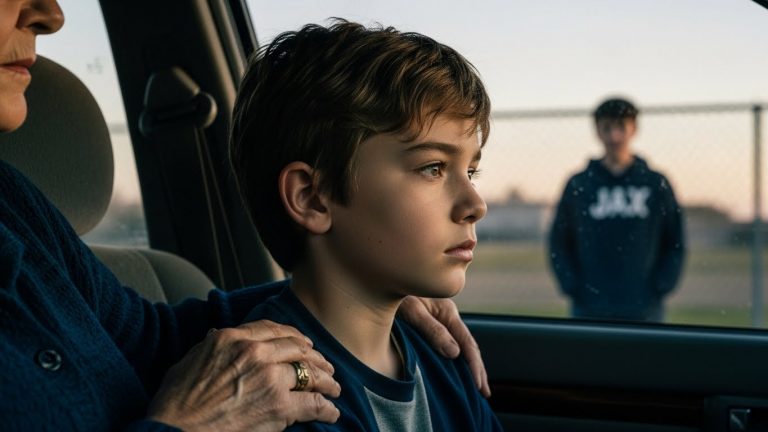
Leo stood at the bus stop, his small frame nearly swallowed whole by the only defense he had against the elements: an oversized, faded olive-drab field jacket. It hung off his shoulders like a tent. The sleeves were rolled up three times, revealing the fraying lining, and the hem knocked against his knees. It smelled faintly of mothballs, old tobacco, and something undefinable—something dusty and ancient that Leo imagined was the smell of courage.
To the kids at Crestwood Junior High, an affluent school where the parking lot was filled with SUVs that cost more than the house Leo shared with his foster mother, the coat was a punchline. To Leo, it was a hug. It was the only physical thing he had left of a father he couldn’t remember—a man who had vanished into the sandbox of the Middle East six years ago and returned only as a folded flag and a box of medals Leo wasn’t allowed to touch.
“Check it out, it’s G.I. Joke,” a voice sneered from behind him as the yellow school bus hissed to a halt.
Leo didn’t need to turn around to know it was Chad Kensington. Chad was twelve, wore brand-name athletic gear that was replaced every season, and had the cruel, predatory instinct of someone who had never heard the word “no” in his entire life.
Leo kept his head down, clutching the lapels of the jacket tighter. He climbed the steps of the bus, ignoring the snickers that rippled through the seats like a contagion. He found his usual spot—third row from the back, window seat—and pressed his forehead against the cold glass.
Tomorrow was Veterans Day. The school was buzzing with performative patriotism. There were paper flags taped to the lockers and a banner in the cafeteria that read “Thank You For Your Service.” For most of the students, it meant a day off school and maybe a barbecue if the weather held. For Leo, it was the hardest day of the year. It was the day the silence in his life felt deafening.
When the bus arrived at Crestwood, Leo waited for the crush of students to exit before he moved. He wanted to be invisible. He wanted to float through the hallways like a ghost, get his work done, and go home. But invisibility was a luxury Leo couldn’t afford. His poverty was too loud; his jacket was too conspicuous.
He made it through his morning classes unscathed, though he felt the eyes on him. The stares were heavy, filled with a mixture of pity and disgust that made his skin crawl. But the real gauntlet awaited him after third period: the main hallway leading to the cafeteria.
It was known as “The Runway.” It was where the social hierarchy of Crestwood was enforced. And today, Chad and his varsity crew were holding court.
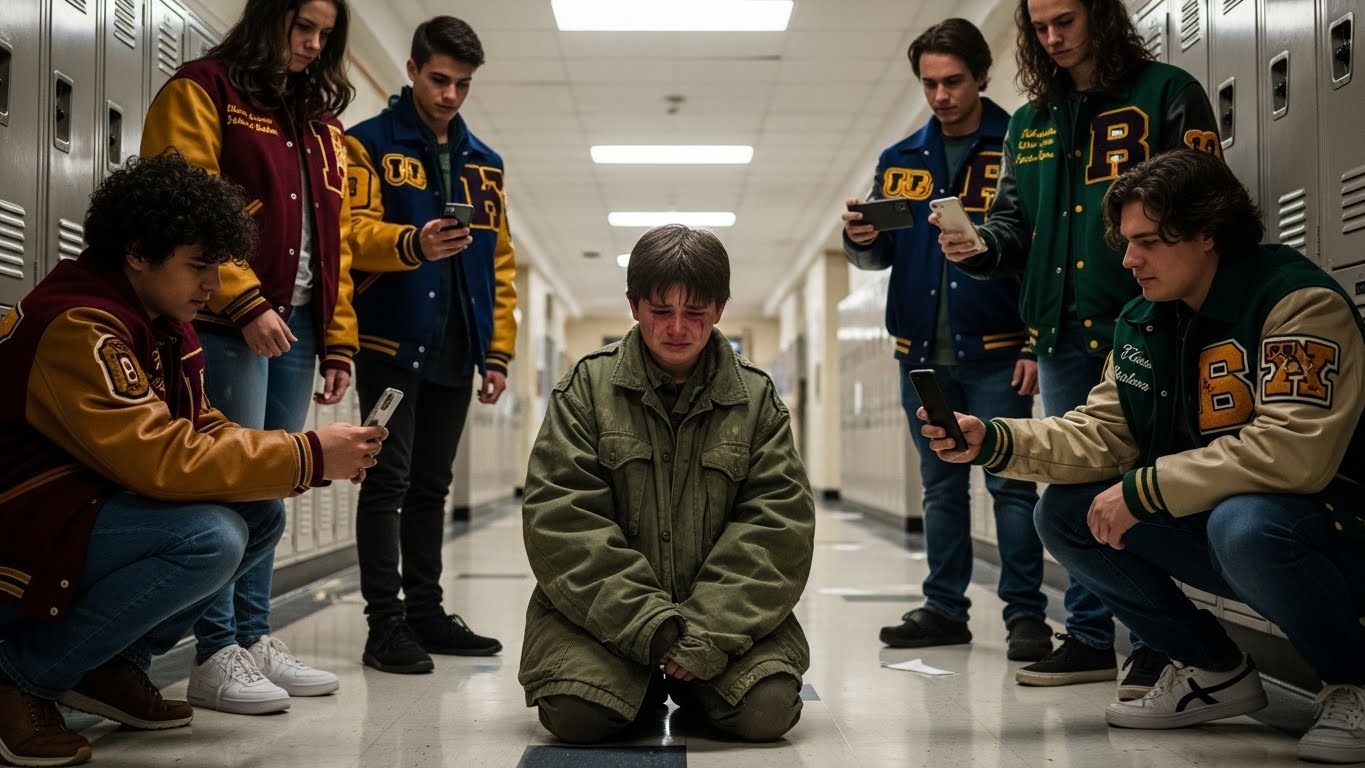
As Leo turned the corner, hugging his books to his chest, he saw them. Chad was leaning against a locker, spinning a football in his hands, surrounded by five other boys wearing matching letterman jackets. They looked like a wall of blue and gold nylon.
Leo’s heart hammered against his ribs. Just keep walking. Don’t look up. Don’t engage.
He hugged the wall, trying to slip past the perimeter of their laughter. He was almost clear, almost safe, when a pristine white sneaker shot out.
It was calculated and precise. Leo tripped. His books went flying, scattering across the polished linoleum with a loud clatter. He hit the ground hard, his palms skidding against the cold tile, his knees banging painfully.
The hallway, which had been filled with the low roar of conversation, suddenly went quiet. Then, the laughter started. It wasn’t the warm laughter of friends sharing a joke; it was the sharp, jagged laughter of a pack closing in on prey.
“Watch your step, Hobo,” Chad laughed, stepping away from the wall to loom over Leo.
Leo scrambled to his knees, reaching for his math textbook. “I… I didn’t see you.”
“Didn’t see me?” Chad mocked, kicking the book just out of Leo’s reach. “Maybe if you didn’t have that trash bag over your head, you could see where you were going.”
One of Chad’s friends, a tall boy named Bryce, pulled out his smartphone. “Record this. This is gold.”
“Please,” Leo whispered, his voice trembling. “Just let me go.”
“Let you go?” Chad sneered. He reached down and grabbed the collar of Leo’s oversized jacket. He yanked upwards. Leo, malnourished and small for his age, was hauled to his feet, dangling like a puppet.
“Where did you get this, huh?” Chad demanded, shaking him. The smell of mothballs wafted into the air, and Chad wrinkled his nose in exaggerated disgust. “God, it smells like a dead raccoon. Did you dig this out of a dumpster, Trash Can G.I. Joe?”
“It’s my dad’s,” Leo choked out, tears stinging his eyes. “Put me down.”
“Your dad’s?” Chad laughed, looking at the camera Bryce was holding. “so your dad was a bum too? Did he panic and run away, leaving his coat behind?”
The cruelty was so specific, so cutting, that Leo felt the air leave his lungs. He struggled, but Chad was stronger.
“Kneel,” Chad commanded, shoving Leo back down toward the floor.
Leo crumbled, his knees hitting the hard tile again. He was surrounded now. Six boys, wealthy, well-fed, and bored, circling a boy who had nothing.
“Apologize for polluting our air with that smell,” Chad said, grinning for the camera. “Beg for forgiveness.”
Leo didn’t fight back. He couldn’t. The weight of his reality—the empty house, the foster system, the missing father—crashed down on him. He just clutched the oversized jacket tighter, wrapping the rough cotton around himself as a shield that was failing. Tears streamed silently down his face, hot tracks on cold skin.
“I said beg!” Chad shouted, drunk on his own power.
The hallway was packed with onlookers. Students, teachers, even the Vice Principal stood at the far end, hesitating. No one moved. No one spoke. The fear of social ostracization paralyzed the good kids, and indifference paralyzed the adults.
Leo closed his eyes, waiting for the next shove, the next kick. He wished he could disappear. He wished the floor would open up and swallow him whole.
But the shove never came.
Chapter 2: The Eagle and the Star
The laughter was at its peak, a cacophony of malice echoing off the metal lockers. And then, it was sliced through by a sound so sharp, so distinct, that it cut the noise like a guillotine.
Clack. Clack. Clack.
It was the rhythmic, heavy strike of hard leather soles on linoleum. It wasn’t the shuffle of sneakers or the click of heels. It was a cadence. Precise. Militant. Dangerous.
The silence started at the back of the hallway, near the double doors, and rolled forward like a wave. The laughter died in throats. Heads turned. Eyes widened.
Chad, still looming over Leo, frowned. He looked up, annoyed that his show had been interrupted.
Standing at the end of the hallway was a figure that seemed to suck the oxygen out of the room. He was a mountain of a man, standing six-foot-four, with posture so erect it looked painful. He was dressed in the United States Army Dress Blues—the formal evening uniform.
The dark blue coat was immaculate, tailored to perfection. The gold stripes on the trousers were razor-sharp. But it was the chest of the coat that mesmerized the students. It was a wall of color—rows upon rows of ribbons and medals that caught the fluorescent lights and threw them back as fire.
And on his shoulders, flashing silver, were four stars.
General Thomas “Iron” Sterling. The face from the nightly news. The man who had coordinated the defense of half the free world. A living legend.
Behind him were two Military Police officers, their faces hidden behind dark sunglasses despite being indoors, and the School Principal, who looked pale, sweaty, and on the verge of a cardiac event.
General Sterling didn’t look at the Principal. He didn’t look at the crowd. His eyes, the color of gunmetal grey, were locked on one point: Chad Kensington.
“Drop the phone,” the General said.
His voice wasn’t loud. He didn’t shout. He didn’t have to. It was a voice that had commanded tank divisions and air strikes. It was a voice that vibrated in the chest of everyone who heard it.
Bryce, the boy filming, dropped his phone. It hit the floor with a crack that sounded like a gunshot in the silent hallway.
Chad froze. His hand was still gripping the collar of Leo’s jacket.
“Remove your hand,” Sterling commanded. “Now.”
Chad released Leo instantly, stumbling back as if the jacket had suddenly turned red hot. “I… we were just…”
The General began to walk. Clack. Clack. Clack. The crowd parted like the Red Sea. No one dared to breathe. The atmosphere shifted from a school hallway to a courtroom, and the verdict was already being written.
General Sterling stopped three feet from where Leo was kneeling. The boy was still trembling, his eyes squeezed shut, bracing for more pain.
The General ignored Chad. He ignored the MPs. He ignored the Principal who was stammering apologies in the background.
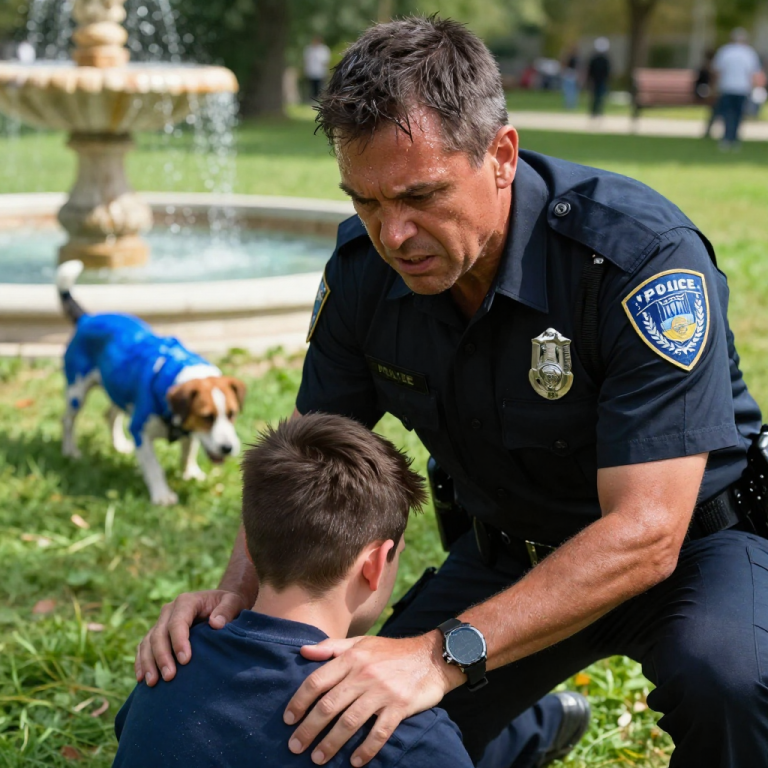
Slowly, painfully slowly, the 4-Star General lowered himself. The fabric of his pristine uniform stretched as he went down on one knee. He didn’t look down on the boy; he brought himself to the boy’s level.
A collective gasp went through the student body. A General did not kneel. Not for anyone.
“Trooper,” Sterling said, his voice softening instantly. “Look at me.”
Leo opened his eyes. He saw the medals. He saw the stern, lined face that was suddenly kind. He saw the stars.
“Sir?” Leo whispered, his voice barely audible.
The General reached out. His hand, large and scarred, gently brushed the faded name tape on the oversized olive-drab jacket. The name tape read: VANCE.
“That’s a heavy coat you’re wearing, son,” Sterling said. “Do you know whose jacket this is?”
Leo sniffled, wiping his nose with the back of his hand. “My dad’s. He… he never came back.”
The General nodded slowly. He closed his eyes for a second, as if in pain, then opened them again. He stood up.
When he turned to face Chad and his crew, the kindness was gone. In its place was a cold, terrifying fury.
“You think this is funny?” Sterling asked. He pointed a gloved finger at the jacket Leo was wearing. “You think this is a costume? A joke?”
Chad was shaking now. “It… it smells. It’s old rags. We were just—”
“Rags?” The General’s voice rose, thundering off the walls. “You call this rags?”
He stepped forward, invading Chad’s personal space. Chad shrank back, hitting the lockers.
“You are laughing at a Silver Star,” Sterling barked. “You are laughing at a Purple Heart. You are laughing at the Distinguished Service Cross.”
The General turned to the silent crowd, addressing the entire school.
“This jacket,” he announced, gesturing to Leo, “belonged to Sergeant First Class Michael Vance. Ten years ago, in the Korangal Valley—a place you boys have only seen in video games—my convoy was ambushed. We were pinned down. Taking heavy fire from three sides.”
The silence was absolute. Even the air conditioning seemed to stop humming.
“I was a Colonel then,” Sterling continued, his voice thick with emotion. “I took shrapnel to the leg. I couldn’t move. A grenade landed five feet from me. Sergeant Vance didn’t hesitate. He didn’t think about his safety. He didn’t think about coming home to his newborn son.”
The General looked down at Leo.
“He jumped on top of me. He used his body as a shield. He took three bullets to the chest and the blast of that grenade to save my life.”
The General looked back at Chad, his eyes blazing. “I am alive today—I am standing here as a 4-Star General of the United States Army—because this boy’s father died protecting me. That ‘smell’ you mocked? That is the smell of a hero’s storage locker. That is the smell of sacrifice. That is the smell of a man who was ten times the man you will ever be.”
Chad was crying now. Silent, terrified tears. The shame was palpable. The students who had laughed earlier were looking at their shoes, their faces burning red.
“You forced him to kneel,” Sterling said, his voice dropping to a dangerous whisper. “You made the son of my savior kneel in the dirt.”
The General turned back to Leo. The anger vanished from his face, replaced by a profound respect.
Sterling snapped his heels together. He stood tall. And then, slowly, crisply, he raised his right hand to the brim of his cap.
He held the salute. A 4-Star General, saluting a ten-year-old boy in a ragged coat.
“Sergeant Vance’s son does not kneel for anyone,” Sterling declared, his voice breaking slightly. “Today, the Army kneels for you.”
The two MPs behind him snapped to attention and saluted. The Principal, realizing the gravity of the moment, awkwardly placed his hand over his heart.
Leo stood up. For the first time in his life, he didn’t feel small. He didn’t feel poor. He looked at the General, and then he looked at his jacket. It wasn’t a heavy weight anymore. It was armor.
Chapter 3: The Departure and the Long Salute
The hallway remained frozen in a tableau of shame and honor. The General held the salute for a full ten seconds—an eternity in the eyes of the students watching—before sharply cutting his hand down.
He stepped forward and placed his large hands on Leo’s shoulders.
“I’ve been looking for you, Leo,” Sterling said gently. “The bureaucracy… finding records… it took longer than I wanted. But I’m here now. And I’m not going anywhere.”
The General then did something that made the Vice Principal gasp. He began to unbutton his own heavy trench coat—a magnificent, high-quality wool coat that likely cost more than a teacher’s monthly salary.
He slid it off his shoulders and draped it over Leo. It was massive, swallowing the boy even more than the green jacket, but the symbolism was heavy enough to crush the room.
“It’s a bit big,” Sterling smiled, “but you’ll grow into it. Keep your dad’s jacket safe at home. Don’t wear it where fools can touch it.”
Then, Sterling took off his service cap—the one with the gold braid and the four silver stars pinned to it—and placed it gently on Leo’s head. The brim fell over Leo’s eyes, and for the first time that day, Leo laughed. A genuine, small giggle.
“Come on, trooper,” Sterling said, offering his hand. “I hear there’s a burger place in town that makes a decent milkshake. My treat.”
Leo took the General’s hand. It was warm and rough. “Yes, sir.”
As they began to walk away, leaving the stunned bullies in their wake, General Sterling paused. He turned his head slightly toward the Principal, who was sweating profusely against the trophy case.
“Mr. Principal,” Sterling said, his voice icy. “I noticed you standing there while this young man was assaulted.”
“I… General, I was just about to intervene,” the Principal lied, his voice cracking.
“I’m sure,” Sterling said dryly. “I am taking my godson to lunch. I expect his attendance record to be excused. And regarding the culture of your school…”
He glanced at Chad, who was still staring at the floor, the phone lying shattered near his feet.
“Fix your school,” Sterling warned, “or I will fix it for you. And trust me, you do not want the United States Army auditing your conduct policies.”
With that, he walked Leo out the double doors.
Outside, the air was still cold, but Leo didn’t feel it. A line of black SUVs was waiting at the curb. Soldiers opened the doors. Leo climbed in, the leather seats soft and warm.
As the motorcade pulled away, Leo looked out the tinted window. He saw Chad and the others watching from the school entrance, looking smaller than they ever had before.
“Did you really know him?” Leo asked quietly, looking up at the General seated beside him. “My dad?”
Sterling looked out the window, his eyes misty. “Best man I ever knew, Leo. He talked about you every single day. He used to show me your baby picture before every patrol. He loved you more than life itself.”
Leo leaned his head against the General’s arm. “I miss him.”
“I know,” Sterling said, putting an arm around the boy. “But you’re not alone anymore. You hear me? You are never going to be alone again.”
Twenty Years Later.
The sun beat down on the parade grounds of West Point Military Academy. It was a sea of grey and white uniforms, thousands of cadets standing in perfect formation.
The stadium was packed. Parents, senators, and dignitaries filled the stands.
At the podium stood the Valedictorian of the graduating class. He was tall, broad-shouldered, and had a jawline that looked carved from granite. He wore the grey uniform of a Cadet First Captain.
“Distinguished guests, families, and fellow cadets,” his voice rang out, strong and confident.
Leo Vance looked out at the crowd. He paused, looking down at the front row.
Sitting there, in a wheelchair, was an old man. His hair was snow white, his face lined with the map of a long life. A blanket was draped over his legs. But his eyes—those gunmetal grey eyes—were as sharp as ever.
Leo smiled.
“We are taught many things at this academy,” Leo continued. “Tactics. History. Engineering. But the most important lesson I ever learned didn’t happen in a classroom here. It happened in a hallway at Crestwood Junior High, twenty years ago.”
The crowd quieted.
“I learned that dignity is not found in the clothes you wear or the money in your pocket. I learned that true strength is not about making others feel small, but about lifting them up. And I learned that legacy is not what you leave behind for yourself, but what you give to others.”
Leo stepped out from behind the podium. He walked down the stairs of the stage, ignoring protocol. The silence in the stadium was heavy with anticipation.
He walked across the grass until he stood directly in front of the old man in the wheelchair.
Retired General Thomas Sterling looked up, his eyes shining with pride.
Leo Vance, now a Second Lieutenant in the United States Army, snapped his heels together. The sound echoed—Clack.
He raised his hand in a slow, perfect salute.
“Thank you, Dad,” Leo whispered.
The old General, his hands shaking with age and Parkinson’s, slowly lifted his hand. It took effort, but he returned the salute.
“At ease, soldier,” Sterling whispered back, a tear rolling down his weathered cheek. “At ease.”
The crowd erupted in applause, a thunderous sound that rolled across the Hudson River. But for Leo and Thomas, the noise faded away. There was only the bond between a boy who needed a father, and a soldier who needed a son—forged in the cold hallway of a junior high school, and sealed forever by a salute.