People Thought He Was Crazy for Eating Dinner with a Ghost Every Friday. But When He Gave the ‘Dead’ Son’s Meal to a Homeless Boy, the Secret He Was Hiding Changed Everything.
Chapter 1: The Table for Two
The rain in Detroit didn’t wash things clean; it just made the grime slicker. It was a cold, November rain, the kind that seeped into your bones and made your joints ache. For Terrence, the ache was familiar. It sat in his right knee, a souvenir from years of bending over motorcycle engines on concrete floors, but mostly, it sat in his chest.
He pushed open the door to “Sal’s Diner,” the bell overhead giving a pathetic, tinny jingle. The warmth hit him instantly, smelling of frying onions, old coffee, and industrial-strength floor cleaner. It was 7:00 PM on a Friday.
He walked to the back corner booth. He didn’t need to ask. It was always empty.
“Evening, Terrence,” Rosa called out from behind the counter. She was sixty, with hair dyed a defiant shade of red and eyes that had seen every tragedy the city had to offer.
“Evening, Rosa,” Terrence grunted. His voice was like gravel in a mixer—low, rough, and used sparingly.
He slid into the booth. The red vinyl was cracked, revealing yellow foam underneath. He placed his heavy hands on the table. They were mechanic’s hands—scarred, calloused, the knuckles swollen. No amount of scrubbing could get the oil out of the creases of his skin; it was part of his DNA now.
Rosa arrived with the notepad she never wrote in. “The usual?”
“Yeah. Two plates.”
“Meatloaf, extra gravy on the second one?”
“Yeah.”
She nodded and walked away. She didn’t ask “Is he coming?” anymore. She didn’t ask “Are you expecting someone?” She learned that lesson two years ago, the first time Terrence had snapped at her, his grief raw and bleeding. Now, she just brought the food.
Terrence looked at the empty seat across from him. He reached into his pocket and pulled out a small, framed photo, placing it face down on the table, then changing his mind and standing it up against the sugar dispenser.
It was Marcus. Seven years old. Missing a front tooth. Smiling like he had a secret that was going to make the whole world laugh.
“Hey, little man,” Terrence whispered. The noise of the diner—the clatter of silverware, the hiss of the grill—swallowed his voice. “Fixed a ’67 Harley today. You would’ve loved the sound of it. Like a lion waking up.”
He waited. Part of him, the part that was slowly going insane, expected an answer. Expected Marcus to bounce in, smelling like playground dirt and bubblegum.
But there was only silence.
Rosa returned with two steaming plates. She set one in front of Terrence and the other—the one with the extra gravy—in front of the empty seat. She lingered for a second, her hand resting on the edge of the table.
“It’s a bad night out there, Terrence,” she said softly. “Roads are slick.”
“I know,” he said, staring at the mashed potatoes on Marcus’s plate. “I walked.”
She sighed and walked away.
Terrence picked up his fork, but he didn’t eat. He just watched the steam rise from his son’s plate. This was the ritual. This was the penance. Every Friday for three years. He bought the meal Marcus had asked for the night he died. The night Terrence had said, “We’ll go next week, son, I’m too tired.”
And then the drunk driver happened. And “next week” never came.
So Terrence bought the meal now. He let it get cold. He paid for it. And then he went home to his apartment above the motorcycle shop and stared at the ceiling until the sun came up. It was a waste of money. It was morbid. It was necessary.
He was just about to signal Rosa for the check—he usually couldn’t stomach more than a few bites—when the door opened again.
A gust of wind blew rain into the entryway, making the few customers at the counter shiver.
Terrence looked up.
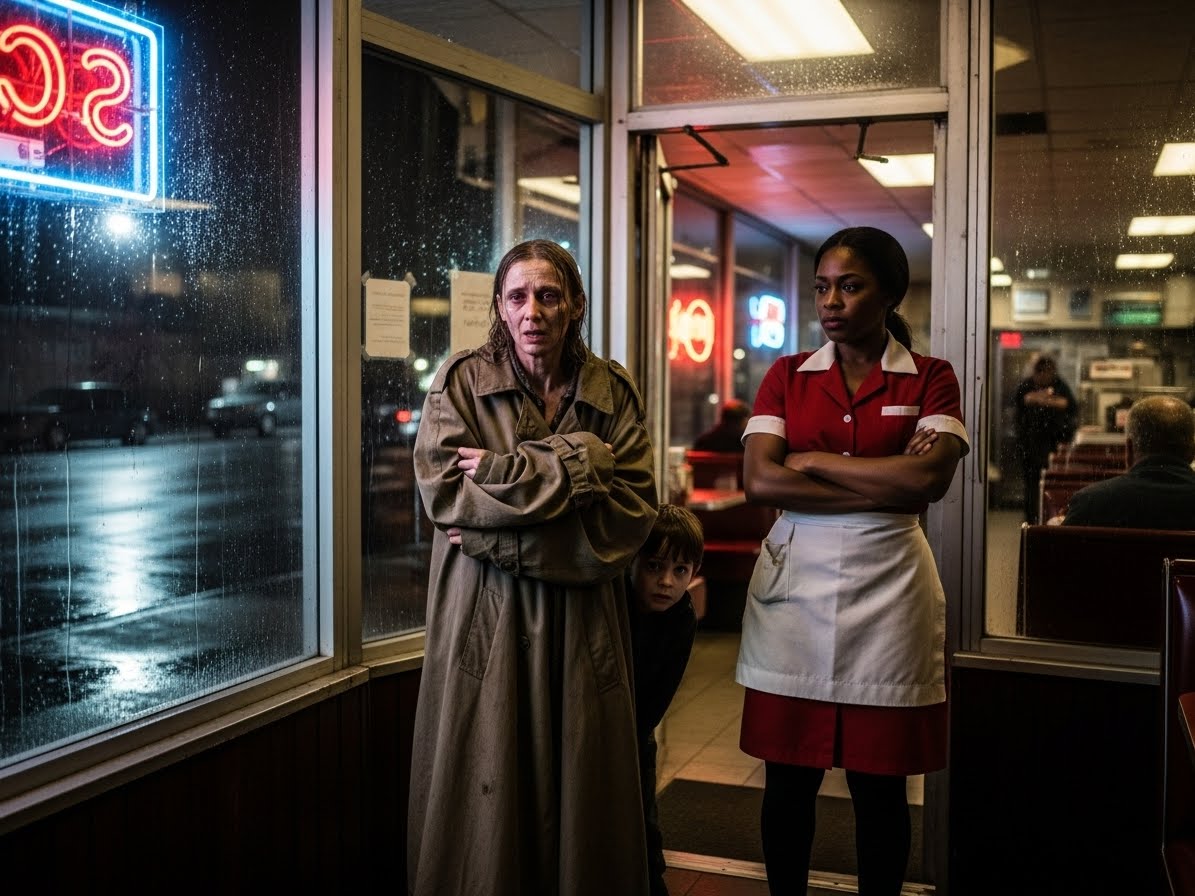
A woman stood there. She was soaking wet, her thin coat clinging to a frame that looked like it might snap in a strong breeze. She was young, maybe late twenties, but her eyes were old. They darted around the room, scanning for danger, scanning for mercy.
And clutching her leg, half-hidden in the folds of her coat, was a boy.
He was small. Too small. His hair was plastered to his forehead, and he was wearing sneakers that were falling apart, the toes wrapped in duct tape. He looked at the diner the way a starving dog looks at a butcher shop window.
Terrence felt a jolt in his chest. The boy was about the same height Marcus had been.
The woman took a tentative step inside. Rosa was there immediately, wiping her hands on a rag.
“Can I help you?” Rosa asked. Her tone wasn’t unkind, but it was firm. She was the gatekeeper.
“We…” The woman’s voice was hoarse. She cleared her throat. “We were wondering if we could sit. Just for a minute. To dry off.”
Rosa looked them over. She saw the lack of bags. The worn clothes. The desperation.
“You looking to order, honey?”
The woman hesitated. “I… I don’t have any cash on me right now. But my son, Elijah… he’s really cold. We just need ten minutes.”
The boy, Elijah, looked up at his mother, then at Rosa. His stomach gave a loud, audible growl that cut through the low hum of the diner conversation. He clamped his hands over his belly, his face flushing red with shame.
That sound—the sound of a hungry child—hit Terrence harder than a wrench to the skull.
“I’m sorry,” Rosa said, shaking her head. “Manager’s in the back. He sees people loitering, he takes it out on me. I can’t let you stay if you’re not a customer.”
“Please,” the woman whispered. Tears were starting to mix with the rain on her cheeks. “Just until the rain lets up.”
“I can’t,” Rosa said, turning back to the counter. “You gotta go.”
The woman nodded, defeated. She took the boy’s hand. “Come on, Elijah,” she murmured. “It’s okay. We’ll find somewhere else.”
The boy didn’t move. He was staring at Terrence’s table. Specifically, he was staring at the second plate. The mound of mashed potatoes. The thick slice of meatloaf swimming in gravy.
He wasn’t looking at it with greed. He was looking at it with pure, unadulterated need.
Terrence looked at the photo of Marcus. Then he looked at Elijah. The distance between the dead and the living suddenly felt very short.
“Stop.”
Terrence didn’t shout, but his voice carried. It was the voice he used when he told a customer their brakes were shot and they weren’t leaving the shop until they were fixed.
The woman froze. Rosa turned back around.
Terrence stood up. The vinyl of the booth squeaked in protest. He was six-foot-two, a wall of a man. He walked over to the entrance, his heavy boots thudding on the linoleum.
He stopped in front of the woman. Up close, she smelled like wet wool and fear.
“You hungry?” Terrence asked, looking down at the boy.
Elijah nodded, his eyes wide.
“They’re with me,” Terrence said to Rosa.
Rosa looked surprised. “Terrence, you sure? You want me to move you to a four-top?”
“No,” Terrence said. He gestured to his booth. “There’s plenty of room.”
He looked at the woman. “I’m Terrence.”
“Sarah,” she managed to say. “This is Elijah.”
“Well, Sarah,” Terrence said, pointing to the booth. “My friend Marcus stood me up tonight. He ordered the meatloaf. Hate to see it go to waste.”
Chapter 2: The Taste of Warmth
Sarah hesitated. She looked at Terrence with a mix of gratitude and suspicion that broke his heart. She had the look of a woman who had learned that nothing in this world was free.
“We can’t pay you back,” she warned him, her voice trembling. “I don’t have anything.”
“Did I ask for payment?” Terrence asked, his brow furrowing. “Food’s getting cold. Sit.”
She guided Elijah to the booth. They slid into the side opposite Terrence—the empty side. Elijah sat right in front of the second plate.
He stared at it, then up at Terrence, waiting for permission.
“Eat,” Terrence said gently.
Elijah didn’t need to be told twice. He picked up the fork—it looked huge in his small hand—and shoveled a mouthful of mashed potatoes in. He closed his eyes, a small whimper of pleasure escaping his throat.
Sarah watched him, her hand covering her mouth to hide the quiver of her lip.
“You too,” Terrence said, pushing his own plate toward her.
“No, I couldn’t taking your—”
“I ate lunch late,” Terrence lied. He hadn’t eaten since 6:00 AM. “Eat.”
She took a bite, tentatively at first, and then, once the taste of hot food hit her tongue, she couldn’t stop. They ate in silence, the only sound the clinking of forks against ceramic. Terrence watched them. For the first time in three years, the Friday night ritual didn’t feel like a funeral.
It felt like… dinner.
He watched Elijah wipe a smear of gravy from his chin. Marcus used to do that. Marcus used to get more food on his face than in his mouth. A phantom pain throbbed in Terrence’s chest, but it was duller than usual.
When the plates were licked clean, Rosa came by to clear the table. She gave Terrence a look he couldn’t quite read—something between respect and worry. She dropped the check.
Terrence pulled out a worn leather wallet and threw enough cash on the table to cover the meal and a heavy tip.
“Where you staying tonight?” he asked. He didn’t look at Sarah; he looked at his hands folded on the table.
The silence stretched out.
“We have a place,” Sarah said. It was a lie. A bad one.
“In the rain?” Terrence asked.
“We’ll figure it out,” she said, her defensive walls going back up. She grabbed her coat, pulling it tighter. “Thank you for the food. You saved us tonight. Really.”
She grabbed Elijah’s hand. “Come on, baby.”
Terrence watched them stand up. He saw the way Elijah shivered even though he was full. He saw the exhaustion in Sarah’s posture.
“I have a shop,” Terrence blurted out.
Sarah stopped. She turned slowly.
“A shop?”
“Motorcycle repair. East side. About ten minutes from here,” Terrence said. He felt awkward, his tongue feeling too big for his mouth. “There’s a back room. Used to be an office. It’s got a heater. A cot. It’s not the Ritz, but it’s dry.”
Sarah’s eyes narrowed. “Why?”
“Why what?”
“Why are you helping us? Men don’t just… help. Not without wanting something.”
Terrence looked at the photo of Marcus, still standing against the sugar dispenser. He picked it up and turned it around so she could see it.
“That’s my son,” Terrence said. “He’d be about Elijah’s age now.”
Sarah looked at the photo, then at Terrence. Her expression softened, the hard lines of survival easing just a fraction.
“Where is he?” she asked softly.
“He’s gone,” Terrence said. The words were simple, but they carried the weight of the world. “Three years.”
He put the photo back in his pocket. “I’m not asking for anything, Sarah. I’m just saying… it’s raining. And I’ve got space. That’s all.”
Sarah looked down at Elijah. The boy was leaning against her leg, his eyes drooping. He was warm, full, and ready to crash. If they went back out there, into the cold Detroit night, the warmth would vanish in minutes.
“Okay,” she whispered. “Just for tonight.”
The drive to the shop was silent. Terrence’s truck was an old Ford F-150, the cab smelling of oil and stale tobacco, though he hadn’t smoked in a decade. Elijah fell asleep instantly in the backseat, his head lolling against the window.
Terrence navigated the wet streets, his eyes constantly checking the rearview mirror. Not because he was being followed, but to make sure the boy was still there. To make sure he hadn’t hallucinated this whole thing.
They arrived at “T’s Moto-Works.” It was a squat brick building in an industrial park, surrounded by chain-link fencing.
Terrence unlocked the heavy metal door and flicked on the lights.
The shop was a cavern of shadows and chrome. Motorcycles in various states of undress stood on lifts—skeletons of steel and rubber. The smell of grease was stronger here, comforting to Terrence, overwhelming to Sarah.
“Back here,” Terrence said.
He led them through the maze of bikes to a small door at the rear. The room was tiny. It held a desk covered in invoices, a filing cabinet, and a narrow cot in the corner with a wool blanket.
Terrence walked over to a space heater in the corner and clicked it on. The coils glowed orange, humming to life.
“Bathroom is down the hall, second door on the left,” Terrence said. “I live upstairs. If you need anything… just holler.”
He turned to leave, feeling like an intruder in his own shop.
“Terrence?”
He stopped in the doorway.
Sarah was standing in the middle of the room, looking lost. “Thank you.”
He nodded, not trusting his voice.
He went upstairs to his apartment. It was sparse—a bed, a TV he rarely watched, and a kitchen he never used. He sat on the edge of his bed and listened.
He could hear the faint murmur of voices downstairs. Sarah talking to Elijah. The creak of the cot springs.
For three years, the silence in this building had been absolute. It had been a tomb.
Tonight, there was life.
Terrence lay back, staring at the ceiling. He closed his eyes and, for the first time in a thousand nights, he didn’t see the accident. He saw Elijah’s face when he took that first bite of meatloaf.
He drifted off to sleep, unaware that down in the shop, Sarah was awake, staring at the door, wondering if she had just made the best decision of her life, or the most dangerous one. She touched the bruise on her upper arm, hidden beneath the coat—a reminder of why she was running.
She hoped this mechanic, this grieving father, was as strong as he looked. Because the man she was running from wasn’t going to stop. And if he found them here…
Sarah shivered, pulling the blanket over her sleeping son. She prayed the rain would wash away their tracks.
But the rain never washes everything away.
Chapter 3: The Oil and the Soap
The sun rose over Detroit with a gray, industrial reluctance. Terrence woke up at 5:30 AM, his internal clock set by decades of opening the shop. He swung his heavy legs out of bed, the floorboards creaking under his weight.
He paused. The shop was usually silent in the morning, a vacuum of sound before the compressors kicked on. But today, there was a scrubbing sound. A rhythmic, wet swish-swish coming from downstairs.
Terrence pulled on his work boots and went down the metal staircase.
Sarah was on her hands and knees in the main bay of the garage. She had a bucket of soapy water and a stiff-bristled brush. She was scrubbing a patch of oil that had been there since the Bush administration. Her face was red, her hair tied back in a messy bun, and she was sweating despite the morning chill.
“What are you doing?” Terrence asked, his voice echoing off the concrete walls.
Sarah jumped, dropping the brush. “Oh! I… I’m sorry. I woke up early. I just… I wanted to do something. To say thank you.”
Terrence looked at the floor. The concrete was lighter, the black stain fading. “You don’t have to clean my floor, Sarah.”
“I can’t just take from you,” she said, wringing out a rag. Her hands were raw, the knuckles red from the cold water and harsh soap. “I need to earn our keep. Please.”
Terrence looked at her. He saw the pride in her eyes. It was a fragile thing, easily broken, and he didn’t want to be the one to break it.
“Fine,” he grunted. “But use the degreaser in the red bottle. Dish soap won’t cut that oil.”
That morning, while Elijah slept curled up under the wool blankets, Terrence made a call.
“Rosa, it’s me.”
“Terrence? Everything okay? You didn’t leave your wallet Friday, did you?”
“No. That girl. Sarah. She needs work.”
There was a pause on the line. “Terrence… I don’t know.”
“She’s a hard worker, Rosa. She’s scrubbing my floor right now just so she doesn’t feel like a charity case. Kitchen help? Dishwasher? Anything.”
Rosa sighed. “Send her over at lunch. If she can handle the rush, she stays.”
Sarah got the job. It wasn’t much—minimum wage, off the books for now—but it was something.
For the next three weeks, a strange new rhythm took over Terrence’s life.
In the mornings, he’d drive Sarah to the diner and drop Elijah off at the elementary school a few blocks away. Terrence had to talk to the principal, claiming he was a “temporary guardian” while the paperwork was sorted out. The lie tasted like ash in his mouth, but it worked.
In the afternoons, Elijah would come to the shop.
The first few days, the boy sat on a crate in the corner, silent, watching Terrence work with wide, fearful eyes. He flinched when the air compressor hissed. He jumped when a wrench clattered to the floor.
But slowly, the fear began to melt into curiosity.
One Tuesday, Terrence was working on a vintage Triumph, trying to seat a gasket deep in the engine block. The shop light was flickering, casting shadows that made it impossible to see.
Suddenly, a steady beam of light cut through the darkness.
Terrence looked up. Elijah was standing there, holding the heavy LED work light, pointing it exactly where Terrence needed it.
“Is that better?” Elijah whispered.
Terrence swallowed the lump in his throat. Marcus used to do this. Marcus used to hold the light and ask a million questions.
“Yeah,” Terrence said, his voice rough. “That’s perfect. Hold it steady.”
“What’s that part?” Elijah asked, pointing to a silver piston.
“That’s a piston. It goes up and down. Makes the power.”
“Like a heart?”
Terrence paused, grease dripping from his wrench. He looked at the boy. “Yeah. Exactly like a heart.”
They fell into a routine. Homework on the workbench. grease on Elijah’s nose. Pizza on Friday nights instead of the diner, because Terrence couldn’t bear to go back there yet. Not when the ghost across the table was starting to feel less real than the boy sitting next to him.
But the world outside the shop wasn’t as kind.
Mrs. Washington, who lived in the apartment building next door and spent her days monitoring the neighborhood from her window, cornered Terrence one evening.
“You playing with fire, Terrence,” she said, leaning over the fence.
“Evening to you too, Mrs. Washington.”
“I see that white girl going in and out. I see that boy. People talk.”
“Let ’em talk.”
“They say you’re trying to replace what you lost. They say it ain’t right, a man like you living with a woman like that. Trouble follows desperate people, Terrence. And that girl? She smells like trouble.”
Terrence gripped the grocery bags tighter. “She’s trying to get on her feet. That’s all.”
“You check her references?” Mrs. Washington scoffed. “You check who she’s running from? Because nobody runs with a kid in the middle of winter unless the devil is chasing them.”
Terrence walked away, but the words stuck to him like burrs.
Was he replacing Marcus? Was he using this boy to patch the hole in his chest?
Late at night, when the shop was quiet and he could hear Elijah breathing in the room below, Terrence would look at the photo on his nightstand. Marcus’s smile seemed different now. Less accusing. More… waiting.
“I’m just helping,” Terrence whispered to the empty room. “I’m just helping.”
But he knew it was more than that. He knew it every time Elijah laughed. He knew it because, for the first time in three years, Terrence wasn’t wishing he had died in that crash too.
Chapter 4: The Fever
The bubble popped on a Tuesday.
It had been a month. The snow had started to fall, dusting the gritty streets of Detroit in white. Terrence was closing up the shop when Sarah burst through the door. She had left work early.
She was carrying Elijah, and her face was a mask of pure terror.
“Terrence!”
He dropped the rag he was holding. “What? What is it?”
“He’s burning up. He… he won’t wake up properly.”
Terrence rushed over. Elijah was limp in her arms. His face was flushed a deep, unnatural red, and sweat was beading on his forehead despite the cold draft coming from the door.
Terrence touched the boy’s cheek. It was like touching a stove.
“Get in the truck,” Terrence ordered.
“I can’t,” Sarah sobbed. “I don’t have insurance. I don’t have money for a doctor. If we go, they’ll ask questions. They’ll call social services.”
“Get. In. The. Truck.” Terrence didn’t yell, but the command was absolute. “I don’t care about the money. We’re going.”
The ride to the hospital was a blur of red taillights and slick asphalt. Sarah sat in the passenger seat, rocking Elijah, whispering nonsensical prayers into his sweaty hair.
Terrence drove with a singular focus. But his mind was screaming. The last time he had driven this fast to a hospital, he was following an ambulance. The last time he had walked through those sliding glass doors, he had left without his son.
His hands shook on the steering wheel. Not again. Please God, not again.
They burst into the ER. It was crowded—flu season in the city. But the triage nurse took one look at Elijah, limp and unresponsive, and rushed them back.
The next two hours were agony. Doctors, nurses, needles. Terrence stood in the corner of the small examination room, his arms crossed tight across his chest, trying to make himself small. He felt like an intruder in their trauma, yet he couldn’t leave.
“Bacterial infection,” the doctor finally said, pulling off his gloves. “Strep that went systemic. Fever is 104. We’ve started antibiotics and fluids. He’ll be okay, but you cut it close, Mom.”
Sarah slumped against the wall, sliding down until she hit the floor. She buried her face in her hands.
Terrence stepped forward. “The bill?”
The doctor looked at him. “Billing will handle that. But the meds alone…”
“I got it,” Terrence said. He walked out to the billing desk. Four hundred and seventy dollars. He paid it with the emergency credit card he kept for parts. He didn’t even look at the receipt.
By the time they left, the fever had broken. Elijah was sleeping peacefully in the backseat, clutching a lollipop the nurse had given him.
The truck cab was silent. The adrenaline was fading, leaving behind a heavy, exhausted tension.
“I can’t keep doing this,” Sarah whispered.
Terrence glanced at her. “He’s okay, Sarah.”
“No. I mean… I can’t keep doing this to you.” She turned to him, her eyes red-rimmed and fierce in the dashboard lights. “You paid the bill. You feed us. You house us. And I have nothing to give you back. Nothing.”
“I told you, I don’t want anything.”
“Everyone wants something!” she snapped, her voice cracking. “Why, Terrence? Why are you doing this? Because Mrs. Washington is right. No one is this nice. Are you… are you pretending he’s your son?”
The truck swerved slightly. Terrence corrected it, pulling over to the curb under a flickering streetlamp. He killed the engine.
The silence in the cab was deafening.
“Yeah,” Terrence said. His voice was a low rumble. “Yeah, I am.”
Sarah froze.
“When I look at him,” Terrence continued, staring out the windshield at the falling snow, “I see Marcus. I see the way he holds a fork. The way he laughs. And for a few hours a day, the pain in my chest… it stops.”
He turned to look at her. “So maybe I am using you. Maybe I’m selfish. If you want to leave, I get it.”
Sarah stared at him. She didn’t look angry. She looked… understood.
“I had a daughter,” she said softly. “Before Elijah.”
Terrence felt his breath hitch.
“Her name was Emma,” Sarah said, tears spilling over. “She was a preemie. She lived three days. My husband… he didn’t take it well. He said I was too weak. He said it was my fault. That’s when the drinking started. That’s when the hitting started.”
She reached out and touched Terrence’s hand. Her fingers were cold, but her grip was strong.
“I stayed for two years because I thought I deserved it,” she whispered. “I thought I had failed him. But when he hit Elijah… I knew. I knew I couldn’t fail another child.”
She looked into Terrence’s eyes. “We’re all broken, Terrence. You’re using us to feel like a father again. And I’m using you to feel safe. Does that make us bad people?”
Terrence looked at her hand on his. He turned his palm up and squeezed her fingers.
“No,” he said. “I think it just makes us survivors.”
“Then don’t make us leave,” she said. “Not yet.”
“I won’t,” Terrence promised. “We figure this out. Together.”
He started the truck. For the first time, he didn’t feel like a man haunting his own life. He felt like a man driving his family home.
But happiness, Terrence would soon learn, is loud. It draws attention. And in the silence of the night, something dark was moving toward them.
Chapter 5: The Wolf at the Door
Two weeks of peace. That was all they got.
It was a Wednesday afternoon. The shop was busy. Terrence was under a Honda Civic, wrestling with a rusted muffler. Elijah was at school. Sarah was at the diner.
The bell above the garage door rang. Not the polite jingle of the front door, but the harsh buzzer of the bay entrance.
Terrence slid out on his creeper, wiping grease from his forehead. “Be right with you.”
He stood up and froze.
Standing in the open bay door was a man. He was tall, wiry, with the kind of lean muscle you get from bar fights and manual labor. He wore a faded denim jacket and boots that looked like they’d kicked in a few doors. His face was handsome in a jagged way, but his eyes were flat. Dead.
He was looking around the shop with a sneer of disgust.
“Can I help you?” Terrence asked, his muscles tightening. He didn’t know this man, but his instincts were screaming danger.
The man looked at Terrence. He didn’t blink.
“I’m looking for my wife,” the man said. His voice was smooth, confident. “And my kid. Heard they were shacking up with a grease monkey on the East Side.”
Terrence felt the blood drain from his face, replaced instantly by a rush of adrenaline. This was him. The husband. The reason for the bruises.
“Don’t know who you’re talking about,” Terrence said calmly. He picked up a heavy wrench from the workbench. He didn’t brandish it. He just held it.
The man chuckled. He walked deeper into the shop, ignoring Terrence’s posture. “Don’t play dumb, big man. Sarah. Elijah. I know they’re here. Some waitress at a diner ran her mouth. Said she saw my boy getting into a truck that belongs to ‘Terrence’s Motors’.”
He stopped three feet from Terrence. He smelled of stale beer and peppermint gum—a scent trying to mask a habit.
“My name is Kyle,” the man said. “And I’m here to take my family home.”
“They aren’t your family,” Terrence said. “Not anymore.”
Kyle’s smile vanished. “Excuse me?”
“She left you,” Terrence said, stepping forward. He towered over Kyle, wider and heavier. “And from what I hear, she had good reason.”
Kyle’s eyes narrowed. “You sleeping with her? That it? You think because you gave her a warm bed you own her?”
“I think if you don’t get out of my shop,” Terrence said, his voice dropping to that dangerous rumble, “you’re going to need a dentist.”
Kyle looked at the wrench in Terrence’s hand. He looked at the size of Terrence’s arms. He did the math.
He took a step back, holding up his hands in mock surrender. “Whoa. easy there, hero. I’m not looking for a fight.”
He backed toward the door. “But here’s the thing about Sarah. She’s weak. She needs me. She always comes back.”
He stopped at the threshold. “Tell her I’m in town. Tell her Kyle is sorry. Tell her… if she doesn’t come see me by tonight, I might have to go pick up Elijah from that school on 3rd Street myself.”
The threat hung in the air like poison gas.
“You go near that boy,” Terrence growled, taking a step forward, “and I will end you.”
Kyle just laughed. “It’s a free country, pal. Fathers have rights.”
He turned and walked away, disappearing into the gray afternoon.
Terrence stood there, his chest heaving. He dropped the wrench. It clattered loudly on the concrete.
He grabbed his phone. He called Sarah.
“He’s here,” Terrence said as soon as she picked up.
“Who?”
“Kyle. He found the shop. Sarah, he threatened to go to the school.”
There was a silence on the other end so profound it felt like the line had gone dead. Then, a sob.
“I have to go,” Sarah said. Her voice was high, frantic.
“No,” Terrence said. “Come to the shop. We’ll call the police. I won’t let him in.”
“You don’t understand!” Sarah cried. “He’ll burn your shop down, Terrence. He’ll hurt you. He’ll hurt everyone. He doesn’t stop. I can’t… I can’t let him hurt anyone else.”
“Sarah, listen to me—”
“Thank you,” she said. “Thank you for everything.”
The line went dead.
“Sarah!” Terrence yelled at the phone.
He ran to his truck. He drove to the school, breaking every speed limit. But when he got there, the playground was empty. The dismissal bell had rung twenty minutes ago.
He drove to the diner. Rosa said Sarah had run out the back door ten minutes ago.
He drove back to the shop, hoping, praying she was there.
The back room was empty. The cot was stripped. The few clothes they had were gone.
But on the workbench, where Elijah usually did his homework, there was a piece of paper.
It was a drawing. Done in crayon. It showed three stick figures. A tall one with brown skin. A woman. And a boy holding a flashlight. Above them was a yellow sun.
And at the bottom, in shaky block letters:
THANK YOU TERRENCE.
Terrence sank to the floor, holding the paper. The shop was silent again. The ghost of his son was gone, but now, a new ghost haunted him. The ghost of the boy he had failed to protect.
He sat there for an hour, the darkness gathering around him. He felt the old pull of the abyss, the desire to just give up, to accept that everyone he loved left him.
But then he remembered Kyle’s face. He remembered the threat. I might have to go pick up Elijah.
Terrence stood up. He crumpled the drawing and shoved it into his pocket, right next to the photo of Marcus.
“No,” he said to the empty room. “Not this time.”
He walked over to the wall where he kept his tools. He wasn’t just a mechanic anymore. He was a father. And a father doesn’t wait for the monsters to leave.
A father hunts them down.
Chapter 6: The Ghost in the Machine
The silence in the shop was different this time. Before Sarah and Elijah, the silence had been a dull, constant ache. Now, it was a screaming void.
Terrence paced the concrete floor. He had called the police, but they were useless. “She’s the mother, sir. If she left voluntarily, there’s no crime. It’s a civil matter.”
Civil matter. Two vulnerable people disappearing into the night with a violent man was a “civil matter.”
He drove.
He spent the first night driving the grid. Up and down the avenues, scanning the sidewalks for a woman in an oversized coat. He checked the bus station. He checked the 24-hour laundromats where people went to stay warm.
Nothing.
By the second day, Terrence was running on caffeine and rage. He went to the motels on 8 Mile—the ones with hourly rates and bulletproof glass at the check-in counters.
He showed the picture on his phone. A photo he’d taken of Elijah sleeping on the cot, wrapped in a blanket.
“Seen this boy?”
The clerk at the Starlight Motel, a man with yellow eyes and shaky hands, squinted at the screen. “Maybe. Maybe not. Hard to remember faces without a little… memory aid.”
Terrence reached through the slot in the glass, grabbed the man by his collar, and pulled his face against the pane.
“Look again,” Terrence whispered.
“Okay! Okay!” The man stammered, his breath fogging the glass. “Yesterday. A guy came in. Driving a beat-up Chevy. Had a woman and a kid. They looked… quiet. Scared. Checked out this morning. Said they were moving to a permanent spot.”
“Where?”
“I don’t know, man! I swear! But the guy… he was bragging on the phone. loud. Said he got his ‘property’ back. Said he was taking them to his old place on Oakwood. near the railyard.”
Oakwood.
Terrence knew Oakwood. It was a scar on the city’s face. abandoned warehouses, crumbling row houses, and darkness that swallowed streetlights.
He ran back to his truck.
As he turned the key, his phone buzzed. Unknown number.
He answered it. “Yeah?”
There was static. Heavy breathing. Then, a whisper so small it barely registered.
“Terrence?”
Terrence froze. He pressed the phone so hard against his ear it hurt. “Elijah? Elijah, is that you?”
“He’s sleeping,” the boy whispered. He was crying. “He drank the bad juice and fell asleep. But Mom is… Mom is hurt.”
Terrence’s heart hammered against his ribs. “Where are you, son? Are you on Oakwood?”
“I don’t know. It smells like garbage. And there’s a blue door. The stairs are broken. Please come. I’m scared.”
“I’m coming,” Terrence said, his voice thick. “I’m coming right now. Don’t hang up.”
“I have to,” Elijah whimpered. “He’s moving.”
The line went dead.
Terrence stared at the phone. Blue door. Broken stairs. Oakwood.
He threw the truck into gear. The tires shrieked against the asphalt. He didn’t care about red lights anymore. He didn’t care about speed cameras. He drove like a man possessed.
He drove like a father.
It took him twenty minutes to reach the south side. The neighborhood was a ghost town. Houses with boarded-up windows, overgrown yards, the skeletons of cars stripped for parts lining the curbs.
He slowed down, his headlights cutting through the gloom. He scanned every house.
Brown door. No door. Boarded up. Red door.
Then he saw it.
A sagging two-story duplex. The porch was collapsing. The gutters hung like broken limbs. And there, peeling and faded under the yellow light of a single streetlamp, was a blue door.
A beat-up Chevy Impala was parked in the driveway.
Terrence parked his truck three houses down. He didn’t want to alert Kyle. He reached under his seat and pulled out a tire iron. It was heavy, cold steel.
He stepped out into the night. The air was freezing, but he was sweating.
He walked toward the house. The silence of the street was heavy, expectant. As he got closer to the porch, he heard it.
A scream. stifled, but distinct.
And then the sound of something heavy hitting a wall.
Terrence didn’t sneak anymore. He didn’t check for traps. He sprinted. He hit the porch steps, ignoring the rotting wood that groaned under his weight.
He reached the blue door. It was locked.
He stepped back, raised his boot, and kicked just below the handle.
The wood splintered with a loud crack, but the door held.
From inside, a voice roared. “Who’s there?”
Terrence didn’t answer. He kicked again. Harder. Channeling every ounce of pain, every ounce of grief from the last three years into his leg.
The door flew open.
Chapter 7: The Fight for Family
The smell hit him first. Stale beer, cigarettes, and fear.
Terrence stepped into the hallway. It was dark, lit only by the flickering light of a TV in the living room.
“Sarah!” he roared.
“Terrence!” Her voice came from the back bedroom. It was followed by a sharp slap and a cry of pain.
Terrence moved. He was a big man, heavy, but he moved with the momentum of a freight train. He barreled down the narrow hallway.
He reached the bedroom doorway and stopped.
The scene burned itself into his retinas. Sarah was on the floor, backed into a corner. Her lip was split, blood running down her chin. She was shielding Elijah, who was curled into a ball behind her, his eyes squeezed shut.
Standing over them was Kyle.
He was shirtless, his chest heaving. He held a half-empty bottle of whiskey in one hand. He spun around as Terrence entered.
His eyes were glassy, wild. He grinned, revealing teeth stained with tobacco.
“Well, well,” Kyle slurred. “The mechanic. You got a death wish, buddy?”
“Get away from them,” Terrence said. His voice was low, deadly calm. He gripped the tire iron.
Kyle laughed. He tossed the bottle onto the bed. “You think you can just walk into a man’s house? This is my family. My property.”
“They aren’t property,” Terrence said. He took a step forward. “And I’m not asking.”
Kyle’s grin vanished. He reached behind him, to the dresser, and pulled out a knife. It was a hunting knife, six inches of serrated steel.
“You want to be a hero?” Kyle spat. “Come on then.”
Kyle lunged.
He was fast, fueled by adrenaline and alcohol. The knife slashed through the air. Terrence tried to dodge, but the hallway was too narrow.
The blade caught his left forearm.
Pain, hot and sharp, seared through him. Blood soaked his coveralls instantly.
Terrence grunted but didn’t back down. He swung the tire iron.
It connected with Kyle’s shoulder with a sickening crunch. Kyle screamed, stumbling back, but he didn’t drop the knife. He was crazy with rage.
“I’ll kill you!” Kyle shrieked. “I’ll kill all of you!”
He charged again.
Terrence dropped the tire iron. It was too slow in close quarters. He needed his hands.
He caught Kyle’s wrist as the knife came down toward his chest. They locked together, grappling. Kyle was younger, wiry, and desperate. Terrence was older, bleeding, but he had something Kyle didn’t.
He had a reason to die.
“Run!” Terrence shouted to Sarah. “Take Elijah and run!”
“No!” Sarah screamed, scrambling to her feet. She grabbed a lamp from the bedside table and smashed it over Kyle’s head.
Glass shattered. Kyle roared, distracted for a split second.
That was all Terrence needed.
He headbutted Kyle. hard. Forehead to nose.
Bone crunched. Kyle’s grip on the knife loosened. Terrence twisted the man’s arm, forcing it behind his back, and slammed him face-first into the wall.
“Stay down!” Terrence yelled, pinning Kyle with his body weight.
But Kyle was slippery. He kicked back, his boot catching Terrence in the bad knee—the one ruined by years on the concrete floors.
Terrence’s leg buckled. He fell.
Kyle scrambled up, blood pouring from his nose. He grabbed the knife from the floor. He stood over Terrence, breathing hard.
“You should have stayed in your garage, old man,” Kyle rasped. He raised the knife.
Terrence looked up. He couldn’t move his leg. He saw the blade gleam in the dim light. He thought of Marcus. I’m coming, son.
Suddenly, a small blur launched itself from the corner.
“Leave him alone!”
Elijah.
The boy threw himself at Kyle’s legs, wrapping his small arms around his father’s knees.
It wasn’t enough to knock him down, but it was enough to throw him off balance. Kyle stumbled, flailing.
“Get off me, you little brat!” Kyle shouted, raising his hand to strike the boy.
That was the mistake.
Seeing Kyle raise a hand to the child ignited something primal in Terrence. The pain in his knee vanished. The fear vanished.
Terrence roared. He launched himself from the floor, tackling Kyle around the waist. He drove him backward, through the bedroom doorway, across the hall, and slammed him into the opposite wall.
The drywall cracked. The air left Kyle’s lungs in a whoosh. The knife clattered to the floor.
Terrence didn’t stop. He punched Kyle. Once. Twice. Three times. heavy, piston-like blows that carried three years of grief behind them.
Kyle slumped to the floor, unconscious.
Terrence stood over him, heaving, his fists bloody. He kicked the knife down the hallway.
He turned back to the bedroom.
Sarah was holding Elijah. They were both crying.
Terrence limped toward them. He sank to his knees, ignoring the blood dripping from his arm.
“Are you okay?” he wheezed. “Did he hurt you?”
Elijah let go of his mother and threw himself into Terrence’s arms. He buried his face in Terrence’s bloody coveralls.
“You came,” the boy sobbed. “You really came.”
Terrence wrapped his good arm around the boy, resting his chin on Elijah’s head. He looked at Sarah. She reached out and touched his face, her hand shaking.
“I thought…” she started, but couldn’t finish.
“I know,” Terrence whispered. “I know.”
Sirens wailed in the distance. Mrs. Washington must have called them. Or maybe the neighbors.
Terrence closed his eyes. He was bleeding. His knee was on fire. He was probably going to jail for breaking and entering.
But as he held the shaking boy and the battered woman, Terrence felt a peace he hadn’t known existed.
The ghost at the table was gone. The family in his arms was real.
Chapter 8: The Third Plate
The legal system moved slow, but for once, it moved in the right direction.
The police arrived at the house on Oakwood just as Terrence was trying to wrap his arm with a torn pillowcase. They saw the scene: the knife, the bruises on Sarah, the unconscious ex-husband.
They cuffed Kyle. They put Terrence in an ambulance, but not in handcuffs.
“Self-defense,” the responding officer said, eyeing the knife. “And defense of a third party. You did good, pal. But don’t make a habit of it.”
Kyle had a warrant out in two other states. Assault. Grand theft. He wasn’t going to be bothering anyone for a long time.
Terrence spent two days in the hospital. He needed twelve stitches in his arm and a brace for his knee.
When he woke up in the recovery room, Sarah was sleeping in the chair next to the bed. Elijah was sitting on the floor, coloring in a book.
When the boy saw Terrence open his eyes, he dropped the crayon.
“Hey,” Terrence croaked.
“Hey,” Elijah whispered. He walked over to the bed. “Does it hurt?”
“Only when I laugh,” Terrence said, forcing a smile.
Elijah didn’t smile. He looked serious. “You saved us.”
“We saved each other,” Terrence said.
Sarah woke up. They didn’t say much. They didn’t have to. She just took his hand and held it until the nurse came in to change his bandages.
The next few months were a blur of paperwork.
Custody hearings. Restraining orders. Terrence had to testify. He wore his only suit—one he hadn’t worn since Marcus’s funeral. He stood before the judge and told the truth. Not just about the fight, but about the diner. About the Friday nights. About the grief.
“Mr. Williams,” the judge asked, peering over her glasses. “Why did you take them in? You had no obligation.”
Terrence looked at Sarah, sitting at the plaintiff’s table. He looked at Elijah.
“Your Honor,” Terrence said, his voice steady. “My son died three years ago. I thought my life was over. I was just waiting out the clock. But when this boy walked into that diner… I realized something. You can’t bring back the dead. But you can make sure the living don’t join them.”
The judge granted Sarah full custody. Kyle’s parental rights were terminated.
Life returned to a rhythm, but it was a new rhythm.
Sarah got a better job managing the inventory at the motorcycle shop. It turned out she had a knack for numbers. She and Elijah moved into the apartment upstairs—Terrence insisted. He took the small room downstairs, converting it into a proper studio apartment for himself. He liked the proximity to the machines.
And then, it was Friday.
Four months after the first night they met.
The rain was falling again, tapping against the windows of “Sal’s Diner.”
Terrence walked in. The bell jingled.
Rosa looked up from the counter. She smiled—a real, genuine smile that crinkled her eyes.
“Table for three, Terrence?”
“Yeah, Rosa. Table for three.”
He walked to the back booth. Sarah and Elijah were already there. Elijah had his red backpack—new, not tattered—sitting on the seat next to him. He was excitedly telling Sarah about his science project.
Terrence slid into the booth.
He looked at the table.
For three years, there had been two plates. One for him, one for the ghost.
Tonight, Rosa brought three plates.
Meatloaf for Terrence. Chicken strips for Elijah. Salad and soup for Sarah.
She set them down. Steam rose into the warm air.
“Anything else?” Rosa asked.
Terrence looked at the empty spot where he used to hang the blue backpack. The hook was empty. He had taken the bag home, placed it in a cedar chest at the foot of his bed. It was a memory now, not an anchor.
He looked at Elijah, who was already drowning his chicken in ketchup. He looked at Sarah, who was watching him with eyes that were no longer afraid.
“No, Rosa,” Terrence said, picking up his fork. “I think we have everything we need.”
He took a bite. It tasted good. It didn’t taste like ash. It tasted like the future.
Elijah looked up, ketchup on his chin.
“Hey, Terrence?”
“Yeah, bud?”
“Can you help me with my volcano project after dinner? I need to make the lava explode.”
Terrence chuckled, a low rumble that vibrated in his chest. “Yeah. We can make it explode.”
“Cool,” Elijah said. He paused, looking down at his plate. “Maybe… maybe you can come to school on presentation day? All the dads are coming.”
The table went silent. Sarah held her breath.
Terrence looked at the boy. He felt the old scar in his heart—the one shaped like Marcus. It was still there. It would always be there. But it wasn’t bleeding anymore. It had healed over, strong and tough.
“I’ll be there,” Terrence said.
Elijah beamed. “Awesome.”
They ate. They laughed. The rain beat against the glass, trying to get in, but it couldn’t touch them. They were safe. They were warm.
And Terrence finally understood.
You don’t get over grief. You don’t move on from it. You expand around it. You build a life big enough to hold the sadness and the joy at the same time.
He raised his glass of water.
“To Marcus,” he whispered, so low only Sarah could hear.
She raised her glass. “To Marcus.”
And somewhere, in the quiet corners of his mind, Terrence felt a weight lift. His son wasn’t at the table anymore. But he wasn’t gone. He was part of the glue that held this broken, beautiful little family together.
Terrence took another bite of meatloaf. He wasn’t eating alone. And he knew, with a certainty that settled deep in his bones, that he never would again.
[END OF STORY]