The Marine Snipers Missed 12 Times. Then the “Janitor” Asked for the Rifle.
Chapter 1: The Invisible Variable
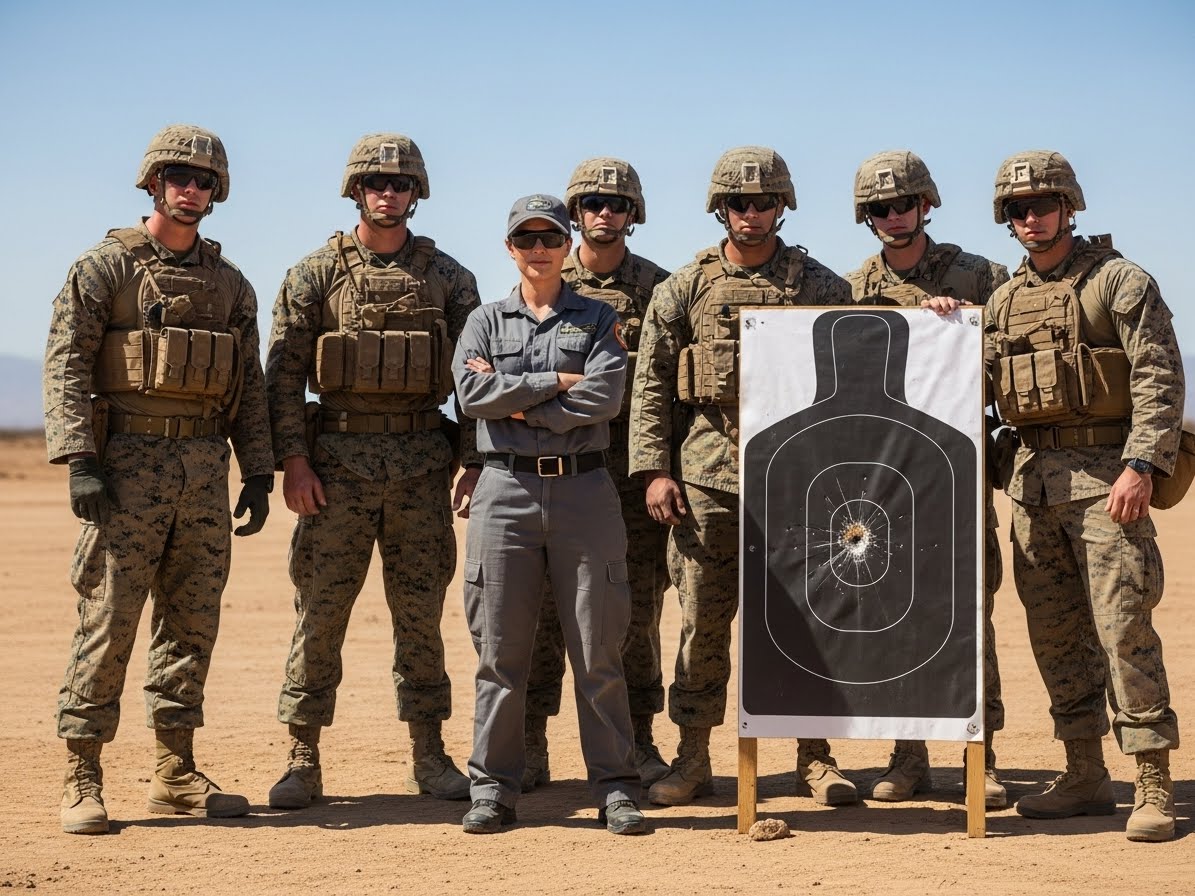
The heat at the Marine Corps Mountain Warfare Training Center wasn’t just hot; it was aggressive. It felt like a physical weight pressing down on the shoulders of the six men lying prone in the dirt, baking the dust into their skin and turning the high-altitude air into a shimmering, distorted mess.
Gunnery Sergeant Marcus Reeves hated this range. He hated the thin air at 8,500 feet that messed with bullet trajectory. He hated the unpredictable gusts that swirled through the Sierra Nevada peaks. But right now, more than anything, he hated the fact that his Force Recon team—supposedly the tip of the spear, the elite of the elite—couldn’t hit a stationary steel plate to save their careers.
“Check your dope!” Reeves roared, his voice cracking with frustration. “You are dialing for a ghost! Adjust two mils left!”
“I’m holding two mils left, Gunny!” Corporal James Williams shouted back, wiping sweat from his eyes. His hands, usually steady as stone, were trembling slightly. “The computer says the wind is 15 mph West-to-East. I’m doing exactly what the math says!”
Bang.
The Barrett M82 kicked up a cloud of dust. 1,700 yards away, the target remained silent. No metallic clang. No impact. Just a puff of dirt on the hillside, a good four feet to the right of the target.
“Miss!” the spotter, Staff Sergeant Elena Torres, called out, her voice flat with exhaustion. “Four minutes right. Elevation is good. Windage is… it’s all over the place, Gunny.”
Reeves ripped his hat off and slapped it against his thigh, sending a cloud of dust into the stagnant air. This was the final qualification for their deployment to Syria. Command had been clear: precision shots were the only thing that mattered for the upcoming mission profile. If they couldn’t qualify here, today, the team would be scrubbed. Replaced by a unit from the Second Battalion.
The humiliation would be absolute.
“This is absolutely ridiculous,” Reeves barked, pacing behind the line of prone shooters. “We have fifty-thousand dollars worth of optics on these rifles. We have ballistic computers strapped to our wrists that can calculate the rotation of the earth. And you’re telling me we can’t hit a piece of steel the size of a man’s chest?”
He stopped pacing and glared at the far end of the firing line.
There was movement there. A distraction.
A woman was kneeling near the brass collection buckets, quietly deadheading the dry roses that grew along the perimeter fence. She wore a grey, shapeless maintenance jumpsuit that had seen better decades, let alone days. Her hair was pulled back in a messy bun, grey strands mixing with the brown.
She was the station’s groundskeeper. Sabrina something. Reeves hadn’t bothered to learn her last name. To him, she was just background noise—a civilian obstacle in a military world.
“Hey!” Reeves shouted, channeling all his failure and rage toward the easiest target available. “You! Cleaning lady!”
Sabrina froze, her hand hovering over a withered rosebush. She turned slowly, her movements deliberate. She held a thermos in one hand and a pair of rusty shears in the other. She looked to be about forty, maybe older, with a face weathered by the high-desert sun and eyes that seemed a little too pale, a little too observant.
“Get off my range,” Reeves snapped, marching toward her. “This is a live-fire exercise for special operations personnel. Not a gardening club.”
Sabrina stood up. She was short, barely reaching Reeves’ chest. “I was told to clear the brass before the 1400 hours cease-fire, Sergeant,” she said. Her voice was soft, raspy, like dry leaves tumbling over concrete.
“I don’t care what you were told,” Reeves spat, looming over her. “You’re distracting my shooters. Get your trash and get out.”
Sabrina didn’t move. She didn’t look down, either. She looked past Reeves, her gaze fixing on the fluttering red flags placed every 200 yards down the range.
“Sorry to be a bother,” she said, and turned to leave. But then she stopped. It was a hesitation that seemed to physically pain her, as if staying silent was harder than speaking up. She turned back.
“Sir,” she said. “I just noticed… your wind flags are lying to you.”
Reeves blinked, his brain taking a moment to process the audacity. “Excuse me?”
“The flags,” she pointed with the shears. “At 400 yards, they’re blowing East. But if you look at the heat shimmer on the rocks at 900… the thermal layer is flowing West. It’s a reverse current.”
The silence on the range was instant. It wasn’t the silence of discipline; it was the silence of shock.
Torres lowered her spotting scope. Williams rolled onto his side, staring at the janitor. Even the wind seemed to die down, as if waiting for the explosion.
“The thermal layer,” Reeves repeated, his voice dangerously low. “You’re talking about thermal layering.”
“Yes,” Sabrina said, clutching her thermos a little tighter. “The hot air rising off the shale creates a tunnel. Your ballistic computers can’t see it because the sensor is here, on the deck. But the bullet has to travel through it. You’re aiming for the wind you can feel, not the wind that’s actually there.”
Reeves felt the blood rushing to his ears. It was bad enough his team was failing. It was intolerable that a civilian—a janitor—was trying to explain why.
“Lady,” Reeves hissed, stepping into her personal space, “I have been a Marine Sniper since before you learned how to operate a vacuum cleaner. I have confirmed kills in three different combat zones. Do you really think I need a lecture on atmospherics from the hired help?”
Sabrina looked at him. Really looked at him. For a second, the dull, tired look in her eyes vanished. Something sharp and cold flickered there. It was like watching a shark swim beneath the surface of a muddy pond.
“I’m just saying,” she said, her voice hardening just a fraction, “that if you keep dialing left, you’re going to keep missing right. Physics doesn’t care about your rank, Gunny.”
Chapter 2: The Impossible Wager
“Get out,” Reeves screamed, pointing a finger at the gate. “Now! Before I have the MPs drag you out!”
Sabrina sighed. It was a sound of deep, profound disappointment. She adjusted the strap of her heavy maintenance bag on her shoulder. She took one step toward the gate, then stopped again.
She looked at the target line. Three steel silhouettes stood at the far end of the valley. One at 1,700 yards. One offset at 2,000 yards. And the furthest, a “hostage” plate, at 2,200 yards.
“You’re running out of time,” Sabrina said. “The sun is cresting the ridge. In ten minutes, the shadow is going to drop the temperature, and that thermal tunnel is going to collapse. If you don’t qualify now, you won’t qualify at all.”
“Are you deaf?” Reeves advanced on her.
“What if I showed you?” Sabrina asked.
The question stopped him. “Showed me what?”
“How to read it.” She looked at the rifles on the mats. “The pattern. It’s a figure-eight flow. If you time it right… you don’t need to adjust the scope. You just wait for the cycle.”
“We don’t have time for lessons from the maid!”
“I can hit them,” she said.
The words were spoken so quietly that Reeves almost missed them. But Torres heard them. She sat up fully.
“What did you say?” Torres asked.
Sabrina turned to the team, ignoring Reeves for a moment. “I can hit the targets. All three of them.”
Reeves laughed, looking around at his men, expecting them to join in. A few chuckled nervously, but Williams didn’t. He was watching the maintenance woman’s hands. They weren’t shaking. She was standing in what looked like a casual slouch, but her feet were shoulder-width apart, her weight perfectly balanced.
“You think you can outshoot Force Recon?” Reeves grinned, a shark-like baring of teeth. “With what? That broom handle?”
“I have a rifle in my truck,” Sabrina said. “Old Remington 700. Deer rifle. Nothing fancy.”
“A deer rifle,” Reeves mocked. “At a mile? Lady, that effective range is maybe 800 yards if you’re lucky.”
“It’s modified,” she said simply.
“This is a restricted range!” Reeves shouted. “Civilians are not permitted to fire weapons!”
“Actually, Gunny,” Master Sergeant Thompson, the Range Master, stepped out from the control tower. He had been watching the exchange from the shade. He was a grizzled man with thirty years in the Corps, and he looked intrigued. “Technically, under Section 4, Paragraph 2 of the base charter, civilian contractors with personal firearms clearance can utilize the range during cease-fire intervals if supervised by a Range Safety Officer. And since I am the RSO…”
Thompson looked at Sabrina. “I’m curious.”
Reeves’ face went purple. “Master Sergeant, you cannot be serious. This is a mockery of my unit.”
“Your unit is failing, Gunny,” Thompson said, his voice cold. “If the janitor has a tip, I suggest you listen. Or do you want to explain to the Colonel why Second Battalion is taking your deployment slot?”
Reeves clenched his jaw so hard a vein throbbed in his temple. He turned back to Sabrina, his eyes burning with malice.
“Fine,” Reeves spat. “You want to play soldier? Go get your toy. But here’s the deal. You get one shot.”
Sabrina raised an eyebrow. “One shot?”
“One round,” Reeves said, crossing his arms. “You fire one round. If you miss—and you will miss—you are fired. I will personally see to it that your contract is terminated and you are banned from this base. You walk away with nothing.”
It was a cruel, impossible wager. To hit a target at 1,700 yards with a cold bore, with an unfamiliar wind, using a hunting rifle, was statistically zero.
Sabrina looked at the ground, scuffing the dust with her worn-out work boot. Then she looked up.
“And if I hit?” she asked.
“If you hit the 1,700-yard plate?” Reeves scoffed. “I’ll let you teach the class. Hell, I’ll clean the latrines for a week.”
“No,” Sabrina shook her head. “I don’t want you to clean. If I hit… I want to take one shot at the 1,700. But I’m going to hit the 2,000 and the 2,200 yard targets too.”
“With one bullet?” Williams blurted out. “That’s physics-impossible, ma’am. Ricochets don’t retain that kind of energy.”
“Ricochet ballistics,” Sabrina said softly. “It depends on the angle of the steel and the hardness of the jacket. If I hit the top corner of the first plate at a 17-degree angle of incidence…”
She trailed off, realizing she was saying too much. She cleared her throat and reverted to her quiet, raspy voice. “I can do it. One shot. Three hits.”
Reeves looked at her like she was insane. “You’re delusional. But fine. One shot. Three hits. You pull that off, and I’ll retire. Go get your gun.”
Sabrina nodded once. “Don’t touch my wind flags,” she said, and walked toward her beat-up Ford pickup truck parked by the shed.
As she walked away, Torres leaned over to Williams. “Did you see her eyes, Corporal?”
“Yeah,” Williams whispered, checking the atmospheric data on his wrist. “She looked like she was doing math.”
“No,” Torres said, watching the small woman retreat. “She looked like she was bored.”
Chapter 3: The Wolf in Sheep’s Clothing
The heat waves radiating off the asphalt parking lot were mesmerizing, but the Marines weren’t looking at the heat. They were watching Sabrina Williams unlock the back of her rusted government-issue Ford F-150.
“Ten bucks says she pulls out a rusty lever-action rifle from the 1800s,” Corporal Davis whispered, trying to break the tension.
“No bet,” Williams replied, his eyes glued to the binoculars. “Wait. That’s not a standard gun case.”
Sabrina reached behind a pile of rake handles and bags of fertilizer. She pulled out a hard case. It wasn’t the sleek, black plastic of a Pelican case used by the military. It looked like an old, beaten-up musical instrument case, covered in stickers from national parks and stained with oil.
She carried it back to the firing line with a different gait. The shuffle was gone. Her stride was longer, purposeful. The heavy case didn’t seem to weigh her down at all.
“Right here, ma’am,” Master Sergeant Thompson said, pointing to the empty shooting mat next to Corporal Williams. “Safety protocols are in effect. Bolt back, magazine out until you are on the line.”
“Understood,” Sabrina said.
She set the case on the concrete bench. The latches clicked open with a sharp, mechanical sound that cut through the silence. She threw the lid back.
Reeves, who had been ready to mock her “deer rifle,” felt the insult die in his throat.
Resting in the custom-cut foam was not a rusted antique. It was a Frankenstein monster of precision engineering.
The action was indeed a Remington 700, but it had been blueprinted and trued to microscopic tolerances. The barrel wasn’t a thin hunting profile; it was a heavy, fluted stainless steel Bartlein barrel, thick as a crowbar. The stock was a McMillan fiberglass composite with a custom cheek riser.
But it was the glass that made Williams gasp.
“Is that a Nightforce ATACR?” Williams whispered. “That scope costs three thousand dollars.”
“Bought it used,” Sabrina murmured, lifting the rifle. It was heavy—easily 16 pounds. She handled it with a familiarity that bordered on intimacy.
She didn’t just pick it up; she checked the chamber, verified the bore, and settled the bolt with a fluidity that only comes from firing thousands of rounds.
“Nice hardware,” Thompson said, his eyebrows raising. “Where does a maintenance specialist get a rig like that?”
“I saved up,” Sabrina said flatly. “Ramen noodles and overtime.”
She moved to the prone position on the shooting mat. As she laid down, something happened to her uniform. The baggy maintenance coveralls pulled tight across her back as she extended her arms.
For a fleeting second, the fabric pressed against something underneath.
Torres saw it. The outline of a plate carrier. A tactical vest worn under the jumpsuit.
“Gunny,” Torres hissed to Reeves. “Look at her back. She’s wearing armor.”
“Don’t be stupid,” Reeves snapped, though he was staring at the rifle with a mix of jealousy and confusion. “It’s probably a back brace for all that sweeping.”
Sabrina settled in behind the rifle. She didn’t touch the scope turrets. She didn’t check a ballistic computer. She didn’t ask for the barometric pressure.
She just closed her eyes.
Chapter 4: The Breathing of the Mountain
The range went quiet. Not the quiet of an empty room, but the heavy, pressurized quiet of a courtroom before the verdict is read.
Sabrina lay perfectly still. To the untrained eye, she looked like she was napping. But Corporal Williams, watching through his spotting scope, saw what she was doing.
She was breathing with the mountain.
Her chest rose and fell in a slow, rhythmic cadence. She wasn’t just calming her heart rate; she was syncing her body with the environment.
“She’s waiting for the thermal cycle,” Williams realized aloud. “Like she said. The wind reversal.”
“She’s wasting time,” Reeves grumbled, checking his watch. “She has two minutes before I kick her off.”
“Hush, Gunny,” Thompson ordered. “Watch.”
Sabrina opened her eyes. They were different now. The dullness of the janitor was gone, replaced by a predatory focus that was almost frightening. She stared down the scope, but her left eye remained open, scanning the grass near the target.
“The wind is a fluid,” she whispered, her voice barely audible. “It’s not a number. It’s a river.”
She watched the mirage—the heat waves shimmering off the desert floor. For the last twenty minutes, they had been boiling straight up. But now, as a cloud passed over the sun, the temperature dropped two degrees.
The boil stopped. The mirage flattened out.
“There it is,” she whispered.
“What?” Davis asked.
“The pause,” Sabrina said. “The thermal tunnel just collapsed. The wind at 900 yards is about to align with the wind at 1,700.”
She shifted the rifle stock into her shoulder pocket. The movement was microscopic.
“Range is 1,720 yards,” she said. “Target one is hardened AR500 steel, angled at 15 degrees right. Target two is 280 yards behind it, offset left. Target three is 200 yards back, center.”
“She’s insane,” Reeves muttered. “You can’t bounce a bullet 200 yards with lethal force.”
“A .300 Winchester Magnum solid copper solid,” Sabrina recited, “retains 85% of its mass upon impact with hardened steel if the velocity is below 2,800 feet per second. If I hit the top right corner of plate one, the spall angle will direct the main slug 40 degrees left.”
She wasn’t talking to them anymore. She was talking to the physics.
Her finger moved to the trigger. It wasn’t the hook-finger pull of a hunter. It was the pad of the finger, perfectly perpendicular.
“Three targets,” she breathed. “One solution.”
She exhaled. She didn’t hold her breath; she fired at the natural respiratory pause, the empty space between the exhale and the inhale where the body is most still.
CRACK.
Chapter 5: The impossible Sound
The sound of the heavy rifle was different from the sharp snap of the Marines’ lighter caliber weapons. It was a boom, a deep, resonant thunderclap that rolled down the valley.
Reeves instinctively looked at his stopwatch. At that distance, the bullet flight time was nearly three seconds.
One second.
The bullet tore through the air, spinning at 200,000 RPM. It sliced through the first wind layer. It hit the thermal pocket Sabrina had predicted—the pocket the Marines’ computers had missed. Instead of drifting right, the bullet held its line, cradled by the invisible river of air.
Two seconds.
“Miss,” Reeves started to say.
CLANG.
The sound was faint but unmistakable. The high-pitched ring of copper hitting steel. The first target, the one at 1,700 yards, swung violently on its chains.
“Hit!” Thompson shouted, raising his binoculars. “Center mass high right!”
But the bullet wasn’t done.
The solid copper slug, deformed but not disintegrated, glanced off the angled steel plate. It screamed off to the left, tumbling now, singing a chaotic buzzing song as it traversed the gap between targets.
CLANG.
The second sound was duller, deeper. The target at 2,000 yards—hidden in the shadow of a boulder—suddenly jerked. A puff of grey dust exploded off its face.
“No way,” Williams gasped. “No freaking way.”
The slug, now a mangled piece of hot metal, was losing energy fast. It was dropping like a stone. It had one final leg of the journey. The “Hostage” plate at the very back of the canyon, 2,200 yards away.
The range went silent again. The echo of the second hit faded.
“It dropped,” Reeves said, relief flooding his voice. “It didn’t make the third leg.”
And then, carried on the wind, a full second later:
Tink.
It was quiet. It was barely a whisper of metal on metal. But the third target rocked. Just a fraction of an inch. But it moved.
The silence that followed was absolute. It was the silence of a paradigm shifting.
Sabrina didn’t cheer. She didn’t pump her fist. She simply cycled the bolt of her rifle, catching the spent brass casing in her hand before it could hit the ground. She placed the hot brass in her pocket.
“The wind flags at 400 yards are irrelevant,” she said, her voice returning to its normal volume. “Always watch the grass on the ridge. That’s the truth.”
She stood up, dusting off her knees.
The Marines were staring at her as if she had just levitated. Corporal Williams’ mouth was slightly open. Staff Sergeant Torres was looking at the targets, then back at Sabrina, shaking her head in disbelief.
“That…” Thompson stammered. “That was impossible. The energy loss alone…”
“Angle of incidence,” Sabrina said, picking up her case. “Geometry is a force multiplier.”
Reeves looked like he had been slapped. His face was pale, his arrogance drained away, replaced by a hollow shock. He looked at the targets, then at the small woman packing up her gear.
“Who are you?” Reeves whispered.
Sabrina paused. She looked at him, and for the first time, she smiled. It wasn’t a nice smile. It was the smile of a wolf that had just decided not to eat a rabbit because it wasn’t worth the calories.
“I’m just the janitor, Gunny,” she said. “Remember?”
She turned to leave. But she didn’t get far.
From the north, a rhythmic thumping sound began to vibrate in their chests. It grew louder, faster. The unmistakable heavy beat of rotors.
“Air traffic?” Thompson frowned, grabbing his radio. “I didn’t authorize any fly-bys.”
A UH-60 Blackhawk helicopter crested the ridge line, flying low and fast—tactical nap-of-the-earth flying. It banked hard, kicking up a storm of dust, and flared for a landing directly on the firing line, less than fifty yards from where they stood.
The side doors slid open before the wheels even touched the dirt.
Part 3
Chapter 6: Operation Ghost Walker
The rotor wash was blinding. Dust and grit slammed into the Marines, forcing them to turn away and shield their eyes.
Sabrina didn’t turn away. She stood facing the helicopter, her hair whipping violently around her face. She dropped her heavy maintenance bag. She stood at attention.
Not the sloppy attention of a civilian trying to mimic a soldier. Perfect, rigid, board-straight attention. Heels locked. Thumbs along the seam of her trousers. Chin up.
Two men jumped out of the Blackhawk. They weren’t wearing standard Marine uniforms. They wore MultiCam tactical gear with no unit patches, high-cut ballistic helmets, and carried suppressed carbines.
Behind them came a man in a crisp dress uniform. A Full Bird Colonel.
“Colonel Hayes?” Thompson shouted over the engine noise. “What is going on?”
Colonel Hayes ignored the Range Master. He walked straight to the maintenance woman. He stopped three feet in front of her and returned a salute she hadn’t even fully thrown yet.
“Agent Williams,” Hayes shouted over the rotors. “We have a Code Black. Extraction is authorized immediately.”
“Agent?” Reeves repeated, the word tasting like ash in his mouth.
Sabrina nodded to the Colonel. “Sir. My cover is intact, mostly. Though I had to burn a little credibility to fix a training error here.”
“I see that,” Hayes glanced at the targets, then at the stunned group of Recon Marines.
He turned to the group. The Colonel’s face was stone.
“Gunnery Sergeant Reeves,” Hayes barked.
Reeves snapped to attention, trembling. “Sir!”
“You just spent twenty minutes screaming at the Senior Ballistic Instructor for the Defense Intelligence Agency’s clandestine operations division,” Hayes said calmly. “Agent Williams has been embedded here for eighteen months as part of Operation Ghost Walker. Her mission was to assess base security and training standards from the bottom up.”
The blood drained from Reeves’ face so fast he looked like he might faint. “The… the janitor, sir?”
“She’s not a janitor, son,” Hayes said, his voice dropping to a dangerous growl. “She’s the woman they send when Delta Force misses.”
Sabrina unzipped the front of her greasy maintenance coveralls. She shrugged them off her shoulders, letting the dirty fabric pool around her boots.
Underneath, she wasn’t wearing a uniform. She was wearing tan tactical pants, a combat shirt, and the plate carrier Torres had spotted. On the velcro patch on her chest, right where her name should be, was a simple black patch with a white skull and crossed arrows.
The symbol of the Ghost Walkers. A unit that officially didn’t exist.
“You have compromised a federal asset,” Hayes continued. “But, lucky for you, Agent Williams seems to have a soft spot for hopeless causes. She requested we delay extraction by ten minutes so she could finish her… demonstration.”
Sabrina looked at the team. Her eyes were no longer cold. They were tired, but kind.
“You’re not bad shooters,” she told the group. “You’re just over-reliant on the tech. You stopped looking at the world. The computer is a tool, not a crutch.”
She walked over to Corporal Williams. The young Marine looked terrified.
“Here,” she handed him a folded piece of paper from her pocket. “It’s a wind chart for this valley. I drew it during my lunch breaks over the last six months. It maps the thermal shifts by the hour. Memorize it.”
Williams took the paper with trembling hands. “Thank you… Ma’am. Agent.”
“Just Sabrina,” she said.
Chapter 7: The Departure
“We have to go,” one of the tactical operators urged, touching his earpiece. “Satellite shows the window is closing. If we’re going to make the rendezvous in Prague, we need to be wheels up in two mikes.”
Sabrina nodded. She grabbed her rifle case.
She turned to Reeves one last time. The Gunnery Sergeant looked like a broken man. He knew his career was likely over. He had disrespected a superior officer—vastly superior—and humiliated his unit.
“Gunny,” Sabrina said.
Reeves looked up, shame burning in his eyes. “Ma’am.”
“Don’t let the pride kill the mission,” she said softly. “You were right about one thing. This is a restricted area. Keep it safe.”
She didn’t wait for an answer. She turned and ran toward the Blackhawk. The operators helped her hustle the heavy rifle case on board. She jumped onto the skid and pulled herself into the cabin.
As the helicopter lifted off, banking hard to the west, Sabrina leaned out. She didn’t wave. She simply tapped her temple with two fingers.
Think.
The Blackhawk roared away, disappearing over the mountain ridge, leaving only a swirling cloud of dust and six Marines standing in stunned silence.
Thompson was the first to speak. He looked at Reeves.
“Well, Gunny,” the Master Sergeant said, pulling a cigar from his pocket. “I believe you owe the lady an apology. And since she’s gone… I guess you owe me a clean latrine.”
Reeves didn’t argue. He just stared at the empty sky.
“Corporal Williams,” Reeves said quietly.
“Yes, Gunny?”
“What does that chart say?”
Williams unfolded the paper Sabrina had given him. It was a masterpiece of hand-drawn topography. Arrows, thermal pockets, wind cycles—it was a cheat sheet for the entire mountain range.
“It says… it says the wind reverses again in four minutes,” Williams said.
Reeves picked up his rifle. He didn’t look at the computer on his wrist. He looked at the grass. He looked at the mirage.
“Get on the line,” Reeves ordered, his voice steady for the first time all day. “We have a qualification to finish. And we are going to do it her way.”
Chapter 8: The Ghost of the Valley
Six Months Later.
The Syrian border was a nightmare of dust and rubble. The village of Al-Tanf was supposed to be secure, but the intel was wrong. It was always wrong.
Sergeant Reeves (demoted, but still leading) lay in the ruins of a bakery. His team was pinned down. An enemy sniper was operating from a ridge line 1,400 yards out, hammering their position.
“I can’t get a lock!” Corporal Williams shouted. “The wind is swirling! The computer is giving me error readings!”
The enemy round impacted the wall inches from Reeves’ head, spraying concrete dust. They were stuck. They couldn’t move, and they couldn’t return fire accurately enough to suppress the threat.
“Forget the computer!” Reeves screamed. “Williams! Look at the terrain!”
Williams froze. He closed his eyes for a second, blocking out the gunfire, the shouting, the fear.
He remembered the heat of the California desert. He remembered the smell of sagebrush. He remembered the small woman in the oversized coveralls breathing with the mountain.
The wind is a river.
Williams opened his eyes. He didn’t look at the flags. He looked at the smoke drifting from a burning tire halfway up the hill. It was curling down, not up. Thermal inversion.
“Reverse flow,” Williams whispered. “He’s shooting through a tunnel.”
He adjusted his scope. He didn’t dial what the computer said. He dialed what the “janitor” had taught him. He held for a wind that shouldn’t exist, aiming into empty space.
“Sending,” Williams said.
Bang.
The shot rang out. Three seconds later, the enemy firing position went silent.
“Target down!” Torres yelled from the spotter scope. “Impact confirmed! You got him, Williams! Clean kill!”
Reeves let out a breath he felt like he’d been holding for half a year. They were alive.
Prague, Czech Republic. Same day.
The rain in Prague was cold and relentless. In a crowded square, a woman in a heavy wool coat sat on a bench, feeding pigeons. She looked unremarkable. A tourist, maybe. Or a tired local.
A man in a dark suit sat down next to her. He didn’t look at her.
“The package is secure,” the man said quietly. “The Syrian operation was a success. The Marine Recon team cleared the sector. No casualties.”
The woman smiled. It was a genuine smile this time.
“Good,” Sabrina Williams said. “They learned.”
“You took a big risk back there, Agent,” the man said. ” exposing yourself like that. Command is still unhappy.”
Sabrina stood up, brushing birdseed from her coat. She looked at the old clock tower in the distance.
“Sometimes,” she said, adjusting her scarf to cover the tactical earpiece, “you have to remind the new dogs that the old tricks still work.”
She picked up her bag—not a maintenance bag this time, but a sleek, leather briefcase that contained three passports and a loaded Glock 19.
“Where to next?” the man asked.
“Wherever the wind blows,” Sabrina said.
She walked away into the crowd, blending in perfectly. Just another face in the street. Just another invisible woman.
But somewhere in a desert in California, three bullet holes in three steel targets rusted in the sun—a permanent reminder that the most dangerous weapon on the battlefield isn’t the one you can see. It’s the one you underestimate.