The Mayor’s Son Stole a Deaf Boy’s Hearing Aid—Then He Saw the Father’s Badge
Chapter 1: The Weight of a Promise
The rain in Oakhaven, Ohio, didn’t just fall; it felt like it was trying to wash the gray paint right off the siding of Mark Reynolds’ small, suburban bungalow. inside, the smell of burnt toast and strong coffee fought a losing battle against the scent of damp wool drying by the radiator.
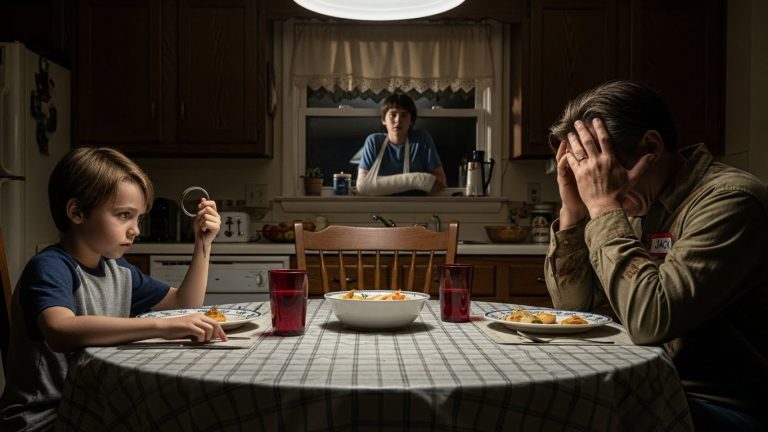
Mark Reynolds, forty-five years old with the kind of face that looked like it had been chiseled out of granite and then left out in the weather too long, sat at the kitchen table. He was fully uniformed, his badge—shield number 402—gleaming under the harsh fluorescent kitchen light. But his shoulders were slumped. In his large, calloused hands, he held a small, beige device as if it were a fragile bird.
It was a Phonak high-fidelity hearing aid. To anyone else, it was plastic and wires. To Mark, it was a four-thousand-dollar miracle. It was the only reason his nine-year-old son, Leo, could hear the wind in the trees, the hum of the refrigerator, or his father saying, “I love you.”
“Leo, buddy, breakfast!” Mark called out, his voice a low rumble. He didn’t yell. He knew yelling didn’t help if Leo didn’t have his ‘ears’ in yet. He tapped his foot on the hardwood floor—three sharp raps.
A moment later, a tousled head of brown hair peeked around the corner. Leo rubbed sleep from his eyes. He looked so much like his mother, Sarah, that it sometimes took the breath right out of Mark’s lungs. Sarah had been gone for two years now. Ovarian cancer had taken her fast and cruel, leaving Mark with a mountain of medical debt, a grieving boy, and a house that felt too big and too quiet all at the same time.
Leo padded over in his dinosaur pajamas. He didn’t speak; he signed. Morning, Dad.
Morning, Champ, Mark signed back, his fingers clumsy but practiced. He held out the hearing aid.
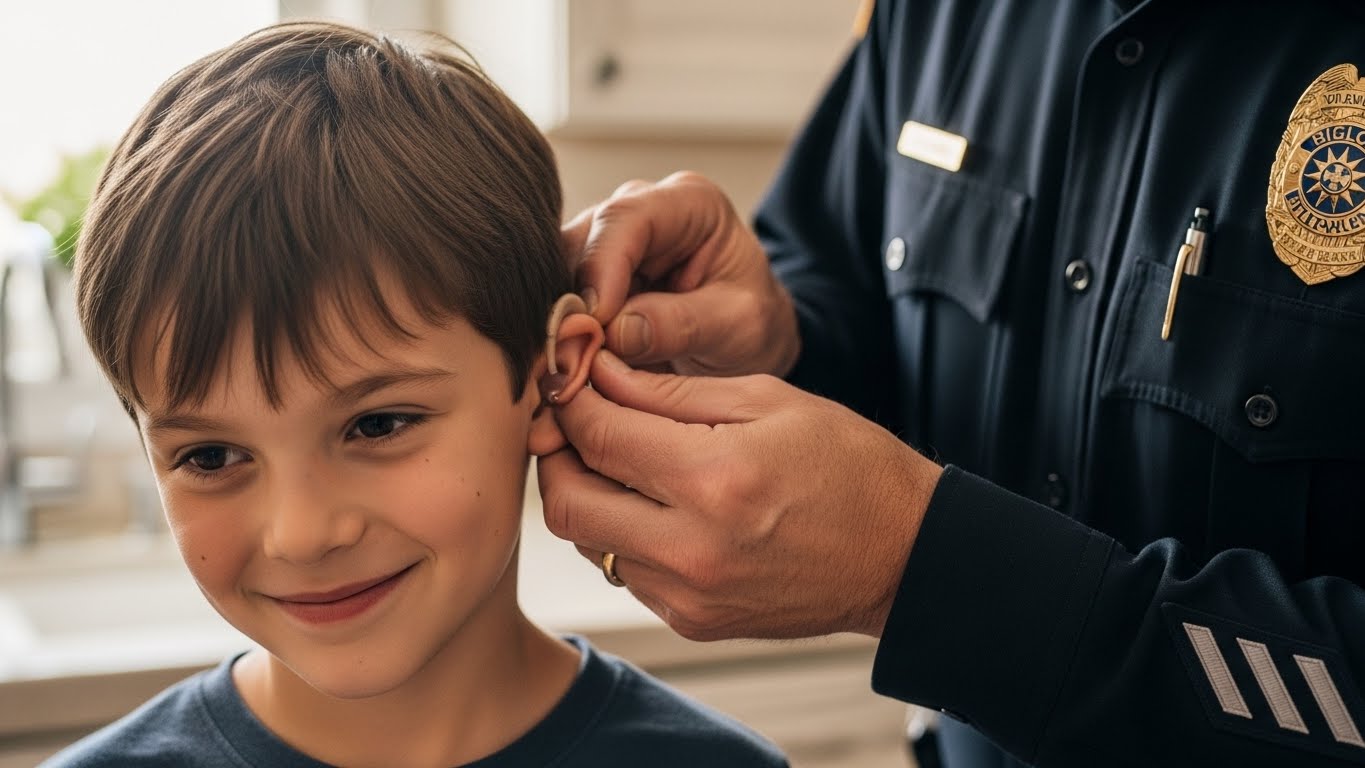
Leo turned his head, exposing his left ear. Mark inserted the device with the precision of a bomb disposal technician. He adjusted the volume, checking for feedback.
“Can you hear me now?” Mark whispered, testing.
Leo’s face transformed. It was like the sun breaking through the Ohio clouds. A shy smile spread across his face, and he nodded. “Loud and clear, Officer Dad,” Leo said. His voice was thick, the consonants slightly rounded because he couldn’t hear himself perfectly, but to Mark, it was the sweetest sound on earth.
“Good,” Mark said, his voice tightening. “You be careful with this today, okay? It’s… it’s the last one the insurance covers for a while. And you know the overtime I’ve been pulling.”
“I know,” Leo said, his smile fading slightly. He touched the device. “Mom picked the color.”
“Yeah. She did.” Mark swallowed the lump in his throat. “Skin tone. So nobody would notice.”
Mark drove Leo to Oakhaven Elementary in his patrol cruiser. It was a perk of the job, or maybe a curse, depending on how you looked at it. He pulled up to the curb, the wipers slapping rhythmically against the glass.
“I have a double shift today,” Mark said, turning to look at his son. “I’m going to be late picking you up from the after-school art program. Mrs. Higgins knows. You stay inside, okay? Don’t go wandering off.”
“I’m drawing today,” Leo said, unbuckling his seatbelt. “I’m making a comic book about you.”
“About me?” Mark chuckled, a tired sound. “The Boring Adventures of Officer Dad? Writing tickets and drinking cold coffee?”
“No,” Leo said seriously. “The Titan. He protects the weak.”
Mark felt a sting behind his eyes. He reached out and squeezed Leo’s shoulder. “I try, kiddo. Go on. Make me proud.”
Mark watched his son run through the rain toward the double doors of the school. He waited until Leo was safely inside before he put the cruiser in drive. As he pulled away, a black SUV cut him off, speeding toward the drop-off zone. Mark recognized the custom license plate: MAYOR 1.
Out stepped Brad Miller. He was fourteen, big for his age, with the kind of sneer that suggested he’d never been told ‘no’ in his entire life. He was technically in the middle school building adjacent to the elementary, but everyone knew the Miller kid roamed wherever he pleased.
Mark gripped the steering wheel. He had pulled the Mayor, Gerald Miller, over for a DUI six months ago. The charges had magically disappeared before the ink on the report was dry. Mark had been warned by his captain to “let sleeping dogs lie” if he wanted to keep his pension.
Mark sighed, turning on his radio. “402, show me 10-8,” he muttered into the mic. He had a job to do. He had bills to pay. He had to keep his head down.
For the next eight hours, Mark absorbed the misery of the town. He mediated a domestic dispute in a trailer park where a husband had thrown a toaster through a window. He directed traffic around a fender bender for two hours in the freezing rain. He took a report from an elderly woman who was convinced her neighbor was training squirrels to spy on her.
By 4:00 PM, his back was screaming, his feet were numb, and his patience was frayed to a single thread. He checked his watch. Leo’s art program ended at 5:00. He had one hour to finish his paperwork and get there.
Then the radio crackled. “All units, we have a 10-50, major accident on Route 9. Multiple injuries. Fire and Rescue en route. We need traffic control immediately.”
Mark closed his eyes. Route 9 was on the other side of town. “402, copying. I’m en route,” he said, his voice flat.
He texted Mrs. Higgins, the art teacher: Emergency call. Running late. Please keep Leo inside. Will be there by 5:30.
He didn’t know that Mrs. Higgins had left early with a migraine, leaving a substitute teacher who didn’t know the protocols, or that the “Titan” was about to be needed much closer to home.
Chapter 2: The Sound of Silence
The hallway of Oakhaven Elementary was usually a cacophony of squeaking sneakers and shouting children, but by 5:15 PM, it had settled into a ghostly quiet. The janitor was buffering the floors in the west wing, the rhythmic hum too far away to be heard near the art room.
Leo sat on a wooden bench outside the art room doors. The substitute teacher had told him she had to lock up and that he should wait “right here” for his father. Leo didn’t mind. He had his sketchbook.
He was working on the cover of his comic. In the drawing, a giant figure in a blue uniform stood between a crowd of tiny, frightened people and a massive, shadowy monster. The monster had no face, just a gaping mouth.
Leo was so absorbed in shading the Titan’s badge that he didn’t feel the vibrations of the footsteps approaching.
He didn’t look up until a shadow fell across his page, blocking the dim hallway light.
Leo looked up. His stomach dropped.
It was Brad Miller. Flanking him were two other boys, Trent and Jason—both wearing varsity jackets that were slightly too big for them, mimicking their leader’s slouch. They were middle schoolers, giants compared to fourth-grader Leo.
“Look at this,” Brad sneered. Leo read the lips perfectly. Look at this.
Brad snatched the sketchbook from Leo’s lap.
“Hey!” Leo said. “Give it back!”
Brad flipped through the pages, laughing. “What is this trash? Is this your daddy? The pig?”
Leo stood up. He was small, but he was brave. “My dad is a hero. Give it back.”
Brad looked at Trent and Jason. They laughed—a cruel, sharp sound that Leo’s hearing aid picked up with painful clarity. “A hero?” Brad mocked. “My dad says your dad is a loser who can’t even pay his electric bill. My dad says he’s a joke.”
“Stop it,” Leo said, his voice trembling. He reached for the book.
Brad shoved him back. Leo stumbled, his sneakers squeaking against the linoleum.
“What’s that in your ear, freak?” Brad asked, stepping closer. His eyes zeroed in on the beige device. “Is that a radio? Are you listening to the police scanner?”
“It’s my hearing aid,” Leo said, instinctively covering his ear. “Leave me alone.”
“I want to see it,” Brad said. The entitlement in his voice was thick, like sludge. “Give it here.”
“No!”
Brad didn’t like being told no. He lunged.
It happened in a blur of motion. Brad’s hand, meaty and rough, clamped onto Leo’s ear. Leo screamed, a sharp cry of pain as the custom mold was yanked violently from his canal.
And then… silence.
Absolute, terrifying silence.
The hum of the distant buffer was gone. The laughter of the boys was gone. The sound of his own breathing was gone. It was as if the world had suddenly been wrapped in thick cotton wool.
Leo gasped, disorientation hitting him like a wave. His balance wavered—his inner ear confusing the sudden loss of input. He fell to his knees on the hard floor.
He looked up, tears blurring his vision. He saw Brad’s mouth moving. He saw Trent and Jason doubling over, slapping their knees. They were laughing. He knew they were laughing, but he couldn’t hear it. That made it worse. The silent laughter looked demonic, their faces twisted into masks of cruelty.
Brad held the hearing aid up to the light. He pretended to inspect it. Then, he looked at Leo, made eye contact, and tossed the device to Jason.
Leo scrambled across the floor, reaching out. “Please! Don’t!” his voice felt strange in his throat, a vibration he couldn’t monitor.
Jason caught it and threw it to Trent. A game of keep-away.
Leo was sobbing now, open, heaving sobs that shook his small frame. He felt utterly naked. Without that device, he was cut off from the world. He was cut off from his dad.
Brad signaled for the device back. He held it high above his head. He looked down at Leo, who was kneeling at his feet, begging.
“You want it?” Brad mouthed. Leo read the lips.
“Yes, please. My dad…” Leo cried.
Brad sneered. “Your dad isn’t here.”
Brad opened his hand.
He didn’t throw it. He just let it drop.
The four-thousand-dollar device, the last gift from Sarah, hit the linoleum floor. It didn’t shatter, but the battery door popped open, and a small piece of plastic skittered away.
Brad raised his foot. He wore heavy, expensive basketball sneakers. He hovered his sole over the device.
Leo froze. He couldn’t breathe. If Brad stepped on it, the connection was gone. The silence would be permanent.
Brad grinned, relishing the power. He pressed his foot down, not enough to crush it yet, but enough to make the plastic groan under the weight. He looked at Leo, waiting for the beg, waiting for the total submission.
Brad was so focused on his victim that he didn’t notice the double doors at the end of the hallway swinging open.
He didn’t notice the silence of the hallway changing, becoming heavier, charged with static electricity.
He didn’t notice that his friends, Trent and Jason, had suddenly stopped laughing. Their eyes went wide, fixed on a point behind Brad’s back. They backed away, slowly, pressing themselves against the lockers.
Brad, confused by their reaction, started to turn around. “What are you idiots look—”
The shadow consumed him before he could finish the sentence.
Chapter 3: The Thunder
Mark Reynolds had parked the cruiser at a crooked angle right in front of the school entrance, leaving the lights flashing. He had run through the rain, his heart hammering a warning rhythm in his chest. He was thirty minutes late.
When he burst through the doors, shaking the water from his uniform, the first thing he saw was the empty hallway. The second thing he saw was his son, on his knees, hands clasped in prayer, face wet with tears.
The third thing he saw was the Mayor’s son, foot poised over the one thing Mark had worked double shifts for six months to pay off.
Mark didn’t run. Running was for chasing suspects who had a chance to escape. This boy had nowhere to go.
Mark walked.
His boots, heavy tactical police issue, struck the floor with a rhythmic, booming cadence. Thud. Thud. Thud.
To Leo, it was still silent. But he felt the floorboards vibrate. Thump. Thump. Thump. A familiar rhythm. The rhythm of the Titan.
Leo looked up, past Brad, and his eyes widened.
Mark was soaked. Rainwater dripped from the brim of his hat, running down the stern lines of his face. His uniform was dark with moisture, making him look larger, denser. His hand rested instinctively near his duty belt—not on his weapon, but on his radio, a habit of a man ready to call down the wrath of God.
Brad turned around and froze.
Officer Reynolds didn’t yell. He didn’t scream. He stopped two feet from Brad. He towered over the fourteen-year-old. Mark was 6’2″, broad-shouldered, and radiating a heat of fury that felt like opening an oven door.
“Move your foot,” Mark said.
The voice was low. It wasn’t a request. It was a tectonic shift.
Brad, usually so full of bravado, trembled. He had expected a teacher. He had expected a mom. He hadn’t expected the Law. And he certainly hadn’t expected the look in Mark’s eyes—a look that promised violence, restrained only by a thread of discipline.
Brad pulled his foot back as if the floor had burned him. “I… we were just… we found it. We were helping him,” Brad stammered.
Mark ignored him completely. He knelt down, the leather of his gear creaking. He picked up the hearing aid with infinite tenderness. He inspected it. The casing was cracked. The battery door was bent.
He looked at Leo. He didn’t need sign language. He saw the terror in his son’s eyes. He saw the red mark on Leo’s ear where the device had been ripped out.
Mark felt a rage so pure, so white-hot, that for a second, his vision tunneled. He wanted to grab this entitled brat by the collar and throw him through the trophy case. He wanted to show him what real power looked like.
But then Leo reached out. His small hand touched Mark’s wet sleeve.
Leo signed, his hands shaking: Dad. You came.
Mark took a deep breath, inhaling the smell of floor wax and fear. He put the broken hearing aid in his shirt pocket, right over his heart.
He stood up. He turned to Brad.
Brad backed up, hitting the lockers. “My dad is the Mayor,” he squeaked. It was his shield, his get-out-of-jail-free card.
Mark stepped into Brad’s personal space. He leaned down, bringing his face inches from the boy’s. Mark smelled of rain, old coffee, and gun oil.
“I know who your father is,” Mark whispered. The sound was more terrifying than a shout. “But right now, your father isn’t here. I am.”
“I didn’t mean to—”
“You ripped a medical device out of a disabled boy’s head,” Mark cut him off. “That’s assault. That’s destruction of property. And in the state of Ohio, given the value of that device, that is a felony.”
Brad’s face went pale. “I’m… I’m a minor.”
“You’re fourteen,” Mark said coldly. “Old enough for handcuffs. Old enough for juvenile detention.”
Trent and Jason, the lackeys, began to inch away toward the exit.
“STAY,” Mark barked, not turning his head. The command cracked like a whip. The two boys froze, terrified.
Mark turned back to Brad. “You think because your daddy runs this town, you’re strong? You think picking on a boy who can’t hear you makes you a man?”
Mark pointed a finger at Brad’s chest. “That badge,” Mark pointed to his own chest, “means I protect people. Even people like you. But right now? The only thing stopping me from dragging you out of here by your ear is the fact that my son is watching. And unlike you, I don’t want to traumatize a child.”
Mark pulled his radio from his belt. The static hiss broke the silence.
“Dispatch, this is 402.”
“Go ahead, 402,” the dispatcher’s voice crackled.
“I need a unit to Oakhaven Elementary. Non-emergency transport.” Mark paused, locking eyes with Brad. “And call Mayor Miller. Tell him to meet me in the Principal’s office immediately. Tell him it involves his son, a felony assault, and…” Mark looked at Leo, “…and tell him to bring his checkbook.”
Chapter 4: The Court of Conscience
Principal Skinner’s office was too small for the amount of ego currently stuffed inside it.
Mayor Gerald Miller was red-faced, pacing the carpet. He wore a tailored suit that cost more than Mark’s car. Beside him sat Brad, slumped in a chair, looking sullen but no longer terrified now that his daddy was here.
Principal Skinner sat behind his desk, looking like he wanted to be anywhere else in the world.
Mark sat on a folding chair, his uniform still damp. Leo sat on his lap, clutching Mark’s hand. Leo couldn’t hear the shouting, but he could feel the tension. He watched the adults’ faces.
“This is ridiculous, Reynolds!” The Mayor shouted, slamming his hand on the desk. “Boys being boys! Roughhousing! You’re blowing this out of proportion because you want a payout.”
Mark sat perfectly still. He didn’t blink. “Your son assaulted mine. He destroyed a four-thousand-dollar medical device. He humiliated a child with a disability.”
“Allegedly!” The Mayor spat. “Brad said they were playing catch and the kid dropped it. It’s his word against a deaf kid’s.”
The cruelty of the phrasing hung in the air. A deaf kid. Not Leo. Not a person. A defect.
Brad smirked. He knew his dad would fix it.
Mark slowly reached into his pocket. He pulled out his phone.
“I anticipated a difference of opinion,” Mark said calmly. “So, before I came in here, I asked the janitor to pull the hallway security footage. It’s amazing what people will do for you when you treat them with respect, Mr. Mayor.”
The smirk vanished from Brad’s face. The Mayor froze.
Mark tapped the screen and turned the phone around.
On the small screen, the grainy black-and-white footage played. They watched Brad corner Leo. They saw the shove. They saw the violent yank of the hearing aid. They saw the high-fives. They saw the mockery. They saw the foot hovering over the device while Leo begged.
The room went silent. A real silence this time. The kind that comes from shame.
The video ended. Mark put the phone back in his pocket.
“That,” Mark said softly, “is not boys being boys. That is cruelty. That is a predator hunting prey.”
The Mayor sank into a chair. He rubbed his face. He looked at his son, really looked at him, perhaps for the first time in years. He saw the malice he had ignored.
“What do you want, Reynolds?” The Mayor asked, his voice hollow. “You want him arrested? It’ll ruin his future.”
Mark stood up, lifting Leo with him. He adjusted his belt.
“I don’t care about his future right now,” Mark said. “I care about my son’s present.”
Mark walked over to the desk and placed the broken hearing aid on the mahogany surface.
“One,” Mark listed. “You will write a check for the full replacement cost of this device. Today. Not through insurance. Personal check.”
The Mayor nodded. “Done.”
“Two,” Mark continued. “Brad will be suspended. I don’t care how you spin it to the press. But he doesn’t step foot in this school for a week.”
Principal Skinner nodded vigorously. “I agree. Mandatory suspension.”
“And three,” Mark turned to Brad. “You will look at my son. You will look him in the eye. And you will apologize. And you will mean it.”
Brad looked at his father. The Mayor didn’t save him this time. “Do it,” the Mayor growled.
Brad stood up. He looked at Leo. Leo, small and silent, held his father’s hand. He looked back at Brad with a gaze that wasn’t angry, just sad.
“I’m sorry,” Brad mumbled.
“He can’t hear you,” Mark said sharply. “Look at him. Speak clearly. Or write it down.”
Brad swallowed hard. He looked at Leo’s lips. “I am sorry,” he enunciated slowly. “I shouldn’t have taken it.”
Leo watched Brad’s lips. He nodded once. He didn’t smile. He just signed to his dad. Can we go home now?
Mark looked at the Mayor. “If your son ever comes near mine again,” Mark said, his voice dropping to that dangerous rumble, “I won’t come as a father. I’ll come as the police. And I won’t be asking for a check.”
Mark turned and walked out, the heavy door clicking shut behind him.
Chapter 5: The Only Sound That Matters
The rain had stopped by the time they got back to the cruiser. The streetlights reflected in the puddles like shattered gold.
Inside the car, it was quiet. Mark didn’t turn on the radio.
He sat in the driver’s seat, staring out the windshield. The adrenaline was fading, replaced by a crushing exhaustion. His hands started to shake. He felt like he had failed. He hadn’t been there when it happened. He had let his boy get hurt.
He felt a tug on his sleeve.
He turned. Leo was watching him in the dim light of the dashboard.
Mark fumbled in his pocket and pulled out a notepad and a pen he kept for tickets. He wrote: I am so sorry I was late. I am so sorry I let them hurt you.
He showed it to Leo.
Leo read it. He shook his head. He took the pen.
In his messy, third-grade handwriting, Leo wrote: You weren’t late. You came just in time. You were the Titan.
Mark read the words. A tear, hot and heavy, rolled down his cheek. He quickly wiped it away, trying to be strong.
Leo reached out. He placed his hand on Mark’s chest, right over his heart. He could feel the steady beat.
Leo signed: I don’t need the machine to hear you, Dad.
Mark furrowed his brow, confused. How? he signed back.
Leo smiled, that same brilliant smile from the morning. He pointed to Mark’s heart, then to his own.
I feel you, Leo signed. Loud and clear.
Mark broke. He reached across the center console and pulled his son into a hug. He held him tight, burying his face in Leo’s hair. He sobbed, letting go of the stress, the anger, the grief for his wife.
Leo hugged him back, patting his father’s broad back.
In the silence of the patrol car, there were no words. There was no noise. There was only the feeling of two people who had lost everything, realizing they still had the only thing that mattered.
Mark pulled back, wiped his eyes, and started the engine.
“Let’s go get ice cream,” Mark said aloud, realizing Leo couldn’t hear him. He smiled and pantomimed eating a scoop.
Leo grinned. Chocolate?
Double chocolate, Mark signed.
As the cruiser pulled away, the blue and red lights reflected off the wet asphalt, not as a warning, but as a promise. A promise that no matter how silent the world got, they would never be alone.