Bully Ties Orphan to a Pole to Steal His Speech, But He Didn’t Know The Boy Was A Marine’s Son
Chapter 1: The Voice in the Shadows
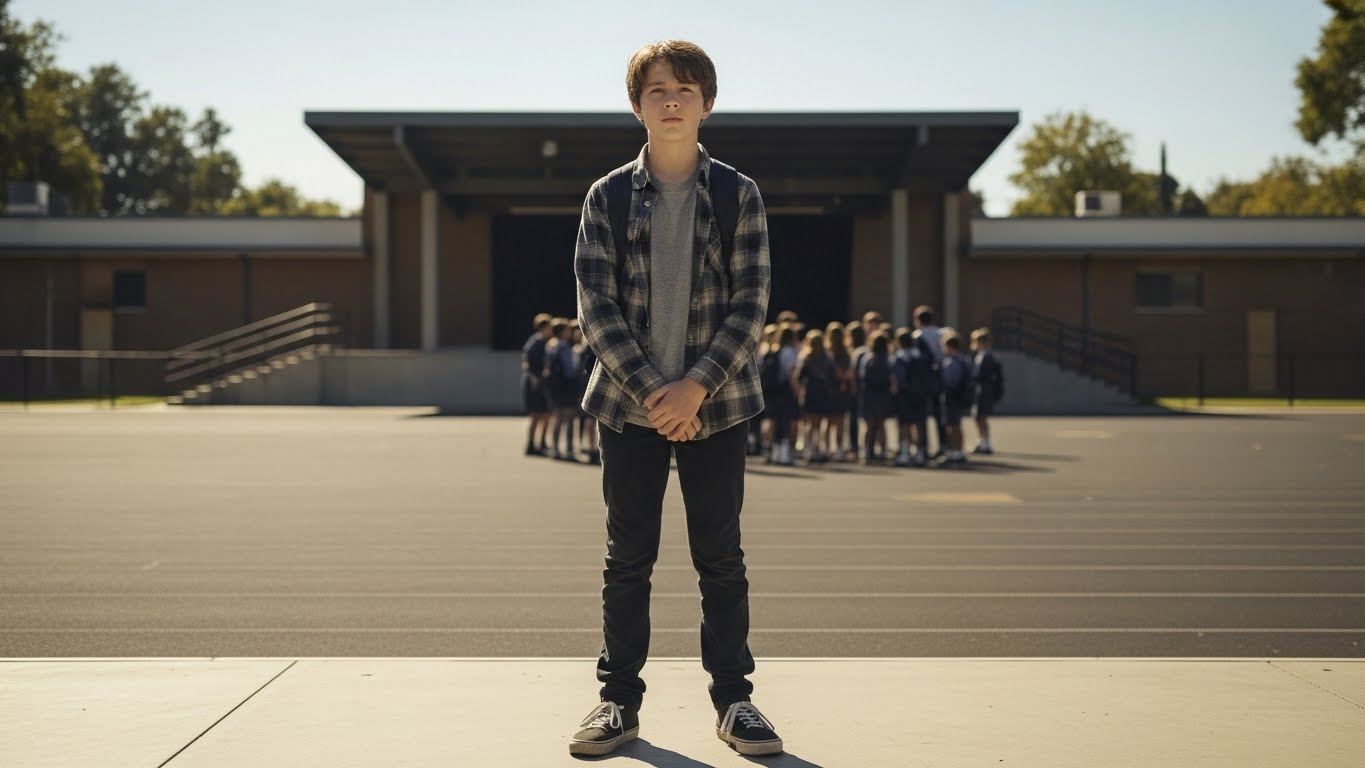
The late October wind in Oak Creek, Indiana, carried the scent of dried corn husks and woodsmoke. It was a patriotic town, the kind of place where the American flag flew on every porch and the high school football team was treated like royalty. But for twelve-year-old Leo Matheson, Oak Creek was less of a home and more of a battlefield.
Leo sat on the edge of his cot in the crowded room of the grim group home on Elm Street. He held a crumpled photograph in his hands. It was the only thing he owned that mattered—a picture of a man in a Marine Corps dress uniform, smiling, holding a baby. The man was his father, Captain John Matheson, who had died in Afghanistan when Leo was just two. The baby was Leo.
“I… I… w-w-will m-m-make you p-p-proud,” Leo whispered to the photo. The stutter was a jagged wall in his throat, a constant reminder of the anxiety that had plagued him since he entered the foster system.
In his head, the words flowed like a clear river. He could recite the Gettysburg Address, the Declaration of Independence, and the lyrics to every patriotic song ever written with perfect clarity—as long as he didn’t open his mouth. But the moment he tried to speak, the wall went up.
“Talking to yourself again, Looney Leo?”
Leo stiffened. He didn’t have to turn around to know who it was. The taunt came from the doorway, where thirteen-year-old Caleb Sterling stood leaning against the frame. Caleb was everything Leo wasn’t: tall, confident, wealthy, and the son of Mayor Sterling. Caleb had golden hair, a dazzling smile, and a heart made of cold stone.
“L-l-leave m-m-me a-a-alone,” Leo stammered, tucking the photo under his pillow.
Caleb laughed, walking into the room and kicking Leo’s small duffel bag across the floor. “I heard the news, Leo. I heard Mrs. Higgins picked you to read the Tribute to the Fallen at the Veterans Day Festival. You? Seriously?”
The Veterans Day Festival was the biggest event in Oak Creek. The entire town gathered in the town square. To be chosen as the youth speaker was the highest honor a student could receive.
“I… I ear-ear-earned it,” Leo said, his face burning. He had written an essay that had made Mrs. Higgins, the stern history teacher, weep openly in class. She had selected him over Caleb, despite the Mayor’s subtle bribes.
“You earned nothing,” Caleb sneered, stepping closer. “You’re a charity case. Mrs. Higgins just feels sorry for the orphan with the broken brain. You think you can stand up there in front of two thousand people and speak? You can’t even order lunch without spitting on the cafeteria lady.”
Caleb leaned down, his voice dropping to a menacing whisper. “My dad is the Mayor. I’m supposed to give that speech. It’s a Sterling tradition. You’re going to embarrass this whole town. Do us all a favor and quit.”
“N-n-no,” Leo said, looking up.
Caleb’s eyes narrowed. “Fine. Have it your way, Looney. But don’t say I didn’t warn you.”
He turned and sauntered out, leaving Leo shaking with a mixture of fear and rage.
Leo waited until the coast was loud, then grabbed his jacket and slipped out the back door. He ran through the alleys, away from the group home, away from the taunts. He ran until his lungs burned, ending up at a small, dilapidated house on the edge of town.
A ramp led up to the porch where an old man sat in a wheelchair, wrapped in a blanket, staring at the fading sun.
“You’re late, Private,” the old man grunted without looking.
Leo smiled, his breathing heavy. “S-s-sorry, S-s-sarge.”
Sergeant Miller was eighty-two years old, a World War II veteran who had lost the use of his legs at the Battle of the Bulge. He was grumpy, solitary, and scared most of the neighborhood kids. But he hadn’t scared Leo. They had bonded a year ago when Leo offered to rake his leaves for free.
“Well, don’t just stand there panting,” Miller said, turning his wheelchair. “We got work to do. Veterans Day is in three days. You ready to sound off?”
“I… I don’t k-k-know if I c-c-can,” Leo admitted, sitting on the porch steps. “C-Caleb s-s-said I’m g-g-gonna em-embarrass ev-everybody.”
Miller scowled, his bushy white eyebrows knitting together. “Caleb Sterling? That boy is all hat and no cattle. He’s got a silver spoon so far down his throat he’s choking on it. You listen to me, Leo. Your daddy was a Marine. Bravery isn’t about not being scared. It’s about being scared to death and saddling up anyway.”
Miller rolled closer. “Now, stand up. Shoulders back. Chest out.”
Leo stood up.
“Close your eyes,” Miller commanded. “Forget the stutter. Forget Caleb. Forget the crowd. I want you to find the rhythm. History is music, Leo. Feel it in your gut. Now, recite the opening.”
Leo closed his eyes. He took a deep breath. He imagined his father standing beside him. He imagined the soldiers Miller talked about, shivering in the snow of the Ardennes. He felt the weight of the words he had practiced a thousand times.
When he opened his mouth, the miracle happened. It always happened when he was with Miller, or when he sang. The part of his brain that tripped over consonants shut down, and a different part took over.
“We are gathered here,” Leo’s voice rang out, deep and resonant, “not to mourn the dead, but to praise the lives they gave for our freedom.”
It was a “radio voice.” Clear. Strong. Commanding.
Miller nodded, a rare smile touching his lips. “That’s it. That’s the voice of a leader. You keep that rhythm. You don’t let anyone break your cadence.”
They practiced for two hours until the sun went down and the chill set in. As Leo helped Miller back inside his house, the old man grabbed Leo’s wrist. His grip was surprisingly strong.
“Leo,” Miller said softly. “People like Caleb… they try to make you feel small because they know they ain’t got no substance. But you… you’ve got iron in your blood. You make your daddy proud on Saturday. You hear me?”
“Yes, sir,” Leo said. And for those two words, he didn’t stutter.
But the confidence Leo felt on Miller’s porch evaporated the next day at school. The harassment escalated. Notes were left in his locker: “Don’t speak.” “Looney Leo.” “Go back to the orphanage.”
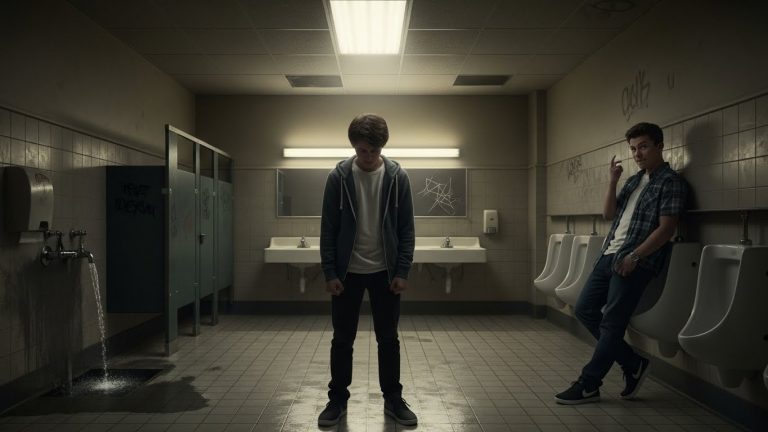
On Friday, the day before the festival, Leo went to the boys’ bathroom between classes. He was washing his hands when the door locked behind him.
He looked up into the mirror to see Caleb and two of his linebacker friends, massive boys named Trent and Bo.
“I thought we had a talk, Leo,” Caleb said, snapping a rubber band against his wrist.
“I’m g-g-going to d-d-do it,” Leo said, backing up against the sink.
Caleb sighed, feigning disappointment. “You just don’t listen, do you? My dad has senators coming tomorrow. Important people. We can’t have a stuttering charity case ruining the image of Oak Creek.”
Trent and Bo stepped forward, cracking their knuckles. They didn’t hit him. That would leave marks too easily seen. Instead, they grabbed him, shoving him into a stall. Bo held him down while Caleb leaned in close.
“This is your last warning,” Caleb hissed. “If you show up to that stage tomorrow, I promise you, I will make you wish you were never born. I will make sure every foster home in the state knows you’re a violent, lying trouble-maker. You’ll be on the street.”
They shoved him down onto the tile floor and left, laughing.
Leo lay there on the cold bathroom floor, his heart hammering against his ribs like a trapped bird. He wanted to cry. He wanted to quit. But then he touched the pocket of his jeans, feeling the outline of his father’s photo.
Saddle up, Miller’s voice echoed in his head.
Leo stood up. He wiped the dirt off his knees. He looked at himself in the mirror. He was pale, shaking, and small. But his eyes were steady.
He would speak. No matter what.
Chapter 2: The Bind and the Break
Saturday morning dawned with a brilliant, cloudless blue sky—the kind of “Marine Corps Blue” that Sgt. Miller always talked about. The town of Oak Creek was transformed. Red, white, and blue bunting draped every storefront. The smell of funnel cakes and barbecue smoke filled the air. The high school marching band was warming up in the distance, a cacophony of drums and brass.
Leo dressed in his best clothes: a white button-down shirt he had bought at the thrift store and a pair of navy slacks that were slightly too short at the ankles. He had polished his worn-out black shoes until they shined.
He arrived at the fairgrounds early, his stomach churning with a mix of nausea and adrenaline. The stage was massive, set up in the center of the football field. Thousands of folding chairs were arranged on the grass.
“Leo!”
Mrs. Higgins waved him over near the backstage tent. She looked nervous but proud. “You look sharp, Mr. Matheson. You’re on in forty-five minutes. Right after the Mayor’s introduction and the National Anthem.”
“I’m r-r-ready,” Leo said, clutching his index cards.
“I know you are. Go relax behind the bleachers. It’s quiet back there. practice your breathing.”
Leo nodded and walked away from the bustle of the stage. He went behind the massive home-team bleachers, a secluded area where the groundskeeping equipment was stored. It was shadowed and cool.
He closed his eyes, leaning against a metal support beam. “We are gathered here…” he whispered, finding his rhythm.
“Found him.”
The voice made Leo’s blood turn to ice.
He opened his eyes. Caleb, Trent, and Bo were standing there. But they weren’t in their school clothes. They were dressed in their “Sunday best” for the festival. Caleb was wearing a suit that looked tailored.
But in Caleb’s hands, the expensive look was ruined by what he was holding: a roll of thick, silver duct tape and a bundle of heavy-duty black industrial zip ties.
“I told you, Leo,” Caleb said, shaking his head. “I told you not to show up.”
Leo tried to run, but Bo was faster. The large boy tackled Leo, slamming him into the dirt. The wind was knocked out of him.
“G-g-get off!” Leo wheezed.
“Grab him!” Caleb ordered.
They dragged Leo toward the far end of the bleachers, where an old, unused tetherball pole stood cemented into the ground, hidden from view by a stack of gym mats.
“Please!” Leo cried out. “Don’t!”
“Shut up!” Trent growled, pinning Leo’s arms behind his back around the pole.
Caleb stepped forward with the zip ties. These weren’t the flimsy plastic ones used for garbage bags. These were thick, law-enforcement grade ties. He looped one around Leo’s left wrist, then around the pole, then around the right wrist.
Zip.
The sound was sickeningly final. Caleb pulled it tight. Too tight. The plastic bit into Leo’s skin, cutting off circulation immediately.
“Make sure he can’t slide down,” Caleb commanded.
They used the duct tape next. They taped his torso to the pole. Then his ankles.
Finally, Caleb ripped off a strip of tape. He smiled, a cruel, empty smile. “You have a nice voice, Leo. When you’re not stammering like an idiot. But today? Today is about silence.”
He slapped the tape over Leo’s mouth.
Leo’s eyes went wide with panic. He screamed behind the tape, but it came out as a muffled, pathetic moan.
“Perfect,” Caleb said, dusting off his hands. He checked his gold watch. “Showtime in twenty minutes. Don’t worry, Leo. I have a copy of the speech. I’ll tell them you got scared. I’ll tell them you ran away crying. My dad will be disappointed, but hey, at least I’m there to save the day.”
Caleb leaned in one last time. “You’re trash, Leo. You always were.”
The three bullies walked away, laughing, disappearing around the corner of the bleachers.
Leo was alone.
The panic set in immediately. He tugged at his wrists. The zip ties were like steel handcuffs. The more he pulled, the more the plastic teeth dug into his flesh. Pain shot up his arms. The pole was rusted and cold against his back.
He could hear the festival starting. The marching band began playing “Stars and Stripes Forever.” The crowd cheered.
He was trapped. He was going to miss it. Caleb was going to steal his moment, steal his honor, and ruin his reputation forever.
Think, Leo. Think.
He remembered Sgt. Miller’s war stories. “When you’re trapped, Private, you don’t panic. You assess. You find the weak point.”
Leo stopped thrashing. He assessed. The tape on his body was strong, but duct tape stretches. The zip ties on his wrists were the real problem. They were tight against the pole.
He looked at the pole. It was old. There was a rusted bolt protruding from the metal just a few inches above where his hands were tied.
If he could slide his hands up…
He gritted his teeth and pushed his body upward, straining against the tape on his legs. He managed to slide his bound wrists up a few inches. He felt the jagged edge of the rusted bolt against the plastic tie.
He began to rub. Up and down. Sawing the plastic against the sharp rust.
It was slow. Agonizingly slow.
From the speakers on the field, he heard the Mayor’s voice booming. “Welcome, citizens of Oak Creek! Today we honor our heroes!”
Leo rubbed harder. The rust scraped his skin. Blood began to trickle down his forearms, warm and sticky. He didn’t stop.
Saw. Saw. Saw.
“And now,” the Mayor’s voice continued, “we had a special youth speaker scheduled. Young Leo Matheson. But…” A pause for dramatic effect. “It seems the pressure was too much for the poor boy. He has… disappeared.”
The crowd murmured. A sound of disappointment.
Leo screamed behind the tape. Liar!
“However,” the Mayor said, his voice swelling with pride, “my own son, Caleb Sterling, has graciously stepped up to fill the void. Give it up for Caleb!”
Polite applause.
Leo felt a snap. One of the bands of the zip tie had weakened, but it wasn’t breaking. It was too thick.
He was running out of time. He needed to get his hand out. But the loop was too small. His hand wouldn’t fit through unless…
Unless his hand was smaller.
Leo looked at his left thumb. He squeezed his eyes shut. He remembered the story Miller told him about escaping a POW camp. “Pain is information, Leo. Nothing more.”
Leo jammed his left thumb against the pole, wedging it. Then, he yanked his wrist downward with every ounce of strength he possessed.
CRACK.
A blinding white light exploded behind his eyes. He had dislocated his thumb. The pain was nauseating, a wave of sickness that almost made him pass out.
But his thumb was limp. It folded inward.
With a guttural, muffled roar, Leo pulled his left hand. The skin tore. The blood flowed freely now. But without the resistance of the thumb bone, his hand slipped through the zip tie loop.
He was free on one side.
He ripped the tape off his mouth, gasping for air. “Arghhhh!”
He didn’t waste a second. He used his free hand—ignoring the screaming pain in his thumb—to claw at the tape on his chest and legs. Adrenaline, pure and potent, flooded his veins. He tore the fabric of his shirt. He ripped the tape from his skin, taking hair and layers of dermis with it.
He fell to the ground, panting, bleeding, dirty.
He looked at his hands. His wrists were raw meat. His left thumb was bent at a sickening angle. His white shirt was stained red and brown.
He looked toward the stage. He could hear Caleb’s voice. “Four score and seven years ago…” Caleb was reading it flatly, rushing the words, sounding bored.
Leo stood up. He swayed dizzily.
Saddle up.
He started to run. He didn’t run away. He ran toward the music.
Chapter 3: The Anthem of the Free
Caleb Sterling stood at the podium, looking bored. He held Leo’s index cards in his hands. He hadn’t even bothered to rewrite them; he was just reading Leo’s work.
“And that is why… um… we honor them,” Caleb droned, flipping a card. He looked out at the crowd. Two thousand people sitting in lawn chairs, fanning themselves. They looked bored too.
In the front row, Sgt. Miller sat in his wheelchair. He was looking around frantically. He knew Leo. He knew Leo wouldn’t run. Something was wrong. Miller gripped the armrests of his chair, his knuckles white.
“So, in conclusion,” Caleb said, ready to wrap it up and get his applause.
SCREEEEEEECH.
A high-pitched feedback noise cut through the sound system. Caleb jumped.
The crowd gasped. Heads turned toward the side of the stage.
Walking up the stairs was a boy. But he didn’t look like a student. He looked like a survivor of a shipwreck.
Leo Matheson limped onto the stage. His white shirt was torn open, revealing red, raw skin where the tape had been. His wrists were circled in deep, bloody gouges. His left hand hung limp at his side. dirt and rust smeared his face.
The Mayor, sitting behind Caleb, stood up. “Security! Get that boy out of here!”
Caleb’s eyes went wide. He took a step back, dropping the note cards. They fluttered to the ground like dead leaves.
Leo didn’t look at the Mayor. He didn’t look at the security guard running toward him. He looked at Caleb.
Leo walked straight up to the microphone. He shoved Caleb aside with his good shoulder. Caleb, too shocked to react, stumbled and fell onto his backside.
Leo grabbed the microphone stand with his bloody right hand. He was breathing hard, the sound amplified by the speakers. Haaa. Haaa.
The security guard reached the stage, but the Mayor signaled him to wait. The crowd was silent. Deadly silent. They were staring at the blood on the boy’s wrists.
Leo looked out at the sea of faces. He saw the confusion. He saw the pity. Then, he found Sgt. Miller in the front row. Miller’s eyes were locked on Leo’s, burning with intensity. Focus, Miller mouthed.
Leo looked at Caleb, who was scrambling to stand up.
“They…” Leo began.
He stopped. The stutter. The wall.
No. Not today.
Leo closed his eyes. He felt the pain in his thumb. He felt the sting in his wrists. He used it.
“They tied me to a pole,” Leo said. His voice was quiet, but it was the Radio Voice. Smooth. Dark. Dangerous.
The crowd murmured.
“They taped my mouth shut,” Leo continued, his voice rising in volume. “They wanted to silence me because I stutter. Because I’m an orphan. Because I’m poor.”
He opened his eyes and pointed a shaking, bloody finger at Caleb.
“He told you I was a coward. He told you I ran away.”
Leo held up his wrists. The bright red blood looked stark against the white sunlight.
“Does this look like I ran away?” Leo roared.
The crowd gasped. A woman in the third row screamed softly.
The Mayor rushed forward. “Cut the mic! Cut the mic now!”
But the sound guy, a Vietnam vet named Earl who was watching from the booth, crossed his arms and did nothing. He let the mic stay hot.
“You can break my bones,” Leo said, turning back to the crowd. “You can tie me up. But you cannot silence a patriot. My father died for this flag. And I will not let you dishonor it with your lies.”
Leo looked at the flag waving high above the bleachers.
“I didn’t get to read my speech,” Leo said. “So I’m going to give you something else.”
He didn’t sing. He didn’t have the melody. But he had the rhythm.
He began to recite “The Star-Spangled Banner.” Not as a song, but as a poem. As a war cry.
“O say can you see…”
His voice was thunder. It boomed across the field.
“By the dawn’s early light…”
He spoke the words with a ferocity that Oak Creek had never heard. He wasn’t just reciting lyrics; he was telling a story of survival.
“What so proudly we hailed at the twilight’s last gleaming…”
Caleb tried to sneak off the stage, but the glare of the spotlight caught him. He froze, shrinking under the judgment of two thousand people.
Leo continued. He channeled every ounce of pain, every year of loneliness, every moment of bullying into the verses.
“And the rockets’ red glare! The bombs bursting in air!”
Leo shouted the line, looking at his broken thumb, channeling the agony into the word “bursting.”
“Gave proof through the night that our flag was still there.”
He looked at Sgt. Miller. Miller was crying. Tears streamed down the old soldier’s weathered cheeks.
Leo lowered his voice to a whisper for the final lines. He leaned into the mic. The silence in the fairgrounds was absolute. You could hear the wind snapping the flags.
“O say does that star-spangled banner yet wave…”
Leo looked directly at the Mayor, then at Caleb.
“O’er the land of the free…”
Leo took a deep breath. He stood up straighter than he ever had in his life. He raised his bloody fist into the air.
“AND THE HOME… OF THE BRAVE!”
The last word echoed, hanging in the air for a heartbeat.
Then, the dam broke.
Sgt. Miller, a man who hadn’t stood on his own legs in five years, gripped the railing in front of him. With a groan of supreme effort, he hauled himself up. His legs shook violently, but he locked his knees. He stood. He raised his hand in a sharp, perfect salute.
Seeing the old veteran stand, a man two rows back stood up. Then a family. Then the entire section.
Within ten seconds, two thousand people were on their feet. The applause wasn’t polite. It was deafening. It was a roar. People were cheering, screaming, crying. Hats were thrown in the air.
Leo stood there, swaying, letting the sound wash over him.
The Mayor tried to grab the microphone, but the Chief of Police—a large man who had seen Leo’s wrists—stepped in between them. He gently guided the Mayor away.
Caleb was gone, having fled the stage in disgrace, disappearing into the parking lot.
Members of the local VFW post—men in their garrison caps covered in medals—marched onto the stage. They didn’t go to the Mayor. They went to Leo.
The Post Commander, a giant of a man, looked at Leo’s wrists and grimaced. “Son,” he said, his voice thick with emotion. “That was the finest speech I’ve ever heard.”
“Th-th-thank you,” Leo stammered, the adrenaline fading, the stutter returning. But he didn’t care. The stutter didn’t matter anymore.
The Commander turned to the other vets. “Lift him up.”
They hoisted Leo onto their shoulders. He sat there, high above the crowd, clutching his father’s photo in his pocket.
As they paraded him off the stage to the thunderous applause of his town, Leo looked down. He saw Mrs. Higgins crying with joy. He saw Sgt. Miller, back in his chair but giving a thumbs up.
Leo Matheson wasn’t the stuttering orphan anymore. He wasn’t Leo the Looney.
He was the boy who broke the ties. He was the voice of Oak Creek. And somewhere, he knew, a Marine captain was smiling.
Epilogue
The fallout was swift. The pictures of Leo’s wrists went viral on the local news. The police investigation revealed the zip ties had been purchased on the Mayor’s credit card.
Mayor Sterling resigned in disgrace two weeks later. Caleb was expelled from school and sent to a military academy three states away—a place where money couldn’t buy respect.
Leo’s hand healed, though his thumb was never quite straight again. It was a battle scar.
He didn’t stay in the group home. The VFW Post Commander and his wife, who had been looking to adopt, took Leo in that very week.
The next Veterans Day, Leo didn’t have to fight to speak. He was the keynote speaker.
He stood on the same stage, Sgt. Miller by his side. He looked out at the crowd. He took a deep breath.
“My n-n-name is Leo,” he began, smiling. “And I am a p-p-patriot.”
The crowd didn’t wait for him to finish. They stood up and cheered before he even got to the second sentence.