I Tried To Stop A Rookie Sniper From Taking A Shot That Physics Said Was Impossible. She Looked Me Dead In The Eye, Turned Off Her Radio, And Pulled The Trigger Anyway. What Happened Next Changed How I See War Forever.
Chapter 1: The Paper Sniper
The gunfire came first as a distant crack, a deception of distance, before turning into a rolling peal of thunder that the valley couldn’t hold. It slammed between the granite walls of the Colorado Rockies, a violent, percussive sound that vibrated deep in your bones.
I felt the concussion in my teeth as I pressed my body hard against a jagged outcrop of rock. Above me, the cliff face shivered, shedding a fine curtain of dust and stone that pattered against my helmet like dry rain. The air, thin and cold at 9,000 feet, tasted of cordite, pine sap, and ancient, disturbed earth.
“Status!” I yelled, my voice barely cutting through the noise.
Three hundred meters down the narrow, scree-choked pass, the medical convoy we were escorting was dead in the water. It was a disaster. Two armored ambulances and a heavy supply truck, sitting like fat, helpless targets on the single lane road. They were pinned, caught in a classic, brutal L-shaped ambush.
The attackers called themselves the Free Mountain Front. Intelligence called them domestic terrorists; I called them professionals. These weren’t disorganized weekend warriors playing soldier in the woods. They were disciplined. They knew this terrain—the wind tunnels, the echoes, the shadows—like the back of their hand. And right now, they were firing from elevated positions that were damn near invisible.
“Hostile contacts, eleven o’clock, range four hundred meters!”
The voice that came through my earpiece was steady. It was a calm, unwavering signal in the storm of chaos that pissed me off more than the gunfire.
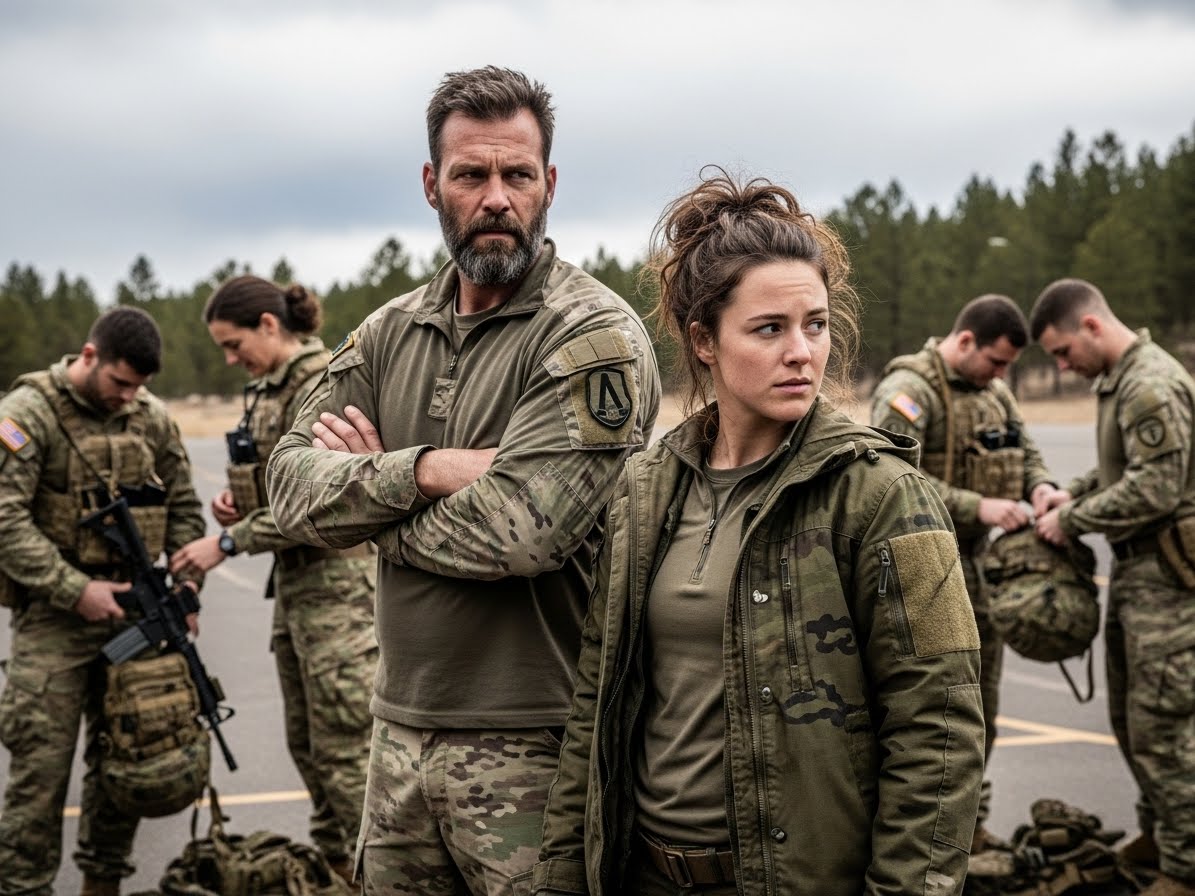
It was Sergeant Elena Ward.
She was prone fifteen meters to my right, nestled into a depression in the rocks. Her entire world was contained in the optical lens of her M40A6 rifle, which was trained on a ridgeline so distant it seemed to shimmer in the crisp mountain air.
I had fought her assignment from the jump. I’d made the calls to command, filed the reports, registered my official protest.
“She’s green, Colonel,” I’d said two weeks ago. “She’s a liability.”
It wasn’t because she was a woman. That was old-school thinking, and I didn’t have time for it. I’d served with women who were absolute machines. No, my problem was her file.
Six months.
She’d only graduated from the Marine Corps Scout Sniper School six months ago. Before that, she was a combat medic. She spent her tours applying tourniquets and pushing morphine, not calculating windage and elevation.
“She’s a ‘Paper Sniper’,” I had told my XO. “She can hit a target on a manicured range at Quantico with a little red flag telling her which way the wind is blowing. Put her on the spine of the continent where the wind is a liar? She’s going to get us killed.”
But Command didn’t care. They needed bodies. So here she was, fifteen meters away, looking through a scope while the world burned around us.
A round sparked off the rock inches from my face, sending a spray of hot lead fragments into my cheek. I winced, wiping the blood away with a gloved hand.
“Maddox,” Ward’s voice crackled again. “I have movement. High ridge. Sector four.”
“Focus on the tree line, Ward!” I snapped back. “That’s where the volume is coming from. Forget the ridge.”
“Negative,” she said. “The tree line is suppression. The kill shot is on the ridge.”
I hated that she was arguing. I hated that we were pinned. But mostly, I hated the sinking feeling in my gut that said this was the day my luck finally ran out.
Chapter 2: The Two-Inch Gap
The supply truck took a hit. An RPG struck the rear axle, lifting the five-ton vehicle into the air before slamming it back down in a twisted heap of metal. The explosion echoed like a thunderclap, rolling down the valley.
“They’re zeroing the ambulances,” Ward said. Her voice had lost none of its calm. It was unnatural. “I see the shooter. He’s setting up for a second volley.”
I pulled my binoculars, risking a look over the edge of my cover. I scanned Sector Four—a sheer wall of gray granite nearly a kilometer away.
“I don’t see anything, Ward,” I hissed. “You’re chasing ghosts. Give me eyes on the trees.”
“He’s there,” she insisted. “Behind the shale curtain. There’s a fissure. He’s firing through the gap.”
I looked again. I saw the fissure. It was a crack in the rock face, maybe a foot wide, shadowed and deep. But the angle? The angle was impossible. To put a round into that gap from her position, she would have to thread a bullet through a shifting crosswind that changed direction three times between here and there.
“Range?” I asked, testing her.
“Nine hundred and twenty meters,” she replied instantly. “Wind is seven miles per hour full value at the muzzle, switching to a quarter value headwind at five hundred, then swirling at the target.”
The math made my head spin. It wasn’t just difficult; it was a shot you didn’t take. Not in combat. Not when missing meant giving away your position to a heavy machine gun team that would turn our cover into gravel.
“Stand down, Sergeant,” I ordered. “That’s a no-go. The probability is too low. We wait for air support.”
“Air is twenty minutes out,” Ward said. “The ambulance won’t last twenty minutes. They’re reloading the RPG.”
“I said stand down!” I roared. The authority in my voice was absolute. It was the voice that had commanded teams in Fallujah and Helmand. It was the voice that meant obey or die.
Ward didn’t flinch. She didn’t look at me.
“He’s lifting the tube,” she whispered.
I watched her hand move. She wasn’t adjusting her turret. She wasn’t checking her dope card. She reached up to her helmet.
Click.
She turned off her radio.
My blood went cold. “Ward!” I screamed, scrambling to get my boots under me. I was going to tackle her. I was going to drag her off that rifle before she got us all killed.
She exhaled. A long, slow puff of white mist escaped her lips.
She saw an impossible shot, a rookie out of her depth, and a mission about to go sideways. I saw a court-martial. I saw a wasted bullet.
But she saw a two-inch gap in the world. She saw a debt that had to be paid—medic to medic—and a truth that only a bullet could speak.
In the heart of the storm, an order was given… and refused.
The recoil rippled through her body. The rifle barked—a sharp, singular report that cut through the chaotic noise of the ambush.
I froze, halfway out of cover, my eyes snapping to the distant ridge.
One second.
Two seconds.
The bullet was in the air, fighting gravity, fighting the wind, fighting my doubt.
Chapter 3: The Echo of Silence
I watched the ridge. For a heartbeat, there was nothing. Just the gray, indifferent face of the mountain and the swirling dust of the battlefield. The wind howled through the pass, a mocking reminder of the impossibility of the shot she had just taken. Nine hundred meters. Uphill. erratic crosswinds. It was a shot that shouldn’t exist.
Then, I saw it.
A tiny, violent puff of pink mist erupted from the shadows of the fissure. It was small, barely a pixel in my vision, but unmistakable.
A split second later, the secondary explosion rocked the valley. The RPG round the gunner had been loading detonated. It must have taken a direct hit, or the gunner’s body convulsed on the trigger as he died. The resulting blast blew out the front of the rock shelf, sending a cascade of boulders and shale tumbling down the cliff face like a waterfall of stone.
The heavy machine gun fire from the tree line stopped instantly. The enemy was stunned. They had thought they were untouchable up there, gods looking down on ants. Suddenly, God was dead.
“Target down,” Ward whispered. Her voice was back in my ear, the radio switched on again. It was flat, devoid of celebration. “Scanning for spotter.”
I stared at her. She was cycling the bolt of her rifle, the metallic clack-clack distinct even in the ringing silence of the aftermath. A brass casing spun through the air and landed in the dirt next to her cheek. She didn’t blink.
My heart was hammering against my ribs, a mixture of adrenaline and cold fury. She had disobeyed a direct order. In the Teams, that’s not just a write-up; that’s the end of a career. It’s a breach of trust that gets people killed.
But the ambulance was still there. Intact. The smoke around it was clearing.
“Move up!” I yelled to the rest of the squad, my voice rough. “Suppress that tree line! Go, go, go!”
I scrambled over the scree, sliding down toward Ward’s position. I hit the dirt beside her, grabbing the drag handle of her vest and hauling her back behind the bulk of the main boulder.
“What the hell was that?” I hissed, my face inches from hers. “I gave you a direct order to stand down, Sergeant!”
She turned to look at me. Her eyes were different. I expected defiance, or maybe the shaky adrenaline of a rookie who just got lucky. Instead, I saw a terrifying clarity. Her pupils were pinpoint sharp. She looked like she was solving a math problem, not fighting a war.
“The wind died, sir,” she said.
“The wind did not die,” I spat back. “I can feel it cutting my face.”
“The thermal column,” she corrected, her voice quiet. “The explosion from the truck created a heat updraft. It pushed the crosswind vertical for about four seconds. It neutralized the drift. I had a window.”
I stared at her, dumbfounded. She had calculated the thermal dynamics of a burning truck affecting the wind currents at 9,000 feet, in real-time, while being shot at?
“And if you missed?” I asked, my voice low. “If you missed, and that RPG fired, and those medics died because you wanted to play hero?”
She looked past me, down the slope toward the burning convoy. Her expression cracked, just for a second. A flash of something raw and painful pushed through the sniper’s mask.
“I wasn’t playing hero, Commander,” she said. “I was a medic for four years. I know exactly what it sounds like inside that ambulance when an RPG hits. I wasn’t going to let them hear it.”
She didn’t wait for my dismissal. She rolled back into position, settling the stock of the rifle into her shoulder. “I have the spotter. He’s running. Taking the shot.”
I should have stopped her. I should have pulled her off the line right there. But the logic of the battlefield is brutal and simple: it works, or it doesn’t.
“Take him,” I said.
Chapter 4: The Ghost in the Machine
We moved under the cover of her rifle. It was the only reason we were still breathing.
Ward was methodical. Every time a muzzle flashed in the tree line, she answered it. She wasn’t firing rapidly; she was firing with a rhythm that was almost hypnotic. Crack. Pause. Crack. Pause. It forced the militia heads down, buying us the precious seconds we needed to bound forward.
“Miller, take the left flank! Jenkins, on me!” I signaled the team to push toward the wreckage of the convoy.
The air grew hotter as we got closer to the burning supply truck. The smell changed from dry dust to the sickeningly sweet scent of burning diesel and melting rubber. The heat was intense, radiating in waves that distorted the air and made it hard to breathe.
I reached the first ambulance, slamming my back against the rear doors. The armor was pitted with small arms fire, looking like the surface of the moon.
“Status inside?” I banged on the door with the butt of my rifle.
“We’re clear! We’re clear!” A voice screamed from inside. “Driver is hit! We need extraction!”
“Sit tight!” I yelled back.
I keyed my radio. “Ward, talk to me. We’re at the package. We need five minutes to offload the wounded and move them to cover.”
“You don’t have five minutes,” Ward replied. “I’m tracking movement. Large force. They’re flanking deep, coming around the finger of the ridge to your East. They’re trying to close the L.”
I checked the East. It was a dense cluster of pines and boulders, perfect for close-quarters ambush. If they got in there, they’d be within grenade range. We’d be fish in a barrel.
“Can you interdict?” I asked.
“Negative. No line of sight. They’re in the dead ground,” she said. Then, a pause. “I’m moving.”
“Negative, Ward! Stay in overwatch!”
“I can’t see them from here, Maddox!” She yelled back, the first time I’d heard her raise her voice. “I need to get higher. I’m moving to the Spire.”
The Spire was a solitary rock formation jutting out of the slope about fifty meters above her current position. It was exposed. It was suicide. If she went up there, she would command the entire valley, but every gun in the Free Mountain Front would see her.
“Elena, don’t do it,” I said, using her first name without thinking. “You’ll be silhouetted.”
“If I don’t, they flank you in three minutes,” she said. “Cover me.”
I cursed, kicking the tire of the ambulance. “All units, suppressive fire on the ridge! Pour it on! Give her cover!”
We unleashed hell. Every rifle we had opened up, chewing apart the rocks and trees above us, trying to keep the enemy’s heads down.
I watched through my optic as Ward moved. She didn’t run like a normal soldier. She moved like a lizard, low and fast, sliding over rocks, using every inch of depression in the ground. She was carrying a fifteen-pound rifle and thirty pounds of gear, moving at 9,000 feet, and she was sprinting.
She hit the base of the Spire and started to climb. It wasn’t a tactical maneuver anymore; it was rock climbing with a death wish.
Bullets began to zip around her. I saw stone chips flying off the rock face inches from her hands. She didn’t stop. She hauled herself up to a narrow ledge, forty feet in the air, completely exposed to the sky.
She settled in.
“I have them,” she said, breathlessly. “Twelve pax. moving in the defilade. Engaging.”
The sound of her rifle changed. It wasn’t the slow, methodical rhythm anymore. It was rapid fire. She was working the bolt so fast it was a blur, putting rounds downrange as fast as the mechanics of the gun allowed.
Down in the ravine, I heard the screams. The flanking force had walked right into her kill zone. She was picking them apart before they could even set up.
“She’s crazy,” Miller yelled next to me, changing a magazine. “She’s absolutely out of her mind!”
“She’s buying us time,” I said, grabbing a wounded medic as the ambulance doors swung open. “Don’t waste it! Get these people out! Move!”
Chapter 5: Blood on the Snow
The evacuation was chaotic. We were dragging wounded medics and drivers through the snow and mud, moving them toward a depression in the earth that offered better cover.
The supply truck finally gave up the ghost, the fuel tanks erupting in a massive fireball that turned the twilight sky a bruised purple and orange. The heat seared my eyebrows.
“Maddox!” Ward’s voice was strained now. “I’m taking heavy fire. I can’t hold this position much longer.”
I looked up at the Spire. The rock around her was being chewed to pieces. Tracers were converging on her position like angry hornets returning to a hive. She was the nail, and the enemy was the hammer.
“Pull back, Ward! We have the package secure! Get off that rock!”
“Pinned,” she grunted. “Sniper. He’s zeroed on the ledge. If I move, I’m dead.”
My stomach dropped. The enemy had a counter-sniper. And he was waiting for her to flinch.
“Where is he?” I demanded.
“Unknown. Somewhere in the deep timber. He’s good. He’s waiting for my muzzle flash.”
I looked around the battlefield. We were secure, but she was trapped. I had treated her like a liability, a paper tiger, and now she was up there taking the heat for my entire team.
“Miller, pop smoke! We need a screen!” I ordered.
“Wind will take it, Boss! It won’t cover her high enough!”
I knew he was right. Smoke stays low in this cold air. It wouldn’t reach the Spire.
“Ward,” I said, forcing my voice to be calm. “Listen to me. We are going to put mass fire on the timber. When I say go, you drop. You don’t climb down, you drop. You slide the scree. It’s gonna hurt, but it’s better than a bullet.”
“That’s a forty-foot drop, Maddox,” she said.
“Better a broken leg than a hole in the head. Trust me.”
There was a pause. A long, static-filled silence.
“I trust you,” she said.
It hit me then. Despite everything—despite my doubts, my yelling, my report trying to get her transferred—she trusted me to get her out.
“On my mark,” I said, raising my rifle. “Target the deep timber! Everything you got! suppressive fire! Three… two… one… GO!”
We emptied our magazines. The timber line disintegrated under thousands of rounds of 5.56 and 7.62. It was a wall of noise, a desperate attempt to make the enemy sniper duck for just a second.
I saw Ward push off the ledge.
She didn’t climb. She threw herself into the void.
She hit the steep slope below the Spire feet first, collapsing instantly into a controlled slide. She was tumbling, bouncing off rocks, a ragdoll of green and tan gear plummeting down the mountain.
“Cover her!” I screamed, running out into the open.
She came to a stop in a cloud of dust at the bottom of the scree, about fifty meters from us. She lay still.
“Elena!” I yelled, sprinting toward her.
For a second, I thought she was gone. I thought the fall had snapped her neck.
Then, the pile of gear shifted. She rolled onto her back, groaning. Her rifle was still strapped to her chest, the barrel caked in white dust.
She looked up at me, her face smeared with dirt and blood from a cut on her forehead. She spat out a mouthful of grit.
“That,” she wheezed, “was a terrible plan.”
I almost laughed. I reached down and grabbed her harness, hauling her up. She winced, putting weight on her left leg, but she stood.
“Can you walk?”
“I can shoot,” she said, gripping her rifle. “Walking is optional.”
“Good,” I said, throwing her arm over my shoulder. “Because we’ve got three miles to the extract point, and the whole mountain knows we’re here.”
We turned back toward the team. The immediate ambush was broken, but the fight was far from over. The Free Mountain Front wasn’t going to let us walk away. And as I looked at the rookie limping beside me, I realized something.
The paper sniper was gone. The woman next to me was something else entirely. She was dangerous. She was reckless.
And she was exactly what we needed.
But the mountain wasn’t done with us yet. As we regrouped, the radio crackled with a new voice. Not one of ours.
“American Team,” a deep, distorted voice cut through our encrypted channel. “You have caused us much pain today. But you are on the wrong side of the pass. The bridge is out. There is no extraction.”
I looked at Ward. She looked at me.
We were trapped.
Chapter 6: The Voice in the Snow
The radio silence that followed the stranger’s voice was heavier than the granite boulders surrounding us. “The bridge is out.” The words hung in the freezing air, a death sentence delivered with a distorted, digital sneer.
I looked at the receiver in my hand like it was a venomous snake. They had cracked our comms encryption. That meant they knew our position, our status, and our desperation. They weren’t just hunting us; they were herding us.
“Check the map,” I ordered, my voice low. “Verify the bridge.”
Ward was already on it, her face pale beneath the grime and dried blood. She tapped her wrist-mounted GPS, but the screen was flickering. “Jamming signal,” she muttered. “They’re blocking GPS. We’re navigating blind, Maddox.”
“Paper map,” I snapped. “Old school.”
I pulled a laminated topographic map from my admin pouch, shielding it from the biting wind with my body. The bridge over Roaring Fork Gorge was three klicks east. If that bridge was gone, we were cut off from the extraction zone. To the north was a sheer cliff face. To the south, the enemy. To the west, a box canyon that ended in a frozen waterfall.
“If the bridge is gone,” Miller said, his voice tightening, “we’re stuck on the wrong side of a two-hundred-foot drop.”
“We check it anyway,” I said. “We need visual confirmation. Maybe it’s a psy-op. Maybe they’re lying to make us panic.”
We moved out, but the dynamic had changed. We weren’t a confident strike team anymore; we were wounded animals. Ward was limping badly, her left leg dragging slightly in the scree. Every step she took was a battle against pain, but she didn’t complain. She kept her rifle up, scanning the ridgelines, her eyes constantly moving.
The weather began to turn. The clear, biting cold of the high altitude gave way to heavy, wet clouds rolling in over the peaks. Snow began to fall—huge, fat flakes that stuck to our eyelashes and melted into our gear. Within twenty minutes, the visibility dropped to fifty meters.
We reached the gorge an hour later. The sound of rushing water echoed up from the darkness below, a roar that drowned out our footsteps.
I crawled to the edge of the ravine, binoculars up.
My heart sank. The stranger hadn’t lied. The steel truss bridge was twisted wreckage, sitting in the riverbed two hundred feet down. The center span had been blown clean, leaving two jagged metal fingers pointing accusingly at each other across a hundred-foot gap.
“Confirmed,” I whispered into the radio, knowing the enemy was listening. “Bridge is down.”
“Copy,” came the distorted voice again. “We told you, American. The mountain is closed.”
“Cut the chatter,” I growled, switching the radio off.
We pulled back into the tree line. The team looked at me. I saw fear in the eyes of the younger guys. They were looking for a way out, and the map said there wasn’t one.
“What’s the play, Boss?” Miller asked.
I looked at the map again. The contours were tight lines, indicating steep terrain.
“We can’t go forward,” I said. “We can’t go back. So we go up.”
I pointed to the ridgeline above us—the same ridge the enemy had fired from initially.
“That’s their territory,” Jenkins argued. “We’d be walking right into them.”
“Exactly,” Ward said. She was leaning against a pine tree, taking the weight off her bad leg. “They expect us to hunker down in the valley or try to rig a crossing. They won’t expect us to assault the high ground in a blizzard.”
I looked at her. She was shivering, but her voice was steady.
“It’s suicidal,” I said.
“It’s unexpected,” she countered. “And there’s an old mining tram station at the peak. It’s marked on the map as ‘abandoned.’ If we can get there, it’s a defensible structure. High ground. Thick walls. We hold out until the storm breaks and the birds can fly.”
It was a crazy plan. Climbing two thousand vertical feet in a snowstorm, with wounded, to fight a superior force on their own turf.
“Let’s move,” I said.
Chapter 7: The Devil’s Spine
The climb was agony.
The snow thickened into a whiteout, a swirling vortex of ice that stung exposed skin like sandblasting. We were climbing the “Devil’s Spine,” a narrow, razor-back ridge that led up to the old silver mine.
The wind howled at forty miles per hour, trying to tear us off the mountain. Ward fell twice. Each time, I hauled her up. Each time, she gritted her teeth and kept moving.
“You okay?” I yelled over the wind.
“Never better,” she lied.
We were halfway up when the first shot rang out. It wasn’t the crack of a rifle; it was the thump of a mortar.
An explosion bloomed in the snow fifty meters behind us, throwing a plume of black earth and white ice into the air.
“They’re walking rounds onto us!” Miller screamed.
“Keep moving! Don’t stop!” I roared.
They were tracking us with thermal optics from a parallel ridge. We were white-hot distinct shapes against the cold background. We couldn’t fight back; we couldn’t see them. We just had to outrun the explosions.
Another mortar hit, closer this time. The shockwave knocked me into the snow. I tasted copper.
“Smoke!” Ward yelled. “Pop smoke!”
“It won’t work in this wind!” I shouted back.
“Do it!”
I grabbed a smoke canister and pulled the pin, hurling it downwind. The purple smoke erupted, and instantly, the wind took it. But instead of dissipating, the heavy, cold air pressed it down against the slope, creating a low, streaking wall of fog.
It was just enough. The next mortar round went wide.
We scrambled the last hundred yards on our hands and knees, lungs burning, muscles screaming. The mining station loomed out of the blizzard like a haunted castle—a skeletal structure of rusted iron and rotting wood clinging to the peak.
We breached the doors, collapsing onto the frozen concrete floor inside. It smelled of rat droppings and century-old dust.
“Secure the perimeter!” I wheezed. “Miller, Jenkins, cover the rear. Ward, get on the catwalk. We need eyes.”
Ward didn’t argue. She dragged herself up a rusted metal staircase to the upper gantry, where a broken window looked out over the ridge we had just climbed.
We waited.
The storm raged outside, rattling the corrugated metal walls. Inside, the silence was heavy. We were cornered. We were out of ammo, out of food, and out of time.
Then, the radio crackled.
“Impressive climb, Commander.” The voice was clear now. No distortion. He was close. “But now you have nowhere left to run.”
“I’m done running,” I said into the mic. “Come and get us.”
“Look out the window,” the voice said.
I moved to a crack in the wall. Down on the ridge, through a break in the snow, I saw them. A dozen figures in white camouflage, moving methodically up the slope. And behind them, a man standing tall, wearing a dark coat, holding a radio.
He wasn’t hiding. He was arrogant. He knew he had us.
“Ward,” I whispered. “Do you have the HVI?”
“I see him,” she said from the gantry above. “Range four hundred meters. High angle. Heavy crosswind.”
“Can you make it?”
“My scope is fogging. My hands are numb. And I can’t feel my trigger finger.”
“Can you make it?” I repeated.
Silence.
“He’s behind a hostage,” she said softly.
I looked again. The man in the dark coat had pulled someone in front of him—one of the medics from the ambulance who must have been captured in the chaos. He was using him as a human shield.
“He knows,” Ward said. “He knows I won’t shoot.”
The enemy commander raised his rifle, aiming it at the back of the medic’s head.
“Surrender,” the voice on the radio said. “Or he dies.”
I looked up at the gantry. I couldn’t see Ward, only the barrel of her rifle protruding from the shadows.
This was the test. The text-book answer was to hold fire. You don’t take a shot with a hostage in the line of fire. The risk is zero-tolerance.
But this wasn’t a textbook. This was the Rockies.
“Maddox,” Ward said. “Trust me.”
It was the same thing I had said to her before she jumped off the cliff.
“Clear to engage,” I whispered.
The shot was deafening in the enclosed space.
I watched through the crack in the wall. The dark coat jerked violently backward, as if kicked by a mule. The medic stood frozen, untouched. The enemy commander collapsed into the snow, a single hole in the center of his forehead.
The “human shield” hadn’t saved him. Ward had put a bullet two inches past the medic’s ear, through the swirling snow, accounting for the wind, the angle, and the shivering of her own body.
She hadn’t hit the hostage. She hadn’t missed.
The militia froze. Their leader was dead. The invincibility was gone.
“Open fire!” I yelled.
We poured fire down the slope. Leaderless and exposed, the enemy broke. They scattered into the storm, their morale shattered by a single, impossible bullet.
Chapter 8: The Truth in the Chamber
The chopper arrived at dawn.
The storm had broken, leaving the mountain bathed in a brilliant, blinding gold. The Blackhawk touched down on the flat plateau behind the mine, kicking up a cyclone of fresh snow.
We limped to the bird. I had my arm around Ward, helping her walk. She was exhausted, her face gray, her eyes sunken. She looked like she had aged ten years in twenty-four hours.
We loaded the wounded. The medic—the one she had saved—grabbed her hand as he was loaded onto the stretcher. He didn’t say anything. He just squeezed her gloved hand and nodded. That was enough.
I sat across from her as the bird lifted off, the ground falling away beneath us. The vibration of the rotors lulled us into a stupor.
She pulled her headset off and leaned her head back against the fuselage, closing her eyes.
I reached into my vest pocket and pulled out a folded piece of paper. It was the transfer request I had written three days ago. The one where I called her a liability. The one where I said a “paper sniper” had no business in the field.
I looked at it for a moment. Then, I crumpled it into a ball.
I leaned forward and tapped her knee. She opened one eye.
“You disobeyed a direct order,” I said, my voice flat.
“Yes, sir,” she rasped. “I expect the court-martial papers by Monday.”
“You turned off your comms.”
“Yes, sir. Too much noise.”
“You took a shot with a hostage in the solution.”
“I had the angle, sir.”
I looked at her. Really looked at her. I saw the grit under her fingernails, the dried blood on her collar, and the absolute, unshakeable steel in her eyes.
“You’re right,” I said. “You had the angle.”
I tossed the crumpled paper ball out the open door of the helicopter. I watched it flutter down toward the trees, disappearing into the vast, white wilderness below.
“What was that?” she asked.
“Trash,” I said. “Just some old paperwork.”
I extended my hand.
“Good shooting, Elena.”
She looked at my hand, then at my face. A slow, tired smile spread across her lips. She took my hand. Her grip was strong.
“Thanks, John.”
We flew south, leaving the mountain behind us. The war wasn’t over. There would be other missions, other impossible shots, other days where the math didn’t add up.
But I wasn’t worried. Not anymore.
I looked out the window at the rugged, unforgiving terrain. People talk about the “fog of war.” They talk about chaos and luck. But up here, at 9,000 feet, I had learned a different truth.
Sometimes, you don’t need luck. Sometimes, you just need to see the gap in the world that no one else can see. And you need the courage to pull the trigger when the whole world is screaming at you to stop.
She was a rookie. She was out of her depth.
And she was the best damn sniper I had ever seen.