The Arrogant Sergeant Thought He Had Caught A Fraud. He Didn’t Realize He Was Interrogating The Deadliest Ghost In U.S. History.
PART 1: THE TRAP
Chapter 1: The Performance
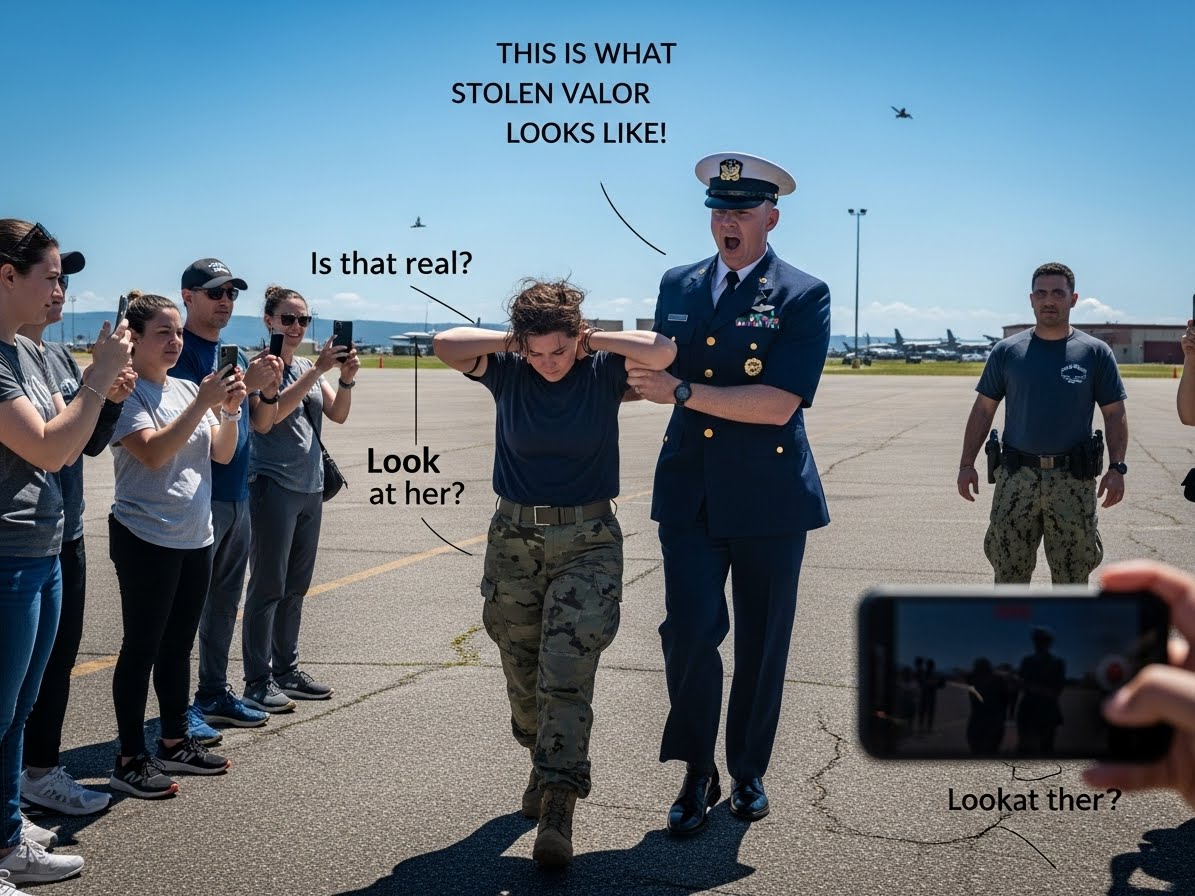
They paraded me across the asphalt in handcuffs, making sure every camera on the base got a good look. To them, I was the ultimate joke: a pathetic woman playing dress-up, caught impersonating a Navy SEAL. The cameras were rolling, the iPhones were out, and the whole base was laughing.
Their golden-boy Staff Sergeant, Colt Ramsay, was tearing me apart for stolen valor. He looked like a recruiting poster and acted like a god. He thought he was breaking a liar. He had no idea that by arresting me, he had just triggered a countdown to uncovering the deadliest traitor in the American military… and he definitely didn’t know that the “fraud” in his backseat was the only thing standing between him and a federal prison cell.
The humidity in Virginia is a physical thing. It sticks to your skin like a layer of grease, magnifying the heat until the air feels heavy in your lungs. But I wasn’t sweating.
My heart rate was a steady 58 beats per minute.
“Head down! Keep moving!”
The hand on the back of my neck was firm, professional, and entirely unnecessary. Staff Sergeant Colt Ramsay was enjoying this way too much. He marched me through the gathered crowd outside the Base Exchange like a trophy hunter dragging a fresh kill.
“Take a good look, everyone!” Ramsay’s voice boomed, projecting perfectly for the smattering of junior enlisted and dependents who had stopped to gawk. “This is what disrespect looks like. This is what happens when you think you can slap a Trident on your chest and walk onto my base without earning the right to breathe the same air as the men who died for it.”
He shoved me forward, just hard enough to make me stumble, but I didn’t. I absorbed the momentum, adjusted my center of gravity, and kept walking.
To the casual observer—and there were dozens of them holding up smartphones—I looked like a mess. My combat trousers were faded and unauthorized. The tactical t-shirt was generic. The muddy boots were a size too big. I looked exactly like what Ramsay said I was: a mental case, a civilian “wannabe” trying to steal valor for a discount at the commissary or a free drink at the local bar.
“You have the right to remain silent,” Ramsay sneered close to my ear as he shoved me toward the back of his patrol cruiser. “But I really hope you don’t. I can’t wait to hear the fairy tale you cooked up.”
He slammed my head down to clear the door frame—rougher than regulation permitted.
I sat in the back of the cruiser, the hard plastic seat digging into my spine. Through the wire mesh, I watched Ramsay high-five his partner, Tucker. They were laughing. Ramsay adjusted his sunglasses, checked his reflection in the side mirror, and flashed a winning smile at a young female corporal filming him.
Enjoy it, Sergeant, I thought, my face remaining a blank mask. Preen for the cameras. Because in about two hours, you’re going to wish you had never walked out of the barracks this morning.
He got into the driver’s seat, slamming the door. “Hope you’re comfortable, sweetheart. We’re going to Interrogation Room 3. No windows. No AC. Just you, me, and the federal crime you just committed.”
I didn’t answer. I was too busy counting the security checkpoints we passed, noting the rotation of the gate guards, and calculating the response time of the Quick Reaction Force I had triggered simply by letting them scan my fingerprints five minutes ago.
Ramsay thought he had caught a mouse. He didn’t realize he had just locked himself in a cage with a viper.
Chapter 2: The Concrete Box
Interrogation Room 3 was a masterclass in sensory deprivation.
It was a concrete box, ten by ten. The walls were painted a soul-sucking shade of institutional beige, scuffed with the ghosts of a thousand other bad days. A metal table was bolted to the floor, accompanied by two metal chairs that looked designed to induce back spasms. A single, small window high on one wall showed nothing but a sliver of flat, indifferent blue sky.
A digital recorder sat on the table, its small red light blinking. Recording.
The room smelled of stale coffee, industrial cleaner, and the faint, metallic tang of fear. It was a smell I knew better than my own perfume. I had sat in rooms like this in Baghdad, in Kabul, in black sites that didn’t officially exist. The only difference was that usually, I was the one sitting on the other side of the table.
Ramsay gestured to the chair with a flick of his chin. “Have a seat, sweetheart.”
He settled into his own chair, the picture of dominant authority. He spread his legs, leaned back, and laced his fingers behind his head. He owned this room. He owned me. Tucker guided me into the seat, his touch still professional, impersonal. I wondered if Tucker had any idea he was a pawn in a performance that had started 18 months ago. He was just a man doing his job, and for that, I respected him more than the peacock strutting in front of me.
“Remove the restraints,” Ramsay ordered. “I want our guest to be comfortable for our little chat. Give her some water, too. We’re civilized here.”
Civilized. That was the word he chose. This man, who had just subjected me to a medieval public shaming, was now playing the part of the reasonable officer. The hypocrisy was so thick I could almost taste it.
Shutterstock
The metallic click-clack of the handcuffs opening was deafening in the small room. The cuffs fell away. My wrists screamed in protest, red and raw from the nerves being pinched.
I didn’t rub them.
That’s what a civilian would do. A civilian seeks immediate comfort.
Instead, I placed my hands flat on the metal table, palms down. The surface was cold. I flexed my fingers, one by one—index, middle, ring, pinky—feeling the blood rush back, cataloging the pinpricks of returning sensation, checking nerve function. It was a precise, medical self-assessment, not the grateful rubbing of a civilian.
Through the one-way observation mirror to my left, I knew they were watching. Lieutenant Commander Pierce and Master Chief Cain. I felt their scrutiny like a physical weight. I had to give them a show, too. Just a different one. This wasn’t for the crowd outside. This was for the professionals behind the glass. I needed them to see the cracks in Ramsay’s story, not in me.
Ramsay opened his manila folder, the one he’d waved around in the courtyard like a prop. He spread several documents across the table with a theatrical flourish. Photographs. Schematics.
“So,” he began, his voice dripping with condescending patience. “Let’s start with the basics. Your name. Your real name, this time.”
I met his gaze. My pupils didn’t dilate. My breathing remained rhythmic. I had already cataloged the room: one door, two guards (Tucker and another by the wall, a new face), one-way mirror. Ramsay was my primary focus. His pupils were blown wide, not with anger, but with excitement. He was high on the power. This was a drug for him.
“Evelyn Cross,” I said. My voice was quiet, steady. No fear. No defiance. Just a statement of fact.
“Age?”
“Twenty-eight.”
“Occupation?”
“Currently unemployed.”
Ramsay’s perfect eyebrows rose. “Unemployed. How convenient. And what did you do before your recent career change to federal criminal?”
For the first time, I let a flicker of something—not amusement, but dry interest—touch my expression. “I worked in logistics.”
“Logistics?” He made a show of writing it down on a yellow legal pad, his pen strokes exaggerated. “And I suppose your ‘logistics’ experience included detailed knowledge of classified military installations, did it? Accessing restricted data? Impersonating dead heroes?”
He fanned the documents toward me. They were aerial photos of the base, technical diagrams, security protocols. The planted evidence he had “found” in my bag.
“Let’s talk about these,” he said, his tone shifting from mockery to a prosecutor’s sharp edge. “Detailed schematics of our defensive positions. Guard rotations accurate down to the minute. Classified protocols that would take months of surveillance to compile.”
He leaned in, his voice dropping, the performance returning. “Unless, of course, someone gave them to you. Who’s your handler, Evelyn? Which foreign service are you working for? Russia? China? Don’t tell me, North Korea? You don’t look the type, but hey, I’m open to surprises.”
This was the moment. The pivot.
I looked at the documents. I didn’t look at them with the panic of a caught criminal. I looked at them with the cold, bored eyes of an analyst. I scanned the images in trained patterns—top-left to bottom-right—identifying key infrastructure, threat vectors, ingress/egress points. My finger traced the edge of one aerial photo, my nail just barely brushing the laminate.
From behind the glass, I heard Master Chief Cain shift his heavy weight. Creak. He’d recognized the scanning technique. He knew what he was looking at. He was old-school intelligence.
“I’ve never seen these documents before,” I said finally, my voice flat.
Ramsay laughed, a sharp, ugly sound. “Right. They just materialized in your backpack. Maybe your fairy godmother left them under your pillow. You expect me to believe that?”
I held his gaze. “I said I’d never seen these documents. I didn’t say I was unfamiliar with the information.”
The distinction, so subtle, landed in the room with the weight of a dropped grenade.
Ramsay’s smile faltered, just for a second. The practiced confidence wavered.
“Explain that,” he demanded, his voice a little tighter.
I leaned back slightly, keeping my posture open, non-confrontational. “Norfolk Naval Base is a major East Coast installation. Its general layout, operational capacity, and primary defensive positions are matters of public record for anyone with basic research skills. Half of these photos,” I tapped one with a fingernail, “look like they were pulled from Google Earth. The resolution is civilian-grade.”
I pointed to one of the “classified” diagrams. “And this schematic of the power grid? It’s outdated. That substation by the south gate was refitted 18 months ago after the hurricane. This diagram still shows the old transformer array. What makes information classified, Staff Sergeant, isn’t its existence. It’s its accuracy. Most of this… it’s just noise. Impressive-looking noise, but noise nonetheless.”
I gave him a small, helpful smile. “If you paid for this information, I’d ask for a refund.”
Ramsay’s jaw tightened. This wasn’t going according to his script. He was supposed to be breaking down a hysterical wannabe, not debating operational security with a logistics manager. He had planted evidence, but he had planted bad evidence. Sloppy. Arrogant. Just like him.
“She’s right,” Commander Blackwood, the base CO, who had joined the others behind the glass, said quietly. I couldn’t hear him, but I knew he’d be there. I’d seen his car pull up. “Half of what he’s showing her could be pulled from Jane’s Defense Weekly.”
Ramsay, flustered, swept the photos aside and replaced them with a new set of documents. Personnel files.
“Fine,” he snapped. “Let’s talk about something more specific. Something you can’t find on Google.” He slammed the file down. “These are the active duty records for SEAL Team 6. Names, deployment histories, family information. The kind of data that gets people killed. We found this in your bag, too.”
My focus sharpened. This was different. This wasn’t open-source. This wasn’t “noise.” This was real. This was the blood.
My breathing pattern shifted. Still controlled, but deeper. Heightened alertness. I reached for one of the files. My movement was precise, confident. The gesture of someone who handled classified materials every day.
I scanned the top page. It was a deployment roster. My stomach twisted. I knew two of the names on that list. I had served with their brothers. I had attended a funeral for one of them. The rage was a cold, hard stone in my gut.
“This information is current as of last month,” I observed. My voice was cold now. All pretense of “logistics” was gone. “That suggests ongoing, active access to classified databases. Not a one-time theft. A leak.”
The observation hit Ramsay like a slap. He’d been so focused on his performance that he’d forgotten basic operational security. By showing me current intelligence, he had revealed a critical piece of the puzzle: the leak was active, and it was inside. He had just confirmed my entire investigation.
“That’s not your concern,” he snapped, but his composure was cracking. He was trying to regain control, but he was losing it.
“Isn’t it?” I set the file down and looked directly at him. “You’re accusing me of espionage based on outdated, public-domain documents I’ve never seen, while simultaneously demonstrating that highly classified, life-threatening information is being leaked from sources I couldn’t possibly have access to. That seems like a logical contradiction, Staff Sergeant.”
Ramsay stood abruptly. The chair screeched against the concrete, a harsh, grating sound designed to startle, to intimidate.
I didn’t flinch. Not an eyelid.
“You know what I think?” he said, pacing behind me now, trying to use his height and position to intimidate. His voice was a low growl. “I think you’re a professional. Not some wannabe playing dress-up, but an actual intelligence operative. The question is, which service? CIA? DIA? Or maybe something… more exotic?”
It was a classic fishing expedition. He was desperate for a reaction, for anything to regain his footing.
I gave him nothing. “What would make you think that?”
The counter-question, the deflection, made his frustration boil over.
“Because civilians don’t sit there analyzing classified documents like they’re reading a restaurant menu!” he exploded, slamming his palm on the metal table. The sound was a gunshot in the small room. The water cup jumped.
“Because normal people don’t discuss operational security like they wrote the manual! And because every instinct I’ve developed over 12 years of service is screaming at me that you are not who you pretend to be!”
I waited. I let the echo of his shout fade. I let the silence stretch, filling it with my calm.
When I finally spoke, my voice was quiet, but it cut through his rage like a scalpel.
“If your instincts are that sharp, Staff Sergeant… perhaps you should trust them completely.”
The challenge hung in the air. He stared at me, his perfect features flushed, his chest heaving. For the first time, he looked uncertain. He looked… afraid.
He had started the day hunting a rabbit and was just now realizing he’d cornered a wolf.
Chapter 3: The Tripwire
The tension in the room was a taut wire, vibrating with the echo of my challenge. Ramsay stared at me, his chest heaving. The golden boy was cracking. He had expected a sobbing apology, not a psychological counter-attack.
Before he could find his voice, the door burst open.
It wasn’t a dramatic entrance. It was a stumble. Private Luna Hayes, the young soldier I’d seen filming in the courtyard, tripped over the threshold. She was holding a steaming mug with both hands, her eyes wide with the terror of interrupting her superior officer.
“Staff Sergeant, I… you requested coffee,” she stammered, shrinking under Ramsay’s furious glare.
“Just put it down and get out, Hayes!” Ramsay snapped, happy to have a softer target for his rage.
Hayes flinched violently. Her hands spasmed, and hot coffee sloshed over the rim of the mug, splashing across the metal table and coating her own fingers.
She gasped, dropping the mug. It clattered loudly, spilling the rest of the brown liquid. Tears of pain welled instantly in her eyes as she clutched her scalded hand to her chest.
Ramsay didn’t move. He just looked disgusted by her incompetence.
But I moved.
Instinct took over. Before Ramsay could yell again, before Tucker the guard could take a step, I was out of my chair. I reached into the cargo pocket of my scuffed pants and pulled out a small, foil-wrapped square. A sterile burn dressing.
“Let me see,” I said, my voice quiet but commanding.
Hayes, stunned, obeyed. I took her hand. The skin was already angry red. With precise, practiced movements—the muscle memory of a thousand field medics—I tore the packet open with my teeth, applied the cooling hydrogel dressing to the burn, and secured it.
“The gel will neutralize the heat and stop the blistering,” I told her softly, looking into her terrified eyes. “Keep it clean. Go to medical in an hour to get it checked.”
Hayes stared at me, then at the professional dressing on her hand. “Th-thank you, ma’am.”
“Get out, Hayes,” Ramsay barked, his voice tight.
Hayes scrambled out of the room, cradling her hand.
The door clicked shut. Ramsay stared at me, his eyes narrowed to suspicious slits. The air had changed again. I wasn’t just the smart-mouthed detainee anymore.
“Where exactly did you learn field medicine, Miss Cross?” he demanded, moving back to his side of the table, putting distance between us.
I sat back down slowly, my demeanor calm again. “First aid certification is required for most high-risk logistics positions. OSHA regulations.”
It was a plausible lie. But the speed, the precision, the lack of hesitation—that wasn’t OSHA training. That was combat medicine.
Ramsay knew it. And more importantly, the men behind the glass knew it.
Behind the one-way mirror, Commander Blackwood had seen enough. He turned to Master Chief Cain.
“I’m making the call,” Blackwood said, his voice grim. “This isn’t a stolen valor case. Cain, run a complete background check on Evelyn Cross. Priority One. I want to know everything. Employment, credit reports, traffic tickets, library fines. Everything.”
“What classification level, sir?” Cain asked.
“Start with civilian. If that comes up empty… escalate it until you hit a wall.”
In the interrogation room, Ramsay’s phone buzzed loudly on the metal table, breaking the silence. He glared at it, annoyed by the interruption, then snatched it up.
He read the text message.
The color drained from his face instantly. It wasn’t a gradual fade; it was like someone had pulled a plug. He went from flushed with rage to a sickly, ashen gray in a heartbeat.
He stared at the screen for a long, agonizing moment. His hand started to shake.
Slowly, very slowly, he lifted his eyes to meet mine. The arrogance was gone, replaced by a dawning, sickening horror.
“Interesting,” he whispered, his voice trembling. “It seems our standard background check on you has hit… complications.”
I kept my face neutral, though I knew exactly what had happened. “What kind of complications?”
“The kind,” he said, his voice cracking, “where your fingerprints just triggered a classified access warning in the federal database. A Pentagon-level tripwire.”
I held his gaze. “That’s unusual.”
“’Unusual’?” He almost screamed the word. “Lady, civilians don’t trigger Pentagon tripwires unless they’re on a terrorist watch list or…” He stopped, the implication too terrifying to vocalize.
“Or what, Staff Sergeant?” I pressed softly.
“Who are you really?” he breathed, terrified of the answer.
Before I could reply, the door opened again. Master Chief Cain stood there. His weathered face was grim as stone. He didn’t look at me. He looked straight at Ramsay.
“Staff Sergeant Ramsay. Outside. Now.”
Ramsay looked like a man being led to the gallows. He stood up numbly and followed Cain out.
The door clicked shut.
For the first time since 0600 hours, I was completely alone in the box.
I closed my eyes and let out a single, long exhale.
Phase One: Complete. The bait was taken. The trap was sprung. Now, we waited for the fallout.
Chapter 4: The Dead Speak
I didn’t have to wait long. The silence in the interrogation room was heavy, vibrating with the unseen chaos I had unleashed outside those beige walls.
Through the one-way glass, I knew Pierce was still watching, probably paralyzed by indecision. I stretched my neck, rolling my shoulders to work out the tension. I wasn’t Evelyn Cross anymore. I was preparing for the next phase of the operation.
Outside in the hallway, I could hear muted voices. Arguments.
“The background check is a black hole, sir,” I heard Cain’s deep rumble through the thin door. “Social Security is valid, but her history is… ghosted. And that fingerprint tripwire? That’s Joint Chiefs level stuff. We kicked a hornet’s nest.”
Then, the sound I was waiting for. Vehicles approaching fast outside. Not a lone patrol car. A convoy. Heavy SUVs with powerful engines, screeching to a halt just outside the building. Doors slamming. The crisp, urgent sounds of a federal response team securing a perimeter.
The door to Interrogation Room 3 flew open.
It wasn’t Ramsay. It was Commander Blackwood.
The base CO walked in, his face a mask of controlled urgency. He didn’t sit. He stood at the end of the table, looking down at me. The dynamic had shifted completely. This was no longer a police matter. This was a national security crisis.
“Miss Cross,” Blackwood began, his voice low and formal. “In the last twenty minutes, my base has been effectively locked down by agencies outside my direct chain of command. Your presence here has created… significant interest in Washington.”
I nodded slowly. “I imagine it has, Commander.”
He studied me, looking past the messy hair and the wrinkled t-shirt, seeing the calm professional underneath. He was a good officer. Cautious. Smart. He deserved the truth, or at least, as much of it as I could give him.
“I’m going to ask you a direct question,” he said. “Are you operating under official cover?”
This was the decision point. The moment of irreversible revelation.
“That depends, Commander,” I said, my voice just as quiet as his. “On your clearance level.”
His jaw tightened. “I have Top Secret clearance. SCI. Special Access Programs authorization.”
I didn’t blink. “That may not be sufficient.”
The silence in the room became suffocating. I had just told a base commander that his highest clearances weren’t high enough. I was claiming access to the “ghost” programs—the ones that didn’t officially exist, funded by black budgets and buried under layers of deniability.
“What,” Blackwood whispered, “would be sufficient?”
I leaned forward slightly. “Contact the Pentagon Duty Officer via secure line. Ask them to run a verification request for Operation Nightfall.”
Blackwood physically recoiled. The color drained from his face. He knew the name. Every senior officer did. It was a legend, a cautionary tale told in hushed tones at the Officers’ Club. The mission that never happened. The total disaster that wiped an entire Tier 1 team off the map two years ago.
“When they ask for authentication codes,” I continued, my voice flat and cold, “tell them Ghost 7 requests extraction confirmation.”
Blackwood stared at me as if I were a specter.
“That’s… that’s impossible,” he stammered. “Ghost 7 was killed in action. Eighteen months ago. She died with her team in the Hindu Kush.”
I met his gaze, and for a brief second, I let the mask slip. I let him see the exhaustion, the cold weight of eighteen months living in the shadows, the memory of the five brothers I left on that mountain.
“Reports of my death,” I said softly, “were greatly exaggerated.”
Blackwood was frozen, his worldview crumbling. A ghost was sitting in his interrogation room.
A sharp knock on the door broke the spell. It opened to reveal a woman in a sharp, dark suit. She had cold, analytical eyes and the unmistakable air of federal authority.
“Commander Blackwood?” she said, flashing a badge that didn’t belong to the Navy. “Special Agent Sarah Carson, FBI National Security Branch. We’re taking jurisdiction of this prisoner and securing this facility.”
Blackwood, still stunned, just nodded weakly.
Carson stepped into the room. She looked at the guards. “Clear the room. Now.”
Tucker and the other guard didn’t hesitate. They fled. Blackwood gave me one last, incredulous look and followed them out.
The door shut. It was just me and Agent Carson. My handler. The only person in the world who knew I was alive.
Carson didn’t smile. She dropped the act instantly.
“Status report, Ghost 7,” she demanded, her voice crisp.
I took a breath. The performance was over. It was time to be an operator again.
Chapter 5: The Extraction
“Cover ID ‘Evelyn Cross’ is compromised,” I reported, my voice monotone. “Mission parameters achieved. The target has been positively identified and profiled.”
Agent Carson pulled out a sleek tablet, her stylus hovering over the screen. “Walk me through it. Confirmed target?”
“Staff Sergeant Colt Ramsay,” I said. The name tasted bitter. “Psychological profile is a match. Malignant narcissism, severe authority complex, deep financial debt hidden under a flashy lifestyle. He’s desperate for validation and money. He’s prime pickings for a foreign handler.”
Carson nodded, tapping notes furiously. “And today’s little circus?”
“A provocation,” I explained. “I allowed the arrest to test his reactions under pressure. A smart operator, an innocent man, would have handled a suspected stolen valor case quietly, by the book. Ramsay turned it into a public spectacle. He wanted the glory. He wanted the cameras. He’s arrogant, sloppy, and he’s our leak.”
I gestured to the scattered papers on the table. “He planted evidence on me, Sarah. But it was bad evidence. Outdated schematics. Stuff you could find online. He was trying to frame a patsy to take the heat off himself because he knows we’re getting close.”
Agent Carson finally allowed herself a thin, cold smile. “Excellent work, Ghost. Your assessment tracks with our surveillance. We needed someone inside his head to confirm it before we moved.”
She tapped the tablet one last time and stood up. “The trap is sprung. My team is arresting Ramsay right now. He’ll be in a federal holding cell within the hour. We’re rolling up his contacts off-base simultaneously.”
She looked at me, her expression softening slightly. “Your mission is concluded, Ghost 7. Eighteen months in the cold. It’s over. You got him.”
I nodded, feeling a wave of exhaustion crash over me that was so profound my knees almost buckled. Eighteen months. Seventeen compromised operations traced back to Norfolk. Three dead SEALs whose locations had been sold. And we finally had the man responsible.
It was over.
“Let’s get you out of here,” Carson said, opening the door. “Transport is waiting.”
I walked out of the concrete box for the last time. The hallway was bustling with Carson’s federal agents in tactical gear. They moved with a professional urgency that was a stark contrast to Ramsay’s peacocking military police.
As I was escorted toward the exit, I saw him.
Ramsay was being led down the opposite hallway by two massive FBI agents. He wasn’t in cuffs yet, but he looked smaller, defeated. His perfect uniform was wrinkled, his shoulders slumped. He looked up as I passed, his eyes wide with a mix of confusion and betrayal. He opened his mouth to say something, maybe to plead, but the agents shoved him forward.
I didn’t feel pity. I felt nothing but cold satisfaction. He was a traitor who sold American blood for cash.
I stepped out into the humid Virginia evening. The sun was setting, casting long purple shadows across the base. A black, armored Chevy Suburban was waiting, its engine idling.
“Home free,” Carson said, sliding into the back seat beside me. The door thudded shut, sealing us in the quiet, air-conditioned bubble.
The vehicle began to move toward the main gate. I leaned my head back against the headrest and closed my eyes. For the first time in nearly two years, I could actually sleep without one eye open.
We were approaching the final security checkpoint before the civilian world when Carson’s secure phone buzzed.
It wasn’t a normal text notification. It was a priority alert. A harsh, discordant ping that made my eyes snap open.
Carson looked at the screen. Her expression, always so controlled, fractured. Her eyes widened in genuine disbelief.
“Driver! Stop the vehicle!” she barked.
The SUV screeched to a halt just inside the gate.
“What is it?” I asked, my adrenaline surging back from zero to a hundred instantly.
Carson looked at me, her face pale. “Ramsay.”
“What about him?”
“He’s gone.”
My brain froze. “Gone? You mean dead? Did he suicide?”
“No,” Carson said, her voice trembling with rage. “I mean gone. The transport team taking him to the holding facility… they were ambushed on base. Non-lethal takedown. Gas grenades. The agents are unconscious. Ramsay isn’t there.”
The silence in the car was absolute.
Ramsay hadn’t escaped. A lone, panicked Staff Sergeant doesn’t overpower a federal transport team.
“That wasn’t an escape,” I whispered, the horrible realization dawning on me. “That was an extraction.”
Carson nodded grimly. “He has backup. Serious, professional backup right here inside the wire.”
My stomach plummeted. If Ramsay had an extraction team capable of hitting federal agents inside a US military base, the conspiracy was infinitely larger than just one greedy sergeant. It meant my entire eighteen-month investigation had just scratched the surface.
“Turn around,” Carson ordered the driver. “Get us back to the command center. Now!”
The Suburban whipped around in a tight U-turn, tires smoking, and roared back toward the heart of the base.
I stared out the window as the landscape blurred past. The mission wasn’t over. It had just exploded into something far worse. The hunter was about to become the hunted again.
Chapter 6: The Message
We roared back onto the base, which was now a scene of organized chaos. Klaxons were blaring. Searchlights swept the dark tree lines. Heavily armed Marines were establishing choke points at every intersection.
Carson was on her phone the entire ride, barking orders to kill teams. “I want a full perimeter! Thermal imaging! If he moves, you drop him!”
Her intensity bothered me. It was too… personal. Too desperate.
We pulled up to the Base Operations Center. Inside, it was a hive of activity. Commander Blackwood was shouting at a monitor, his face red.
“Agent Carson!” Blackwood yelled as we entered. “My perimeter guards found your transport vehicle. It wasn’t an ambush from the outside. The doors were opened from the inside.”
Carson froze. “That’s impossible.”
“Is it?” Blackwood countered. “Your agents are awake. They’re groggy, but they’re talking. They say Ramsay didn’t have help. They say he grabbed the driver’s sidearm while he was being handcuffed. He kicked them out of the car and drove off.”
I stepped forward, my mind racing. “A single MP Sergeant disarmed two federal agents and hijacked a vehicle? That doesn’t fit the profile of a desperate, broken man. That fits the profile of a highly trained operator fighting for his life.”
Carson spun on me. “He’s dangerous, Ghost. You said it yourself.”
“I said he was narcissistic,” I corrected. “I didn’t say he was suicidal.”
Suddenly, a communications technician stood up, his headset askew. “Ma’am! We just picked up a signal. Low frequency, encrypted. It’s broadcasting on a looped emergency channel.”
“Triangulate it!” Carson ordered.
“We don’t have to,” the tech said, looking pale. “It’s a text message. And it’s addressed to… Ghost 7.”
The room went silent.
I walked over and took the headset. The message was scrolling across the screen.
GHOST 7. AMPHITHEATER. 20 MINUTES. COME ALONE. ASK YOURSELF: WHY DID I ARREST YOU IF I WANTED TO STAY HIDDEN?
The question hit me like a physical blow.
It was the one variable that hadn’t made sense all day. If Ramsay was a spy trying to smuggle data, why make a scene? Why arrest me publicly? A spy would have let me walk, or interrogated me quietly in a back room and made me disappear.
By arresting me in front of cameras, he had guaranteed eyes on himself. That wasn’t the action of a traitor. That was the action of a man who didn’t know he was playing a game.
“It’s a trap,” Carson said instantly. “He wants a hostage. We’ll surround the amphitheater. Snipers on the ridge. We take him out.”
“No,” I said, my voice hard.
Carson stared at me. “Excuse me?”
“He’s asking for a parley,” I said. “If you send in a tactical team, he’ll dig in. He knows this base better than we do. You’ll have a firefight in a residential zone. People will die.”
I grabbed a tac-vest from a nearby rack and started strapping it on. “I’m going in alone.”
“I can’t authorize that,” Carson snapped.
“I’m not asking for authorization,” I replied, checking the load on a 9mm sidearm I grabbed from the armory table. “I’m a Tier 1 asset, Sarah. I have autonomous operational authority in crisis scenarios. I’m going.”
I turned to Blackwood. “Give me a radio channel. Keep your men back. If I give the code word ‘Thunder,’ you light him up. Until then, nobody fires. Clear?”
Blackwood nodded, respect in his eyes. “Clear.”
Carson looked furious, her jaw working tight. “Fine. But you wear a wire. I want to hear every word. If he makes one threatening move, my snipers will end it.”
I put the earpiece in. “Understood.”
I walked out into the night, leaving the safety of the command center behind. The air was cooling, but the heat of the situation was just reaching its boiling point.
Chapter 7: The Kill Zone
The base amphitheater was a concrete bowl carved into a hillside, used for concerts and graduations. Tonight, it was a tomb. The floodlights were off, leaving the rows of empty seats bathed in moonlight and shadow.
I walked to the center of the stage. I was a perfect silhouette. A target.
“I’m here, Ramsay!” I called out. My hand hovered near my weapon, but I didn’t draw it.
Silence. Then, a voice echoed from the darkness of the projection booth high above the seats.
“Check your six,” the voice said.
I spun around.
Ramsay wasn’t in the booth. He was ten feet behind me, emerging from the shadows of the stage curtain. He held a standard-issue Beretta, but it wasn’t pointed at me. It was pointed at the ground.
He looked like hell. His uniform was torn, his face bruised. He was sweating, his chest heaving.
“You came,” he said, his voice raspy.
“You asked for me,” I replied, keeping my body angled to minimize my profile. “Put the weapon down, Colt. It’s over.”
“Is it?” He laughed, a bitter, broken sound. “You know, I sat in that cell for twenty minutes thinking. Thinking about everything you said. The profile. The debts. The evidence.”
He took a step closer. “I didn’t plant those files in your bag, Ghost.”
“Of course you’d say that.”
“Think!” he pleaded. “Who had access to your bag after you were detained? Who processed the evidence? Tucker. My partner.”
“Tucker is a grunt,” I said.
“Tucker just bought a boat he can’t afford,” Ramsay shot back. “And Tucker was the one who handed the evidence bag to… your handler.”
My blood ran cold.
“Carson,” he spat the name. “She was in the room before you even got to interrogation. She was ‘securing the scene.’ I saw her.”
In my ear, Carson’s voice crackled, sharp and urgent. “He’s lying to confuse you, Ghost. He’s closing distance. Prepare to engage.”
“Why call me here, Colt?” I asked, ignoring the voice in my ear.
“Because you’re the only one smart enough to see the holes,” he said. “You said I was sloppy. I’m not sloppy. I’m the best damn MP on this base. If I were selling secrets, you never would have found me. The clumsiness of the evidence… the Google Earth photos… it was designed to be found. It was designed to be a slam dunk.”
He looked at me with desperate intensity. “It was a frame job. A perfect frame job to close a case file so someone could stop looking.”
“He’s manipulating you!” Carson screamed in my ear. “Take the shot, Ghost! That is a direct order!”
“Who benefits, Colt?” I asked him softly.
“Who closes the file?” he countered. “Who gets the credit for catching the ‘traitor’? And who makes sure the real leak stays plug-free? Your handler.”
He reached into his pocket.
“He’s reaching for a weapon!” Carson yelled. “Snipers! Green light! Green light!”
“NO!” I screamed.
Ramsay didn’t pull a gun. He pulled out a small, black data drive.
“I took this off the federal agent in the car,” he said, tossing it to me. I caught it. “It’s their comms log. Read the last outgoing message.”
I looked at the small screen on the drive. It wasn’t encrypted. It was a simple text sent five minutes before they picked me up.
Subject: Asset Ghost 7. Message: The patsy is in custody. Terminate Ghost 7 after debrief. Make it look like a suicide. Loose ends tied.
The world stopped spinning.
Carson hadn’t come to extract me. She had come to kill me. I was the loose end. I had found the “traitor” she created, and now I was a liability.
“Sniper 1, take the shot!” Carson’s voice was ice cold in my ear.
I didn’t think. I reacted.
I lunged forward, tackling Ramsay.
CRACK.
The bullet tore through the air where Ramsay’s head had been a millisecond before. It slammed into the stage floor, sending concrete splinters flying.
“Move!” I screamed, rolling us both behind a heavy stack of speakers.
CRACK-CRACK.
Two more shots. They weren’t trying to arrest him. They were trying to erase us.
“She’s jamming the local frequency!” I shouted to Ramsay over the ringing in my ears. “We’re cut off from Blackwood!”
Ramsay looked at me, wide-eyed. “You believe me?”
“I believe the bullet that just tried to brain you,” I growled. “We need to get to hard cover. The maintenance shed, 50 yards, three o’clock.”
“I’m with you,” Ramsay said, gripping his pistol. The arrogance was gone. The soldier was back.
Chapter 8: The Ghost Rises
We moved as a single unit. Suppressing fire, move, cover.
I popped up, firing two rounds at the projection booth where a glint of glass betrayed a sniper. The glass shattered. It bought us three seconds.
“Go! Go! Go!”
We sprinted across the open ground. Bullets kicked up dirt at our heels. I felt the wind of a round pass inches from my ear.
We crashed through the door of the maintenance shed, collapsing onto the oily concrete floor. I kicked the door shut and barred it with a steel pipe.
It was dark inside, lit only by the moonlight filtering through high windows. We were breathing hard, the adrenaline coursing through our veins like jet fuel.
Ramsay slumped against a workbench, clutching his side. “I think… I think I’m hit.”
I was at his side instantly. “Let me see.”
It was a graze. A bullet had sliced through his uniform top and scored his ribs. Painful, but not lethal.
“You’ll live,” I said, ripping a strip off my own t-shirt to bind it.
As I moved, the tear in my shirt widened, exposing my right shoulder and upper arm.
Ramsay hissed in pain as I tightened the bandage, but then he froze. His eyes locked onto my exposed arm.
He wasn’t looking at the bandage. He was looking at the tattoo.
The ink was black, stark against my pale skin. A compass rose. An arrow piercing the center. And the coordinates: 34°32’N 69°08’E.
Kabul. The extraction point where my team died.
And below it, the motto: MORIOR IN TENEBRIS. I die in the dark.
Ramsay’s eyes went wide. He looked from the tattoo to my face. The realization hit him like a freight train.
“Operation Nightfall,” he whispered. “The Lost Team.”
He swallowed hard. “You’re not just an operative. You’re her. You’re the survivor. The Ghost.”
I paused, holding his gaze. “I’m the one who didn’t make it home, Sergeant. Until now.”
“I arrested a legend,” he muttered, shaking his head in disbelief. “I tried to lecture a ghost on stolen valor.”
“Focus, Colt,” I snapped, pulling him back to reality. “We’re not legends right now. We’re targets in a tin can, and an FBI kill team is stacking up outside.”
“What do we do?” he asked. “We can’t fight a whole squad.”
“No,” I said, reaching into my boot. I pulled out a small, chunky device. It wasn’t a phone. It was a distress beacon. A useless relic I kept for sentimental reasons. Or so I thought.
“This beacon operates on a satellite frequency reserved for downed pilots,” I explained. “It bypasses local comms. It goes straight to the Pentagon Watch Floor.”
“Will they hear it?”
“If I key in the distress code for a Tier 1 asset?” I smiled grimly. “They’ll wake the President.”
I punched in the code: GHOST-7-ACTUAL.
I hit transmit.
Outside, the shooting stopped.
“They’re stacking,” Ramsay whispered. “Breaching charges.”
“Get down behind the engine block!” I ordered.
BOOM.
The door blew inward, twisting metal screaming. Flashbangs rolled in. BANG. BANG.
White light blinded us. My ears rang.
Shadows moved in the smoke. Men in black gear. Executioners.
I raised my weapon, ready to die fighting.
Then, a roar.
Not a shout. A sound from the sky.
A deafening, rhythmic thump-thump-thump that shook the tin roof of the shed.
Floodlights from above turned the night into day, blasting through the windows.
A voice, amplified by a “Voice of God” speaker system from a hovering helicopter, shook the very ground.
“FEDERAL AGENTS ON THE GROUND. DISARM AND STAND DOWN IMMEDIATELY. YOU ARE TARGETED BY US MARINE CORPS COBRAS. DROP YOUR WEAPONS OR BE DESTROYED.”
The men in the doorway froze.
The cavalry hadn’t just arrived. The cavalry had brought the wrath of God.
EPILOGUE: 48 HOURS LATER
The debriefing room at the Pentagon was nicer than the one at Norfolk. Leather chairs. Mahogany table.
Colonel Mitchell sat across from me. Ramsay sat to my right.
“Agent Carson is in custody,” Mitchell said, sliding a file across the table. “She wasn’t just selling data. She was cleaning house. Eliminating operatives who got too close to her network. You were supposed to be her final cleanup.”
I opened the file. It was a list of names. My friends. My team. Carson had sold them all.
“She’ll never see the sun again,” Mitchell promised.
He turned to Ramsay. “Staff Sergeant, the charges against you are dropped. Expunged. In fact, considering you assisted a Tier 1 asset in exposing a high-level mole, the Navy has approved a meritorious promotion.”
Ramsay looked at his hands. “I don’t want it, sir.”
Mitchell raised an eyebrow. “Oh?”
“I don’t want to be an MP anymore, sir,” Ramsay said. He looked at me. “I’ve seen what real work looks like. I want to do that.”
Mitchell smiled. He looked at me. “Ghost 7. Your cover is blown. You’re officially alive again. That means you’re retired.”
“Not yet, sir,” I said, tapping the file of names—Carson’s other buyers. “The network is still out there. Carson was just the middleman. Someone paid her.”
I stood up. “I’m going to find them.”
Mitchell sighed, but he was smiling. “I figured you’d say that. You’ll need a team. But since you’re officially dead… you can’t use official channels.”
“I don’t need official channels,” I said. I looked at Ramsay. “I have a logistics guy.”
Ramsay stood up, a slow grin spreading across his face. “I’m pretty good with a map, ma’am.”
“Don’t call me ma’am, Colt,” I said, walking toward the door. “Call me Eve.”
We walked out of the Pentagon together. The sun was shining. The ghost was gone. But the hunt?
The hunt was just beginning.