Rich Bully Dumps Scholarship Student’s “Garbage” Lunch on the Floor, Then the Terrifying School Chef Reveals the Heartbreaking Secret Inside
Chapter 1: The Architecture of Silence
The alarm clock on the bedside table didn’t buzz; it rattled. It was an old analogue piece, the kind with glowing green hands that hummed loudly in the dead of night, a relic from a time before smartphones ruled the world. For Elara Vance, 16 years old and carrying the weight of a mortgage on her narrow shoulders, that rattle was the starting gun.
4:30 AM.
Outside, the town of Oak Creek, Virginia, was still draped in the heavy, velvet darkness of early autumn. It was a wealthy town, a place where manicured lawns were treated with the reverence of golf courses and the driveways were paved with fresh asphalt every other year. But Elara didn’t live in the gated communities of Oak Creek. She lived on the fringe, in a small, shingled bungalow that had seen better decades, let alone better days.
She rolled out of bed, the floorboards cold against her bare feet. The house was silent, save for a shuffling sound coming from the kitchen. Elara frowned. He was up early again.
She pulled on her robe—a thick, oversized flannel that had once belonged to her brother before he moved west—and crept down the hallway. The kitchen light was a harsh, fluorescent yellow that flickered intermittently. Standing at the counter was her father, Elias.
Elias Vance was a man who looked like he had been carved out of oak and then left out in a storm. He was only fifty-five, but the lines etched into his face told a story of a century. He stood with his back to Elara, his broad shoulders hunched over the cutting board.
“Dad?” Elara whispered, stepping into the room.
Elias flinched, his body jerking slightly. He turned, trying to hide the knife he was holding. “Elara. You’re up early, sweetheart. Go back to bed. You’ve got a big day.”
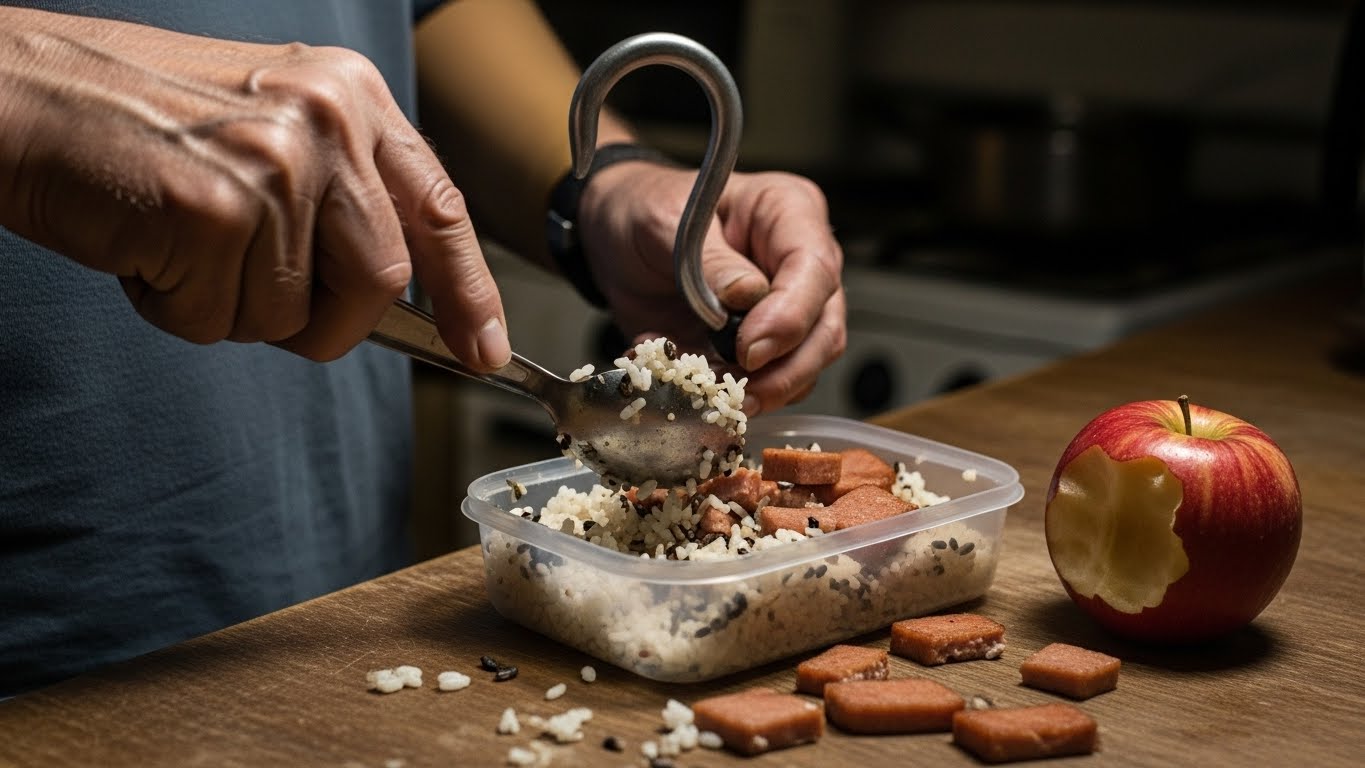
Elara didn’t move. Her eyes drifted to his hands. His left arm was intact, though the vision in his left eye was clouded by a milky film—the result of a chemical burn from a skirmish in the Gulf meant to preserve freedom, or so the medals in the drawer claimed. But it was his right side that broke her heart every morning. His right sleeve was pinned up, the arm gone just below the elbow. He was using a prosthetic hook this morning, a functional, ugly piece of metal and plastic, to hold a bruised apple in place.
In his left hand, he held a paring knife. He was shaking.
On the counter sat the Tupperware container. It wasn’t the brand name kind; it was a reused margarine tub, scrubbed clean so many times the label was a white blur. Inside lay a bed of rice that looked slightly scorched at the edges and three slices of Spam, cut into jagged, uneven shapes.
“I was just… finishing up,” Elias said, his voice raspy. He tried to smile, but the frustration was evident in the tight set of his jaw.
Elara walked over gently. She saw the apple. It was peeled, but it looked like a massacre. chunks of the fruit were gouged out, the skin hanging in ribbons. It wasn’t the clean, spiraling peel of a machine or a steady hand. It was a battleground.
“You didn’t have to do this, Dad,” Elara said softly, reaching out to touch his good arm. “I can make my own lunch. The school has the free meal program, I can just—”
“No,” Elias cut her off, a flash of stubborn pride in his good eye. “Not that slop. You need real food. My girl needs energy. Besides… I’m useless enough around here as it is. Let me do this.”
The word useless hung in the air like smoke. Since the accident at the VA hospital—a cruel twist of fate after surviving the war—and the subsequent denial of full benefits due to “clerical errors,” Elias had waged a war against his own limitations. Cooking was his new battlefield.
He had woken up at 3:30 AM. Elara knew this because the rice was cold. It had taken him an hour to wash the rice with one hand, spilling half of it, and another hour to fry the meat without burning the house down. The apple… the apple probably took the longest.
“It looks delicious, Dad,” Elara lied, her throat tight. She looked at the jagged Spam, the burnt rice, the mangled apple. To anyone else, it looked like garbage. To her, it looked like love.
“It’s not much,” Elias mumbled, snapping the lid onto the margarine tub. It didn’t seal right on the first try, and he fumbled, the hook slipping against the plastic. He let out a sharp breath of rage.
“Here,” Elara said, pressing the lid down until it clicked. “Perfect.”
She packed the tub into her backpack, right next to her heavy Biology textbook. She was a scholarship student at Oak Creek High, a place where “scholarship” was a polite word for “charity case.”
“Study hard, Elly,” Elias said, leaning against the counter, exhausted from the simple act of making a sandwich.
“I will, Dad. I always do.”
As she walked out into the cool morning air to catch the bus, the weight of the Tupperware container felt heavier than the textbooks. It carried the weight of a man’s dignity. She prayed, just for today, that no one would notice her.
Chapter 2: The Kings of the Cafeteria
Oak Creek High School was less of an educational institution and more of a runway for the junior executives of America. The parking lot was a sea of BMWs, Jeep Wranglers, and the occasional Tesla, gifts from parents who equated affection with horsepower.
Elara stepped off the yellow school bus—the “loser cruiser,” as it was affectionately known—and kept her head down. She wore a thrifted sweater that she had carefully de-pilled with a razor blade the night before, and jeans that were fashionable three years ago.
She navigated the hallways like a ghost. She was smart, top of her class in AP History and Chemistry, but social invisibility was her survival strategy. If they didn’t see you, they couldn’t hurt you.
But today, the universe had other plans.
By fourth period, her stomach was growling. She hadn’t eaten breakfast, wanting to save the eggs for her dad. The anticipation of lunch was the only thing keeping her focused during a lecture on the Great Depression. The irony wasn’t lost on her.
The bell rang, signaling the start of the lunch hour. The cafeteria at Oak Creek High was a cavernous space with floor-to-ceiling windows overlooking the football field. It smelled of industrial pizza and expensive perfume.
At the very center of the room sat “The Kings.”
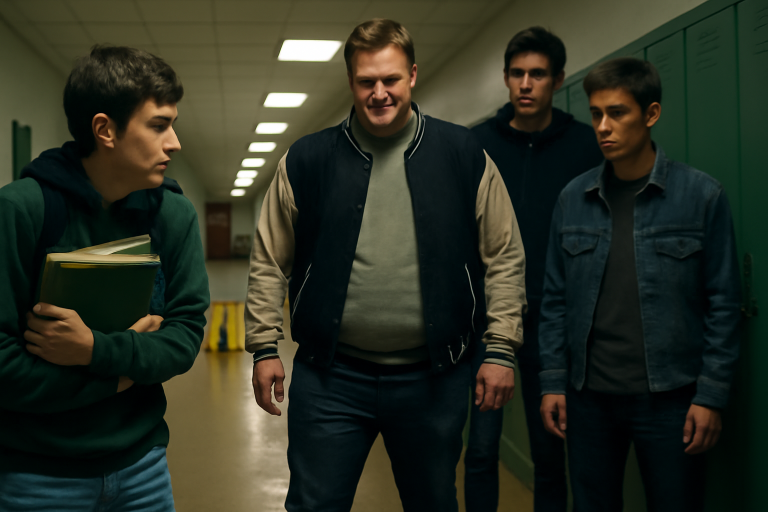
Brad Kensington, Josh Miller, and Tyler Vance (no relation to Elara, thank God). They were the varsity quarterback, the pitcher, and the point guard, respectively. They wore their letterman jackets like suits of armor. Brad was the ringleader, a boy with a jawline that could cut glass and a soul made of Teflon. His father owned the largest chain of car dealerships in the state. Brad had never heard the word “no” in his life.
Elara grabbed a tray, but didn’t get in the food line. She walked to the far corner of the cafeteria, near the exit doors, to a small, wobbly table usually reserved for the quiet kids. She sat down alone.
She hesitated before unzipping her backpack. Every day, this was the moment of anxiety. The unveiling of the margarine tub.
She pulled it out. The plastic was clouded and scratched. The words “Country Crock” were barely visible. She placed it on the table and cracked the lid. The smell of fried Spam and garlic rice wafted up. It wasn’t the smell of the cafeteria pizza; it was the smell of a struggling home, of a kitchen with flickering lights.
She picked up her plastic fork.
“Well, well, well. What is that smell?”
Elara froze. The voice was loud, booming, designed to carry.
She looked up. Brad Kensington was standing over her table, flanked by Josh and Tyler. They were holding their trays—gourmet burgers and fries from the premium line.
“I think something died in here, boys,” Brad smirked, looking around to ensure he had an audience. The cafeteria noise level dropped. The Kings were performing; everyone watched.
“Leave me alone, Brad,” Elara said quietly, her hand trembling slightly over the open tub.
“I’m just concerned for the public health,” Brad said, stepping closer. He peered into the tub. “What is that? Seriously. Is that… is that dog food? Did you raid a dumpster on the way to school?”
Laughter rippled through the room. It was a cruel, sharp sound.
“It’s rice and meat,” Elara said, her face burning. “Go away.”
“And look at that apple,” Josh chimed in, pointing at the mangled fruit. “Did you chew the skin off with your teeth?”
“My dad made this,” Elara said, her voice rising, defensive. She shouldn’t have said it. Information was ammunition to people like Brad.
“Your dad?” Brad laughed, a cold, barking sound. “The cripple? The guy who scares the kids at the park? I heard he can’t even tie his own shoes. No wonder it looks like vomit. He probably made it with his feet.”
The cruelty took the air out of Elara’s lungs. It wasn’t just an insult to her; it was an insult to the two hours of struggle, the 4:00 AM wake-up, the shaking hand holding the knife.
“Give me that,” Brad said.
Before Elara could react, Brad snatched the tub from the table.
“No! Give it back!” Elara stood up, panic seizing her. That was her lunch. That was her dad’s effort.
Brad held it high above his head like a trophy. “I’m doing you a favor, Elara. You shouldn’t eat trash. You might catch rabies.”
“Please,” Elara begged, tears stinging her eyes. “Please, Brad. Don’t.”
Brad grinned. He turned the tub upside down.
Chapter 3: The Giant and the Shrapnel
Time seemed to slow down. The block of rice, the jagged slices of Spam, and the bruised, painstakingly peeled apple fell through the air.
Splat.
It hit the linoleum floor with a wet, pathetic sound. The rice scattered. The meat slid across the wax finish. The apple rolled and came to a stop at Brad’s designer sneakers.
The cafeteria erupted in laughter. It was a wave of sound, crashing over Elara. She stared at the food on the floor. She didn’t see a mess. She saw her father’s face. She saw him waking up in the dark. She saw the sweat on his brow as he tried to stabilize the cutting board.
She felt a sob clawing its way up her throat, but she bit her lip until it bled. She would not cry. Not in front of them.
“Oops,” Brad said, feigning innocence. “Slippery fingers. My bad. Tell your dad to buy better Tupperware next time. Oh wait, he can’t afford it.”
He turned to high-five Tyler.
But the high-five never happened.
The laughter in the cafeteria died. Instantly. It was as if someone had sucked the oxygen out of the room.
Brad frowned and turned around to see why everyone had gone quiet.
Standing behind him was a mountain.
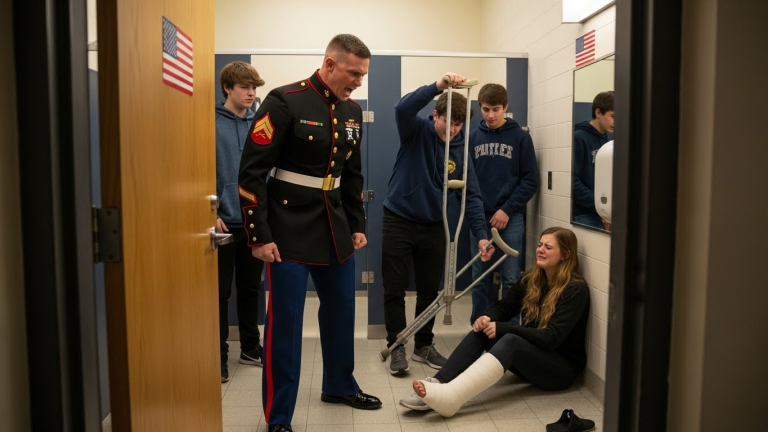
Arthur Miller, known to the students only as “Sarge,” was the head of the cafeteria kitchen. He was a terrifying figure. Six-foot-five, with forearms the size of tree trunks and a shaved head that gleamed under the lights. A thick, white scar ran from his jawline down into the collar of his chef’s coat. He rarely spoke. He just served food with a scowl that could curdle milk.
Sarge wasn’t looking at Brad. He was looking at the floor.
He held a large metal ladle in one hand, gripping it so tightly his knuckles were white.
“Pick. It. Up.”
The voice was low, a subterranean rumble that vibrated in the chests of everyone nearby.
Brad blinked. He wasn’t used to being spoken to like this by the help. “Excuse me?”
Sarge slowly raised his eyes. They were grey, cold, and hard as flint. “I said, pick it up.”
Brad let out a nervous chuckle, looking to his friends for backup. Josh and Tyler took a step back. They weren’t stupid.
“Relax, lunch lady,” Brad sneered, trying to regain his composure. “It’s just garbage. I’ll call the janitor. Or hey, I’ll buy her a burger. My dad owns the dealership, I can buy this whole kitchen if I wanted to.”
Sarge didn’t blink. He took a step forward. The gap between them vanished. The smell of old grease and old violence radiated off him.
“You think money fixes this?” Sarge whispered.
Then, he did something that made the entire student body gasp.
The giant man knelt down.
His knees cracked loudly in the silence. Sarge ignored Brad completely now. He reached out with a massive, scarred hand and gently picked up a slice of the Spam from the dirty floor.
He held it up to the light. He inspected the jagged cut. He looked at the uneven thickness—thick on one end, paper-thin on the other. He looked at the rice, seeing the slight char where it had stuck to the pan.
He stood up, towering over Brad again. He held the dirty piece of meat in front of Brad’s face.
“Look at this,” Sarge commanded.
Brad recoiled. “Get that away from me.”
“I said look at it!” Sarge roared. The sound was like a cannon shot. Brad jumped, his arrogance shattering.
Sarge turned to Elara. His expression softened, just a fraction. “Your father,” Sarge said, his voice rough. “Right arm?”
Elara nodded, tears finally spilling over. She couldn’t speak.
“And the eyes?” Sarge asked. “He struggling to see the details?”
“His left eye,” Elara whispered. “He’s… he’s legally blind on that side.”
Sarge nodded solemnly. He turned back to Brad and the silent cafeteria. He held the meat up like a sacred relic.
“You call this garbage?” Sarge asked the room. “I know this cut. I know this sear.”
He pointed a thick finger at the jagged edge of the meat.
“This wasn’t cut by a machine. And it wasn’t cut by a careless man. This was cut by a man holding a knife with his non-dominant hand because he left his right arm in a desert somewhere so you could drive your daddy’s BMW.”
The silence in the room was heavy, suffocating.
“The rice is burnt,” Sarge continued, his voice shaking with suppressed rage. “Because he couldn’t see the flame clearly. He stood there, smelling the smoke, panicking because he wanted it to be perfect for her. He woke up before the sun. He fought his own body. He fought the pain in his phantom limb.”
Sarge stepped closer to Brad, forcing the boy to look him in the eye.
“He didn’t make this because he’s poor, son. He made this because he loves his daughter enough to fight a war every single morning in his kitchen. This isn’t food. This is dignity. And you just threw it on the floor.”
Chapter 4: The Taste of Penance
Brad Kengsington, for the first time in his life, looked small. His face was pale, his mouth opening and closing like a fish. He looked at the food on the floor, then at Elara, who was wiping her eyes.
“I… I didn’t know,” Brad stammered.
“Ignorance is not an excuse for cruelty,” Sarge snapped.
Sarge slowly rolled up the sleeve of his chef’s coat. On his forearm, amidst the burns and scars of a kitchen life, was a faded tattoo. It was a unit insignia. A specific division of the Marine Corps.
“I know her father,” Sarge said quietly. “Not by name. But I know him. I served in the same sand. I know what it takes to come back and try to be a human being again when pieces of you are missing.”
He pointed to the floor.
“You destroyed a sacrifice. You want to be a man? You want to be a ‘King’?”
Sarge reached into his pocket and pulled out a clean spoon from his apron. He held it out to Brad.
“You eat it.”
The cafeteria gasped.
“What?” Brad whispered, horrified.
“You heard me,” Sarge said, crossing his massive arms. “You threw it on the floor because you thought it was beneath you. Now, you’re going to show it the respect it deserves. You eat it, or I take you to the principal’s office and I explain to him—and your father—exactly why you were bullying a veteran’s daughter. And trust me, I know your father. He buys his steaks from my butcher shop on weekends. He respects men like me. Do you think he’ll respect you after this?”
It was a bluff—Sarge didn’t know Brad’s dad personally—but Brad didn’t know that. Brad was terrified. The social hierarchy had flipped. The varsity jacket meant nothing in the face of this raw, adult authority.
Brad took the spoon. His hand was shaking.
He knelt down. The humiliation was palpable. He scooped up the piece of Spam that Sarge had dropped back down. He scooped up a bit of the burnt rice.
He hesitated.
“Eat,” Sarge commanded.
Brad put the spoon in his mouth. He chewed and swallowed.
“It tastes like ash,” Brad whispered, grimacing.
“No,” Sarge corrected him. “It tastes like fatherhood. Remember that taste.”
Sarge snatched the spoon back. “Get up. And get out of my sight. If you ever come near her table again, you won’t be dealing with the principal. You’ll be dealing with me.”
Brad scrambled up and ran. His friends, Josh and Tyler, followed him, heads hung low, stripping off their varsity jackets as if the wool suddenly burned their skin.
Chapter 5: The Salute
The cafeteria remained silent for a long moment. Then, slowly, the noise returned, but it was different. It wasn’t the raucous noise of chaotic teenagers. It was a subdued, respectful murmur.
Sarge turned to Elara. The terrifying mask fell away, replaced by a look of profound sadness and kindness.
“I’m sorry you had to go through that, kid,” he rumbled.
“It’s okay,” Elara sniffled. “But… I don’t have lunch now.”
Sarge smirked. “Yeah, you do.”
He walked back to the serving line and disappeared into the kitchen. He emerged a moment later carrying a plate. It wasn’t the standard cafeteria slop. It was a plate of roast chicken, roasted vegetables, and mashed potatoes—the staff meal he made for himself and the teachers.
He set it down gently on Elara’s table.
“On the house,” Sarge said. “And tell your dad… tell him ‘Semper Fi’ for me.”
Elara looked at the food, then up at the scarred giant. “Thank you, Sarge. I will.”
She sat down. As she picked up her fork, she noticed something.
A girl from the cheerleading squad stood up two tables away. She picked up her tray and walked over to Elara’s table. Without a word, she sat down opposite Elara.
Then a boy from the band did the same.
Then two guys from the football team—sophomores who had always been afraid of Brad.
One by one, the students of Oak Creek High stood up and moved. They filled the empty seats around Elara. They sat on the edges of the table. They stood in a circle around her.
They didn’t say much. They didn’t need to. It was a silent wall of solidarity. A message that the reign of the “Kings” was over, and that the girl with the Tupperware box was worth more than all of them combined.
Elara took a bite of the chicken. It was good. But as she ate, she thought of the burnt rice and the jagged Spam. She couldn’t wait to go home and tell her dad that his lunch was the most famous meal in school history.
She would leave out the part about the floor. She would just tell him that everyone saw it, and everyone knew exactly how much he loved her.
Epilogue
Wealth is not what you have in the bank. It’s not the car you drive or the brand of plastic you carry your lunch in. Wealth is what you are willing to give when you have nothing left to give. It is the burnt rice. It is the jagged cut. It is the love that persists even when the body is broken.