He Mocked Her Civilian Clothes and Called the Police to Arrest Her—Unaware He Was Assaulting a Special Ops Colonel Who Reported Directly to His 4-Star General.
Chapter 1: The Invisible Colonel
The California sunrise painted Camp Pendleton’s main gate in shades of amber and violent gold. It was 0600 on a Tuesday morning—early enough that the marine layer still clung to the coastal hills like a wet blanket, late enough that the gate guards had settled into the rhythmic, robotic rotation of checking IDs.
Colonel Iris Kovac slowed her personal sedan, a nondescript charcoal model, as she approached the checkpoint. She wasn’t in a government vehicle. She wasn’t in the Dress Blues that usually made junior Marines snap their spines trying to salute. She wore civilian clothes: dark, straight-cut jeans and a worn leather bomber jacket that had seen the inside of transport planes from Syria to the Philippines. Her dark hair was pulled back in a severe, simple ponytail.
She looked like a spouse. Or a contractor. Or a tourist who took a very wrong turn.
The young Marine Corporal at the gate stepped forward, hand raised to halt her. He leaned down, ready to recite the standard script for unauthorized civilians. Then he saw her face.
He froze. His eyes widened, the pupils dilating in recognition. He’d seen her face in a threat briefing two weeks ago—not as a target, but as the new Commander of Special Operations Task Force West. He started to snap to attention, his arm twitching to salute.
Kovac raised one finger to her lips. A subtle, sharp gesture. Silence.
The Corporal understood. He swallowed hard, took her ID card, scanned it with trembling hands, and handed it back without the usual “Oorah” or formalities reserved for field-grade officers. Some inspections worked better when you didn’t announce yourself with trumpets and a staff car. The gate arm lifted. Kovac nodded once and drove through, heading deeper into the sprawling base toward the Supply Battalion headquarters on the eastern edge of the installation.
The drive took her past rows of tan buildings, functional and ugly, the architecture of bureaucracy. Morning physical training groups jogged past in formation, their cadence calls echoing off the concrete. Left, left, lefty, right, lay-o.
She had conducted dozens of these unannounced readiness inspections across the Pacific theater. They were designed to cut through the “dog and pony shows.” If you gave a unit three days’ notice, they painted the rocks white and hid the incompetent officers in the back room. But if you showed up at 0615 on a Tuesday in jeans? You saw the rot.
She parked in the visitor lot outside the Supply Battalion HQ. It was a three-story administrative block, all right angles and fading desert camouflage paint. She grabbed her tablet and a leather portfolio. Inside was an inspection authorization from Pacific Command, signed by General Marcus Thornhill himself. It was the “Golden Ticket”—authority to go anywhere, see anything, anytime.
She walked through the main glass doors. The air conditioning hit her instantly, a fifteen-degree drop from the morning sun, smelling of industrial floor wax and strong, burnt coffee.
She made it twenty feet down the hallway when a voice boomed behind her.
“Excuse me, miss. You look a bit lost.”
Kovac stopped. She didn’t flinch. She turned slowly on her heel.
Standing in the hallway was Commander Garrett Brennan. He was the archetype of a garrison commander: mid-40s, jawline like a shovel, uniform starched so stiff it could stand up on its own. The oak leaves on his collar—signifying a Lieutenant Colonel, the Battalion Commander—glinted under the fluorescent lights. He was holding a mug of coffee like a weapon.
He looked her up and down, his eyes lingering on her jeans, then her boots, then her face. His expression shifted from helpful to dismissive.
“I’m exactly where I need to be,” Kovac said. Her tone was neutral, smooth like a river stone. “I’m here to review some battalion readiness documentation.”
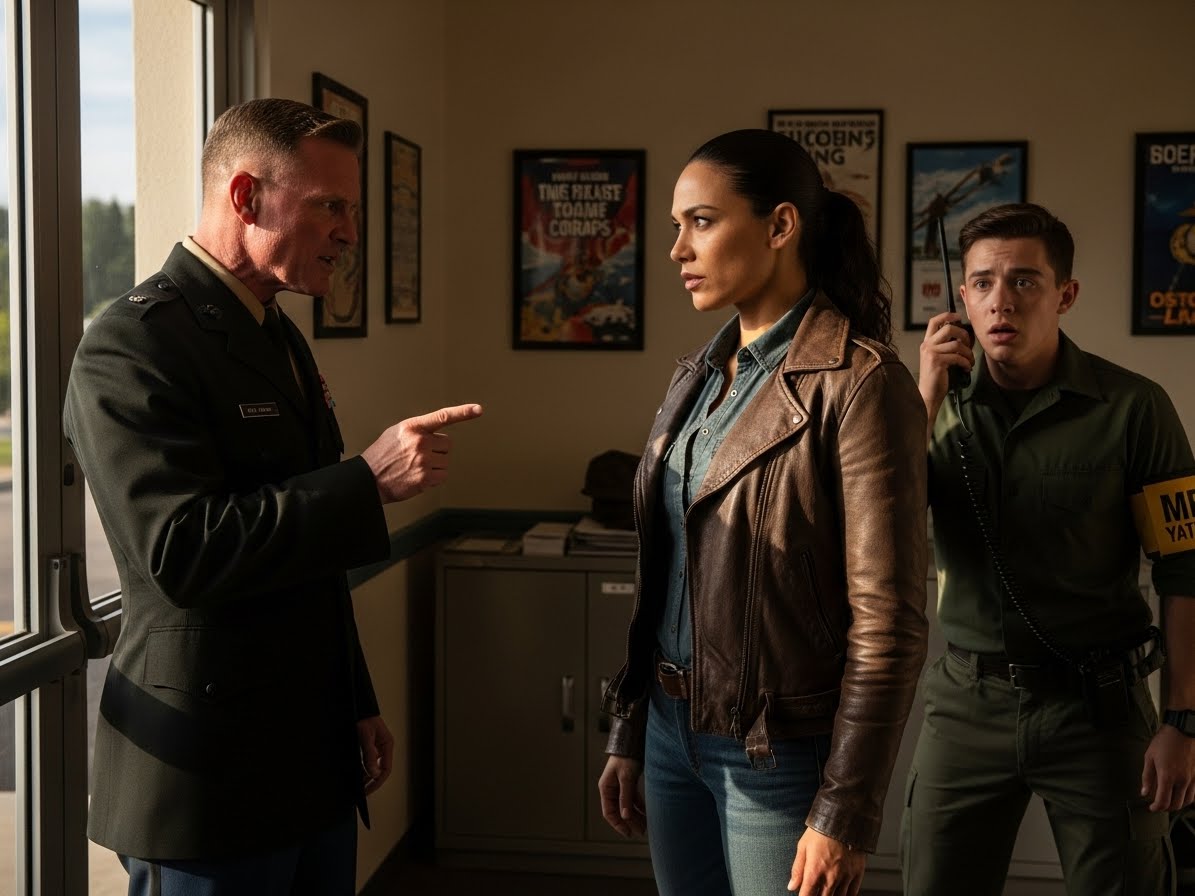
Brennan blinked. He tilted his head, a smirk tugging at the corner of his mouth. “The Visitor Center is back at the main gate, sweetheart. This is a restricted administrative area. You need to check in through proper channels. Did a vendor give you bad directions?”
“I have clearance to be here,” Kovac replied. She didn’t reach for her ID. Not yet. She wanted to see how he handled the friction. “I need to see your last three quarterly assessments and your current maintenance status boards.”
Brennan actually laughed. It was a short, sharp bark of amusement that carried down the hallway.
“Okay, look,” Brennan stepped closer, crossing his arms. He was big—six-two, gym-built—and he used his size to crowd her. “I don’t know who told you that you could just walk into a battalion HQ, but contractors absolutely do not get access to operational documents. Those are classified, at minimum ‘Official Use Only.’ Some are Secret.”
He leaned in, his voice dropping to a patronizing purr. “Now, turn around, get back in your car, and have your company submit a request. Maybe in three or four weeks, we’ll fit you in.”
Chapter 2: The Double Down
Through an open office door to Kovac’s right, a Staff Sergeant stopped typing. Her name tape read REEVES. She was a thirty-year-old lifer with sharp eyes. She watched the exchange, her fingers hovering over her keyboard. She looked at the woman in the leather jacket—the posture, the lack of fear, the way she tracked Brennan’s movements without turning her head.
That’s not a contractor, Reeves thought. The hair on her arms stood up. She slowly reached into her pocket and pulled out her phone, holding it low against her thigh.
“Your Commanding Officer should be briefed on my visit,” Kovac said, her voice dropping an octave. It was the ‘Command Voice’—the tone that made privates wet themselves. “If you could direct me to him, that would expedite things.”
Brennan’s amusement evaporated. He didn’t like being told what to do, especially not by a civilian woman in his hallway. “I am the Commander,” he snapped. “And I’m extremely busy. I definitely don’t have time for vendor reps who refuse to listen.”
“I’m not a vendor representative,” Kovac said quietly.
“Then what are you?” Brennan demanded, his voice rising. “Because you’re dressed like a civilian, you’re asking for classified material, and you’re claiming you have clearance I’ve never heard of. That’s three strikes.”
“I am here on official business, authorized by Marine Forces Pacific.”
“Here’s what’s going to happen,” Brennan interrupted, stepping sideways to block her path deeper into the building. He squared his shoulders. “You are going to leave. Now. Or I call Security.”
Kovac held his gaze. She didn’t blink. “I see. Then I’ll need to speak with your superior since you are unwilling to facilitate this inspection.”
“There is no inspection!” Brennan shouted. A vein in his neck bulged. “I am calling the MPs.”
He pulled his phone from his cargo pocket and keyed it with aggressive stabs of his thumb. “Yeah, this is Commander Brennan at Supply Battalion. I need a patrol at my HQ. I’ve got a hostile civilian claiming she has access authorization. She’s refusing to leave. Yeah. I’ll keep her here until you arrive.”
He hung up and smirked at her. “Security will be here in five minutes. You can explain your ‘clearance’ to them while they escort you off the base in cuffs.”
Kovac didn’t move. She shifted her portfolio to her other arm. She looked like she was waiting for a bus, completely unbothered by the threat of armed law enforcement.
The next four minutes were thick with silence. Staff Sergeant Reeves was now openly watching, her phone angled to capture the scene. A Corporal named Okafor poked his head out of the intel office, looking confused.
Then, the heavy doors swung open.
Two Military Police officers walked in. The lead was Sergeant Yates, a veteran MP with a cynical look in his eyes. Behind him was a young Lance Corporal. Yates had his hand resting on his sidearm, expecting a drunk or a belligerent spouse.
Yates saw Brennan first. “Commander, what’s the situation?”
“She’s trespassing,” Brennan pointed a finger at Kovac like a weapon. “Remove her. Detain her if she resists.”
Yates turned to the woman. He took two steps, aggressive and purposeful. Then he stopped.
He stopped so hard he almost lost his balance. He looked at the woman’s face. He looked at the scar. He looked at the way she stood.
Yates went pale. He recognized her instantly from the VIP protection detail briefing last month.
“Ma’am?” Yates said. His voice cracked. He took a step back, his body language shifting from aggression to submissiveness. “Ma’am, is… is everything alright? Do you need assistance?”
Brennan’s head snapped toward Yates. “Sergeant, what are you doing? I just gave you an order. Throw her out!”
Yates didn’t look at Brennan. He couldn’t take his eyes off Kovac. It was like seeing a ghost. “Sir,” Yates said, speaking to the Commander but looking at the Colonel. “With respect, Sir, I don’t believe we have a trespassing situation here.”
“She is a civilian demanding classified docs!” Brennan screamed. “Are you refusing a direct order?”
“Sir, I recommend we all take a step back,” Yates pleaded, sweat beading on his forehead. He was trying to save his Commander, but Brennan was too blind to see the lifeline.
“I am the higher authority in this building!” Brennan yelled. He turned back to Kovac. “You think because you spooked some junior MP you can stay? I’m done playing.”
Kovac finally spoke. Her voice cut through the shouting like a razor blade.
“Commander Brennan. I am giving you one opportunity to step aside and allow me to complete my inspection. Verify my credentials. Make the call. Do not continue down this path.”
“Are you threatening me?” Brennan’s face turned a violent shade of purple. “In my own headquarters?”
He took a step toward her. He reached out.
“Sir, don’t!” Yates shouted, stepping forward.
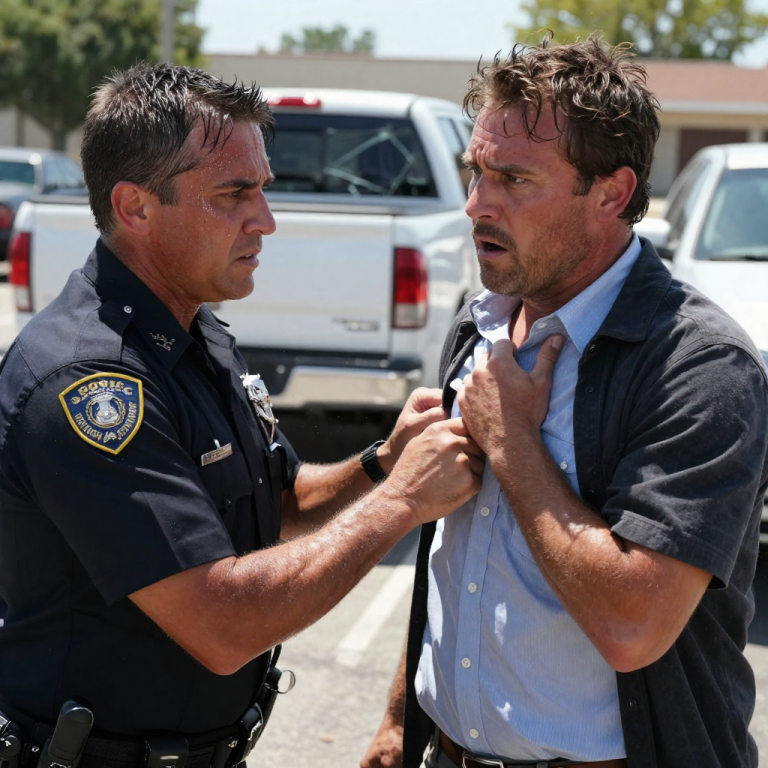
But it was too late. Brennan’s hand closed around Colonel Kovac’s upper arm. He gripped her leather jacket, his fingers digging in.
“You are leaving,” Brennan hissed. “Now.”
In the office doorway, Staff Sergeant Reeves gasped. Her thumb hit the Record button on her phone.
Brennan had just physically assaulted a superior officer. He had just signed his own professional death warrant. And the silence that followed was the sound of a career turning to ash.
Chapter 3: The Point of No Return
The silence in the hallway of Supply Battalion Headquarters was heavier than lead. It was the kind of silence that usually follows a gunshot.
Commander Garrett Brennan’s hand was still clamped around the leather sleeve of Colonel Iris Kovac’s jacket. His knuckles were white. He was breathing hard, fueled by a cocktail of adrenaline, righteous indignation, and the absolute, unshakable certainty that he was the hero of this story. He believed he was protecting his command from an intruder.
He was wrong.
Kovac didn’t pull away. She didn’t strike him, though her muscle memory, honed by years of close-quarters combat training, was screaming at her to neutralize the threat. Instead, she slowly lowered her gaze to his hand on her arm. Then she looked up, locking eyes with him. Her expression was terrifyingly devoid of fear. It was the look of a judge passing a sentence.
“Commander,” Lieutenant Chavez, the senior MP officer who had just arrived with a backup team, stepped forward. Her voice was sharp, cutting through the tension. “I strongly advise you to release the individual. Physical contact is not authorized.”
“I am escorting a trespasser out!” Brennan barked, though he released his grip. He took a half-step back, planting his feet wide, physically blocking the corridor. He looked like a bouncer at a cheap nightclub, not a Battalion Commander. “She refuses to leave. She refuses to identify herself properly. I want her detained.”
“Sir,” Sergeant Yates whispered, leaning in close to Brennan, risking his career to save his boss. “That’s not a trespasser. That’s Colonel Kovac. Special Operations. I saw her at the Third Marines briefing. You need to stop.”
Brennan spun on him, his face twisting into a sneer. “Colonel? Look at her, Yates! She’s wearing jeans and a bomber jacket. She’s probably some stolen valor case or a contractor trying to scam access. You’re letting a civilian push you around.”
Footsteps echoed rapidly from the stairwell. Captain Diana Volkov, the Battalion Executive Officer (XO), burst into the hallway. She had been alerted by the commotion. She was sharp, ambitious, and currently, looking like she had seen a ghost.
Volkov stopped dead. She looked at Brennan, red-faced and heaving. She looked at the MPs, hands hovering near their belts. And then she looked at the woman standing calmly in the center of the storm.
Volkov recognized her instantly. She had attended a joint logistics symposium in Oahu three months prior. Kovac had been the keynote speaker on “Asymmetric Supply Lines in Hostile Environments.”
“Sir,” Volkov said, her voice trembling slightly. She moved quickly to Brennan’s side. “Sir, can I speak with you? Privately? Right now?”
Brennan waved her off without looking. “Not now, Captain. I’m dealing with a security breach.”
“Sir, it’s not a breach,” Volkov hissed, grabbing his sleeve. “That is Colonel Iris Kovac. She reports directly to MarForPac. She’s the inspect—”
“Enough!” Brennan shouted. The sound echoed off the linoleum floors. “I don’t care who she claims to be! Until I see a Military ID, she is a civilian trespasser. Captain, if you can’t support your Commander, go back to your office.”
Volkov recoiled as if slapped. She looked at Kovac with wide, apologetic eyes. Kovac gave her the smallest of nods—a signal. Do what you have to do.
Volkov turned on her heel and sprinted back toward her office. She wasn’t running away. She was running to a secure phone line.
Brennan turned back to the MPs. “I gave you an order. Get her out of my building.”
Lieutenant Chavez stood her ground. She moved her body, subtly positioning herself between Brennan and Kovac. “Sir, we are going to pause here. We are going to verify. No one is moving until I get confirmation from Base Command.”
“You’re mutinying,” Brennan spat. “I’ll have your badge.”
“You can have my badge later, Sir,” Chavez said, her voice icy. “But right now, nobody touches this woman again.”
Kovac adjusted her jacket where Brennan had grabbed her. “Commander,” she said softly. “You have crossed a line that is very difficult to uncross. I am going to wait right here. I suggest you go to your office and answer your phone. It’s going to start ringing very soon.”
Brennan scoffed, crossing his arms over his chest, blocking the hallway like a stone wall. “My phone is fine. And you’re not waiting here. You’re waiting in the brig.”
He had no idea that the fuses he had lit were already burning toward the dynamite.
Chapter 4: The Digital Paper Trail
Forty feet away, inside the glass-walled intelligence office, the atmosphere was frantic.
Staff Sergeant Helena Reeves had pulled Corporal Marcus Okafor, the unit’s intel analyst, away from the door. They were huddled behind a dual-monitor workstation, out of Brennan’s line of sight.
“Tell me you got that,” Reeves whispered, her heart hammering against her ribs.
“I got the audio,” Okafor said, his hands flying across his keyboard. “The video is a little shaky, but I got him grabbing her. I got him yelling.”
“We need to know who she is. For sure,” Reeves said. “Yates said ‘Kovac.’ Run it.”
Okafor opened the secure personnel database. The system was old and clunky, the spinning wheel of death mocking their anxiety.
“Come on, come on…” Okafor muttered.
The screen flashed. A file populated.
Both Marines stopped breathing.
The official photo stared back at them. It was the woman in the hallway, but in the photo, she was wearing Dress Blues. The collar bore the eagle, globe, and anchor of a full-bird Colonel. Below that, her chest was a colorful fruit salad of ribbons.
Top row: Silver Star. Bronze Star with ‘V’ device. Purple Heart.
Okafor scrolled down to the bio.
KOVAC, IRIS. CURRENT ASSIGNMENT: Commander, Special Operations Task Force West. CLEARANCE: TS/SCI. REPORTING AUTHORITY: CG, Marine Forces Pacific (General Thornhill).
“Oh my god,” Reeves whispered. “She’s a war hero. She’s a literal legend in the Spec Ops community.”
“Look at this,” Okafor pointed to a red banner flashing at the top of the profile. DO NOT DETAIN. DO NOT IMPEDE.
“Wait,” Reeves said, leaning in. “Check the access logs. Did anyone get a notification she was coming?”
Okafor clicked into the base notification system. He queried the morning’s automated alerts.
“There,” he said, his voice dropping to a horrified whisper. “At 0600 hours. When her ID was scanned at the main gate. The system sent an automated ‘Distinguished Visitor’ alert to the Battalion Command Group.”
Reeves felt sick. “Who gets those alerts?”
“The XO… the Sergeant Major…” Okafor swallowed hard. “And the Battalion Commander.”
“He knew?” Reeves asked.
“He got the email,” Okafor said. “He opened it. Look at the timestamp. 0605. ‘Read by user: Brennan, G.’ He opened the email telling him she was on base.”
“He ignored it,” Reeves realized. “He saw a woman in jeans, and his brain just… deleted the email he read twenty minutes earlier. He couldn’t reconcile the two things.”
“What do we do?” Okafor asked, looking toward the door where the shouting had quieted down to a tense standoff. “He’s going to bury us if he finds out we’re looking at this.”
Reeves stood up. She grabbed her phone. “He’s not going to bury anyone. Because we’re going to bury him first.”
“Staff Sergeant?”
“We document everything,” Reeves commanded. “Save those logs. Save the video. Screenshot the notification he read. We are sending this to the Inspector General. Right. Now.”
“That’s nuclear,” Okafor warned. “If we go over his head…”
“He just assaulted a Colonel, Marcus,” Reeves said, her eyes hard. “The nuclear bomb already went off. We’re just trying to survive the fallout.”
She opened her email client. She attached the video file. She attached the screenshots. In the subject line, she typed: URGENT: GROSS MISCONDUCT / ASSAULT ON SUPERIOR OFFICER – SUPPLY BN.
She hesitated for a fraction of a second—the fear of retribution was ingrained in every Marine. But then she looked out the window and saw Brennan’s back, stiff with arrogance, blocking the path of the woman who had likely saved more American lives than Brennan had met.
Reeves hit SEND.
Chapter 5: The Call to Hawaii
Captain Diana Volkov didn’t stop running until she reached the far side of the parking lot, away from the prying ears of the junior Marines. Her hands were shaking as she pulled out her personal cell phone.
She didn’t call Base Security. She didn’t call the Regimental Commander. She knew Brennan would just talk his way out of that, spinning it as a “misunderstanding.”
She went straight to the top.
She dialed the direct line for the Marine Forces Pacific (MarForPac) Chief of Staff in Hawaii. It was a number she had saved during the symposium, intended for “logistics emergencies.”
This was a logistics emergency. Her Commander’s logic was missing in action.
“MarForPac, Colonel Ishida speaking,” a crisp voice answered on the second ring.
“Colonel, this is Captain Volkov, XO of Supply Battalion, Camp Pendleton,” she said, forcing her voice to be steady. “I have a Code Red situation involving a VIP.”
“Go ahead, Captain.”
“Colonel Iris Kovac is at my headquarters conducting a no-notice inspection. My Battalion Commander, Lieutenant Colonel Brennan, has refused to acknowledge her credentials.”
There was a pause on the line. “Refused? Is there a problem with her paperwork?”
“No, Sir. Her paperwork is valid. But she is in civilian attire. Commander Brennan has… escalated the situation.”
“Define escalated.”
Volkov closed her eyes. “He called the MPs to arrest her for trespassing. He accused her of espionage in front of junior enlisted. And, Sir… about five minutes ago, he physically laid hands on her to remove her from the building.”
The silence on the other end of the phone was absolute. It stretched for five seconds, then ten.
“He touched her?” Ishida’s voice was dangerously quiet.
“Yes, Sir. He grabbed her arm. He is currently blocking her path and refusing to let her move.”
“Captain, is Colonel Kovac safe?”
“She is calm, Sir. The MPs have stepped in to prevent further contact, but Brennan is… he’s doubling down, Sir. He won’t listen to me. He won’t listen to the police.”
“Stand by.”
Volkov heard a muffled conversation. Then, a new voice came on the line. It was deeper, rougher. It sounded like gravel tumbling in a dryer.
“Captain Volkov. This is General Thornhill.”
Volkov nearly dropped the phone. Four-Star General Marcus Thornhill. The “Old Man” of the Pacific.
“General,” she squeaked.
“Tell me exactly what you saw,” Thornhill ordered.
She repeated the story. The insults. The refusal to check ID. The grab.
“Okay,” Thornhill said. “Here is what is going to happen. You are going to go back inside. You are to ensure that nobody—and I mean nobody—touches Colonel Kovac again. I am scrambling a jet. I will be on deck at Pendleton in four hours.”
“You… you’re coming here, Sir?”
“I am coming to relieve your Commander personally,” Thornhill said. “And Captain? Tell Brennan to answer his damn phone. Legal is trying to reach him to save his life, but I think it’s already too late.”
The line went dead.
Volkov stared at the phone. A Four-Star General was airborne. The wrath of God was inbound.
Inside the building, Brennan was pacing. He felt good. He felt like he was holding the line.
His desk phone rang. He ignored it.
It rang again.
“Sir,” Lieutenant Chavez said. “That might be important.”
“It’s probably just the gate trying to explain how they let a fraud onto my base,” Brennan sneered.
The phone rang a third time. Brennan finally stomped into his office and snatched the receiver up.
“What?” he barked.
“Commander Brennan?” It was a woman’s voice, sharp and frantic. “This is Major Reigns, Base Legal. You need to listen to me very carefully.”
“Make it quick, Major. I’m handling a crisis.”
“Sir, we just got a call from Hawaii. The woman in your hallway is Colonel Iris Kovac. You need to stand down immediately. You are currently committing assault on a superior officer and unlawful detention.”
Brennan paused. For a second, a flicker of doubt crossed his mind. But his ego was a fortress.
“Major, you’ve been duped,” Brennan said, shaking his head. “She’s got a fake ID. She’s got a fake story. She’s good, I’ll give her that. But I’m looking at her right now. She’s a civilian. And I’m not going to be the Commander who let a spy walk out with our readiness reports.”
“Sir, do not hang up! General Thornhill is—”
Brennan slammed the phone down.
He walked back into the hallway, chest puffed out. He looked at Kovac, who was leaning against the wall, checking her watch.
“Legal thinks you’re real,” Brennan mocked. “You must have quite a team working on this con.”
Kovac looked up. She smiled. It wasn’t a nice smile.
“Commander,” she said. “I genuinely hope you enjoyed that phone call. Because it was the last time you will ever exercise authority as a Battalion Commander.”
“Is that so?” Brennan laughed.
“Yes,” Kovac said. “The General is wheels up. Tick tock, Garrett.”
Brennan’s smile faltered. She had used his first name. And for the first time, looking into her cold, dark eyes, he felt a flicker of true terror.
Chapter 6: The Sound of Consequences
The next three hours were a study in agonizing, slow-motion disaster.
Commander Brennan retreated to his office, leaving Lieutenant Chavez and her MPs to stand guard over Colonel Kovac in the hallway. He spent the time pacing, drinking stale coffee, and rehearsing the speech he would give to the “investigators” he assumed were coming.
He convinced himself that General Thornhill coming personally was actually a good thing. The General appreciates security, Brennan told himself. He’ll see that I was the only one with the guts to hold the line.
At 1340 hours, the sound began.
It started as a low thrumming vibration in the window glass, then grew into a rhythmic whup-whup-whup that rattled the fluorescent lights in the ceiling.
Every Marine on Camp Pendleton knew that sound. It was the heavy, chopping beat of a Blackhawk helicopter. But helicopters usually landed at the airfield, miles away. This sound was getting louder. It was directly overhead.
“What is that?” Brennan muttered, walking to the window.
Outside, dust and dry grass were being whipped into a frenzy on the battalion parade deck—a patch of asphalt directly in front of the headquarters that was definitely not a designated landing zone.
A black UH-60 Blackhawk, bearing the four-star insignia on its side, flared its nose and settled onto the deck. The rotors were still spinning, screaming like banshees, as the side door slid open.
Brennan’s stomach dropped. This wasn’t an investigator. This wasn’t a chat. This was an invasion.
Marines from every office pressed their faces against the glass.
Two aides jumped out first, heads ducked against the rotor wash. Then, a figure emerged. He was tall, silver-haired, and wore combat utilities that looked tailored. Even from fifty yards away, the four silver stars on his collar caught the California sun.
General Marcus Thornhill. The Commander of Marine Forces Pacific. The man who controlled every Marine from California to Japan.
He didn’t walk; he marched. He bypassed the terrified Battalion XO, Captain Volkov, who was waiting on the tarmac, and headed straight for the glass doors of the HQ.
Brennan adjusted his uniform. Show no fear, he thought. Explain the situation. He stepped out into the hallway just as the General burst through the double doors.
The hallway snapped to attention. Forty spines straightened. Forty heels clicked together. The silence was absolute, save for the hum of the air conditioner.
Thornhill didn’t look at Brennan. He walked straight to Colonel Kovac, who was standing quietly by the water fountain.
“Iris,” Thornhill said. His voice wasn’t a shout. It was a low, dangerous rumble. “Report.”
Kovac came to attention, but her face remained impassive. “General. Inspection interrupted at 0620. Access denied. Credentials ignored. Physical contact initiated by Battalion Commander at approximately 0700.”
Thornhill’s jaw tightened. He finally turned his head. His eyes locked onto Brennan. It felt like a laser sight settling on a target.
“Commander Brennan,” Thornhill said.
Brennan stepped forward, saluting crisply. “General Thornhill. Sir, I can explain. We had a security breach involving a civilian with questionable—”
“Quiet,” Thornhill said. He didn’t raise his voice. He just dropped the word like a stone.
Brennan’s mouth snapped shut.
“You received a Distinguished Visitor notification at 0600,” Thornhill stated. It wasn’t a question. “My staff confirmed you opened the email.”
Brennan’s eyes widened. The email. The one he had skimmed while drinking his coffee. The one he had deleted because he was busy.
“Sir, I…”
“You ignored a direct alert,” Thornhill continued, stepping closer. “You ignored the advice of your Executive Officer. You ignored the warnings of the Military Police. You ignored the guidance of Base Legal.”
Thornhill was now two feet from Brennan’s face. The General smelled of aviation fuel and cold fury.
“And then,” Thornhill whispered, “you put your hands on one of my combat commanders.”
“Sir, she was in civilian clothes!” Brennan blurted out, desperation cracking his voice. “She refused to show military ID! I was protecting the classified—”
“She showed you my signature,” Thornhill cut him off. “She showed you an authorization letter. You decided it was fake because she was a woman in jeans. That is not security, Commander. That is arrogance. And it is incompetence.”
Thornhill looked around the hallway. He saw Staff Sergeant Reeves holding her phone. He saw the terrified Lance Corporals. He saw the culture of fear Brennan had built.
“Commander Brennan,” Thornhill announced, his voice carrying to every corner of the room. “You are relieved of command, effective immediately. Cause: Loss of confidence in your ability to lead, lack of judgment, and conduct unbecoming an officer.”
Brennan staggered back a step, as if physically struck. “General… Sir, my career…”
“Your career ended the moment you grabbed her arm,” Thornhill said. He gestured to the MPs. “Lieutenant Chavez.”
“Sir!” Chavez stepped forward, vindication burning in her eyes.
“Escort Lieutenant Colonel Brennan to his office to collect his personal keys. Then escort him to Base Legal for processing. He is to have no further contact with this Battalion.”
Brennan looked around for an ally. He looked at Volkov. She looked away. He looked at Yates. Yates was staring at the wall. He was alone.
“Move,” Thornhill ordered.
As Brennan was marched past his own Marines, stripped of his authority in seconds, the silence broke. It wasn’t a cheer—Marines are too disciplined for that. It was the sound of a collective exhale. The tyrant had fallen.
Chapter 7: The Autopsy of a Career
The relief of command was just the beginning. The investigation that followed was surgical and brutal.
General Thornhill didn’t just fire Brennan and leave. He set up a temporary command post in the conference room. He wanted to know how this happened.
Colonel Ishida, the Chief of Staff, took lead on the interviews.
Staff Sergeant Reeves was the first one called in. She sat nervously, clutching her phone.
“You sent an email to the Inspector General,” Ishida said, reviewing a file.
“Yes, Sir,” Reeves said, bracing for a reprimand. Jumping the chain of command was risky.
“Why?”
“Because,” Reeves said, finding her courage. “I’ve seen him do it before, Sir.”
Ishida looked up. “Explain.”
Reeves placed her phone on the table. “He has a pattern, Sir. Last month, a female safety inspector came by. He made her wait outside for two hours because he didn’t like her tone. Two months ago, he publicly berated Lieutenant Nakamura for ’emotional outbursts’ when she was just giving a passionat briefing. He doesn’t listen to women, Sir. He dismisses them.”
Ishida nodded slowly. “And today?”
“Today, he couldn’t process that the most powerful person in the room was the woman in the leather jacket,” Reeves said. “So he tried to physically dominate the situation.”
Ishida slid a piece of paper across the table. “General Thornhill agrees. Your quick thinking to document the assault likely saved this investigation weeks of ‘he-said-she-said.’ You are being recommended for a Commendation Medal.”
Reeves blinked back tears. “Thank you, Sir.”
Meanwhile, across base, Brennan was sitting in a sterile interview room at the Legal Services Support Section. He was no longer shouting. He was slumped in a metal chair, watching his life dissolve.
Major Reigns, the JAG officer he had hung up on earlier, walked in. She didn’t look happy.
“Mr. Brennan,” she said. She didn’t call him Commander. “We are preparing the charge sheet.”
“Charges?” Brennan whispered. “I thought I was just being relieved.”
“General Thornhill is pushing for a Court Martial,” Reigns said, opening a folder. “Article 89: Disrespect toward a superior commissioned officer. Article 90: Assaulting or willfully disobeying a superior commissioned officer. Article 92: Dereliction of duty.”
She slid a photo across the table. It was a still frame from the hallway video. It showed Brennan’s hand gripping Kovac’s jacket, his face twisted in rage.
“This image is going to be the cover of the case study they teach at Officer Candidate School for the next twenty years,” Reigns said ruthlessly. “Title: How Not to Command.“
Brennan put his head in his hands. “I didn’t know,” he sobbed. “I really didn’t know.”
“You were told,” Reigns replied, closing the file. “Three times. You just chose not to hear it.”
Back at the Battalion, the atmosphere had shifted. Captain Volkov was named Acting Commander. Her first act was to apologize to the Battalion.
“We are going to get back to work,” Volkov told the assembled Marines. “But things are going to be different. If you see something wrong, you speak up. I don’t care if you’re a Private or a Major. Rank does not protect incompetence.”
In the back of the room, Colonel Kovac watched the formation. She was back in her civilian clothes, leaning against the wall.
General Thornhill walked up beside her.
“You okay, Iris?” he asked quietly.
“I’m fine, Sir,” she said. “He had a weak grip.”
Thornhill chuckled darkly. “He’s going to lose his retirement. He’s going to lose his rank. Was it worth the trip?”
Kovac looked at the young Marines—Reeves, Okafor, Yates—who were walking taller now. They looked like a weight had been lifted off their shoulders.
“We found the rot, Sir,” Kovac said. “And we cut it out. It was a good day.”
Chapter 8: The Ghost of the Gate
Six months later.
The supply warehouse at Camp Pendleton was buzzing with activity. Forklifts whirred, and Marines shouted inventory counts over the noise of industry.
A government sedan pulled up to the loading dock. The driver stepped out and opened the back door.
Colonel Iris Kovac stepped out.
This time, there was no leather jacket. She was wearing her Service Alphas—the iconic green uniform of the Marine Corps. The Silver Star and Purple Heart ribbons on her chest caught the light. The bird insignia on her collar was polished to a mirror shine.
The sentry at the door, a young Lance Corporal, snapped a salute so sharp it cracked like a whip.
“Good morning, Ma’am!”
“Good morning, Marine,” Kovac returned the salute.
She walked inside. The warehouse went silent. But it wasn’t the fearful silence of Brennan’s era. It was a respectful silence.
A woman with three chevrons on her collar—Sergeant Reeves—walked up. She had been promoted two months ago.
“Colonel Kovac,” Reeves said, smiling. “Welcome back to Supply Battalion.”
“Good to see you, Sergeant,” Kovac said. “I hear your readiness scores are up 40%.”
“Yes, Ma’am,” Reeves said. “Captain Volkov runs a tight ship. We actually read the emails now.”
They shared a brief, knowing look.
“I’m here for the follow-up inspection,” Kovac said, looking around. “Is the Battalion Commander available?”
“She’s expecting you, Ma’am.”
Kovac walked toward the headquarters building—the same hallway where she had been grabbed, insulted, and threatened.
The ghost of Garrett Brennan was gone. The atmosphere of toxicity had been scrubbed away with the floor wax.
Brennan was currently a civilian, living in a small apartment in San Diego, working mid-level logistics for a trucking company. He had been discharged with an “Other Than Honorable” characterization. He had lost his pension. He had lost his status. He was a cautionary tale, a story whispered in mess halls.
Kovac reached the Commander’s office. The door was open. Captain Volkov (now Major-Select) stood up and offered a hand.
“Colonel. No need for the MPs this time?”
“I think we’re good,” Kovac smiled.
She spent the day reviewing the logs. The unit was efficient. The morale was high. The fear was gone.
As Kovac was leaving that evening, the sun was setting over the Pacific, painting the sky in the same purple and gold as that fateful morning.
She paused at her car. Sergeant Yates, the MP who had first tried to warn Brennan, was on patrol nearby. He saw her and nodded.
Kovac nodded back.
She thought about the nature of power. Brennan had thought power was shouting, intimidation, and the uniform you wore. He thought power was demanding respect.
But real power was quiet. Real power was knowing who you were without needing to scream it. Real power was accountability.
She got into her car, checked her mirror, and drove toward the gate. The guard waved her through.
The inspection was complete. The lesson had been delivered. And somewhere, in the dusty archives of the Marine Corps legal system, the file on Garrett Brennan sat as a permanent reminder:
Assume nothing. Verify everything. And never, ever judge a book by its cover—especially when that book can call in an airstrike.