She Left Me And Our Baby At A Gas Station For A Rich Tech Exec. 5 Years Later, She Froze When She Saw Who Was Standing Behind Me.
Chapter 1
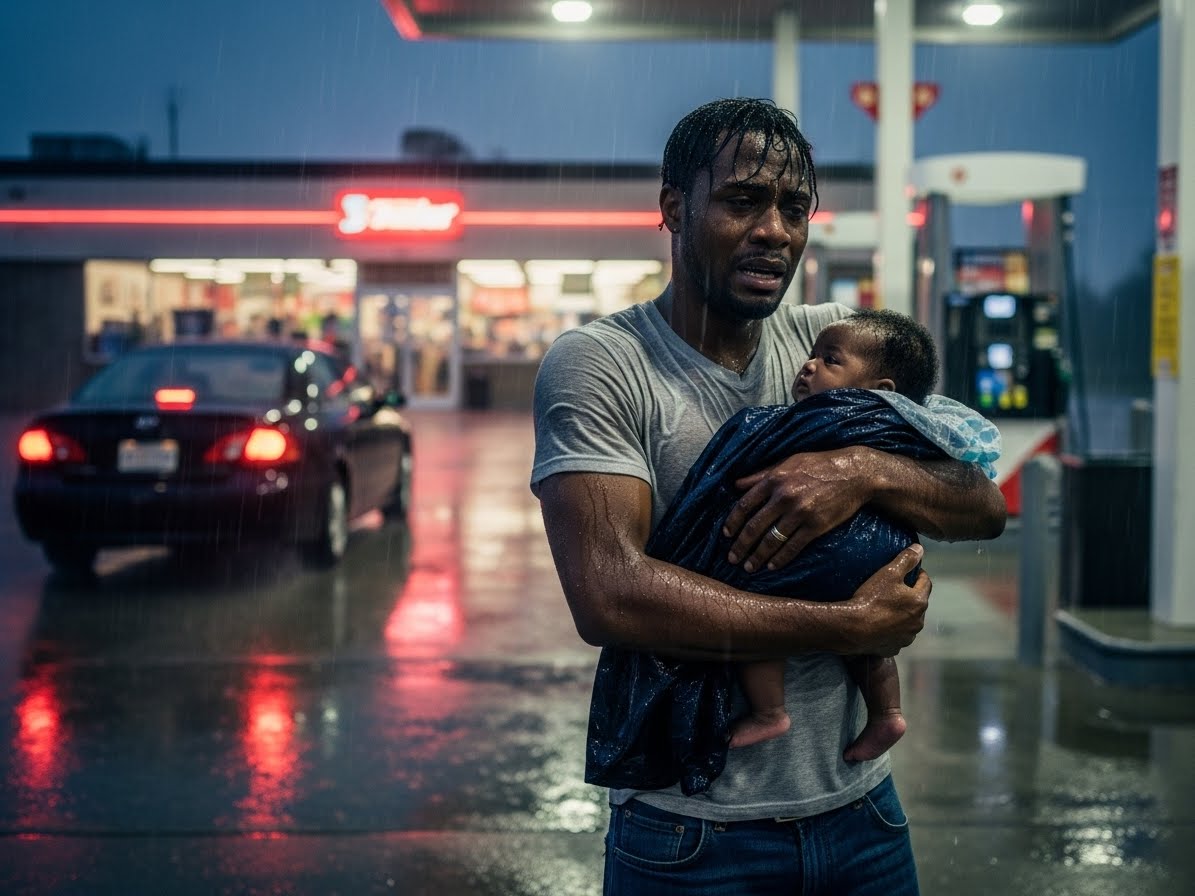
The rain in Seattle doesn’t wash things clean; it just makes the grime slicker. It was a Thursday night in November, 2019, the kind of night where the cold seeps through the soles of your shoes and settles in your bones. I was standing at Pump 4 of a BP station off Highway 167, watching the numbers on the digital display tick upward.
$38.50. $39.00.
I squeezed the handle to stop it at exactly forty bucks. That was the budget. I was twenty-eight years old, an assistant manager at a distribution warehouse making $48,000 a year, and forty dollars was the difference between eating lunch next week or not. Inside the car, my 2008 Honda Accord, the heater was rattling, fighting a losing battle against the chill.
I could see her through the rain-streaked window. Brittany. My wife of three years. She was staring at her phone, her face bathed in that ghostly artificial blue light. She hadn’t looked at me since we left her mother’s house. She hadn’t spoken a word. In the back seat, our six-month-old daughter, Maya, was screaming. It was a jagged, tired cry—the sound of a baby who picks up on the tension in the air.
I tapped on the glass. “I’m gonna grab a water. You want anything?”
Brittany didn’t look up. She just shook her head, a sharp, dismissive jerk of her chin.
I sighed, the exhaust from my breath clouding in the air, and jogged toward the convenience store. I was exhausted. I’d worked a double shift, slept three hours, and then driven across town to pick them up because Brittany claimed the Honda was stalling again. My back ached. My eyes burned. All I wanted was to get home to our cramped apartment in Renton, heat up some leftovers, and sleep.
The line inside was slow. The guy in front of me was arguing about the price of lottery tickets. I checked my watch. 9:08 PM. Finally, I paid for the water and a pack of gum.
“Have a good night,” the clerk mumbled.
“You too,” I said.
I pushed the glass door open, bracing myself for the wind. I looked toward Pump 4.
It was empty.
My brain didn’t process it at first. It did a stutter-step. I actually chuckled, a dry, confused sound. She moved the car, I thought. She pulled around to the air pump. Or maybe she parked closer to the door.
I walked around the side of the building. Nothing. Just a dumpster and a stray cat seeking shelter.
I walked to the edge of the lot, scanning the highway. The road was a river of red taillights and headlights reflecting off the wet asphalt.
“Brittany?” I called out. The wind snatched the name right out of my mouth.
Then I heard it. A cry. Not from a car, but from the ground.
I spun around. There, sitting on the curb near the air compressor, sheltered slightly by the overhang of the station roof, was the car seat.
My heart hammered against my ribs like a trapped bird. I sprinted over. Maya was there, strapped in, a thin blanket tucked around her. She was red-faced, screaming, her tiny fists bunching the fabric.
She had taken the baby out. She had unbuckled the seat, placed our daughter on the cold concrete, got back in the car, and drove away.
I scooped up the carrier, clutching it to my chest, shielding Maya from the spray of rain. “It’s okay, baby. Daddy’s here. Daddy’s got you.”
My phone buzzed in my pocket. I fumbled for it with freezing fingers, nearly dropping it.
New Message: Brittany
I can’t do this anymore. She’s your problem now. Don’t try to find me.
I stared at the cracked screen. The words swam before my eyes. She’s your problem now. Not “our daughter.” Not “Maya.” She. Like she was a defective appliance being returned to the store.
I dialed her number. It rang once, then straight to voicemail. I dialed again. And again. Seventeen times I called her standing in that parking lot, water dripping off my nose onto the screen.
Panic is a cold thing. It starts in your stomach and spreads to your limbs until you can’t feel your fingers. I was stranded. No car. No diaper bag—she’d taken that too. Just me, a screaming infant, and a bottle of water.
I walked back inside the store. The clerk looked up, startled. “Hey man, you can’t bring the baby in here if she’s screaming like that.”
“My wife just left,” I said. My voice sounded hollow, like it was coming from someone else. “She took the car. She left us.”
The clerk’s face softened from annoyance to pity. That was the first time I saw that look. The Pity. I would get used to it over the next few months. It was in the eyes of the police officer who came to take the report. It was in the eyes of my sister, Crystal, when she picked us up at midnight.
“She’s gone, Darnell,” the cop told me, closing his notebook. “She’s not missing. She left voluntarily. Unless she endangered the child directly—and leaving her on the curb is borderline, but you found her quickly—this is a civil matter. Get a lawyer.”
“A lawyer?” I laughed, hysteria bubbling up. “I don’t have money for a cab, let alone a lawyer.”
I didn’t know then that Brittany had been planning this for months. I didn’t know she had moved her good clothes, her jewelry, and her passport to a penthouse in Bellevue days ago. I didn’t know she was lying in the arms of Tyler Richardson, a 42-year-old tech executive who drove a Tesla and had told her explicitly, I don’t do other men’s kids.
She chose the Tesla. She chose the view of Lake Washington. She chose herself.
And she left me in the rain to figure out how to keep a six-month-old alive on forty-eight thousand a year.
Chapter 2
The first six months after the gas station were a blur of gray exhaustion. If you have never been a single parent to an infant while working a manual labor job, you cannot understand the bone-deep fatigue. It is a physical weight.
I lost the apartment in Renton within seven weeks. Without Brittany’s part-time income—small as it was—and with the sudden cost of emergency childcare so I could work, the math didn’t work. I sold everything I could. The TV, my game console, even my wedding ring. It wasn’t enough.
The eviction notice came on a Tuesday. By Friday, I was moving into my mother’s basement in Tacoma.
Moving back in with your mom at twenty-nine feels like failure. It tastes like ash. I remember carrying the boxes down the narrow stairs, the damp smell of the basement hitting me. My mother, Dorothy, was a saint. A retired math teacher, tough as nails.
“Put the crib in the corner, Darnell,” she directed, holding Maya on her hip. “It’s warmer there.”
“I’m sorry, Ma,” I whispered, sitting on a stack of books, head in my hands. “I’m so sorry.”
“For what?” She snapped. “For stepping up? For doing what a man is supposed to do? You didn’t leave, baby. You stayed. Don’t you ever apologize for surviving.”
That was the turning point. I stopped waiting for Brittany to come back. I stopped checking her social media, which had gone completely dark anyway. I stopped hoping for an explanation.
I got angry. And then, I got organized.
I worked the morning shift at the warehouse, 6:00 AM to 2:00 PM. My mom watched Maya. I’d come home, sleep for three hours, and then wake up. While my friends were out or watching Netflix, I was studying.
I realized that if I stayed an assistant manager, we would be in that basement forever. I needed a skill. I needed leverage. I started taking online certifications in supply chain management.
My routine was brutal:
05:00 AM: Wake up, prep Maya’s bottles.
06:00 AM – 02:00 PM: Work. Lift boxes. Direct forklifts.
02:30 PM – 05:30 PM: Sleep.
06:00 PM – 08:30 PM: Dad time. Bath, books, feeding.
09:00 PM – 01:00 AM: Study. Logistics. Data analysis. Workflows.
I documented everything. Every penny I spent on diapers. Every doctor’s appointment. Every night Brittany didn’t call. I created a Google Drive folder simply titled “Evidence.” I didn’t know law, but I knew logistics. If she ever came back, I wanted a paper trail so thick it would bury her.
Maya was the light. She didn’t know her mom was gone. She only knew that Nana sang her songs and Daddy read her books with funny voices. She thrived. She walked at ten months. She said “Dada” at eleven.
Four months in, a process server knocked on my mom’s door.
Divorce papers. Filed in Portland, Oregon. Grounds: Irreconcilable differences.
I scanned the document, my hands shaking. I flipped to the custody section. Petitioner (Brittany Thompson) requests no custody. Petitioner requests no visitation. Petitioner offers no child support.
She was washing her hands of us. Legally erasing her motherhood.
“She’s evil,” my sister Crystal said, reading over my shoulder. “Pure evil.”
“No,” I said, signing the paper with a grim sense of finality. “She’s giving me a gift. She’s giving me full control.”
I mailed the papers back. I was now a single father in the eyes of the law.
Two years passed. The grind paid off. I landed a job as a Logistics Coordinator for a manufacturing firm. $62,000 a year. We moved out of the basement into a small duplex. It wasn’t a palace, but it had windows. It had light.
Then, I met Simone.
It was a Saturday morning parent-child music class at the community center. I was the only dad there, as usual, feeling awkward while sitting in a circle on the floor. Maya was three now, banging enthusiastically on a tambourine.
“She has a good rhythm,” a woman next to me said.
I turned. She was beautiful. Natural hair, kind eyes, a smile that seemed to say, I see you. She was there with her nephew.
“I think she’s just loud,” I joked. “I’m Darnell.”
“Simone.”
Simone was different. She was a software developer. She owned her own condo. She was smart, pragmatic, and fiercely independent. But what floored me was how she treated Maya.
On our third date, I told her the truth. I told her about the gas station. I told her about the basement. I laid my baggage out on the table and said, “This is it. If it’s too much, run now.”
Simone didn’t run. She reached across the table and took my hand.
“That woman is a fool,” Simone said, her voice steady. “And you are the strongest man I’ve ever met.”
We built a life. Brick by brick. Simone didn’t try to replace Brittany; she just filled the empty space with love. Maya started calling her “Simone” at first, and then, without prompting, “Mama Simone.”
By 2023, we were married. I was making $78,000 as a Senior Manager. We bought a house in Spanaway. We had a backyard. We had peace.
I thought the past was dead. I thought the ghost of the gas station was exorcised.
Then came the knock on my office door. October 2024.
A man in a cheap suit handed me a card. “Mr. Thompson? I’m a private investigator.”
My stomach dropped. “Who hired you?”
“Brittany Thompson. She wants to meet.”
I stood there, holding that card, feeling the adrenaline of five years ago rushing back. She was back. And she wanted something.
Chapter 3
“Why now?” Simone asked. We were sitting at our kitchen table. The house was quiet; Maya was asleep upstairs. The business card the PI had given me sat in the center of the table like a piece of radioactive waste.
“I don’t know,” I said, rubbing my temples. “Curiosity? Guilt? Maybe she needs money.”
“Do you want to see her?”
I looked at my wife. Simone wasn’t jealous. She was protective. She was a lioness watching the perimeter.
“I need to know,” I admitted. “For five years, I’ve wondered why. Why leave a baby on a curb? I need to look her in the eye.”
“Then do it,” Simone said. “But Darnell? Don’t let her inside your head. You built this. She destroyed it.”
I called the number. We arranged to meet at a coffee shop in Federal Way. Neutral ground. Public.
I arrived fifteen minutes early. I sat in the corner, back to the wall—a habit I’d picked up when I felt threatened. I watched the door.
At 2:00 PM, she walked in.
Brittany looked… older. Not just the natural aging of five years, but worn. Her clothes were nice—a beige trench coat, leather boots—but they looked a few seasons old. The confident, arrogant woman who scrolled through Instagram while I pumped gas was gone. In her place was someone nervous.
She spotted me. She smiled, but it didn’t reach her eyes.
“Darnell,” she said, sliding into the chair opposite me. “You look good. Success suits you.”
“Brittany,” I nodded, keeping my face like stone. “What do you want?”
She flinched at the tone. “Can’t we just say hello? It’s been five years.”
“Exactly. Five years. You left a text message and vanished. So skip the pleasantries. Why did you hire a PI to find me?”
She took a breath, wrapping her hands around her coffee cup as if for warmth. “I made a mistake, Darnell. A huge mistake.”
“Which one? The affair with Tyler? The abandonment? The divorce papers where you waved all rights to your child?”
She looked down. “All of it. Tyler… Tyler wasn’t who I thought he was.”
I almost laughed. “Let me guess. He got bored? He traded you in for a newer model?”
Her silence was my answer. “He kicked me out three years ago,” she whispered. “I’ve been in Portland. I’ve been working on myself. Thinking about what I lost.”
She looked up, and her eyes were wet with tears. “I want to see her, Darnell. I want to see our daughter.”
The rage that hit me was blinding. It was white-hot. It took every ounce of discipline I had learned in the warehouse, every ounce of patience I had learned from raising a toddler, not to flip the table.
“Her name is Maya,” I said, my voice shaking with suppressed fury. “And she is not our daughter. She is my daughter.”
“I gave birth to her!”
“And you left her at a BP station!” I hissed, leaning in. People at nearby tables turned to look. I lowered my voice to a lethal whisper. “You haven’t sent a birthday card. You haven’t paid a dime. You don’t know her favorite color. You don’t know she’s allergic to strawberries. You are a stranger to her.”
“I’ve changed,” she pleaded. “I have rights, Darnell. I’m her mother.”
“You signed your rights away.”
“I was under duress! I was depressed!” The excuses poured out of her. “I want to be in her life. I’m willing to start slow. Visitation. Weekends.”
I stood up. “The answer is no.”
“You can’t keep her from me.”
“Watch me.”
I walked out. But as I drove home, my hands gripping the steering wheel, I knew it wasn’t over. I had seen the look in her eyes. It wasn’t just regret. It was desperation. She had lost her rich boyfriend, her lifestyle, and her pride. Now she wanted the only thing she had left: the family she threw away.
I called my lawyer, Patricia, on the drive home.
“She’s back,” I told her.
“Did she threaten legal action?” Patricia asked.
“She implied it. She thinks she can get visitation.”
Patricia let out a dry laugh. “Let her try. Darnell, you have the ‘Evidence’ folder, right? The one we talked about?”
“I have everything,” I said. “Five years of receipts.”
“Good. Because if she files a petition, we aren’t just going to defend. We are going to go on the offensive. We’re going to terminate her rights permanently.”
Chapter 4
Brittany didn’t wait. Two weeks later, I was served. She had found a lawyer—some strip-mall guy working on contingency, probably—and filed for a modification of custody. She was claiming I had alienated Maya from her and that she had been coerced into the original divorce decree.
“She’s lying,” Simone said, reading the petition, her face pale. “She says you threatened her?”
“It’s a standard tactic,” I said, trying to stay calm for my wife. “Throw mud, see what sticks.”
We had to tell Maya. She was five now. Smart as a whip. We couldn’t let her walk into a courtroom or meet this woman without context.
We sat her down in the living room. Simone held Mr. Hopscotch, Maya’s stuffed rabbit.
“Maya,” I said gently. “You know how some kids have a mommy and a daddy, and some have two daddies?”
“Like Aiden,” she nodded.
“Right. Well, before I met Mama Simone, I was married to someone else. And that person is the one who gave birth to you.”
Maya frowned. “Where is she?”
“She wasn’t ready to be a mommy when you were a baby,” Simone explained, her voice soft. “So she went away to figure things out. But now she’s back, and she wants to see you.”
Maya looked at me, then at Simone. She shrugged. “Okay. Is she nice?”
“We hope so,” I said.
The court ordered mediation first. We met in a sterile conference room. Brittany was there, looking more polished this time, playing the victim card hard.
“I just want to be a mother,” she cried to the mediator. “He’s keeping my baby from me.”
I slid a binder across the table. It was three inches thick.
“What is this?” her lawyer asked.
“That,” I said, “is a record of every single day for the last 1,825 days. Every day she wasn’t there.”
The mediation failed. Brittany refused supervised visits; she wanted weekends immediately. I refused to let her take Maya out of my sight.
We went to court.
Judge Catherine Brooks was a woman who did not suffer fools. She peered over her glasses as Brittany’s lawyer gave a passionate opening statement about redemption and the maternal bond.
Then, it was Patricia’s turn.
She didn’t make a speech. She called witnesses.
She called my mother, who testified about the night I came home with a crying baby and no diaper bag. She called Maya’s pediatrician, who testified that Brittany had never been listed as a contact and never called for records. She called Simone, who spoke about the nightmares Maya used to have about being left alone.
And then, she put me on the stand.
“Mr. Thompson,” Patricia asked. “Can you read this text message for the court? The one labeled Exhibit A?”
I held the printout. I looked at Brittany. She wouldn’t meet my eyes.
“It says: I can’t do this anymore. She’s your problem now. Don’t try to find me.”
“And where were you when you received this?”
“Standing in the rain at a BP station off Highway 167.”
“Where was your daughter?”
“On the curb. Beside the air pump.”
The courtroom went silent. Even the stenographer stopped typing for a second.
Judge Brooks looked at Brittany. “Is this true, Ms. Thompson?”
Brittany stood up, her voice trembling. “I was young! I was confused!”
“You were twenty-five,” the Judge snapped. “That is not a child. That is an adult.”
The hearing lasted two days. In the end, Judge Brooks didn’t just deny Brittany’s petition. She granted our counter-petition.
“Ms. Thompson,” the Judge said, her voice echoing in the chamber. “Parenthood is not a hobby you pick up when you’re bored. It is a commitment. You broke that commitment in the most egregious way possible. You voluntarily abandoned this child. You have shown no cause for why you should be reinstated into her life other than your own sudden desire. That is not enough.”
“I am terminating your parental rights effective immediately. Mr. Thompson retains sole legal and physical custody. You are to have no contact with the child unless initiated by the father. Case closed.”
Brittany collapsed into her chair, sobbing.
I didn’t feel triumphant. I just felt… light. The weight I had been carrying since that night at the gas station finally evaporated.
I walked out of the courthouse, holding Simone’s hand.
“It’s over,” Simone whispered.
“Yeah,” I said, looking at the sky. It wasn’t raining. “It’s finally over.”
Or so I thought.
Chapter 5
Three months after the court case, my phone rang. It was a Portland area code.
“This is Darnell.”
“Mr. Thompson? This is Jennifer Collins, a social worker at Portland General.”
My stomach tightened. “Yes?”
“We have a patient here, Brittany Thompson. She listed you as her emergency contact.”
“We’re divorced,” I said automatically. “What happened?”
“She… there was an incident. A suicide attempt. She’s stable now, but she’s in psychiatric hold.”
I closed my eyes. I hated her for what she did, but hearing that… it struck a chord of basic humanity.
“Why are you calling me?”
“She keeps asking for you. She says she needs to apologize.”
I discussed it with Simone. “You don’t owe her this,” Simone said. “But if you need to go for you, then go.”
I drove to Portland alone.
The hospital room smelled of antiseptic—a different smell than the gas station, but just as cold. Brittany looked small in the bed. Her wrists were bandaged. She looked broken.
“You came,” she rasped.
“I’m here,” I said, standing by the door.
“I ruined everything,” she cried. tears streaming down her face. “I had a good husband. I had a beautiful baby. And I threw it away for a fantasy. Tyler… he never loved me. He loved that I looked good on his arm. As soon as I got ‘too old’ or ‘too sad,’ he tossed me out.”
“Brittany,” I said gently. “You can’t fix the past.”
“I know. I just wanted you to know… you were right. You were always enough. I was the one who was empty.”
I looked at her, really looked at her, and realized I didn’t hate her anymore. I pitied her. She was a ghost haunting her own life.
“Get better, Brittany,” I said. “For yourself. Not for me. Not for Maya. We’re gone. You have to find a way to live for you.”
I left. I didn’t look back.
But life has a way of twisting the knife one last time.
Five years later. 2029.
I was forty now. A Director of Operations making nearly six figures. Maya was ten, a soccer star, bright and funny. Simone and I were solid as a rock.
We were at Costco on a Saturday—the ultimate suburban cliché. We were buying bulk snacks for Maya’s team.
We were in the checkout line when I heard a voice.
“Darnell?”
I turned.
Standing there was a man in his fifties. expensive sweater, silver hair, holding a bottle of expensive wine.
It was Tyler. The tech executive. The man she left me for.
And hanging on his arm was a young woman, maybe twenty-two. Blonde. Pretty. Looking bored.
“Tyler,” I said. My voice was calm.
“Wow,” he laughed, looking me up and down. “You look… different. Better.”
“I am better.”
He looked at Simone, then at Maya, who was leaning on the cart reading a book.
“This your family?”
“Yes.”
Tyler shifted uncomfortably. “Hey, look. About Brittany… that whole thing back then. It was messy. Sorry about that.”
He apologized for destroying my marriage like he was apologizing for spilling a drink.
“It wasn’t messy, Tyler,” I said, stepping closer. I was taller than him. Broad-shouldered from years of warehouse work. “It was life-altering. She left her child on a curb for you.”
He shrugged. “She was a lot of drama, man. You know how she is. High maintenance.”
I looked at him, and then I looked at the young girl on his arm. I saw the future. In five years, he would trade her in too.
“She wasn’t high maintenance,” I said. “She was lost. And you exploited that. But honestly? I should thank you.”
He blinked. “Thank you?”
“Yeah. If you hadn’t tempted her away, I wouldn’t have hit rock bottom. I wouldn’t have built the resilience I have now. I wouldn’t have met Simone. And my daughter wouldn’t have the mother she deserves.”
I put my arm around Simone.
“You did me a favor, Tyler. You took out the trash.”
His jaw dropped. The young girl stifled a giggle.
“Have a nice life,” I said. “Come on, girls.”
We walked out of Costco into the sunshine.
Maya looked up at me. “Who was that, Daddy?”
“Nobody, baby,” I said, kissing the top of her head. “Just a ghost.”
We loaded the car. A nice SUV, fully paid for. I looked at Simone. She smiled and squeezed my hand.
“You okay?” she asked.
“I’m perfect.”
And I was.
I drove home, thinking about that night at the gas station. It was the worst night of my life. But looking in the rearview mirror at my happy, healthy daughter and my loving wife, I realized something.
Sometimes, the rain doesn’t just wash you out. Sometimes, it waters the seeds of the life you were actually meant to have.
Brittany froze when she saw me at the coffee shop years ago, and Tyler froze in the Costco line today. They froze because they expected to see a victim. They expected to see the broken man they left behind.
Instead, they saw a king.
And the best revenge? It wasn’t the court case. It wasn’t the words.
It was simply being happy.
Chapter 6
I thought the encounter with Tyler at Costco was the period at the end of the sentence. I thought the book on Brittany was closed, shelved, and gathering dust. I was wrong. The past is never really dead; sometimes, it’s just waiting for a new way to haunt you.
Two weeks after seeing Tyler, I was in my office reviewing Q3 shipping manifests when my cell phone buzzed. Unknown number. Usually, I let those go to voicemail. Spammers, robocalls—I didn’t have time for it. But for some reason, the hair on the back of my neck stood up. A gut instinct.
I answered. “This is Darnell.”
“Mr. Thompson?” The voice was professional, clipped, authoritative. “This is Detective Sarah Mitchell with the Seattle Police Department. I need to speak with you regarding a Ms. Brittany Thompson.”
The room seemed to drop five degrees. My first thought was a car accident. My second was that she had finally succeeded in taking her own life.
“She’s my ex-wife,” I said, gripping the edge of my desk. “Is she… is she dead?”
“No, sir, she’s alive. But she is currently a victim in an active investigation, and your name—and your daughter’s name—have come up in the evidence.”
The air left my lungs. “My daughter? Maya? She’s ten years old. What does she have to do with a police investigation?”
“I can’t discuss the details over the phone, Mr. Thompson. I need you to come down to the station. Today.”
I didn’t ask permission from my boss. I just grabbed my keys and walked out. The drive to Seattle was a blur of panic. My daughter’s name. Had Brittany tried to kidnap her? Had she stalked her?
When I arrived at the precinct, the atmosphere was grim. Fluorescent lights, the smell of stale coffee and industrial cleaner. Detective Mitchell met me in the lobby. She was a sharp woman in her forties with eyes that looked like they’d seen everything and were impressed by nothing.
She led me to an interview room. “Take a seat. Coffee?”
“No. Just tell me what’s going on.”
She opened a file folder. “We are investigating a man named Richard Monroe. He’s a career con artist who specializes in romance scams. He targets vulnerable women online, builds a relationship, and drains their finances.”
“Okay,” I said, confused. “Brittany fell for a scam. I’m sorry to hear that, but what does—”
“She didn’t just give him money, Mr. Thompson,” Mitchell interrupted. “She gave him approximately forty-two thousand dollars in cash. She maxed out credit cards in her name for him. She is currently seventy thousand dollars in debt.”
I winced. It was tragic, in a pathetic sort of way. Brittany, always chasing the high life, getting played by a man pretending to be rich.
“But here is the problem,” Mitchell continued, sliding a photocopy across the table. “When we raided Mr. Monroe’s apartment, we found a stack of documents in his safe. Personal documents.”
I looked down.
It was a birth certificate. Maya’s birth certificate. Next to it was a copy of my old social security card and a copy of the original custody decree.
“Why…” My voice failed me. “Why did this man have my daughter’s birth certificate?”
“Brittany gave them to him,” Mitchell said, her voice flat. “He convinced her he was helping her build a ‘trust fund’ case to get custody back. He needed ‘documentation.’ In reality, we believe he was prepping to open lines of credit in your daughter’s name. Identity theft of a minor.”
I stood up, the chair screeching against the floor. I walked to the corner of the room, hands on my head, trying to breathe.
“She gave a criminal my daughter’s social security number,” I whispered. “To impress a boyfriend.”
“Essentially, yes.”
“Is he in jail?”
“He is. Facing multiple counts of fraud and grand larceny.”
“And her? Is she being charged?”
“She’s cooperating as a witness,” Mitchell said. “She claims she didn’t know. She thought he was a lawyer/investor helping her. Stupidity isn’t a crime, Mr. Thompson. But negligence…”
I sat back down. The anger I felt was different this time. It wasn’t the hot, fiery rage of the gas station. It was a cold, heavy disgust. Even from a distance, even with no legal rights, her incompetence was a weapon.
“What do I need to do?” I asked.
“Freeze your daughter’s credit immediately,” Mitchell advised. “Contact the credit bureaus. Monitor everything. We caught him before he opened anything in Maya’s name, but you can never be too safe.”
I left the station feeling dirty. I felt violated. I drove home, called Simone, and we spent the next four hours on the phone with Equifax, TransUnion, and Experian. We locked Maya’s identity down so tight nobody could open a library card without a DNA test.
That night, I stood in the doorway of Maya’s room watching her sleep. She was oblivious. She was dreaming about soccer or school or whatever ten-year-olds dream about. She didn’t know that her biological mother had traded her safety for a shot at a fake romance.
“She never stops, does she?” Simone whispered, coming up behind me.
“She’s chaos,” I said. “She’s a hurricane. Even when she’s not trying to hit us, we get the rain.”
Chapter 7
The fallout from the fraud investigation lasted months. Not legally—the guy pleaded guilty—but emotionally. It rattled us. It reminded us that the wall we built around our family had cracks.
We became vigilant. Paranoid, almost. I checked the mail three times a day. I monitored our bank accounts daily. I was waiting for the next shoe to drop.
But then, silence.
Six months passed. Then a year. 2030 arrived. Maya turned eleven. She got braces. She made the varsity travel team for soccer. Life returned to its beautiful, boring rhythm.
I started to relax. I started to believe that maybe, finally, Brittany had run out of ways to mess up.
Then came May 15th, 2030.
I was at work. My assistant buzzed me. “Darnell, there’s a letter here for you. Marked ‘Personal and Confidential.’ It was forwarded from your attorney’s office.”
Patricia. I hadn’t spoken to her in years.
“Bring it in.”
The envelope was thick. Cream-colored paper. The handwriting on the front was familiar, though shakier than I remembered. Darnell Thompson.
I knew who it was from before I opened it.
I sat there for a long time, holding the letter opener. Part of me wanted to shred it. Whatever she had to say, I didn’t owe her an audience. But curiosity is a powerful drug. And Patricia wouldn’t have forwarded it if she thought it was a threat.
I sliced the envelope open.
Dear Darnell,
I don’t expect you to read this. I don’t expect you to respond. I definitely don’t expect you to forgive me. But my therapist says I need to try to make amends to the people I’ve shattered, even if those amends aren’t accepted. So, here I am.
I leaned back in my chair. Therapist. That was new.
I’ve spent the last year in intensive therapy, working through why I make the choices I make. I’ve been diagnosed with Borderline Personality Disorder and severe attachment issues. None of these are excuses. They are just explanations for the bomb I set off in your life.
I read on. It wasn’t the usual Brittany letter. There were no demands. No justifications. No “but Tyler made me do it.” It was raw.
I abandoned my daughter at a gas station. I drove away from my baby because I was delusional. I thought a man I barely knew could give me a ‘better’ life. I was selfish, cruel, and weak. There is no other way to say it.
You were a good husband. You worked yourself to the bone for us. And I repaid that by betraying you in the worst possible way. You are a good father. Maya is lucky to have you. I know I lost the custody case. I know my rights were terminated. I know that Maya doesn’t know me.
I’m not writing to change that. I’m writing because you deserve to hear me say: I was wrong.
My eyes scanned down the page. She talked about the romance scam. She admitted her stupidity.
I got scammed recently. Lost everything. Got into debt. I almost let it kill me. But instead, I’m using it as a wake-up call. I am done chasing fantasies. I am learning to be okay with an ordinary life. I work as a receptionist now. I pay my bills. I go to therapy.
I hope Maya is happy. I hope she is surrounded by people who love her. If Simone is good to her—and I know she is—then I am grateful. Maya deserves a mother who shows up. I wasn’t that mother.
I’m sorry, Darnell. For everything.
Brittany.
I put the letter down on my desk. I looked out the window at the gray Tacoma skyline.
For ten years, I had held onto a knot of anger. Even when I thought I let it go, it was there. A tightness in my chest whenever her name came up. A need to prove her wrong. A need to win.
But reading this… the knot loosened. She finally got it. She finally understood the magnitude of what she broke. And she wasn’t asking for a fix. She was just owning the wreckage.
I folded the letter. I didn’t tear it up. I put it in my desk drawer. I wouldn’t reply. There was nothing to say. But the war was over. The enemy had surrendered.
Chapter 8
That weekend, we took Maya to Point Defiance Park. It was our spot. The place I proposed to Simone. The place we went when we needed air.
Maya ran ahead, her long legs carrying her swiftly down the trail. She was shouting something about a squirrel.
Simone slipped her hand into mine. “You’ve been quiet since Wednesday. Since the letter.”
“I have,” I admitted.
“Did it upset you?”
“No,” I said, surprised to find it was true. “It freed me.”
We walked in silence for a moment, the sound of the Puget Sound lapping against the shore below us.
“You know,” I said, “that night at the gas station… I thought my life was over. I stood there in the rain holding Maya, and I thought, This is it. I’m dead. I can’t do this.”
Simone squeezed my hand. “But you did.”
“I did. And looking back… it wasn’t the end. It was the beginning. If she hadn’t left, I would have stayed in that dead-end job trying to please a woman who couldn’t be pleased. I wouldn’t have gone back to school. I wouldn’t have met you.”
I stopped and looked at my wife. The sun was catching her hair, lighting up her face.
“She did me a favor,” I said. “A terrible, painful favor. She cleared the path for the life I was actually supposed to have.”
Maya ran back to us, breathless, cheeks flushed pink. “Dad! Mom! You gotta see this! There’s a baby seal on the rocks!”
“A seal?” I laughed, scooping her up—she was getting too big for it, but she let me anyway. “Show me.”
We ran to the overlook. We watched the seal pup for twenty minutes. We laughed. We took pictures. We were a family. Not a broken one. Not a “blended” one. Just a family.
That night, after Maya was asleep, I sat at my computer. I opened a blank document.
I wasn’t writing to Brittany. She was the past. I was writing to someone else.
To the man at the gas station,
It’s me. You. Ten years from now.
I know you’re scared right now. I know you’re cold. I know you’re looking at that empty parking spot and wondering how you’re going to survive the night, let alone the next eighteen years.
I’m writing to tell you: You’re going to make it.
The pain you feel right now is fuel. Burn it. Use it to get up at 5 AM. Use it to study while the baby sleeps. Use it to build a fortress around that little girl.
You think you lost your wife. You didn’t. You lost an anchor that was dragging you down. You are about to meet a woman who will love you for exactly who you are. You are about to build a career you can be proud of.
Whatever you do, don’t chase her. Let her go. Let her drive that Honda into the ground. She is driving toward misery. You are walking toward joy.
Keep going. Keep loving Maya. It’s worth it. Trust me.
Signed, Darnell.
I saved the file. May 2030.
I turned off the computer and walked into the bedroom. Simone was reading in bed. She looked up and smiled.
“You okay?”
“Yeah,” I said, climbing in beside her. “I’m finally okay.”
The next morning, I woke up to Maya jumping on the bed.
“Dad! Dad! My tooth! It fell out!”
She held up a tiny white tooth, grinning with a gap in her smile. “The Tooth Fairy owes me money!”
“Oh really?” I laughed, grabbing her in a bear hug. “What’s the going rate for a tooth these days?”
“Five bucks! Inflation, Dad!”
Simone burst out laughing. “She sounds like you.”
“She does,” I said, looking at my daughter. She was happy. She was safe. She was loved.
And that was the only victory that mattered.
Brittany Thompson was a memory. A lesson. But Maya? Maya was my legacy. And looking at her, I knew I had won the only game worth playing.