My Commander Stared At The Tattoo On My Wrist In Horror. He Thought The Owner Of That Ink Died In His Arms Three Years Ago. He Was Wrong.
Chapter 1: The Slip
The heat in Southern California is different than the heat in the Middle East. Here, near the ocean, the air has moisture; it sticks to you, heavy and salty. In Yemen, the heat was a dry oven that cracked your lips and turned your lungs to paper. But the smells—the metallic tang of blood, the sharp bite of antiseptic, and the underlying musk of unwashed bodies and gun oil—those were the same everywhere.
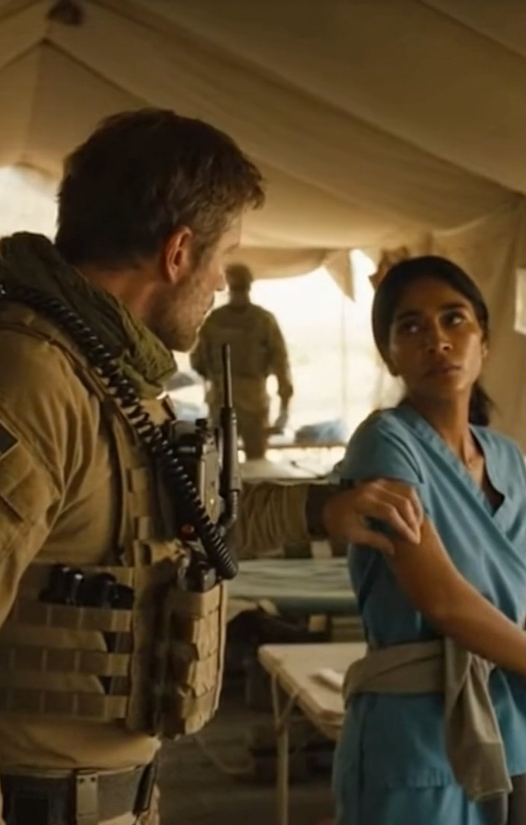
I was working the midday shift at the Naval Amphibious Base Coronado. To everyone here, I was just “Doc Torres,” a civilian contractor hired to handle the overflow of injuries during Hell Week. My file was scrubbed clean. It listed me as a trauma nurse with civilian experience in inner-city ERs. No front-line service. No combat record. It was safer that way.
The media had a field day with Operation Black Sand three years ago. It was a botched extraction that resulted in classified losses. I had no interest in being their poster girl for “miraculous survival” or the subject of a congressional hearing. I just wanted to work. To be useful. To forget.
The buzzing in the medical tent was a familiar kind of chaos. Drills, shouting, the rhythmic thud of boots on hard-packed dirt just outside. It was just another Tuesday. I kept my head down, my hands steady as I cleaned a recruit’s wound. The kid couldn’t have been more than twenty, his face pale under a layer of sweat and grime. He was vibrating with adrenaline and pain.
“Just a graze,” I murmured, my voice low and calm. It’s the voice I’d perfected. Calm, quiet, invisible. “You’ll be back in the surf in twenty-four hours.”
I reached for fresh gauze, moving with the efficiency that comes from stitching up bodies in the back of moving Humvees. And that’s when it happened.
My sleeve, normally buttoned tight at the wrist, snagged on the sharp corner of the stainless steel surgical tray. I pulled my arm back too quickly. The fabric caught, tore, and slid up my forearm.
The buzzing in the tent didn’t just quiet down. It died.
It was sucked into a black hole, leaving a ringing silence that was louder than any explosion. I felt the air change. I felt the eyes.
You have to understand the culture here. The Trident—the insignia of the US Navy SEALs—is sacred. You earn it through blood, sweat, and the hardest military training on earth. Wearing one when you haven’t earned it isn’t just a fashion faux pas; it’s an invitation to violence. It’s called “Stolen Valor,” and these men take it personally.
One of the men near the cot, a massive Instructor named Miller, whispered, his voice cracking with disbelief. “Wait… is that… is that Team Four’s insignia?”
I froze. Not my body—my hands kept moving, wrapping the gauze with practiced precision—but my soul. My soul turned to ice. I didn’t have to look. I knew what they saw. An old tattoo, faded by sun and time, but unmistakable. A SEAL trident, wrapped in a blood-red ribbon, with a small date inked beneath it.
Miller stepped forward, his shadow falling over my workstation. “Hey. Doc. You got some explaining to do. That ink isn’t something you pick up at a spring break parlor.”
The menace in his voice was palpable. The other recruits and instructors stopped what they were doing. The air was thick with sudden aggression. They saw a civilian woman wearing the badge of their brotherhood. They saw a liar.
I didn’t answer him. I couldn’t. If I spoke, I would give it away. I just focused on the recruit’s arm, my fingers tying the knot on the bandage.
“I’m talking to you!” Miller barked, reaching out to grab my shoulder.
The tent flap flew open, slamming against the canvas wall. The sudden noise made the recruit jump, but I didn’t flinch. I hadn’t flinched in three years.
Chapter 2: The Ghost of Team Four
Commander Ethan Ward stepped in, his eyes sweeping the room, hard and impatient. He was a man carved from granite, all sharp angles and authority. He was 42, the Commanding Officer of SEAL Team 4, and he didn’t waste time on civilians. He was looking for his man, but his gaze snagged on the silence, on the way every operator in the room was staring at me.
Miller froze, his hand inches from my shoulder. He snapped to attention, but his finger pointed accusingly at me. “Sir. We have a situation. Stolen Valor.”
Ward’s eyes followed the finger. Down to my arm. To the ink.
He went absolutely still.
The man who was all motion and command just… stopped. I could see the blood drain from his face, leaving a sickly gray pallor under his tan. His jaw tightened, a muscle jumping. He wasn’t looking at the Trident with anger. He was looking at it with recognition.
He knew that specific design. He knew the red ribbon. He knew the scar that ran parallel to it—a burn mark from a hot shell casing.
“Who is she?” he demanded. His voice was a low growl, meant to terrify. But underneath the anger, I heard it—the tremor of disbelief.
No one spoke. The silence stretched, thin and brittle. The only sound was the recruit’s ragged breathing.
Slowly, I finished tying off the bandage. I gave the kid a small pat on the shoulder. “You’re good to go.”
Then, I turned. I let my sleeve fall back into place, but it was too late. The ghost was out.
I met his eyes. Commander Ethan Ward. A man I had patched up under gunfire. A man whose life I had saved. A man who had screamed my name into a radio before the transmission went dead.
My voice was steady. It was the calmest thing in the tent. “Just the medic you left behind, sir.”
The words hit him like a physical blow. He actually took a half-step back. The instructors looked between us, confused. They expected him to rip me apart for wearing the patch. Instead, they saw their iron-willed Commander looking like he was about to collapse.
“Clear the room,” Ward whispered.
Miller blinked. “Sir? She’s wearing—”
“I SAID CLEAR THE DAMN ROOM!” Ward roared, his voice cracking with a ferocity that shook the canvas walls.
The recruits scrambled. Miller looked at me one last time, eyes wide, before backing out. Within ten seconds, it was just the two of us. The dust motes dancing in the shaft of sunlight between us.
Ward walked toward me slowly, as if approaching an unexploded bomb. He stopped two feet away. He smelled like coffee, CLP gun oil, and guilt.
“Maya?” he whispered. The name sounded foreign on his tongue, a word he hadn’t spoken aloud in years.
“Hello, Ethan,” I said, dropping the formalities.
“You’re dead,” he said, shaking his head. “I wrote the letter to your… to the state. We found the crash site. There were no survivors.”
“You found a crash site,” I corrected him, my voice devoid of emotion. “You found the decoy bird. I was on the ground. Holding the perimeter while you got the VIP out.”
He reached out, his hand trembling, and hovered it near my face, as if checking to see if I was a hallucination. “Three years. You’ve been here… how long?”
“Six months.”
“Why?” His eyes were searching mine, desperate for an answer that made sense. “Why hide? Why let us think you were KIA? Do you know what that did to the team? Do you know what that did to me?”
I looked down at the supply manifest on my desk, unable to hold his gaze any longer. The pain in his voice was raw, and it was slicing through my defenses.
“I didn’t come back to haunt you, Commander. I came back to work. I’m a civilian now. My war is over.”
“Your war is over?” He laughed, a harsh, bitter sound. He reached out and grabbed my wrist—the one with the tattoo—and pulled it up. “You wear the mark of my team. You saved my life in that alleyway in Sana’a. You don’t get to just decide you’re a civilian because you changed your name.”
“I lost the right to be anything else when the extraction window closed,” I snapped back, pulling my arm free. “I was left behind, Ward. That changes a person.”
He flinched. “We tried to go back. Command denied the request. The airspace was compromised.”
“I know,” I said softly. “I heard the radio traffic. I heard you begging them.”
That stopped him. He stared at me, his eyes glistening. “You heard?”
“I heard everything. Until my battery died. And then I heard the silence.”
He turned away from me, running a hand over his face, pacing the small length of the tent. He was trying to reconcile the dead hero from his nightmares with the woman standing in front of him.
“You can’t stay here as ‘Doc Torres,'” he said finally, turning back to me. “The men… they saw the ink. Questions are going to be asked. The Admiralty will find out.”
“Let them ask,” I said. “I have nothing to hide. I survived. I made it home. That’s not a crime.”
“No,” he said, his voice dropping to a whisper. “But coming back from the dead usually comes with a hell of a lot of paperwork. And ghosts aren’t supposed to bleed.”
He looked at me, really looked at me, for the first time in three years.
“I’m not letting you go this time, Maya,” he said. “You’re going to tell me everything. How you survived. Who helped you. And why the hell you didn’t call me the second you touched American soil.”
I looked him in the eye. “Because, Commander… sometimes it’s easier to be dead than to explain how you lived.”
Chapter 3: The Whisper Network
News on a military base travels faster than a virus in a sealed room. By the time I walked to the mess hall for dinner that evening, I could feel the change in the air. It wasn’t just the eyes anymore; it was the whispers.
“Doc Torres has the ink.” “Bullshit. She’s a civilian.” “Chief Miller saw it. Said it’s the real deal. Team Four markings.”
I kept my head forward, tray in hand, moving through the sea of green and tan uniforms like a ghost haunting its own graveyard. I sat in the far corner, my back to the wall—a habit I’d never been able to break.
I didn’t eat. I just stirred the lukewarm coffee and thought about Ethan Ward. Seeing him had cracked something open in my chest that I had spent three years sealing shut with silence and work.
That night, my off-base apartment felt smaller than usual. It was a reflection of my life: bare white walls, no pictures, no decorations. Just a desk with a stack of medical journals and a small, wooden box on the nightstand.
I sat on the edge of the bed and stared at the box. I hadn’t opened it since I arrived in California. My hands hovered over the lid, trembling slightly. Inside was a piece of burned metal, warped by intense heat. Part of a name tag recovered from my flak jacket before I ditched it in the desert.
SEAL – 04 / TORRES, M.
I touched the wood, closing my eyes. I could still smell the burning rubber of the tires. I could feel the grit of the sand in my teeth. I could hear the radio silence that followed the chopper’s departure.
Across base, I knew Ward was doing the exact same thing. I could picture him in his office, the glow of a classified terminal illuminating the hard lines of his face. He would be tearing through old files. Operation Black Sand. October 2022. Yemen.
He would be pulling up the casualty report. He would see the words in red text: MISSING IN ACTION. PRESUMED KILLED.
He would see my photo. Younger. Eyes brighter. A woman who believed she was invincible.
And he would be torturing himself with the memory of the call. The order from Command to abort the rescue. The way he had to order his pilot to pull up while looking down at the smoke where I was pinned down.
I didn’t blame him. I never had. But I knew Ethan. He blamed himself for every scratch on his men, let alone a death. And finding out I was alive… it wasn’t a relief for him yet. It was a haunting.
The next morning, the tension on the base was thick enough to choke on. Ward was there when I arrived at the medical station, standing in the doorway like a sentinel. He looked like he hadn’t slept. His eyes were red-rimmed, his uniform impeccable but his posture heavy.
“We have a joint training exercise today,” he said, his voice flat. “Live fire. Vet team working with the new recruits. I want you on the perimeter. Close.”
“I’m usually stationed at the secondary tent,” I said, organizing my kit.
“Not today,” he said, and there was steel in his tone. “Today, I want you where I can see you.”
He was testing me. Or maybe he was protecting me. I couldn’t tell.
“Yes, Commander.”
He lingered for a second, watching my hands check the seals on the trauma dressings. “You’re good at that,” he murmured. “Too good for a civilian contractor.”
I looked up, meeting his gaze. “I had good teachers.”
He held my look for a beat too long, then turned and marched out into the blinding California sun. I watched him go, a knot of dread tightening in my stomach. The ghost was walking in the daylight now, and I didn’t know if I could keep it from burning everything down.
Chapter 4: Eagle Two
The training ground was a mock village built to resemble the clustered, chaotic streets of a Middle Eastern war zone. Concrete walls, blown-out windows, narrow alleys. It was designed to induce stress.
I stood on the catwalk perimeter with my medical bag, watching the team move. Ward was down there with them, barking orders, correcting formations. He was in his element. Violence controlled by discipline.
The recruits were nervous. They knew the Commander was on edge today. They moved jerkily, their communication sloppy.
“Check your corners!” Ward roared. “You’re dead! You just walked past a blind spot! Do it again!”
They reset. They breached again.
Then, chaos.
It wasn’t part of the script. A recruit on the point position tripped over loose rubble just as he was firing a simulation round. The gun jerked. The round hit a steel beam at a weird angle.
Ping.
A high, thin whine followed by a wet, sickening thump.
A young corporal named Jenkins went down, clutching his neck. A scream tore from his throat—a high-pitched, terrifying sound that stopped every heart in the arena.
“CEASE FIRE! CEASE FIRE!” Ward screamed.
I didn’t wait for the call. I vaulted over the safety rail, dropping six feet to the dirt below, and sprinted.
The team was freezing up. Men who were trained to be killers were staring, pointing. Blood was bright red and pulsing—an arterial spray. It was hitting the dust in a rhythmic jet.
“Get back!” I yelled, shoving a frozen lieutenant out of my way.
I skidded to my knees beside Jenkins. He was gasping, his eyes rolling back. The ricochet had caught him just below the collarbone, nicking the subclavian artery.
He had ninety seconds before he bled out. Maybe less.
“Ward!” I shouted, not looking up. “Get me pressure! Now!”
Ward was there instantly, dropping to his knees opposite me. He looked at the wound, then at me.
“It’s too deep,” he said, his voice tight. “We can’t compress it.”
“I’m not compressing it,” I said. My hands were moving with a speed that felt alien to the ‘civilian’ persona I’d worn for three years. I ripped open my trauma kit, bypassing the standard bandages. “I’m clamping it.”
“You can’t do a blind clamp in the field!” a medic from the base team yelled, running up behind us. “You’ll hit the nerve cluster!”
“Shut up!” I snapped. I looked at Jenkins. He was fading. “Commander, hold his head. Don’t let him move.”
I reached into the wound. It’s a feeling you never forget—hot, slick, terrifying. I had to find the artery by feel, amidst the blood and torn muscle.
“Flashlight!” I ordered.
Ward clicked on his tactical light, shining it into the mess.
I felt the pulse against my finger. Weak, fluttering, but there. I slid the hemostat in.
“Maya…” Ward whispered, his voice shaking.
“I got it,” I gritted out. “Steady… steady…”
Click.
The clamp locked. The fountain of blood stopped instantly.
Silence slammed back into the arena. The only sound was Jenkins’ wet, ragged breathing and the wind whipping through the mock village.
I slumped back on my heels, wiping blood from my eyes with my forearm. My hands were shaking now.
Ward was staring at me. He wasn’t looking at the recruit. He was looking at my hands.
“Where did you learn to do a blind subclavian clamp in the dirt?” he asked. His voice was quiet, dangerous.
I didn’t look up. I was checking Jenkins’ vitals. “Yemen,” I said, the adrenaline overriding my filter. “Under your old call sign, sir. Eagle Two.”
He jerked back as if I’d slapped him. The other soldiers gathered around, listening, confused.
“How do you know that name?” Ward whispered. “That was a classified op. That call sign hasn’t been used since…”
I finally looked up. My hands were covered in his recruit’s blood. My eyes met his, and I let the mask drop completely.
“Because I was the one patching you when your shoulder was blown out in that alley,” I said. “I was the one who told you to stay awake. I was the one who called in the airstrike coordinates while holding your artery closed.”
The color drained from his face. The memories were hitting him like a freight train. The explosions. The taste of burning sand. A voice over the radio, calm in the middle of hell. Stay with me, Commander. Stay with me.
It had been me. All along.
“Torres?” he choked out.
“Yes, sir,” I said softy.
“I thought… I watched the building collapse. I thought you were inside.”
I gave him a sad, tired smile. “I was. I dug myself out.”
We got the recruit stabilized and evacuated. The ambulance roared away, leaving a cloud of dust. The rest of the team just stood there, staring at me in shocked silence.
I stood up, my knees shaking. I started to pack my kit.
“Don’t go,” Ward said. It wasn’t an order. It was a plea.
I stopped. “I have to file the incident report, Commander.”
“To hell with the report,” he said, stepping closer. “You and I are going to talk. Now.”
Chapter 5: The Choice
Ward marched me into his office and slammed the door. He didn’t sit behind his desk. He paced, an animal in a cage.
“Three years,” he muttered. “Three years, Maya. I wrote letters to your family. I stood at a memorial service with an empty casket. I have carried the weight of your death every single day.”
He stopped and spun on me, his eyes blazing. “And you were here? Fixing scratches on recruits? Hiding?”
“I wasn’t hiding from you,” I said, my voice steady, though my heart was hammering. “I was hiding from the life.”
“Bullshit!” he slammed his hand on a filing cabinet. “You’re a warrior. I saw what you did out there today. That wasn’t a civilian nurse. That was a operator.”
“I was!” I yelled back, my own temper finally snapping. “I was a warrior! And look where it got me!”
I ripped the sleeve of my scrub top up, past the tattoo, revealing the jagged, ugly scar that ran from my shoulder to my elbow.
“I spent six months in a dark hole after that extraction failed, Ethan! I didn’t just walk home. I was taken. I was held. And when I finally escaped, when I finally dragged myself across the border… I was broken.”
The room went silent. Ward stared at the scar, horror dawning on his face.
“I didn’t know,” he whispered. “We thought you were KIA instantly.”
“I know you did,” I said, lowering my arm, the fight draining out of me. “That’s why I didn’t come back. I didn’t want to be the victim. I didn’t want the pity. I didn’t want to be the broken toy you all looked at with guilt.”
He walked over to me slowly. He reached out and gently touched my arm, just above the tattoo.
“We wouldn’t have looked at you with pity,” he said softly. “We would have looked at you with awe.”
He moved back to his desk and unlocked a drawer. He pulled out a folded, yellowed piece of paper.
“I found the After Action Report this morning,” he said. “The unredacted one. From the drone surveillance.”
He handed it to me.
I didn’t want to take it, but I did. I read the tactical summary.
Time 1400: Extraction Bird takes heavy fire. Abort order given. Time 1402: Ground element retreats. Time 1403: Single heat signature detected remaining in Zone 4. Time 1405: Signature engages enemy combatants, drawing fire away from extraction vector.
I stared at the words.
“You didn’t get left behind,” Ward said, his voice thick with emotion. “You stayed.”
I looked up at him. My eyes were burning.
“The bird was heavy,” I whispered. “One engine was smoking. If you had tried to hover for me… we all would have died. Someone had to provide suppression so you could lift off.”
“So you sacrificed yourself,” he said. “For us.”
“For the team,” I corrected him. “That’s the job.”
“No,” he shook his head, tears standing in his eyes. “That’s not the job. That’s… that’s something else.”
He took a deep breath. “Why didn’t you tell me? Today? Yesterday? Why let me keep thinking I failed you?”
“Because if I told you the truth,” I said, “you would have spent the rest of your life trying to pay a debt you don’t owe. I made the choice, Ethan. Not you.”
He looked at me for a long time. The silence in the room wasn’t heavy anymore. It was clear.
“You’re wrong,” he said finally. “I do owe you. We all do.”
He straightened up, the Commander returning to his posture.
“This ends today. The hiding. The fake name. The civilian act. You’re Lieutenant Maya Torres. You’re a hero of this regiment. And I’m going to make sure everyone knows it.”
“Ethan, no,” I started to panic. “I don’t want the attention.”
“Too bad,” he said, a ghost of a smile touching his lips. “You saved a recruit’s life today in front of fifty witnesses using a classified combat technique. The cat isn’t just out of the bag, Maya. The cat is driving a tank down Main Street.”
He walked to the door and opened it.
“Get cleaned up, Lieutenant. We have a debriefing with the Base Admiral in one hour. And this time, you’re wearing your Trident.”
I looked at him, terrified and exhausted. But as I looked at the man I had saved, the man who had carried my memory for three years, I realized something.
I wasn’t afraid of the truth anymore.
“I don’t have a uniform,” I said.
He grinned. “I kept your old kit. In storage. Just in case.”
He tossed me a set of keys.
“Welcome home, Doc.”
Chapter 6: The Scars beneath the Service
Walking into the Base Admiral’s office felt like walking into a court-martial. The room was cold, air-conditioned to a chill that made the sweat on my back turn clammy. Admiral Halloway sat behind a mahogany desk that looked like it cost more than my entire yearly salary. He was an old-school frogman, leathery skin and eyes that had seen everything.
Ward stood beside me, rigid at attention. I was wearing the uniform he had kept. It smelled like mothballs and memories. It fit, but it felt heavy—like putting on a suit of armor I had sworn never to wear again.
“Lieutenant Maya Torres,” Halloway said, reading from a tablet. He didn’t look up. “Officially listed as Killed in Action, October 21, 2022. Operation Black Sand. Yet, here you are. Working as a civilian contractor on my base for six months. Collecting a paycheck under an assumed name.”
He finally looked up. His gaze was withering. “Do you have any idea the level of fraud you’ve committed? The security clearance violations? I could have you in Leavenworth by dinner.”
“Sir,” Ward interjected, his voice firm. “Lieutenant Torres is a decorated—”
“I didn’t ask you, Commander,” Halloway snapped. He looked back at me. “Well? Why shouldn’t I throw the book at you?”
I took a breath. I didn’t flinch. “Because I didn’t do it to defraud the Navy, Admiral. I did it because I survived something no one was supposed to. And when I came back… I just wanted to be useful without being a spectacle.”
“A spectacle?” Halloway raised an eyebrow.
“The media, sir,” I said. “The ‘Miracle Medic.’ The interviews. The questions about why I lived and the others didn’t. I couldn’t do it. I just wanted to do the job. So I became Doc Torres.”
A young Lieutenant Commander, an adjutant standing in the corner, scoffed audibly. “With all due respect, Admiral, it sounds convenient. A ‘hero’ hiding out? How do we even know she was there? The records are sealed. For all we know, she washed out and made up a story.”
The room went dead silent. Ward took a step toward the adjutant, his hands balling into fists. “You watch your mouth, son.”
“No,” I said, stopping Ward with a hand on his chest. I turned to the adjutant. He was young, clean-cut, probably fresh from the Academy. He had never smelled burning tires mixed with iron.
“You want proof?” I asked quietly.
“I want to know who we’re hiring,” he challenged, crossing his arms.
I didn’t say another word. I unbuttoned the cuff of my dress shirt. I rolled it up past the elbow. Then, I unbuttoned the top three buttons of the shirt and pulled the collar aside.
The room gasped.
“This,” I pointed to the jagged, ugly knot of scar tissue on my forearm, “is from an AK-47 round that tumbled through the muscle in Sana’a, 2018. I stitched it myself so I could keep fighting.”
I pointed to the burn scar that twisted up my neck, a white, shiny map of pain. “This is from the IED blast in Aden. It fused my comms wire to my skin.”
Then, I turned my back to them and lifted the shirt slightly. A massive, star-shaped scar puckered on my lower back. “And this? Shrapnel from the RPG that took down our support vehicle in Yemen. It missed my spine by an inch.”
I buttoned my shirt back up with steady hands. I looked the adjutant in the eye. He looked like he was going to be sick. He couldn’t meet my gaze.
“I didn’t hide because I was ashamed,” I said, my voice ringing in the office. “I hid because I didn’t think I had anything left to give you but my hands. I was wrong.”
Admiral Halloway stared at me for a long time. Then, he slowly stood up. He didn’t call the MPs. He didn’t yell.
He saluted.
“Welcome back to the living, Lieutenant,” Halloway said softly. “We’ll sort out the paperwork. But for now… you’re reinstated. Pending a medical eval.”
Ward let out a breath he seemed to have been holding for an hour. “Thank you, Admiral.”
As we walked out into the hallway, the adrenaline started to fade, replaced by a deep, bone-weary exhaustion. Ward walked beside me, his shoulder brushing mine.
“You okay?” he asked.
“I will be,” I said. “But Ethan? That adjutant was right about one thing.”
“What’s that?”
“I’m not the same person who left three years ago.”
“I know,” he said, stopping to look at me. “You’re stronger.”
Chapter 7: The Fire
Reinstatement didn’t mean things went back to normal. It meant I was under a microscope. Every move I made was watched. The rumors had turned into legends. The recruits looked at me with wide eyes, whispering as I passed. “That’s her. The Ghost.”
I hated it. But I did the work.
A week later, the real test came. And it wasn’t a drill.
It was 1400 hours. The sun was blazing. I was in the supply depot, inventorying morphine syrettes, when the ground shook.
BOOM.
It wasn’t the dull thud of a training charge. It was a deep, resonant concussion that rattled my teeth.
Then the sirens started. The real ones. The high-pitched, screaming wail that signals a catastrophic base emergency.
“ALL HANDS, THIS IS NOT A DRILL. EXPLOSION AT FUEL DEPOT BRAVO. MULTIPLE CASUALTIES. FIRE TEAMS RESPOND.”
I didn’t think. I grabbed the trauma bag—the big one—and ran.
When I got to Depot Bravo, it was like looking into the mouth of hell. A tanker truck had collided with a stationary fuel reserve. The fireball was rising two hundred feet into the air, black smoke blotting out the sun. The heat was so intense it singed the hair on my arms from fifty yards away.
Fire crews were blasting water, but it was like spitting on a volcano. Men were scrambling, dragging injured soldiers away from the blast zone.
I saw Ward. He was directing the perimeter, shouting into his radio.
“Get those civilians back! I want a headcount! Now!”
I ran up to him. “Where do you need me?”
He looked at me, eyes wide. “Maya! Stay back! The secondary tanks are gonna blow!”
“Where are the wounded?” I yelled over the roar of the fire.
“We got everyone out!” he yelled back. “Except the driver! He’s pinned in the cab! We can’t get close!”
I looked at the truck. It was a crumpled heap of metal in the center of the inferno. The cab was crushed, but I could see movement inside. A hand waving against the glass.
“He’s alive!” I screamed.
“We can’t go in there!” Ward grabbed my arm. “It’s suicide, Maya! The heat alone will kill you!”
I looked at the fire. Then I looked at the hand in the window. It was slowing down.
I thought about the helicopter in Yemen. I thought about the decision to stay behind. The logic of sacrifice.
“Not on my watch,” I said.
I broke his grip. I didn’t run to the truck. I ran to the fire marshal’s truck. I grabbed a silver fire-proximity suit—the heavy, foil-looking gear that reflects heat. I jammed the helmet on. I grabbed a heavy crowbar and a portable oxygen tank.
“TORRES! STAND DOWN!” Ward screamed.
I didn’t listen. I was already running into the smoke.
The heat hit me like a physical wall. It felt like walking into a blast furnace. My suit crackled. I couldn’t breathe, even with the mask. The air was being sucked out of the world by the fire.
I reached the cab. The metal was glowing cherry red. Inside, the driver was screaming, but I couldn’t hear him over the roar of the flames. His door was jammed.
I jammed the crowbar into the gap. I put my boot on the fender. I pulled. I pulled with everything I had—every ounce of anger, every ounce of grief, every ounce of strength I had built over three years of hiding.
CREAAAAK.
The metal groaned.
“COME ON!” I roared inside my helmet.
With a final, agonizing screech, the door popped open. The heat rushed in. I grabbed the driver by his harness. He was a big guy, dead weight.
“I got you!” I yelled, though he probably couldn’t hear me. “Move!”
I dragged him out. He stumbled, falling onto me. I took his weight.
Behind us, a hissing sound started. The pressure release valve on the secondary tank. It was about to blow.
“RUN!” I screamed.
We hobbled, me half-carrying him, away from the core.
“GET DOWN!” I heard Ward’s voice through the chaos.
I threw the driver into a drainage ditch and dove on top of him, covering his body with the silver suit.
KA-BOOM.
The world turned white. The shockwave lifted me off the ground and slammed me back down. Debris rained on my back like hail. The heat was unbearable.
Then… silence.
I lay there, gasping, my ears ringing. I couldn’t feel my legs.
“Maya!”
Hands were grabbing me. Pulling me up. Someone ripped the helmet off.
Fresh air hit my face.
Ward was there. His face was soot-stained, his eyes wild with panic. He was checking me for shrapnel, his hands shaking violently.
“You crazy… stupid… brave…” he was choking on the words.
I looked down. The driver was coughing, but he was alive. He gave me a thumbs up.
I looked at Ward. I grinned, my teeth white against my soot-covered face.
“Once a medic,” I wheezed, “always the last one out.”
Ward pulled me into a hug that crushed my ribs. He buried his face in my neck, not caring who saw.
“I thought I lost you again,” he whispered. “Don’t you ever do that to me again.”
“I’m not going anywhere, Commander,” I whispered back. “I’m right here.”
Chapter 8: The Long Road Home
The explosion at Depot Bravo changed everything. There was no hiding anymore. The Navy wanted to give me a medal—another one. The Silver Star.
I accepted it on one condition: no press. No cameras. Just the team.
The ceremony was small. Just Team 4, Admiral Halloway, and Ward. When Halloway pinned the medal on my chest, right next to the Purple Heart Ward had retrieved from my file, I felt a weight lift. The imposter syndrome was gone. I wasn’t the ghost of Black Sand anymore. I was Lieutenant Torres.
But the fire had done something else. It made me realize that my days of kicking down doors were over. My body was holding together with scar tissue and willpower. I couldn’t keep up with the 20-year-olds forever.
I declined the offer to rejoin a deployable combat team.
“I’ve fought my war,” I told Ward a month later. We were sitting on the tailgate of his truck, watching the sunset over the Pacific. The ocean was turning a deep, bruised purple. “I want to teach others to survive theirs.”
Ward smiled. He was retiring in two weeks. Twenty-five years of service. He looked lighter, younger.
“You’d be a hell of an instructor,” he said. “Scare the crap out of them.”
“That’s the plan,” I laughed.
Six months later, I opened the Black Sand Initiative.
It wasn’t your standard medical course. It was hell. We took the best medics from the SEALs, Rangers, and PJs, and we broke them down to build them back up.
My logo was simple: A Trident wrapped in a red ribbon.
I taught them the textbook stuff, sure. But mostly, I taught them what wasn’t in the books. How to clamp an artery in the dark. How to keep a man calm when his legs are gone. How to make the choice to stay behind if it means saving the team.
“Ma’am, how do you deal with the ones you couldn’t save?” a student asked me late one night. He was shaking, fresh from a simulation where he’d lost his ‘patient.’
I looked at him. I saw the fear in his eyes. The same fear I’d seen in Ethan’s eyes years ago.
“You honor them by saving the next one,” I said softly. “And the one after that. You carry them with you, but you don’t let them weigh you down. That’s the job.”
“Even when it hurts?”
“Especially when it hurts.”
Ward visited often. One afternoon, about a year after the school opened, he walked into my office. He was wearing civilian clothes—jeans and a t-shirt. He looked happy.
He placed a wooden box on my desk.
“What’s this?” I asked.
“Open it.”
Inside was a shadow box. It had my original Team 4 patch—the one recovered from Yemen. My name tape. And a photo.
It was a photo taken three days ago. Me, teaching a class, covered in mud, laughing. And in the background, out of focus, Ward was watching me with a look of pure pride.
“You built something better than a unit, Doc,” he said. “You built a legacy.”
I looked up at him, tears stinging my eyes. “You helped me build it.”
“I just cleared the runway,” he grinned. “You flew the bird.”
We walked out to the beach behind the center. The waves were crashing, the sound eternal and rhythmic. I looked down at the tattoo on my wrist. The ink was still there, still a part of me. But it didn’t feel like a brand anymore. It felt like a badge of honor.
Ward put his arm around me. We didn’t need to say anything. We were two survivors who had found our way back to the shore.
I touched the tattoo. I looked at the ocean. And I whispered the words I had carried for so long, finally at peace.
“Still one of you.”
Epilogue: The Sandbox
Five years later.
The California sun was setting, casting long, golden shadows across the “Sandbox”—the nickname for the obstacle course at the Black Sand Initiative.
I stood on the observation deck, a mug of coffee in my hand, watching the current class. They were in the middle of “The Grinder.” It was a simulation designed to replicate the chaos of a mass casualty event in a confined space. Speakers blared the sounds of screaming, gunfire, and sirens. Smoke machines pumped gray fog into the training pit.
“Check his airway!” a young woman screamed from the pit. She was a Ranger candidate, small but fierce. “He’s not breathing!”
“Then make him breathe!” her partner yelled back, trying to suppress a simulated hemorrhage on a dummy.
I watched them, my heart swelling with a quiet, fierce pride. They were panicking, but they were working. They were terrified, but they weren’t quitting.
“She reminds me of you,” a voice said beside me.
I didn’t turn. I knew the voice. It was Ethan.
He was retired now, fully. He spent his days fishing and consulting for the center. He looked different without the uniform—softer, maybe, but the steel was still there in his spine.
“She’s faster than I was,” I said, taking a sip of coffee.
“Not faster,” Ethan corrected. “Just… louder.”
We laughed. It was an easy sound, born of years of shared history and healing.
“You got a letter,” he said, handing me an envelope. It was thick, creamy paper. Official Navy seal.
I took it. “What did I do now? Did I violate another dress code?”
“Open it.”
I tore the envelope open. Inside was a formal invitation.
The Department of the Navy requests the honor of your presence at the commissioning of the USS Torres (DDG-145).
I stared at the words. The paper shook in my hand.
“They’re naming a Destroyer after you?” I whispered.
“No,” Ethan said gently. “Not just you. After the Team. It’s an Arleigh Burke-class destroyer. The USS Black Sand was the working title, but they went with USS Torres in honor of the corpsman who refused to leave.”
I felt the tears prick my eyes. “I’m still alive, Ethan. They usually wait until you’re dead for this.”
“Rules are meant to be broken,” he shrugged, leaning against the railing. “You taught me that.”
I looked out at the trainees below. They had stabilized the patients. They were moving to the extraction point. They were going to make it.
I thought about the dark hole in Yemen. I thought about the silence of the desert. I thought about the ghost I used to be.
“I don’t need a ship,” I said, folding the letter.
“You’re getting one anyway,” he smiled. “But you’re right. You don’t need it. You have this.” He gestured to the students below. “This is the legacy.”
“It’s not about legacy,” I said, watching the Ranger candidate wipe sweat from her brow, a fierce determination on her face. “It’s about making sure that the next time a commander screams into a radio, someone answers.”
Ethan put his hand on my shoulder. His grip was warm, solid.
“Someone always will, Maya,” he said. “Because of you.”
I looked down at my wrist. The tattoo was faded now, blending into the tan of my skin. The red ribbon was a dull pink. The date was barely legible. But I didn’t need to see it to know it was there.
I took a deep breath of the salty air.
“Come on,” I said, setting my coffee down. “Let’s go down there. That tourniquet on the second dummy is loose. If I don’t fix it, they’ll fail the extract.”
Ethan laughed, pushing off the railing. “You’re a nightmare, Doc.”
“I’m a SEAL,” I corrected him, heading for the stairs.
“Yeah,” he said, following me down into the dust and the noise. “You are.”
The ghost was gone. The medic remained. And the mission?
The mission never ends.
[END OF STORY]