The Landlord Cut The Power To Our Street To Save Money On Christmas. So I Built My Own Lights Out Of Trash, Wired Them To A Transformer, And Showed Him That You Can’t Evict The Spirit.
PART 1
Chapter 1: The Street Where Christmas Died
If you drove past Blackwood Avenue in December, you’d think the apocalypse had already happened. The houses were row homes, slumped against each other like tired drunks relying on their neighbors to stay upright. The windows were dark eyes staring blankly at the road. The streetlights had been dead since November because the city budget forgot us and the landlord, a man named Silas Kroft, was too cheap to pay for the private security lights.
It was the Rust Belt. The factories had closed, the snow was gray with soot before it even hit the ground, and hope was something you saw on TV commercials, not in real life.
My name is Lily. I’m twelve years old. And I hate the dark.
My dad used to love Christmas. Before the mill laid him off, before Mom packed her bags and moved to Arizona, he used to cover our stoop in lights that blinked to the beat of “Jingle Bells.” He was an electrician. He made magic happen. But now, he spent his evenings in the armchair, staring at a blank wall, wrapped in a blanket because we kept the thermostat at fifty-eight degrees.
Then came the letter from Kroft. It was taped to the front door of every unit on the block.
NOTICE TO TENANTS: Due to rising insurance costs and fire safety regulations, all exterior decorations are strictly prohibited. No lights. No wreaths. No unauthorized use of common area electricity. Violators will face immediate fines and potential eviction.
It was a death sentence for the season. The street went silent. People here were terrified of Kroft. He owned the block, and he evicted families for being a day late on rent.
But I looked at my dad that night. I saw how the darkness was eating him alive. He wasn’t speaking much anymore. He was fading, just like the peeling paint on our front door.
I needed to wake him up. I needed to wake everyone up.
I didn’t have twenty dollars for a string of LEDs. I didn’t have money for a tree. But I noticed something about our trash. It was shiny.
People drank a lot on Blackwood Avenue to forget the cold. Aluminum cans. Green glass beer bottles. Clear plastic jugs. Foil wrappers.
I sat on the back steps and realized that if you cut an aluminum can open and flattened it, it reflected moonlight like a mirror. I realized that if you put a candle inside a green glass bottle, it looked like an emerald.
I started my mission on a Tuesday. I waited until the heavy winter sun dipped below the horizon. I put on my dad’s oversized leather work gloves, pulled my beanie down low, and grabbed my rusty red wagon.
I became the scavenger of the night.
Chapter 2: The Architect of Junk
I had to be careful. Mr. Kroft drove a black pickup truck with a lift kit. He patrolled the block like a warden, looking for trouble, looking for reasons to keep our security deposits. If he caught me digging in the dumpsters, he’d tell my dad. If he saw me hoarding “trash,” he’d fine us for a sanitation violation.
So, I moved in the shadows.
I went to the alley behind the Henderson place. Mr. Henderson drank Heineken. Green glass. Perfect for holly leaves. I fished twenty bottles out of the bin, wrapping them in old newspapers so they wouldn’t clink and alert the stray dogs.
I went to the Miller house. Mrs. Miller was a seamstress who had been evicted last month. In the pile of wet garbage on the curb, I found scraps of red velvet and gold lamé fabric she had left behind. Ribbons of memory.
I brought it all to the basement of our building. It was a terrifying place—damp, smelling of mold and heating oil—but it was the only place Kroft didn’t check often.
I set up a workshop on top of an old, broken washing machine.
I used tin snips I stole from my dad’s toolbox. I cut the soda cans into stars. Hundreds of them. The edges were razor sharp. I sliced my thumb open on the first night, a deep cut that welled up red, but I just wrapped it in duct tape and kept working. The pain kept me awake. The pain made it real.
I learned to weave. I took the wire from a broken toaster oven I found and stripped the casing. I used it to bind the aluminum stars together into long, shimmering garlands that rattled like wind chimes.
I took the green glass bottles and smashed them carefully inside a pillowcase, turning them into glittering shards. I glued the shards onto cardboard cutouts of trees using old caulking I found.
It was ugly work. It was dirty. But when I shined my flashlight on the pile of finished “decorations,” they didn’t look like trash anymore. They sparked and danced. They looked like diamonds and rubies found in a coal mine.
But decorations are useless without light. And we had no power to spare.
I had a plan for that, too. A dangerous one.
There was an old, abandoned utility box at the corner of the street. The city had disconnected the streetlights, but I had watched a YouTube video on my school tablet about “phantom voltage.” The line was dead, but the transformer behind the fence wasn’t.
My dad had taught me basics before he got sad. Red is hot. Black is ground. Don’t touch them together unless you want to see God.
If I could run a jumper cable from the transformer leads to the dead string of streetlights… I could power the whole block. Not with city power, but with leaked voltage.
It was illegal. It was lethal if I touched the wrong wire.
It was Christmas Eve. The snow was falling thick and fast, covering the grime of the street in a deceptive blanket of white.
I loaded the wagon. My masterpiece was ready.
I dragged the wagon out into the snow. The wheels squeaked. I froze, looking up and down the street. Empty. Dark. Silent.
I started hanging the garlands. I climbed the porch railings of my neighbors’ houses—houses where people were sleeping, shivering in the dark. I draped the aluminum stars over their doors. I tied the red velvet ribbons to the rusted fences.
I worked for three hours. The cold seeped into my bones. My fingers were numb claws inside the leather gloves.
I reached the utility pole at the end of the block. This was it. The final step.
I threw a rope over the lowest climbing peg and hauled myself up. I had the heavy copper wire coiled over my shoulder.
I reached the box. I opened it with a screwdriver. The hum of electricity buzzed in my ears like a hive of angry bees.
“Hey!” a voice barked from below.
I froze. A beam of light hit me, blinding me.
“Get down from there, you little vandal!”
It was Kroft. And he wasn’t alone. He had his two “security” goons with him.
I looked at the wire in my hand. I looked at the dark, dead street behind me.
I had one chance to light the fuse.
PART 2
Chapter 3: The Spark in the Dark
“I said get down!” Kroft screamed, slamming his baseball bat against the wooden pole. The vibration traveled up the timber, shaking my boots. “You’re trespassing on utility property! I’ll have you arrested!”
I looked down. Kroft’s face was twisted in rage, lit by the flashlight beam. His two goons were circling the base of the pole like wolves waiting for a squirrel to fall.
I looked at the open utility box in front of me. The copper contacts were right there. I just needed to bridge the gap.
“Lily!” It was a neighbor, Mrs. Miller, peeking out from her door. “Child, come down! He’ll hurt you!”
“I’m not coming down,” I whispered to the wind.
I wrapped the copper wire around my gloved hand. I knew the risk. If my dad’s gloves had a hole in them, if the rubber insulation was cracked, 120 volts would stop my heart before I hit the ground.
“Grab her legs!” Kroft ordered the bigger guy.
The goon started to climb the metal pegs. I felt the pole sway.
I didn’t wait. I took a deep breath of the freezing air.
“Merry Christmas,” I said.
I jammed the jumper cables onto the contacts.
CRACK.
It sounded like a gunshot. A shower of blue and orange sparks erupted from the box, raining down on Kroft and his men like fireworks. They yelled and scrambled back, shielding their faces.
The hum in the box turned into a roar.
And then, the impossible happened.
At the end of the block, the first streetlight flickered. It buzzed, glowed orange, and then burst into a brilliant, steady white.
Then the next one. And the next one.
The wave of electricity raced down Blackwood Avenue faster than I could blink.
Chapter 4: The Galaxy of Garbage
The streetlights alone would have been enough to make people cheer. Light is safety. Light is warmth.
But what happened next was magic.
The harsh white light of the streetlamps hit my creations.
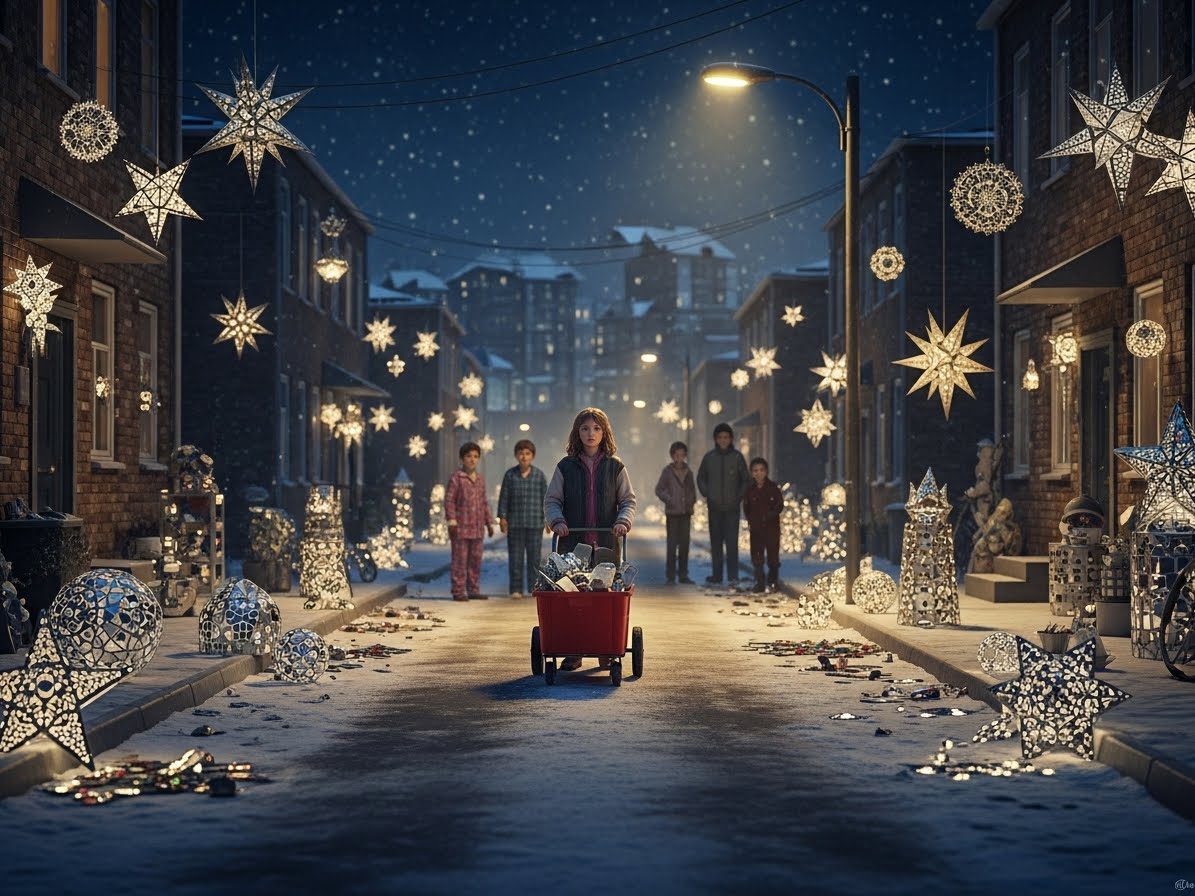
The aluminum stars I had hung from the porches didn’t just reflect the light; they amplified it. They shattered the beams into a million tiny diamonds, dancing across the snow-covered street.
The green glass shards I had glued to the cardboard trees caught the light and glowed with a deep, emerald fire.
The red velvet ribbons, wet with snow, looked like veins of ruby running through the grey world.
It wasn’t trash anymore. It was a galaxy. It was a cathedral made of junk. The ugly, broken street had vanished, replaced by a shimmering tunnel of light.
I stayed clinging to the pole, staring. It was beautiful. It was the most beautiful thing I had ever seen.
Doors started opening.
Slowly at first. People stepping out in their bathrobes and heavy coats. Mr. Henderson dropped his beer can. Mrs. Miller covered her mouth with her hands.
They walked out into the middle of the street. They looked up at the aluminum stars spinning in the wind. They looked at the glowing green trees.
For a moment, nobody was cold. Nobody was poor. They were just amazed.
“Turn it off!” Kroft roared, breaking the spell. He was standing in the snow, furious. He shielded his eyes from the glare. “You’re stealing power! That’s theft!”
He swung his bat at the control box cable running down the side of the pole.
WHACK.
The conduit dented. The lights flickered.
“Stop!” Mrs. Miller yelled. “Leave it alone, Silas!”
“Shut up!” Kroft screamed, swinging again. “I’m the landlord! I say it stays dark!”
He hit the pole again, harder. The vibration nearly shook me loose. I hugged the wood, terrified.
“Go get her,” Kroft ordered his men again. “Pull her down. Cut the wire.”
The goon started climbing again. He grabbed my ankle. His grip was bruising.
“Let go!” I kicked, but I had no leverage. He yanked hard.
I slipped.
Chapter 5: The Electrician
I screamed as I slid down the pole, splinters tearing at my jacket. The goon had me by the leg, dragging me into the snow.
“I got her, boss,” the man grunted, hauling me up by my collar.
Kroft walked over to me, the bat resting on his shoulder. He looked down at me with pure malice.
“You think you’re smart?” he hissed. “You think you’re a hero? You’re just a little rat digging in the garbage. And now you’re going to juvenile detention.”
He raised his hand to grab my wire cutters.
“Take your hands off my daughter.”
The voice wasn’t loud. It wasn’t a scream. It was a low, rumble that cut through the cold air like a saw.
Kroft froze.
We all looked at the stoop of my house.
My dad was standing there.
He wasn’t the man slumped in the chair anymore. He was standing tall. He was wearing his tool belt. And in his hand, he held a heavy, steel pipe wrench.
“Dad?” I whispered.
He walked down the steps. The snow didn’t crunch; it seemed to yield to him. He walked straight up to the goon holding me.
“I said,” my dad repeated, locking eyes with the man, “let go.”
The goon looked at the wrench. He looked at my dad’s eyes—eyes that had seen hard labor and harder times. He let go of my collar and took a step back.
I scrambled behind my dad.
“This doesn’t concern you, Clarke,” Kroft spat, though he took a step back too. “Your kid vandalized my property.”
“She decorated the neighborhood,” Dad said. He looked up at the lights. A look of wonder crossed his face for a split second before it hardened back into anger. “She did what you were too cheap to do.”
“It’s illegal!” Kroft yelled. “I’m calling the cops!”
“Go ahead,” Dad said. “Call them. Tell them you turned off the security lights in a high-crime area to save a buck. Tell them you’re threatening a twelve-year-old girl with a baseball bat.”
Kroft gripped his bat tighter. “You’re evicted, Clarke. You and the brat. Out. Tonight.”
“No,” another voice said.
Mr. Henderson stepped off his porch. He was holding a shovel.
“If they go, we all go,” Mrs. Miller said, stepping up beside my dad. She didn’t have a weapon, but she had a look that could kill.
One by one, the neighbors stepped forward. The man from 4B with the cane. The young couple from the end unit. They formed a semi-circle around us. A wall of winter coats and angry faces.
Kroft looked around. He was outnumbered twenty to three.
“You’re all crazy,” Kroft muttered, backing toward his truck. “You’re all evicted! I’ll have the sheriff here in the morning!”
“Wait,” Dad said.
He walked over to the utility pole. He looked at my wiring job. He looked at the sparks still dripping occasionally from the box.
“You did good work, Lily,” he said, not looking at me. “But the ground wire is loose. It’s a fire hazard.”
He looked at Kroft.
“I can fix it,” Dad said. “I can make it safe. Code compliant. But you walk away. You leave the lights on until New Year’s. And you forget about the eviction.”
“Why would I do that?” Kroft sneered.
“Because,” Dad said, pointing to the end of the block.
A news van was pulling up. The local channel. Someone must have called them when the lights went on.
“Because if you don’t,” Dad smiled, “I’m going to tell that reporter exactly why a twelve-year-old had to climb a pole to keep us from freezing in the dark.”
Kroft looked at the news van. He looked at the angry mob. He looked at the lights reflecting off the snow.
He lowered the bat.
“Fine,” he spat. “January 1st. I cut the line myself.”
He got in his truck and sped off, his tires spinning in the slush.
Dad dropped the wrench. He turned around and looked at me. He dropped to his knees in the snow and pulled me into a hug that smelled like sawdust and old flannel.
“I’m sorry,” he whispered into my hair. “I’m so sorry I was asleep, Lil.”
“You’re awake now,” I said, hugging him back.
“Yeah,” he said, looking at the shimmering aluminum stars dancing above us. “I’m awake now.”
PART 3
Chapter 6: The Union of Blackwood Avenue
The news van didn’t leave. The reporter, a woman in a thick parka named Ms. Vance, stood in the snow with her cameraman, filming the twinkling aluminum stars and the glowing green glass trees. She interviewed Mrs. Miller. She interviewed Mr. Henderson. And then, she turned the camera on my dad.
Dad didn’t hide. He stood by the utility pole, his toolbox open in the snow.
“I’m just making it safe,” Dad told the camera, his voice rough but steady. “We don’t want charity. We just want a little light.”
He climbed the pole. He didn’t use a rope like me; he used his lineman’s belt that had been gathering dust in the closet for two years. He moved with a rhythm I had forgotten he possessed. He stripped the wires properly, installed a breaker box he scrounged from his truck, and grounded the connection.
“Lily,” he called down. “Toss me the electrical tape.”
I threw it up to him. He caught it one-handed.
While he worked, the street changed. It wasn’t just a row of isolated houses anymore. It became a living room.
Mrs. Miller brought out a pot of hot cocoa. It was made with water because milk was expensive, but nobody cared. Mr. Henderson brought out a portable radio and tuned it to a station playing continuous Christmas carols.
People from the next block over—people who usually looked down on Blackwood Avenue—started walking over. They saw the glow from the highway. They came to see the “Trash Lights.”
They didn’t laugh.
I watched a man in a fancy coat reach out and touch one of my aluminum stars.
“It’s a soda can,” he whispered to his wife. “Look at the way she cut it. It’s incredible.”
The snow kept falling, but it wasn’t cold anymore. The heat from the bodies, the hum of the transformer, and the strange, fierce energy of the crowd kept us warm.
Dad climbed down. He wiped his greasy hands on a rag. He looked at the streetlights, burning steady and bright.
“It’ll hold,” he said.
He looked at me. “You did good work on the stars, Lil. Your angles are precise.”
It was the first compliment he had given me in a year. It felt better than any present under a tree.
Chapter 7: The Wagon of Miracles
Christmas Day broke with a sky the color of slate, but Blackwood Avenue was shining.
The news story had run at 11:00 PM and again at 6:00 AM. “The Miracle on the Rust Belt,” they called it.
By noon, the street was gridlocked.
Cars were bumper to bumper. Nice cars. SUVs from the suburbs. Sedans from the city. They were driving slowly past our slumped row homes, rolling down their windows to take pictures of the garbage that looked like diamonds.
I sat on the stoop with my red wagon. I hadn’t planned on begging. I just had the wagon there because I was proud of it. It was my toolbox.
But then a car stopped. A window rolled down. A woman handed me a twenty-dollar bill.
“Merry Christmas, honey,” she said. “Buy some more wire.”
Then another car. A five-dollar bill. A ten.
I looked at Dad. He was standing by the door, watching with a bewildered expression.
“Dad,” I whispered. “What do I do?”
“You take it,” he said, his jaw tightening. “We aren’t beggars, Lily. But we aren’t stupid. This is… this is appreciation.”
By sunset, the wagon was full. Not with tools, but with crumpled bills.
But the real miracle wasn’t the money. It was Mr. Kroft.
He showed up at 5:00 PM. He brought a City Inspector with him. A man with a clipboard and a sour face.
“There!” Kroft shouted, pointing at the pole. “Illegal wiring! Fire hazard! Shut it down! Condemn the street!”
The crowd of tourists went silent. The neighbors stepped off their porches.
The Inspector walked up to the pole. He looked at the jumper cables. He looked at the breaker box Dad had installed. He opened the panel and checked the voltage reading.
He turned to Kroft.
“This work is up to code,” the Inspector said. “It’s a temporary bypass, sure. But it’s grounded. It’s fused. Whoever did this is a master electrician.”
“But he stole the power!” Kroft sputtered.
“Actually,” the Inspector said, looking at the news crew that had just returned for a follow-up, “The City Council just held an emergency vote over Zoom. Due to the… public interest… the City is waiving the utility fees for Blackwood Avenue until January 2nd.”
The Inspector looked at my dad. He nodded.
“Nice work, Mr. Clarke. I haven’t seen a splice that clean since the Union days.”
Kroft turned purple. He looked at the crowd, who were now booing him. He looked at the cameras.
He got in his truck and drove away, reversing down the street because there was no room to turn around.
The street erupted. People were hugging. Mrs. Miller was crying.
I looked at the wagon full of money. I counted it later on the kitchen table.
Three thousand dollars.
It wasn’t a million. But on Blackwood Avenue, it was enough to pay everyone’s back rent. It was enough to buy heating oil for the rest of the winter.
Chapter 8: The Light That Stayed
January 1st came too fast.
The deal was the deal. The city waiver expired. We had to take the lights down.
It was a solemn day. The snow had turned to gray slush. The magic felt like it was fading.
I went out with my wire cutters. I started snipping the copper ties holding the aluminum stars to the railings. I took down the green glass trees.
Dad came out to help me disconnect the transformer.
“It’s okay, Lil,” he said, seeing my face. “Ideally, Christmas doesn’t last all year. That’s what makes it special.”
We cut the power.
Click.
The streetlights died. The aluminum stars stopped shimmering and went back to being soda cans. The velvet ribbons looked like wet rags. The darkness rushed back in, heavy and familiar.
But then, I saw something.
The lights were off, but the street wasn’t empty.
Mr. Henderson was outside, sweeping his sidewalk. He waved at us.
Mrs. Miller was on her porch, fixing a planter box.
And a white truck pulled up to the curb. It wasn’t Kroft.
It was a contractor’s truck. Miller & Sons Electric.
A man got out. He walked up to my dad.
“You Clarke?” the man asked.
“Yeah,” Dad said, wiping his hands.
“I saw the news,” the man said. “I saw the splice you did on that pole. I need a foreman who can work under pressure and knows how to improvise. You looking for work?”
Dad looked at the truck. He looked at his hands. Then he looked at me.
For the first time in two years, his eyes didn’t look tired. They looked hungry.
“Yeah,” Dad said, shaking the man’s hand. “I’m looking.”
“Start Monday,” the man said. “Good pay. Benefits.”
He drove off.
Dad stood there on the sidewalk. He looked at our dark house.
“We’re going to be okay, Lily,” he said.
“I know,” I said.
I looked down at my red wagon. It was empty of money now—we had distributed it to the neighbors yesterday—but it was full of my decorations.
“What do we do with the stars?” I asked.
Dad picked one up. It was sharp, jagged, made of trash, but it still caught the last ray of the setting sun.
“We save them,” he said. “We put them in the attic. Because next year… next year we’re going to have real lights. But these? These are the ones that saved us.”
We walked inside together. The house was still cold, and the street was dark again. But as I closed the door, I didn’t feel the darkness anymore.
I realized that I hadn’t just built lights out of garbage. I had built a bridge back to my father.
And that was a light that would never go out.
THE END.