The Quarterback Crushed The Deaf Kid’s Hearing Aid For A Laugh. He Didn’t Expect The FBI To Shut Down The School Two Hours Later.
Chapter 1: The Sound of Snapping Plastic
I’ve always been invisible. That’s my superpower. I’m not the geek, I’m not the jock, I’m not the burnout. I’m just Sam. The guy who sits three tables away from the drama, nursing a lukewarm soda and watching the hierarchy of Oak Creek High play out like a bad nature documentary.
But on Tuesday, the documentary turned into a horror movie.

It started with the kind of silence that actually hurts your ears. You know the kind? One second, the cafeteria is a roar of gossip, slamming trays, and crinkling wrappers. The next, it’s a vacuum.
The cause of the silence was standing in the center of the room. Braden Miller. Senior year quarterback, son of the town’s richest car dealership owner, and a guy who had never been told “no” in his entire eighteen years of existence.
He was looming over a table near the window. The “Exile Table,” we called it. That’s where the new kid sat.
Lucas.
We didn’t know much about Lucas. He’d transferred in three weeks ago. He was small, pale, and wore hoodies that were two sizes too big, like he was trying to disappear inside the fabric. But the most noticeable thing about him were his hearing aids.
They weren’t the sleek, invisible Bluetooth ones people wear now. These things were bulky, beige, behind-the-ear units with a thick wire running down into his shirt collar. They looked ancient. They looked medical.
Braden had been circling Lucas for days, like a shark smelling blood in the water. Today, he decided to bite.
“I asked you a question, defect,” Braden barked, his voice echoing off the cinderblock walls.
Lucas didn’t look up. He was staring at his untouched mystery meat, his hands folded in his lap.
“Oh, right. He’s deaf and dumb,” Braden sneered, turning to his entourage—the offensive line—who chuckled on cue. “Hey! Earth to Sputnik!”
Braden reached out and flicked Lucas’s ear. Hard.
That got a reaction. Lucas flinched, his hand flying up to protect the device. But in the scramble, the left hearing aid dislodged. It tumbled through the air in slow motion, landing on the speckled linoleum floor.
I held my breath.
Lucas scrambled out of his chair. “Don’t,” he said. It was the first time I’d heard him speak. His voice was low, urgent.
Braden grinned. It was a cruel, wide thing. “Don’t what? This?”
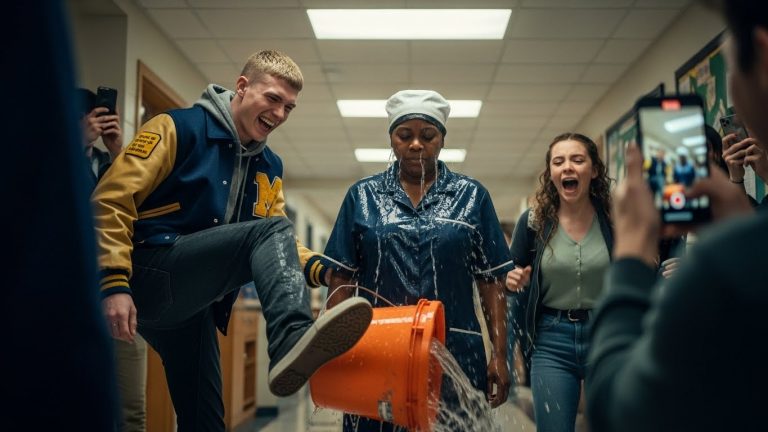
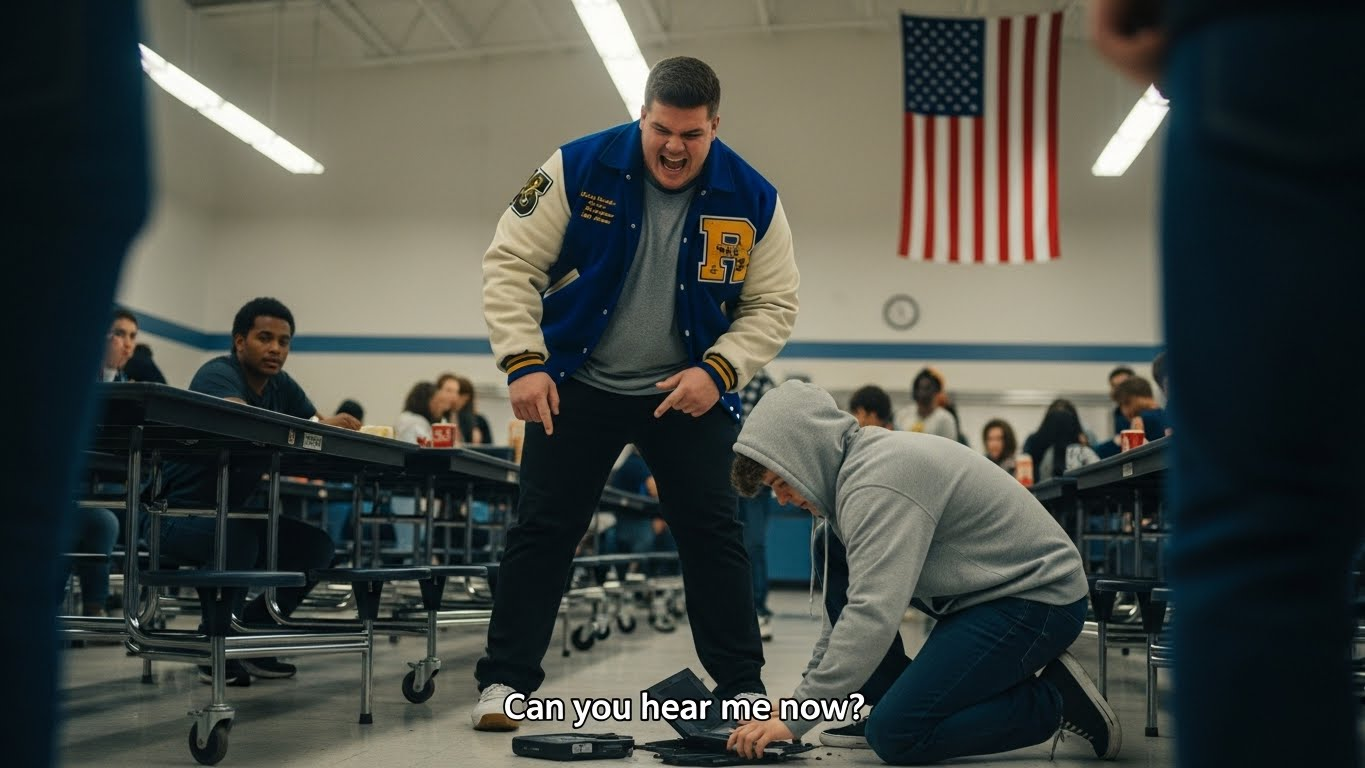
He lifted his foot—shod in a pristine, limited-edition Jordan sneaker—and brought it down.
CRUNCH.
It wasn’t a clean break. It was a grinding noise. Plastic shattering, capacitors popping, wires stripping. Braden ground his heel into it, twisting back and forth like he was putting out a cigarette.
The cafeteria was dead silent. I could hear the hum of the vending machines in the hallway.
Braden lifted his foot. What was left of the hearing aid was a sad pile of beige plastic and green circuitry. A tiny red LED light on the crushed board flickered once—rapidly, frantically—and then died.
“Oops,” Braden said, feigning shock. “My bad. Didn’t see your little radio there. Maybe my dad can buy you a new one. Or maybe you can just learn to read lips better.”
We all waited for the tears. We waited for Lucas to run to the principal, or to take a swing, or to just crumble. That’s what Braden wanted. He wanted the breakage.
But Lucas didn’t break.
He slowly knelt down. He picked up the largest shard of the device. He examined the exposed circuitry with an intensity that made the hair on my arms stand up. He wasn’t looking at it like a kid who lost his hearing aid. He was looking at it like an engineer looking at a failed reactor core.
He stood up. He was six inches shorter than Braden, but in that moment, he looked ten feet tall.
“You shouldn’t have done that,” Lucas said. His voice was perfectly steady. Clear. No tremor.
“What?” Braden laughed, looking around for applause. “I can’t hear you. Speak up.”
Lucas took a step closer. He looked Braden dead in the eye. “That wasn’t a hearing aid, you idiot. It was a containment unit for a transponder. And you just triggered a Level 4 distress beacon.”
Braden blinked. “A what? You watching too much Sci-Fi, mute boy?”
Lucas didn’t answer. He just looked at his wrist watch—a cheap digital Casio—and started a timer.
“You have about… forty minutes before the perimeter is breached,” Lucas murmured, more to himself than to Braden. “I need to get to the extraction point.”
And then, he just walked away. He stepped over the remains of the device, bypassed the stunned football team, and walked out the double doors.
“Freak!” Braden yelled after him, kicking the debris toward the trash can. “Go cry to the nurse!”
The tension broke. The noise of the cafeteria returned, but it was nervous laughter now.
“What a psycho,” my friend Greg whispered next to me. “Transponder? Distress beacon? Kid’s been playing too much Call of Duty.”
“I don’t know,” I said, looking at the door where Lucas had vanished. “Did you see his face, Greg? He wasn’t scared. He was… annoyed.”
“Whatever,” Greg bit into his sandwich. “Braden’s gonna get detention, Lucas gets a new ear-piece, life goes on.”
I looked down at the floor where the debris lay. The tiny red light was gone, but I couldn’t shake the feeling that something invisible was pulsing through the air, screaming for help.
I checked my phone. 12:15 PM.
If Lucas was crazy, nothing would happen.
If Lucas wasn’t crazy… well, I didn’t want to think about that.
Chapter 2: The Code Red
History class was usually my nap time. Mr. Henderson had a voice that could cure insomnia. He was droning on about the Industrial Revolution, the ceiling fan was clicking rhythmically, and the heavy lunch was settling in my stomach.
1:45 PM.
Ninety minutes since the incident.
I was staring out the window. Our classroom was on the second floor, facing the front of the school. From here, you could see the main circular driveway, the flagpole with the Stars and Stripes hanging limp in the humid air, and the faculty parking lot.
Everything looked normal. A delivery truck was backing out. The janitor was sweeping the steps.
Then, my phone buzzed in my pocket.
I checked it under the desk. No signal.
That was weird. Oak Creek High had spotty Wi-Fi, but I always had cell service. I tapped the screen. “Searching…”
I looked over at Greg. He was frowning at his phone too.
“No bars?” I mouthed.
He shook his head.
Suddenly, the classroom intercom gave a sharp, high-pitched squeal that made everyone jump. Mr. Henderson dropped his dry-erase marker.
We waited for the morning announcements voice—usually cheerful Cindy from the student council or Principal Higgins with his gravelly ‘good afternoon.’
But the voice that came through wasn’t local. It was synthesized. Automated.
“Code Red. Code Red. This is a federal lockdown. All students and faculty are to remain in their designated rooms. Lock all doors. Move away from windows. This is not a drill. Repeat. This is not a drill.”
The class froze. We’d done drills before. Intruder drills. Fire drills. Tornado drills.
But “Federal Lockdown”? That wasn’t in the handbook.
“Alright, everyone,” Mr. Henderson said, his voice cracking slightly. “You heard the announcement. Into the corner, away from the door. Now.”
He moved to lock the door, his hands shaking as he fumbled with the keys.
I didn’t move to the corner immediately. I was glued to the window.
“Sam! Get away from there!” Mr. Henderson hissed.
“Sir, look,” I whispered.
Down on the main road leading to the school, the traffic had stopped. But it wasn’t a jam. It was a blockade.
Two massive black SUVs had pulled perpendicular across the school entrance, blocking the exit. Blue lights were flashing, but they weren’t the standard police light bars. These were hidden inside the grilles and windshields.
Behind them, a sleek black armored truck—like a SWAT van but smoother, more high-tech—roared up the curb, tearing through the pristine flowerbeds Principal Higgins was so proud of.
“Oh my god,” Sarah, the girl sitting in the front row, whispered. She had crept up beside me.
The doors of the SUVs flew open.
Men spilled out. They weren’t local cops. They were wearing greenish-grey tactical gear, helmets with face shields, and holding rifles that looked way too short and way too serious for a school response. On their backs, in bold yellow letters, it didn’t say POLICE or SHERIFF.
It said: HRT.
“What’s HRT?” Sarah asked, her voice trembling.
“Hostage Rescue Team,” I said, the realization hitting me like a punch to the gut. “FBI.”
They moved with terrifying speed. No shouting. No waving. Just precise, fluid movement. They formed a phalanx moving toward the front doors.
And then I saw the dogs.
Two handlers were running alongside the team, leading German Shepherds that looked ready to tear a tank apart. The dogs weren’t barking. They were focused.
“Get down!” Mr. Henderson yelled, grabbing my arm and yanking me to the floor. “Everyone down!”
He slammed the blinds shut, plunging the room into semi-darkness.
We huddled in the corner, a pile of terrified teenagers. Some were crying. Some were texting—or trying to.
“My messages aren’t going through,” Greg whispered, showing me his screen. “SOS only.”
“They jammed the signals,” I said, remembering movies I’d seen. “They cut communications so no one can tip off the target.”
“Target?” Greg looked at me with wide eyes. “What target? Is there a shooter?”
“I don’t think so,” I said, my mind racing back to the cafeteria. Back to the crunch of plastic. Back to Lucas checking his watch. Forty minutes, he had said.
From the hallway, we heard heavy boots. Thud-thud-thud-thud.
Then, a sound that made my blood freeze.
The sound of a heavy battering ram hitting a door down the hall. BOOM.
Then screaming. It was Braden’s voice.
“I didn’t do anything! Get off me! My dad knows the Mayor!”
“Secure the subject!” a deep voice bellowed, muffled through the walls. “Room clear! Moving to extraction!”
“Braden?” Sarah whispered. “Why are they taking Braden?”
I closed my eyes, picturing the shattered hearing aid.
“They aren’t taking Braden,” I whispered back, a cold realization washing over me. “They’re securing the scene.”
“For what?”
“For whatever Lucas is.”
Suddenly, the handle of our classroom door jiggled. We all stopped breathing. Mr. Henderson stood in front of us, holding a stapler like a weapon.
A key slid into the lock. The tumblers clicked.
The door swung open.
A man in full tactical gear stood there, his face covered by a ballistic mask. He scanned the room, his weapon lowered but ready.
“Clear,” he said into his radio.
Then he stepped aside.
Walking into our History class wasn’t the Principal. It wasn’t the police chief.
It was Lucas.
He was wearing a Kevlar vest over his hoodie now. He held a tablet in one hand. He didn’t look at us. He looked at the soldier.
“This is the witness,” Lucas said, pointing a finger… directly at me.
“Grab him,” Lucas commanded.
The soldier lunged toward me.
Chapter 3: The Asset and the Liability
The soldier didn’t ask nicely. He grabbed my arm with a grip like a hydraulic clamp and hauled me out of the classroom.
“Hey! He’s just a kid!” Mr. Henderson shouted, finding a sudden burst of courage.
“Stay down!” the soldier barked, leveling his rifle at the teacher. Mr. Henderson froze, hands up.
I was dragged into the hallway. It was unrecognizable. The familiar lockers were now cover positions for tactical operatives. Red laser sights cut through the dusty air. The smell of fear—sweat, floor wax, and something metallic—was overwhelming.
They marched me toward the cafeteria. Or rather, the command center.
Tables had been overturned to form barricades. In the center, where Braden usually held court, a bank of portable servers and satellite uplinks had been set up.
And there was Braden.
He wasn’t the king of the school anymore. He was zip-tied to a chair, sobbing. His varsity jacket was torn. A soldier was standing over him, checking his pulse, not out of care, but to ensure the “hostile” wasn’t going into shock.
“Sam?” Braden blubbered when he saw me. “Sam, tell them! It was a joke! I didn’t mean to break his radio!”
“Silence!” a commander shouted.
They pushed me into a chair opposite Lucas.
Lucas was typing furiously on a ruggedized laptop. He didn’t look up. “Did you see the sequence?” he asked me.
“What?” My voice squeaked.
“When the device shattered,” Lucas said, his fingers flying across the keys. “You were watching. Did the red light blink three times fast, or one long pulse?”
“I… I don’t know.”
Lucas looked up. His eyes were cold, calculating blue. “Think, Sam. It matters. Three fast blinks means the signal went to the Agency. One long pulse means the Fail-Safe failed, and the Other Side heard it first.”
I closed my eyes, trying to replay the moment. Braden’s sneaker. The crunch. The tiny LED.
“It flickered,” I whispered. “Fast. Really fast. Like a strobe. Then it died.”
Lucas stopped typing. He let out a breath he seemed to have been holding for hours. “Three blinks. Okay. We have a head start.”
“Lucas,” I stammered. “What is going on? Who are you?”
He looked at me, then at the soldiers surrounding us.
“My name isn’t Lucas,” he said quietly. “And I’m not deaf. That device wasn’t a hearing aid. It was a localized jamming unit.”
“Jamming what?”
“Me,” he said.
Chapter 4: The Chimera Protocol
“Section Chief,” the commander interrupted, touching his earpiece. “Perimeter drones are picking up heat signatures in the woods. Four bogeys. Moving fast.”
Lucas nodded. “They’re here. The Cleaners.”
“Cleaners?” Braden whimpered. “Like… janitors?”
Lucas stood up, walking over to Braden. He looked down at the bully with a mixture of pity and disgust.
“No, Braden. Not janitors. People who erase mistakes. And thanks to your foot, I’m currently a mistake.”
Lucas turned to the Commander. “Initiate Protocol Chimera. Lock the school down. Hard. No one in, no one out. If those heat signatures breach the gym, we lose the containment.”
“Lucas,” I asked again, my hands shaking. “Why do you need a jammer? What are you?”
Lucas pulled up his sleeve. On his forearm, there wasn’t a tattoo, but a complex, scarring pattern that looked like a barcode burned into his skin.
“I’m a biological hard drive, Sam,” he said, his voice flat. “My father was a cryptographic genius for a government you don’t want to know about. He stole terabytes of data—nuclear launch codes, undercover agent lists, dirty money trails. He didn’t trust a USB drive. He trusted his son.”
He tapped his head. “It’s all in here. Encoded into my DNA. The ‘hearing aid’ emits a frequency that keeps the data dormant. Keeps me off the grid. When you broke it…” He pointed at Braden. “…you turned me into a terrifyingly loud GPS beacon for every assassin in the hemisphere.”
Braden’s face went pale. “I just wanted to be funny.”
“Well,” Lucas racked the slide of a pistol he had pulled from a duffel bag—a movement so natural it was terrifying. “I hope the laugh was worth it. Because now we have to survive the next twenty minutes until the extraction chopper arrives.”
BOOM.
An explosion rocked the building. Dust rained down from the ceiling.
“They breached the North entrance!” a soldier yelled. “Contact! Contact!”
Gunfire erupted. Not the pop-pop of movies, but the deafening, chest-thumping roar of automatic weapons indoors.
Chapter 5: The Siege of Oak Creek High
The cafeteria turned into a slaughterhouse of noise. The FBI agents—the HRT guys—moved instantly to the windows, returning fire.
“Get down!” Lucas grabbed me and Braden, shoving us under the heavy steel table he had been using.
“We need to move to the library,” Lucas shouted over the noise. “It has reinforced walls. The cafeteria is a fishbowl!”
“I’m not going!” Braden screamed, curling into a ball. “I’m waiting for my dad!”
Lucas slapped him. It wasn’t a bully’s slap; it was a soldier’s wake-up call.
“Your dad isn’t coming, Braden! The men outside will kill everyone in this school to get to me. You want to live? You move when I say move.”
Lucas looked at me. “Sam, grab the laptop. Do not drop it. It has the frequency key to restart the jammer if we survive.”
I nodded, grabbing the ruggedized computer. It felt like a brick of lead.
“Move!”
We sprinted. The hallway was filled with smoke. The fire alarm was blaring now, mixing with the gunfire.
We ran past the trophy case. I saw the glass shatter as bullets strafed the wall. The MVP trophy Braden had won last year exploded into gold shards.
“They’re flanking us!” The HRT Commander shouted. “Unit Two, hold the hallway! Unit One, protect the Package!”
We were the Package.
We burst into the library. It was dark, the blinds drawn. The smell of old paper and dust was comforting for a split second before the reality crashed back in.
“Barricade the door!” Lucas ordered.
The soldiers started piling desks against the double wooden doors.
“Why are they shooting?” Braden whispered, shivering. “Why don’t they just arrest you?”
“Because they don’t want me alive,” Lucas said, checking the magazine of his pistol. “They just want the data. And they can extract DNA from a corpse just as easily as a living boy.”
Chapter 6: The Betrayal
We huddled behind the librarian’s counter. The sounds of war were getting closer. The “Cleaners” were pushing the FBI back. These guys were elite.
Suddenly, the radio on the dead soldier next to us crackled.
“Package is in the library. Flush them out. Gas.”
“Gas?” I looked at Lucas.
“Tear gas. Maybe nerve agent. Depends on how desperate they are,” Lucas said grimly. He looked at the air vents. “Block the vents! Now!”
We grabbed books, coats, anything to stuff into the floor vents.
Then, the library door shook. Thud.
Someone was ramming it.
“Friendly?” the Commander yelled.
No answer. Just another heavy THUD.
Then, silence.
A small metal canister rolled under the gap beneath the door.
“Grenade!” the Commander shouted, diving on top of it.
It wasn’t a grenade. It was a flashbang.
BANG.
A blinding white light seared my retinas, followed by a ringing in my ears that made the world go mute. I couldn’t hear, I couldn’t see.
I felt hands grabbing me. Rough hands.
My vision slowly cleared, swimming in spots of purple and green.
The library had been breached. Three men in black tactical gear, wearing gas masks that looked like skulls, were standing over us. The FBI agents were down—stunned or worse.
One of the Skull Masks grabbed Lucas by the throat and lifted him off the ground.
“Found him,” a distorted voice said.
Another mask pointed a gun at Braden. “Witnesses?”
“Clean them,” the leader said.
Braden screamed. I froze.
“Wait!” Lucas choked out, kicking his legs. “Wait! The data… it’s not in me anymore!”
The leader paused. “What?”
“I transferred it!” Lucas gasped. “Before the jammer broke. I moved the key.”
“Where?”
Lucas pointed a shaking finger.
He pointed at Braden.
Chapter 7: The Bluff
The room went still. The Skull Mask looked at Braden. Braden looked like he was about to faint.
” Him?” The leader laughed darkly. ” The letterman jacket?”
“He’s the carrier,” Lucas lied, his voice desperate. “Why do you think he took the hearing aid? He needed the proximity to download the packet. He’s an insider.”
Braden’s eyes bulged. “No! I’m not! I’m just a quarterback! I hate computers!”
“He’s acting,” Lucas said. “He’s a deep-cover operative. Check his phone. The upload is there.”
The leader hesitated. It was just enough time.
“Check the boy,” the leader ordered the second gunman.
The gunman turned away from us to grab Braden.
That was the mistake.
Lucas dropped his hand. A small knife, concealed in his sleeve, slid into his palm. He jammed it into the gap of the leader’s body armor, right under the armpit.
The leader grunted and dropped Lucas.
Simultaneously, the glass window of the library shattered inward.
CRASH.
A black rope descended from the sky.
“HRT! GO! GO! GO!”
Fresh agents rappelled in from the roof, swinging through the broken window like angels of death.
The distraction of Lucas’s lie had bought the sniper team time to get into position.
Gunshots rang out—precise, controlled. The three Skull Masks dropped before they could pull their triggers.
Lucas scrambled back, gasping for air.
“You… you lied?” Braden squeaked, staring at the dead mercenaries. “You told them I was a spy?”
Lucas wiped blood from his lip. He looked at Braden, trembling in his expensive sneakers.
“I bought you five seconds of life, Braden. Try not to waste them.”
Chapter 8: The Ghost in the Hallway
The extraction was a blur.
We were rushed out the back exit of the library, through the loading dock, and onto the football field.
The helicopter was there—a massive Blackhawk, rotors churning up the turf, flattening the grass.
The wind was incredible.
“Let’s go! Move! Move!” The agents shoved us toward the bird.
“Wait!” Lucas stopped at the ramp. He turned back to me and Braden.
The Commander grabbed Lucas’s shoulder. “We need to leave, asset. Now.”
Lucas shook him off. He walked up to me.
“Sam,” he yelled over the rotor noise. “You kept the laptop safe.”
I handed him the rugged computer. “Yeah.”
“You’re a good guy, Sam. You see things.” He reached into his pocket and pulled out a small, metallic coin. He pressed it into my hand. “If you ever need to disappear… call the number on the back.”
Then he turned to Braden.
Braden was a mess. Crying, muddy, traumatized.
Lucas leaned in close.
“You broke my silence,” Lucas said, his voice hard as iron. “But I fixed your hearing. You’ll never be able to ignore the quiet kids again, will you?”
Braden shook his head frantically. “Never. Never again.”
“Good.”
Lucas turned and ran up the ramp. The helicopter lifted off immediately, banking hard to the right and disappearing over the treeline.
Within minutes, the black SUVs pulled away. The bodies were removed in unmarked vans.
By the time the local police were allowed past the perimeter, the school was empty of federal agents.
Epilogue
They told us it was a “Gas Leak Drill gone wrong.” That was the official story on the news that night. A gas main broke, causing hallucinations and panic. The SWAT team was just a precaution.
No mention of the gunfight. No mention of the hearing aid. No mention of Lucas.
Braden never played football again. He quit the team the next day. He sits at the front of the class now. He doesn’t bully anyone. Actually, he jumps every time someone drops a pencil.
As for me?
I still sit three tables away. I still drink my lukewarm soda.
But sometimes, when the cafeteria gets too loud, I touch the coin in my pocket. I think about the boy who carried the secrets of the world in his DNA, and the day the invisible kid made the loudest noise in history.
I look at the empty spot where the “Exile Table” used to be.
And I swear, sometimes, amidst the chatter of high school gossip, I can hear the faint, rhythmic beeping of a distress signal that was finally answered.
THE END.