A Little Girl Knocked On My Door Asking For A Place To Hide. When I Followed Her Home To See Why She Couldn’t Go Inside, I Found The Door Locked From The Inside—And A Nightmare Waiting Behind It.
PART 1
Chapter 1: The Question
If you live in Oak Creek, you know the rules. You keep your lawn manicured to the millimeter, you wave to your neighbors with a smile that doesn’t quite reach your eyes, and you absolutely never ask questions about what happens behind closed blinds. It’s a “perfect” neighborhood. The kind where the Homeowners Association measures your grass with a ruler and the police blotter is mostly just noise complaints about teenagers playing music too loud.
I was part of the charade. My name is Sarah. I’m thirty-four, recently divorced, and I live in a four-bedroom colonial that feels entirely too big for one person. My life had become a series of empty rooms and quiet evenings.
That Tuesday night, the rain was relentless. It drummed against the vinyl siding, a white noise that usually helped me sleep. But that night, it felt oppressive. Heavy. I was sitting in my living room, reading a book I hadn’t turned the page of in twenty minutes, staring at the rain streaking the front window like tears.
Then came the tap.
Tap. Tap. Tap.
It was so faint I almost dismissed it as a tree branch hitting the siding. But the wind wasn’t blowing hard enough for that. It was rhythmic. Deliberate.
I got up, pulling my cardigan tighter around myself to ward off the chill, and walked to the foyer. I flipped the porch light on. Through the frosted glass of the front door, I saw a silhouette. It was small. Too small to be a delivery guy. Too small to be a threat.
I unlocked the deadbolt and pulled the door open.
My heart broke instantly.
Standing on my welcome mat, shivering violently, was a little girl. She couldn’t have been more than six years old. She was wearing pink pajama pants with cartoon clouds on them and a t-shirt that was soaked through to her skin. She was barefoot. Her tiny toes were curled against the rough bristles of the mat, turning a terrifying shade of blue.
She had long, blonde hair that was plastered to her skull, dripping water into her eyes. In her hand, she clutched a dirty, one-eyed teddy bear by the ear.
“Sweetheart?” I gasped, stepping aside to block the wind. “Oh my god, look at you. Come inside.”
She didn’t move. She didn’t step over the threshold. She just looked up at me with eyes that were unnervingly calm. They weren’t the eyes of a scared child. They were the eyes of someone who had been waiting a long time.
“Are we welcome here?” she asked.
Her voice was tiny, but clear. Not “Am I welcome?”
Are WE welcome?
I looked behind her. The driveway was empty. The street was empty. Just the rain and the streetlights reflecting in the oil-slicked puddles.
“Who is ‘we’?” I asked, scanning the darkness for a parent, a sibling, anyone.
“Me and Mr. Cuddles,” she said, lifting the soggy bear. “We are looking for a place where we would be welcome.”
It was such a strange turn of phrase. Formal. Archaic. Like something she had read in a storybook, or something she had been told to say.
“Yes,” I said, reaching out a hand. “You are welcome. Please, come in. You’re freezing. I have hot chocolate. I have a phone. We can call your mom.”
At the mention of her mother, the girl’s face changed. It didn’t crumple in sadness. It went blank. A shutter came down behind her eyes.
“No,” she said softly. “If we aren’t welcome, we have to keep looking.”
“I said you are welcome!” I insisted, stepping onto the porch. The rain hit me instantly, soaking my socks. “Honey, come inside. It’s dangerous out here.”
She shook her head. “You didn’t say it right.”
“Say what right?”
“The welcome,” she whispered. She took a step back, off the mat and onto the wet concrete. “The house has to want us. The people have to want us.”
“I want you to be safe!” I practically shouted, panic rising in my chest. “Tell me your name.”
“Lucy,” she said.
“Lucy, I’m Sarah. Please. Just step inside.”
She looked at the open door behind me. She stared into the warm, yellow light of my hallway. For a second, I saw a flash of pure longing in her eyes. But then she looked back at the bear.
“Mr. Cuddles says this isn’t the right place,” she said.
And then, she turned around.
“Lucy, wait!” I lunged for her, grabbing her small, icy arm.
She didn’t pull away. She just stopped and looked at my hand on her skin. Her skin was freezing. Like marble.
“You can’t make us stay,” she said. “That’s against the rules.”
The way she said it—so matter-of-fact, so final—made me let go. It was an instinctual reaction, like touching a hot stove, but in reverse. A cold dread spiked in my stomach.
She walked down the driveway, her bare feet slapping against the wet pavement. She didn’t run. She walked with a slow, deliberate pace, heading toward the house next door. The Petersons’.
I stood on my porch, soaked, watching a six-year-old girl walk into the storm. I should have grabbed her. I should have dragged her inside and called 911.
But I froze. And that hesitation is something I will never forgive myself for.
Chapter 2: The Sound of Slamming Doors
I didn’t go back inside. I couldn’t. The idea of closing my door and returning to my warm tea while that child wandered the streets made me physically ill.
I stood in the shadows of my porch, watching.
Lucy walked up the driveway of the Petersons’ house. It was a massive brick structure with a three-car garage. Mark and Linda Peterson were the head of the Neighborhood Watch. They were the kind of people who put up “Slow Down” signs but drove their massive SUVs at forty miles per hour through the residential streets.
I saw Lucy climb their front steps. She had to stand on her tiptoes to reach the doorbell.
Ding-dong.
I waited. The rain was picking up, turning into a torrential downpour. Thunder rumbled in the distance, low and menacing, shaking the ground beneath my feet.
The Petersons’ door opened. Mark stood there. I could see the blue flicker of a football game on the massive TV behind him. He held a beer in one hand, looking annoyed at the interruption.
I couldn’t hear every word over the rain, but I heard the tone.
“Where are your parents?” Mark’s voice boomed.
Lucy said something. She held up the bear. She asked the question. Are we welcome here?
Mark laughed. It was a harsh, dismissive bark. He looked past her, scanning the street, assuming it was a prank. Assuming there was a parent nearby watching, waiting for a reaction for a TikTok video or a dare.
“Go home, kid,” Mark said loud enough for me to hear. “It’s ten o’clock. Tell your dad this isn’t funny.”
He stepped back and slammed the door.
The sound echoed like a gunshot through the neighborhood.
Lucy didn’t cry. She didn’t pound on the door. She just stood there for a moment, staring at the wood. Then, she turned around and walked back down the steps, her posture slightly more slumped than before.
She moved to the next house. The Millers.
I felt a surge of rage. How could Mark just close the door? How could he look at a barefoot child in a storm and think “prank”?
I watched her walk up the Millers’ path. Mrs. Miller answered this time. She was older, a grandmother. Surely she would help.
The door opened. Mrs. Miller leaned out, tightening her robe. She spoke to Lucy for a moment. She pointed down the street. She shook her head.
Then, she closed the door.
I gasped. Even the grandmother?
I realized then what was happening. It was the bystander effect mixed with the toxicity of the suburbs. Everyone assumed she belonged to someone else. Everyone assumed she was just a neighbor’s kid having a tantrum or playing a game. Nobody wanted to get involved. Nobody wanted the liability.
Lucy was walking away from the Millers’ house now. She was stumbling. The cold was getting to her. She dropped the bear, picked it up, and kept walking.
She wasn’t going to the next house. She was heading toward the end of the cul-de-sac. toward the dark stretch of road that led to the old Victorian homes that backed up against the woods.
I couldn’t watch anymore.
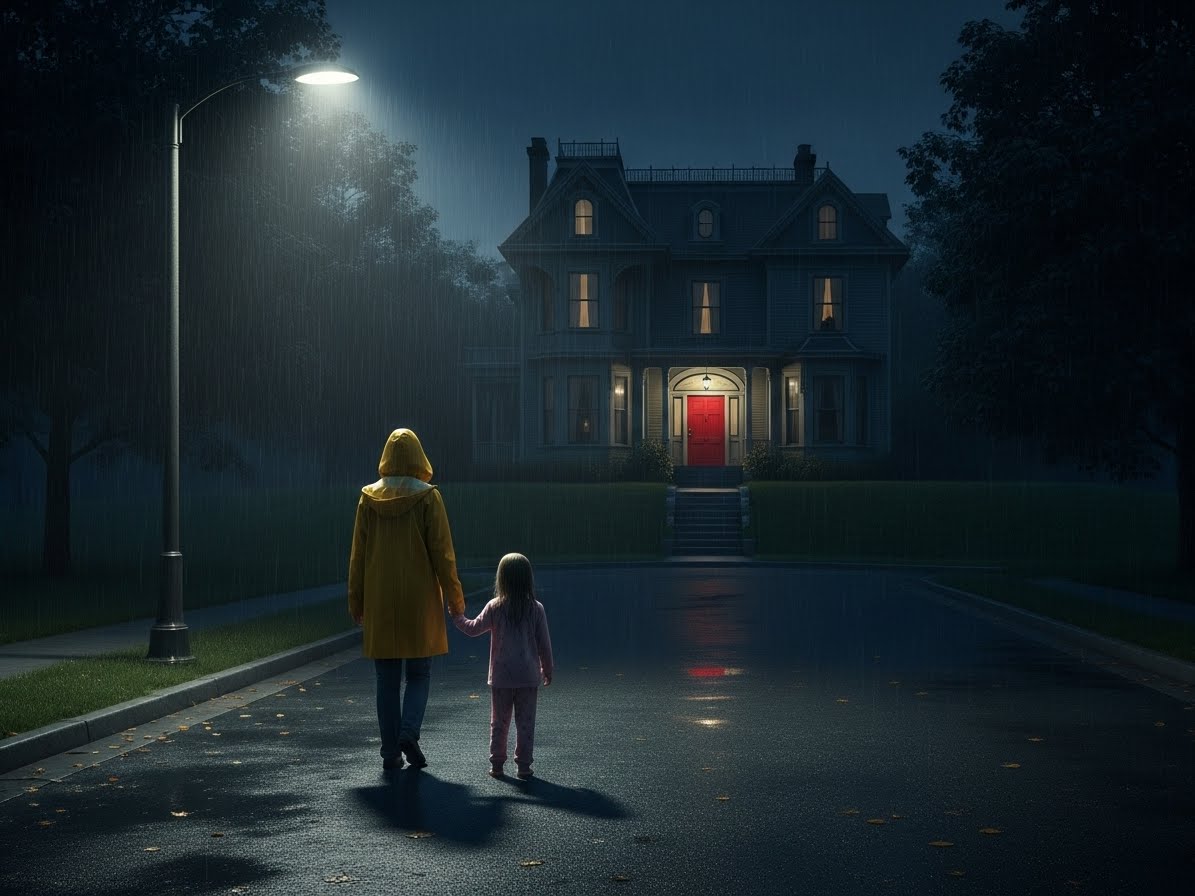
I ran inside, grabbed my heavy yellow raincoat and a heavy-duty flashlight. I didn’t bother with shoes—I shoved my feet into my gardening rainboots.
I ran out the door.
“Lucy!” I yelled, sprinting down my driveway.
She was about fifty yards ahead of me now. She didn’t stop. She didn’t turn around.
I ran past the Petersons’ house. I saw Mark looking out the window, watching me run. Let him watch. Let him feel the shame of what he just did.
I caught up to her at the stop sign. I grabbed her shoulder, gently this time.
“Lucy, stop,” I panted, water streaming down my face. “Please. You don’t have to knock anymore. I’m coming with you.”
She stopped. She looked up at me. Her lips were purple, her skin translucent.
“You’re following us?” she asked.
“I’m walking you home,” I said firmly. “If you won’t come to my house, take me to yours. We need to get you warm. We need to find your mom and dad.”
She looked at the flashlight in my hand. Then she looked down the dark road.
“Okay,” she whispered. “But the door is locked.”
“Do you have a key?” I asked.
She shook her head. “No. It’s locked from the inside.”
“Then we’ll ring the bell,” I said. “We’ll pound on the door until they answer.”
“They won’t answer,” Lucy said.
“Why not?”
She looked at me, and the streetlights reflected in her eyes made them look entirely black, void of any light.
“Because they are asleep,” she said. “And they promised not to wake up.”
A chill that had nothing to do with the rain shot down my spine.
“Show me,” I said, my voice trembling. “Show me the house, Lucy.”
She reached out and took my hand. Her fingers were stiff. Cold.
We walked into the darkness together.
PART 2
Chapter 3: The House on Blackwood Lane
The rain was coming down in sheets now, a relentless gray curtain that obscured the world. We walked past the manicured lawns of the “good” neighborhood and turned onto Blackwood Lane. This was the older section of town, where the houses were set further back from the road, separated by towering oak trees that groaned in the wind.
Lucy’s hand was a block of ice in mine. She didn’t skip or run; she walked with a mechanical trudge, staring straight ahead.
“Is this it?” I shouted over the thunder.
We stopped in front of a looming Victorian house at the end of the cul-de-sac. It was dark. Not just sleeping-dark, but abandoned-dark. The windows were black eyes staring out at the storm. The siding, once white, was grey with age and neglect. Vines choked the trellis near the porch, twisting like skeletal fingers.
“Yes,” Lucy whispered. “That’s where we live.”
I shined my flashlight up the driveway. There were no cars. The grass was overgrown, whipping in the wind.
“Okay,” I said, trying to keep the tremor out of my voice. “Let’s get you inside.”
We walked up the rotting wooden steps. They creaked under my boots. The porch was deep and shadowed, providing a momentary relief from the rain.
I approached the front door. It was heavy, solid oak, with an oval glass insert that was too high for me to see through.
I tried the knob.
It didn’t budge. Locked.
I rang the doorbell. I couldn’t hear a chime inside. I pounded on the wood with my fist.
“Hello!” I yelled. “Oak Creek Police! Open up!”
I lied about being the police, hoping it would scare the parents into action. If they were drunk or high, maybe that would sober them up.
Silence. Just the wind howling around the eaves.
“I told you,” Lucy said quietly from the top step. She was hugging Mr. Cuddles tight to her chest. “They promised not to wake up.”
“Is there a key hidden somewhere?” I asked, scanning the doorframe and under the mat. “A rock? A planter?”
“No key,” she said.
I moved to the window to the right of the door. I cupped my hands around my eyes and pressed my face against the cold glass. I shined my flashlight inside.
The beam cut through the darkness of a living room. I saw furniture covered in white dust sheets. I saw a fireplace filled with cold ash. It looked like nobody had lived there in years.
“Lucy,” I said, turning back to her. “Are you sure this is your house? It looks empty.”
“We live upstairs,” she said. “In the master room.”
I went around to the back of the house. The mud sucked at my boots. I tried the back door. Locked. I tried the kitchen window. Painted shut.
I was getting desperate. This child was hypothermic, and her parents were either negligent or… worse.
I found a loose brick near the garden bed. I didn’t want to break into a stranger’s house, but the “perfect neighbor” rules didn’t apply tonight.
“Stand back, honey,” I warned.
I wrapped the brick in the sleeve of my raincoat and smashed the small pane of glass in the back door.
Crash.
The sound was swallowed by a clap of thunder. I reached through the jagged hole, fumbling for the lock.
My fingers brushed the deadbolt. It was thrown. I turned the thumb-turn. It clicked.
I opened the door.
A smell hit me instantly. It wasn’t the musty smell of an old house. It was metallic. Sharp. Like a butcher shop at closing time.
Chapter 4: The Silent Hallway
I stepped into the kitchen. My flashlight beam danced across linoleum floors that were surprisingly clean.
“Lucy, stay close to me,” I whispered.
She didn’t answer. I turned around.
Lucy was standing on the back porch, just outside the threshold. She wouldn’t come in.
“Lucy?”
“I can’t come in,” she said, her voice trembling for the first time. “He said if I come back, he’ll make me sleep too.”
“Who said that? Your dad?”
She didn’t answer. She just pointed to the ceiling.
“Okay,” I said, my heart hammering against my ribs. “You stay right there. I’m going to find your parents. Don’t move.”
I walked through the kitchen. The silence in the house was heavy, oppressive. It felt like the air itself was holding its breath. The metallic smell grew stronger as I moved toward the hallway.
I passed the dining room. A table was set for three. But the plates were covered in dust.
“Hello?” I called out. “Is anyone home? I have your daughter!”
My voice echoed up the staircase in the foyer. No answer. No footsteps.
I put my hand on the banister. It was sticky.
I shined my flashlight on the wood. It wasn’t dust. It was a dark, tacky smear. I rubbed it between my fingers. It was red.
Blood.
I wiped my hand on my jeans, fighting the urge to vomit. I should leave. I should grab Lucy and run to the police station.
But if someone was hurt up there—if her mom was bleeding out—I couldn’t just leave.
I started climbing the stairs. Every creak of the wood sounded like a scream.
The second floor was a long corridor with four doors. Three were closed. One, at the very end, was slightly ajar.
The smell was overpowering now. It was the smell of copper and bowels. The smell of death.
I walked past the first door. A child’s room. I peeked in. It was pink, filled with toys. The bed was unmade, as if someone had been ripped out of it quickly.
I walked past the second door. A bathroom.
I reached the door at the end of the hall. The Master Bedroom.
I pushed the door open with the toe of my boot, holding the heavy flashlight up like a club.
The beam swept the room. It hit a vanity mirror first, reflecting the light back into my eyes. Then it hit the bed.
I screamed.
I couldn’t help it. It was a raw, primal sound that tore from my throat.
There were two people in the bed. A man and a woman. They were dressed in their Sunday best—suits and a dress. They were sitting up, propped against the headboard.
But they didn’t have faces.
Not anymore.
Chapter 5: The Locked Room
I stumbled back, slamming into the doorframe. I clamped my hand over my mouth, choking back bile.
It was a massacre. A shotgun, maybe. Or something worse. The walls behind the bed were painted in a gruesome abstract of violence.
They had been dead for a while. Not hours. Days. Maybe longer.
I turned and ran. I scrambled down the hallway, slipping on the hardwood floor. I had to get Lucy. We had to get out.
I reached the bottom of the stairs.
“Lucy!” I screamed. “Run! Go to the street!”
I sprinted into the kitchen.
The back door—the one I had just broken the window of to unlock—was closed.
And Lucy was gone.
I ran to the door. I grabbed the handle.
It wouldn’t turn.
I twisted the deadbolt. It wouldn’t budge.
I looked closer. A fresh, heavy-duty key was snapped off inside the lock cylinder on the inside of the door.
Panic, cold and sharp, washed over me.
I ran to the front door. The one I had tried from the outside.
It was bolstered by a heavy steel bar dropped across two brackets. A barricade.
I ran to the windows. I tried to lift the sash of the living room window. It was nailed shut. Large, six-inch nails driven through the frame.
My mind raced, trying to process the impossible geometry of the nightmare.
The front door was barred from the inside. The windows were nailed shut from the inside. The back door, which I had unlocked, was now locked again, the key broken off in the mechanism.
Someone was in here.
Someone had watched me come in. Someone had waited for me to go upstairs. And while I was screaming at the bodies of the parents, someone had locked me in.
“Lucy!” I yelled, spinning around in the foyer, shining my light into the dark corners.
“She can’t hear you,” a voice rasped.
It came from the basement door, tucked under the stairs.
I froze. I slowly turned my flashlight toward the sound.
The door creaked open.
A man stepped out. He was gaunt, pale, wearing a suit that matched the dead man upstairs. But his suit was filthy, caked in dried blood. He held a hammer in one hand and a handful of long nails in the other.
“She kept knocking,” the man whispered, his eyes wide and unblinking. “Tap, tap, tap. She wanted to leave. So I let her out through the coal chute. She’s so small. She fits.”
He took a step toward me.
“But you…” He smiled, revealing rotting teeth. “You are too big for the chute. You have to stay. We need a new mommy. The old one broke.”
I raised my flashlight. I was trapped in a house with a monster, the doors sealed tight, the storm drowning out my screams.
I realized then what Lucy meant.
Are we welcome here?
She wasn’t asking for a place to stay. She was trying to transfer the haunting. She was trying to trade places.
She had brought me here to be the replacement.
The man raised the hammer.
I didn’t think. I ran for the stairs. It was the only place left to go. Up. To the room with the faceless parents. To the only window I hadn’t checked.
I sprinted up the blood-stained steps, the heavy footfalls of the madman thundering behind me.
PART 3
Chapter 6: The Bedroom of Horrors
I slammed the heavy oak door of the master bedroom shut and threw the deadbolt. It was an old-fashioned lock, the kind with a skeleton key, and miraculously, the key was still in the hole. I turned it just as a heavy weight slammed against the wood from the other side.
THUD.
“Open the door, Sarah,” the man crooned. His voice wasn’t rasping anymore; it was sickeningly sweet, like he was talking to a frightened pet. “We have to start the ceremony. The old mommy is spoiling. She smells bad.”
I backed away, gagging. The smell in the room was thick enough to taste—rotting meat and old perfume. I tried not to look at the bed, but I couldn’t help it. The two figures propped up against the headboard seemed to be watching me with their faceless heads.
They were the real parents. The man outside—the one with the hammer—was an intruder. A squatter? A relative? A demon wearing a human skin? It didn’t matter. He was trying to get in, and the wood around the lock was already splintering under the blows of his hammer.
CRACK.
A jagged splinter of wood flew across the room.
“I’m going to count to three!” he yelled, his voice turning guttural again. “One!”
I scanned the room frantically for a weapon. A lamp? A chair?
My eyes landed on the nightstand between the corpses. Lying there, amidst a scattering of pill bottles, was a heavy, cast-iron fireplace poker. Why it was upstairs, I didn’t know. Maybe the real father had tried to defend himself.
I grabbed it. It was cold and heavy in my hand.
“Two!”
I ran to the window. It was a large bay window overlooking the backyard. I fumbled with the latch. It was painted shut, just like the ones downstairs.
“Three!”
SMASH.
The hammer head punched through the door panel. A hand reached through, groping for the key.
I didn’t wait. I swung the iron poker with both hands, aiming for the window pane.
SHATTER.
The glass exploded outward into the storm. Rain and wind instantly whipped into the room, swirling the curtains and partially masking the smell of death.
“Naughty girl!” the man screamed from the hallway. He kicked the door near the lock. The jamb gave way.
The door swung open.
He stood there, silhouetted by the hall light. He looked like a nightmare brought to life—blood-soaked suit, wild eyes, and a claw hammer raised high.
“You broke the house,” he whispered, stepping over the threshold. “Now I have to break you.”
He charged.
Chapter 7: The Roof of the World
He moved faster than a man that gaunt should have been able to move. He swung the hammer at my head.
I ducked. The metal claw embedded itself in the drywall inches from my face, showering me with white dust.
I swung the poker. It connected with his ribs with a sickening crunch.
He grunted, stumbling back, but he didn’t drop the hammer. He laughed. A wet, gurgling sound.
“I don’t feel that,” he hissed. “I don’t feel anything anymore.”
He yanked the hammer from the wall and lunged again. This time, he didn’t swing. He tackled me.
We hit the floor hard. The breath left my lungs. He was on top of me, smelling of mold and dried blood. His hands went for my throat.
I couldn’t breathe. Black spots danced in my vision. I dropped the poker.
My hand scrabbled across the floor, searching for anything. My fingers brushed against broken glass from the window.
I grabbed a large, jagged shard. I didn’t think. I jammed it into the side of his neck.
He screamed—a high-pitched shriek that sounded like tearing metal. Blood sprayed onto my face, hot and metallic.
He recoiled, clutching his neck.
I kicked him off me and scrambled backward toward the broken window.
“You witch!” he gurgled, blood pouring between his fingers. “You ruined it! You ruined the family!”
He staggered to his feet, raising the hammer again. He was stumbling, weakening, but his rage was keeping him upright.
I climbed onto the window sill. The rain lashed at my face. Below me, the porch roof was a slick, dark slope of slate shingles. Beyond that, a fifteen-foot drop to the concrete driveway.
“Come back!” he yelled, lunging for my ankle.
I threw myself out the window.
I landed hard on the slanted roof. The wet slate was like ice. I slid immediately, clawing for a grip. My fingernails tore against the shingles, but I couldn’t stop.
I slid to the edge. My legs dangled over the abyss. I grabbed the rain gutter. It groaned under my weight, rusted metal peeling away from the rotting wood.
I looked up.
The man was climbing out the window. He was bleeding out, his face pale as the moon, but he was smiling.
“Together,” he whispered. “We go together.”
He didn’t try to climb down carefully. He jumped.
He launched himself from the window sill, arms outstretched, aiming to land on top of me and take us both down.
I let go of the gutter.
Chapter 8: The Girl in the Window
I fell.
It wasn’t a long fall, but it felt like eternity. I hit the hydrangeas bushes next to the porch. Branches snapped, scratching my face and arms, breaking my fall just enough to save my bones.
I rolled onto the wet grass, gasping for air, pain shooting through my shoulder.
A second later, a heavy, wet THUD shook the ground a few feet away.
I froze. I slowly lifted my head.
The man had missed the bushes. He had landed head-first on the concrete steps of the porch. He lay in a crumpled, unnatural heap. He wasn’t moving. The hammer lay on the grass next to his open hand.
I didn’t get up immediately. I couldn’t. I just lay there in the mud and the rain, sobbing, listening to the storm wash the world clean.
Eventually, I saw lights. Blue and red. Flashing against the trees.
Mark Peterson—the neighbor who had slammed the door—must have called. Or maybe Mrs. Miller.
I crawled toward the driveway as the first police cruiser screeched to a halt. Officers spilled out, guns drawn.
“Help,” I croaked. “He’s… he’s dead.”
They swarmed me. Blankets. Paramedics. Questions I couldn’t answer.
They found the bodies upstairs. They identified the man on the concrete. He wasn’t the father. He was the mother’s estranged brother. A man with a history of violence and mental institutions who had broken in three days ago.
But that wasn’t what chilled me to the bone.
While the EMTs were loading me into the ambulance, I saw a police car pull up from down the street. The back door opened.
A female officer stepped out, holding a small hand.
It was Lucy.
She was wrapped in a police blanket, holding Mr. Cuddles. She looked dry. Calm.
The officer led her toward the ambulance to get checked out. Lucy saw me sitting there.
She stopped. She looked at the house, then at the body of her uncle being covered with a tarp, and then at me.
She walked over to the back of the ambulance.
“You got out,” she said. Her voice was flat.
“I did,” I whispered, shivering. “Lucy… why didn’t you tell me? Why did you lead me there if you knew he was waiting?”
She hugged the bear tighter. She looked up at me with those ancient, knowing eyes.
“He told me he needed a trade,” she whispered. “He said he would let me go out the coal chute if I brought him a new mommy. He said the door had to stay locked until someone else came inside.”
My blood froze in my veins.
“You… you traded me?”
“I knocked on every door,” Lucy said softly, tears finally filling her eyes. “Mr. Peterson said no. Mrs. Miller said no. You were the only one who said yes.”
She reached out and touched my hand.
“Thank you,” she said. “For letting me leave.”
The officer gently pulled her away. “Come on, sweetie. Let’s get you some cocoa.”
I watched her walk away. The little girl who knocked on every door. She wasn’t looking for a savior. She was looking for a sacrifice.
And because I was the only “good neighbor” on the street… I was the only one who qualified.
I laid my head back against the ambulance wall and closed my eyes, listening to the rain. I was alive. But I knew that every time I heard a knock at my door for the rest of my life, I wouldn’t open it.
Not for anyone.
THE END.