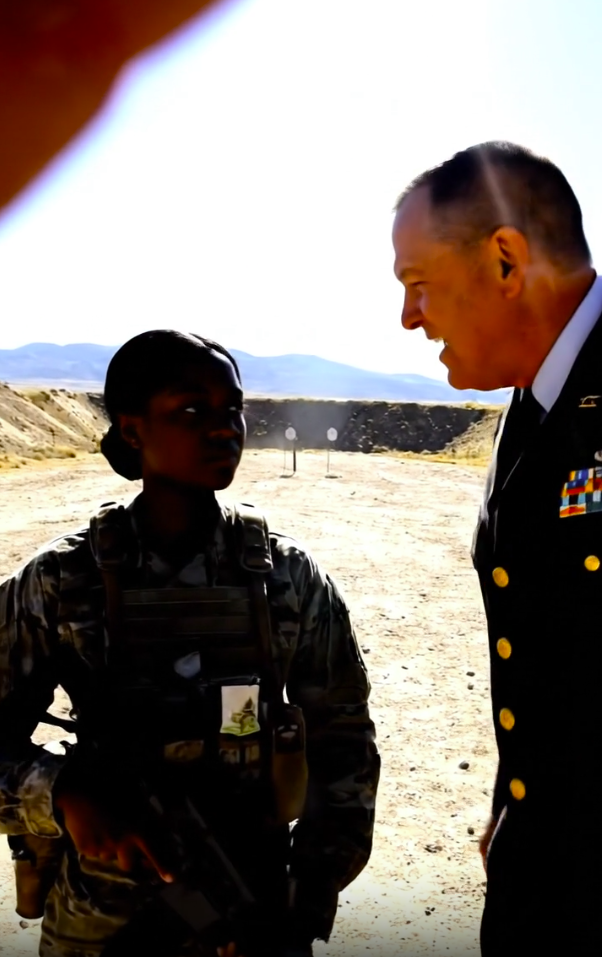
The Colonel mocked me for being a “useless logistics clerk” when I missed the target five times. He wanted to prove a point. He didn’t know I was a ghost. Then the Range Master checked the concrete wall behind the target and went pale. She whispered five words that shattered my cover and silenced the entire base.
PART 1
Chapter 1: The Invisible Woman
I perfected the art of being invisible a long time ago. At 28 years old, I had the kind of face you forgot the moment you looked away. Shoulder-length brown hair, usually pulled back in a regulation ponytail that was a little too tight. Hazel eyes that observed everything but revealed absolutely nothing. A compact frame that filled out standard-issue fatigues without drawing a single second glance.
To the soldiers at Fort Ironwood, I was just Nicole Harper. I was the woman who counted their ammunition, cleaned their rifles, and filed their requisitions. I was part of the furniture.
“Harper, you’re late on the inventory for the mess hall,” Staff Sergeant Webb had grumbled that morning, barely looking up from his coffee.
“On it, Sergeant,” I’d replied, my voice perfectly modulated to be forgettable.
That was the job. Arrive at 0630. Complete tasks with methodical precision. Disappear into my quarters after the evening roll call. No complaints. No questions. No stories about “the old days.”
Fort Ironwood sprawled across 3,000 acres of Wyoming wilderness, a place where the wind cut through you like a knife and the sun bleached the color out of everything. It was a facility for advanced tactical training, a playground for the best and brightest young soldiers destined for Special Ops. They walked around with steel in their spines and fire in their eyes, eager to prove they were elite.
I worked in Building 7, a nondescript concrete box that smelled of dust and gun oil. While the combat trainees practiced room clearing and repelling, I practiced spreadsheets.
Getty Images
Khám phá
It was safe. It was boring. It was exactly what I needed to stay alive.
But safety is an illusion, especially when you’re dealing with men like Colonel Thomas Bradley.
“The problem with this generation,” Bradley’s voice boomed from the observation tower that afternoon, “is that they don’t understand the fundamental difference between warriors and support personnel.”
I was down on the range, cleaning a row of M4 carbines that were still warm from the morning’s practice. My hands moved on autopilot—strip, clean, oil, reassemble—while my ears locked onto the conversation drifting down from the tower.
“Sir, regulations require basic proficiency for all staff,” a younger voice argued. That was Lieutenant Colonel Scott, the base shrink.
Bradley laughed, a sound devoid of humor. “You put a rifle in the hands of a logistics clerk, Scott, and all you accomplish is wasting tax-payer ammunition. They panic. They flinch. It’s embarrassing.”
I didn’t stop scrubbing the carbon off the bolt carrier group. I’d heard this speech a thousand times in a dozen different languages. The arrogance of command. The belief that a title made you a soldier.
“Perhaps a demonstration is in order,” Bradley continued, his voice dropping to that dangerous register that meant someone was about to have a very bad day. “Tomorrow. Combat Group Charlie has evaluations. Let’s throw some of the logistics staff on the line. Let the ‘warriors’ see firsthand why they need to stay in their lane.”
My hands paused for a fraction of a second. Just a glitch.
He was going to use us as props. A public humiliation to stroke his own ego.
I finished reassembling the rifle, the metallic click sounding loud in the quiet range. I looked up at the tower, shielded by the brim of my cap. Colonel Bradley didn’t know it, but he was playing with fire. He thought he was exposing incompetent clerks. He had no idea he was trying to unmask a ghost.
Chapter 2: The Impossible Miss
The next morning, the Wyoming air was crisp enough to freeze the breath in your lungs. The sky was a piercing blue, the kind that offers no cover.
We were lined up at Thunder Ridge Range. The “Logistics Losers,” as Private ‘Tank’ Hughes had loudly whispered to his buddies. There were four of us. Specialist Patterson, who looked like he might vomit; Corporal Mitchell, who was shaking; Private Bennett, who was barely twenty; and me.
Behind us stood twenty-three of Fort Ironwood’s finest combat trainees, grinning like sharks. They had front-row seats to the circus.
“Remember,” Range Master Sergeant Diane Foster announced over the PA, her voice tight. She didn’t like this. She respected the range, and she respected weapons. This wasn’t training; it was theater. “Five rounds. Fifty-yard target. Safety is the priority.”
“Twenty bucks says she drops the rifle,” Tank whispered behind me.
“You’re on,” his buddy chuckled.
“Harper,” Foster called out. “You’re up first.”
I stepped to the firing line. I could feel the eyes boring into my back. I picked up the M4 carbine. It felt like an extension of my arm—a limb I hadn’t used in six months but remembered perfectly.
I went through the motions of a novice. I checked the chamber a little too awkwardly. I seated the magazine with a hesitation that suggested I wasn’t sure if it was in right. I adopted a stance that was functional but “ugly”—elbows out, head tilted weirdly.
“Look at that stance,” Bradley scoffed from behind the safety barrier. “She’s holding it like a garden hose.”
I looked downrange. Fifty yards. The standard silhouette target: black on white paper, eighteen inches wide. For a trained operator, this was a chip shot. I could hit the center of that target with my eyes closed.
But if I drilled the center, questions would start. Where did a logistics clerk learn to shoot like a Ranger? Why is her grouping sub-MOA?
Questions led to background checks. Background checks led to the classified gaps in my file. And those gaps led to people who wanted me dead.
I had to miss. But I had to miss in a way that satisfied me.
I raised the rifle. Through the rear aperture, I found the front sight post. I settled it on the target. Then, I shifted my focus.
I wasn’t looking at the black silhouette. I was looking past it.
The target was stapled to a wooden frame. Between the edge of the paper and the wood of the frame, there was a tiny, almost invisible gap. Maybe two millimeters wide. Beyond that gap, thirty yards further downrange, stood the concrete backstop wall.
I took a breath. I let it out halfway. The world slowed down. The heartbeat in my ears became a rhythmic thrum.
Bang.
The first shot cracked through the valley.
“Miss!” someone shouted. The paper was pristine.
Laughter erupted behind me. “Jesus, she missed the whole frame!”
I didn’t flinch. I racked the bolt. Bang.
Second shot. Nothing. The paper remained white.
“Maybe she’s aiming at the mountain!” Bradley roared, slapping his knee.
I fired the third, fourth, and fifth rounds in a steady cadence. Bang. Bang. Bang.
Every single one missed the paper. Every single one missed the wooden frame.
I lowered the rifle, engaged the safety, and placed it on the table. The silence from the logistics team was heavy with shame. The noise from the combat group was raucous.
“Ladies and gentlemen,” Bradley announced, stepping forward like a ringmaster. “I believe we’ve just witnessed an important lesson. This is why we have soldiers, and this is why we have support staff.”
I turned to leave, keeping my face neutral, ready to fade back into the background. I had done it. I was the incompetent clerk. I was safe.
But Range Master Foster wasn’t dismissing us.
She was walking downrange.
“Sergeant Foster?” Bradley called out, annoyed. “Is there a problem?”
Foster didn’t answer. She walked past the target I had supposedly missed. She peered at the wooden frame. Then, she kept walking. She went all the way to the concrete backstop.
She stopped. She leaned in. She ran a finger over the grey concrete.
Shutterstock
The laughter behind me died out, replaced by confused murmuring. Foster stood there for what felt like an eternity. Then she turned around.
She looked at the Colonel. Then she looked at me. It was a look of profound confusion mixed with sudden, terrifying realization.
She walked back to the firing line, her boots crunching on the gravel. When she reached us, she ignored the Colonel and spoke directly to the group, her voice trembling slightly.
“Sir,” she said to Bradley, but her eyes were locked on mine. “I need you to check the back wall.”
“What are you talking about, Sergeant?” Bradley snapped.
“Five rounds were fired, Colonel,” Foster whispered, the sound carrying in the dead silence. “They all found their mark.”
“Impossible,” Tank Hughes grunted. “We saw her miss.”
“Did we?” Foster challenged. “We saw her miss the paper.”
We all walked downrange. Bradley led the way, impatient. I trailed at the back, my heart hammering against my ribs. This wasn’t part of the plan. No one was supposed to look that closely.
When we reached the back wall, Bradley froze.
Embedded in the concrete, exactly chest height if a man were standing behind the target, was a single, jagged hole.
It wasn’t five separate shots scattered around. It was five bullets, drilled through a gap the size of a pencil lead, impacting the concrete in a group tighter than a quarter.
“Holy…” Private Bennett breathed.
“The angle,” Captain Webb, the intel officer, murmured, stepping closer. “She shot through the gap between the paper and the frame. Two millimeters wide. From fifty yards.”
He turned to look at me. “Harper. That’s not luck. That’s physics.”
Colonel Bradley looked at the hole, then at me. His face went from smug to purple to pale. “Are you suggesting,” he stammered, “that you deliberately missed the target to hit… this?”
I met his gaze. I let the mask slip, just for a fraction of a second. I let him see the Sarah Phoenix inside Nicole Harper.
“I fired five rounds at the designated area, Colonel,” I said, my voice flat. “Where they impact is a matter of ballistics.”
It was the standard non-denial denial. But the damage was done. The air on the range had changed. I wasn’t the clerk anymore. I was a variable they couldn’t calculate.
And from the tree line on the ridge above us, I saw a glint of light. A reflection.
Someone was watching. And now, they knew.
PART 2
Chapter 3: The Intelligence Trap
The walk from the range to Building 12 felt like a funeral procession for my quiet life. Captain Webb didn’t say a word, but his stride was purposeful. He was Intelligence. That meant he didn’t deal in rumors; he dealt in patterns. And I had just broken every pattern I’d established in six months.
Building 12 was different from the rest of Fort Ironwood. It had reinforced doors, electromagnetic shielding, and air that smelled of ozone and secrets.
“Sit,” Webb said, pointing to a chair in his office. It wasn’t a request.
The office was sparse. A desk, a secure terminal, and a wall of certificates that screamed ‘I know more than you do.’ He sat down and placed a manila folder on the desk. He didn’t open it. He just rested his hand on it, tapping his index finger rhythmically.
“Harper,” he began, his voice deceptively calm. “I’m going to ask you a few questions. Your answers will determine if this stays a conversation or becomes an interrogation.”
I sat with ‘relaxed alertness’—a posture drilled into me during survival training. “I understand, sir.”
“Your personnel file,” Webb said, tapping the folder again. “It has gaps. Specifically, a six-month period seven years ago. It lists ‘Administrative Duties’ at a classified location. No unit designation. No location code. And your medical records are sealed above my clearance level.”
He leaned forward. “Most logistics clerks don’t have medical records classified higher than a Captain’s. And most logistics clerks don’t shoot sub-MOA groups through a crack in a target frame.”
“I have a hobby, sir,” I lied smoothly. “My father taught me to shoot. Physics is just math.”
“Physics is math,” Webb agreed. “But muscle memory is training. What you did out there? That wasn’t math. That was instinct. You didn’t even aim at the target; you aimed through it. That’s counter-sniper logic. You were looking for a threat behind the cover.”
My blood ran cold. Webb was sharper than I thought. He hadn’t just seen the shot; he’d analyzed the psychology behind it.
“I think you’re overthinking a lucky day on the range, Captain.”
Webb opened the folder. He pulled out a single sheet of paper. “I ran a trace on your social security number this afternoon, Harper. It flagged. It didn’t give me a name, but it triggered a ‘Silent Alert’ in the Pentagon’s database. Do you know what a Silent Alert is?”
I stayed silent. I knew exactly what it was. It meant Do not detain, do not approach, notify the handling agency immediately.
“It means you’re a ghost,” Webb whispered. “It means you don’t exist, or you’re protected by someone very high up. Or…” He paused, his eyes narrowing. “Or you’re hiding from someone.”
“Captain,” I said, dropping the ‘clueless clerk’ act just enough to show him respect. “If my file is flagged, then asking these questions might not be good for your career.”
“I don’t care about my career. I care about my base,” Webb shot back. “And right now, I have a mystery operator in my logistics department. But that’s not the worst part, Harper.”
He stood up and walked to the window, peering through the blinds.
“When you were putting on your little show at the range,” he said quietly, “I was watching the tree line. Thunder Ridge is surrounded by hills. Perfect for observation.”
I stiffened. I had seen the glint of light too.
“I saw it,” I admitted.
“Good. Then you know,” Webb turned back to me. “There was a glint. High-powered optics. Someone wasn’t just watching the training exercise, Harper. They were recording it. And they were focused entirely on you.”
The implications hit me like a physical blow. The shot I took was a message—a warning to whoever was watching that I wasn’t helpless. But in sending that message, I had confirmed my identity. I had told the hunters exactly where the prey was hiding.
“Who was it?” I asked.
“Unknown,” Webb replied. “But they aren’t base personnel. And now Bradley is demanding a full investigation into your ‘anomalous performance.’ He’s calling in favors. He wants to prove you cheated.”
Webb leaned over the desk, his voice dropping to a whisper. “He’s bringing in the Feds, Harper. FBI. They’ll be here within the hour.”
He pushed the folder toward me.
“I can’t stop the FBI,” Webb said. “But I can give you a head start on the questions they’re going to ask. You need to decide right now: are you Nicole Harper, the logistics clerk? or are you whoever you were before the world forgot you?”
“I’m just a soldier, Captain,” I said, standing up.
“Let’s hope that’s enough,” Webb said grimly. “Because whoever was in those trees? They aren’t looking for a soldier. They’re looking for a target.”
Chapter 4: The Ghost in the Machine
I left Building 12 with my mind racing. The FBI was coming. Bradley’s bruised ego had escalated a training incident into a federal witch hunt. If the FBI ran my prints through the deep databases, the real databases, the “Nicole Harper” mask would crumble.
I headed back to Building 7, the logistics center. I needed a plan. Escape was the first instinct—grab my go-bag, steal a car, disappear into the Rockies. But the “Silent Alert” Webb mentioned meant my exit routes might already be flagged.
I walked into the supply room, the smell of cardboard and metal grounding me. I sat at my computer, pretending to work, my fingers hovering over the keyboard.
“Interesting reading material?”
I spun around. Master Sergeant Dave Riley was leaning against a stack of crates, blocking the aisle. Riley was “Special Operations”—a former operator who moved like a cat and smiled like a wolf. He was the one man on base I had actively avoided. Real recognizes real.
“Just inventory, Sergeant,” I said.
Riley pushed off the crates and walked toward me. He didn’t stop until he was in my personal space. He reached past me and tapped my monitor.
“You’ve been tracking supply request #8904,” Riley said. “Medical trauma kits. Specifically, the combat-grade ones with coagulant gauze and airway tubes. And request #9921. Encrypted localized comms units.”
I didn’t blink. “It’s my job to track inventory.”
“Those aren’t standard training supplies, Harper,” Riley said, his voice low. “Trauma kits are for live fire casualties. Encrypted comms are for ops that don’t want a paper trail. Someone at Fort Ironwood is ordering gear for a private war. And you’ve been watching it.”
He looked at me, and for the first time, I saw genuine curiosity in his eyes.
“You’re not just a clerk,” he stated. “I saw the back wall, Harper. That grouping? That’s ‘Operator’ level. That’s ‘I’ve killed people’ level.”
“I don’t know what you’re talking about,” I said, my hand inching toward the letter opener on the desk. A pathetic weapon, but it was something.
Riley laughed softly. “Relax. I’m not here to turn you in.”
He turned and looked out the warehouse door, checking for listeners.
“Three weeks ago,” Riley said, keeping his back to me, “I was contacted by a recruiter. Not Army. Private sector. They claimed to be a ‘government contractor’ that doesn’t exist on Google. They were asking questions about personnel at Fort Ironwood.”
“What kind of questions?” I asked, my grip on the letter opener tightening.
“They were looking for anomalies,” Riley said, turning back to face me. “They asked if I’d noticed anyone with skills that didn’t match their rank. Anyone ‘hiding in plain sight.’ They specifically asked about female personnel with gaps in their service history.”
My heart hammered against my ribs. The hunters weren’t just watching from the trees. They were actively headhunting inside the base.
“What did you tell them?”
“I told them to go to hell,” Riley grinned. “I don’t like spooks. And I don’t like people hunting soldiers on my base.”
He stepped closer, lowering his voice to a conspiratorial whisper. “But yesterday, when you drilled that wall? I realized why they were asking. You’re who they’re looking for, aren’t you?”
I looked at him. Riley was a wild card. But he was a soldier first.
“If I were that person,” I said carefully, “I would say that telling them anything would be a death sentence.”
Riley nodded slowly. “That’s what I figured.”
“So, what happens now, Sergeant?”
“Now?” Riley checked his watch. “Now we figure out who is ordering illegal combat gear to a training base. Because if someone is stockpiling trauma kits and encrypted radios, they’re planning an operation. And my guess? The operation is you.”
Before I could respond, the warehouse door banged open.
Private Bennett stood there, breathless and pale.
“Sergeant Riley! Harper!” she yelled. “Sergeant Foster needs you at the range immediately. It’s urgent.”
Riley and I exchanged a look. The truce was formed in that second.
“Did she say why?” Riley asked.
“No,” Bennett shook her head. “But there are black SUVs parking at the main gate. And Colonel Bradley looks like he’s about to wet himself.”
The FBI had arrived.
Chapter 5: The Federal Hammer
The conference room in Building 12 felt smaller than a prison cell. The air conditioning was humming, but I was sweating cold bullets under my uniform.
Across the table sat two agents.
Agent Marcus Stone was older, wearing a suit that cost more than my annual salary. He had the tired, cynical eyes of a man who had seen too many lies. Agent Lisa Kane was younger, sharp, with a tablet in front of her that she tapped with annoying precision.
Colonel Bradley stood in the corner, looking vindicated. Captain Webb stood by the door, arms crossed, looking like he wanted to punch someone.
“State your name for the record,” Agent Stone said, placing a digital recorder on the table.
“Nicole Marie Harper,” I said.
“Rank?”
“Specialist. Logistics.”
Agent Kane looked up from her tablet. “Is that your legal name, Ms. Harper?”
“It is the name on my military ID, Agent.”
“That’s not what I asked,” Kane said sharply. She slid a photo across the table.
It was me. But not the me of today. It was a younger version. I was wearing desert fatigues, holding a suppressed carbine, standing in front of a bombed-out building in Aleppo, Syria. My eyes in the photo were hard, dead. The nametag on my chest didn’t say Harper.
It read PHOENIX.
“Do you recognize this individual?” Kane asked.
I stared at the photo. It shouldn’t exist. That mission was “black.” No photos. No records. Someone had dug deep.
“It looks like a soldier,” I said neutrally.
“It looks like you,” Stone corrected. “Facial recognition is a 99.8% match. We ran your biometrics against a classified database that Colonel Bradley demanded we access.”
Bradley smirked in the corner. “I told you. She’s a fraud.”
“This woman,” Stone tapped the photo, “is Staff Sergeant Sarah Elizabeth Phoenix. A Tier-1 operator attached to a Joint Task Force in Syria. A ghost unit.”
He leaned forward, his voice heavy with accusation. “Staff Sergeant Phoenix was reported Killed in Action seven years ago. Her unit was wiped out in an ambush. No survivors. Her body was never recovered.”
The room went deathly silent.
“So,” Stone whispered, “imagine our surprise when a dead war hero shows up in Wyoming, posing as a logistics clerk and shooting holes through concrete walls.”
“I am Nicole Harper,” I repeated, my voice steady despite the chaos screaming in my head. “If you have questions about classified operations, you need to speak to the Department of Defense, not me.”
“We are the federal government, Ms. Harper,” Kane snapped. “And right now, you are looking at charges for identity fraud, falsifying military records, and potentially espionage. Who sent you here? Who are you working for?”
“I’m not working for anyone!”
“Then explain the shooting!” Bradley shouted. “Explain how a clerk shoots like a SEAL!”
“She can’t,” Stone said. “Because she isn’t a clerk. She’s a sleeper agent. Or a deserter.”
He reached for handcuffs on his belt. “Nicole Harper, or Sarah Phoenix, or whoever the hell you are… you are under arrest pending federal inquiry.”
I tensed. I calculated the distance to the door. Webb was there, but he looked hesitant. Riley was outside. If I moved now, I would have to hurt people. Good people.
Stone’s hand touched the cuffs.
Suddenly, the door burst open.
It wasn’t Riley. It was Captain Webb, who had stepped out a moment ago and just returned, looking frantic.
“Stop!” Webb shouted. “Agent Stone, don’t touch her.”
“Back off, Captain,” Stone warned. “This is federal jurisdiction.”
“Not anymore,” Webb panted. “There’s been an incident at the range. You need to see this.”
“It can wait,” Bradley scoffed.
“No, it can’t, Colonel!” Webb yelled, losing his composure. “It’s evidence tampering!”
Stone froze. “What?”
“Range Master Foster just called it in,” Webb said, looking directly at me with wide eyes. “Someone broke onto the range last night. They bypassed the sensors.”
“So what?” Bradley said. “Probably kids.”
“No,” Webb said, his voice dropping. “They didn’t steal anything. They went to the backstop wall. The concrete wall.”
I felt a chill that had nothing to do with the air conditioning.
“They dug the bullets out,” Webb whispered. “They used diamond-tipped drills. They extracted the five rounds Harper fired. And then… they tried to patch the concrete to make it look like nothing happened.”
Stone dropped his hand from the cuffs. He looked at me, then at Webb.
“Someone is cleaning up her mess,” Kane realized aloud. “Someone is trying to erase the proof that she can shoot.”
“Or,” I said, speaking for the first time in minutes, realizing the terrifying truth, “they aren’t erasing proof. They are collecting the evidence to verify it.”
The hunters in the tree line. They needed to know if it was really me. They saw the shot. But they needed the ballistics to match the ghost they killed in Syria seven years ago.
“Take me to the range,” Agent Stone commanded, grabbing his radio. “Now.”
As they ushered me out, I caught Webb’s eye. He looked terrified. The game had changed. I wasn’t just a suspect anymore. I was the bait in a trap that was snapping shut around the entire base.
PART 3
Chapter 6: The Override
The scene at Thunder Ridge Range was a chaotic collision of jurisdictions. FBI agents were taping off the concrete wall like a murder scene. Colonel Bradley was shouting orders that everyone was ignoring. Master Sergeant Riley stood near the backstop, staring at the gouged concrete where my bullets used to be, his face grim.
“Look at the precision of the extraction,” Agent Stone muttered, crouching by the wall. “They didn’t use a hammer and chisel. They used a core drill. Portable, silent, diamond-tipped.”
He stood up and turned to me, his eyes cold. “This wasn’t vandalism, Ms. Harper. This was ballistic verification. Someone wanted to confirm that the bullets matched a specific rifle profile. Probably the same profile used by a dead ghost named Sarah Phoenix.”
“I told you!” Bradley interjected, his face flushed. “She’s compromised! She’s a security risk!”
Agent Kane stepped forward, cuffs in hand. “That’s enough. Nicole Harper, you are coming with us. We’re taking you to the Denver Field Office for enhanced interrogation.”
I looked at Riley. He was tensed, his hand hovering near his sidearm. Captain Webb looked sick. I was about to be swallowed by the federal machine, and once I was in the system, the people hunting me would know exactly where to find me.
“Agent Stone,” I said calmly. “If you take me in, I won’t survive the night in federal custody.”
“We can protect you,” Stone scoffed.
“You can’t even protect a concrete wall on a military base,” I shot back.
Stone grabbed my arm. “Let’s go.”
Before he could pull me, a convoy of three black sedans tore onto the range, gravel spraying as they drifted to a halt. They weren’t FBI vehicles. They had no markings, but they radiated authority.
The doors opened, and a woman stepped out. She was in her fifties, wearing a sharp grey suit that looked expensive and severe. She moved with the kind of confidence that makes Colonels look like privates. Behind her were four men in tactical gear—no insignias, just heavy weaponry.
“Release the prisoner,” the woman commanded. Her voice wasn’t loud, but it cut through the wind like a razor.
“Excuse me?” Stone bristled, flashing his badge. “I am Special Agent Stone, FBI. This is an active federal investigation.”
The woman walked right up to him. She didn’t blink. “And I am General Linda Murphy, Department of Defense, Office of Special Projects. And as of ten seconds ago, your investigation has been reclassified under National Security Protocol 77-Alpha.”
She snapped her fingers. One of her guards handed Stone a document.
Stone read it. His face went pale. He looked at the document, then at Murphy, then at me.
“This… this says she’s a protected asset under a Special Access Program,” Stone stammered. “This says this entire incident never happened.”
“Correct,” Murphy said. “You will pack up your tape. You will destroy your recordings. And you will leave my base.”
“Your base?” Bradley sputtered. “I am the commander of Fort Ironwood!”
Murphy turned to Bradley. She looked him up and down with withered disdain. “Colonel, you command a training facility. I command the assets you unwittingly tried to expose. If you say one more word, I will have you reassigned to monitoring weather balloons in Alaska.”
Bradley shut his mouth so fast I heard his teeth click.
Murphy turned to me. Her eyes were hazel, like mine. Intelligent. Dangerous.
“Get in the car, Sarah,” she said.
Not Nicole. Sarah.
I looked at Webb and Riley. Webb gave a small, almost imperceptible nod. He knew this was the only way I walked away free.
“Goodbye, gentlemen,” I said softly.
I climbed into the back of the sedan. The heavy door slammed shut, sealing out the wind, the FBI, and the life of Nicole Harper.
As we drove away, leaving the confused chaos of the range behind, Murphy didn’t look at me. She opened a laptop.
“You made a mess, Phoenix,” she said. “But at least you proved you haven’t lost your touch.”
Chapter 7: The Resurrection of Sarah Phoenix
We didn’t go to a prison. We drove two hours deep into the mountains to a facility that looked like a corporate ski lodge but had the perimeter security of a nuclear silo.
Inside a soundproofed conference room, Murphy poured two cups of coffee. Black. Just how I used to drink it before I forced myself to drink tea to fit the “Nicole” persona.
“You think you escaped Syria on your own,” Murphy began, sitting across from me. “You think you created Nicole Harper. You think you’ve been hiding for seven years.”
“I did hide,” I said. “I survived.”
“We let you hide,” Murphy corrected. “We scrubbed the traffic cameras. We diverted the facial recognition hits. We kept the wolves at bay because we needed you on ice. A reserve asset.”
“I’m not an asset,” I snarled. “I’m a survivor of a unit that was betrayed by its own command.”
“I know,” Murphy said. Her voice softened, just a fraction. “That’s why I’m here. That’s why I pulled you out of the fire back there.”
She tapped a key on her laptop, projecting images onto the wall. They were crime scene photos. Car accidents. Heart attacks. Robberies gone wrong.
I recognized the faces.
“That’s Major Cross,” I whispered. “And Sergeant Fitzgerald.”
“Dead,” Murphy confirmed. “All of them. Fourteen operatives from your original program. Systematically eliminated over the last eighteen months. The people who betrayed your unit in Syria? They aren’t done. They’re cleaning up loose ends.”
“Why now?”
“Because they’re getting sloppy. And greedy.” Murphy switched the slide. It showed a man in a bespoke suit shaking hands with a politician.
“Jonathan Blackwood,” Murphy said. “CEO of Meridian Defense Systems. The company that supplied the tech your unit was sent to destroy in Syria. He was playing both sides. Selling to the enemy to drive up demand for his own countermeasures.”
“And the politician?”
“Senator Harrison Webb,” Murphy said.
I froze. “Webb? Any relation to…”
“Captain Brian Webb’s uncle,” Murphy nodded. “The Captain suspects his family is dirty. That’s why he protected you. He’s been trying to investigate his own uncle for years, but he hit a wall. His uncle is the Chairman of the Defense Appropriations Committee. He’s untouchable.”
“Nobody is untouchable,” I said automatically. It was an old mantra.
“They are to the law,” Murphy said. “Blackwood and the Senator have bought the judges, the FBI, and half the Pentagon. If we take them to court, you die before the opening statements. Witnesses have a habit of disappearing.”
She leaned forward. “That’s why I need Sarah Phoenix. I don’t need a witness. I need a ghost.”
I stood up and walked to the window. The sun was setting over the Rockies, casting long, bloody shadows across the snow. I had spent seven years trying to be normal. Trying to forget the weight of a rifle and the smell of cordite.
“You want me to kill them,” I said.
“I want you to finish the mission,” Murphy corrected. “They killed your friends. They killed your unit. Now they are hunting the people at Fort Ironwood because they stood near you. Do you think they’ll let Riley live? Or Captain Webb? Or that Range Master?”
She let that sink in.
“They know you were there, Sarah. If you run again, they will tear Fort Ironwood apart looking for clues. They will burn everyone you worked with.”
I closed my eyes. I saw Riley’s grin. I saw Webb’s worried face. I saw Foster checking the wall, terrified but honest.
They were good soldiers. They didn’t deserve to die for my past.
I turned back to Murphy. The logistics clerk was gone. The posture was back. The eyes were dead.
“I need access to the armory,” I said. “And I need a extraction plan for Captain Webb and Sergeant Riley if this goes sideways.”
Murphy smiled. It was a cold, predatory smile.
“Welcome back, Sergeant.”
Chapter 8: The Back Wall
Three Weeks Later
The news cycle was dominated by two tragic stories.
The first was the sudden death of defense contractor Jonathan Blackwood. He had suffered a massive cardiac event while alone in his penthouse suite in Denver. The coroner noted nothing suspicious, just the stress of a man running a billion-dollar empire. No one noticed the microscopic puncture wound at the base of his skull, or the fact that his encrypted laptop was wiped clean.
The second story was a hunting accident in Montana. Senator Harrison Webb, a fixture of Washington power, had fallen down a ravine while tracking elk. It was a tragic misstep. Authorities ruled it “death by misadventure.” They didn’t find the tripwire, and they certainly didn’t find the operator who had watched him fall.
The corruption network didn’t just lose its leaders; it lost its confidence. Without Blackwood’s money and Webb’s political cover, the lower-level conspirators panicked. They started turning on each other. The FBI—the honest agents, not the bought ones—had a field day with the anonymous evidence dropped on their doorsteps.
I returned to Fort Ironwood on a Tuesday.
The base was quiet. The investigation was officially “closed due to lack of evidence.” The FBI had packed up and left, frustrated and confused.
I walked into Building 12. Captain Webb was at his desk. He looked tired, but the weight that had been crushing him was gone. He was reading the newspaper—the obituary section.
He looked up as I entered. He didn’t look surprised.
“Staff Sergeant,” he said. Not Harper.
“Captain,” I replied.
He slid the newspaper across the desk. “My uncle,” he said quietly. “Tragic accident.”
“Gravity is a constant, sir,” I said. “Like physics.”
Webb looked at me for a long moment. There were tears in his eyes, but he blinked them away. “He was a monster. I tried to stop him the legal way. I failed.”
“The legal way has limits,” I said. “Soldiers don’t.”
He opened his drawer and pulled out a new file. “General Murphy sent this over. It’s your new assignment. You’re being promoted. You’re now the Chief Instructor for the Advanced Marksmanship Program. It’s a new unit. Specifically for… non-standard personnel.”
“Non-standard?”
“People who don’t exist,” Webb smiled. “You’ll be working with Riley. He requested you personally.”
I took the file. I wasn’t running anymore. I wasn’t hiding. I was right where I belonged.
I walked out to the range. The sun was high and bright. The air smelled of sagebrush.
Riley was there, leaning against the firing table. He was looking downrange at the concrete backstop. The hole had been patched with fresh cement, a slightly lighter shade of grey than the rest of the wall. A scar.
“Nice patch job,” I said, walking up beside him.
Riley chuckled. “Foster did it herself. Said she wanted to remind herself that impossible things happen.”
He handed me a loaded magazine. “You ready to get to work, Phoenix?”
“The name is Harper,” I said, taking the mag and slapping it into an M4. “Nicole Harper.”
Riley grinned. “Right. Harper. The clerk.”
“The clerk who never misses,” I corrected.
I raised the rifle. I didn’t look at the target. I looked past it, to the back wall. To the things people try to hide, and the things that refuse to stay buried.
“Check the back wall,” Riley whispered, echoing the words that started it all.
I squeezed the trigger.
Bang.
Dead center.
The legend of the invisible woman was over. The reality of the soldier had just begun. And at Fort Ironwood, we were ready for whatever came next.
THE END.