He Ordered Me To Strip My Uniform For “Stolen Valor.” Then He Saw The Forbidden Ink On My Back And The Whole Base Went Silent.
PART 1
Chapter 1: The Weight of Dust
The Texas sun over Eagle Point didn’t just shine; it judged you. It was a physical weight, a hammer made of UV rays and dry heat that pressed down on the roof of my battered pickup truck as I navigated the final stretch of highway toward Fort Blackhawk.
I turned the radio down. The country song about trucks and heartbreak felt too trivial for where I was heading. The silence that replaced it was heavy, filled only by the hum of my tires on the asphalt and the thumping of my own heart. I was forty-two years old. My hands, gripping the steering wheel, were scarred map-makers of a life spent stitching people back together. They were steady now, but I could feel the phantom tremors—the ghost of adrenaline that always hit me when I got close to a perimeter fence.
I wasn’t Captain Laura West anymore. I was just Laura. A civilian contractor. A ghost returning to the machine that had chewed her up and spat her out a decade ago.
I glanced down at my clothes. I had debated this choice for three hours this morning. I was wearing my old Battle Dress Uniform—the BDUs. They were faded to a soft, undefined pattern of greys and greens, the fabric thinned by years of abrasive sand and aggressive washing machines. They didn’t have my rank on the collar. They didn’t have the unit patches that were currently folded inside a vacuum-sealed bag in a footlocker I treated like a coffin.
But they were functional. They were comfortable. And honestly? They were my armor.
I was coming to Blackhawk to teach advanced trauma to the new kids—the “Tik-Tok generation” of combat medics who had never smelled a sucking chest wound or had to improvise a tourniquet out of a rifle sling while taking fire. I figured looking the part was half the battle.
The gate guards were babies. That’s the first thing you notice when you get out. Everyone stays the same age, but the soldiers at the gate get younger and younger. They checked my civilian contractor ID with the seriousness of kids playing cops and robbers, but their eyes lingered on my fatigues. It was a look I knew well: Assessment.
Who is she? Why is she wearing that? Is she one of us, or is she pretending?
I drove through, the base opening up like a sprawling concrete city. Low-slung buildings, the smell of diesel and freshly cut scrub grass, the distant, rhythmic chanting of a platoon on a run. It hit me in the gut—a wave of nostalgia so sharp it tasted like bile. I missed it. God help me, I missed the clarity of it. In the civilian world, things were complicated. Bills, loneliness, the silence of an empty apartment. Here, the mission was simple: Keep your people alive.
I parked in the visitor lot, grabbed my duffel bag, and walked toward the administrative building. The automatic doors hissed open, and the blast of air conditioning felt like a blessing.
The lobby was busy. Soldiers in crisp, modern OCP uniforms moved with purpose. Their boots were clean. Their haircuts were fresh. The air smelled of floor wax and bureaucracy. I walked to the front desk, my boots—resoled twice but still the most comfortable things I owned—making a distinct thud-thud sound on the polished tile.
Behind the desk sat a Specialist. His name tag read REED. He was typing furiously, probably processing leave forms or requisitions for staples. He didn’t look up immediately.
“I’m Laura West,” I said. My voice came out lower than I intended, a little raspy. “Appointment with Sergeant Major Ramos. Medical training support.”
Reed stopped typing. He looked up. His eyes scanned my face—noting the crow’s feet, the sun damage, the lack of makeup—and then dropped to my clothes. His brow furrowed.
“ID?” he asked.
I slid the plastic card across the counter. He took it, looked at the screen, looked at me, and then sighed. It was a heavy, annoyed sigh.
“Ma’am, your appointment is in the system,” Reed said, sliding the card back. “But we have a problem.”
“Problem?”
“The uniform,” he said, pointing a pen at my chest. “Base policy is strict. Only active duty personnel are authorized to wear military utilities on the installation. Contractors are to wear business casual or appropriate civilian work attire.”
I felt the heat rise in my cheeks. It wasn’t embarrassment; it was frustration. “These are practical for the training I’m doing, Specialist. I’m heading to the simulation labs.”
“Doesn’t matter,” Reed said, his voice carrying that specific tone of petty authority that only administrative soldiers possess. “You can’t go past this desk looking like that. It’s… inappropriate.”
The lobby had gone quiet. I could feel the stares. A group of young officers near the bulletin board stopped talking. They were watching the middle-aged woman getting dressed down by the desk clerk.
I took a breath. Don’t engage, Laura. You’re not an officer anymore. You’re a consultant.
“I understand,” I said, keeping my voice even. “I brought a change of clothes just in case. Is there a restroom?”
I was ready to de-escalate. I was ready to walk away. But then I heard the boots approaching from the right. Fast, sharp, authoritative.
“Is there a problem here, Specialist?”
I turned. It was a Lieutenant. Name tag: BISHOP. He was everything the modern Army wanted to be. tall, fit, jawline you could cut glass on, and a uniform that looked like it had been tailored by a laser. He was looking at me, but he wasn’t really seeing me. He was seeing a violation of his world’s order.
Chapter 2: The Skin Underneath
“Ma’am, I’m Lieutenant Bishop,” he said. He didn’t offer a hand. He stood with his thumbs hooked into his belt, chest out. “I couldn’t help but overhear. The Specialist is right.”
“I was just about to go change, Lieutenant,” I said, gripping the strap of my duffel bag tighter.
“Good,” he said, but he didn’t step back. He stepped closer. He wanted to make a point. He had an audience—the other officers, the junior enlisted in the lobby—and he needed to show them he protected the standards. “But I want to be clear about why. It’s not just a rule in a book.”
I looked him in the eye. He had blue eyes, clear and unclouded by the things I had seen. “I’m listening.”
“That uniform,” he gestured vaguely at my faded fatigues, “represents a sacrifice. It represents men and women who put their lives on the line. It’s not a costume for contractors to wear because they want to feel tough. You have to earn the right to wear that flag.”
The irony was so thick I could almost taste it like copper in my mouth. Earn it.
I thought about the night in the Panjwai district when the mortar hit the chow hall. I thought about the blood that wouldn’t scrub out from under my fingernails for a week. I thought about the letter I wrote to Corporal Miller’s mother because he couldn’t hold a pen anymore.
“I have great respect for the tradition, Lieutenant,” I said. My voice was ice cold now. “I’m not wearing this to make a statement.”
“Then take it off,” Bishop said. It was a command. “You can’t proceed past this point in unauthorized gear. There’s a restroom down that hall. Change. Now.”
It was humiliating. He was treating me like a child, like a pretender. The anger flared in my gut, a hot coal of resentment. I outrank you, kid, the ghost of Captain West whispered in my ear. I have boots older than your career.
But Captain West was gone. Laura West needed this job. Laura West needed the money, and more importantly, she needed to make sure these kids didn’t die because they didn’t know how to pack a junctional wound.
“Understood,” I said.
I didn’t argue. I didn’t pull out my DD-214 or scream about my Silver Star. I just turned away from him.
The heat in the lobby was stifling now, despite the AC. I felt like every eye was a laser burning into my back. I needed to get out of the jacket. It was an old field jacket, heavy canvas, worn over a simple black tank top.
I stopped. I didn’t want to walk all the way to the bathroom wearing the symbol of my shame. I wanted to comply. Malicious compliance? Maybe a little.
“I’ll take the jacket off right here,” I muttered, mostly to myself.
I reached for the zipper. The sound was loud in the quiet lobby—zzzzzip.
Lieutenant Bishop was still watching, arms crossed, a smirk playing on his lips. He thought he had won. He thought he had put the civilian in her place.
I shrugged the heavy jacket off my shoulders, letting it slide down my arms. The movement was slow, deliberate. As the fabric fell away, the cool air of the lobby hit my skin.
I was wearing a racerback tank top. My shoulders were bare.
And then, the silence changed.
It wasn’t the silence of awkwardness anymore. It was the silence of shock.
I didn’t see it, but I felt it. I felt Lieutenant Bishop’s smirk vanish. I felt Specialist Reed stop breathing.
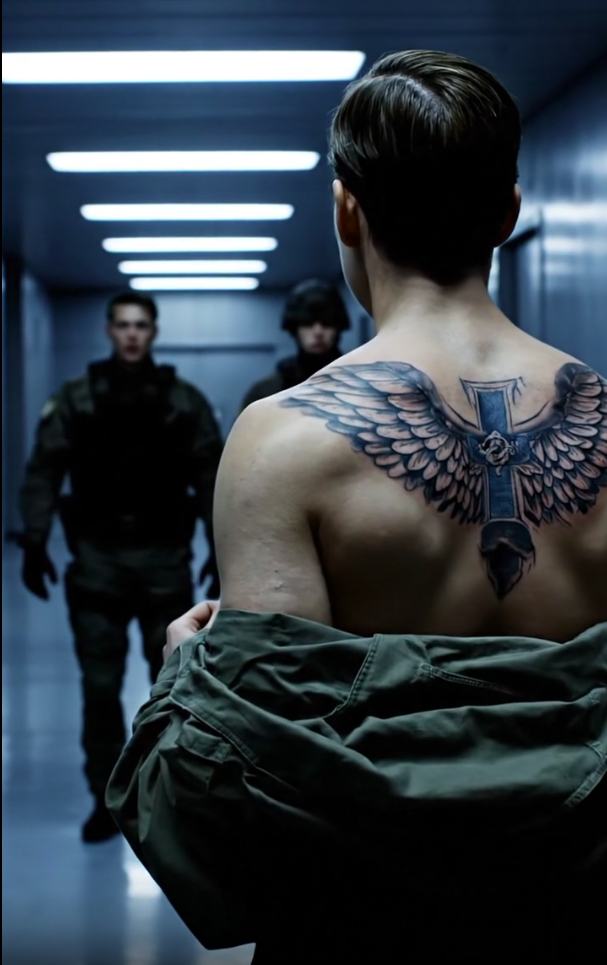
Because on my back, spanning from shoulder blade to shoulder blade, was the ink. It wasn’t pretty parlor work. It was dark, jagged, and etched with the kind of permanence that pain brings.
A combat medic’s cross. The caduceus, but instead of snakes, it was wrapped in angel wings made of steel feathers—shattered, bent, but unbroken. And beneath it, in gothic script that looked like it had been carved into stone:
07 MARCH 2009
I heard a sharp intake of breath behind me.
“That… that date,” someone whispered. It might have been one of the officers by the bulletin board.
I didn’t turn around. I didn’t acknowledge them. I just bundled my jacket into a ball, shoved it under my arm, and walked toward the restroom.
They didn’t know the full story yet. They didn’t know that on March 7, 2009, in a valley that God forgot, a convoy was ambushed. They didn’t know that for two hours and seventeen minutes, a single female medic moved through a kill zone that was being raked by machine-gun fire, dragging twenty-three grown men to safety, treating them with dirt and duct tape when the supplies ran out.
They didn’t know they were looking at the back of the “Angel of Kandahar.”
But they knew enough. They knew that tattoo wasn’t something you bought. It was something you survived.
I pushed the restroom door open and let it swing shut behind me, cutting off the stares. I leaned against the sink, gripping the porcelain until my knuckles turned white. I looked at myself in the mirror.
“Just do the job, Laura,” I whispered to the tired woman in the reflection. “Just teach them how to stay alive.”
I changed into my khakis and polo shirt. I looked like a substitute teacher. I looked harmless.
When I walked back out, the lobby was different. Lieutenant Bishop was gone. Specialist Reed wouldn’t meet my eyes as he handed me my visitor badge. His hands were shaking slightly.
“You’re… you’re clear to proceed to Sergeant Major Ramos’s office, Ma’am,” he stammered.
“Thank you, Specialist.”
I took the badge. I walked past the security checkpoint. But I knew the game had changed. The rumors would start now. In the military, gossip moves faster than light. By lunch, everyone would know about the crazy contractor lady with the 2009 ink.
I just hoped they were ready to learn, because I wasn’t there to tell war stories. I was there to make sure they didn’t become one.
PART 2
Chapter 3: The Fortress of Authority
Sergeant Major Gloria Ramos didn’t sit; she occupied her chair like it was a throne made of bureaucracy and iron will. Her office was a shrine to efficiency. Not a paperclip was out of place. The walls were lined with unit photos, the faces getting younger as the years progressed, while Ramos seemed timeless—carved from granite and polished by regulation.
“Ms. West,” she said, not looking up from the file on her desk. “You’re late.”
“Had a wardrobe malfunction at the front desk,” I said, dropping my bag by the door.
Ramos looked up then. Her eyes were dark, intelligent, and didn’t miss a thing. She scanned my civilian clothes—the khakis that were a little too loose, the polo that felt like a straightjacket. A ghost of a smile touched her lips.
“Bishop?” she asked.
“Bishop,” I confirmed.
“He’s a good officer. By the book. But he forgets that the book was written in blood, not ink.” She closed the file. “Your credentials are… impressive, Laura. Even with the redactions. Especially with the redactions.”
I sat down without being asked. Ramos and I had a history, though we’d never met. We knew the same people. We spoke the same language of trauma protocols and triage.
“The redactions are there for a reason, Sergeant Major. I’m here to teach skills, not history.”
“That’s the problem,” Ramos said, leaning forward. “These kids… they’re technically brilliant. They can recite the TCCC guidelines backward. They know the dosage for ketamine down to the microgram. But they’ve never seen a friend screaming for their mother while they’re trying to stuff gauze into a femoral artery.”
She stood up and walked to the window, looking out at the training grounds.
“I need you to scare them, Laura. I need you to break them a little bit, so the enemy doesn’t break them completely.”
“That I can do,” I said.
The door opened with a sharp knock. A young corporal stepped in. He was wound tight, vibrating with energy.
“Corporal Gray reporting as ordered, Sergeant Major!”
“At ease, Gray,” Ramos said. “This is Ms. West. She’s the new consultant. You’ll be her point man for the advanced course.”
Corporal Luke Gray turned to me. He was handsome in a corn-fed, all-American way, but his eyes were skeptical. He looked at my civilian clothes, my messy hair. He saw a mom. He saw a civilian.
“Ma’am,” he said, extending a hand. His grip was firm, testing. “Pleasure. I heard you were… experienced.”
“You could say that,” I replied, matching his grip. I didn’t squeeze back too hard, just enough to let him know there was bone and muscle under the skin.
“Corporal Gray is our top medic,” Ramos said. “He thinks he knows everything.”
“I know enough to do my job, Sergeant Major,” Gray shot back, confident but respectful.
“We’ll see,” I said. “Class starts in ten minutes. Simulation Lab 4.”
As Gray left, I caught the look he gave Ramos. A look that said, Why are we wasting time with this civilian?
Ramos saw it too. “He’s going to challenge you.”
“Good,” I said, picking up my bag. “I don’t trust medics who don’t ask questions.”
Chapter 4: Chaos Theory
Simulation Lab 4 was a masterpiece of technology. It looked like a movie set—a replica of a dusty village street, complete with overturned carts, rubble, and the smell of burning rubber pumped in through vents.
Twelve medics stood in a semi-circle. They were the elite of the intake. Young, fit, arrogant. They looked at me with polite disinterest. To them, I was just another PowerPoint presentation they had to endure before deployment.
“I’m Laura West,” I said, my voice echoing slightly in the fake street. “Put away your notebooks. We’re not doing theory today.”
I walked over to the control panel on the wall. The simulation technician, a bored-looking sergeant, raised an eyebrow.
“Load Scenario 7,” I told him. “But modify it.”
“Modify it how, Ma’am?”
“Cut the lights by fifty percent. Add strobes. Crank the audio volume to max—chopper noise and small arms fire. And I want the casualties to have equipment failure.”
The technician blinked. “Equipment failure isn’t in the standard curriculum for day one.”
“Do it.”
I turned back to the students. “You have four casualties. Two critical. One expectant. One walking wounded. You have five minutes until extraction. Go.”
I hit the start button.
The room exploded into chaos. The lights died, replaced by disorienting strobe flashes. The speakers roared to life with the deafening thwup-thwup-thwup of a Blackhawk rotor and the snap of AK-47 fire.
The medics scrambled. It was impressive at first. They moved to the mannequins—high-tech dolls that bled, breathed, and screamed.
Corporal Gray went for the “critical” casualty, a mannequin with a severed leg. He reached for his tourniquet. He was fast. Smooth.
“Tourniquet snap!” I yelled over the noise, pressing a button on my remote.
The mannequin’s limb kept bleeding. Gray looked down, confused. “What? The tourniquet is applied!”
“It snapped!” I shouted, stepping right into his personal space. “Defective gear, Gray! Your high-speed kit just failed! He’s bleeding out! What do you do?”
Gray froze. Just for a second. But a second is a lifetime when an artery is open. He fumbled for a second tourniquet.
“Too slow!” I barked. “He’s dead. Move on.”
I moved to the next group. Private Guerrero, a small but fierce woman, was trying to intubate a casualty.
“Suction failure!” I yelled. “Throat is full of blood. You can’t see the cords.”
Guerrero panicked. She kept trying to jam the tube in blindly.
“Stop!” I grabbed her wrist. “You’re killing him. Improvise!”
She looked at me, eyes wide, terrified. “I… the protocol says…”
“The protocol is for clean hospitals!” I leaned in close. “Turn him! Gravity is your suction! Use your finger! Clear the airway!”
I spent the next twenty minutes tearing their textbook world apart. I made their radios fail. I made their morphine syrettes break. I threw simulated grenades that forced them to stop treating and return fire.
By the time I hit the “STOP” button, the room was silent except for the heavy breathing of twelve exhausted, humbled soldiers.
The lights came back up. The “casualties” lay there, mostly dead according to the simulation monitors.
I stood in the center of the carnage.
“You’re dead,” I said, pointing to Gray. “You died trying to fix a piece of plastic while you took a round to the head. You,” I pointed to Guerrero, “your patient suffocated because you were waiting for a machine to work.”
I looked at them. They were angry now. Good.
“You think this is unfair?” I asked quietly. “You think I rigged it?”
“You did rig it,” Gray spat out, wiping sweat from his forehead. “That wasn’t realistic. Three major equipment failures in one squad? That’s statistically impossible.”
I laughed. It was a dry, humorless sound.
“Statistically impossible,” I repeated. “March 7th, 2009. We had four failures in the first ten minutes. My radio took a round. My bag was crushed by a falling Humvee door. And my hands were so slippery with blood I couldn’t open the sterile packaging on the combat gauze. Statistics don’t care about you, Corporal.”
Gray stared at me. The anger in his eyes flickered, replaced by something else. He was looking at me, really looking at me, and he was remembering the rumors from the lobby.
“Who are you?” he whispered.
“I’m the person who is going to teach you how to cheat death,” I said. “Clean up. We go again in ten minutes.”
Chapter 5: The Leak
By lunchtime, the base was buzzing. I could feel it in the mess hall. I sat alone, eating a sandwich that tasted like cardboard, but I kept my head up.
I saw the phones. Soldiers at other tables were subtly—and not so subtly—taking pictures of me.
The crazy contractor. The dragon lady. The fake.
I checked my own phone. A friend from the Pentagon, an old contact who watched the digital waves, had sent me a text.
Laura. Chatter on the local mil-net is high. People are asking about the tattoo. Someone got a partial pic in the lobby. You need to be careful.
I sighed and put the phone away. I didn’t care about the chatter. I cared about the training.
Staff Sergeant Dan Murphy sat down across from me without asking. He was an older guy, logistics, with a face that looked like weathered leather.
“Mind if I join you?”
“Free country, Sergeant,” I said.
He opened a soda. “Heard you tore Gray a new one in the Sim Lab.”
“Gray needed it. He’s too good. He thinks the enemy follows the rules.”
Murphy nodded. He took a sip, then looked at me over the rim of the can. “You know, I was in Kandahar in ’09. Supply run.”
I froze mid-chew. I swallowed carefully. “Is that right?”
“Yeah. Nasty time. Heard stories about a convoy getting hit up north. Some medic held the line. They say she was a ghost. Never got a name.”
He was fishing. He was good at it.
“lots of stories in the desert, Sergeant,” I said, keeping my face blank. “Most of them are bullshit.”
“Maybe,” Murphy said. He leaned in. “But I saw you today. In the lab. The way you moved. You don’t move like a contractor. You move like you’re waiting for the ceiling to drop.”
“I have bad knees,” I deflected.
Murphy chuckled. “Sure. Bad knees.” He stood up. “Watch your six, Ms. West. People are curious. And when the Army gets curious, they start digging.”
He walked away, leaving me with a cold knot in my stomach. He knew. Or he suspected. The tattoo in the lobby had been the spark, but my behavior in the lab was the fuel.
I went back to the training ground for the afternoon session. This one was outside. 104 degrees. Full kit.
We were doing extraction drills. Dragging a 200-pound dummy across 100 yards of sand while taking “fire.”
I was demonstrating the drag. I grabbed the dummy’s vest, threw my weight back, and drove with my legs. My shirt, soaked with sweat, clung to my back.
I didn’t realize until it was too late that the sweat had made the white fabric of my polo shirt translucent.
I was shouting instructions—”Keep your head down! Move! Move!”—when I saw Gray stop. He was ten feet away, panting, staring at my back.
The sun was hitting me just right. The black ink of the wings, the cross, the date… it was visible right through the wet shirt.
Gray’s eyes went wide. He looked at the date. 07 MARCH 2009.
He looked at me. The skepticism was gone. It was replaced by a look of absolute, terrifying awe.
“Holy…” he mouthed.
I straightened up, turning to face him. I saw where his eyes had been. I knew I was blown.
“Eyes on the objective, Corporal!” I roared, channeling every ounce of command voice I had left.
“Yes, Ma’am!” he shouted, snapping out of it. But he moved differently now. He ran faster. He dragged harder.
He knew he was being trained by a myth.
Chapter 6: The Summons
That evening, I was in my temporary quarters when the knock came. It wasn’t a polite knock. It was the Military Police knock. Bang-bang-bang.
I opened the door. Two MPs stood there, looking uncomfortable.
“Ms. West?”
“Yes.”
“Colonel Chase requests your presence in the briefing room. Immediately.”
“Am I under arrest?” I asked, only half-joking.
“No, Ma’am. But… General Hayes is on the secure line.”
My heart dropped. General Hayes. Pentagon. Special Operations Command.
I grabbed my jacket—a windbreaker this time—and followed them. We drove in silence to the HQ. The base looked peaceful at night, the lights twinkling, but I felt like I was walking to the gallows.
Colonel Chase’s office was dark, lit only by the screens on the wall. Chase was a good man, tired, with grey hair and a worry line between his brows. He was standing by a speakerphone.
“Sir,” I said.
“Laura,” he said. He didn’t call me Ms. West. “We have a situation.”
“The tattoo?” I guessed.
“The tattoo,” Chase confirmed. “And the internet. Someone posted a description. It’s trending on the veteran forums. ‘The Angel of Kandahar sighted at Fort Blackhawk.'”
The voice on the speakerphone crackled. It was General Hayes.
“Captain West,” she said. She used my old rank. “Your cover is blown. We have journalists asking questions. We have inquiries from the Senate Armed Services Committee.”
“I just wanted to train the medics, General,” I said, my voice steady. “I didn’t want the parade.”
“I know, Laura,” Hayes said, her voice softening. “But the cat is out of the bag. We have a choice. We can pull you out. Send you home. Deny everything.”
“Or?”
“Or we lean into it,” Chase said. He turned to me. “We tell them the truth. We tell the students who you really are. We use it.”
“Use it?”
“Morale,” Hayes said. “Inspiration. These kids are scared, Laura. The world is getting dangerous again. They need to know that heroes are real people. People with scars and bad knees.”
I thought about Gray. I thought about Guerrero. I thought about the way Gray looked at me when he saw the ink. He didn’t look at me like a celebrity. He looked at me like proof. Proof that you could survive the worst day of your life and keep going.
“If I stay,” I said, “I do it my way. No press conferences. No ribbon cuttings. I finish the training cycle. I tell them the story, but I tell them the ugly parts. The parts where I was scared. The parts where I cried.”
Chase looked at the speakerphone. “General?”
“Agreed,” Hayes said. “Give ’em hell, Captain.”
Chapter 7: The Unveiling
The next morning, the auditorium was full. Not just my twelve students. The whole medical battalion was there. Rumors had done their work.
I walked onto the stage. I was wearing my BDUs. This time, I had pinned my rank on the collar. Captain.
The room went dead silent.
Colonel Chase stepped up to the podium.
“At ease,” he said. “Normally, I introduce our instructors. But today, I think the instructor needs no introduction. However, she has a story you need to hear. A story that was classified for twelve years.”
He stepped back. I walked to the mic.
I looked out at the sea of faces. Hundreds of them. Young, hopeful, terrified.
“Take a look,” I said.
I took off my BDU blouse. I turned my back to the crowd. I let them see it. The ink. The date. The scars that ran through the wings, pink and jagged where the shrapnel had hit me.
A murmur went through the room like a wave.
I turned back around and put the jacket back on.
“March 7th, 2009,” I began. “I was twenty-four years old. I was the only medic for a convoy of four vehicles. We were hit at 0900 hours.”
I told them everything. I told them about the smell of burning diesel. I told them about the scream of the driver when the IED hit. I told them about running through the open ground, the dirt kicking up around my boots as the bullets snapped past.
I told them about the fear.
“I didn’t feel brave,” I told them. “I felt like I was going to throw up. I wanted to hide under the truck and wait for it to end.”
I looked at Gray in the front row. He was crying. Silent tears running down his face.
“But I didn’t,” I said. “Because my guys were bleeding. And the only thing stronger than fear is love. You love the person next to you more than you love yourself. That is the job.”
I spoke for an hour. You could hear a pin drop.
When I finished, I didn’t get applause. I got silence. The kind of silence that is heavy with respect.
Then, slowly, one person stood up. It was Gray. He snapped to attention and saluted.
Then Guerrero. Then Murphy. Then the whole room. Five hundred soldiers, standing, saluting a middle-aged woman in faded fatigues.
I returned the salute. And for the first time in twelve years, I didn’t feel heavy. I felt light.
Chapter 8: The Graduation
Two weeks later, we held the graduation for the advanced course.
They looked different. They stood taller. Their uniforms were dirty, their faces tired, but their eyes were clear.
I walked down the line, pinning the certification tabs on their collars.
I got to Guerrero. She smiled at me.
“Thank you, Captain,” she whispered.
“You earned it, Guerrero. Remember the suction.”
“Gravity,” she said. “I remember.”
I got to Gray. He looked me in the eye.
“I’m sorry,” he said. “About the first day.”
“Don’t be,” I said. “You were protecting the standard. That’s a leader’s job.”
I pinned the tab on him. He looked down at it, then back at me.
“I’m getting a tattoo,” he said.
I raised an eyebrow. “Oh yeah?”
“Yeah. The date of our graduation. To remind me.”
I smiled. A real smile.
“Make sure you spell it right.”
As the ceremony ended, I walked back toward my truck. The Texas sun was setting, painting the sky in purples and oranges. It was beautiful.
I was leaving Fort Blackhawk. My contract was up. I was going back to my quiet life.
But as I drove out of the gate, the young guard—a different one this time—saw my truck. He saw me.
He snapped a salute so sharp it almost vibrated.
“Have a good evening, Ma’am! Angel, Ma’am!”
I laughed.
“Just Laura, son,” I said. “Just Laura.”
I drove onto the highway, the radio off, the silence comfortable now. The tattoo on my back tingled slightly, a reminder of the past. But for the first time, it didn’t feel like a burden. It felt like wings.
THE END.