I’m a 90-Year-Old Pilot. A Biker Gang Tried to Bully Me, So I Called My Old Platoon.
PART 1
Chapter 1: The Shadow Vipers
The smell of gasoline always takes me back. It’s a sharp, chemical scent that cuts through the morning air, reminding me of wet runways and the burning hydraulic fluid of a UH-1 Huey helicopter. But this wasn’t a fire base in Vietnam; it was Mike’s Gas and Go in Riverstone, Virginia.
I’m Peggy Thompson. I’m ninety years old. My back is straight—military posture is the one thing age hasn’t stolen from me—but my hands are weathered like old maps. I was standing by my faded Ford Taurus, watching the numbers tick up on the pump. It was a Tuesday. Tuesdays are for the VA meetings.
Riverstone used to be quiet. It was the kind of town where you left your doors unlocked and your keys in the ignition. But lately, shadows had lengthened over our streets.
The rumble started as a vibration in the soles of my orthopedic shoes. Then came the sound—a jagged, tearing roar that echoed off the brick storefronts.
The Shadow Vipers.
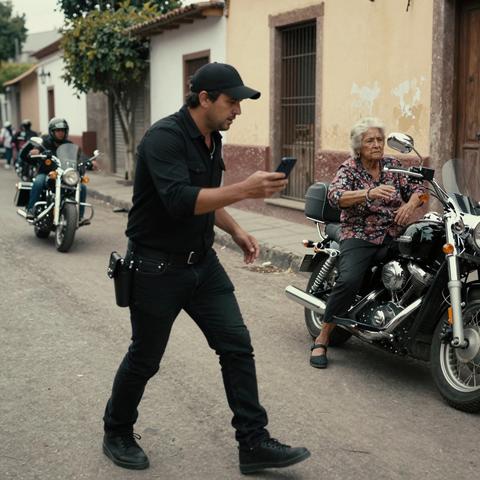
They rolled into the lot like they owned it. Fifteen bikes. They parked diagonally, taking up all the pumps, boxing me in. They cut their engines, but the air still felt heavy with the threat of violence.
I didn’t stop pumping gas. Rule number one in a hostile zone: maintain your routine. Don’t show fear.
“Well, look at this.”
The voice was loud, scratching against the morning calm. The leader, a man they called Havoc, swung his leg over his bike. He was big, wearing a leather vest covered in patches that hadn’t been earned in any service, just bought online to look tough.
He walked toward me, his boots crunching on the gravel.
“Grandma, you’re in my spot,” Havoc said. He had a toothpick rolling around in his mouth.
I kept my eyes on the nozzle. “There are four other pumps, son. Take your pick.”
The gas station attendant, Jimmy, a sweet kid barely out of high school, poked his head out the door. His face was pale. He reached for the phone, but one of Havoc’s goons pointed a gloved finger at him, and Jimmy froze.
“I’m not talking about the pump,” Havoc said, stepping into my personal space. He smelled of stale tobacco and aggression. “I’m talking about Riverstone. This is Viper town now. We don’t like relics cluttering up the view.”
He reached out and slapped the gas handle. Clang.
It hit the pavement. A few drops of gasoline splattered onto my shoes.
My heart didn’t race. That’s the funny thing about surviving a war. When you’ve had anti-aircraft fire ripping through the floorboards of your chopper while you’re trying to lift a squad of wounded Marines out of a hot zone, a man in a leather vest doesn’t scare you. He just annoys you.
“Pick it up,” I said. My voice was low, but it didn’t shake.
Havoc blinked. He looked back at his boys, grinning. “Did you hear that? She wants me to pick it up.”
The gang laughed. It was a cruel, hyena sound.
“You need to learn respect, old woman,” Havoc sneered, leaning down so his face was level with mine. “You’re nothing. You’re dust. You pay the toll, or you bleed. That’s how it works now.”
I looked him in the eye. I saw a bully. A man who had never faced a real fight, only victims who couldn’t fight back.
“Respect,” I said, testing the word. “You think fear is respect. You’re wrong.”
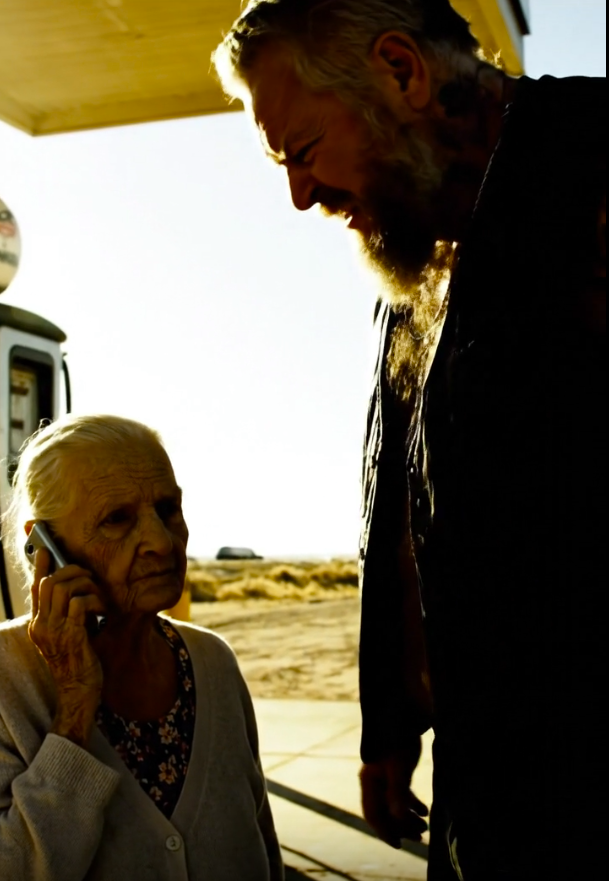
I reached into my cardigan pocket.
Havoc flinched, his hand moving to his belt. When he saw it was just a flip phone, he relaxed, letting out a mocking breath.
“Gonna call your grandkids?” he asked. “Tell ’em to come save you?”
“No,” I said, flipping the phone open with a snap. “My grandkids are in college. I’m calling the boys I used to drive to work.”
I dialed a number I knew by heart. It rang once.
“Morrison,” a voice answered. Rough. Alert.
“Jack,” I said. “It’s Peggy.”
The line went silent for a heartbeat. “Captain Thompson? Is everything alright?”
“I’m at Mike’s Gas and Go. I’ve got about fifteen gentlemen here, led by a man named Havoc. They seem to think they own the town. They just knocked the gas pump out of my hand.”
I watched Havoc’s face. He looked bored. He had no idea what was happening.
“Are you hurt?” Jack’s voice changed. It wasn’t the voice of the 70-year-old man who ran the local mechanic shop anymore. It was the voice of Colonel Iron Jack Morrison.
“Not yet,” I said. “But they’re blocking my car. And Jack? They said veterans are just relics.”
“Hold position, Peggy,” Jack growled. “We’re five minutes out. Alpha protocol.”
I snapped the phone shut and slipped it back into my pocket.
“You got five minutes,” I told Havoc. “If you leave now, you can keep your dignity. If you stay… well, you’ll get an education.”
Havoc laughed, shaking his head. “I ain’t going nowhere, Grandma. Let’s see who shows up. I hope they bring cookies.”
I leaned back against my Ford Taurus and crossed my arms. “I hope you’re hungry,” I whispered.
Chapter 2: Iron Jack
The minutes stretched out, heavy and thick. The Shadow Vipers loitered around the station, lighting cigarettes right next to the pumps, kicking at the tires of my car. They were trying to intimidate me, circling like wolves around a wounded deer.
But I wasn’t wounded. I was the bait.
Jimmy was still watching from the window, looking terrified. I gave him a small nod, trying to tell him to stay put. The police in Riverstone were underfunded and overworked; by the time they got here, this would be over one way or another.
“Time’s up,” Havoc said, checking his flashy watch. “Your friends ain’t coming. Now, hand over your wallet, and maybe we let you drive away with just a flat tire.”
Then, the ground started to shake.
It wasn’t the jagged, chaotic noise of the Vipers’ bikes. This was a low, synchronized thrum. It sounded like a B-52 bomber taxiing for takeoff. It was a sound that you felt in your teeth.
Havoc frowned, looking toward the main road. “What is that?”
The sound grew louder, organized, disciplined.
Then they crested the hill.
The Veterans Guard.
They didn’t ride like a gang. They rode like a cavalry unit. Two by two, perfectly spaced, moving at the exact same speed. At the front was a massive Harley Davidson, black as night, ridden by a man with broad shoulders and silver hair streaming out from under his helmet.
Iron Jack Morrison.
Behind him were fifty riders. Maybe more. Men who had served in Vietnam, Desert Storm, Iraq, Afghanistan. They wore vests, yes, but their patches were the screaming eagles of the 101st Airborne, the anchors of the Navy SEALS, the globe and anchor of the Marines.
They swept into the gas station lot, moving like water. They didn’t park haphazardly. They formed a perimeter. Within thirty seconds, the Shadow Vipers were completely surrounded, blocked in by a wall of American steel.
The silence that followed was deafening.
Jack killed his engine. Fifty other engines died in unison. The discipline was terrifying.
Jack kicked down his stand and dismounted. He was 72, but he looked like he could still bench press a Buick. He walked toward us, his boots heavy on the pavement. He didn’t look at Havoc. He looked straight at me.
He stopped, snapped his heels together, and offered a crisp salute.
“Captain Thompson,” he said, his voice carrying across the lot. “Reporting for duty.”
I returned the salute. “At ease, Jack.”
The Vipers were looking around nervously now. They did the math. They were outnumbered three to one, and their opponents looked like they ate barbed wire for breakfast.
Havoc, to his credit—or his stupidity—tried to bluster through it. He stepped forward, puffing out his chest.
“Who do you think you are?” Havoc barked. “This is private business.”
Jack turned slowly. He looked at Havoc like he was a stain on a dress uniform.
“I’m the guy who owes this woman his life,” Jack said calmly. “In 1968, my platoon was pinned down in the A Shau Valley. No one would come for us. Too hot. Too much anti-aircraft fire. But Peggy here? She flew her bird right into the mouth of hell. She sat on the ground for three minutes taking fire until every single one of my men was on board.”
Jack stepped closer. He towered over Havoc.
“She took a bullet in the leg and still flew us home. So when you disrespect her, son, you aren’t just disrespecting an old lady. You’re disrespecting every man standing behind me.”
A low growl of agreement rippled through the Veterans Guard.
Havoc looked at his own men. They were backing away, hands up, eyes wide. They were bullies, and bullies crumble when the target hits back.
“We… we didn’t know,” one of the Vipers stammered.
“Ignorance is not a defense,” Jack said. He pointed to the gas nozzle lying on the ground. “Pick it up.”
Havoc stared at him.
“I said,” Jack’s voice was like a whip crack, “pick. It. Up.”
Havoc swallowed hard. His face turned red, a mix of rage and humiliation. Slowly, he bent down. He picked up the nozzle and placed it back on the pump.
“Now fill her tank,” I said softly.
Havoc’s hand shook, but he did it. He squeezed the handle. We all stood there in silence, listening to the gas flow, watching the tough guy play attendant.
When it clicked off, he hung it up.
“We done?” Havoc muttered, unable to meet my eyes.
“For today,” Jack said. “But let me make something clear. If I see a Viper patch within ten miles of this woman again… well, we won’t be this polite.”
Havoc signaled his crew. They mounted up, their engines sounding whiny and weak compared to the Guard’s machines. They peeled out of the lot, kicking up gravel, fleeing like frightened dogs.
Jack watched them go, his face grim. He turned back to me, his expression softening.
“They’ll be back, Peggy,” he warned quietly. “Guys like that… their pride is hurt. They’ll want revenge.”
I looked at the dust settling on the road. I felt the old adrenaline humming in my veins, a feeling I hadn’t felt in forty years.
“I know, Jack,” I said. “Let them come. We were bored anyway, weren’t we?”
Jack grinned, a wolfish smile. “Yes, Ma’am. We were.”
But as I drove away, escorted by fifty of the finest men I’d ever known, I knew Jack was right. This wasn’t the end. It was the opening shot of a war for the soul of Riverstone. And Havoc wasn’t going to fight fair.
PART 2
Chapter 3: The Night the Town Burned
Revenge, I’ve found, is rarely a straight line. It’s a jagged scar that tears open when you least expect it.
After the confrontation at the gas station, a deceptive quiet fell over Riverstone. It was the kind of heavy, humid silence that precedes a monsoon. The Veterans Guard had escorted me home—a small, clapboard house with a porch swing I rarely used. Iron Jack had posted a sentry down the block, a Gulf War vet named Miller who sat in his truck pretending to read a newspaper.
I told Jack it was unnecessary. He told me that in his experience, a wounded animal is the most dangerous kind.
He was right.
Night fell hard. I was sitting in my armchair, nursing a cup of chamomile tea, listening to the crickets. My old bones were aching, a phantom pain in my leg where a viet cong bullet had grazed the bone fifty years ago. It always hurt when a storm was coming.
The phone rang at 2:00 AM.
It wasn’t a social call. Nobody calls a 90-year-old woman at 2:00 AM unless someone has died.
“Peggy.” It was Jack. His voice was tight, like a wire about to snap. “Don’t come downtown. Stay inside.”
“What’s happened?” I asked, already reaching for my shoes.
“They hit us, Peggy. They didn’t come for you. They came for everyone who stood up.”
I didn’t listen to him. I put on my coat, grabbed my cane, and walked out the door. Miller tried to stop me, but one look at my face and he just opened the passenger door of his truck.
“Get me to Main Street,” I ordered.
When we turned the corner onto Third Street, the sky was orange.
It wasn’t the sunrise. It was fire.
Mason’s Hardware, the oldest store in Riverstone, was engulfed in flames. Tom Mason had been the first one to clap when the Veterans Guard drove Havoc away that morning. Now, his legacy was turning to ash.
Firefighters were battling the blaze, their hoses looking like thin white veins against the inferno. The heat was intense, radiating through the truck’s windshield.
Further down the street, Diana’s Diner had its front windows smashed in. “TRAITORS” was spray-painted in jagged red letters across the brickwork.
I got out of the truck, ignoring Miller’s protests. The air smelled of acrid smoke and melting plastic. It smelled like the burning villages I’d seen from the cockpit of my Huey.
Tom Mason was sitting on the curb, his face streaked with soot, his head in his hands. Jack was standing over him, his hand on Tom’s shoulder.
I walked over, my cane tapping a grim rhythm on the pavement.
“Havoc,” I said. It wasn’t a question.
Jack looked at me. His eyes were hard, reflecting the flames. “Molotov cocktails. Hit and run. Cowards didn’t even stop their bikes.”
“He’s sending a message,” I said, watching the roof of the hardware store collapse in a shower of sparks.
“The message is that we don’t own this town,” Jack growled. “He wants us to know that if we stand up, he’ll burn us down.”
I looked at Tom. He was weeping silently. He had lost everything because I had made a phone call. Because I had too much pride to let a bully win.
Guilt is a cold stone in your gut. I felt it then, heavier than it had been in years.
“This is my fault,” I whispered.
Jack spun around, grabbing me by the shoulders. Gentle, but firm. “No, Captain. This is war. You didn’t start the fire. You just refused to let the arsonist hold the matches anymore.”
A police cruiser rolled up slowly. Chief Roberts stepped out. He was a good man, or he used to be, but he looked tired. Defeated.
“I can’t prove it was the Vipers,” Roberts said, not meeting our eyes. “No witnesses. Cameras were painted over before the attack.”
“You know it was them, Roberts,” Jack snapped.
“Knowing and proving are different things, Jack,” the Chief sighed. “And the Mayor… he’s worried about ‘escalation.’ He wants peace.”
“There is no peace,” I said, my voice cutting through the noise of the fire sirens. “There is only surrender, or there is victory.”
I looked at the burning building, then at the shattered diner. Havoc thought this would break us. He thought terror would drive the veterans back into the shadows and make the townspeople bow their heads.
He didn’t understand who he was dealing with. He didn’t understand that fire doesn’t destroy steel; it tempers it.
“Jack,” I said, turning away from the blaze. “Call the boys. All of them.”
“What’s the plan, Peggy?”
“We’re not reacting anymore,” I said. “We’re done playing defense. Havoc wants to burn this town? Fine. We’re going to show him what happens when you trap a tiger in a corner.”
“Where are we going?” Jack asked.
“To the War Room,” I said. “It’s time to take back the night.”
Chapter 4: The War Room
The “War Room” was actually the basement of the local VFW hall. It smelled of stale beer, floor wax, and memories. But tonight, it crackled with an energy I hadn’t felt since the briefing rooms at Da Nang.
By 4:00 AM, the room was packed. Fifty men and women. The Veterans Guard.
They weren’t just bikers. That’s what people forgot. They saw the leather vests and the beards and assumed they were outlaws. They forgot that beneath the denim were men who had been Combat Engineers, Snipers, Medics, Intelligence Officers, and Logistics experts.
We pushed three pool tables together to make a command center. A map of Riverstone was spread out across the felt.
I stood at the head of the table. I didn’t need a cane right now. Adrenaline is a powerful crutch.
“Status report,” I said.
Sarah Chen, a former Army Intelligence officer who now ran the local bakery, stepped forward. She placed a tablet on the table.
“I’ve been monitoring their comms,” Sarah said. “The Shadow Vipers aren’t using encrypted channels. They’re arrogant. They’re bragging about the fire. But there’s something else.”
“What?” Jack asked, leaning over the map.
“They’re receiving transfers,” Sarah said, swiping the screen. “Big money. Moving through shell accounts. And I picked up chatter about a shipment coming in tomorrow night. Heavy trucks. Not motorcycles.”
“Drugs,” Jack spat.
“More than that,” I said, studying the map. “Havoc isn’t just a thug. He’s a middleman. He’s been selling Riverstone out to a cartel. That’s why he needs control. That’s why he can’t let us humiliate him. If he looks weak, his buyers lose confidence.”
The room went silent. The stakes had just shifted. We weren’t fighting a biker gang anymore; we were fighting a distribution hub for organized crime.
“This is police work, Peggy,” one of the younger vets, a kid named Miller who served in Afghanistan, said. “We should hand this to the Feds.”
“The Feds take months,” I replied. “By the time they build a case, Havoc will have burned the rest of Main Street to the ground to teach us a lesson. We don’t have months. We have hours.”
I looked around the room. I saw fear in some eyes, but mostly I saw resolve. These were people who had sworn an oath to protect domestic enemies as well as foreign ones.
“Here is the situation,” I began, my voice steady. “Havoc thinks he won tonight. He thinks we’re licking our wounds. He expects us to either hide or come at him in a blind rage, attacking his warehouse directly.”
“He’d be ready for a frontal assault,” Jack noted. “He’ll have that warehouse fortified.”
“Exactly,” I said. “Which is why we aren’t going to the warehouse. We’re going to starve him out.”
I picked up a marker and circled three spots on the map.
“Sarah says there’s a shipment coming. We’re going to intercept it. Not destroy it—that’s criminal. We’re going to delay it. We’re going to make him miss his delivery window.”
“Then,” I pointed to the downtown area, “we initiate Operation Rolling Thunder. Every business that Havoc has threatened? We garrison it. Two Guard members in every shop, open carry. If he wants to extort money, he has to ask a Marine for it.”
“And finally,” I looked at Jack, “we cut off the head.”
“We kill him?” Miller asked, looking nervous.
“No,” I said sharply. “We aren’t murderers. We destroy his reputation. A bully without fear is nothing. We’re going to humiliate him so badly that his own men won’t follow him, and his cartel bosses will view him as a liability.”
“How do we do that?” Jack asked.
I smiled, a cold, tight smile. “Havoc loves an audience. He loves to show off. Tomorrow is the Riverstone Founder’s Day Parade. He’s been bragging that the Vipers are going to lead the procession, forcing the Mayor to let them ride up front.”
“He wants to be the King of Riverstone,” Jack nodded.
“We’re going to let him think he is,” I said. “Until he turns the corner onto Main Street.”
“What happens on Main Street?” Sarah asked.
“On Main Street,” I said, tapping the map, “he runs into the Angel of Khe Sanh.”
The plan was risky. It relied on timing, intimidation, and the assumption that Havoc’s ego was bigger than his brain. But in my experience, men like Havoc always tripped over their own pride.
“Get some sleep,” I told them. “Tomorrow, we retake our town.”
As the meeting broke up, Jack lingered. He looked worried.
“Peggy,” he said softly. “You know if this goes south… if the cartel gets involved… we could be looking at a firefight in the middle of a parade.”
“I know,” I said. I looked down at my shaking hands and clenched them into fists until they stopped. “But Jack? I’m ninety years old. I’ve lived a full life. If I go out, I’d rather go out standing on my feet than lying in a hospital bed.”
Jack put a hand on my shoulder. “You won’t be standing alone, Captain.”
Chapter 5: The Parade
Founder’s Day in Riverstone used to be about high school marching bands and floats made of tissue paper. This year, the air was thick with tension. The smell of the burnt hardware store still lingered, mixing uncomfortably with the scent of cotton candy.
The streets were lined with people, but they weren’t cheering. They were watching. Waiting.
At noon, the roar began.
Havoc and the Shadow Vipers turned onto the parade route. They hadn’t asked for permission; they just took the lead. Thirty bikes now—he had called in reinforcements from a neighboring chapter. They revved their engines, drowning out the high school band. They weaved back and forth, forcing families to step back onto the sidewalks.
Havoc was at the front, no helmet, grinning like a shark. He looked like a conqueror surveying his new kingdom. He thought he had won. He thought the fire had scared us into submission.
He turned the corner onto Main Street, right in front of the charred remains of Mason’s Hardware.
And then he slammed on his brakes.
Blocking the road was a single vehicle.
My Ford Taurus.
I was sitting on the hood. I wore my old flight jacket, the leather cracked and faded, patches from the 1st Cavalry Division stitched on the shoulder. I held my cane like a scepter.
Behind me, lining the rooftops of the buildings on both sides of the street, were the Veterans Guard. They stood silent, arms crossed, looking down. They weren’t holding guns—that would be illegal—but they were holding something worse: cameras. High-definition video cameras, streaming live to the state police, the local news, and the internet.
Havoc stopped his bike ten feet from my car. The parade ground to a halt behind him. The silence returned, heavier than before.
“Move the car, Grandma!” Havoc shouted, his engine idling angrily. “Or I’ll push it out of the way!”
“You’re welcome to try,” I called out. My voice was amplified. Sarah had rigged a PA system under my car. “But you might want to look up first.”
Havoc looked up. He saw the fifty men on the roofs. He saw the cameras.
“Smile, Havoc,” I said, my voice echoing off the buildings. “You’re on TV.”
“I don’t care about cameras!” Havoc screamed, losing his cool. “I own this town!”
“Do you?” I asked. “Because it looks to me like you’re just a traffic obstruction.”
Then, from the side streets, the townspeople began to emerge.
This was the part I wasn’t sure would work. Jack had spent the morning talking to the shop owners, the teachers, the mechanics. He told them we would stand, but only if they stood with us.
Tom Mason walked out from the crowd. He was holding a broom. He stood next to my car.
Then Diana from the diner. She was holding a frying pan.
Then the high school football team. Then the librarians. Then the grandmothers.
Hundreds of them. They flooded the street behind my car, a human wall of ordinary people tired of being afraid. They didn’t have weapons. They had numbers. And they had dignity.
Havoc looked at the wall of people. Then he looked at his men. His reinforcements were looking nervous. They were tough guys, sure, but attacking a 90-year-old woman and a high school football team on live television? That wasn’t gang business. That was suicide.
“This is your last chance, Havoc,” I said. “Turn around. Ride out. Don’t come back.”
Havoc’s face turned purple. His ego was fracturing in real-time. He revved his engine, lurching forward an inch.
“I’ll kill you!” he roared.
“Do it!” Jack shouted from the rooftop. “Make the mistake!”
For a second, I thought he would. I saw the madness in his eyes. I braced myself, gripping my cane.
But then, a black SUV pulled up behind the line of bikers. The back window rolled down. I couldn’t see who was inside, but Havoc could.
He looked at the SUV. He paled.
The person in the car gave a single, sharp nod. Retreat. Even the cartel knew this was too much heat. A massacre on Main Street would bring down the National Guard. It was bad for business.
Havoc looked back at me. Hate radiated off him like heat waves.
“This isn’t over,” he hissed, just loud enough for me to hear. “You think you’re smart? You just painted a target on your back.”
“I’ve been a target since 1968, son,” I replied. “Get used to missing.”
He spat on the ground, signaled his men, and they turned their bikes around. The crowd parted just enough to let them through, watching in silence as they slunk away, back toward the warehouse district.
When the last bike disappeared, the cheer that went up shook the windows.
People rushed the car. Tom Mason was crying, hugging me. Jack came down from the roof, a grin splitting his face.
“We did it, Peggy,” he shouted over the noise. “We drove them back!”
But I didn’t smile. I was watching the black SUV as it slowly reversed and disappeared down a side alley.
Havoc was a thug. He could be beaten with shame and numbers. but the man in the SUV? That was different. That was calculated evil.
I had humiliated their puppet. Now, the puppet masters would get involved.
“Jack,” I said, leaning close so only he could hear. “Get the boys back to the HQ. Double the perimeter.”
“Why?” Jack asked, his smile fading.
“Because the Vipers are leaving,” I said grimly. “Which means the heavy hitters are clocking in.”
I looked at the celebrating town. They thought they had won the war. They didn’t know they had just survived the opening skirmish.
The real enemy hadn’t even stepped onto the battlefield yet. And unlike Havoc, they wouldn’t bring baseball bats. They would bring war.
PART 3
Chapter 6: The Professionals
The celebration on Main Street didn’t last long. By sunset, the streamers were coming down, and the mood had shifted from jubilant to wary. We knew the Vipers were gone, but the silence they left behind was heavier than their noise.
I sat in the War Room—the VFW basement—watching the surveillance feeds Sarah had rigged up.
“It’s too quiet,” Jack muttered, pacing the floor. “Havoc would be breaking windows by now. Throwing a tantrum.”
“Havoc isn’t in charge anymore,” I said, pointing to a grainy feed from the industrial district. “Look.”
Three black SUVs were gliding through the streets. They moved with precision, maintaining perfect distance. No revving engines. No loud music. They were ghosts.
“Who are they?” Miller asked.
“Contractors,” I said. “Mercenaries. The Cartel sent in the cleaners.”
The phone in the War Room rang. It wasn’t a secure line. It was the public line.
I picked it up. “Thompson.”
“Captain Thompson,” a voice said. It was smooth, calm, and utterly devoid of emotion. “My name is Marshall. I believe we have a mutual acquaintance.”
“If you mean the thug on the motorcycle,” I replied, “we aren’t friends.”
“Havoc was… a blunt instrument,” Marshall said. “I prefer surgical tools. I’m calling to offer you a professional courtesy. You have embarrassed my employers. They want a resolution.”
“I’m listening.”
“Leave town,” Marshall said. “You and Mr. Morrison. Take a vacation. Tonight. If you’re gone by midnight, Riverstone goes back to being a quiet little town. We’ll conduct our business, and no one gets hurt.”
“And if we stay?”
“Then I stop treating this as a civil dispute and start treating it as a hostile extraction. I have three teams of men who learned their trade in Fallujah. You have a biker club.”
“We have home-field advantage,” I said.
“That only matters if you survive the first hour,” Marshall replied. “Midnight, Captain. Check your watch.”
The line went dead.
I looked at Jack. “We have six hours.”
“To pack?” Miller asked.
“To set a trap,” I corrected.
The dynamic had changed. Havoc wanted to scare us. Marshall wanted to erase us. We couldn’t beat them in a straight firefight. They had body armor, night vision, and automatic weapons. We had hunting rifles and Vietnam-era tactics.
“We can’t outshoot them,” Jack said, reading my mind.
“No,” I agreed. “But we can outthink them. Marshall expects us to dig in. To fortify the VFW or the Police Station. He expects a siege.”
I looked at the map of Riverstone. I traced the winding streets, the narrow alleys, the construction sites.
“We’re going to give him what he wants,” I said. “We’re going to give him a target. Me.”
“Peggy, no,” Jack started.
“I’m going to be at Diana’s Diner at midnight,” I said firmly. “Sitting in the window. A clear shot. That will draw his teams in.”
“That’s suicide,” Sarah said.
“It’s bait,” I replied. “Because while they’re watching me, you boys are going to be watching them.”
I turned to Jack. “Get me the City Engineer plans. I want to know exactly where the main power grid junctions are for the downtown sector.”
Jack smiled slowly. “You want to turn the lights out.”
“I want to take them back to the jungle,” I said. “They have night vision? Fine. We have fifty years of knowing how to move in the dark.”
Chapter 7: The Kill Box
11:55 PM.
Diana’s Diner was dark, except for a single booth near the window where I sat. A cup of cold coffee sat in front of me. The street outside was deserted.
I felt like a mannequin in a display case.
Through my hidden earpiece, I heard Sarah’s voice. “Team Alpha is in position. Rooftops on the north side. Team Bravo is in the alley behind Mason’s.”
“Do you see them?” I whispered.
“We have eyes on three SUVs,” Sarah reported. “They’re parking two blocks away. Foot mobiles moving in. They’re approaching from the east and west. Pincer movement.”
Marshall was good. He was cutting off my escape routes. He wasn’t just coming to kill me; he was coming to make sure no one saw it happen.
The door to the diner opened.
The bell jingled cheerfully, a stark contrast to the man who walked in. Marshall wore a tailored suit, but he moved like a panther. He slid into the booth opposite me.
“You’re stubborn,” he said. He placed a heavy pistol on the table, resting his hand over it.
“I’m old,” I said. “Stubborn is all I have left.”
“Your friends aren’t here,” Marshall observed, looking around the empty diner. “Did they abandon you?”
“I told them to stay home,” I lied. “This is between you and me.”
Marshall checked his watch. “Midnight.”
“Time’s up,” I said.
“Goodbye, Captain,” Marshall said. He began to lift the gun.
“Jack,” I said clearly. “Now.”
CLICK.
The entire downtown grid died.
The streetlights, the diner lights, the traffic signals—everything plunged into absolute, suffocating darkness.
Marshall froze. He hadn’t expected the infrastructure to fail. He reached for his radio. “Team One, status!”
Static.
“We jammed the frequencies,” I said, my voice calm in the dark. “And Marshall? You’re not the only one with night vision.”
Outside, the chaos began. But it wasn’t the loud chaos of gunfire. It was the sound of tires slashing, of engines being disabled, of men being tackled in the dark.
The Veterans Guard moved in. They knew every curb, every loose brick, every doorway. They wore blackout gear. They swarmed the mercenary teams with baseball bats, zip ties, and overwhelming numbers.
In the diner, Marshall lunged across the table.
But I wasn’t there anymore. I had slid under the table the moment the lights went out.
A red laser dot appeared on Marshall’s chest.
“Don’t move,” Jack’s voice boomed from the darkness of the kitchen. “I’ve got a hunting rifle that can take the head off a quarter at fifty yards. You’re a much bigger target.”
Marshall froze. The door burst open, and Chief Roberts rushed in with four officers, flashlights blinding the mercenary.
“Federal Agents are hitting the warehouse right now,” Roberts shouted. “It’s over, Marshall. Drop the weapon.”
Marshall hesitated. He was a professional. He calculated the odds. 0% chance of success. 100% chance of death.
He slowly took his hand off the gun. “Well played,” he muttered.
Outside, the streetlights flickered back on. The scene was surreal. Twelve mercenaries lay zip-tied on the sidewalk. The Veterans Guard stood over them, looking grim and satisfied.
We had won. The “professionals” had been dismantled by retirees with a plan.
But as Roberts cuffed Marshall, a frantic voice crackled over the police radio.
“Chief! It’s Havoc! He wasn’t at the warehouse! He’s in a truck! He’s got explosives!”
My blood ran cold. Havoc had gone rogue. He wasn’t working for the cartel anymore. He was working for pure spite.
“Where is he?” Roberts screamed into the radio.
“He’s heading for the dam!” the officer yelled. “He’s going to blow the spillway! If that dam goes, half the town floods!”
I looked at Jack. We didn’t need to speak.
The war wasn’t over. The final battle was just beginning.
Chapter 8: The Final Flight
The Riverstone Dam was an old earthen structure three miles upstream. If Havoc cracked it, millions of gallons of water would sweep through Main Street, washing away everything we had fought to save.
“My truck,” Jack yelled. We sprinted to his heavy-duty pickup.
“He’s got a ten-minute head start,” Jack said, peeling out of the lot, tires screaming.
“He’s on the main road,” I said, my mind racing. “The winding road. It takes fifteen minutes to get up there.”
“We can’t catch him,” Jack slammed the steering wheel.
“We don’t need to catch him,” I said. “I know a shortcut. The old logging trail.”
“Peggy, that trail hasn’t been used in twenty years. It’s a goat path. In the dark?”
“Drive, Jack! Or we all learn how to swim!”
Jack veered off the asphalt onto a dirt track that looked more like a cliff edge than a road. The truck bounced violently. My teeth rattled, and my old spine screamed in protest, but I held on.
We tore through the woods, branches whipping the windshield. We were gaining altitude fast, cutting the switchbacks.
“There!” I pointed.
Below us, on the paved road, we saw the headlights of a box truck. Havoc. He was driving recklessly, swerving across lanes.
“We’re going to beat him to the service entrance,” Jack said, flooring the gas.
We burst out of the tree line and onto the gravel service road at the top of the dam just as Havoc’s truck crested the hill.
Jack slammed on the brakes, drifting the truck sideways to block the narrow access road.
Havoc saw us. He didn’t slow down.
“He’s going to ram us!” Jack shouted.
“Get out!” I yelled.
We scrambled out of the cab and dove behind a concrete barrier just as Havoc’s truck plowed into Jack’s pickup.
CRASH.
The sound was sickening. Metal screamed against metal. Jack’s truck was shoved backward, but it held. Havoc’s truck crumpled, steam hissing from the radiator.
Silence returned to the dam, broken only by the hiss of the engine.
Havoc kicked his door open. He stumbled out, blood streaming down his face. In his hand, he held a detonator. Wires trailed back into the ruined truck.
“I told you!” he screamed, his voice cracking with madness. “I told you I’d wipe this town off the map!”
Jack raised his rifle, but he couldn’t shoot. If Havoc’s finger twitched, the truck—and the dam—would go.
“Put it down, son,” Jack said calmly.
“Don’t call me son!” Havoc shrieked. “You took everything! My reputation! My money! Now I take your town!”
I stood up. I walked out from behind the barrier.
“Peggy, get back!” Jack warned.
I ignored him. I walked toward Havoc. I was ninety years old. Unarmed. A stiff wind could knock me over.
“Stay back!” Havoc yelled, raising the detonator. “I’ll do it! I swear!”
“I know you will,” I said softly. I stopped ten feet from him. “Because you’re scared. You’ve been scared since the moment you rode into my gas station.”
“I ain’t scared of you!”
“No,” I said. “You’re scared that you don’t matter. You built a kingdom on fear, and when we took the fear away, you realized you were just a small man in a leather vest.”
Havoc’s hand was shaking violently. tears mixed with the blood on his face.
“It’s too late,” he sobbed. “I can’t go back.”
“You can’t go back,” I agreed. “But you don’t have to take everyone with you.”
I took a step closer. “Look at me, Havoc. Look at an old woman. Is this how you want to be remembered? As a murderer? Or as a man who finally made one right choice?”
For a second, his eyes flickered. The madness receded, replaced by exhaustion.
Then, a shadow moved behind him.
It was Diesel. His second-in-command. The man who had been riding in the passenger seat, unnoticed in the crash.
Diesel didn’t look mad. He looked tired.
“Boss,” Diesel said softly. “She’s right. It’s over.”
Havoc spun around. “Diesel! Help me wire this!”
Diesel looked at the dam. Then he looked at the lights of Riverstone twinkling in the valley below.
“My mom lives down there, Havoc,” Diesel said.
BANG.
Diesel didn’t shoot Havoc. He tackled him.
The detonator flew out of Havoc’s hand, skittering across the pavement. It stopped at the toe of my orthopedic shoe.
Jack was on them in a second, securing Havoc. Diesel stood up, hands raised, surrendering.
“I’m done,” Diesel said. “We’re done.”
I looked down at the detonator. I picked it up, my hand trembling now that the danger was over.
I looked over the edge of the dam at the sleeping town. They had no idea how close they had come to washing away.
One Year Later.
The gas station is busy today. Jimmy is manager now.
I’m filling up my Taurus. Tuesday. VA meeting.
A motorcycle pulls up to the pump next to me. It’s Diesel. He’s not wearing a Viper vest anymore. He’s wearing a mechanic’s shirt with “Morrison’s Garage” stitched on the pocket. Jack gave him a job once he got out on parole.
“Morning, Mrs. Thompson,” Diesel says respectfully.
“Good morning, James,” I reply.
Riverstone has changed. The burnt buildings have been rebuilt, stronger than before. The Veterans Guard still rides, but they don’t patrol for enemies anymore. They escort funerals, they raise money for schools, they watch over the town.
Marshall is in federal prison. The Cartel never came back—too much trouble, too much exposure. Havoc is serving life.
And me?
I’m just an old woman getting gas.
But sometimes, when the wind hits the trees just right, I remember the sound of chopper blades. I remember the fear. And I remember that even when you’re ninety, even when you’re small, even when the world thinks you’re finished… you can still fight.
I hung up the nozzle.
“Full tank, James,” I told him.
He smiled. “Yes, ma’am. Full tank.”
I got in my car and drove toward the sunrise. The town was safe. The war was over. And for the first time in a long time, I was just Peggy again.
THE END.