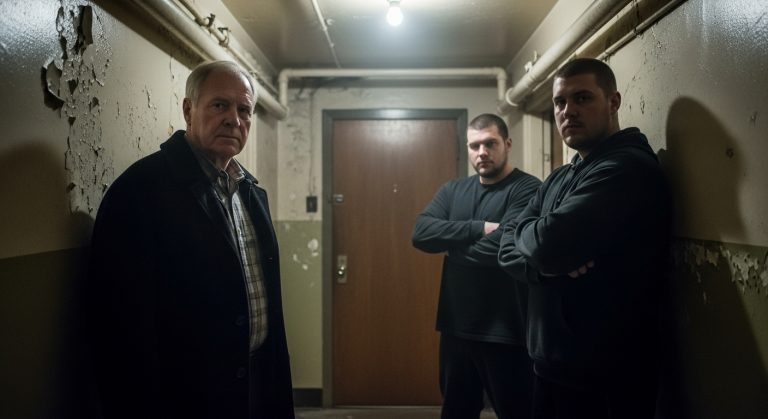
The Teacher Mocked My “Unemployed” Parents and My Old Clothes. She Didn’t Realize Who Was Standing Behind the Door Until It Was Too Late.
PART 1
Chapter 1: The Inventor of Nothing
The smell of Oak Creek Middle School was always the same. It was a mixture of floor wax, cedar pencils, and the distinct, metallic scent of money.
I didn’t smell like money. I smelled like the lavender detergent my foster mom bought in bulk at the dollar store, and the stale, dusty scent of the thrift shop where we bought my jeans on “half-off” color tag days.
I was eleven years old, but I felt like I was a hundred.
My name is Marcus. But to the twenty-eight other kids in Room 304, and to Mrs. Gable, I was “The Inventor.”
It sounds like a cool nickname, right? Like Tony Stark? Like someone who builds rockets?
It wasn’t.
It started in September when I brought a broken toaster to school because I didn’t have a backpack. I had fixed the heating element using a paperclip and some stripped copper wire I found behind the cafeteria. I was proud of it. I wanted to show someone that I could make things work again.
Jason Miller, the kid whose dad owned half the car dealerships in the county, knocked it out of my hands in the hallway. When the springs and screws scattered across the floor, he laughed.
“Look at the Inventor,” he had sneered. “Inventing new ways to be trash.”
The name stuck.
Mrs. Gable, my homeroom teacher, heard it. She didn’t stop it. She adopted it. She would hand back my tests—usually graded with Cs because I was too tired from working odd jobs to study—and say, “Not much of an invention here, is it, Marcus?”
She was a woman who wore pearls to a middle school. She had a smile that didn’t reach her eyes, a smile that looked painted on. She loved the kids who came from the “right” neighborhoods. The kids who went to skiing camps in Aspen over winter break. The kids whose parents were on the PTA board.
I was invisible to her, unless she needed a punching bag to make the other kids laugh.
That Tuesday started like any other. The Virginia humidity was already clinging to the windows, making the classroom feel like a greenhouse. My t-shirt, a faded black one with a band logo that had long since washed away, was sticking to my back.
“Alright, settle down, settle down,” Mrs. Gable chirped, clapping her hands. Her rings clicked together. “Today, we’re going to do something a little different. Since the district Career Fair is coming up, I want to go around the room. I want you to stand up and tell us what your parents do.”
My stomach dropped. It felt like I had swallowed a stone.
This was it. The trap.
I slumped lower in my chair. The laminate wood felt cool against my forearm. I tried to calculate the time. If each kid took two minutes, and there were twenty-eight kids… maybe the bell would ring before she got to me.
“Jason, let’s start with you,” she said, her voice dripping with sugar.
Jason stood up. He didn’t just stand; he posed. He hooked his thumbs into the belt loops of his designer jeans. “My dad is the CEO of Miller Automotive Group. And my mom runs the charity gala for the hospital.”
“Wonderful,” Mrs. Gable cooed. “Leadership and philanthropy. Excellent.”
Next was Sarah. “My dad is a patent lawyer. My mom is a judge.”
“The pillars of justice,” Mrs. Gable nodded. “Very impressive, Sarah.”
It went on and on. Engineers. Architects. Stockbrokers. A terrifying amount of Real Estate agents.
Every time a kid spoke, the room seemed to get smaller. The air got thinner. They were building a wall of success, brick by brick, and I was on the outside.
I looked down at my sneakers. The duct tape on the left toe was peeling up. I pressed it back down with my other foot, hoping no one noticed.
“Marcus?”
The name hung in the air like a curse.
I didn’t move.
“Marcus,” Mrs. Gable said again, her voice losing the sugar. Now it was just vinegar. “We’re waiting. Stand up, please.”
I slowly pushed my chair back. It scraped against the floor, a loud, harsh screech that made everyone wince.
I stood up. My knees were shaking. I crossed my arms over my chest to hide the stain on my shirt.
“Well?” Mrs. Gable raised an eyebrow. “Share with the class. What do your parents do?”
Chapter 2: The Commander
I looked at the clock. Five minutes to the bell. I just needed to survive five minutes.
“They…” My voice cracked. I cleared my throat, hating myself for being so weak. “They don’t work.”
A pin could have dropped in that room and it would have sounded like a bomb.
Jason turned in his seat, a wide, predatory grin spreading across his face. “They don’t work? Like, at all?”
“No,” I whispered.
“So they just sit around?” Sarah asked, wrinkling her nose.
I opened my mouth to explain. I wanted to tell them that my foster mom had a disability that kept her bedridden, and my foster dad had left three years ago. I wanted to tell them that I didn’t have “parents” in the way they did. I had a system. I had caseworkers.
But the words wouldn’t come out.
“So you’re saying,” Mrs. Gable interrupted, stepping closer to my desk, “that they are unemployed?”
“Yes, ma’am,” I said, staring at her shoes. They were shiny. Everything about her was shiny.
“Well,” Mrs. Gable let out a breathy laugh, looking around at the other students as if inviting them in on the joke. “That certainly explains a lot, doesn’t it?”
The class giggled. It started low, then grew.
“Explains what?” Jason called out, playing along.
“The wardrobe situation,” Mrs. Gable gestured vaguely at my outfit. “The lack of… supplies. The general hygiene. It’s all starting to make sense. You know, Marcus, usually, people who want to succeed in life contribute to society. They don’t just… take.”
The laughter was loud now. It was open. They weren’t hiding it. They were laughing at my poverty. They were laughing at my life.
“Maybe if they got jobs, you wouldn’t look like you slept in a dumpster!” Jason shouted.
Mrs. Gable didn’t scold him. She smirked. “Now, now, Jason. Be kind. Not everyone has the same… advantages.”
My face burned. I felt hot tears prick my eyes. Don’t cry, I screamed internally. Do not let them see you cry.
But I couldn’t stop it. A single tear rolled down my cheek. I quickly wiped it away with my dirty sleeve, but they saw.
“Aww, the Inventor is crying!”
“Does he need a tissue? Or is that too expensive?”
I wanted to die. Right there. I wanted the ceiling to collapse.
And then, the door handle turned.
It wasn’t a gentle turn. It was a firm, decisive motion.
The heavy classroom door swung open with a mechanical thud.
The laughter didn’t stop immediately. It trailed off, confusingly, as the students turned to see who had interrupted their fun.
A man walked in.
He was tall. Over six feet. He had broad shoulders that seemed to fill the doorframe.
But it wasn’t his size that stopped the room. It was what he was wearing.
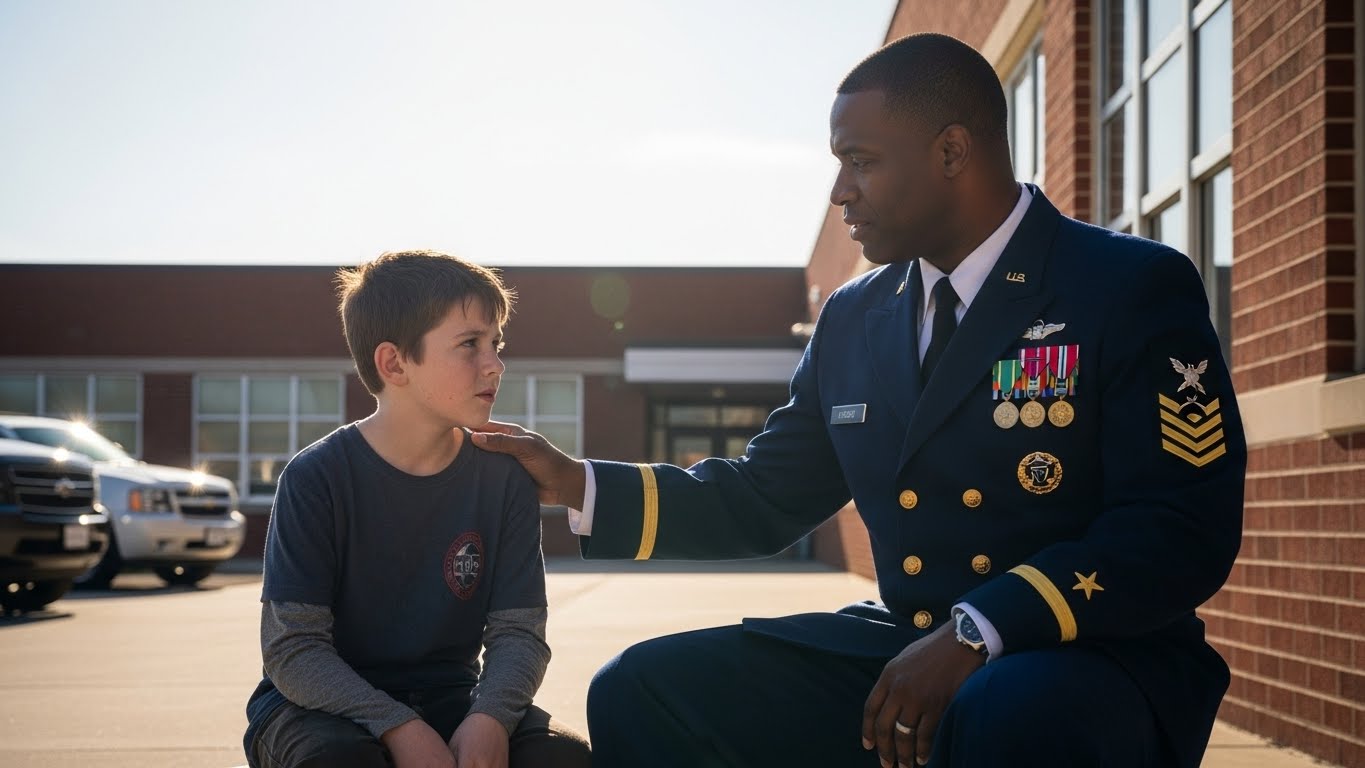
He was in a Navy dress uniform. The fabric was a deep, midnight blue. The buttons were gold. He wore a white hat with a black brim, which he removed slowly as he stepped into the room, tucking it under his arm.
Rows of colorful ribbons sat above his left pocket. Gold stripes circled his sleeves. He looked like something out of a movie, but he was terrifyingly real.
His face was stone. His eyes were dark and scanning the room with the precision of a radar system.
He looked at Jason, who immediately slumped in his chair, his mouth hanging open.
He looked at Mrs. Gable, who had frozen mid-gesture, her hand halfway to her pearls.
Then, he looked at me.
The scary stone face cracked. Just a little. A warmth flooded into his eyes that I had never seen before.
He walked toward me. His boots—black, polished to a mirror shine—clicked rhythmically on the floor. Click. Click. Click.
The room was so silent you could hear the hum of the air conditioner.
He stopped right in front of my desk. He didn’t look at my old clothes. He didn’t look at the tear on my face. He looked me in the eye.
“Marcus,” he said. His voice was deep, resonant, and incredibly calm. “I am here to get your notebook. You forgot it in the car this morning.”
He held out a notebook. It was a brand new, leather-bound journal. I had never seen it before in my life.
I stared at him, confused. “I…”
He gave me a tiny, imperceptible wink.
Mrs. Gable found her voice. It was squeaky, high-pitched, and terrified. “Excuse me? Sir? You can’t just… walk in here. Who are you?”
The man turned slowly. He pivoted on his heel to face her. He didn’t raise his voice. He didn’t have to.
“I am Commander Jenkins,” he said. “United States Navy.”
Mrs. Gable gulped. “Oh. I… I see. Well, Commander, we were just… having a discussion about careers. About parents’ jobs.”
Commander Jenkins looked at her. Then he looked at the class. Then he looked back at her.
“Is that right?” he asked. “And what, exactly, was the funny part of that discussion? I heard a lot of laughter from the hallway.”
Mrs. Gable turned pale. “Oh, nothing. Just… classroom banter. We were discussing the importance of… work ethic.”
Commander Jenkins took a step toward her. Just one step. But it felt like a tank advancing.
“Work ethic,” he repeated. He placed a heavy hand on my shoulder. “Marcus here has more work ethic in his little finger than most adults I know. And as for his parents…”
He paused. The tension in the room was electric.
“His parents,” the Commander continued, his voice dropping an octave, becoming dangerous, “gave more to this country than you will ever understand. And I am here to make sure that is respected.”
Mrs. Gable trembled. “I… I didn’t know. He said they didn’t work.”
“They don’t,” Jenkins said simply. “Because they’re dead. They died serving this country. And I am his guardian now.”
PART 2
Chapter 3: The Ghost in the Room
The silence that followed Commander Jenkins’ words was absolute. It wasn’t just quiet; it was a vacuum. The air had been sucked out of the room, leaving everyone gasping.
“Dead?” Mrs. Gable whispered. Her hand flew to her mouth. Her eyes darted from the Commander to me, wide with horror. Not sympathy—horror. She was terrified of the repercussions. She was terrified of how this looked.
I was just as shocked as she was.
My parents? Dead? Heroes?
I didn’t know them. I had never known them. I was a ward of the state. I bounced from house to house. The “parents” I had mentioned earlier were my current foster family—the ones who sat on the porch all day smoking while I fixed the neighbors’ toasters for spare change.
But looking up at Commander Jenkins, seeing the steel in his jaw and the fire in his eyes, I realized something. He wasn’t talking about my foster parents. He was building a shield. He was crafting a new reality for me, right there in front of everyone.
“Yes,” Jenkins said, his voice hard. “They were the best of us. And Marcus carries that legacy.”
He looked down at me again. His hand on my shoulder was heavy, grounding. It felt like protection. It felt like armor.
“Grab your things, Marcus,” he said softly. “We’re leaving.”
“Leaving?” Mrs. Gable stammered. “But… school isn’t over. You need a slip from the office. You can’t just—”
Jenkins turned his head slowly. He didn’t blink. “I’m checking him out. Unless you’d like to explain to the Superintendent why you were mocking a Gold Star orphan in front of twenty-eight witnesses?”
Mrs. Gable’s mouth snapped shut. She looked like she was going to be sick.
“I… of course not. Go ahead. Take your time.”
I stood up. My legs felt like jelly. I grabbed my battered binder. I grabbed my pencil case with the broken zipper.
As I walked toward the door, I passed Jason’s desk.
Jason, the kid who had terrorized me for months, wouldn’t look at me. He was staring at his desk, his face bright red. He looked small. For the first time all year, he looked like just a kid.
I walked past Sarah. She looked ashamed.
I reached the door where the Commander was waiting. He held it open for me. A gentleman.
“After you, son,” he said.
We walked out into the hallway. The door clicked shut behind us, sealing away the toxicity of Room 304.
The hallway was empty and quiet. My heart was pounding so hard I thought it would burst through my chest.
I looked up at the giant man walking beside me.
“Who are you?” I whispered. “Really?”
He stopped walking. He crouched down on one knee so he was eye-level with me. The medals on his chest jingled softly.
“I’m Commander Jenkins,” he said, a small, genuine smile appearing on his face. “But you can call me David. I knew your father, Marcus. A long time ago. Before… everything.”
My breath hitched. “You knew him?”
“I did,” he nodded. “He was a good man. A brilliant man. He liked to fix things, too.”
He reached into his pocket and pulled out a small, worn photograph. He handed it to me.
It was a picture of two young men in uniform, standing in front of a jeep. One was clearly a younger version of Jenkins. The other…
The other man had my eyes. He had my messy hair. He was holding a wrench, laughing at the camera.
“That’s him,” Jenkins said softly. “That’s your dad.”
Chapter 4: The Ride Home
We walked out of the school building into the bright afternoon sun. It felt different now. The air felt cleaner.
Parked at the curb, right in the “No Parking” zone that even the buses didn’t use, was a black SUV. It was sleek, polished, and had government plates.
Jenkins opened the passenger door for me. The interior smelled like new leather and mints.
“Where are we going?” I asked, buckling the seatbelt. It was the first time I had ever been in a car this nice.
“To get a burger,” Jenkins said, starting the engine. It purred to life. “And then, we’re going to have a talk about your future.”
We drove in silence for a few minutes. I watched the familiar streets pass by, but they looked different through the tinted windows of the SUV. I felt separated from my old life. I felt safe.
We pulled into a diner on the edge of town. Jenkins ordered us both cheeseburgers and milkshakes.
When the food came, he didn’t eat right away. He watched me devour the burger. I hadn’t realized how hungry I was.
“I’ve been looking for you for a long time, Marcus,” he said finally.
I wiped ketchup from my mouth. “Why?”
“Because I made a promise,” he said. “To your dad. We served together in a unit that… well, we did dangerous work. He saved my life once. He pulled me out of a burning vehicle when everyone else had given up.”
He paused, looking out the window, his eyes distant.
“He made me promise that if anything ever happened to him, I’d look out for you. But the system… the foster system is a maze. It took me years to track you down. Paperwork, red tape, sealed files. But I found you.”
He leaned forward.
“I was in the hallway today, Marcus. I was coming to the office to file the adoption papers. I heard what that teacher said to you.”
My face flushed hot again. “She hates me.”
“She doesn’t hate you,” Jenkins corrected. “She fears you. She fears what she doesn’t understand. She sees a boy with nothing who still tries to build things, and it scares her because she has everything and builds nothing.”
He took a sip of his milkshake.
“But that’s over now. The papers are signed. The judge approved it this morning. That’s why I came.”
I stopped chewing. I stared at him. “What papers?”
“The adoption papers,” Jenkins said. “You’re coming home with me, Marcus. No more foster homes. No more broken toasters unless you want to fix them for fun. You’re my son now.”
The world stopped spinning.
I had dreamed of this moment for six years. I had dreamed of a family. But I had expected a nice couple in a minivan. I never expected a Commander. I never expected a hero.
“Really?” I whispered.
“Really,” he smiled. “And I have a garage full of tools that haven’t been touched in years. I could use an Inventor to help me organize them.”
Chapter 5: The Return
The next morning, I didn’t want to go to school.
“You have to,” David—Dad—said as he poured orange juice in his bright, clean kitchen. “You have to walk in there with your head high. You have to show them that you aren’t afraid.”
He was right.
He drove me to school. But this time, I wasn’t wearing the faded black t-shirt.
He had taken me shopping the night before. I was wearing new jeans. No holes. No stains. I was wearing a clean polo shirt and brand new sneakers. They weren’t designer—David said we don’t need labels to prove our worth—but they were solid, comfortable, and cool.
But the biggest change wasn’t the clothes. It was how I felt.
I walked into the school building, and for the first time, I didn’t look at the floor. I looked straight ahead.
I walked into Room 304.
The chatter stopped instantly.
Jason looked up. His eyes went to my new shoes, then to my face. He didn’t sneer. He looked… uncertain.
Mrs. Gable was at her desk. She looked tired. Her eyes were puffy, like she hadn’t slept.
“Good morning, Marcus,” she said. Her voice was quiet. Humble.
“Good morning, Mrs. Gable,” I said clearly.
I walked to my desk.
“Hey, Marcus,” a voice whispered.
I turned. It was Sarah.
“I like your shirt,” she said. She wasn’t being sarcastic. She was trying.
“Thanks,” I said.
During recess, I didn’t go to the back of the playground to hunt for scraps. I sat on a bench.
Jason walked over. He had two other boys with him. I tensed up, ready for a fight.
“Is it true?” Jason asked. “Is your dad really a Commander?”
“My adopted dad,” I said. “Yeah. He is.”
“That’s… cool,” Jason said. He kicked the dirt. “My dad just sells cars. He yells at his employees a lot.”
It was a strange admission. It was an olive branch.
“He has a lot of medals,” I said.
“Did he really know your real dad?” Jason asked.
“Yeah. They were heroes together.”
Jason nodded. He looked at me with something new. It wasn’t pity. It wasn’t disdain. It was respect.
“Do you… do you still fix stuff?” he asked. “My Switch is broken. The joy-con drifts.”
I smiled. “Yeah. I can take a look at it.”
“Cool,” Jason said. “Thanks, Marcus.”
He walked away. He didn’t call me “The Inventor” in a mean way. He just said my name.
Chapter 6: The Aftermath
Things changed quickly after that.
Mrs. Gable took an “early retirement” two weeks later. The rumor was that Commander Jenkins had a long, private conversation with the Superintendent and the School Board. No one knew exactly what was said, but Mrs. Gable cleared out her desk on a Friday and never came back.
We got a new teacher, Mr. Henderson. He was young, energetic, and he actually liked science. When he saw me tinkering with a circuit board during free time, he didn’t tell me to put it away. He asked me how it worked. He started an “Innovation Club” after school and asked me to lead it.
But the biggest change was at home.
Living with David was different. It was structured. There were rules. “Bed is made before breakfast,” he would say. “Homework is done before screens.”
But there was also love.
We spent weekends in the garage. It was a massive two-car space filled with tools, engines, and gadgets. David taught me how to weld. I taught him how to code. We built a go-kart from scratch.
One night, about six months after the incident in the classroom, we were in the garage working on an old radio.
“David?” I asked.
“Yeah, bud?” He was under the workbench, looking for a screw.
“Did you really mean what you said? About my parents being heroes?”
He slid out from under the bench. He wiped his grease-stained hands on a rag.
“I did,” he said seriously. “Maybe not in the way the Navy defines it. They didn’t have medals. But they survived, Marcus. They brought you into the world. And even though they couldn’t stay, they gave you the resilience to survive until I could find you. That’s heroic.”
I nodded. It made sense.
“And,” he added, grinning, “it shut Mrs. Gable up pretty good, didn’t it?”
I laughed. “Yeah. It really did.”
Chapter 7: The Project
The end of the year Science Fair was approaching.
In the past, I never entered. I didn’t have the money for poster boards or supplies.
This year was different.
“We’re going to win this thing,” David said.
We worked for weeks. We built a fully functional robotic arm using 3D printed parts and servos I salvaged from old toys. It could pick up an egg without breaking it.
On the night of the fair, the gym was packed. Parents were everywhere.
Jason was there with a volcano. It was a nice volcano, but it was just baking soda and vinegar.
Sarah had a display about photosynthesis.
I stood by my robotic arm. I was wearing a suit. David insisted. “You look like a scientist,” he said.
The judges came around. They were impressed. They asked questions about the coding, about the torque, about the power source. I answered them all. I knew this machine inside and out. Because I invented it.
When they announced the winners, I held my breath.
“And first place,” the Principal announced into the microphone, “for the most innovative project… Marcus Jenkins!”
The gym erupted in applause.
I walked up to the stage. I looked out at the crowd.
I saw Jason clapping. I saw Sarah cheering.
And in the back, standing tall above everyone else, wearing his casual clothes but looking just as commanding as ever, was David.
He gave me a thumbs up.
I held the trophy high. It was gold. It was shiny.
But it wasn’t the best thing I had won that year.
Chapter 8: The Real Invention
Years later, when I tell this story, people always focus on the moment David walked into the classroom. They love the justice of it. They love seeing the bully teacher get put in her place.
And yeah, that was a great moment. It was the turning point of my life.
But the real story wasn’t about the Commander saving me.
It was about what happened after.
It was about learning that “poverty” isn’t a character flaw. It was about learning that my value wasn’t determined by the brand of my jeans or the job title of my parents.
I went on to study engineering at MIT. David was there when I graduated. He was older, his hair a little grayer, but he still had that steel in his spine.
I started my own company. We design low-cost prosthetics for kids in developing countries. We use 3D printing and recycled materials. We turn “trash” into miracles.
I’m still “The Inventor.”
But now, when people say it, they say it with respect.
Sometimes, I think back to that little boy in the faded t-shirt, crying at his desk. I wish I could go back and tell him it’s going to be okay.
I wish I could tell him, “Hold on. The door is about to open.”
And for anyone reading this who feels like that little boy—who feels small, or poor, or forgotten—please listen to me.
You are not your circumstances. You are not your clothes. You are not what people say about you.
You are what you build. You are what you survive.
And somewhere, even if you can’t hear them yet, there are boots walking down the hallway, coming to find you.
Just hold on.
[THE END]