She Was Told to Leave Him to Die Under the Tree. She Didn’t Listen. Now the Monster Who Broke Him Wants Him Back.
Chapter 1: The Invisible Thing in the Rain
It was the kind of rain that seemed to wash the city clean only to reveal all the loneliness tucked into its corners. The clouds hung low, bloated and gray, pressing Lakewood’s narrow streets beneath a heavy curtain of freezing drizzle.
There, at the edge of Hollis Park, Anna Sullivan drew her old gray cardigan tighter around her shoulders. The wool clung damply to her thin frame, smelling of mothballs and rain. At 68, Anna moved with a purposeful care. Her back was only slightly stooped, her stride still sure, though perhaps more hesitant than it had been years before.
She wore no makeup. Not out of disregard, but because the habit of beauty had faded gently after her husband, Richard, passed away five years ago. Now, she had only herself left to impress, and she wasn’t particularly demanding.
Anna had lived in this neighborhood for nearly thirty years. She was neither chatty nor cold. She was simply there. A fixture. The woman who trimmed her hydrangeas on Tuesdays and bought the same loaf of sourdough on Fridays. Those who knew her well enough—few these days—said Anna’s heart was too soft for her own good. It was a softness shaped by years of teaching elementary school, by a grief she wore with dignity, and by the silence that had settled around her house like dust.
She still made tea for two in the evenings, out of habit. Sometimes, as she walked the sodden paths of Hollis Park, she imagined Richard’s arm hooked through hers, steadying her against the wet wind.
It was on one of these gray afternoons that Anna’s routine broke.
She nearly passed him by.
At first, he looked no different than a heap of old rags tossed aside beneath the skeletal limbs of a maple tree. Just another piece of refuse in a city that generated too much of it. But as she neared, she saw a twitch. A quiver. A flash of dull gold beneath the grime.
Anna stopped. Her eyes, sharp even behind her rain-spattered glasses, widened.
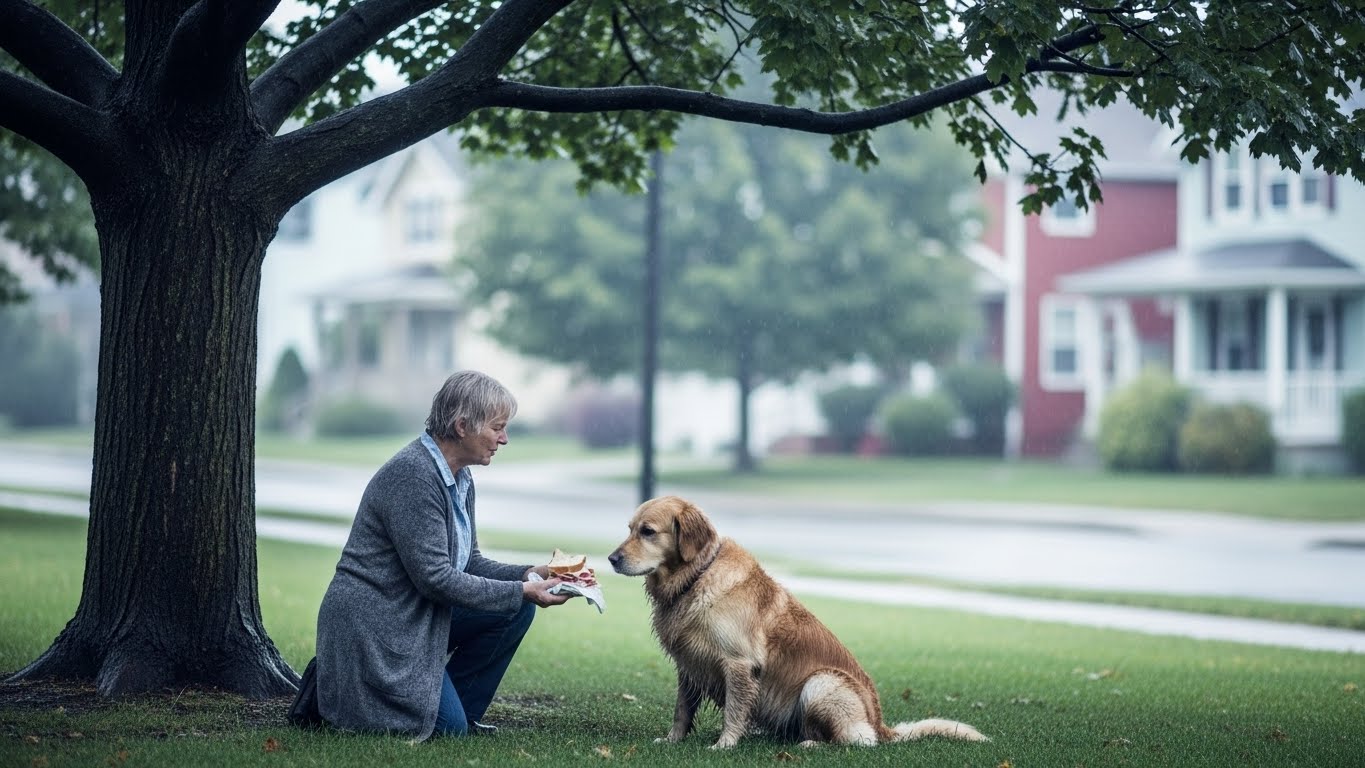
Curled in a miserable knot, soaked through and shivering, was a dog.
No, not just a dog. A Golden Retriever. But the name felt like a cruel joke. His fur, which should have been radiant, was matted with mud and motor oil. It clung to his lean ribs and trembling flanks like a dirty rug. He couldn’t have been more than six or seven years old, but his face held the exhaustion of a creature that had lived a hundred lifetimes of fear.
His eyes—the deepest brown—watched Anna with a weary intensity. It wasn’t hope. It was the look of an animal who had learned that not all humans offered kindness. In fact, most offered pain.
Anna knelt, ignoring the mud that quickly seeped into the knees of her beige slacks. Her breath misted in the cold air.
“Hello there,” she murmured. Her voice was gentler than the rain.
The dog flinched. He drew his paws tighter against his chest, making himself a smaller target. But he did not growl.
There was a deep gash along his right leg, half-healed, the skin swollen and angry. Anna could count every rib beneath his sodden coat. She glanced up and down the path. No owner in sight. No collar on the dog’s neck.
The city hurried past. A man in a yellow rain slicker barely spared a glance, stepping around a puddle. Two teenage girls stopped, whispered, giggled at something on a phone, then hurried on, their laughter trailing behind them like smoke.
Anna felt the eyes of the world—judgmental, remote, uncaring. But she didn’t move. She knew better than most how easy it was for something, or someone, to be left behind when the world moved too quickly.
She dug into her canvas tote bag. Her hands were shaking as she unwrapped her uneaten lunch.
“Oh, here, boy,” she offered, holding out a piece of turkey.
The dog hesitated. His nostrils flared. Hunger warred with terror in his eyes. Slowly, agonizingly, he inched forward. He took the food from her hand with a softness that broke her heart. His teeth didn’t even graze her skin.
For a moment, Anna and the dog—later she would name him Rufus—sat together in the rain. Strangers, bound by a quiet desperation.
She made her decision.
“Come on then,” she said softly, pushing herself upright. Her knees cracked.
The dog eyed her wearily. But after a long pause, he stood. He limped badly, each step sending a shudder through his body, but he did not resist the gentle guidance of Anna’s outstretched hand.
The walk home felt longer than usual. Anna felt every glance from the houses they passed. She knew some neighbors would not approve. She remembered, almost with amusement, how the people on her street prized order and routine above all else. A dirty, limping stray was a disruption.
As she approached her small white clapboard house—paint peeling, but windows always clean—she caught sight of Grace Moore standing on her porch next door.
Grace was in her early thirties, holding a mug of coffee that steamed in the cold air. Her brown hair was tied in a practical ponytail, and her face was pinched with the stress of single motherhood. Grace was a good woman, but she carried the energy of someone who was always waiting for the other shoe to drop.
Grace’s gaze snapped to Anna, then to the drenched dog limping at her side.
“Is that safe?” she called out. Worry pinched her features tight. “Anna, you should be careful. Some strays… you never know where they’ve been. Ethan’s already afraid of big dogs.”
Anna managed a tired smile. She shifted her body to shield the dog from Grace’s scrutiny. “He’s hurt, Grace. He just needs a place to dry off. I’ll be careful.”
Grace bit her lip, uncertainty warring with sympathy. She hovered a moment, then slipped back inside, glancing nervously at the window where a small, pale-faced Ethan peered out, his eyes big and solemn.
Anna guided Rufus inside.
Chapter 2: The Nightmares and the Blue Truck
The house was warm. It smelled of lavender and old books—the scent of safety.
Anna took care not to slip on the linoleum as she led him in. She fetched old towels, coaxing Rufus to let her dry his sodden fur. He submitted with a kind of desperate gratitude, though he watched every movement of her hands with those wide, haunted eyes. He expected a hit. He flinched when she moved too fast.
It was then that Mr. Jenkins appeared on his porch across the street.
Mr. Jenkins was a fixture in the neighborhood, an old man of indeterminate age with thinning gray hair combed back so tightly it accentuated the deep furrows in his brow. He wore the same brown cardigan every day, even in summer. His sharp blue eyes missed nothing.
He scowled when he saw Anna and Rufus through her open door.
“You’re not bringing that mongrel into the neighborhood, are you?” he called, his voice raspy and heavy with suspicion. He tapped his cane against the railing. “We don’t need trouble. Dogs like that are bad news. Mark my words.”
Anna nodded politely, refusing to rise to the bait. “Thank you for your concern, Mr. Jenkins. He’s just staying for tonight. He’s hurt.”
Mr. Jenkins snorted. “One night becomes two. Then suddenly he’s terrorizing the street. You’ll see.”
Anna shut her door gently, her heart pounding harder than she’d like to admit.
She made Rufus a makeshift bed near the front door, using an old quilt Richard used to use for camping. Rufus promptly curled into a tight ball, his nose tucked beneath his tail. He wouldn’t enter further. He wouldn’t come into the living room where the lights glowed warm against the storm. He stayed by the exit.
Anna sighed, settling herself into her armchair, a cup of tea cradled in her hands. For a long time, the only sound was the rain drumming on the roof and the gentle, anxious whimpers of the dog who wouldn’t trust anyone yet.
As night fell, the atmosphere in the house shifted.
Just after midnight, the nightmares came.
Rufus began to twitch in his sleep. His paws jerked against the floorboards as if he were running for his life. A low, panicked whimper escaped his throat, escalating into a high-pitched yelp.
Then, suddenly, he jerked awake. He scrambled up, claws scrabbling on the wood, and crashed against the front door, snarling at an invisible enemy.
Anna hurried to him, her movements slow but deliberate, hands outstretched and open.
“Easy, boy. Easy. You’re safe,” she cooed, kneeling beside him despite the pain in her joints.
Rufus’s eyes darted wildly around the dark room, his heart thundering against his ribs like a trapped bird. He looked at Anna, confused, expecting violence.
Anna hesitated only a moment before carefully reaching out to touch his back. When he didn’t pull away, she pressed a warm compress against the angry scar on his leg. She sat on the floor beside him for hours, humming softly, telling him old stories, promising in a voice just above a whisper that he would never be left alone again.
As the storm raged outside, Anna dozed beside Rufus, her back resting against the door, keeping vigil.
Morning came with a pale sun and the distant sound of a garbage truck.
Rufus, still nervous, followed Anna with hesitant steps as she made tea and toast. Each loud sound—a slammed car door, a barking dog in the distance—sent him shrinking into the corners.
The doorbell startled them both.
Anna rose and opened the door to reveal Dr. Miles Carter. He was an old friend and the closest thing the neighborhood had to a country vet, though he was mostly retired now. Miles was tall and lanky, with a sunburned face and kindness etched into his wrinkles.
“Anna,” he said, stepping in. “Grace told me you might need a hand.”
He knelt by Rufus. “Well, aren’t you a handsome fellow?”
Rufus allowed the examination, though he trembled. Dr. Carter’s hands were gentle but thorough.
“He’s had a rough go, Anna,” Miles said, his voice dropping. “These scars here… across his shoulders. And the leg. They weren’t accidental.”
He looked up, meeting Anna’s gaze over the rim of his glasses. “Looks like he’s been hit. Maybe even trained harshly. You can see the pattern—old rope burns. And this patch… that’s from a bite. Probably another dog.”
Anna’s hands tightened on her mug. “Can you help him?”
“Time and kindness will do most of the work now,” Miles said.
As Dr. Carter packed his bag, a deep, guttural rumble vibrated through the floorboards.
A battered blue pickup truck pulled up at the end of the street. It idled there, the engine coughing black smoke.
Anna looked out the window.
Behind the wheel sat a man. His face was shadowed by the brim of a dirty baseball cap. He was thick-set, with a jagged scar along his jawline. He wore a leather jacket that looked like it had been dragged through gravel.
Logan Price.
He didn’t live on this street, but everyone knew the truck. He was a man who carried a heavy, dark presence.
His eyes flicked to Anna’s door. He seemed to be looking right through the wood, right at the golden shape cowering in the hallway. He stared with a cold, possessive recognition.
Then, he spat out the window, shifted gears, and the truck rumbled off into the morning.
Inside, Rufus had pressed himself flat against the floor.
Anna watched the truck disappear. A cold chill that had nothing to do with the weather settled in her stomach.
She locked the door.
Chapter 3: The Shadow at the Gate
The week brought a fragile sense of routine to Anna’s little house, a gentle rhythm marked by careful steps and soft encouragements. Spring’s chill had finally eased, and the first shy blossoms of crocuses and daffodils peeked through the grass along Hollis Park’s borders.
Anna, feeling her world expand just a little, decided it was time to see how Rufus would manage outside the safety of her walls during the day.
That morning, she took extra care brushing her hair and pulling on her raincoat. It was her way of inviting hope back into her days. Rufus watched her from the threshold. His tail was low, but it wagged ever so slightly, a pendulum of uncertainty. He wasn’t sure if joy was allowed yet.
Anna clipped the leash to Rufus’s collar—a plain blue nylon thing Dr. Carter had dropped off—and murmured, “Ready, boy?”
Rufus hesitated at the front step. His nostrils flared, taking in the scent of wet asphalt and blooming earth. The sunlight glinted on the coppery streaks of his fur, which was finally beginning to look like gold again.
Each new sound was a hurdle. Children playing down the block, the distant hammer of a construction crew, the drone of a plane overhead. Each one made him pause, flatten his ears, and look to Anna.
But Anna kept her pace slow. Her voice was a soft anchor in the shifting tide of his anxiety. She wasn’t a tall woman, but the dignity in her carriage made her seem to command the space around her.
“It’s okay,” she whispered. “I’ve got you.”
As they reached the park, Anna let Rufus set the pace. The leash hung loose between them, a physical symbol of the trust forming by inches. Rufus sniffed at tufts of grass, then at a low stone wall where a chipmunk skittered past.
When Anna reached down to scratch behind his ears, he flinched at first—old habits die hard—but then leaned in just a little. He closed his eyes, letting the sun warm his back.
They rounded the corner by the old oak tree, and the spell broke.
The neighborhood playground was buzzing. Grace stood there with her son, Ethan. Ethan was clutching a plastic dinosaur, his knobby knees stained with grass.
Grace, tall and slender, looked exhausted. Her hair was in a hurried braid, and she was wrestling with Tommy, their little terrier mix. Tommy was a scrapper. He was all white fur and Napoleon complex.
As soon as Tommy spotted Rufus, he launched into a volley of high-pitched barking. He lunged at the end of his leash, his body language making him seem twice his size.
Rufus shrank back. His tail tucked immediately between his legs. He tried to hide behind Anna’s legs, shivering.
“Tommy! Stop it!” Grace hissed, scooping the little dog up.
Tommy, still growling, peered over Grace’s shoulder at Rufus. Ethan pressed closer to his mother, his face pale.
“Is he going to bite, Mom?” Ethan whispered.
Anna crouched down, ignoring her knees, putting herself on Rufus’s level. “No, honey. Rufus is gentle. See? He’s scared of Tommy.”
Grace looked apologetic. “Sorry, Anna. He does this with every big dog. He thinks he’s the king of the block.” She looked at Rufus, really looked at him. “He looks… better. Cleaner.”
“He’s getting there,” Anna said, stroking Rufus’s head.
Just then, the truck came.
It wasn’t Logan’s truck this time. It was a battered delivery van, its exhaust pipe loose and rattling against the chassis. The guttural growl echoed against the houses.
Rufus didn’t just get scared. He collapsed.
He dropped to the ground as if his strings had been cut. He pressed his belly into the dirt, trembling violently.
Anna felt her heart lurch. She knelt, blocking his view with her body. “You’re safe. Look at me. You’re safe.”
She stayed there until the van passed. When Rufus finally stood up, his legs were shaking so hard he nearly fell again.
They walked home in silence, but trouble was waiting for them.
Mr. Jenkins stood on his porch. His arms were crossed over his chest, his cardigan buttoned up to the neck despite the warming weather. He held a clipboard.
“Anna,” he barked. “That dog is disturbing the peace.”
Anna sighed. She was exhausted, but she wouldn’t be cowed. “He hasn’t made a sound, Mr. Jenkins.”
“I heard barking last night,” Jenkins said, tapping his pen against the clipboard. “Twice. This neighborhood has standards. The HOA has rules about nuisance animals.”
“He had a nightmare,” Anna said, her voice firm. “He’s recovering from abuse. Please, have some patience.”
Jenkins grumbled, scribbling something on his form. “One man’s patience is another man’s disturbance. Mark my words, Anna. Strays always bring trouble to the door.”
As Anna unlocked her front door, eager to get inside, a shadow fell over her garden gate.
She turned.
Logan Price was leaning against her fence.
He had a way of standing that felt like an invasion. One hand was hooked casually in the pocket of his dirty jeans. The other rested on the wood of her fence, fingers tapping a slow rhythm.
“Afternoon, Ms. Sullivan,” he drawled. His gaze slid from Anna to the barely visible shape of Rufus in the hall. “Didn’t know you were the dog-saving type.”
Anna stood her ground. “He was in trouble. I couldn’t just leave him.”
Logan’s mouth curved into something that wasn’t quite a smile. It was too sharp. “Funny though. Heard there’s been a lot of lost dogs in the area lately. Someone’s got to be careful, right?”
The threat hung in the air, heavy and humid.
“He has a name,” Anna said. “And he has a home now.”
Logan tipped his cap. “Strays can be more trouble than they’re worth. Hope you know what you’re getting into.”
He sauntered off, his heavy boots thudding on the sidewalk.
Anna watched him go, the old anxiety curling in her stomach like a snake. She went inside and locked the deadbolt.
She found Rufus pressed close to the door, eyes wide and frightened. She knelt, whispering comfort.
“You’re safe here,” she said again, making it a promise she prayed she could keep.
Chapter 4: The Fall and the Rescue
It was one of those golden mornings that promised nothing but peace.
The sunlight spilled over Anna’s tidy front garden, bathing the pale clapboard house in warmth. Anna woke early, drawn by the chirping of robins and the faint scent of lilac drifting through the open window.
She moved with her usual care, her joints stiff, but her mind alert. She set about watering the small rows of peonies and zinnias she’d coaxed into blooming.
Rufus padded after her. His coat was shining brighter now, the result of weeks of steady meals and quiet reassurance. He had begun to develop the kind of confidence that comes from belonging. He took to lying in the sun while she weeded, occasionally lifting his head to sniff the breeze.
The day was bright, but the air was heavy. An early summer heatwave had settled over Lakewood, turning the air into soup.
Anna, wearing a blue sun hat with a ribbon trailing down her neck, paused to mop her brow. She felt a wave of dizziness pulse behind her eyes. The world seemed to swim for a second.
“Just need some water,” she muttered to herself.
She bent down to trim a wild sprig of lavender.
The ground rushed up to meet her.
She didn’t even have time to put her hands out. She crumpled onto the soft earth, her watering can clattering against the stone path.
Silence.
The birds kept singing. The cars kept driving in the distance. Anna lay unmoving beside the riot of summer flowers, hidden from the street by the hedge.
Rufus froze.
Confusion flickered across his dark eyes. He trotted over to her, nudging her hand with his wet nose.
“Anna?”
No response.
He whined. He licked her cheek. Her skin was hot, dry.
Panic set in. The old instinct—flight—kicked in. The gate was open. He could run. He could disappear back into the shadows where no one could hurt him.
But then he looked at Anna. The woman who had shared her sandwich. The woman who sat on the floor in the dark.
Rufus barked. It was a loud, booming sound that he hadn’t used in months.
He ran to the fence. He barked at the street. No one stopped.
He looked at the house next door. Grace’s house.
He squeezed through a loose slat in the picket fence—a tight fit now that he had gained weight—and raced across the neatly mowed strip of grass to Grace Moore’s porch.
Grace was inside, trying to get Ethan to eat his breakfast. She barely registered the scratching at the door.
Tommy, however, went berserk. He leaped at the window, yipping furiously.
“What is it now, Tommy?” Grace sighed.
“Mom!” Ethan called from the living room window. “It’s Rufus! He’s going crazy!”
Grace frowned. She opened the door just a crack.
Rufus was there. He wasn’t aggressive. He was frantic. He barked at her, then ran back toward the fence, then stopped and looked back, barking again.
It was the universal language of Lassie, something Grace thought only happened in movies.
“Show me,” she murmured, a chill running down her spine.
She grabbed her phone and Ethan’s hand. “Come on.”
They followed the golden dog. He led them straight to the garden, where Anna lay slumped among the peonies.
“Oh my god,” Grace gasped.
She dropped to her knees. “Ethan, call Dr. Carter! The number is on the fridge! Go!”
Ethan nodded with the seriousness only children possess in emergencies and sprinted back to the house.
Grace checked Anna’s pulse. It was thready. “Anna? Anna, can you hear me?”
Within minutes, the clatter of Dr. Carter’s aging sedan echoed down the street. He emerged still in slippers, his graying hair askew, medical bag in hand.
“Let’s get her inside,” he instructed gently. “It’s heat exhaustion.”
Together, he and Grace supported Anna. Rufus trotted closely at their heels, refusing to leave Anna’s side. He pressed his body against her leg as they walked, as if trying to lend her his strength.
The crisis had drawn an audience.
Mr. Jenkins had shuffled onto his porch. When he saw the commotion, his face twisted not with annoyance, but with genuine concern. He watched as the “nuisance dog” paced anxiously on the porch while the humans tended to Anna.
“Well I’ll be,” Jenkins muttered. He put his phone away; he had been about to call the city about the noise.
But someone else was watching, too.
From the corner of the street, the blue truck idled.
Logan Price leaned out the window. He watched Rufus. He saw the way the dog stayed by the door. He saw the intelligence in the animal’s eyes. He saw the loyalty.
“That’s a good dog,” Logan whispered to himself. “That’s a fighter.”
A slow, greedy smile spread across his face. A dog like that—loyal, smart, strong—could be worth a lot of money in the right (or wrong) circles.
He shifted the truck into gear and rolled away, but the plan was already forming in his mind.
Chapter 5: The Turn of the Tide
Anna recovered quickly. Fluids and rest, Dr. Carter had said.
But the real change wasn’t in Anna’s health; it was in the neighborhood.
News of Rufus’s heroism spread. The “dirty stray” became the “hero dog.”
Grace brought over a casserole the next day. She stood on the porch, looking at Rufus through the screen door.
“He saved you, Anna,” Grace said softly. “I didn’t think… I didn’t think he had it in him.”
Ethan was standing behind her. He held a tennis ball.
“Can I… can I play with him?” Ethan asked.
Anna smiled from her armchair. “Go ahead, honey. Just be gentle.”
They went into the yard. Rufus watched the ball. When Ethan tossed it, Rufus didn’t just run; he bounded. He caught it on the first bounce and trotted back, dropping it at Ethan’s feet with a happy, open-mouthed grin.
Ethan laughed. It was a real, unguarded sound that made Grace tear up.
Even Mr. Jenkins changed.
A few days later, Anna was in the garden (seated this time, under strict orders). Jenkins walked over to the fence. He looked uncomfortable.
“Mind if I… borrow the hound?” he asked, his voice gruff.
Anna blinked. “Excuse me?”
“Just for a walk. Down the block. My knees aren’t what they used to be. Could use the company.”
Anna handed him the leash.
They walked slowly, the old man and the rescue dog. Jenkins began to talk to the dog, low and quiet.
“Had a dog once,” Jenkins mumbled. “Big black Lab named Duke. Saved my Helen’s life, you know. Pulled her out of the river when she fell through the ice in ’88.”
He paused, patting Rufus’s head. Rufus leaned into the touch.
“Never did thank him properly,” Jenkins said, his voice cracking. “But you… you’ve got that same look. Like you’d die for her.”
By the time they returned, the neighborhood felt different. Tighter. Warmer.
Officer Riley stopped by that afternoon.
Riley was the neighborhood patrolman. He was tall, broad-shouldered, with sandy hair and a reputation for being strict but fair. He had heard about the incident.
“Just wanted to check on you, Anna,” Riley said, stepping onto the porch. “And meet the hero.”
He crouched down, letting Rufus sniff his hand. “Good boy.”
Riley pulled out a scanner. “We should get him registered, Anna. Just to be safe. If he gets out again, we want to make sure he comes back to you.”
He ran the scanner over Rufus’s neck. A beep sounded.
Riley frowned. He looked at the device, then at the dog.
“What is it?” Anna asked.
“He’s chipped,” Riley said. “But… the registration is flagged. It’s from out of state. It’s old.”
“Do you know who he belonged to?”
Riley hesitated. “I’ll have to run the number at the station. It’s probably nothing. People move, they forget to update things.”
But Riley’s eyes were serious. He stood up, adjusting his belt. “You keep him close, Anna. He’s a special dog.”
That night, the feeling of safety began to fray.
The sun set, painting the sky in bruises of purple and black. Anna locked the doors. Rufus lay by her feet, chewing on the tennis ball Ethan had left him.
Outside, the street was quiet. Too quiet.
Across the street, parked deep in the shadows of an oak tree, the blue truck sat silent.
Logan Price wasn’t driving away this time. He was sitting there, smoking a cigarette, the cherry glowing in the dark like a watching eye.
He watched the lights in Anna’s house go out one by one.
He looked at the heavy leather leash on the seat beside him. He looked at the thick muzzle.
“Soon,” he whispered.
Inside the house, Rufus lifted his head. He growled, a low rumble that vibrated through the floorboards.
“What is it, boy?” Anna called from her bedroom.
Rufus didn’t answer. He just stared at the front door, his muscles coiled tight. He knew the scent. He knew the sound of the engine, even when it was silent.
The monster was back. And this time, he wasn’t just passing through.
PART 3
Chapter 6: The Thief in the Night
The night in Lakewood was rarely silent, but this was a darkness that pressed close, heavy and suffocating. It was broken only by the rhythmic ticking of the grandfather clock in Anna’s hallway and the occasional settle of the old house’s bones.
Anna had left the porch light on. The old yellow bulb cast a trembling circle onto the front steps, a beacon she had subconsciously lit against the encroaching shadows.
Inside, the house felt safe. It was a fortress built on new friendships and the steady heartbeat of a dog whose presence had come to define peace. Rufus slept by the front door, his preferred spot. His chest rose and fell in a slow rhythm, his fur burnished gold in the faint light filtering from the street.
But outside, the world held its breath.
Just past 2:00 AM, the streetlamp at the corner flickered and died.
A figure emerged from the darkness of the oak trees across the street. He moved with the furtive, hunch-shouldered gait of a predator.
Logan Price.
He was unshaven, his face drawn tight with a mixture of resolve and bitterness. He wore dark clothes that blended into the hedges. In one gloved hand, he carried a heavy, braided leather leash. In the other, a piece of raw meat laced with a sedative.
Logan had always walked with a swagger—his bulk filling doorways, his voice pitched just too loud. But tonight, there was no swagger. Only calculation.
He had watched Anna. He had watched the dog that used to be his “property.” He saw the health returning to the animal’s frame, the strength in its legs. He didn’t see a pet; he saw an investment he had foolishly discarded. With gambling debts mounting and old connections calling for “fresh blood” in the underground circuit, he had made a choice.
He slipped silently through Anna’s gate. The latch, usually squeaky, had been oiled earlier that day by Mr. Jenkins. The irony was cruel.
Logan stepped onto the porch. He didn’t knock. He didn’t break a window. He knelt by the lock, pulling a thin metal pick from his pocket. He had done this before.
Click.
The deadbolt slid back with a sound like a cracking bone.
Inside, Rufus’s eyes snapped open.
He didn’t bark immediately. His first instinct, bred into him by the man now standing on the porch, was silence. To be invisible was to be safe.
The door creaked open.
The smell hit Rufus first. Stale tobacco, old sweat, and something metallic. It was the scent of his nightmares.
Logan stepped into the entryway. He loomed over the dog, a dark silhouette against the streetlights.
“Hey, mutt,” Logan whispered. His voice was a low growl, terrifyingly familiar.
Rufus scrambled to get up, his claws clicking on the wood. He opened his mouth to bark, to warn Anna, but Logan was faster.
He tossed the meat. Rufus ignored it. He lunged for the living room, toward Anna’s bedroom.
But Logan grabbed his collar. He twisted it tight, cutting off the dog’s air, choking the bark into a strangled wheeze.
“Don’t you do it,” Logan hissed. “You know what happens.”
He clipped the heavy leash on. He produced a thick nylon muzzle from his jacket pocket and shoved it over Rufus’s snout, buckling it tight behind his ears.
Rufus thrashed. He threw his weight back, his eyes rolling white with terror. He looked toward the hallway, toward Anna’s room. Help me.
Logan yanked the leash hard, a brutal, practiced motion that threw Rufus off balance.
“Let’s go.”
He dragged the dog out the door. Rufus dug his paws into the rug, sliding it across the floor, but he was no match for the man’s strength.
The door clicked shut.
In the morning, Anna’s world ended.
The first thing she noticed was the silence.
Usually, she woke to the sound of Rufus stretching, his tags jingling softly. Today, the house was a tomb.
“Rufus?” she called, her voice thick with sleep.
No answering thump of a tail.
She sat up, a cold dread pooling in her stomach. She grabbed her robe and rushed into the hallway.
“Rufus!”
The rug in the entryway was rumpled, kicked up against the wall. The front door was unlocked.
Anna ran out onto the porch.
“Rufus! Where are you, boy?”
Her voice was thin, frantic, cracking in the morning air.
She saw the gate standing wide open. She saw the muddy boot print on her clean white step.
And she saw it—lying in the grass near the sidewalk. Her red wool scarf. The one Rufus liked to sleep with. It was trampled into the mud.
Anna fell to her knees. She clutched the dirty wool to her chest.
He was gone.
The panic was a physical blow. She couldn’t breathe. She fumbled for her phone with shaking hands, dialing 911, then Grace.
News of the disappearance swept through the street like a wildfire.
Grace was the first to arrive. She was still in her robe, her hair wild, Ethan trailing close behind her, clutching his dinosaur toy like a weapon.
Grace embraced Anna, holding the older woman upright as she sobbed.
“We’ll find him,” Grace promised, though her own voice trembled. “We will find him.”
By midday, the house was a command center.
Dr. Carter had arrived, wearing his oldest jacket. He looked grimmer than Anna had ever seen him. He conferred quietly with Mr. Jenkins.
Mr. Jenkins, usually the source of complaints, was a man possessed. He wore his ancient wool coat and a well-worn hat. He had already printed flyers. MISSING. REWARD. FAMILY.
“You check the park,” Jenkins barked at Ethan and Grace, his military background surfacing. “I’ll take the old railway trail. He might have headed for the woods.”
Officer Riley arrived ten minutes later. His patrol car screeched to a halt.
He didn’t look like a friendly neighbor today. He looked like a cop. His jaw was set, his eyes hard.
“Tell me everything,” Riley said, clicking his pen.
Anna, clutching the muddy scarf, told him about the lock. The boot print. The silence.
Riley walked to the mud. He knelt, examining the tread of the boot print.
“Work boots,” he muttered. “Heavy tread. Size 11.”
He stood up and looked at Anna. “I ran the chip number again, Anna. I dug deeper.”
The room went silent.
“The chip is registered to Logan Price,” Riley said, his voice low and dangerous. “Three years ago, he was arrested for running an illegal dog fighting ring two counties over. He got off on a technicality and moved here.”
Anna covered her mouth. “Oh my god.”
“He’s been watching,” Grace whispered, horrified.
“He didn’t take him to keep him as a pet,” Riley said, his face darkening. “I think he’s trying to get back into the game. And he needed a bait dog. Or a fighter.”
Anna felt the room spin. “He wouldn’t… he couldn’t…”
“We have to find him,” Ethan said. His small voice cut through the despair. “We have to go now.”
Riley nodded. “I’m calling it in. We’re going to tear this city apart.”
Chapter 7: The Warehouse and the Escape
That evening, as the search widened and hope began to fray at the edges, Logan drove his truck into the industrial district on the far side of the city.
Rufus lay in the back, chained to the floor of the truck bed. He was exhausted, dehydrated, and terrified. But he was not broken.
The truck stopped in front of a squat, windowless warehouse. The brickwork was stained with years of neglect.
Logan got out. He hauled Rufus out of the truck, dragging him by the heavy chain.
“Come on, money maker,” Logan grunted.
He opened a rusty metal side door.
The smell inside was overpowering. Bleach, old blood, and the musk of fear.
Two men were waiting inside. They sat on crates under a flickering halogen light. They were rough, their arms covered in tattoos, their eyes dead.
“That him?” one of them asked, spitting on the concrete.
“That’s him,” Logan said, forcing a smile. “Loyal. Strong. He’s got fight in him. I trained him myself before he… took a vacation.”
Rufus looked around. There were cages lining the walls. Some were empty. Some held shadows that whimpered.
“He looks soft,” the second man sneered. “Living in a house makes ’em soft.”
“He’s a survivor,” Logan said. “Put him in the pit. I’ll show you.”
Logan reached down to unclip the muzzle.
It was a mistake.
In the months he had lived with Anna, Rufus had learned something Logan didn’t understand. He had learned that he mattered. He had learned that he had a pack to protect.
As soon as the buckle clicked open, Rufus didn’t cower.
He exploded.
He didn’t go for the throat—he wasn’t a killer. He went for the escape.
He snapped his jaws, catching Logan’s hand—the hand that had hurt him for years. He bit down, hard.
Logan screamed, dropping the chain. “You stupid mutt!”
Rufus bolted.
He scrambled across the slick concrete floor. The two men jumped up, shouting, kicking at him. One of them swung a heavy metal pole.
It grazed Rufus’s hip, a blinding flash of pain that nearly knocked him down. But he kept moving.
He saw a gap in the loading bay door—a sliver of evening light.
“Get the gun!” Logan yelled, clutching his bleeding hand.
Rufus threw himself at the gap. He squeezed through, the metal scraping his skin raw. He tumbled out onto the asphalt of the alleyway.
He didn’t look back. He ran.
He ran until his lungs burned. He ran until the sounds of the warehouse faded into the hum of the city.
But he was lost.
This wasn’t Lakewood. The streets were loud, confusing. Cars screamed by like metal monsters. The air smelled of gasoline, not lavender.
And he was hurt. The blow to his hip was throbbing. He was limping again, just like the day Anna found him.
Rain began to fall. Cold, relentless rain.
It washed the blood from his hip, but it soaked into his fur, weighing him down.
Rufus stopped under a bus shelter, shivering. He closed his eyes.
He could smell it—faintly, clinging to his own fur—the scent of Anna’s soap.
Home.
He stood up. He put his nose to the wind. He didn’t know the street names, but he knew the direction. He knew where safety was.
He began to walk.
Back in Lakewood, the search party had regrouped at Anna’s house.
Night pressed against the windows. Exhaustion was visible in the slump of every shoulder.
Grace was passing out cocoa that no one was drinking. Her face was drawn.
Mr. Jenkins sat beside Anna on the sofa. For once, he had nothing to say. He just patted her hand, over and over.
Officer Riley was on the phone in the kitchen. He had been fielding calls from shelters, dog wardens, and patrol units for six hours.
“Yeah. Yeah, check the railyard,” Riley was saying. “He’s a Golden. Red collar. No, he’s… he’s family.”
Anna sat by the window. She was clutching Rufus’s favorite toy—the rope Ethan had made. She stared out at the darkness, whispering his name like a prayer.
“Come home, Rufus. Please, just come home.”
A little after midnight, Riley’s phone rang again.
The room went deadly silent.
Riley listened. His eyes widened. He grabbed a notepad.
“Where? Is he… okay?”
He listened for another agonizing ten seconds.
“Understood. We’re on our way.”
He hung up and turned to the room. His eyes were shining with a cautious hope.
“They found something,” Riley said, his voice trembling slightly. “A security guard at the railyards, about five miles east. He saw a dog matching Rufus’s description.”
“Is he…?” Anna couldn’t finish the sentence.
“He’s alive,” Riley said. “The guard said the dog was limping. He tried to catch him, but the dog ran. He was heading west.”
“West,” Mr. Jenkins whispered. “That’s this way.”
“He’s trying to come home,” Grace realized, tears spilling over.
“He’s fighting,” Riley said. “And we’re going to go get him.”
But the city was vast, and the night was dark.
Somewhere out there, battered and aching, Rufus was following the invisible thread of love that linked him to the white clapboard house. He was leaving bloody paw prints on the pavement, marking his path back to the only person who had ever told him he was good.
Chapter 8: The Dawn of Second Chances
The hours between midnight and dawn are the longest hours of the soul.
Anna refused to leave the window. The search parties had fanned out again, driving the streets, calling his name. But Anna stayed. She knew, with a strange, bone-deep certainty, that if he could, he would come to this door.
The rain had turned into a steady, drumming downpour.
3:00 AM.
The street was empty. The silence was deafening.
And then—a sound.
It was so soft, Anna thought she imagined it. A scratch.
Scritch. Scritch.
Then a low, heartbreaking whine.
Anna flew to the door. Her hands fumbled with the lock, her fingers numb. She threw it open.
There, on the porch, framed in the thin circle of the yellow light, was Rufus.
He looked worse than the day she had found him. He was covered in black grease and mud. His left side was streaked with dried blood. His right hind leg—the bad one—was held high off the ground.
He was trembling so violently his teeth chattered.
But his eyes found hers.
“Rufus!” Anna cried out. It was a sound torn from the bottom of her lungs.
She fell to her knees on the wet porch.
Rufus took one shuddering step forward. Then another. He reached her and simply collapsed. He let his heavy head fall onto her shoulder. He let out a long, ragged sigh, as if letting go of every burden he had carried for three years.
“I’ve got you,” Anna sobbed, burying her face in his filthy, wet neck. “I’ve got you, baby. You’re home.”
Grace came running from the kitchen. “Oh my god!”
“Get blankets!” Anna yelled. “Call Dr. Carter!”
They carried him inside. He was dead weight now, his energy completely spent. They laid him on the rug by the hearth.
Dr. Carter arrived seven minutes later. He must have driven like a maniac.
He pushed past everyone, his medical bag hitting the floor.
“Let me work,” he commanded gently.
The living room became an emergency ward. Dr. Carter cleaned the wounds. He stitched the gash on Rufus’s hip. He set up an IV drip for fluids.
“He’s exhausted,” Miles said, his voice tight. “He’s lost blood. He’s in shock. But… no broken bones. Just bruises.”
He looked up at Anna, who was holding Rufus’s paw as if it were a lifeline.
“He ran five miles on a bad leg, Anna. I don’t know how he did it.”
“He had to get home,” Ethan whispered from the corner.
The vigil began again.
But this time, it was different.
Mr. Jenkins sat in the armchair, watching the dog breathe. He wiped his eyes with a handkerchief, unashamed.
“That’s a good boy,” he muttered. “That’s a soldier.”
Just as dawn broke, painting the sky in soft grays and pinks, Officer Riley returned.
He walked in, looking exhausted but grimly satisfied.
“We got him,” Riley said quietly.
Anna looked up. “Logan?”
“Found him at a clinic downtown,” Riley said. “Getting stitches for a nasty dog bite on his hand.”
A ripple of dark satisfaction went through the room.
“We raided the warehouse an hour ago,” Riley continued. “We found the other dogs. They’re safe. We found the equipment. Logan Price isn’t going to get a slap on the wrist this time, Anna. With the kidnapping, the animal cruelty, the illegal gambling ring… he’s going away for a long, long time.”
Riley looked at Rufus, sleeping deeply on the rug.
“He saved them all, Anna. By escaping, he led us right to them.”
For three days, Rufus slept.
He woke only to drink water and eat small bites of chicken from Anna’s hand. He never tried to stand up. He just watched her, making sure she was there, then drifted back into the healing dark.
But on the fourth morning, the sun came out.
It spilled across the kitchen floor, bright and insistent.
Anna was making tea. She heard a sound behind her. Click, click, click.
She turned.
Rufus was standing there. He was wobbly. He had a bandage on his hip and a shaved patch on his leg.
But his tail—his glorious, golden tail—gave a slow, deliberate wag.
He walked over to her and nudged her hand with his wet nose.
Anna dropped her spoon. She knelt down and wrapped her arms around his neck.
“You’re back,” she whispered.
And he was.
The celebration a week later was unlike anything Lakewood had ever seen.
It was supposed to be a small tea, but it turned into a block party.
Grace and Ethan strung paper lanterns from the porch to the oak tree. Mr. Jenkins brought his new dog—a rescued black Lab named Barney that he had adopted from the shelter where the warehouse dogs were taken.
“Figured Rufus needed a friend,” Jenkins grumbled, though he was smiling.
Officer Riley stopped by, off duty, wearing a t-shirt that said Lakewood K-9 Unit Supporter.
The street was filled with laughter. Children chased dogs through the sprinklers. Neighbors who hadn’t spoken in years were sharing potato salad and stories.
And in the center of it all sat Anna.
She sat on her porch swing, swaying gently. Rufus was beside her, his head resting on her knee. He watched the street—his street—with calm, proprietary eyes.
He wasn’t searching for threats anymore. He was watching his family.
Anna stroked his velvet ears. She looked at the scars on his leg, now fading into the fur. She touched the invisible scars on her own heart and realized they had healed, too.
She had thought her life was over. She had thought she was just waiting for the end.
But looking at the golden dog who had fought his way through hell to get back to her, she understood the truth.
Sometimes, the things we rescue end up rescuing us right back.
Love, she realized, isn’t just a feeling. It’s a homing beacon. No matter how dark the night gets, no matter how far you run, it will always, always guide you home.
THE END.