MY DOG KEPT GROWLING AT THE FLOOR AT 2:14 AM. WHEN I FINALLY OPENED THE HATCH UNDER THE RUG, I REALIZED HE WASN’T PROTECTING THE HOUSE FROM A GHOST—HE WAS PROTECTING US FROM WHAT WAS LIVING DOWN THERE.
CHAPTER 1: The Vigil
Eleanor Whitmore wasn’t the kind of woman who frightened easily. Standing five-foot-eight with a posture as straight as the chalk line she used to etch across her classroom blackboard, she carried herself with a quiet resilience. It was a strength born not from privilege, but from surviving the kind of silent, domestic storms that leave no bruises but shatter the foundation of a home.
Since the divorce two years ago, Eleanor had built her life around order, calm, and her son, Luca. At two years old, Luca was her gravity. A soft-cheeked boy with curls like spilled milk and eyes the color of twilight, he was the only thing that mattered. He was frail, born premature with a chest that rattled on cold nights, but his laugh could shake off any of Eleanor’s lingering doubts.

They had moved into the house on Montclair Street just six weeks ago. It was located in the quiet heart of the Garden District in New Orleans—a city that wore its history like a heavy velvet coat. The house was a two-story Greek Revival with white brick walls that glowed golden under the morning sun and a creaky charm Eleanor told herself she could live with.
“The house has history,” the realtor had said, fanning herself on the porch. “But good bones. Solid.”
Eleanor chose it because it felt distant from her past. It felt safe.
At least, it did at first.
Then there was Ezekiel.
Ezekiel was a four-year-old Golden Retriever with fur the color of old honey and eyes as pale and knowing as river fog. He was tall for his breed, with a regal posture that seemed too serious for a dog. Ezekiel had once been trained as a therapy animal for veterans but had failed the final phase of training due to what the handlers called “excessive environmental sensitivity.”
Simply put, he reacted to things no one else noticed. Shifts in air pressure. Low vibrations. Flickering lights. Where others saw shadows, Ezekiel watched them.
Eleanor had adopted him from a shelter on impulse. But when she saw Ezekiel sit quietly beside Luca’s stroller, head tilted in solemn interest, tail brushing once against the floor, she knew he was meant to be theirs.
Since then, Ezekiel had become Luca’s constant companion. He lay beside the crib during naps, curled up beneath the high chair during meals, and trailed silently behind Eleanor like a sentinel made of gold.
And that’s why what happened over the past week disturbed her so deeply.
It began on the first Wednesday of spring.
Eleanor had just tucked Luca in. The toddler was already twitching into the breathy rhythm of early sleep. The nursery was warm, painted in soft blues and yellows, with a mobile of felt stars swaying above the crib. Ezekiel, as usual, padded inside and lay at the foot of the crib.
Eleanor kissed her son’s forehead, turned off the light, and left the door ajar.
Less than ten minutes later, she heard the sound.
It was a low, gravelly vibration. Not a bark, not even a whimper. It was a growl—low and steady, like a kettle left on a back burner.
She tiptoed back toward Luca’s room, her heart ticking faster. As she peered in, what she saw made her pause.
Ezekiel wasn’t lying down anymore.
He was standing on Luca’s bed, his front paws near the headboard. His body was taut, ears forward, eyes fixed on the far right corner of the room—the shadowed wedge between the antique dresser and the wall.
“Ezekiel,” she whispered.
The dog didn’t blink. The growl deepened, but his posture didn’t change.
Eleanor walked in slowly, careful not to wake Luca. She glanced at the corner. Nothing. Just the wooden baseboard, a stuffed bunny, and a spot where the paint had started to peel from the humidity.
She touched the dog gently. He glanced at her briefly, his eyes wide and white-rimmed, then snapped his gaze back to the corner.
“It’s probably a mouse,” she murmured, though she knew Ezekiel didn’t growl at mice. Not like that.
The next night, the same thing happened.
Again and again, Ezekiel would enter the room, wait until Luca was asleep, and then—and only then—stand guard. His eyes locked on the same corner, his growl steady as distant thunder.
By the fifth night, Eleanor began to lose sleep. She checked for drafts. She pried up a floorboard to check the pipes. She called pest control.
Nothing. No rodents, no broken pipes, no strange noises.
Except Ezekiel still growled. And always at exactly 2:14 AM.
CHAPTER 2: The Hollow Girl
The real fracture in Eleanor’s reality happened on Saturday when Sophie came over to play.
Sophie was the daughter of Nora, Eleanor’s neighbor across the street. Sophie was six, a curious, talkative girl with tangled auburn curls and a habit of stating odd things with total sincerity. Eleanor liked her. She reminded Eleanor of herself at that age, before life took the edge off her imagination.
That afternoon, while Eleanor made sweet tea in the kitchen, Sophie sat cross-legged on the living room rug with Luca and Ezekiel. The dog lay beside them, unusually still.
“I don’t like the man who sits under Luca’s floor,” Sophie said suddenly.
Nora looked up from her phone, her brow furrowing. “What man, sweetie?”
“The one with the white shirt,” Sophie replied, not looking up from her dolls. “He watches us at night. I saw him when Ezekiel looked.”
Nora glanced at Eleanor, eyebrows raised. “Where did you see him, love?”
Eleanor wiped her hands on a dish towel and walked into the living room, keeping her voice light. “Sophie, honey, what do you mean?”
Sophie pointed toward the ceiling. “Right there. Under Luca’s room. He has no eyes.”
Eleanor laughed nervously, but the sound died in her throat. “What a wild imagination,” she said.
But Ezekiel lifted his head. He stared directly at Sophie, his ears pricked forward, and let out a single, sharp bark.
That night, Eleanor couldn’t sleep.
She lay in bed listening to the old pipes murmur and the wind sift through the magnolia trees outside. The house felt different tonight. Heavier.
Around 2:14 AM, she got up, barefoot and cold, and walked to Luca’s room. She didn’t know why, only that her skin tingled with that strange premonition animals feel before storms.
The room was silent, except Ezekiel was once again on the bed. This time, he was positioned fully between Luca and the corner wall. His body was perfectly still, except for his ears twitching like a radar dish.
He didn’t growl. He didn’t bark. He simply watched, his pale eyes glowing faintly in the moonlight pouring through the window.
Eleanor walked in slowly, heart in her throat. She reached out to touch him, but Ezekiel didn’t move. He stood as if carved from golden stone between the crib and that peeling stretch of wall—as if daring something to try to cross the line.
Eleanor’s hand trembled at her side. She didn’t say anything. For the first time, she wondered if Sophie’s imagination might not be imagination at all.
The next morning brought no relief. The light that spilled through Luca’s window felt thinner somehow, like the warmth in the room had been peeled back just a little too far.
Eleanor watched Ezekiel lying on the rug, his golden fur dull in the pale morning sun, his head resting between his paws. He hadn’t slept the night before. Not really. He had remained vigilant by Luca’s crib until dawn, unmoving, but intensely alive.
Luca, for his part, had begun coughing again. It wasn’t the usual congestion Eleanor had grown used to. This was deeper, raspier—a bark from his lungs that arrived every night like clockwork, always worsening between midnight and 3:00 AM.
The pediatrician had said it could be mold allergies. “Old New Orleans houses,” the doctor had sighed. “They’re full of spores.”
But Eleanor had scrubbed this house clean.
That afternoon, while Luca napped on the couch in the living room—where, notably, he slept without coughing—Eleanor returned to the nursery. The window was closed as always.
She sat cross-legged on the floor, pressing her palm flat against the oak planks. For a while, she felt nothing but the cool smoothness of wood.
Then, near the corner Ezekiel watched so intently each night, she felt it.
The faintest whisper of cold air against her skin. Like someone breathing through a keyhole.
She lifted the rug. Nothing unusual. But when she leaned closer, pressing her ear to the floorboard, she heard it.
A low sigh. Or maybe a whimper.
Her skin chilled. She didn’t tell Nora. Not yet. Eleanor needed answers, not pity.
Instead, she walked next door and knocked on the weathered blue door of Mr. Duval.
Gaspar Duval was seventy-eight, a retired mason with hands like carved stone and eyes that always seemed to be measuring things that couldn’t be seen. He was thin and stooped, dressed in the same gray cardigan no matter the heat. He had lived on Montclair Street longer than anyone else.
When Eleanor explained what she had found—the cold draft, the strange noise, Ezekiel’s behavior—Mr. Duval grew still.
“You live in the old Claymont property,” he said slowly, his accent thick with the local dialect. “I remember the renovations. I helped seal the old basement myself twenty years ago with cement bricks and mortar.”
“Why was it sealed?” Eleanor asked.
He rubbed his chin, his nails blunt and yellowed from decades of lime dust. “The owners said it was unstable. Said it flooded every winter. But that wasn’t the truth. I know what a flood-damaged wall looks like. This one didn’t crack. It moaned.”
Eleanor stared at him.
He looked away, uncomfortable. “After the work was done, I still heard things for weeks. Little knocks under my bedroom floor. A girl singing. A cough, like someone was buried with a cold.” He gave a dry, humorless laugh. “Eventually, it stopped. I told myself it was the wind.”
Eleanor said nothing, but her mind was reeling. She hadn’t told him about Luca’s cough.
When she returned home, Ezekiel met her at the door. His ears were lifted, eyes sharp. He turned and walked directly to Luca’s room. Not a hesitation.
Eleanor followed him. He stood by the corner, nose low to the floor, and began to sniff in tight, deliberate circles. Then, slowly, he started to scratch.
At first, it was a casual pawing. Then it became frantic. Wood splinters scattered across the floor as Ezekiel dug, his powerful limbs striking against something harder than the plank beneath—something solid set just below.
“Ezekiel,” she said sharply.
But he wouldn’t stop.
Eleanor knelt beside him and brushed away the splinters. Beneath the floorboard, someone had laid a patch of cement, uneven and hastily done.
“That’s odd,” she whispered. All the other floorboards had insulation underneath, or at least air space. Why would someone pour cement in just this one section?
Ezekiel growled again. Not loud, but guttural. Like warning a ghost.
She fetched a small chisel from the toolbox and began to chip away. Piece by piece, the cement gave in, flaking like dry clay.
Ten minutes later, her tool struck something metal. A hinge.
She stopped.
The square of cement was a cover, barely the size of a crawl space hatch. Someone had sealed a door beneath the boy’s room.
Her breath caught. She didn’t open it. Not yet.
Instead, she reached down with the tip of the chisel and scraped away more of the dust and grime that coated the metal.
That’s when she saw it.
Carved into the center of the cement slab beneath the hatch was a symbol. A cross, but reversed.
The lines were shallow, old, and deliberate. Not a child’s graffiti. This was a mark. A seal.
Ezekiel stood perfectly still now. His tail didn’t wag. His chest rose and fell in time with hers.
Eleanor stepped back.
That night, she moved Luca’s crib to the living room. He slept soundly without a single cough.
Ezekiel lay beside the hatch all night, head resting on his paws, his eyes open until morning.
And in the silence of that long spring night, Eleanor heard the wind whistle under the floorboards again. But it wasn’t wind.
It was a voice. Very soft. Almost like it was singing a lullaby.
CHAPTER 3: The Visitor
The morning came heavy and gray, clouds clinging low over the tiled rooftops of the Garden District like the sky had forgotten how to lift its weight. Eleanor stood by the window with her second cup of coffee cooling in her hand, staring blankly at the hatch in the floor of Luca’s room.
She hadn’t touched it again—not since scraping away the last of the cement and revealing that chilling, reversed cross.
Ezekiel hadn’t moved from his post either. The dog lay curled near the hatch, eyes open, always watching, like he expected something to come out of it. Luca had slept again in the living room, and for the second night in a row, hadn’t coughed once.
Eleanor told herself she was being paranoid. She told herself the air was just stale under the floor. But she couldn’t shake the memory of the voice she’d heard the night before. Not words, just a tone drifting faintly upward like a lullaby—or a warning.
Later that day, Nora came over. She brought a casserole dish she claimed was “good for nerves” and a USB stick.
Nora Everly was the kind of friend everyone needed once in their life: blunt but not unkind, fiercely loyal, with a natural ability to read tension like it was printed on a page. She was thirty, slightly shorter than Eleanor, with dark curls that frizzed when she was anxious.
“I rewatched the footage from Luca’s baby monitor,” she said, plugging the USB into Eleanor’s laptop. “You need to see this.”
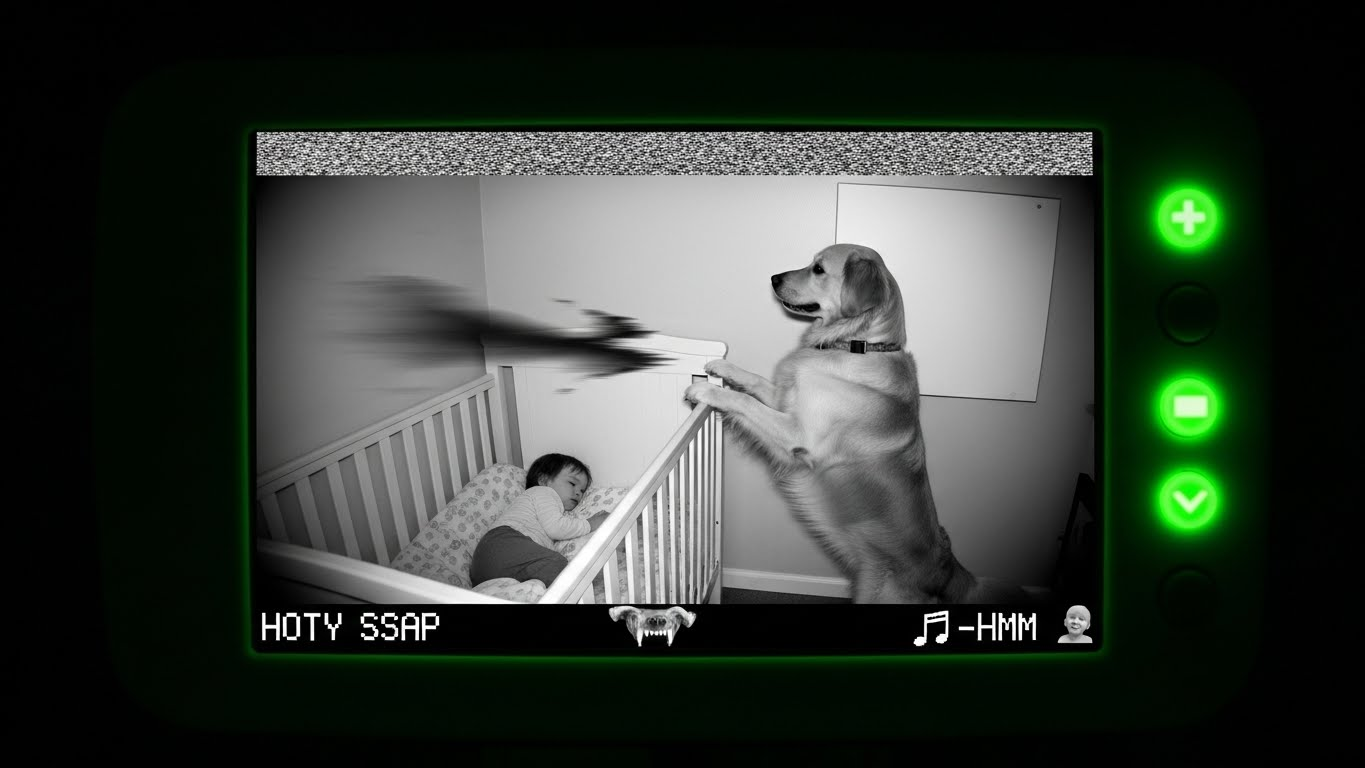
The screen lit up with familiar, grainy black-and-white footage of Luca’s room from two nights ago. It showed Luca sleeping in his crib. Ezekiel lay on the floor, head flat against the boards, not moving.
For several minutes, nothing changed.
Then, at exactly 2:06 AM, Ezekiel’s ears twitched. He stood up. His head jerked toward the camera. Not the crib, not the door—the camera.
And then he barked. Loud. Two sharp, unmistakable bursts of alarm.
Luca didn’t stir. The camera didn’t flicker. But Ezekiel backed up toward the crib and stood stiffly between the bed and the corner.
“What was he barking at?” Eleanor asked, even though she felt a cold pit forming in her stomach.
“Nothing,” Nora replied quietly. “I went back and checked every frame. No movement, no shift in light. Nothing visible.”
They were silent a moment before Nora asked, “Have you called anyone about what you found under the floor?”
Eleanor shook her head. “Not yet. I don’t know who to call. The police will laugh at me.”
That was when Nora mentioned someone she knew from her time working as a paralegal. A retired detective named Marius Lenoir, known for his obsession with New Orleans’ cold cases.
“He’s a little intense,” she warned. “But if anyone can give context to what’s going on here, it’s him.”
Two hours later, Detective Marius Lenoir arrived at Eleanor’s front door. He was in his mid-sixties, lean and wiry, with silver hair brushed neatly back and deep frown lines carved like scars into his forehead. He wore a brown suit that looked a decade out of style and smelled faintly of clove cigarettes and old paper.
Lenoir didn’t shake hands. He nodded once, walked in with slow deliberation, and scanned the space as if it were a crime scene.
“Ms. Whitmore,” he said, his voice gravelly, “I understand you’ve opened something that wasn’t meant to be reopened.”
Eleanor led him upstairs, explaining what she’d found—the cold air, the voice, the reversed cross. When he saw the hatch, he paused, his expression unreadable.
“I’ve seen that symbol before,” he murmured, kneeling. “Not a cross. A seal. It was used by a fringe religious faction that operated in the bayou parishes for nearly thirty years. They called themselves Levo—The Pure Voices.”
“A cult?” Eleanor asked.
“They preferred ‘congregation.’ They were quiet, charitable. Known for sheltering children, offering cleansing rituals for the sick.” Lenoir traced the symbol with a gloved finger. “But behind the sermons, there were whispers. Accusations of psychological abuse, isolation, ritual fasting for minors. We never had enough evidence to pursue them.”
Eleanor stared at him. “And this house?”
“This house,” Lenoir nodded, “was one of their administrative properties. It was converted into a residence in 2008, a year before a girl named Marie Vasser disappeared.”
“Marie?”
“Twelve years old. Blonde, withdrawn. Parents said she ran away. Some believed otherwise.” Lenoir stood up, dusting off his knees. “Marie’s file is still open.”
As if summoned by her name, the front doorbell rang.
Eleanor blinked, exchanging a weary glance with Nora before heading down. Through the glass, she saw a woman standing on the porch.
She looked to be in her early forties, wearing a soft gray wool coat buttoned high at the collar and a faded floral scarf wrapped tightly around her neck. Her hair was a pale ash-blonde pulled into a severe bun, and her eyes were a striking shade of pale blue that seemed almost too light to be natural.
When Eleanor opened the door, the woman smiled—serene and practiced.
“Good afternoon. I’m sorry to bother you,” she said, her voice soft and melodious. “My name is Agatha Clement. I used to volunteer with a religious outreach program many years ago. I helped children here. I was in the neighborhood and I just wondered… is this the old Sanctuary property?”
Eleanor’s pulse spiked. She gripped the doorframe tighter. “Yes,” she said slowly. “Why?”
Agatha’s smile didn’t falter, but it didn’t reach her eyes. “Sometimes I like to revisit places that held light. It’s a comfort. I lost someone dear to me here.”
From the top of the stairs, Ezekiel let out a low, menacing growl that vibrated through the hallway.
Agatha’s eyes flicked upward, just briefly. Then she nodded again, turned, and walked down the steps with the grace of a ghost.
“Back upstairs,” Nora whispered, looking down from the landing. “What does she want?”
Lenoir stared out the window, watching Agatha’s car drive away. “To see if the past has been disturbed,” he said grimly.
Eleanor felt the chill again. This time, it wasn’t from the floor. The air in the house had changed.
CHAPTER 4: The Shadow on the Screen
Eleanor felt it the moment she woke the next morning. It wasn’t the temperature, though it had turned unseasonably cold overnight, but something subtler. It was as if the house had begun to exhale slowly through every crack, every pipe, every sliver of old wood.
Ezekiel had remained stationed at the hatch all night. He hadn’t barked or growled, just sat like a statue of gold and bone, watching, listening. His ears twitched occasionally, and once—just once—he’d let out a low whine that made Eleanor’s chest tighten.
She had slept in the armchair near Luca’s makeshift crib in the living room. The boy curled beneath a thick-knit blanket, his small fist resting by his cheek. The silence that surrounded them was unnatural. Even the birds seemed to avoid the house that morning.
Later that day, while Luca napped, Eleanor sat alone with her laptop and clicked open the footage from the baby monitor again.
She scrolled past the early hours until the familiar timestamp blinked onto the screen: 02:14 AM.
The night before, Ezekiel hadn’t barked or moved from his place. But in the video, his body was taut, alert. He sat facing the far wall—away from the crib this time—his eyes locked on something just out of view.
Then, slowly, he turned his head. He was tracking something across the room.
Eleanor leaned closer to the screen.
There was nothing visible at first. But then, a shift in the shadows. Barely perceptible. A blur, like heat rippling over pavement, passed across the screen from left to right.
It had no form, no face. But the height was unmistakable. A child. Small, thin, moving just beyond the light.
Ezekiel followed it with his eyes, motionless, as it passed near the camera and vanished at the corner where the hatch had been opened.
Eleanor’s breath caught in her throat. She paused. Rewound.
The video replayed. The shape never changed. It wasn’t an illusion of light.
She watched it pass again and again. Ezekiel always watching. Always silent.
Before she could think further, the front door creaked open.
Nora and Sophie stepped in, carrying a small bag of groceries. Sophie bounded ahead, her tangled auburn curls bouncing with each step. She wore a blue corduroy jacket and a backpack shaped like a fox.
But her face, usually lit with childlike wonder, looked unusually subdued.
“She’s been quiet since yesterday,” Nora said softly, hanging their coats. “Ever since your visitor.”
Eleanor knelt beside Sophie and gave a small, forced smile. “Hey, you okay?”
Sophie nodded, then hesitated. “That lady with the scarf…”
“You mean Agatha?”
Sophie bit her lip and glanced down at her shoes. “She stopped us on the sidewalk. She said she knew Marie.”
Eleanor blinked. “What?”
“She said Marie wanted me to finish something. That I’m the same. That I see what others can’t.”
Eleanor’s stomach sank. She looked at Nora, who looked equally horrified.
“Did she say anything else?” Eleanor asked gently.
Sophie looked up, her eyes too old for six years. “She said the house needed a voice again. She said Marie had one, but it was taken away. So now it’s my turn.” She paused. “She said not to be scared of the girl in the walls.”
Nora grabbed Sophie’s hand, pulling her close. “She is not going near that woman again. I’ll speak to Lenoir.”
“I’ll call him,” Eleanor said, her voice trembling with rage.
That night, things escalated.
Luca began coughing again around midnight. But this time, it was different. Deeper. Wet.
His forehead was burning hot, and his tiny body shivered despite the warmth of the room. Eleanor cradled him, frantic, whispering to him, pressing a damp cloth to his skin.
She needed the fever reducer from her nightstand upstairs. She stood up, holding Luca against her shoulder.
But when she tried to walk toward the stairs, Ezekiel blocked her.
The dog stood firmly at the foot of the staircase, his body low, his eyes locked on hers. He didn’t growl, he didn’t bark, but he refused to move.
“Ezekiel, move!” she snapped, panic rising.
He didn’t budge. Eleanor tried stepping around him. He sidestepped with her, his heavy body acting as a barrier.
“Ezekiel, please!” she cried. “He needs medicine!”
The dog whined, a high, desperate sound. Then, he trotted ahead—not up the stairs, but to the hall closet on the ground floor. He pawed frantically at the bottom drawer.
Eleanor paused. She opened the drawer.
There, tucked in the back, was an unopened bottle of children’s ibuprofen she’d placed there weeks ago during a cleaning frenzy and forgotten about.
She stared at the dog.
He turned and padded slowly back toward the living room, positioning himself between the stairs and Luca.
He wasn’t stopping her from getting medicine. He was stopping her from going upstairs.
The fever broke just before dawn. Luca’s breathing steadied, and the tightness in his chest seemed to lift as quickly as it had arrived.
Eleanor dozed off briefly, curled on the couch beside him, until the sound of a soft knock pulled her from sleep.
It was Mr. Duval.
He stood on the porch holding a small wooden box, worn at the edges, the kind used to hold tools or love letters from another century. His hands trembled slightly from the morning cold.
“I found this in my attic,” he said without preamble. “It belonged to the previous owners. I was asked to store it after the house changed hands. Forgot I had it until last night.”
Inside the box were letters, handwritten notes, prayers, and sketches of room symbols. But one paper caught Eleanor’s eye.
It was a floor plan of her house.
There were markings drawn in red ink. The hatch. The attic.
And another space.
A small square drawn directly beneath the nursery. A space not listed in the official blueprint.
As Eleanor traced the lines, Ezekiel rose from his spot in the living room and walked to the corner. He looked at her, then to the floor.
There was more down there. And something was still alive in memory, if not in form.
CHAPTER 5: The Second Hatch
Inspector Lenoir arrived just after dusk, his coat still damp from the drizzle that had hovered over the city all day. The smell of rain and ozone followed him into the house.
He carried a leather satchel, worn at the seams, the kind professors and detectives alike never seemed to replace. His face was drawn tighter than usual.
Eleanor met him in the living room. Luca was asleep in the guest room, his fever under control, and Nora had taken Sophie back to her flat, insisting the girl needed a night away from whatever strange tide was swelling inside Eleanor’s home.
Lenoir sat carefully, placing the satchel on the coffee table. He didn’t speak immediately. Instead, he opened the clasp and began to lay out the contents one by one.
A series of photographs, faded and yellowing. Photocopies of police reports. And finally, a child’s drawing protected in a plastic sleeve.
“Marie Vasser,” he said at last. “This was taken in 2007, two years before her disappearance.”
He passed Eleanor the first photograph. A girl no older than ten stared back at her. Round face, sharp blue eyes, and hair the same auburn shade as Sophie’s. There was something eerie in her expression. Not fear, but knowledge. A child too used to keeping secrets.
Eleanor’s heart thudded. “She looks just like Sophie,” she whispered.
Lenoir nodded slowly. “It’s uncanny. But what struck me more is this.”
He held up the drawing. It depicted a house—her house. Scrawled in rough crayon lines was a floor plan, clearly the same as the blueprint Mr. Duval had brought earlier, but with an addition.
A small square beneath the nursery, marked with a red symbol. The same reversed cross etched into the cement.
“Marie made this?” Eleanor asked.
“It was confiscated during a welfare inspection. They never pursued it. Said it was imagination. But she drew this symbol everywhere. On walls. On scraps of paper. Even on herself.”
Eleanor took the photo and sat back, her mind spinning. “What do you think it meant to her?”
“That something was down there,” he replied simply. “Something that shouldn’t have been.”
As if on cue, Ezekiel stirred from his position by the stairs.
The dog lifted his head, ears pricked. Then he stood abruptly. A low growl bubbled from his throat—louder than before.
“Again?” Eleanor asked, standing.
But Ezekiel wasn’t looking at the living room. He was staring toward the ceiling. Toward the nursery.
They followed him up the stairs. Lenoir moved with more urgency than Eleanor expected from a man of his age. The hallway was quiet. Too quiet.
Ezekiel reached the nursery door and began barking. Loud. Frantic. His claws scratched at the wood as if trying to dig through it.
Eleanor’s heart hammered. She reached for the doorknob and turned it.
Inside, everything was still. The crib was empty. The curtains moved gently, though the window was closed.
But something was wrong.
The floor beneath the rug in the far corner—the corner Ezekiel had watched for nights—was lifted. A plank of wood was splintered and warped, as if something had pressed up from underneath.
Ezekiel lunged forward, growling, and began tearing at the boards. Splinters flew as his paws struck again and again.
Lenoir stepped forward, pulling the rug aside completely.
Beneath it, the patch of floor had cracked. Hairline fractures spidered out from a rusted metal hinge.
“This is it,” Lenoir muttered. “Help me.”
Together, they cleared the remaining wood, revealing a square iron hatch with a corroded lock. It was different from the first one Eleanor had found. This one was older, heavier.
The metal was nearly fused with age, covered in rust and a filmy green patina. But even beneath the decay, Eleanor could see the faint outline of the reversed cross carved into it.
“It’s locked,” Lenoir said, reaching for his penknife.
Ezekiel barked again, nose pressed to the metal. Then he stepped back, watching intently, his breath shallow and fast.
Lenoir twisted his blade into the hinge and pried. With a sickening groan, the old metal gave way.
Dust and cold air billowed up through the gap, and with it came a smell. Not of rot, but of damp stone and something older. Like the inside of a sealed crypt.
They paused. Then Lenoir lifted the hatch, fully revealing a narrow staircase descending into pitch-black shadow.
Mr. Duval appeared at the door behind them, breathing hard from climbing the stairs. The old man looked shaken.
“I heard the barking,” he said softly.
Eleanor turned, startled. “Mr. Duval, you shouldn’t be—”
“I have to say it,” he interrupted, his voice trembling. “I should have said it long ago.”
They stared at him. He took a breath.
“I helped seal this hatch. Not the other one. This one. I poured the cement over it. They told me it was for safety, that the lower chamber had collapsed. But I lied.”
He swallowed hard. “I heard the knocking every night for a month. Soft. Like fingertips against stone. And one night…” He looked at Eleanor, his eyes wet. “I heard singing.”
“Singing?” Eleanor asked.
He nodded. “A child’s voice. Thin. Broken. I told the Pure Voices. They said it was memory. That I had no proof. That if I valued my retirement, I’d forget.”
“And you did,” Lenoir said, his voice devoid of judgment.
“I tried,” Duval whispered. “But I never stepped foot near this house again. Until now.”
They stood in silence for a long moment.
Then Ezekiel, with slow precision, began to descend the stairs into the darkness.
The others followed.
CHAPTER 6: The Sanctuary
The staircase led down into a small, circular chamber no wider than a shed. Stone walls were lined with old shelves. Dust coated everything, and water stains bloomed like dark flowers across the low ceiling.
But at the center of the room sat something that made Eleanor’s blood run cold.
A child’s bed frame. Rusted. Empty.
Beside it were chalk drawings on the stone floor—scrawled symbols, names, and a small cloth doll. The doll looked newer than the rest, untouched by the heavy mold that coated the room.
Eleanor knelt beside it, her voice a whisper. “She was here. Marie was here.”
Ezekiel growled again. This time, he wasn’t looking at the bed. He was looking at the far wall, where a set of finger-length scratches marked the stone. Deep gouges, as if someone had tried to claw their way out.
The chamber was colder than it should have been. Not just damp, but bone-deep freezing, the kind of chill that lives in graves. Eleanor wrapped her arms around herself as she stepped deeper into the room.
“This wasn’t just a chamber,” Lenoir muttered, sweeping his flashlight beam across the walls. “It was a holding cell.”
Ezekiel padded silently ahead of them. His paws made soft thuds against the stone floor. His fur caught the flashlight beam like old gold, but his eyes were fixed forward, unblinking.
He had stopped growling. Now, his movements were hesitant, as if even the dog was bracing for a truth he didn’t want to find.
In the far corner, beneath a collapsed shelving unit, Eleanor spotted it first. A flash of color in the gray.
She crouched quickly and brushed aside the loose soil.
It was a child’s jacket. Bright yellow with a teddy bear patch on the chest.
Eleanor gasped. “This isn’t old.”
Lenoir crouched beside her. He touched the fabric. “No mold. No rot. The zipper is still shiny.”
“Someone placed this here recently,” Eleanor said, her voice trembling.
“There’s no body,” Lenoir noted, scanning the dirt. “Which means whoever wore it might still be alive. Or they were never meant to die down here.”
Around the chamber, they began to uncover more fragments. A rusted toy train. A cracked ceramic cup with the name Leon etched beneath it in messy cursive.
And then, Ezekiel began to dig.
He went to a mound of loose earth near the wall and pawed frantically. Eleanor rushed over.
What emerged wasn’t a bone. It was a small, wooden box.
Inside lay several photographs. Blurry Polaroids stained with moisture. Faces of children, most looking directly into the lens. All solemn. All unsmiling.
And on top of the pile, a photo of a house. Her house. Taken from the bushes across the street.
The date stamp on the bottom right corner was from three days ago.
“This wasn’t abandoned,” Lenoir said, his voice hard as flint. “It’s being maintained.”
Before Eleanor could reply, a loud crash echoed from upstairs.
They froze.
Ezekiel snarled, spun around, and bolted toward the stairs.
CHAPTER 7: The Intruder
Eleanor and Lenoir scrambled up the narrow stairs after the dog.
The house was silent when they emerged into the hallway, but Ezekiel wasn’t barking at shadows this time. He was sprinting down the hall, claws skidding on the hardwood, heading straight for the guest bedroom where Nora and Sophie had stayed previously.
Eleanor raced after him, heart in her throat.
“Nora?” she screamed, forgetting her friend wasn’t there.
She burst into the room.
The window was shattered. Glass covered the floor.
And standing in the center of the room, amidst the debris, was Agatha Clement.
She held a screwdriver in one hand. She was prying at a loose plank near the wall—the same wall that backed up to the nursery.
Ezekiel stood between her and the door, teeth bared, a guttural roar ripping from his chest.
Agatha looked up slowly. Her face was pale but composed. Not frightened. Not guilty.
“Get away from the wall!” Lenoir shouted, drawing his service weapon.
Agatha didn’t move. She didn’t drop the tool.
“She called me,” Agatha said softly. Her voice was calm, terrifyingly so. “Sophie… or Marie through her. It doesn’t matter. The voice came, and I came to finish what I should have completed years ago.”
“You have no right to be here!” Eleanor yelled, positioning herself behind Ezekiel.
Agatha turned her gaze to Eleanor. Her pale eyes flickered like dying candlelight.
“Do you know what it means to be chosen?” she asked. “Do you understand what happens when a voice is silenced before its time? The cycle has to complete. You can’t bury a calling and expect it not to rise.”
“You’re sick,” Eleanor spat.
“This house remembers,” Agatha said, turning back to the wall. “And the voice in its belly remembers, too. I only came to listen.”
She raised the screwdriver, not as a weapon, but as if to strike the wall again.
Ezekiel lunged.
He didn’t bite her. He slammed his heavy chest into her, knocking her backward onto the bed. The screwdriver clattered to the floor.
Lenoir was on her in a second, pulling her hands behind her back.
“Agatha Clement, you are under arrest for breaking and entering,” Lenoir grunted, handcuffing her.
As he hauled her up, she looked at Eleanor one last time.
“She’s the one Marie was meant to be,” she whispered. “Don’t stop the girl from speaking. If you do, the walls will.”
Lenoir dragged her out of the room.
Eleanor stood shaking in the debris. Ezekiel paced the room, sniffing the spot on the wall Agatha had been attacking.
He scratched at it once. Then he sat down and looked at Eleanor.
The storm outside broke then, thunder rattling the window panes. But the real storm was inside the walls.
That night, after the police had taken Agatha away and Lenoir had finished his report, Eleanor couldn’t sleep.
She sat in the living room, Luca asleep in her arms. Ezekiel sat by the stairs, watching the darkness.
At 3:12 AM, Ezekiel began to scratch again.
Not at the hatch. Not in the nursery.
He was scratching at the wall in Sophie’s room—the guest room. The exact spot Agatha had been trying to open.
Eleanor laid Luca on the sofa and grabbed a hammer from the kitchen. She walked upstairs.
Ezekiel was digging at the drywall now, dust clouding the air.
“Move, boy,” she said gently.
She swung the hammer. The drywall crumbled easily. Behind it was a hollow space.
Cold air hissed out.
Inside the cavity was a narrow, vertical shaft. About six inches wide. Lined with corroded metal.
A vent.
It ran down through the floorboards, bypassing the basement, going deeper than the foundation.
And then, she heard it. Clear as a bell.
A hum. Carrying up through the metal tube like a telephone wire.
The “voice” wasn’t a ghost. It was acoustics. Someone—or something—breathing into the other end of the pipe, deep underground.
CHAPTER 8: The Gatekeeper
The next morning, Lenoir returned with a technician from the city. Julian, a man with oil-stained hands and a fiber-optic camera, snaked the lens down the vent.
“It connects to the sub-foundation,” Julian said, watching his monitor. “It’s an old air exchange system. Probably illegal.”
“Is anyone down there?” Eleanor asked, holding Luca tight.
“I see… movement,” Julian said, squinting. “Heat signatures. Rats, maybe. Or…”
He stopped.
“Or what?”
“Or someone living in the tunnels beneath the hatch.”
The revelation broke the case wide open.
By noon, the State Police had arrived. They drilled through the concrete floor of the hidden chamber and found a second tunnel.
It led to the city’s storm drain system.
And there, huddled in a makeshift camp near the drainage exit, they found evidence of recent habitation. Blankets. Canned food. And a stack of letters addressed to “The New Mother.”
But they didn’t find a monster.
They found the truth.
Later that afternoon, Detective Lenoir sat with Eleanor on her porch. The sirens had faded. The sun was finally breaking through the clouds.
“Agatha wasn’t working alone,” Lenoir explained. “But she wasn’t the one living under your floor.”
“Who was it?” Eleanor asked.
“Marie Vasser.”
Eleanor gasped. “She’s alive?”
“She survived the sanctuary all those years ago,” Lenoir said. “She escaped through the vents. She’s been living off the grid, traumatized, hiding in the tunnels. When you moved in… when she saw Luca… she started coming back. She used the vents to listen. To sing.”
“And Agatha?”
“Agatha was part of the old congregation. She found out Marie was alive. She was trying to get to her. She believed Marie was a prophet. She wanted to take Sophie and Luca to join her.”
Eleanor felt sick. “So Ezekiel…”
“Ezekiel heard Marie in the vents,” Lenoir said, looking at the dog sleeping by the door. “He smelled her scent coming through the cracks. He wasn’t growling at a ghost. He was growling at an intruder.”
Eleanor looked at her dog.
He lay stretched out in the sun, his golden fur gleaming. He looked exhausted.
He had stood guard every night, facing a threat he couldn’t see but knew was there. He had placed his body between her son and the walls that held a stranger.
He hadn’t failed his training as a service dog. He had transcended it.
That evening, the city crews sealed the vents with reinforced concrete. They welded the hatch shut permanently.
Luca slept in his crib that night for the first time in weeks. He didn’t cough. The air in the room was still and warm.
Eleanor stood in the doorway, watching him.
Ezekiel padded up beside her. He looked at the crib, then at the corner where the hatch used to be. He sniffed the air once.
Then, he let out a long, heavy sigh. He turned in three circles and collapsed on the rug, closing his eyes.
For the first time since they moved in, Ezekiel slept deeply.
Eleanor knelt beside him, burying her face in his neck. “Thank you,” she whispered.
Sometimes, the ones who protect us don’t speak our language. They don’t shout warnings. They simply stand between us and the dark, holding the line until we are ready to see the truth.
Ezekiel was no longer just a dog. He was the gatekeeper. And his watch had finally ended.
[END OF STORY]