THE BULLY LAUGHED AT THE “OLD MAN” UNTIL HE SAW THE 4 STARS…
Chapter 1: The Ghost in the Parking Lot
The engine of my truck rumbled, a low, guttural vibration that I felt more in my chest than I heard with my ears. It was an old Ford, specifically kept for days like this—days when I needed to shed the skin of General Thomas Vance, Chairman of the Joint Chiefs, and just be Tom.
Tom, the guy who liked lukewarm coffee. Tom, the father who was trying to figure out how to raise a son who was everything I wasn’t.

I sat in the far corner of the parking lot at St. Jude’s Preparatory Academy. It was a sprawling campus in Northern Virginia, the kind of place where the tuition cost more than what my father made in a decade of coal mining. The lawns were manicured to a unnatural shade of green, and the buildings looked more like Ivy League dorms than a high school.
It was quiet inside the cab of the truck. I liked the quiet. My life was usually a cacophony of ringing phones, briefing officers, and the low hum of the situation room screens. Silence was a luxury I couldn’t afford often.
I checked my watch. 3:15 PM. Leo would be coming out any minute.
Leo. My boy.
He was sixteen, but he still had the eyes of a child who hadn’t seen the cruelty of the world yet. He was soft, in the best way possible. He liked charcoal sketching and old jazz records. He didn’t care about football, he didn’t care about rank, and he certainly didn’t care about the military industrial complex.
I loved that about him. But it terrified me, too.
Because the world eats soft things. I knew that better than anyone.
I took a sip of my coffee, my eyes scanning the perimeter. It was a habit I couldn’t break. Old instincts die hard. I scanned the exit doors, the tree line, the flow of traffic. Threat assessment. It was as natural to me as breathing.
That’s when I saw him.
Leo walked out of the Arts building, his backpack slung over one shoulder, his head down. He was looking at his shoes, trying to shrink into himself.
My stomach tightened. I knew that body language. That was the posture of prey.
Three boys were following him. They moved with a predatory swagger, taking up too much space on the sidewalk. They were wearing the school’s varsity jackets—blue and gold leather that shone in the afternoon sun.
I sat up straighter, the leather of my seat creaking.
The leader was a tall kid, blonde, handsome in that generic, manufactured way. He had the arrogant stride of someone who has never been told “no” in his entire life. I recognized the type instantly. I’d seen officers like him—men who got their commissions because of their last names, who treated soldiers like pawns.
They flanked Leo near the bike racks, cutting off his path to the parking lot.
“Hold position,” I whispered to myself.
My hand hovered near the door handle. Every fiber of my being wanted to launch out of that truck and neutralize the threat. But I stopped.
Let him handle it, Tom. He needs to learn.
It was the hardest order I’d ever given myself.
I watched through the windshield, my eyes narrowing. The blonde kid said something. I couldn’t hear it, but I saw Leo flinch. The other two boys laughed—cruel, sharp laughs that seemed to cut through the glass of my truck.
Leo tried to step around them. The blonde kid stepped in his way, blocking him. He poked a finger into Leo’s chest. Once. Twice.
Leo stumbled back, clutching his sketchbook to his chest like a shield.
My jaw clenched so hard I thought a tooth might crack.
Stand your ground, Leo. Look him in the eye. Just look him in the eye.
But he didn’t. He looked at the ground.
The blonde kid slapped the sketchbook out of Leo’s hands. Charcoal pencils scattered across the asphalt. The pages fluttered in the wind, landing in a puddle of muddy water.
Leo looked at his ruined drawings, then up at the bully. There was no anger in his face. Only resignation.
Then, the bully did something that made the world stop turning.
He reached out, grabbed the collar of Leo’s shirt, and shoved him hard against the chain-link fence. The metal rattled. Leo gasped, his head snapping back. The bully leaned in, his forearm pressing against my son’s windpipe, pinning him there.
The cop, the civilian, the “Tom” in me vanished.
The General took over.
I didn’t think. I didn’t plan. I opened the door.
Chapter 2: The Command Voice
I stepped out of the truck.
The air was crisp, smelling of impending rain and exhaust fumes. I didn’t run. Running suggests you are reacting to the enemy. A commander does not react; a commander dictates the flow of battle.
I walked.
I have a specific walk. It’s a rhythmic, heavy cadence developed over thirty years of marching on parade decks and patrolling hostile territories. My boots struck the pavement with a heavy thud-thud-thud that vibrated through the ground.
I closed the distance in seconds.
I stopped exactly four feet behind the ringleader. This is the tactical distance—close enough to strike, far enough to react if he turns with a weapon.
The two lackeys, the ones standing guard, saw me first.
They were big kids, probably linebackers, fed on protein shakes and entitlement. But when they looked at me, they froze.
Maybe it was the scar. A jagged, pale line running from my jawline down to my ear, a souvenir from a piece of shrapnel in Kabul back in ’09. Or maybe it was just the energy coming off me. Violence, contained in a human suit.
Their snickering died instantly. They took a collective step back, their eyes widening.
But the leader? The blonde kid? He was too busy enjoying his power trip.
“I said beg,” the bully hissed at Leo, leaning his weight onto my son’s throat. “Beg me to let you go.”
Leo’s face was turning a blotchy red. He was clawing weakly at the kid’s arm, his eyes watering. He looked over the bully’s shoulder and saw me.
“Dad?” he wheezed.
The bully laughed. “Dad? You think calling for your mommy or daddy is going to help you? My dad owns the police in this town. Nobody is coming for you.”
I took a deep breath, filling my lungs with the cool air.
When I spoke, I didn’t shout. Shouting is for drill sergeants trying to break recruits. I used what we call the “Command Voice.” It’s a tone that resonates from the diaphragm, low, flat, and absolutely final. It is the voice that stops panicked soldiers from routing.
“Release him.”
The sound cut through the noise of the parking lot like a knife.
The bully froze. His muscles tensed. He didn’t let go of Leo, but he stopped squeezing. He turned his head slowly, annoyance flashing across his face. He expected a teacher. Or maybe a janitor. Someone he could intimidate with a phone call.
He saw me. An older man in a grey t-shirt and cargo pants. No uniform. No stars visible. Just a man.
He sneered.
“Beat it, old man,” he spat, turning his attention back to Leo. “Unless you want to end up on the ground with the freak here.”
Rage is a fire. But discipline is the steel that contains it. I didn’t strike him. I didn’t break his arm, even though I knew exactly where to apply pressure to snap the radius like a dry twig.
“I will not give a second order,” I said. My voice dropped an octave. It sounded like grinding stones. “Release. Him. NOW.”
The sheer weight of the authority in my voice made him flinch. He finally let go of Leo’s collar.
Leo slid down the fence, coughing, clutching his throat. He scrambled sideways, putting distance between himself and the bully.
The blonde kid turned fully to face me. He was tall, almost as tall as I was. He puffed his chest out, trying to make himself look bigger.
“Do you have any idea who I am?” he demanded, his voice cracking slightly. “My father is Senator Sterling. He sits on the Appropriations Committee. If you touch me, he’ll have you buried in legal fees so deep you’ll never see the sun again.”
I stepped into his personal space. I breached the comfort zone. I stood so close I could smell the expensive, cloying cologne he wore to mask the smell of his own fear.
“Senator Sterling,” I repeated, my face inches from his. “I know him. He votes on my budget.”
The kid blinked, confused. “What?”
I reached into my back pocket.
The two lackeys behind him jumped. “He’s got a gun!” one of them yelped.
I didn’t pull a gun. I pulled out my leather credential wallet. I flipped it open with a snap of the wrist.
The afternoon sun caught the silver crest. But more importantly, it caught the four silver stars etched into the ID card.
General. United States Army. Chairman of the Joint Chiefs of Staff.
I held it up to his eye level.
“I don’t care who your father is,” I whispered. My voice was soft now, intimate, terrifying. “But you should probably know who I am. I’m the guy the monsters in this world check under their bed for. I command the most powerful military force in human history. And right now, you are threatening my son.”
The bully stared at the ID. His eyes darted from the stars to my face, then back to the stars. The blood drained from his face so fast he looked like a ghost. His arrogance evaporated, replaced by the primal terror of a child who realizes he has woken a dragon.
“I… I…” he stammered.
“Silence,” I commanded.
He shut his mouth so hard his teeth clicked.
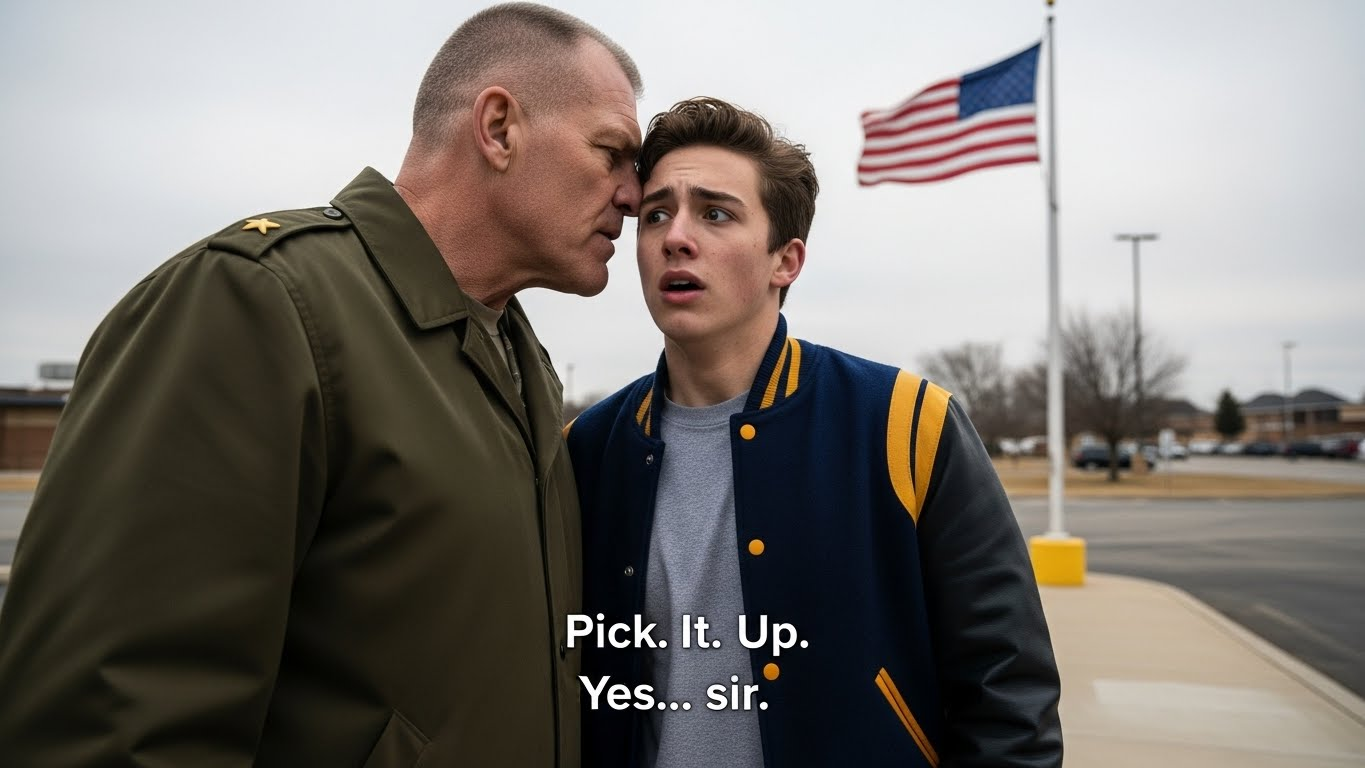
“Pick up the book,” I said, pointing to the muddy sketchbook on the ground.
He stared at me, paralyzed.
“Pick. It. Up.”
He moved. He scrambled like a recruit on day one. He fell to his knees, disregarding his expensive jeans, and grabbed the wet sketchbook. He gathered the charcoal pencils with shaking hands.
He stood up, trembling, and held them out towards Leo. He couldn’t even look at me.
“Give them to him,” I said.
He thrust them at Leo. “Here,” he squeaked.
Leo took them, looking from the bully to me with wide, shocked eyes.
I stepped back, giving the bully room to breathe, but keeping my gaze locked on him.
“If you ever touch him again,” I said, my voice carrying to the other two boys who were now backing away toward their cars. “If I hear you even breathed in his direction… I won’t be coming here as a concerned parent. I won’t call the principal. I will bring the full weight of my world down upon yours. Do you understand me?”
“Yes,” the bully whispered.
“Yes Sir,” I corrected.
“Yes, Sir!” he shouted, his voice breaking.
“Leave.”
They ran. They didn’t walk. They sprinted to their cars, tires screeching as they peeled out of the parking lot.
I watched them go until they were out of sight. Only then did I let the tension leave my shoulders. I turned to Leo.
He was standing there, clutching his muddy book, rubbing his red neck. He looked at me, really looked at me, for the first time in years.
“You okay?” I asked, my voice returning to the gentle tone of a father.
“Yeah,” he whispered. “Dad… I didn’t know you could do that. You sounded… different.”
“Just a trick of the trade, kid,” I said, reaching out to squeeze his shoulder. “Get in the truck. Let’s go get some burgers. Don’t tell your mom about this part.”
“Okay,” he smiled weakly.
We got in the truck. I started the engine and pulled out onto the main road. I thought it was over. I thought I had put the fear of God into a spoiled brat and that would be the end of it.
I was wrong.
As I turned onto my street twenty minutes later, I saw them.
Three black SUVs were parked in my driveway. Men in dark suits were standing on my lawn. And in the center of them, leaning against a limousine, was a man I recognized from CSPAN.
Senator Sterling.
The war hadn’t ended in the parking lot. It had just begun. And this time, the battlefield was my front lawn.
Chapter 3: Rules of Engagement
I put the truck in park, but I didn’t turn off the engine.
“Stay here,” I told Leo. My voice was calm, but my blood was boiling.
“Dad,” Leo whispered, looking at the black SUVs and the men in suits swarming our lawn. “Is that… is that the Senator?”
“Stay here, Leo.”
I stepped out of the truck. This time, I didn’t walk with the heavy thud of a soldier. I walked with the measured, predatory silence of a hunter.
Senator Sterling was leaning against his limo, checking his watch. He looked exactly like he did on TV—impeccable suit, perfect hair, and a smile that didn’t reach his cold, shark-like eyes.
Two of his security detail—private contractors, ex-Blackwater types by the look of their tactical stances—stepped forward to intercept me.
“Step aside,” I said. I didn’t stop walking.
One of them put a hand on my chest. “Sir, you need to—”
I didn’t let him finish. I grabbed his wrist, twisted it outward, and used his own momentum to shove him into the other guard. They stumbled. It took less than a second.
I walked right up to Sterling.
“Get off my property,” I said.
Sterling looked up, unbothered. He smiled. “General Vance. A pleasure. I see you’ve met my son, Tyler.”
“I met a bully who assaulted a minor,” I corrected. “I assumed he learned that behavior at home. Now I see I was right.”
Sterling’s smile vanished. He stepped closer, lowering his voice.
“You threatened my son, Tom. You flashed your rank to intimidate a civilian teenager. Do you know what the press would do with that? ‘Chairman of Joint Chiefs Threatens High Schooler with Military Retribution.'”
“Your son had his hands around my boy’s throat,” I growled.
“That’s not how Tyler tells it,” Sterling countered smoothly. “He says your boy attacked him. Unprovoked. And then you showed up, unstable, waving a weapon.”
“A weapon?” I laughed darkly. “I showed him ID.”
“My son felt threatened. That’s all that matters in the court of public opinion,” Sterling brushed imaginary dust off his lapel. “Here is how this goes, General. You are going to apologize. You are going to issue a public statement saying you overreacted due to PTSD. And then, you are going to approve the defense contract for the Titan Missile system my donors are pushing for.”
I stared at him. It wasn’t about the kids. It was never about the kids. It was about leverage. He was using his son’s cruelty as a bargaining chip.
“And if I don’t?”
“Then your career ends. Tomorrow. I sit on the Oversight Committee. I’ll bury you in investigations until you’re forced to resign in disgrace.”
I looked at the house. Leo was watching from the truck window.
I looked back at Sterling.
“Senator,” I said, my voice dropping to a whisper. “You think you’re playing chess. But you just walked onto a live firing range.”
“Is that a threat?”
“It’s a weather report. Get off my land. Now.”
Sterling glared at me. He signaled his men. “You have 24 hours, Vance. Be smart.”
They got in their cars and drove off.
I stood in the driveway, watching the dust settle. I knew, with absolute certainty, that the hardest battle of my life had just started. And I didn’t have my army. I only had myself.
Chapter 4: The Smear Campaign
The attack began at 6:00 AM the next morning.
I woke up to my phone buzzing incessantly. It was my Public Affairs Officer, Colonel Higgins.
“Sir, don’t turn on the TV,” Higgins said, panic in his voice.
I turned on the TV.
Every major news network was running the headline: “GENERAL UNHINGED? Top Commander Accused of Assaulting Teenager.”
They had video. It was grainy, shot from a cell phone across the parking lot. It showed me looming over Tyler Sterling. It showed me pointing. It showed Tyler on his knees.
But it was edited. It didn’t show Tyler choking Leo. It didn’t show the bullying. It only showed the ‘scary General’ terrorizing a ‘helpless kid.’
“They cut the beginning,” I said to the empty room.
Leo walked into the kitchen. He was pale. He was holding his phone.
“Dad,” he said, his voice trembling. “Look at Instagram.”
I took his phone. Tyler Sterling had posted a picture of a bruised neck—fake makeup, I knew instantly—with the caption: “Attacked by a psycho general today. Just glad to be alive. #StopAbuse.”
The comments were vile. Thousands of them. Calling for my firing. Calling Leo a freak.
“I caused this,” Leo whispered, tears welling up. “I should have just let him beat me up.”
My heart broke. I dropped the phone and grabbed Leo by the shoulders.
“Listen to me,” I said firmly. “You did nothing wrong. Do you hear me? Nothing. Men like them… they rely on silence. They rely on victims being too scared to speak. We are not going to be silent.”
“But Dad, the news…”
“The news shows what they are fed,” I said. “I’m going to work. You stay home today. Lock the doors.”
I drove to the Pentagon. The atmosphere was icy. Soldiers saluted, but I could see the questions in their eyes.
I walked into my office. The Secretary of Defense was waiting for me.
“Tom,” he said, not offering me a seat. “We have a problem.”
“It’s a lie, Mr. Secretary.”
“It doesn’t matter if it’s a lie,” he sighed. “The optics are a disaster. Sterling is calling for a hearing. He wants your stars, Tom. He’s offering a quiet resignation. Full pension.”
“I don’t surrender,” I said. “Not to terrorists, and not to politicians.”
“This isn’t a battlefield, Tom.”
“Everywhere is a battlefield if you look close enough.”
I walked out. I had 48 hours before the hearing. I needed ammo.
Chapter 5: The Ghost in the Machine
I didn’t go to my staff. I couldn’t trust anyone inside the loop—Sterling had eyes everywhere.
I drove to a dingy diner in Anacostia. I sat in the back booth. Ten minutes later, a woman in a hoodie sat opposite me.
Sarah “Ghost” Jenkins. She was dishonorably discharged five years ago for hacking into a foreign prime minister’s bank account without authorization. She was the best cyber-intelligence operator I had ever trained.
“You look like hell, General,” she said, popping a french fry into her mouth.
“I need a favor, Ghost.”
“I saw the news. You beat up a kid?”
“I defended my son. The video was doctored.”
“I figured. You’re too disciplined to lose it on a civilian without cause.” She opened her laptop. “What do you need?”
“Senator Sterling. Not his public records. I want the deep stuff. The stuff he keeps on encrypted servers in the Cayman Islands. Specifically, his connection to the Defense Contractor ‘Aegis Corp’.”
“Aegis?” She whistled. “That’s the company pushing the faulty Titan missiles. The ones you rejected last month because they failed the safety tests.”
“Exactly. Sterling wants me gone so he can push that contract through. If those missiles get approved, soldiers will die.”
“So, it’s not just about his kid,” Ghost typed furiously. “It’s a multi-billion dollar cover-up.”
“Find the link, Sarah. Find the money.”
“It’ll cost you.”
“Name it.”
“You get my discharge upgraded to Honorable. I want my GI Bill back.”
“Done.”
She worked for six hours. I drank coffee and watched the door. Finally, she stopped typing. She turned the screen to me.
“Got him,” she whispered.
It was an email thread. Not just implied corruption—blatant. Sterling explicitly promising the CEO of Aegis that he would “remove the Vance obstacle” in exchange for a 10% kickback routed to a shell company.
And there was more. Text messages from Tyler to his father, dated ten minutes after the parking lot incident.
Tyler: “Dad, some old guy yelled at me. He’s a General.” Sterling: “Perfect. Provoke him? Did you get it on video?” Tyler: “No, but my friends can say whatever we want.” Sterling: “Good. This is the leverage we needed. Cry victim. I’ll handle the press.”
They planned it. Maybe not the initial bullying, but everything after. They were using a schoolyard spat to compromise national security.
“Print it,” I said. “All of it.”
Chapter 6: The Counter-Offensive
The hearing was scheduled for the school auditorium. Sterling wanted a public spectacle. He wanted to humiliate me in front of the community, the press, and the school board before taking it to Washington.
He framed it as a “School Safety Town Hall.”
The auditorium was packed. Parents, reporters, cameras. Sterling sat on stage, looking solemn and concerned. Tyler sat next to him, wearing a neck brace that I knew he didn’t need.
I stood in the wings. I was in full Service Dress Uniform. Medals covering my chest. Four stars on my shoulders.
I wasn’t alone.
Behind me stood Leo. He was terrified, shaking.
“You can do this, Leo,” I said. “Just tell the truth.”
“What if they don’t believe me?”
“Then we go down swinging. Together.”
The moderator, a school board member in Sterling’s pocket, opened the mic.
“We are here to address the violent incident involving General Vance,” she said. “Senator, would you like to speak?”
Sterling stood up. He gave a performance worthy of an Oscar. He talked about safety, about how military aggression has no place in schools. He pointed at Tyler, who looked down and wiped a fake tear.
“I demand General Vance’s immediate resignation,” Sterling thundered. “For the safety of our children!”
The crowd cheered. The mob was with him.
“General Vance?” the moderator called out. “Do you have a statement?”
I walked onto the stage. The sound of my boots was the only thing audible over the murmurs. I approached the podium. I didn’t look at the crowd. I looked at Sterling.
“I do not have a statement,” I said into the mic. “I have a witness.”
I gestured to the side.
Leo walked out. The crowd went silent. He looked small next to the podium.
“This is my son,” I said. “The boy your son assaulted.”
“Objection!” Sterling shouted. “This is hearsay!”
“And I have evidence,” I continued, my voice overriding his.
I pulled a flash drive from my pocket and plugged it into the presentation laptop on the podium. Ghost had hacked the school’s A/V system remotely just in case they tried to cut my mic.
The screen behind me flickered.
It wasn’t the email. Not yet.
It was security footage.
“You see,” I addressed the crowd. “Senator Sterling released a cell phone video. But he forgot that St. Jude’s has security cameras in the parking lot.”
Ghost had found it. The unedited, high-angle footage.
The video played. The crowd watched in stunned silence as Tyler Sterling shoved Leo. They watched him slap the books. They watched him grab Leo by the throat and pin him to the fence.
The crowd gasped.
Then they saw me step in. They saw me speak. They saw Tyler cower.
“That,” I pointed at the screen, “is a bully. And that,” I pointed at myself on screen, “is a father protecting his child.”
Sterling was red in the face. “Turn it off! This is a violation of privacy!”
“I’m not done,” I said. The Command Voice was back.
I clicked the next slide.
The emails appeared. The bribe. The text messages about “removing the Vance obstacle.”
The room erupted. Flashbulbs went off like strobe lights. Reporters were shouting questions.
I turned to Sterling. He was frozen, his mouth opening and closing like a fish.
“You wanted a war, Senator,” I said, my voice booming through the speakers. “You attacked my family to cover your crimes. You traded your honor for a paycheck. And you used your son as a pawn.”
I looked at Tyler. The kid was trembling, looking at his father with horror. He realized, in that moment, that his dad didn’t care about him—only about the leverage he provided.
“It’s over,” I said.
Chapter 7: The Fallout
The next hour was chaos.
Federal agents—actual FBI, not Sterling’s goons—arrived. Turns out, once I sent the files to the Department of Justice earlier that morning, they moved fast.
They arrested Senator Sterling on stage. The image of him being cuffed in front of his constituents was instantly iconic.
Tyler was left sitting there. He looked lost.
I walked over to him. He flinched.
“I’m not going to hurt you, son,” I said gently. “But you need to make better choices than your father.”
I turned and walked off the stage. Leo was waiting for me at the bottom of the stairs.
He ran to me and hugged me. It was a tight, desperate hug. I held him back, ignoring the cameras, ignoring the reporters screaming my name.
“Let’s go home,” I said.
The drive back was quiet, but it was a good quiet. The heavy, oppressive silence of secrets was gone.
“Dad?” Leo asked as we pulled into the driveway.
“Yeah, kid?”
“Are you going to get in trouble?”
“For exposing a traitor? No. I might get a medal. Or a lecture about chain of command. Probably both.”
I parked the truck.
“Leo,” I turned to him. “I’m sorry I haven’t been around enough. I’m sorry I let you feel like you had to face those kids alone.”
“It’s okay,” he smiled. “You were there when it mattered.”
Chapter 8: At Ease
Two weeks later.
The scandal had settled. Sterling was awaiting trial. The “Titan Missile” contract was cancelled. I was cleared of all wrongdoing, though the President did suggest I take a “short vacation” until the media frenzy died down.
I was in the garage, working on the truck.
Leo came in. He was holding a sketchbook. A new one.
“Hey,” he said.
“Hey.”
He leaned against the workbench. “I drew something.”
He handed me the book.
It was a charcoal sketch. It showed a parking lot. A small, scared boy on the ground. And standing over him, not a monster, not a General, but a figure that looked like a shield. A guardian.
The caption at the bottom read: My Dad.
I stared at it for a long time. I’ve received the Distinguished Service Cross. I’ve been given medals by Kings and Presidents.
None of them meant as much as that piece of paper.
“It’s good, Leo,” I said, my voice thick. “Really good.”
“I signed up for a self-defense class,” he said suddenly. “Krav Maga. Starts Tuesday.”
I looked up, surprised. “Yeah?”
“Yeah. I don’t want you to have to fight my battles forever.”
I wiped the grease off my hands and stood up. I looked at my son—really looked at him. He stood a little taller. His shoulders were a little squarer.
“Good,” I said. “But Leo?”
“Yeah?”
“I’ll always be in your corner. Whether I’m fighting or just cheering.”
He grinned. “I know. Thanks, General.”
“At ease, soldier,” I smiled back. “Now, hand me that wrench.”
We worked on the truck together as the sun went down. The world outside was still chaotic, full of bullies and politicians and wars. But in that garage, everything was exactly as it should be.