They Threw Quarters At Him When His Shoes Fell Apart. Then His Teammates Did Something That Silenced The Entire Gym.
Chapter 1: The Silver Tape and the Golden Court
The gymnasium at Oakmont Academy didn’t smell like a high school gym. It didn’t smell of stale sweat, floor wax, and teenage desperation. It smelled of vanilla, expensive HVAC systems, and money. Pure, unadulterated money.
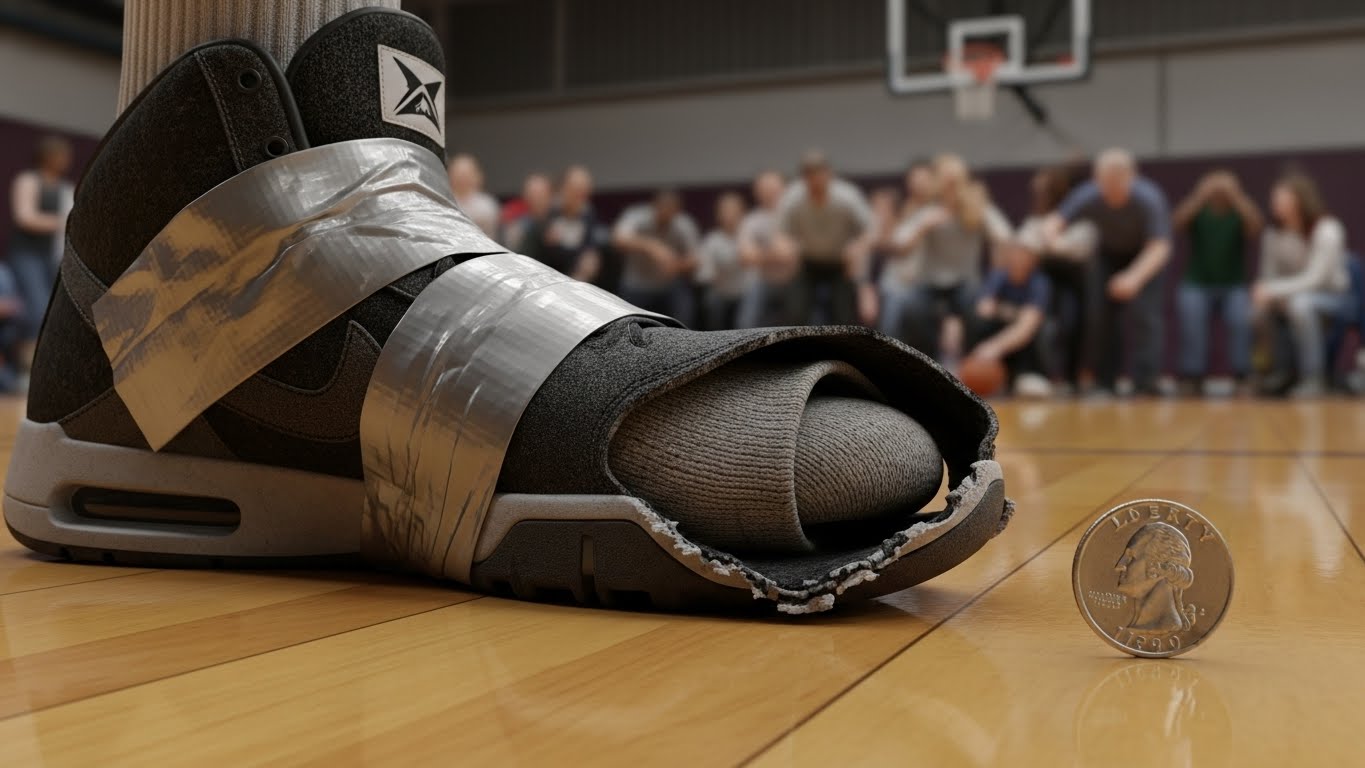
Leo sat on the visitor’s bench, his knees bouncing with a nervous energy that felt more like electricity than adrenaline. He looked down at his feet. They were a size 13 tragedy. The sneakers were originally a generic off-brand he’d bought at a discount store two years ago, but now they were more structure than shoe. Layers of silver duct tape wrapped around the toe box and the arch, holding the separation anxiety of the sole in check.
“Stop staring at ’em, Leo,” Tyrell muttered, sitting next to him. Tyrell was the team captain, a shooting guard with a chip on his shoulder the size of the rust-belt town they came from. He was lacing up a pair of pristine, red-and-black Jordans—the kind that cost more than Leo’s mom made in a week. “They holdin’?”
“They’re holding,” Leo lied. He pressed his toes into the insole, feeling the gap where the rubber had worn through to the sock. “Just need forty-eight minutes.”
“We need more than that,” Tyrell said, looking out at the court. “Look at these rich kids. They look like they were manufactured in a lab.”
The Iron Works High School team—affectionately known back home as “The Rust Buckets”—looked out of place against the backdrop of Oakmont. Oakmont’s court was polished to a mirror shine, the wood light and honey-colored. The bleachers were packed with parents in cashmere sweaters and students in blazers.
In contrast, the Iron Works fans were a small, rowdy cluster in the far corner: parents in work boots and union jackets, faces lined with the stress of the mill closures.
“Alright, bring it in!” Coach Miller barked. Miller was a man carved out of granite and disappointment, a former mill foreman who coached basketball the way he used to run a shift line: with efficiency and zero tolerance for excuses.
The team huddled. The smell of Wintergreen rubbing alcohol and old jerseys filled the circle.
“Listen to me,” Miller said, his voice a low rumble. “Look at the scoreboard. It says 0-0. It doesn’t list bank accounts. It doesn’t list ZIP codes. It lists points. You play hard. You play fast. And you make them feel every single screen. They’re soft. You’re iron. Iron breaks everything else. On three. One, two, three—IRON!”
Leo roared with the rest of them, trying to drown out the doubt in his gut. He was the point guard. The floor general. He had to be the fastest thing on the court, and he was doing it on tires that were bald and blowing out.
The game started with a ferocity that surprised everyone. Oakmont expected a rollover. They expected the kids from the crumbling town to fold under the bright LED lights. But Leo played possessed.
He drove the lane, splitting two defenders who looked like Abercrombie models. He ignored the slip of his right heel inside the shoe. He laid the ball up—smooth, soft glass. Two points.
“Too slow!” Leo yelled, clapping his hands.
Chase, the Oakmont captain, sneered. Chase was everything Leo wasn’t: blonde, six-foot-four, and entitled. He played with a sneer that suggested merely touching a public school kid was a health code violation.
“Lucky shot, garbage man,” Chase whispered as they ran back on defense.
The first half was a war of attrition. Iron Works played physical, scrappy defense. They dove for loose balls. They took charges. They played like men who knew that losing meant going back to a town where the streetlights were being turned off to save budget. Winning was the only light they had.
By the fourth quarter, the unthinkable was happening. Iron Works was up by two points. 58-56. Three minutes left on the clock.
Leo was exhausted. His lungs burned. But worse, his feet were screaming. The duct tape on his left shoe had begun to peel back, flapping against the hardwood with every stride. Thwack. Thwack. Thwack.
“Iso! Iso!” Leo called out, waving his teammates clear. He had the ball at the top of the key. Chase was guarding him, eyes narrowed, chewing his gum arrogantly.
“Come on, charity case,” Chase taunted, slapping the floor. “Try me.”
Leo saw the opening. Chase was leaning too far right. Leo planted his left foot hard to execute a crossover dribble—a move he had practiced a thousand times on the cracked asphalt of the playground back home.
He drove his weight into the ball of his foot. He twisted.
RIIIIIP.
The sound was louder than the squeak of sneakers. It was the sound of fabric surrendering.
Leo’s left shoe disintegrated. The entire sole separated from the upper canvas, peeling away like a banana skin. His foot, clad only in a thin, worn-out sock, slid violently across the polished wax of the Oakmont floor.
Leo flailed. He lost the ball. He crashed onto his hip, sliding five feet before coming to a halt. A sharp pain shot through his ankle, but the physical pain was instantly eclipsed by a cold, drowning wave of humiliation.
The gym went silent for a heartbeat.
Leo lay there, staring at his foot. The shoe was destroyed. The duct tape hung like dead skin. His big toe was poking through a hole in his sock.
Then, the laughter started.
It began with Chase. He stood over Leo, hands on his hips, throwing his head back. “Oh my God! Look at that! A blowout! A literal blowout!”
The Oakmont student section caught on. It started as a murmur, then a giggle, then a roar.
“Trash! Trash! Trash!” The chant began in the back row and swept forward like a tidal wave.
Leo scrambled to sit up, trying to hide his foot, trying to pull the broken pieces of the shoe together. His face burned hot, tears stinging the corners of his eyes. He wouldn’t cry. He couldn’t cry. Not here. Not in front of them.
The referee blew his whistle, trotting over. He wasn’t looking at Leo with sympathy; he was looking at the floor to see if it was scratched.
“Get up, son,” the ref said, annoyed.
Chase reached into his pocket. He was smiling, a cruel, predatory grin. “Hey, ref, timeout. I think he needs some sponsorship.”
Chase flicked his wrist. A silver quarter—twenty-five cents—tumbled through the air. It hit the floor right next to Leo’s broken shoe with a metallic ding that echoed in Leo’s soul.
“Go buy some glue, charity case,” Chase said loud enough for the first five rows to hear.
The laughter redoubled. A few more coins clattered onto the floor from the student section. Pennies. Nickels. They were throwing change at him. They were treating his poverty as a sideshow act.
Leo stared at the quarter. It featured George Washington’s profile. It looked shiny. It looked like hate.
Coach Miller was on the court in a second, shoving Chase back. “Back off! Back the hell off!”
“Tech! Technical foul on White #12!” The referee signaled, pointing at Chase. But the damage was done. The coins were on the floor. The shoe was dead. And Leo felt like he was naked in front of a thousand strangers.
“Leo,” Coach Miller said, his voice uncharacteristically soft, kneeling beside him. “Let me see.”
Leo shook his head, unable to speak. He didn’t want anyone to see. He wanted to disappear. He wanted the floor to open up and swallow him whole.
Chapter 2: The Insulin Secret
The walk to the bench was the longest journey of Leo’s life. He limped, one foot in a sneaker, the other dragging the carcass of a shoe that flopped uselessly. The chant—”Trash! Trash!”—had died down, replaced by a buzzing murmur of amusement and pity. Pity was worse. Hate you could fight. Pity just made you feel small.
Leo collapsed onto the folding chair, burying his face in a towel. He felt a hand on his shoulder. It was Tyrell.
“Don’t listen to them, man,” Tyrell said, though his voice was tight with anger. “They don’t know nothing.”
The referee approached the bench, checking his watch. He was a stickler, a man who loved the rulebook more than the game. “Coach Miller, I can’t let him play like that. It’s a safety hazard. Rule 4, Section 2. Appropriate footwear.”
“It’s just a shoe, Ref,” Miller argued, wiping sweat from his forehead. “Let us tape it back up.”
“It’s destroyed, Coach. The sole is gone. He’s sliding on a sock. If he slips and breaks a leg, or trips another player, it’s on me. He needs regulation footwear. You have two minutes, or I have to disqualify him from the contest.”
Miller turned to the bench. “Alright, who’s a thirteen? Anybody got a thirteen?”
The team looked at each other. They were big kids, but Leo was the tallest guard. “I’m an eleven,” Tyrell said. “Twelve,” said Marcus, the center. “Ten,” whispered the freshman reserve.
Miller looked frantic. He sat down and started unlacing his own heavy black coaching sneakers. “I’m a twelve-wide. Maybe we can squeeze you in.”
Leo looked up, his eyes red. “Coach, don’t. Please.”
“We aren’t forfeiting, Leo,” Miller grunted, pulling his shoe off. The smell of old leather and foot powder wafted up. He shoved the shoe toward Leo.
Leo tried. He really tried. He jammed his foot into the coach’s shoe, but his heel hung two inches off the back. It was impossible. He couldn’t run. He couldn’t pivot.
“It’s no good,” Leo whispered, pulling his foot out. He dropped the coach’s shoe. He looked at the scoreboard. 2:45 remaining. Iron Works up by 2. And he was the reason they were going to lose.
“I’m sorry,” Leo choked out. “I’m so sorry, guys.”
He began to unlace his right shoe—the one that was still intact. He was quitting. He was taking himself out so the game could continue without him, even though they’d lose without their point guard.
Tyrell stared at him. Tyrell had been riding Leo all season. They competed for minutes, for shots, for the attention of college scouts. Tyrell had always been jealous of Leo’s natural talent.
“Leo,” Tyrell said sharply. “Stop unlacing. Where are the Nikes?”
Leo froze.
“The Booster Club,” Tyrell pressed, his voice dropping to a harsh whisper. “Mr. Henderson gave you a pair of LeBrons last month. Brand new. White and Gold. I saw them in your locker. Why are you wearing this garbage when you have $150 shoes at home?”
The locker room—or rather, the huddle around the bench—went dead silent. Even Coach Miller stopped trying to fix the broken shoe.
Leo looked at Tyrell. Then he looked at Marcus. He looked at the boys he had grown up with. Boys who knew what it was like to open the fridge and see nothing but a jug of water and a lightbulb.
“I don’t have them,” Leo whispered.
“You lost them?” Tyrell asked, incredulous.
“I sold them,” Leo said. The truth tasted like bile. “On eBay. The day after I got them.”
“Why?” Tyrell asked. “You crazy? You’re the star player, man. You need the gear.”
Leo took a shuddering breath. He lowered the towel. He looked Tyrell dead in the eye.
“Mom’s insurance lapsed,” Leo said, his voice trembling but clear. “The plant cut her benefits again. She had one vial of insulin left. One. If she doesn’t take it, she goes into shock. She… she gets the shakes, Tyrell. I found her on the kitchen floor last Tuesday.”
Leo wiped his nose with the back of his hand.
“The shoes went for $140. That bought two weeks of insulin and the electricity bill so the fridge would keep it cold. I taped these up. I thought… I thought they’d last one more game. I just needed one more game.”
The silence on the Iron Works bench was absolute. It was a heavy, suffocating silence. It wasn’t the silence of awkwardness; it was the silence of reality crashing into the fantasy of sports.
Across the court, the Oakmont cheerleaders were doing a routine. The Oakmont parents were laughing, sipping oversized coffees. They were worrying about SAT scores and college applications.
Leo was worrying about whether his mother would wake up tomorrow.
Tyrell looked at Leo. He looked at the broken shoe. He looked at the duct tape that had failed.
Tyrell had been jealous of Leo all year. He had wanted Leo’s spot. But in that moment, the jealousy evaporated, replaced by a burning, molten rage—not at Leo, but at the world. At the unfairness of a universe where a kid had to choose between ankles and his mother’s life.
The buzzer sounded. Two minutes were up.
The referee walked over, blowing his whistle. “Time’s up, Coach. He can’t play. Sub him out or I call the forfeit.”
Coach Miller looked defeated. He opened his mouth to call for a sub.
But Tyrell stood up.
He didn’t look at the coach. He didn’t look at the ref. He looked at Chase, standing smugly at center court.
Tyrell sat down on the hardwood floor. He reached down and untied his red-and-black Jordans.
“Tyrell, what are you doing?” Coach Miller asked.
Tyrell didn’t answer. He pulled the left shoe off. Then the right. Then he peeled off his socks. He balled them up and threw them under the bench.
He stood up, barefoot. His dark skin contrasted against the pale, polished wood of the court.
“If he can’t wear shoes,” Tyrell said, his voice booming in the quiet gym, “then I don’t wear shoes.”
Marcus, the center, didn’t hesitate. He sat down. His size 14 Adidas hit the floor with a heavy thud.
Then the freshman. Then the shooting guard.
One by one, like a chain reaction of defiance, the Iron Works players sat down. The sound of laces loosening, of velcro ripping, of rubber hitting wood filled the air. It was a percussion of solidarity.
Within thirty seconds, eleven pairs of sneakers lay in a pile under the bench. Eleven boys stood on the baseline, twenty-two bare feet gripping the cold, expensive floor of Oakmont Academy.
Chapter 3: Skin on Hardwood
The referee stared. His mouth opened, but no sound came out. He looked like a computer that had encountered a fatal error.
“You can’t…” the ref stammered. “You can’t do that.”
Coach Miller stood up. He looked at his team—his barefoot, defiant, beautiful team. A swell of pride, hot and fierce, rose in his chest. He turned to the official.
“Show me the rule,” Miller challenged.
“Excuse me?”
“Show me the rule that says the whole team can’t play barefoot,” Miller said, stepping into the ref’s personal space. “Rule 4, Section 2 says ‘appropriate footwear.’ If both teams agree to a surface, or if a team accepts the hazard, there is no explicit ban on bare feet unless it poses a danger to others. My boys aren’t wearing cleats. They aren’t wearing spikes. They are wearing skin. That is not a danger to your precious Oakmont students. It’s only a danger to us. And we accept the risk.”
The referee looked at the scorer’s table. He looked at the Oakmont coach, who was standing with his arms crossed, looking baffled.
“We play,” Tyrell yelled from the court. “Or you forfeit us for being poor. Go ahead. Do it. See how that looks in the papers tomorrow.”
The referee swallowed hard. He felt the eyes of the crowd. He sensed the shift in the atmosphere. The mockery had died. The Oakmont parents weren’t laughing anymore. They were leaning forward, confused, uncomfortable.
“Play on,” the referee muttered, waving his hand. “But if I see blood, you’re out.”
The whistle blew.
The game resumed, but it was a different game now.
Basketball relies on friction. It relies on the grip of rubber against varnish to allow for cuts, stops, and explosive jumps. Without shoes, that friction was gone.
It was ugly. It was messy. It was beautiful.
Iron Works couldn’t cut. They couldn’t stop on a dime. On the first possession, Tyrell tried to drive, slipped, and went skidding across the key.
Chase grabbed the loose ball and scored an easy layup. 58-58.
“Look at them slide!” Chase yelled, laughing. “Like Bambi on ice!”
But the Iron Works team adjusted. They stopped trying to play fast. They played low. They boxed out with grit. They used their bodies as walls.
And it hurt. Oh, God, it hurt.
Leo ran down the court. Every impact of his heel against the hardwood sent a shockwave up his spine. The floor burned the balls of his feet. When players stepped on him—and they did, intentionally—the rubber soles of the Oakmont sneakers tore at his skin.
Chase stomped on Leo’s toes during a rebound battle. Leo stifled a scream, biting his lip until it bled. He didn’t stop.
“Switch!” Leo screamed, limping into position.
The sound of the game had changed. Gone was the squeak-squeak-squeak of sneakers. Now, it was the heavy, rhythmic thud-slap, thud-slap of flesh on wood. It was a primal sound. It sounded like a drumbeat of war.
The Oakmont team, for all their skill and expensive gear, began to falter. They were unnerved. They were playing against ghosts, against madmen. When Chase drove to the hoop, he saw Tyrell standing in the lane, barefoot, eyes blazing, waiting to take a charge.
Tyrell didn’t care if he got hurt. He didn’t care if he broke a toe. He stood like a statue. Chase hesitated, pulled up for a jumper, and missed.
The crowd shifted. It was subtle at first. The “Trash” chants had vanished completely. In the silence of the gym, the sound of the Iron Works players hustling—diving for balls, skin squealing against the varnish—became hypnotic.
A woman in the Oakmont section stood up when Marcus grabbed a rebound, his bare feet sliding but holding firm. She clapped. Then a man next to her.
Chase heard it. He looked at the stands. His parents were clapping for the other team.
“Stop clapping for them!” Chase screamed at the crowd. “They’re freaks!”
“They’re heart, son!” a man from the third row yelled back. “They’ve got heart! Show some yourself!”
The game entered the final minute. 64-63, Oakmont leading.
Leo’s feet were raw. He left faint, sweaty smears on the floor with every step. He could feel a blister on his heel popping, the sting sharp and hot. But he looked at Tyrell. Tyrell gave him a nod. We do this together.
“Defense!” Leo rasped. “One stop! One stop!”
Oakmont had the ball. Chase tried to dribble out the clock. He crossed over, looking for a foul. Leo didn’t bite. Leo stayed low, sliding his feet, ignoring the fire in his soles.
Chase panicked. He tried to force a pass. Leo anticipated it. He lunged, his bare toes gripping the floor with everything he had.
He tipped the ball.
Steal.
Leo sprinted. It was a breakaway. 10 seconds left.
Usually, Leo would finish this with a dunk. But he had no lift. No traction. He drove to the rim, knowing he was going to get hit.
Chase was chasing him down. “Not in my house!” Chase roared.
Leo went up for the layup. Chase didn’t go for the ball. He hammered Leo across the arms, shoving him mid-air.
It was a hard foul. Dangerous.
Leo crashed to the floor. He slid into the padded wall behind the basket.
The whistle blew. A collective gasp went through the gym.
Leo lay there for a second, staring at the ceiling lights. His body ached. His feet felt like they were on fire.
“Two shots!” the referee signaled.
Leo rolled over and pushed himself up. He limped to the free-throw line. The lane was cleared. It was just him, the basket, and the silence.
Chapter 4: The Long Walk Home
The gymnasium was so quiet you could hear the hum of the electric scoreboard.
Leo stood at the line. He looked down at his feet. They were bruised, red, and dirty. There was a smear of blood on his left pinky toe. They were the ugliest feet he had ever seen. And they were the strongest.
He looked up at the rim. It seemed miles away.
For Mom, he thought. For the insulin. For Tyrell. For the shoes I sold.
He bounced the ball. Once. Twice.
He bent his knees, wincing as the raw skin stretched. He released the ball.
Swish.
Tie game. 64-64.
Chase stood on the lane line, hands on his knees, shaking his head. He looked at Leo’s feet. He looked at his own $200 Nikes. For the first time all night, Chase didn’t look arrogant. He looked ashamed. He looked small.
“One more, Leo,” Tyrell whispered from behind him. “Ice in your veins.”
Leo took the ball from the ref. The leather felt heavy. His hands were shaking.
He took a deep breath. He visualized the ball going through the net. He visualized walking into his kitchen and hugging his mom.
He shot.
The ball hit the front rim. It bounced up. It hit the backboard. It rattled around the cylinder.
Leo held his breath.
It dropped in.
65-64.
“Time out! Time out Oakmont!”
But they had no timeouts left. The buzzer sounded.
Pandemonium.
The Iron Works bench cleared. But they didn’t jump. They didn’t pile on. They were too tired, too sore. They just rushed to Leo and engulfed him in a hug. A massive, sweaty, barefoot embrace.
“You did it! You crazy son of a gun, you did it!” Tyrell yelled, grabbing Leo’s head.
Leo looked around. The Oakmont players were walking off the court, heads down. But then, something happened.
The Oakmont Head Coach stopped his team. He pointed to Iron Works.
“Watch them,” the Oakmont coach commanded his rich, entitled players. “You watch them celebrate. That is what sacrifice looks like. You learned more tonight losing to them than you would have winning by twenty.”
Chase looked at Leo. He hesitated. Then, he walked over.
The gym went quiet again. Chase stood in front of Leo. He looked at the floor, where the quarter he had thrown earlier had been kicked under the scorer’s table.
Chase reached down and untied his shoes. He took them off. He held them out to Leo.
“I…” Chase’s voice cracked. “I don’t know what size you are. But take ’em. Please.”
Leo looked at the shoes. Then he looked at Chase.
“I don’t need your shoes, Chase,” Leo said, his voice calm, devoid of malice. “But thanks.”
Leo turned away. He didn’t want charity. He had dignity.
The locker room celebration was subdued. There was no champagne. There was just the school nurse, Mrs. Higgins, kneeling on the concrete floor with a bottle of peroxide and a mountain of gauze, bandaging twenty-two battered feet.
“You boys are idiots,” Mrs. Higgins said, tears in her eyes as she wrapped Tyrell’s ankle. “Brave, stupid idiots.”
“We won, didn’t we?” Tyrell grinned, wincing as the antiseptic hit a cut.
The door opened. Coach Miller walked in. He was carrying a cardboard box.
“Listen up,” Miller said. The room quieted down.
“That was…” Miller choked up. He had to clear his throat. “That was the finest thing I have ever seen on a basketball court. I’ve worked in steel mills. I’ve worked on loading docks. I’ve never seen toughness like that.”
He put the box on the bench next to Leo.
“This is from the Oakmont Booster Club,” Miller said. “And their Head Coach.”
Leo opened the box. Inside was the game ball, signed by the Oakmont team. And under the ball was a check.
It was made out to “The Reynolds Family Medical Fund.” The amount was $5,000.
“The Oakmont coach heard me arguing with the ref about the shoes,” Miller said softly. “He heard about the insulin. He passed the hat around the VIP section during the fourth quarter. Turns out, rich folks have a conscience if you wake it up.”
Leo stared at the check. It was enough for a year of insulin. It was enough to breathe.
He started to cry. Not the silent tears of the first quarter, but heaving, relieving sobs. Tyrell put an arm around him.
“We got you, man,” Tyrell said. “We got you.”
Twenty minutes later, the team walked out to the bus. The parking lot was dark. The rain had started to fall, cold and biting.
They didn’t put their shoes back on. Their feet were too swollen, too bandaged.
They walked in a single file line, carrying their sneakers in their hands, their white-bandaged feet splashing through the black puddles of the asphalt. They walked like soldiers returning from a battle they weren’t supposed to survive.
They boarded the rusted yellow school bus, laughing, exhausted, brothers forever.
And somewhere in a trash can inside the gym, a roll of silver duct tape sat unused, no longer needed to hold anything together. The team held itself together now.